Publication: Fl. Cap. (Harvey) 2: 347. 1862 [15-31 Oct 1862]
Description
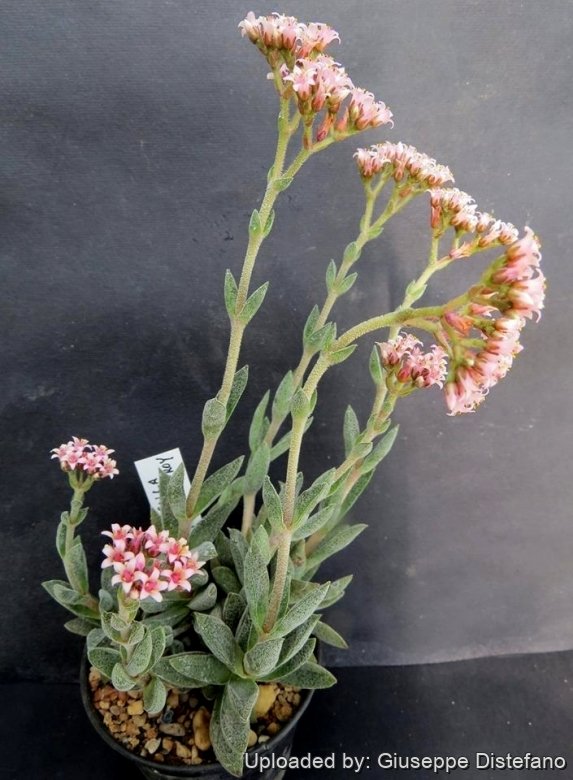
Crassula exilis is a dwarf annual or cushion forming perennial succulent up to 100 mm high when flowering with spirally arranged rosettes and rather narrow, acute leaves. The leaves are quite variable in size and appearance. The species is distinguished by its fruits: mature follicles spreading at right angles to the axis.
Stem: Short, erect, succulent, simple or several from the same root, closely leafy, scabrous 2.5-5 cm high, 4-6 mm in diameter.
Rosettes: With leaves loosely spirally arranged, old leaves remaining attached to stems.
Root system: Adventitious.
Leaves: In opposite pairs 4-6 mm apart, connate at base, in 4 ranks. Blade oblong, linear-oblanceolate to linear-elliptic, (4-)12-35(-45) mm long 1-10 mm broad, fleshy, but usually with membranous margin, rounded in cross-section or flat only on upper surface green to brown often with dark spots on upper surface. Pubescence minute, but copious, white. Tip pointed. Margin with hairs sometimes reduced to teeth and one stouter terminal hair per leaf.
Inflorescence: Peduncles terminal, short (c. 2,5 cm), slender, pubescent, bearing a more or less flat-topped 3–5-flowered, corymbulose cyme, leaves gradually becoming shorter along indistinct erect peduncle.
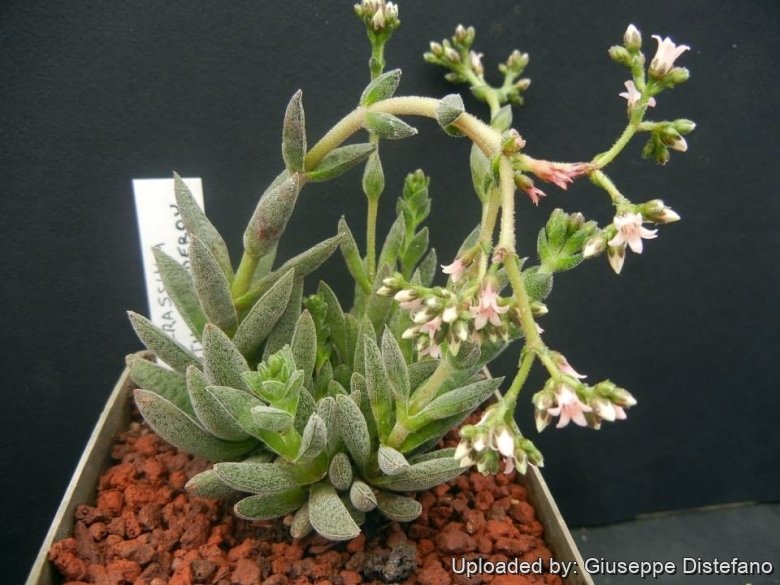
Flowers: Subsessile, small and cup-shaped c. 3 mm long, white or pink with petal tips spreading from midway up the corolla tube. Sepals 2-2.5 mm, ovate-oblong to triangular, blunt or pointed, margins hairy half as long as the recurved, obovate petals. Corolla tubular, fused basally for 0,2-0,8 mm, white or tinged more or less pink. Petals 4-4.5mm. oblong-obovate. with a projection, white, tinged pink. Styles subulate. Stamens 3-3.5 mm minute, fleshy. Anthers yellow. Flowers have musty honey-like fragrance.
Blooming season: Flowers appear in late summer through to late autumn.
Fruit (capsules): Small, spreading at right angles to flower-stalk.
Seeds: Fine dust-like.
Remarks: A complex group of garden hybrids including Crassula × justi-corderoyi and Crassula picturata hybrids, would also key out here.
Origin and Habitat
South Africa,Cape Province, northern Namaqualand, Bushmanland, southern Namibia and in the eastern karoo.
Habitat: Crassula exilis is an obligate cliff dwellers present in very arid regions and forms dense mat or cushions in crevices and soil pockets on vertical or steep rock faces. Rocks sandstones, granites and shales.
Cultivation and Propagation
Crassula exilis is an attractive, dwarf succulent flowering cushion, it does well in containers, and makes a good houseplant it is also excellent for rockeries and living walls. It is not difficult to cultivate. It thrive with bright light and ample airflow.
Growth rate: Moderately fast.
Soil: It grows best in sandy-gritty soil. Good drainage is very important as it is prone to root rot.
Repotting: Repot every two or four years in spring. Do not radically cut off roots: about 10 percent of the root ball is right.
Fertilization: Feed it from mid spring to early autumn every four or five weeks with a fertilizer specifically formulated for cactus and succulents (poor in nitrogen), including all micro nutrients and trace elements diluted to ½ the strength recommended on the label. Do not feed plants during winter.
Watering Needs: It is a very dry-tolerant plant. Water regularly in the growing season, but avoid water-logging and let dry between waterings. Water with caution in winter, as the plant can lose its roots if the soil stays cold and wet for extended periods. The lower the temperature the less water is needed. If grown in a container, bottom watering by immersing the container is recommended. Mist spraying is not needed, it must have very dry atmosphere.
Sun Exposure: Does well in filtered sun, but can handle some shade, too. In shade the leaves colour will remain more green, while in harsh full sun conditions the foliage can develop a pinkish tinge. In summer keep cool and provide some shelter from direct sun during the hottest hours. It can be sunburned if moved from shade/greenhouse into full sun too quickly. It tends to get leggy in deep shade.
Frost Tolerance: Protect from frost to prevent scarring. It requires a minimum temperature of about 5°C, but will take a light frost and is hardy down to -5° C for short periods if it is in dry soil (Lethal temperature in habitat -6 to -10 ° Celsius). USDA zones 9A – 11. In areas prone to frost, grow in an intermediate greenhouse or conservatory, in pots. The plant may be kept indoors throughout the year at a minimum winter temperature of 10°C not exceeding 18°C. In summer, the temperature will rise higher, but as this is accompanied by better light it does not matter. Position the plant near a sunny window.
Garden uses: They make wonderful rocker plants in hot, dry areas and also grow well in containers or luminous patios.
Traditional uses: None recorded.
Pests and diseases: May be susceptible to mealybugs and rarely scale. Protect from cold.
Propagation: From seed but it is easily increased by cuttings. Cuttings root easily. It is also possible, to plant the leaves in good, sandy soil where they will take root - members of this family often propagate vegetatively in this way. Take leaf cuttings in spring and summer. Detach a leaf from an established plant by pulling or bending, and leave it to dry for a day. Insert the broken end of the leaf into a mix of one part slightly moist peat and two parts sharp sand Firm the mix around the bases of each cut-ting, which will later grow roots. The leaf cutting can then be repotted.
Bibliography
Major references and further lectures
-
Vera Higgins “Crassulas in Cultivation.” 1964
-
Edgar Lamb, Brian Lamb “The Illustrated Reference on Cacti & Other Succulents” Volume 5 Blandford Press, 1978
-
Werner Rauh “The Wonderful World of Succulents: Cultivation and Description of Selected Succulent Plants Other Than Cacti” Smithsonian Institution Press, 1984
-
Doreen Court “Succulent Flora of Southern Africa” CRC Press, 01/Jun/2000
-
Stuart Max Walters “The European Garden Flora: Dicotyledons” (Part I) Cambridge University Press, 1989
-
Gordon D. Rowley “The illustrated encyclopedia of succulents” Crown Publishers, 01/Aug/1978
-
Gordon Rowley “Crassula: A Grower’s Guide” Cactus & Company, 2003
-
Eggli, Urs “Illustrated Handbook of Succulent Plants, Crassulaceae Illustrated Handbook of Succulent Plants.” Springer, Berlin 2002
-
Hermann Jacobsen “Abromeitiella to Euphorbia” Blandford Press, 1960
-
Hermann Jacobsen “A handbook of succulent plants: descriptions, synonyms, and cultural details for succulents other than Cactaceae” Volume 1 Blandford Press, 1960
-
Toelken, H.R. 1997. “A revision of the genus Crassula” in southern Africa. Annals of the Bolus Herbarium 8,1-595.
-
Van Jaarsveld, E., Van Wyk, B-E. & Smith, G. “Succulents of South Africa.” Tafelberg, Cape Town. 2000
-
John Wilkes “Encyclopaedia Londinensis” Volume 5 1810
-
John Manning “Field Guide to Fynbos” Struik, 2007
-
Otto A. Leistner “Flora of southern Africa” 1985
-
Alfred Byrd Graf “Exotica, series 4 international: pictorial cyclopedia of exotic plants from tropical and near-tropic regions” Roehrs Co. Publishers, 1985
-
Dr J.P. Roux “Flora of South Africa” 2003
-
W. H. Harvey “Flora Capensis” Vol 2, 1894
From llifle page Crassula x justi-corderoyi
Description
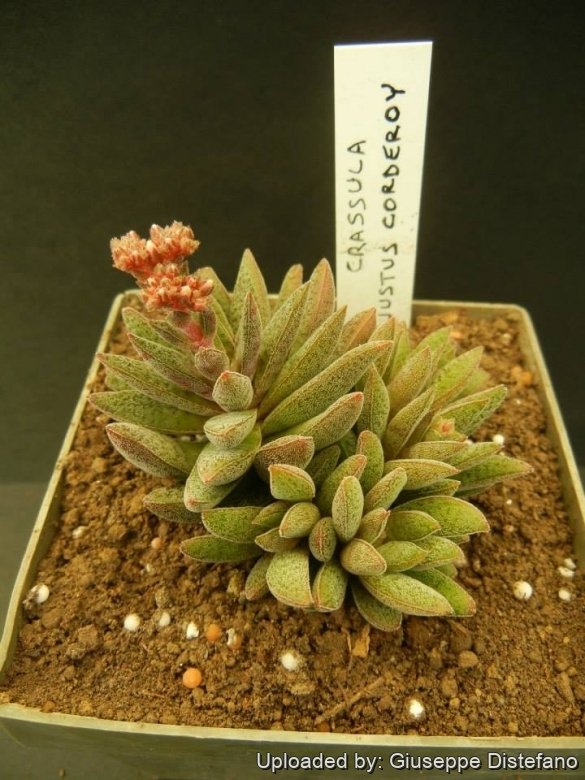
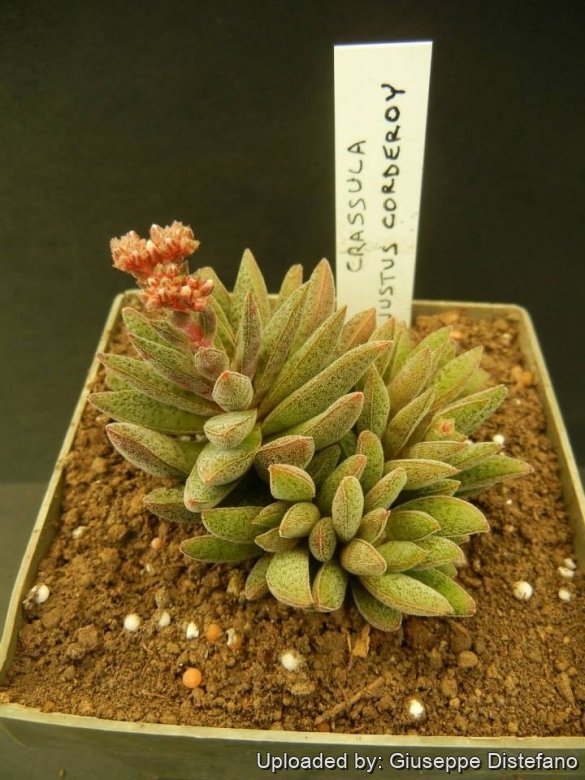
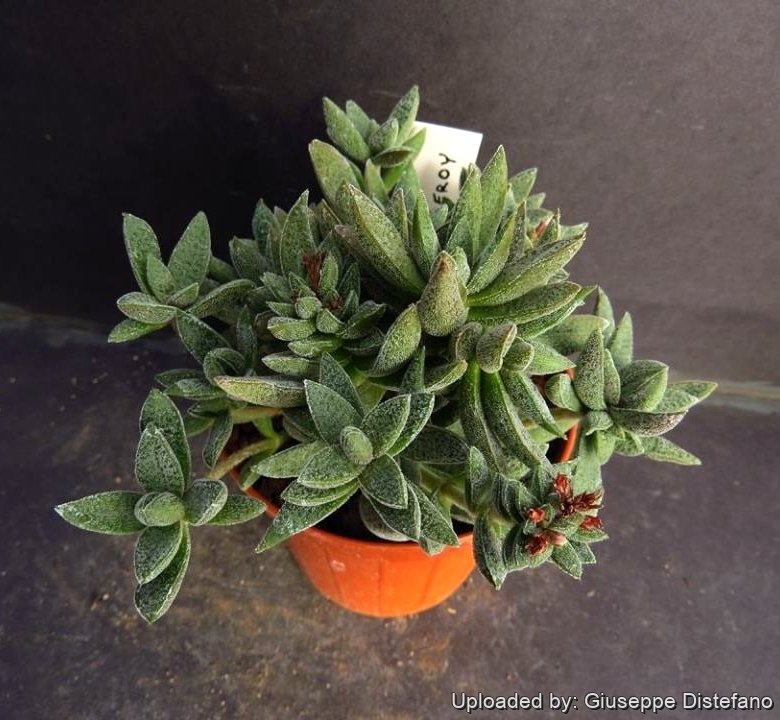
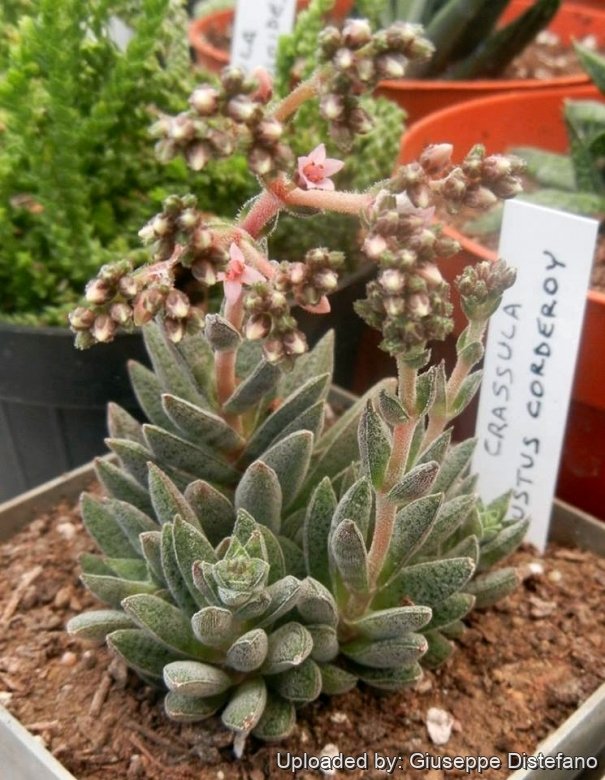
Crassula x Justi-Corderoyi (Crassula perfoliata x Crassula perfoliata) is a small, cluster-forming hybrid with very interesting leaf colouration and texture that might be called a larger edition of Crassula exilis with more fleshy leaves and brighter pink or red flowers. As might be expected of a hybrid, it is quite variable in size, shape and colouration.
Leaves: Very narrow, triangular, gold to dark green which become quite reddish in the sun measuring approximately 10-12 cm long by 1 cm wide.
Blooming season: Midsummer.
Origin and Habitat
Hybrid.
Cultivation and Propagation
Crassula x justi-corderoyi are of easy cultivation and relatively low maintenance, which makes them a good houseplant, and can be an excellent subject for the beginning succulentophile (they can grow easily on window sills, verandas and in miniature succulent gardens where they are happy to share their habitat with other smaller succulent plants, or in outdoor rockeries). They are spring and autumn grower (summer dormant).
Soil: They are tolerant of a wide range of soils and habitats, but prefer a very porous potting mix to increase drainage. A non-acid soil is ideal. You can grow a plant in a 6-10 cm pot for years and have perfectly happy plants. For best results, use a shallow pot.
Watering: Provide some water all year around, in the wild most of the growth occurs during spring and autumn. During the hot summer months, the soil should be kept moist but not overly wet. During the winter months, water only when the soil becomes completely dry. Wet soil quickly causes root and stem rot, especially during chilly winter months, but can re-root if taken care of. No water should ever be allowed to stand around the roots. Low ambient humidity is always needed.
Fertilization: The plants are fertilized only once during the growing season with a balanced fertilizer diluted to ½ the recommended strength.
Sun Exposure: They need full sun or bright, filtered light with ample airflow to stay compact, but avoid direct blasting sun in mid summer (with sun exposure the leaf develops a nice reddish tint), they do not do well in full shade as they tend to etiolate, fall over and rot easily.
Pest & diseases: Crassulas are sensitive to mealybugs.
Rot: Rot is only a minor problem with Crassula if the plants are watered and “aired” correctly. If they are not, fungicides won’t help all that much. Care must be given in watering, keeping them warm and wet while growing, and cooler and dry when dormant.
Hardiness: Although the plants will survive mild frost if kept dry (hardy as low as -5° C) they should be protected from frost to prevent scarring. USDA 9b-12
Use: It is an excellent potted plant great for windowsill culture as well as in rock gardens. Indoors only in brightest position.
Pruning: Remove old leaves from plant base and dead flower spikes only.
Propagation: They are easily propagated by the removal of off shoots, remove a lateral shoot and insert the basal part buried in the soil. This shoot should root within a month, and small offshoots will form at the base.
Bibliography
Major references and further lectures
-
James Cullen, Sabina G. Knees, H. Suzanne Cubey “The European Garden Flora Flowering Plants: A Manual for the Identification of Plants Cultivated in Europe, Both Out-of-Doors and Under Glass” Cambridge University Press, 11/ago/2011
-
Hermann Jacobsen ”A Handbook of Succulent Plants: Abromeitiella to Euphorbia” Blandford Press, 1960
-
John Robert Brown “Unusual Plants: 110 Spectacular Photographs of Succulents” Abbey Garden Press, 1954
-
John Robert Brown, Alain Campbell White, Boyd L. Sloane, George W. Reynolds “Succulents for the amateur: introducing the beginner to more than eight hundred fascinating succulent plants” Abbey garden press, 1946
Source: Crassula x justi-corderoyi, LLIFLE - Encyclopedia of living forms, CC-BY-SA, retrieved 2026-10-25.
Cultivars and forms (3)
Gallery