Publication: Pl. Rar. Afr. 10. 1760 [20 Dec 1760]
Description
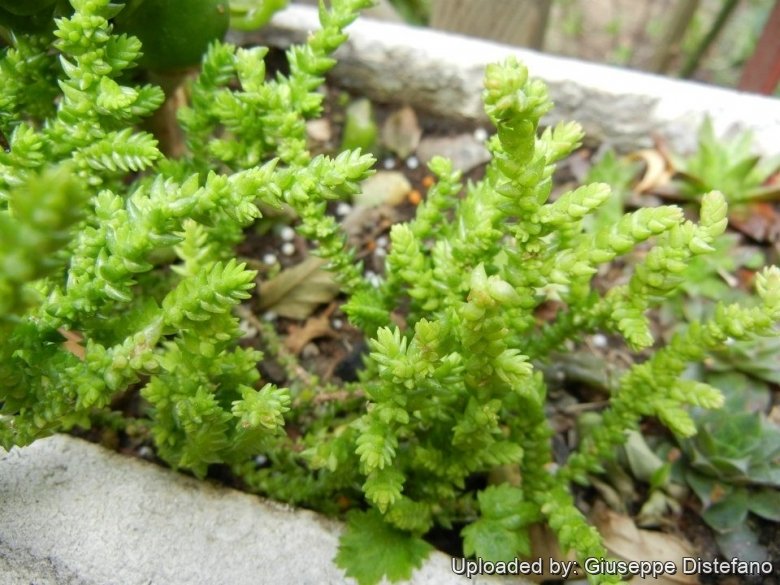
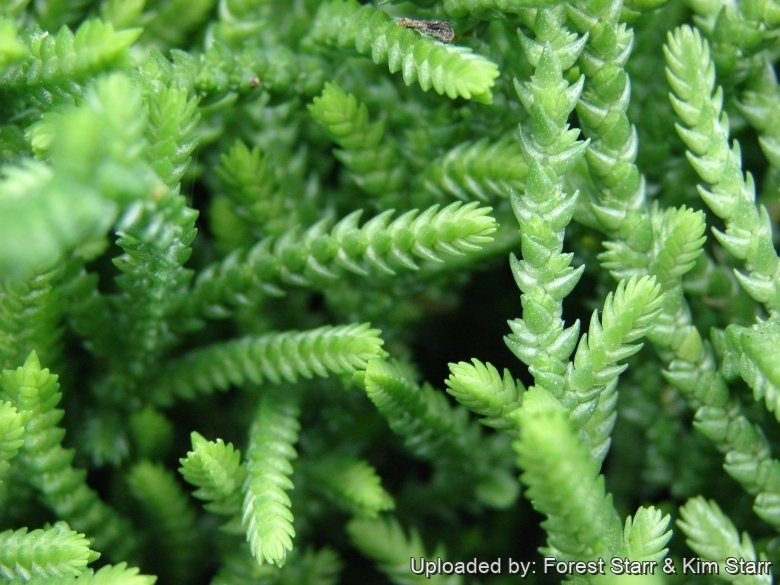
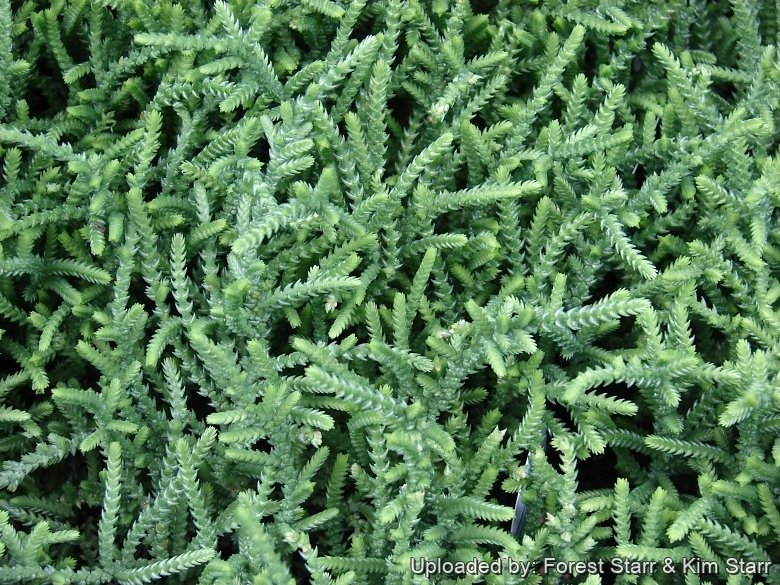
Crassula lycopodioides is better known as Crassula lycopodioides, and now placed in synonymy. It is a dense scrambling bushy perennial succulent 100-400 mm tall; the slender branching stems are slightly woody, densely covered by small, scale-like, neatly overlapping, leaves arranged in 4 rows. In spring, produces tiny, 5-petalled, greenish-yellow flowers. C. lycopodioides is probably the commonest species of all, and comes in various leaf sizes and colours; slenderness and robustness is equally extremely variable.
Stems: Suffruticose, 10-60 cm long spreading or suberect, or decumbent, flexuous, irregularly branched, woody-based, hidden by dead and living leaves, not more than 5 mm across.
Leaves: 2-8 mm long, 1-4 mm broad, conspicuously 4-ranked, usually with minute axillary leaftufts in the axils, scaly, ovate to triangular, flat, pointed or blunt, hairless, very fleshy to leathery, green tinged yellow, grey or brown, densely crowded or loosely overlapping, often giving the stem a ‘pipe-cleaner’ appearance; leaf sheath 1.5 cm.
Flowers: Minute, solitary or densely clustered on sessile 2-8-flowered dichasia, in the axils of the leaves, malodorous. 5-merous , corolla cup-shaped, pale yellow-green to brown. Sepals c. 1 mm long, triangular or shortly lanceolate, acute. Petals c. 2 mm long, connate, erect, oblong or triangular, acute, concave, keeled, yellow-green to brown. Stamens 0.5-1 mm long. Anthers yellow. Ovaries tapered, style shortly subulate less than half ovary length.
Blooming season: Summer.
Origin and Habitat
Crassula muscosa is present in Southern Africa (Eastern Cape, Free State, Northern Cape, North West, Western Cape, Namaqualand) and southern Namibia.
Habitat: It is widely distributed throughout semi-arid and arid karoo areas, and grows preferably in rocky habitats, but is also found on plains. It is often an invasive species and easily propagated from stem cuttings.
Cultivation and Propagation
Crassula lycopodioides syn: Crassula lycopodioides is easy to grow under a wide variety of climatic conditions provided it is planted in a well-drained situation given adequate water but not over-watered. It is always a good standby for the rockery, colour of the leaves is often yellowish green. This species is very hardy and seems to stand fairly severe frosts at times. Flowers are small and insignificant.
Growth rate: It is a pretty slow grower.
Soil: Plants grow well in a well-drained mineral soil.
Pots: It needs a relatively shallow pot to accommodate its fibrous roots and provide a very good drainage. It may stay in the same pot for many years.
Watering: It is an opportunistic grower that needs moderate water year around– not too wet nor too dry from autumn to spring with regular water in summer (careful watering required in winter), fairly drought tolerant elsewhere.
Fertilization: Light fertilizer seems to boost its growth whenever additional water is given. Feed it during the growing season with a fertilizer specifically formulated for cactus and succulents (high potash fertilizer with a dilute low nitrogen), including all micro nutrients and trace elements diluted to ½ the strength recommended on the label. It thrive in poor soils and needs a limited supplies of fertilizer to avoid the plant developing excess vegetation, which is easily attacked by fungal diseases.
Special need: Provide very good ventilation. Nearly all problems occur as a result of overwatering and poor ventilation, especially when weather conditions are dull and cool or very humid.
Exposure: It cannot take direct sun in summer but generally needs sun part of the day to bloom. In deep shade it gets pretty weak and leggy and eventually rots and dies.
Pest and diseases: Crassulas are sensitive to mealybugs. Protect against frost.
Maintenance: After growing for several years tend to become untidy, and should be cut very short or restarted from cuttings.
Hardiness: Outdoors in frost free areas, indoors all other zones
Propagation: Seeds/ Stem cuttings. Sow seeds in autumn. Plants root easily from cuttings, place cuttings in clean river sand, mist every three to four days, roots should appear within 2-3 weeks.
Bibliography
Major references and further lectures
-
Edgar Lamb, Brian Lamb “The Illustrated Reference on Cacti & Other Succulents” Volume 5 Blandford Press, 1978
-
Werner Rauh “The Wonderful World of Succulents: Cultivation and Description of Selected Succulent Plants Other Than Cacti” Smithsonian Institution Press, 1984
-
Doreen Court “Succulent Flora of Southern Africa” CRC Press, 01/Jun/2000
-
Stuart Max Walters “The European Garden Flora: Dicotyledons” (Part I) Cambridge University Press, 1989
-
Gordon D. Rowley “The illustrated encyclopedia of succulents” Crown Publishers, 01/Aug/1978
-
Gordon Rowley “Crassula: A Grower’s Guide” Cactus & Company, 2003
-
Eggli, Urs “Illustrated Handbook of Succulent Plants, Crassulaceae Illustrated Handbook of Succulent Plants.” Springer, Berlin 2002
-
Hermann Jacobsen “Abromeitiella to Euphorbia” Blandford Press, 1960
-
Hermann Jacobsen “A handbook of succulent plants: descriptions, synonyms, and cultural details for succulents other than Cactaceae” Volume 1 Blandford Press, 1960
-
Toelken, H.R. 1997. “A revision of the genus Crassula” in southern Africa. Annals of the Bolus Herbarium 8,1-595.
-
Van Jaarsveld, E., Van Wyk, B-E. & Smith, G. “Succulents of South Africa.” Tafelberg, Cape Town. 2000
-
John Manning “Field Guide to Fynbos” Struik, 2007
-
Christopher Brickell “RHS Encyclopedia of Plants and Flowers” Dorling Kindersley Ltd, 01/set/2010
-
Otto A. Leistner “Flora of southern Africa” 1985
-
Alfred Byrd Graf “Exotica, series 4 international: pictorial cyclopedia of exotic plants from tropical and near-tropic regions” Roehrs Co. Publishers, 1985
-
W. H. Harvey “Flora Capensis” Vol 2, page 327 1894
-
Antje Burke “Wild flowers of the southern Namib” Namibia Scientific Society, 2003
Gallery