Publication: J. S. African Bot. 41(2): 115 (1975)
Description
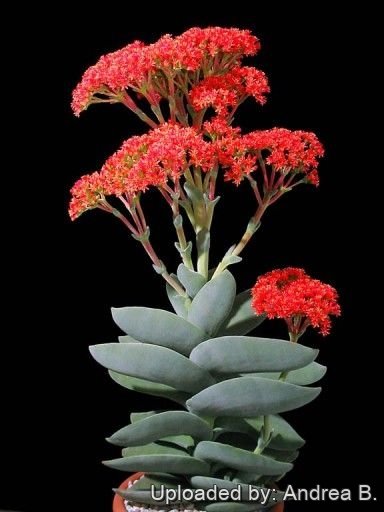
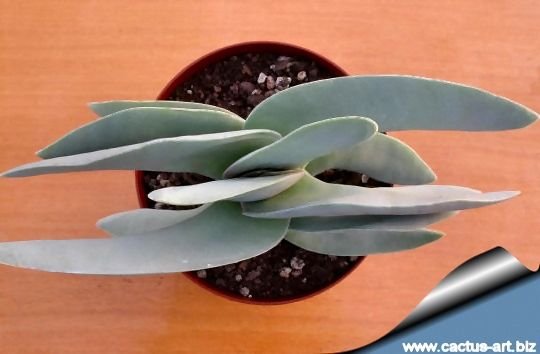
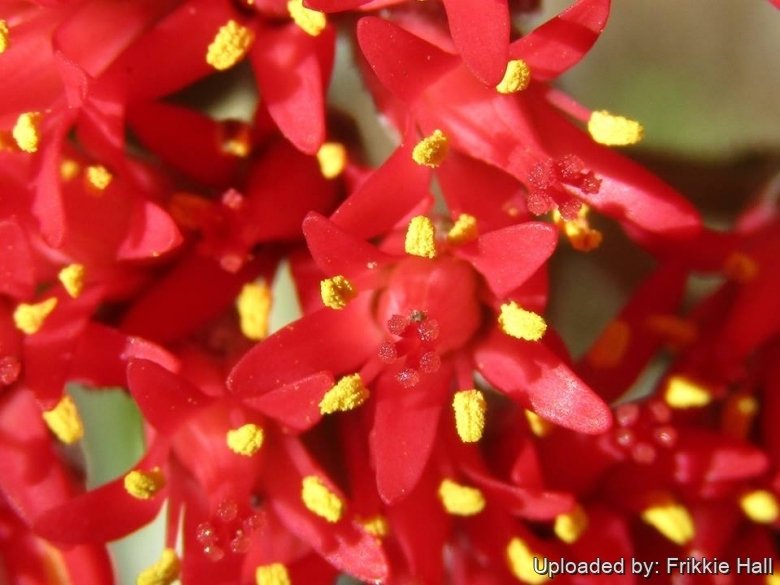
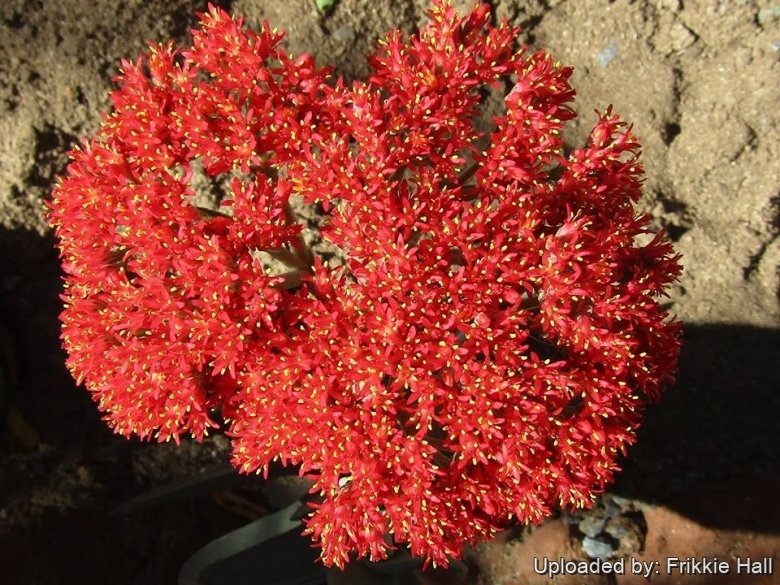
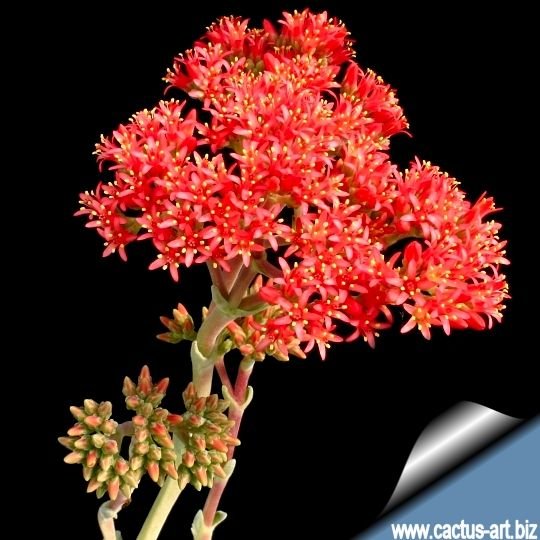
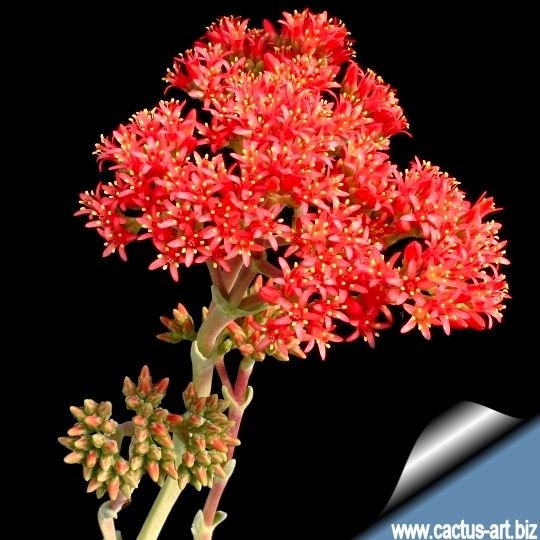
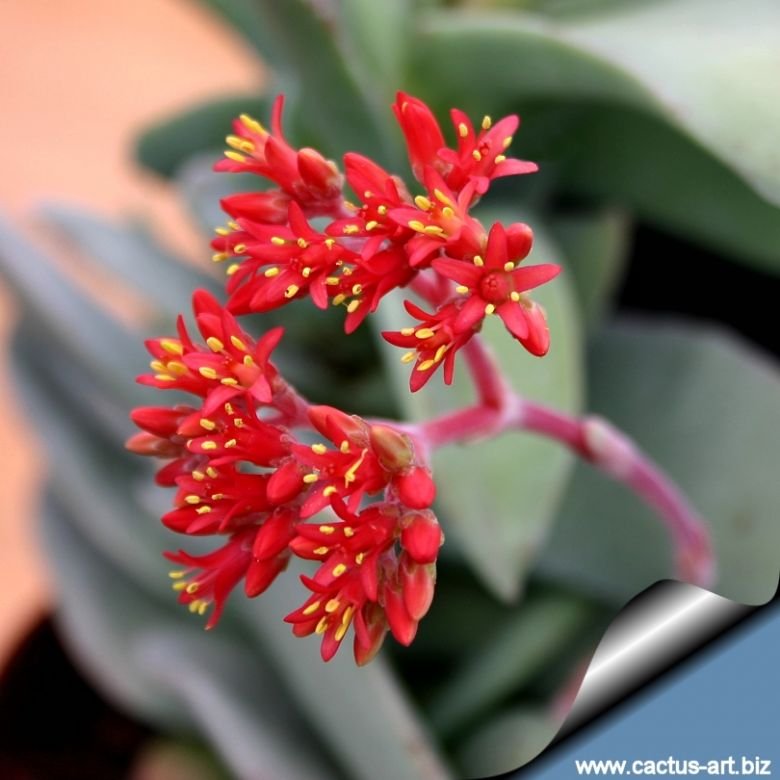
Crassula perfoliata var. falcata (The ‘Propeller Plant’ or ‘Airplane plant’) make a lovely clump/low growing shrub, that usually grows less than 60 cm tall (but some sources say 1.2 m of height). It has very peculiar grey-green sickle-shaped leaves that are arranged in overlapping pairs along a usually unbranched stem. Tiny scarlet red flowers are massed together in very showy dense clusters that rise above foliage in mid summer. The flowers open slowly and last for nearly a month when in full bloom. Another common name used for this plant is Scarlet Paintbrush, refering to the beautiful flowers.
Stem: Usually unbranched above (but forming new shoots at the base), succulent becoming woody in age.
Roots: Fibrous.
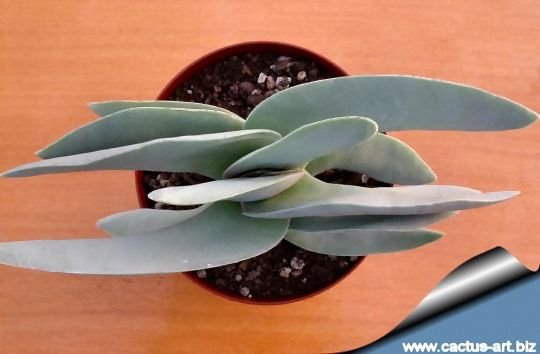
Leaves: Interesting glaucous grey-green arranged in overlapping pairs, leaves are propeller shaped (sickle shaped), decussate, ascending, becoming spreading, lanceolate, slightly falcate, smooth, upper face flat, channelled at the base, margins acute toward the apex, truncate lower down, lower face convex, tip recurved and acute, mucronate up to 10 cm long, 2-3 cm wide. These leaves radiate outward in opposite directions like wings, which gives the plant the common name “Airplane Plant”.
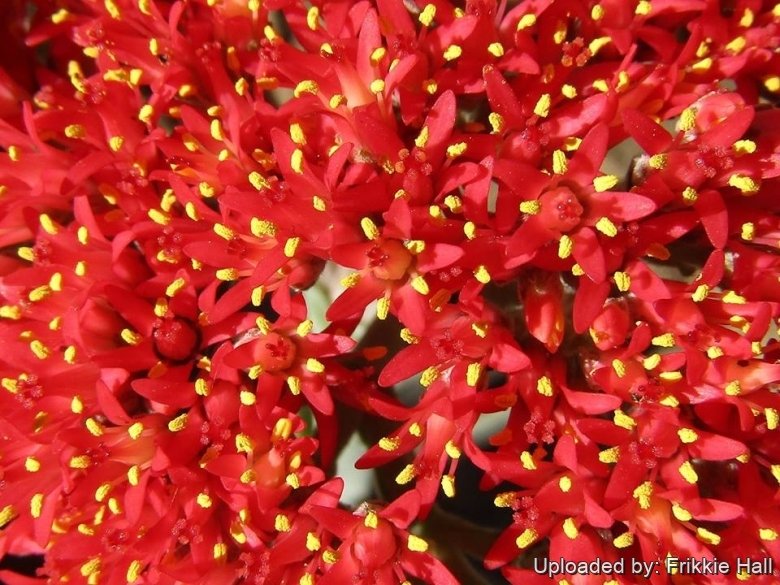
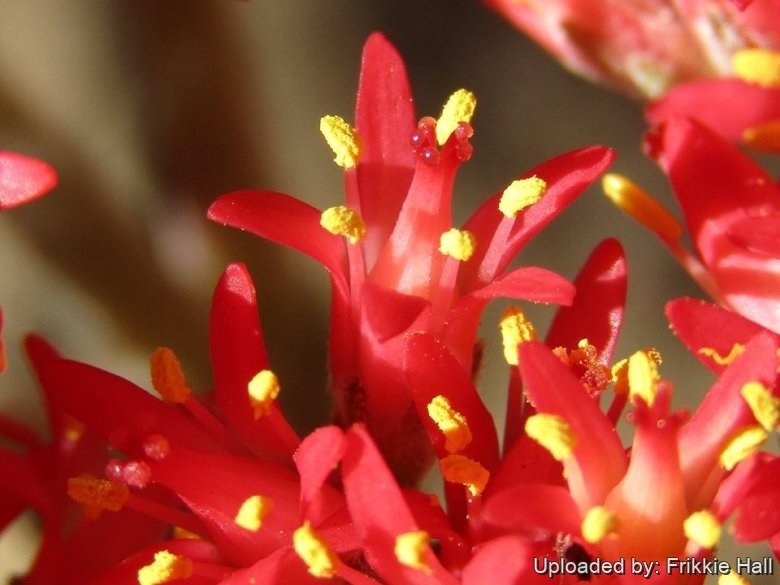
Flowers: Spectacular clusters of tiny bright orange-red or scarlet-red florets arranged in dense cymes, that rise above foliage. Flower heads grow 8 to 12 cm wide and are scented.
Blooming season: Flowers starts to develop in June and are in full bloom in August. The flowers open slowly and last for nearly a month when in full bloom.
Taxonomy: This plant, long grown as Rochea falcata and then Crassula falcata is now correctly named Crassula perfoliata var. minor though in cultivation it continue to be listed is a Crassula falcata as this name is better recognized.
Origin and Habitat
South Africa from the Cape of Good Hope (Eastern Cape Province)
Cultivation and Propagation
The Airplane plant is a stunning as a container plant, in decorative pots, in courtyards and rockeries, and especially ideal for mass plantings and borders, where its dramatic foliage and spectacular flower heads are shown to their best effect. Attractive and interesting when not in bloom but a show stopper when the bright red flowers emerge.
Soil: It needs well drained soil (standard cactus potting mix).
Waterings: Requires very little irrigation in coastal gardens, irrigate occasionally in hotter inland climates. In pots needs regular wateringsall year, but reduce watering during winter month and apply a balanced liquid fertilizer during the summer months (June, July, August).
Exposure: It grows well in light shade to full sun.
Hardiness: Protected from frosts, but hardy to -5 C for short periods if very dry.
Maintenance: Remove spent flower heads to maintain vigour and bushy habit.
After growing for several years tend to become untidy, and should be cut very short or restarted from cuttings.
Pests & Disease: Aphids, mealy bugs, powdery mildew, fungal leaf spot, stem and root rot if over watered.
Propagation: Leaf or stem cuttings in spring or summer.
Bibliography
Major references and further lectures
-
Forest & Kim Starr “Crassula perfoliata var. falcata (propeller plant, red crassula)”. Plants of Hawaii. <http://www.starrenvironmental.com\>. Web. 27 Sep. 2014.
-
Doreen Court “Succulent Flora of Southern Africa” CRC Press, 01/giu/2000
-
Stuart Max Walters “The European Garden Flora: Dicotyledons” (Part I) Cambridge University Press, 1989
-
Gordon D. Rowley “The illustrated encyclopedia of succulents” Crown Publishers, 01/Aug/1978
-
Eggli, Urs “Illustrated Handbook of Succulent Plants, Crassulaceae Illustrated Handbook of Succulent Plants.” Springer, Berlin 2002
-
Hermann Jacobsen “Abromeitiella to Euphorbia” Blandford Press, 1960
-
Hermann Jacobsen “A handbook of succulent plants: descriptions, synonyms, and cultural details for succulents other than Cactaceae” Volume 1 Blandford Press, 1960
-
Toelken, H.R. 1997. “A revision of the genus Crassula” in southern Africa. Annals of the Bolus Herbarium 8,1-595.
-
Dr J.P. Roux “Flora of South Africa” 2003
-
Van Jaarsveld, E., Van Wyk, B-E. & Smith, G. “Succulents of South Africa.” Tafelberg, Cape Town. 2000
-
John Manning “Field Guide to Fynbos” Struik, 2007
-
Vera Higgins “Succulent Plants Illustrated” Blandford Press, 1949
-
Leistner, O.A. “Seed plants of southern Africa: families and genera” Strelitzia 10. National Botanical Institute, Pretori
-
Werner Rauh “The Wonderful World of Succulents: Cultivation and Description of Selected Succulent Plants Other Than Cacti” Smithsonian Institution Press, 1984
-
Smith, C.A. “Common Names of South African Plants.” Dept. of Agricultural Technical Services, Botanical Survey Memoir No 35, Government Printer. 1966
-
San Marcos Growers contributors “Crassula falcata - Airplane plant. San Marcos Growers <http://www.smgrowers.com\>. Web. 27 Sep. 2014.
Gallery