Publication: Bot. Jahrb. Syst. 45: 254 1910.
Description
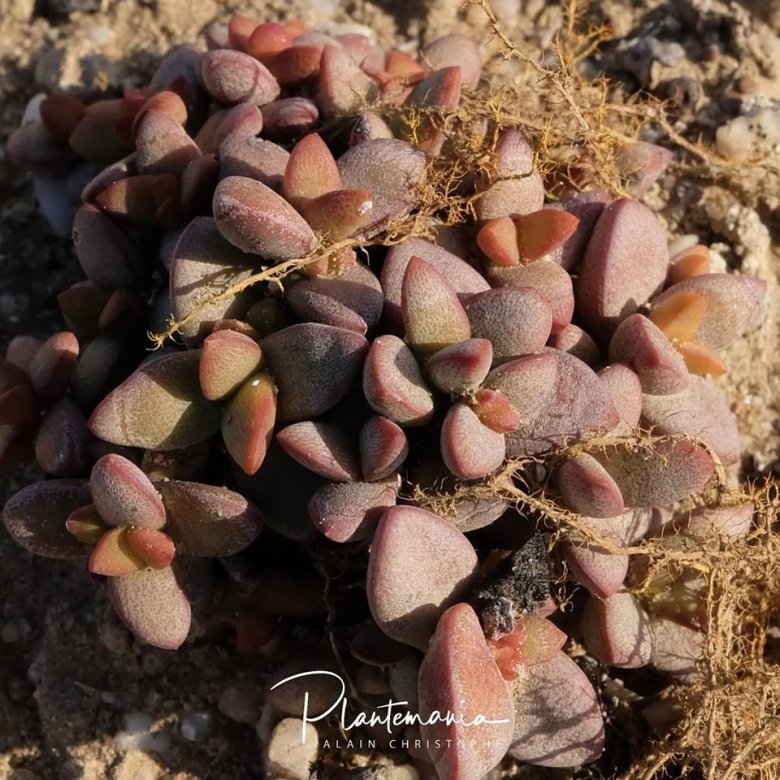
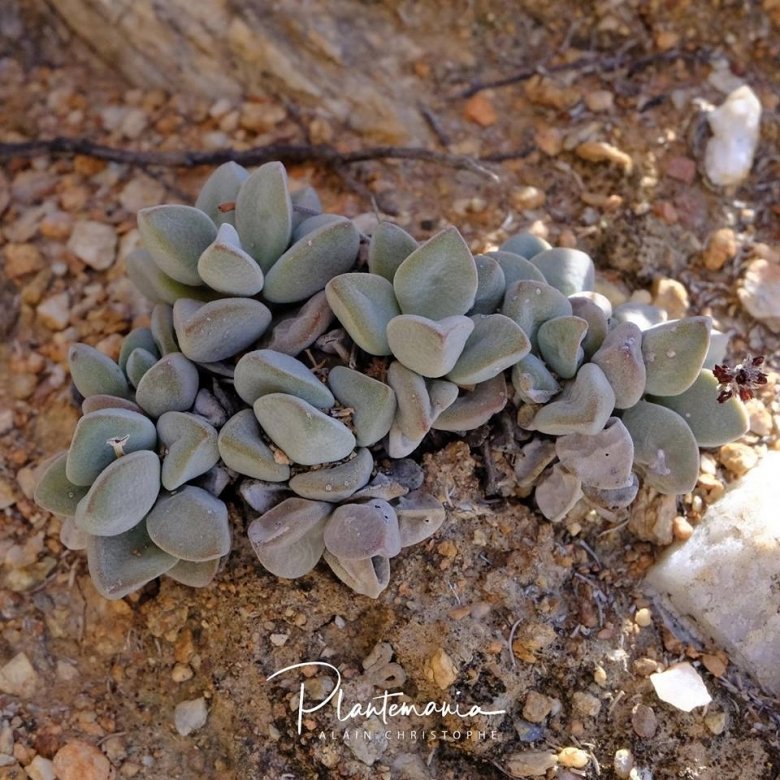
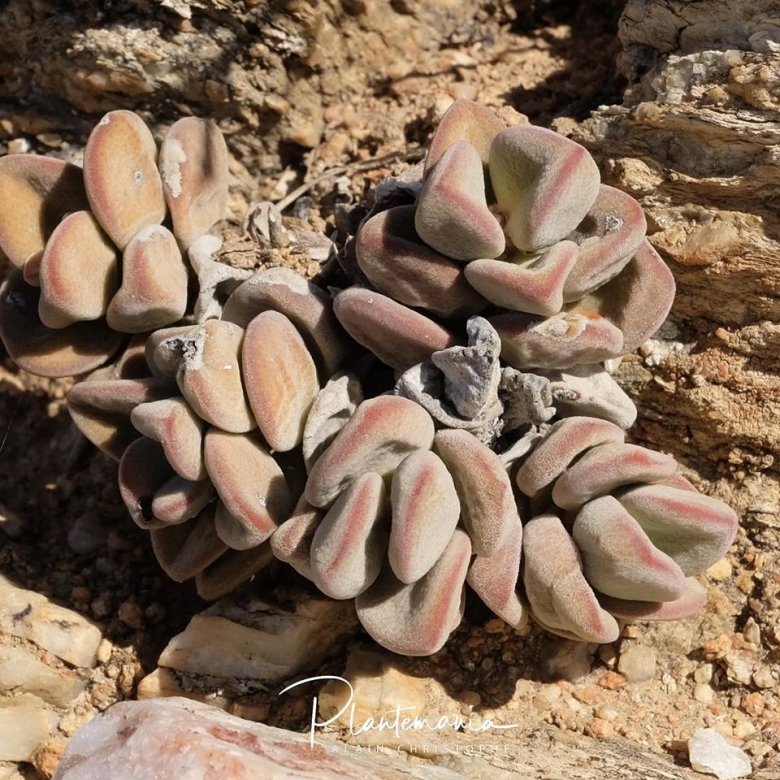
Crassula sericea (var. sericea) is a small perennial succulent subshrub up to 20 cm high, usually much branched, forming rounded spreading tufts. Its densely hairy leaves are borne at the ends of the branches, the are flat, rather blunt, and have a brown margin. The stems of old plants are sometimes woody and leafless. The petals have characteristic and distinctive dorsal appendages. A yellow-green versions of C. sericea is commonly encountered in the wild, but all forms of the species are worth cultivating. The variability of it foliage makes it easy to confuse with other species.
Leaves: Borne at the ends of the branches, spreading, densely hairy and greyish-green. Usually oblanceolate or (broadly) obovate, rarely oblanceolate, elliptic or orbicular, (8-)10-25(-45) mm long, (4-)10-25(-35) mm broad, base cuneate, tip rounded, rarely pointed; blade usually laterally compressed, upper face slightly concave to convex, more or less convex below. Hairs (fine, silky, white, hairlike papillae) spreading, rarely with recurved to globular trichomes, green to grey-green or greyish brown and often somewhat brown along margin towards tips. The old leaves are not deciduous.
Inflorescences: Elongated thyrses 4-10 cm long with few to many dichasia, peduncle hairy, purplish, 2 mm in diameter at the base, bracts triangular, clasping, 2 mm long.
Flowers: Calyx lobes triangular-lanceolate, 1-2,5 mm long, usually rounded, covered with spreading sometimes recurved hairs and marginal cilia, fleshy, green. Corolla tubular 4 mm long, 2 mm wide, fused basally for 0,7-1 mm, cream to pale yellow, rarely tinged pink; lobes oblong to oblong-oblanceolate, 3-4 mm long, 1.3 mm wide, ,ascending-spreading, acute, white, each with a more or less distinct dorsal appendage or rarely absent, more or less recurved. Stamens with brown anthers. Squamae transversely oblong to square, 0,4-0,8 x 0,5-0,7 mm, truncate to slightly emarginate, somewhat constricted downwards, fleshy, yellow.
Chromosome: 2n = 14.
Similar species: C. sericea is usually erect (rarely decumbent) and more robust than Crasula lanuginosa, it is distinguished by its woody stems and distinct peduncle.
Origin and Habitat
Witputz in southern Namibia along coastal mountains to Komaggas in Namaqualand, and across Bushmanland (Northern Cape, South Africa).
Habitat and ecology: Crassula sericea grows in shallow, sandy soil on the edges of koppies and in rock crevices often under overhanging rocks, usually fully exposed to the blazing sun together with other cliff-dwelling succulent plants such as Tylecodon ellaphieae, Aloe meyeri, Bulbine pendens and Ornithogalum suaveolens. It is quite abundant, particularly in the western part of its range. Flowering time May – August.
Cultivation and Propagation
Crassula sericea is grown from leaf cuttings during autumn. They can be planted in sand and kept moist, in a sunny or partially shaded region. Rooting is rapid and leaves will proliferate from their base. They can be planted out directly to the chosen container. It is best suited for summer-dry succulent gardens on shady rockeries. Outside of its habitat it should preferably be grown as a pot plant in a greenhouse under controlled conditions.
Bibliography
Major references and further lectures
-
Urs Eggli “Illustrated Handbook of Succulent Plants: Crassulaceae” Springer Berlin Heidelberg, 05/Nov/2012
-
Doreen Court “Succulent Flora of Southern Africa” CRC Press, 01/June/2000
-
J.P. Roux, “Flora of South Africa”, 2003
-
Crassula sericea in: International Crassulaceae Network. Web: http://www.crassulaceae.ch/de/artikel?akID=31&aaID=2&aiID=S&aID=2696
-
Tölken, H. R. “Crassulaceae. Flora of Southern Africa.” Vol. 14. Botanical Research Institute. 1985
-
Crassula sericea in: Cactus and Succulent Journal, Volume 81,editions 1-6, 2009
-
ARS 34, Volume 34, Edition 32, United States. Agricultural Research Service,1963
-
Tölken, H.R. “A revision of the genus Crassula in southern Africa”. Contributions of the Bolus Herbarium no. 8, part 2. Bolus Herbarium, University of Cape Town, Republic of South Africa.1977.
-
Rowley, G.D. “Crassula”. Cactus & Co. Libri. 2003.
-
Crassula sericea Schönland var. sericea, Ernst van Jaarsveld, Kirstenbosch National Botanical Garden, August 2009, web: http://pza.sanbi.org/crassula-sericea-var-sericea