Publication: Kakteen Südamerika 2: 492. 1980
Description
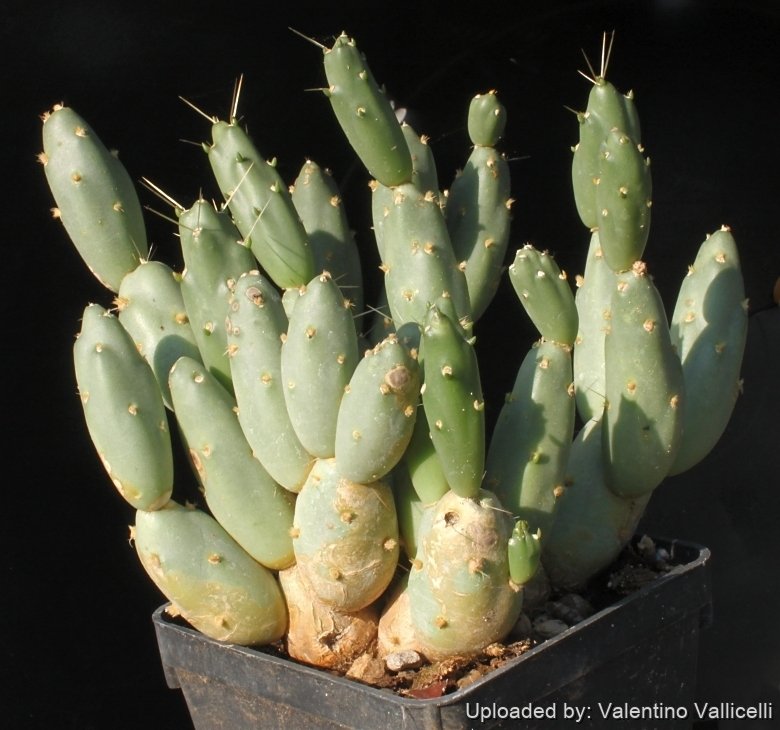
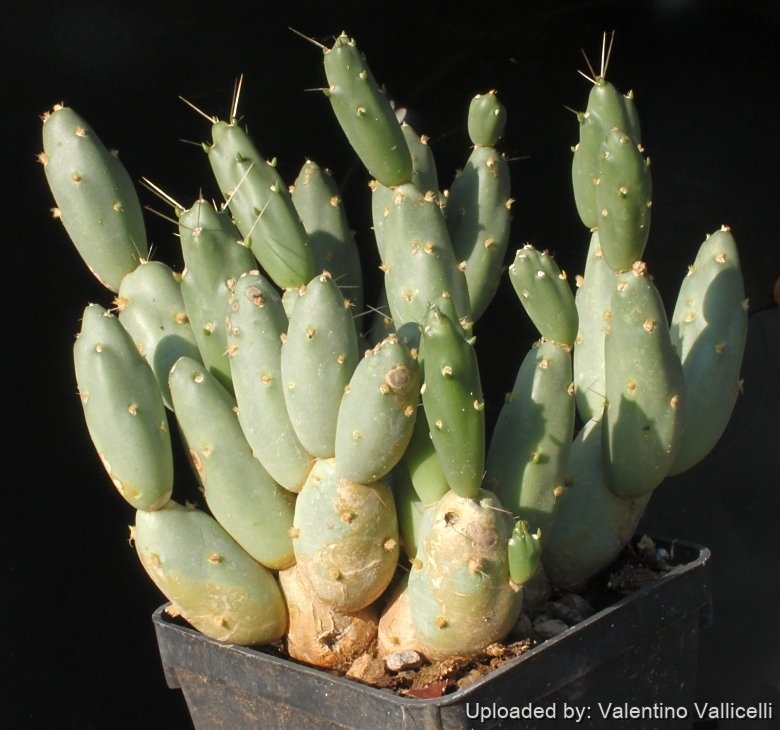
Cumulopuntia boliviana WG086 (Cumulopuntia boliviana v inermis ? ) is an almost spineless local or morphological form of this widespread species. Though plants without or with very few spines are somewhat rare, however nude specimens occurs naturally throughout its range, and can be encountered in many cultivated specimens. In cultivation it seem a bit tricky, not usually flowering.
Habit: Cumulopuntia boliviana is a cushion-forming cactus native to high elevation deserts around 4000 m in the Andes. It forms large mounds up to 100 cm in diameter.
Root: It has a thick napiform root.
Stem segments: Elongate to ovoid, light green, tuberculate apically, 3.5-7 cm long 3,5-4 cm in diameter.
Tubercles: At first well delimited, later only dimly discernible, mostly on upper portions of segments.
Areoles: About 15, near the segment tips, rounded, about 4 mm across, bearing a ring of brownish yellow glochids, with a small white or yellowish woolly centre. Basal areoles spineless.
Leaves: Minute and ephemeral.
Spines: Usually absent or very few only on the uppermost areoles near the segment tips, erect or somewhat spreading, straight, rounded or slightly compressed yellow to reddish brown, becoming grey with age.
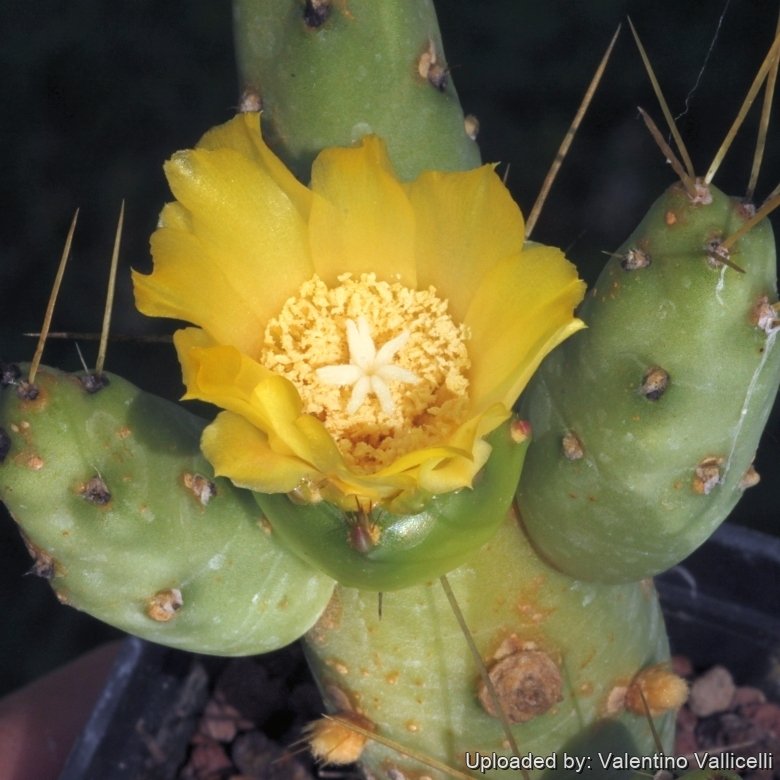
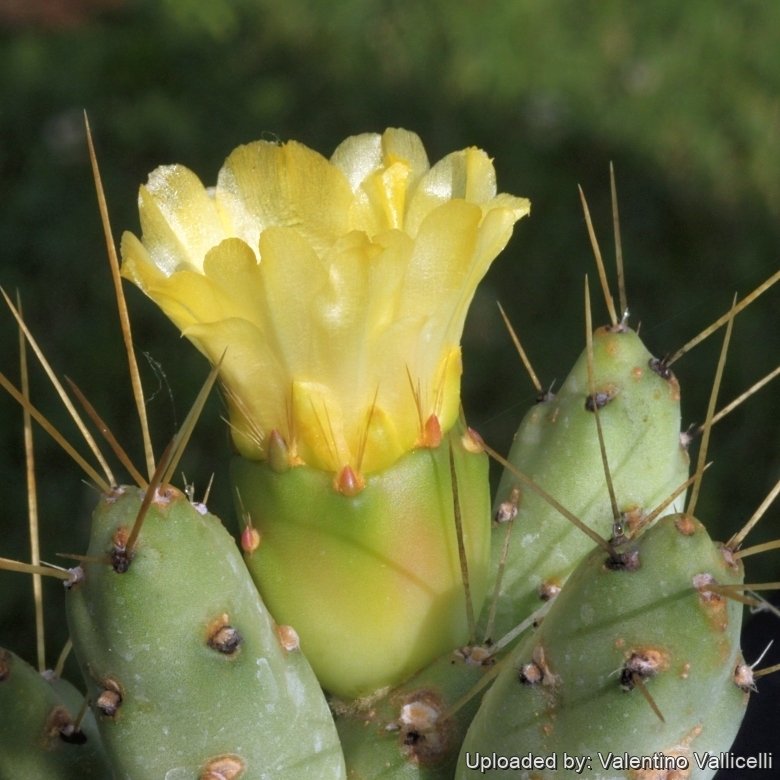
Flowers: Yellow (rarely orange, pink or red), to 4-5,5 cm long, 5-6 cm in diameter; pericarpels bristly above. Tepals small spatulate more or less mucronate. Outer tepals pale yellow or slightly tinged with red. Stamens sensitive. Filaments are light yellow anthers of the same colour. Style light yellow. Stigma lobes 7-8, paler, whitish or greenish.
Fruits: Usually nearly spherical and truncated, fleshy, green to yellow, mostly spineless but sometimes with a few flexible bristles approximately 20 mm long.
Seeds: 3 x 2 mm testa, shinning, very hard, aril with prominent annular rim.
Cultivation and Propagation
Cumulopuntia boliviana cannot endure any standing heat and need an absolutely airy and sunny place this brings very healthy plants with a good spination and flowers, but often in cultivation the plants are rarely so compact as they are best grown inside a greenhouse because of our very humid weather in North Europe and America which gives a relatively low light intensity compared to the temperature. However, this species takes considerable frost and is certainly worth growing.
Soil: Use a very draining compost-mix with a high mineral content, they needed deeper pots to accommodate the big tap root.
Watering: Water and feed in the vegetation period from April until to mid of September, keep dry and cool in winter, they have to be stimulated to bloom by dryness and you may give them water first when the plants start to produce the new buds.
Repotting: Generally, these plants should be re-potted every other year, in order to provide fresh soil. Pot bound, starved plants will rapidly look tatty and won’t flower well.
Hardiness: Hardiness Zone 8. The plant tolerates low temperatures (-8°C), can tolerate occasional snow cover for up to a couple of weeks per year.
Propagation: Cuttings (let dehydrate the cuttings for a few weeks and the roots will coming quick). To get new clones it is necessary to use seeds. Seeds require some preliminary manipulations, in fact, the shell/husks of the seeds are very hard (like a hazelnut), it is necessary to soak the seeds 24 hours, and break or scarify the husks before planting, by any means. In these conditions, germination occurs in 5 or 6 days. Otherwise, with intact seeds, germination can take several months or even years.
Bibliography
Major references and further lectures
-
Edward Anderson “The Cactus family” Timber Press, Incorporated, 2001
-
James Cullen, Sabina G. Knees, H. Suzanne Cubey “The European Garden Flora Flowering Plants: A Manual for the Identification of Plants Cultivated in Europe, Both Out-of-Doors and Under Glass” Cambridge University Press, 11/Aug/2011
-
David R Hunt; Nigel P Taylor; Graham Charles; International Cactaceae Systematics Group. “The New Cactus Lexicon” dh books, 2006
-
Urs Eggli, Leonard E. Newton: “Etymological Dictionary of Succulent Plant Names” Springer, Berlin/Heidelberg 2010
-
Trevisson, M., Lowry, M., Kiesling, R., Cáceres, F., Faundez, L. & Ostalaza, C. 2013. Cumulopuntia boliviana. In: IUCN 2013. “IUCN Red List of Threatened Species.” Version 2013.2. <www.iucnredlist.org>. Downloaded on 05 December 2013.
-
Friedrich Ritter “Kakteen in Südamerika. Ergebnisse meiner 20jährigen Feldforschungen.” volume 2: Argentinien/Bolivien.” Selbstverlag, Spangenberg 1980