Description
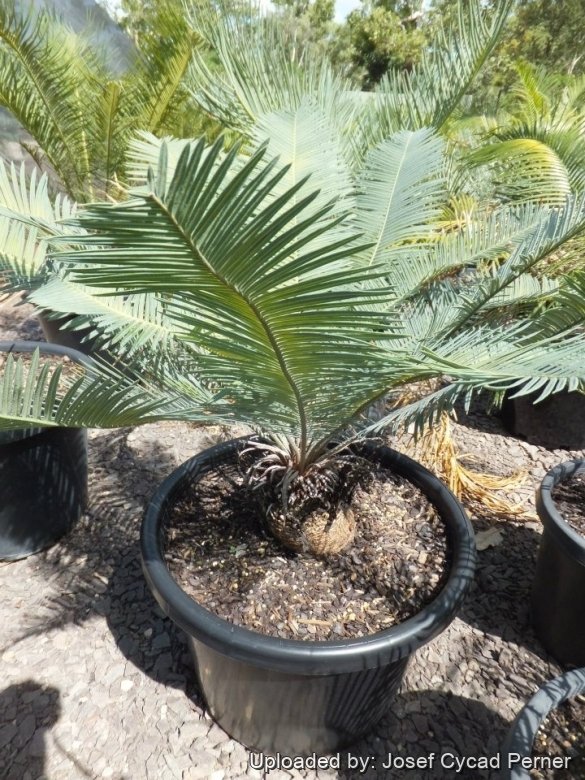
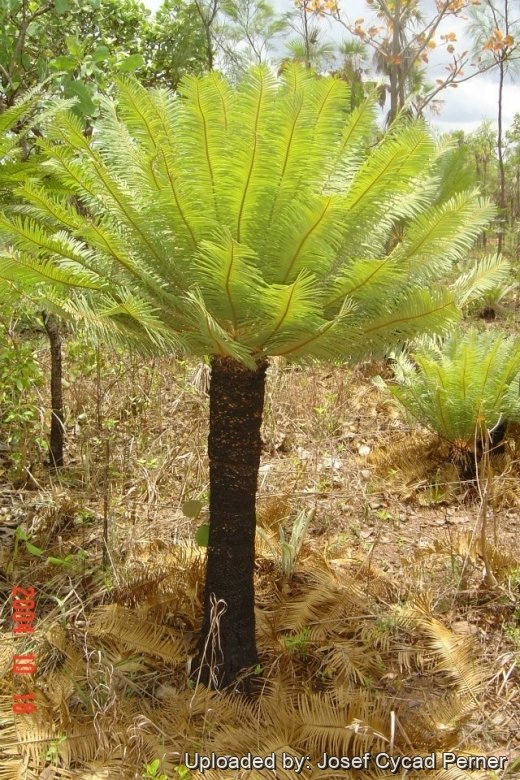
Cycas maconochiei is a medium to tall palm-like cycad with slenderer woody trunk to about 5 m tall topped with a neat crown of fairly short, flat, fronds, and arching out from the central trunk. It is distinguished by the flattened leaves with short petioles and leaflets with recurved margins, and the basal leaflets reducing in size. New growth with mainly light orange-brown or even paler trichomes. Individual specimens take 10-20 years to mature and may live for up to 120 or more years. The seeds have orange-brown coloured flesh and are slightly pruinose. C. maconochiei currently comprises three subspecies: Cycas maconochiei ssp. lanata, Cycas maconochiei ssp. maconochiei, and Cycas maconochiei ssp. viridis. Two subspecies are very abundant and one, C. maconochei ssp. machonochei has been assessed as Near Threatened due to ongoing habitat destruction.
Subsp. maconochiei: Differs in the dull green to grey-green, flatter and more widely spaced leaflets usually retaining some tomentum, leaflets 5.5-7.0 mm wide, margins slightly recurved, spaced at 8-10 mm on rachis and the less densely tomentose cataphylls.
Similar species: C. maconochiei is distinguished from Cycas arnhemica by the abundant orange-brown tomentum around the cataphylls.
Derivation of specific name: The epithet “maconochiei” honours the late John Maconochie, formerly botanist with the Northern Territory government, who had commenced a major revision of the genus Cycas.
Stem (trunk): Slender, straight 1-2.5 m tall, to maximum of 5 m tall, occasionally branching on some plants and often blackened by fire in habitat. Diameter average 15 cm to 40 cm. Some plans produce basal suckers.
Leaves (fronds): Up to about 125 cm long, rachis up to 90 cm long. Petiole 30-33 cm long spiny, spines up to 40, 6-12 mm apart, set the full length of the petiole. Leaflets 108-113 pairs, length at the top average 6-8.5 cm, middle 13-15cm, bottom average cm, grey/blue on the underside and dull, greenish/blue on the top, some having green mottling. Orange-brown or even paler tomentum covers back of rachis/petiole and very short pinnae right to the leafbase. Some without hair on the petiole but always on the leaf-base. All pinnae curved downwards slightly, 5 mm wide. Margins entire. Fronds are deciduous as in Cycas armstrongii.
Cataphylls: The cataphylls (Modified leaf, much reduced and thickened, serving to protect the apical meristem in cycads produced in flushes preceding the emergence of cones or leaves.) are linear, soft, densely orange-brown floccose and persistent.
Cycas maconochiei is a medium to tall palm-like cycad with slenderer woody trunk to about 5 m tall topped with a neat crown of fairly short, flat, fronds, and arching out from the central trunk. It is distinguished by the flattened leaves with short petioles and leaflets with recurved margins, and the basal leaflets reducing in size. New growth with mainly light orange-brown or even paler trichomes. Individual specimens take 10-20 years to mature and may live for up to 120 or more years. The seeds have orange-brown coloured flesh and are slightly pruinose. Cycas maconochiei currently comprises three subspecies: Cycas maconochiei ssp. lanata, Cycas maconochiei ssp. maconochiei, and Cycas maconochiei ssp. viridis. Two subspecies are very abundant and one, Cycas maconochei ssp. machonochei has been assessed as Near Threatened due to ongoing habitat destruction.
Subsp. maconochiei: Differs in the dull green to grey-green, flatter and more widely spaced leaflets usually retaining some tomentum, leaflets 5.5-7.0 mm wide, margins slightly recurved, spaced at 8-10 mm on rachis and the less densely tomentose cataphylls.
Derivation of specific name: The epithet “maconochiei” honours the late John Maconochie, formerly botanist with the Northern Territory government, who had commenced a major revision of the genus Cycas.
Stem (trunk): Slender, straight 1-2.5 m tall, to maximum of 5 m tall, occasionally branching on some plants and often blackened by fire in habitat. Diameter average 15 cm to 40 cm. Some plans produce basal suckers.
Leaves (fronds): Up to about 125 cm long, rachis up to 90 cm long. Petiole 30-33 cm long spiny, spines up to 40, 6-12 mm apart, set the full length of the petiole. Leaflets 108-113 pairs, length at the top average 6-8.5 cm, middle 13-15cm, bottom average cm, grey/blue on the underside and dull, greenish/blue on the top, some having green mottling. Orange-brown or even paler tomentum covers back of rachis/petiole and very short pinnae right to the leafbase. Some without hair on the petiole but always on the leafbase. All pinnae curved downwards slightly, 5 mm wide. Margins entire. Fronds are deciduous as in Cycas armstrongii.
Cataphylls: The cataphylls (Modified leaf, much reduced and thickened, serving to protect the apical meristem in cycads produced in flushes preceding the emergence of cones or leaves.) are linear, soft, densely orange-brown floccose and persistent.
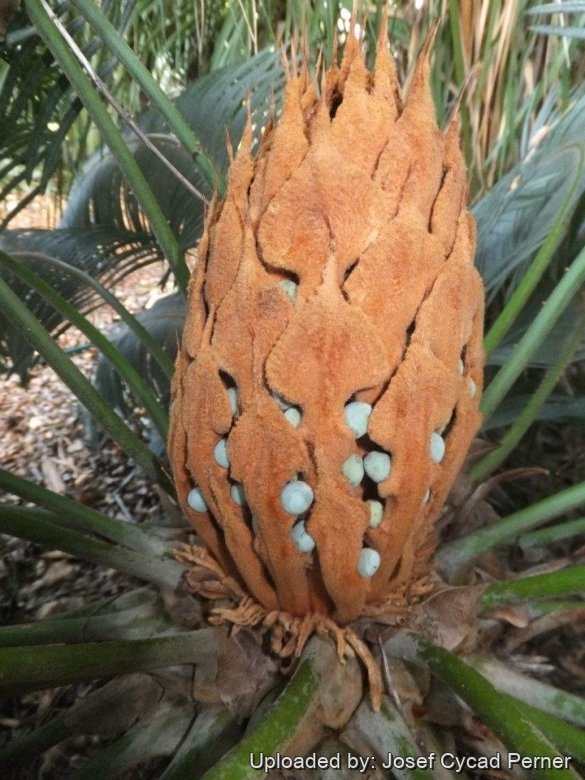
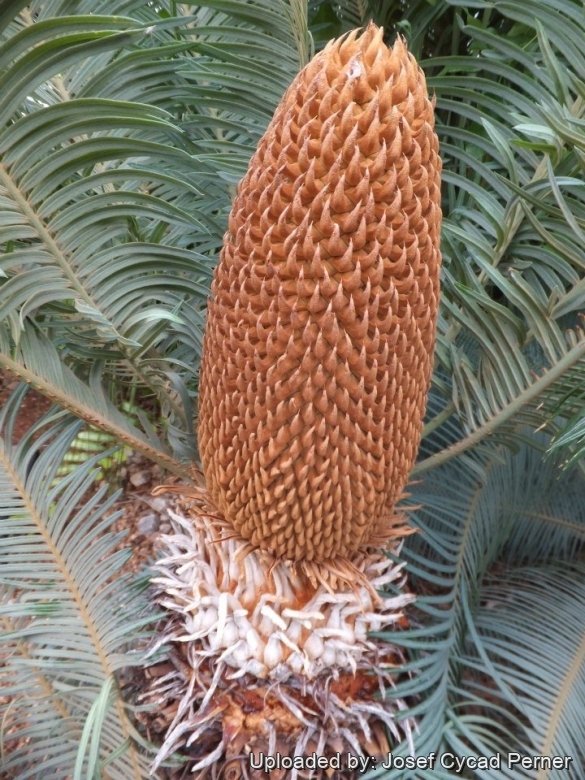
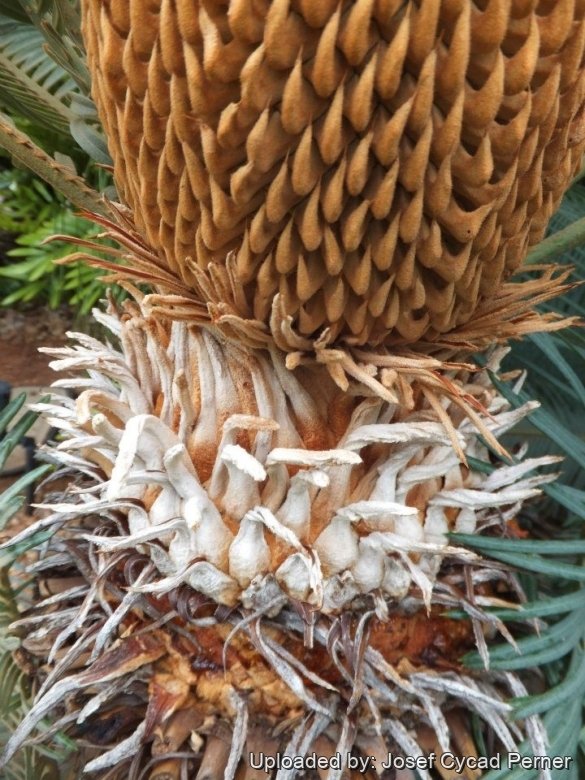
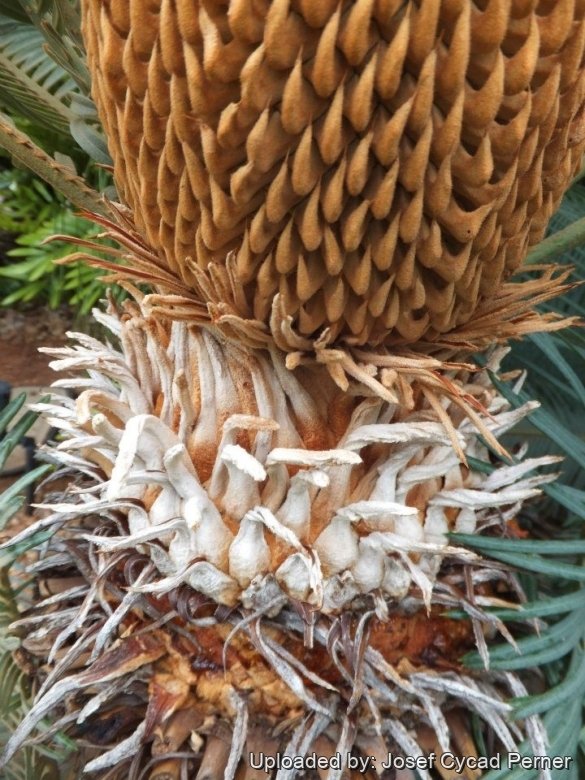
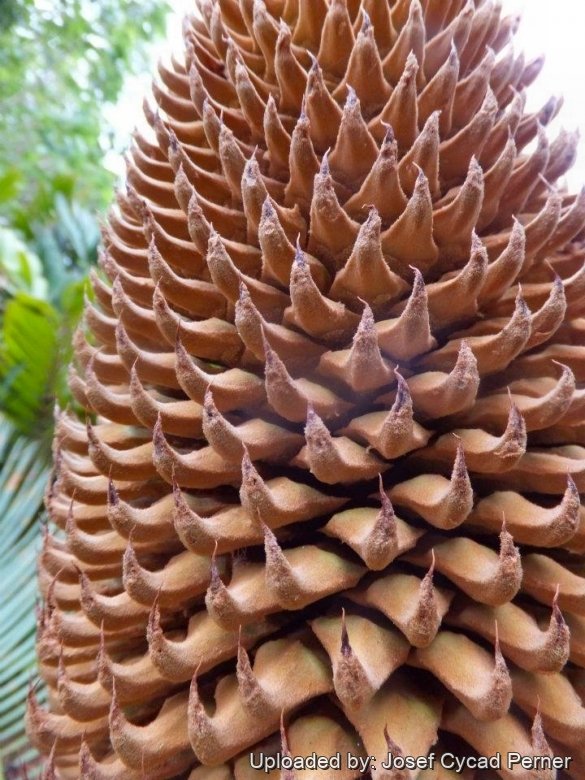
Pollen cones: Narrowly ovoid, orange, 21-34 cm long, 10-14 cm in diameter, microsporophyll lamina firm with a prominent apical spine, sharply upturned, 4-8 mm long.
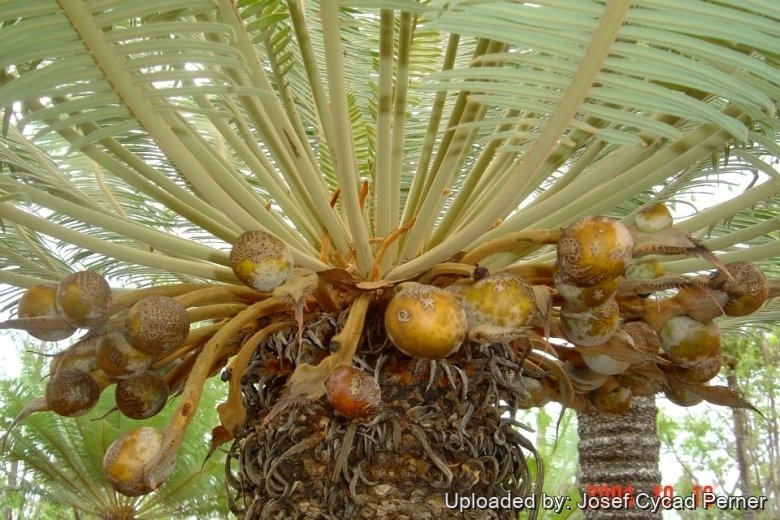
Female flowers: Like other Cycas species, the female plants do not bear cones; instead they carry ovules and seeds on large, orange-brown-tomentose and brown-tomentose megasporophylls which are 20-29 cm long, with between 2 and 4 glabrous ovules.
Seeds: Flattened-ovoid, 30-35 mm long; sarcotesta orange-brown.
Origin and Habitat
Cycas maconochiei (ssp. maconochiei) is known from the Northern Territory, Australia. Plants occur in the northwest of this state and are restricted to a small area right along the Cox Peninsul abetween Fog Bay and Port Darwin, to the southwest of Darwin.
Altitude range: This species occurs from sea level up to 40 m.
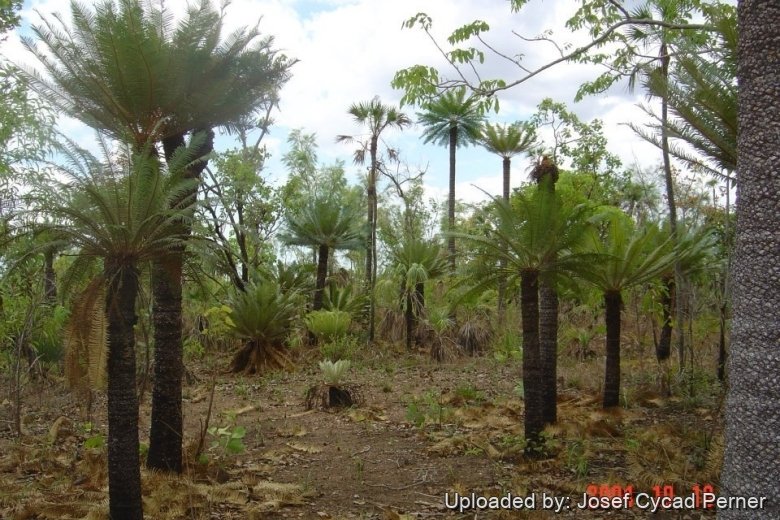
Habitat and Ecology: C. maconochiei can form large stands in coastal, open, savanna forests on flat sites dominated by Eucalyptus miniata and Eucalyptus tetrodonta on sandy soil over Tertiary laterites, and also on a variety of well-drained soils. Also found in swampy areas and coastal dunes just back from the beach, scrub cover being Pandanus, Eucalyptus and Planchonia. The climate is tropical with average rainfall of about 1500 mm per annum. The cycas tend to grow in scattered groups within a community, preference being for damper fresh water areas in the proximity of large shade trees. Cycas maconochiei is often covered with a local orchid, Dendrobium affine (aka the Darwin orchid). This orchid is on the endangered species list. In unburned areas like coastal strips, cycads are probable hosts for many such thing. The invasion of alien grasses into areas of native vegetation and an increase in fire intensity due to increases in fuel load is likely to have a negative impact on this species. With the expansion of rural development and agriculture, especially in the Darwin and Katherine regions, cycads such as Cycas maconochiei, Cycas armstrongii and Cycas canalis are especially vulnerable to clearing. Seed and plant collectors may pose a problem in the future, in particular when frequent fire also effectively blocks reproduction and uncontrolled development alienates significant proportions of the habitat. Apparent natural hybrids are known with Cycas armstrongii and Cycas calcicola.
Cultivation and Propagation
Cycas maconochiei is suited to tropical regions which have a seasonally dry climate. It is easy to grow, tolerating dry periods. It makes a beautiful ornamental for tropical and some warm temperate areas but is rather rare in cultivation.
Growth rate: Usually slow growing, however good conditions can speed it up considerably. Because of its growth habit, fertilize only when terminal bud begins to swell, indicating the start of the annual growth cycle.
Exposure: It prefers bright light exposure but colour bleaches when in full sun; best with some protection from afternoon heat.
Soil: Needs a well drained spot, with deep soil, but will still thrive in less than ideal conditions.
Maintenance: Minimal; removal of offsets if desired, removal of spent fronds.
Use: Landscape as cultivated perennial in warm, coastal areas; House-plant or interior-scape, as container plant in cool areas, as well very well suited to bonsai culture.
Propagation: Seed. After fertile seeds are collected, they usually need several months of storage before the inner embryo is ready to germinate. Therefore, it is best to clean the seeds of external fruit and set them aside before attempting to propagate the seeds.
Bibliography
Major references and further lectures
-
Hill, K.D 2010. Cycas maconochiei. The IUCN Red List of Threatened Species. Version 2014.3. <www.iucnredlist.org>. Downloaded on 15 November 2014.
-
Boris Lariushin “Cycadaceae Family” Lulu.com
-
Australia. Bureau of Flora and Fauna, Australian Biological Resources Study “Flora of Australia: Ferns, gymnosperms and allied groups” CSIRO, 1998
-
V.P. Singh “Gymnosperm (naked seeds plant) : structure and development” Sarup & Sons, 01 January 2006
-
Whitelock, Loran M., “The Cycads”, Timber press, 2002.
-
PACSOA contributors “Cycas maconochiei”. In: Cycads. Palm and Cycad Societies of Australia (PACSOA). 23 November 2013 Web. 28 August 2015.
-
Haynes J.L, “World List of Cycads: A Historical Review”, IUCN/SSC Cycad Specialist Group, 2012
-
The Cycad Pages “Cycas maconochiei” Royal Botanic Gardens Sydney Written and maintained by Ken Hill 1998-2010 Maintained by Leonie Stanberg and Dennis Stevenson 2010-2012 <http://plantnet.rbgsyd.nsw.gov.au/cgi-bin/cycadpg?taxname=Cycas+maconochiei\> Web. 25 August 2015
-
Palms & Cycads No. 27, Apr-Jun 1990.
Gallery