Description
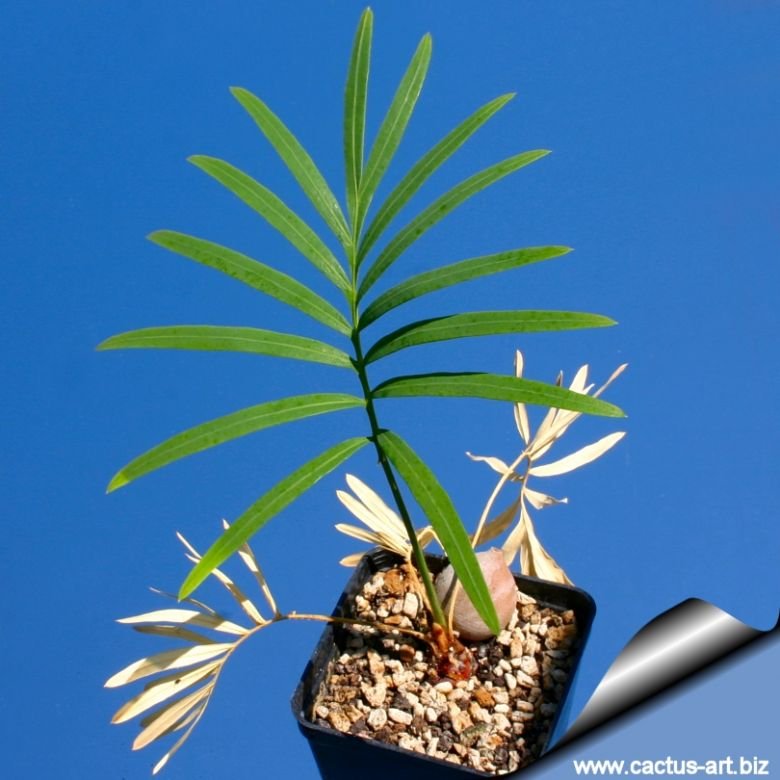
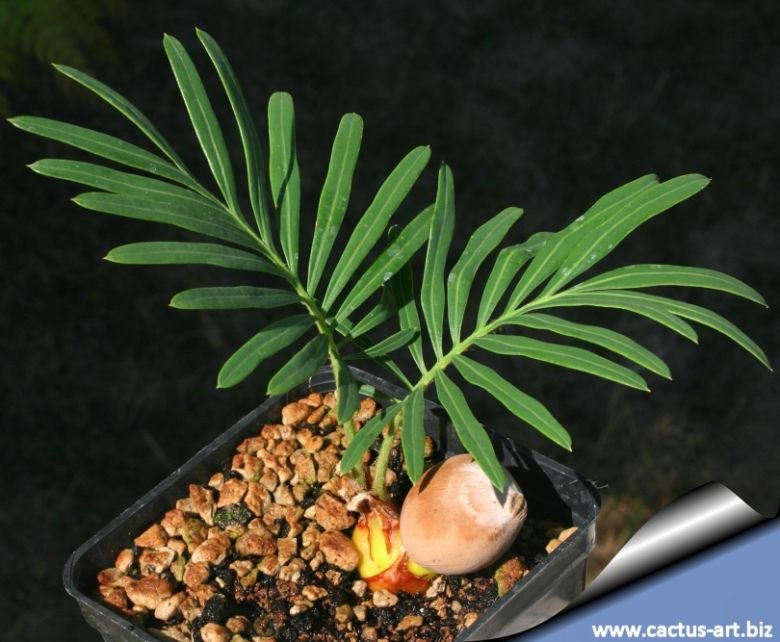
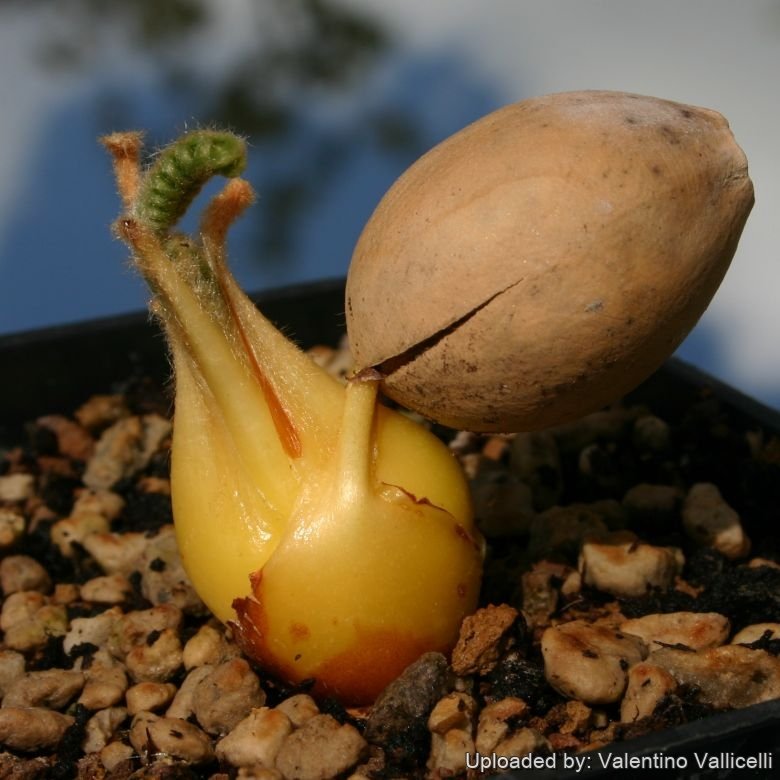
The typical Cycas siamensis is is a short stemmed, unisexual, dioecious, palm-like plant with a swollen trunk and an attractive crown. The leaves (fronds) are pinnately compound, with a very short petiole and basal leaflets gradually reducing in size towards the spines. They also differ in being usually densely brown-tomentose, with the tomentum persisting around their bases and on the trunk around the persistent leaf-bases. Plants vary in colour from white through yellow, orange to brown, depending on the colour of the hairs on the leaves. There are no other clear distinguishing features, and they must all be regarded as the same species. The seeds are yellow to orange.
Silver form: Plants with dense silver woolly hairs on the leaves are often sold as “Silver” or “Thai Silver” form. Their emergent leaves are silver in colour. The white colour comes not from a lack of chlorophyll but from fine white hairs that cover the new fronds. As they mature a lot of the hairs are lost but the plant still looks very silvery white. However the young seedlings are dark green in colour for some years. They are some absolutely stunning cycads, but, unfortunately, they are incredibly expensive at any sort of a decent size.
Flowers: Male cones are small of a distinct oblong shape, orange to brown, 10-24 cm long, 5-7.5 cm diam.
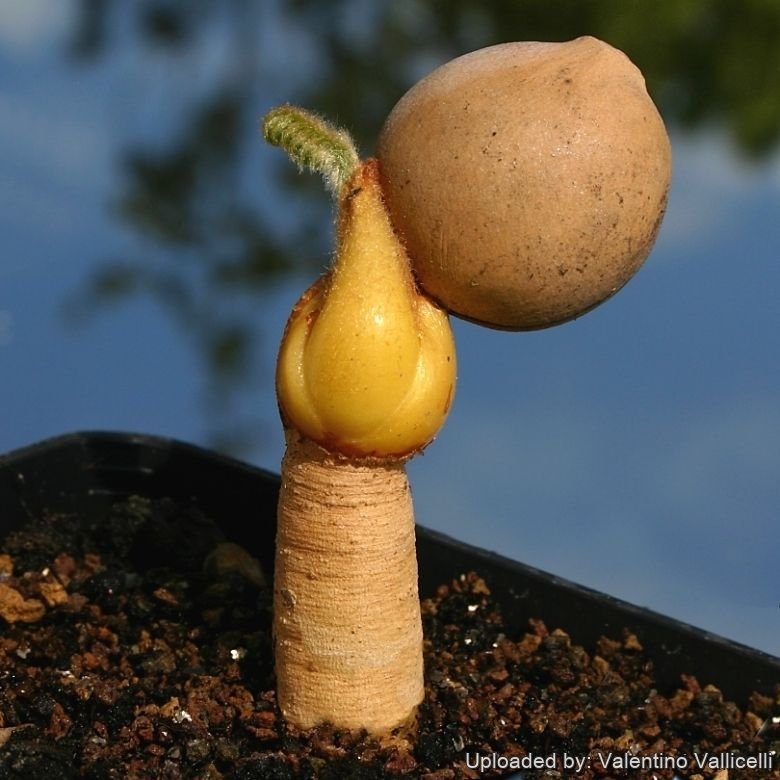
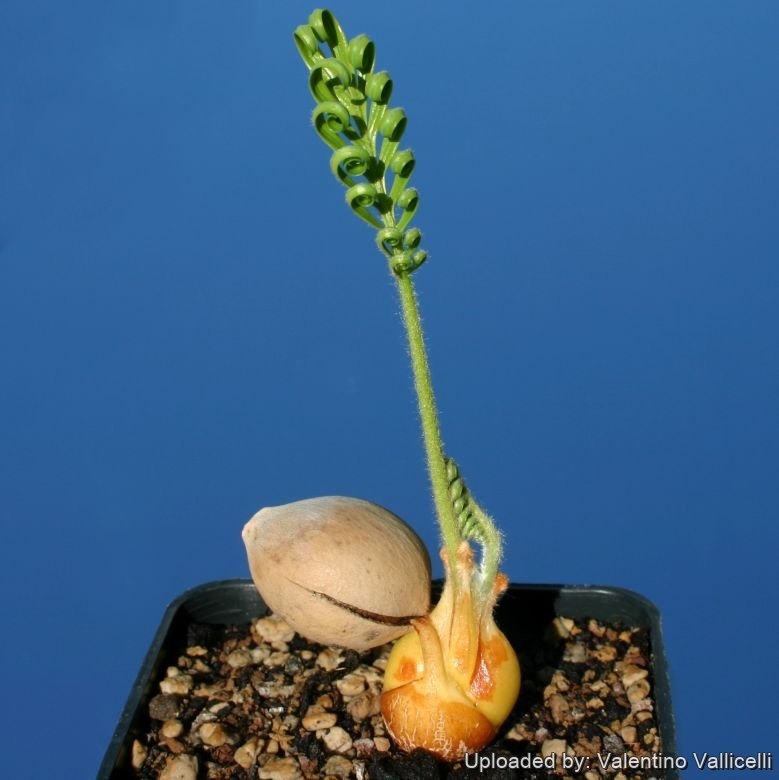
Seeds: Subglobose: 30-37 mm long, 26-37 mm wide.
Origin and Habitat
Central Thailand and Vietnam. Also recorded from Laos, Cambogia and Myanmar (Burma).
Habitat: It is a widespread and locally extremely abundant species, it is found in many places in dry open deciduous forest on poor rocky soil to 1200 m. This species occurs in full sun to light shade on flat country or on low hills, often in dense stands. These woodlands are characteristically seasonally wet and dry with the monsoon weather patterns of the region, with particularly pronounced and extended dry periods.
Cultivation and Propagation
Ideal for the tropical to warm temperate garden and particularly adapted to pot culture, it requires partial sun and a well drained soil. In cultivation, at least in cooler climates, it is one of the few deciduous cycads, losing its leaves every winter. Coming as it does, from areas with high annual rainfall, it requires a plentiful supply of water and should never be allowed to dry out, but eventually it could stay dry for a long time. it’s a bit fastidious for this climate- prefers it wetter and warmer (In temperate climate the plant might be treated like a succulent and kept rather dry and cool during the winter).
Propagation: Easy to germinate.
Warning: All parts of this plant are highly toxic, but rarely eaten due to poor flavour.
Bibliography
Major references and further lectures
-
Boris Lariushin “Cycadaceae Family” Lulu.com
-
Shiu-ying Hu “Food Plants of China” Chinese University Press, 2005
-
Whitelock, Loran M., “The Cycads”, Timber press, 2002.
-
Nguyen, H.T. 2010. Cycas siamensis. The IUCN Red List of Threatened Species. Version 2015.2. <www.iucnredlist.org>. Downloaded on 28 August 2015.
-
Haynes J.L, “World List of Cycads: A Historical Review”, IUCN/SSC Cycad Specialist Group, 2012.
-
Osborne, R.; Hill, K.D.; Nguyen, H.T. & Phan Ke, L. “Cycads of Vietnam.” Osborne, Brisbane (Australia) and Eeden, Capre Town (South Africa) 2007.
-
Jones, D. L. “Cycads of the world.” Smithsonian Institution Press, Washington, DC 2002.
-
Umberto Quattrocchi “CRC World Dictionary of Medicinal and Poisonous Plants: Common Names, Scientific Names, Eponyms, Synonyms, and Etymology” (5 Volume Set) CRC Press, 03 May 2012
-
The Cycad Pages “Cycas siamensis” Royal Botanic Gardens Sydney Written and maintained by Ken Hill 1998-2010 Maintained by Leonie Stanberg and Dennis Stevenson 2010-2012 <http://plantnet.rbgsyd.nsw.gov.au/cgi-bin/cycadpg?taxname=Cycas+siamensis\> Web. 25 August 2015
-
Joseph Seckbach “Symbiosis: Mechanisms and Model Systems” Springer Science & Business Media, 31 May 2002
-
Hsuan Keng, Ro-Siu Ling Keng “The Concise Flora of Singapore: Gymnosperms and Dicotyledons” Volume 1 NUS Press, 1990
-
American Florist, Volume 11, 1896
Gallery