Publication: Kaktus-ABC [Backeb. & Knuth] 123. 1936 [12 Feb 1936]
Description
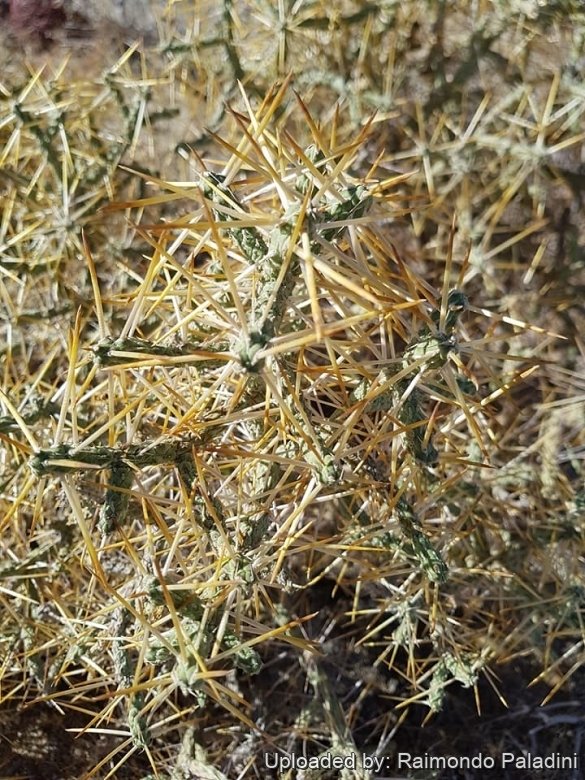
Opuntia arbuscula is a densely branched tree or shrub, up to 3 m high with many intricately branched stems from a solid trunk and thin pencil-like joints 7-10 mm wide, but not infrequently the plant is less than 1 m high and openly branched. It has small flowers that can be dark bronze to pale orange-bronze or green. The fruits are 20-25 mm long, pale green but sometimes tinged with red or purple.
Stem: Main stem (trunk) well developed 10-12 cm in diameter. The ultimate segments are cylindrical, smooth, green with purple tint, 6-11 cm by 5 to 30 mm in diameter, with narrow, obscure tubercles about 1-2 cm long appearing as wrinkles when dry.
Areoles: Broadly elliptic to round, 1-2 mm in diameter, 4-55 mm apart with tan to brown wool. Glochids pale yellow encircling areole. Usually only a few areoles spiniferous.
Spines: 0-3 per areole, of which one longer 8-35(-50) mm long, with often 1 or 2 smaller ones under it, distributed sparsely along segments, stout, usually bent downward, light to dark grey or yellow ir reddish brown near base, ageing black with age. Each spine is clothed by a loose fitting, l yellowish or yellowish brown sheath.
Flowers: Small, dark bronze to orange-bronze, about 2.5-3(-3.5) cm in diameter. Inner tepals moderately spreading, yellow, greenish yellow, or orange-bronze, broadly obovate to spatulate, 17-20 mm, apiculate. The style is white and sometimes light orange distally. The stigma lobes are pale green.
Blooming season: Late spring (May-June.)
Fruits: Commonly sterile, bovoid, truncate and deeply excavated at summit, fleshy, mostly spineless, green to yellow, sometimes tinged red to purplish at areoles, fertile ones stipitate, obconic, 2.5-3(-5) cm long, 1.5-3.5 cm in diameter, sometimes proliferous. Areoles 15-17(-34). Umbilicus 3-4 mm deep.
Seeds: Circular to oblong, irregularly angular but not markedly compressed, smooth, thick, 3-5 mm long and wide, pale yellow and lumpy
Chromosome number: C. arbuscula is hexaploid (2n = 66).
Origin and Habitat
Cylindropuntia arbuscula ranges from central Arizona south into Sonora, Mexico.
Altitude ranges: 300 to 1000 metres above sea level.
Habita and ecology: It grows on in heavy soil in Sonoran desert flats, bajadas, along sandy washes and scrub. This species is not abundant and its distribution tends to be scattered. However, there are many occurrences of individual plants. Cylindropuntia arbuscula is occasionally cultivated for use in landscape planting. This species is sensitive to frost.
Cultivation and Propagation
The fruits of the species are used by local people to make a drink.
The Papago Indians utilized the young joints of the pencil cholla and similar species as a boiled vegetable but probably only in times of want.
Notes
C. arbuscula hybridizes with Cylindropuntia spinosior (Cylindropuntia × neoarbuscula), Cylindropuntia versicolor (Cylindropuntia x vivipara), and Cylindropuntia leptocaulis (2n = 55). Hybrids have intermediate stems, flowers colour and fruit size.
Bibliography
Major references and further lectures
-
Cylindropuntia arbuscula in Cholla Web <https://www.opuntiads.com/cyl/cylindropuntia-arbuscula/\>
-
Engelmann 1857. “Proceedings of the American Academy of Arts and Sciences” 3: 309. (Original species description)
-
Edward F. Anderson, “The Cactus Family”, (Timber Press, 2001)
-
Cylindropuntia arbuscula in “Flora of North America” @ efloras.org FNA Vol. 4 Page 104, 106, 109 retrieved 10 December 2017 from <http://www.efloras.org/florataxon.aspx?flora\_id=1&taxon\_id=242415141\>
-
Hunt, D., Taylor, N. and Charles, G. (compilers and editors). 2006. “The New Cactus Lexicon.” dh Books, Milborne Port, UK.
-
Paredes, R., Van Devender, T.R. and Felger, R.S. 2000. “Cactaceas de Sonora, Mexico: su diversidad, uso y conservacion”. Arizona-Tucson Desert Museum Press, Tucson.
-
Pinkava, D.J., Puente, R. & Baker, M. 2017. Cylindropuntia arbuscula. (amended version published in 2013) The IUCN Red List of Threatened Species 2017: e.T152128A121459369. Downloaded on 10 December 2017.
-
Daniel F. Austin, Baboquivari Mountain Plants: Identification, Ecology, and Ethnobotany, University of Arizona Press, 2010
-
Thomas Henry Kearney, Robert Hibbs Peebles, “Flowering plants and ferns of Arizona” U.S. Dept. of Agriculture, 1942
-
Forrest Shreve, Ira Loren Wiggins, “Vegetation and Flora of the Sonoran Desert”, Volume 1, Stanford University Press, 1964
Gallery