Publication: Bradea 6(16): 144 (1992)
Description
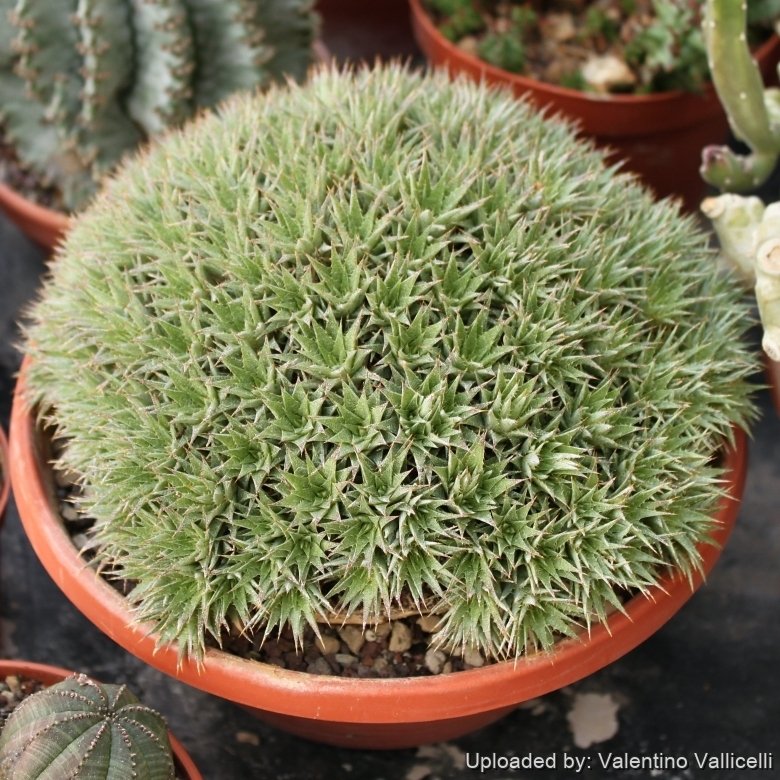
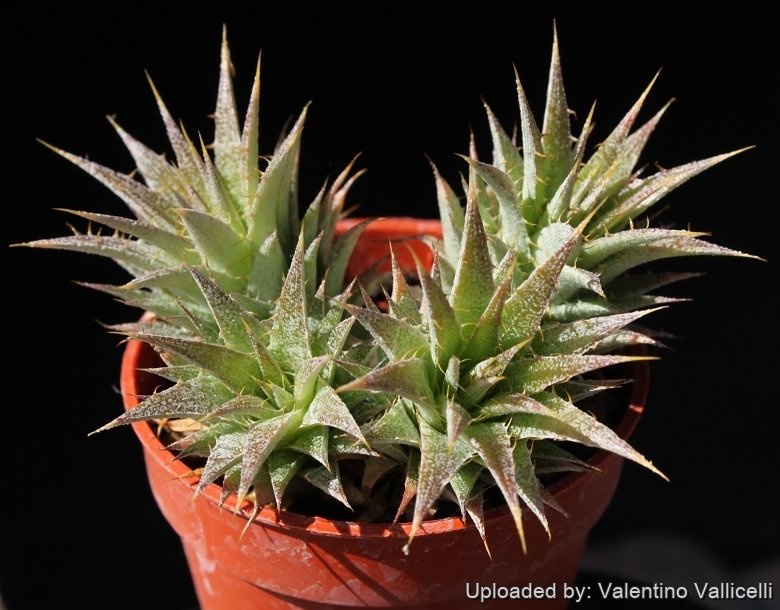
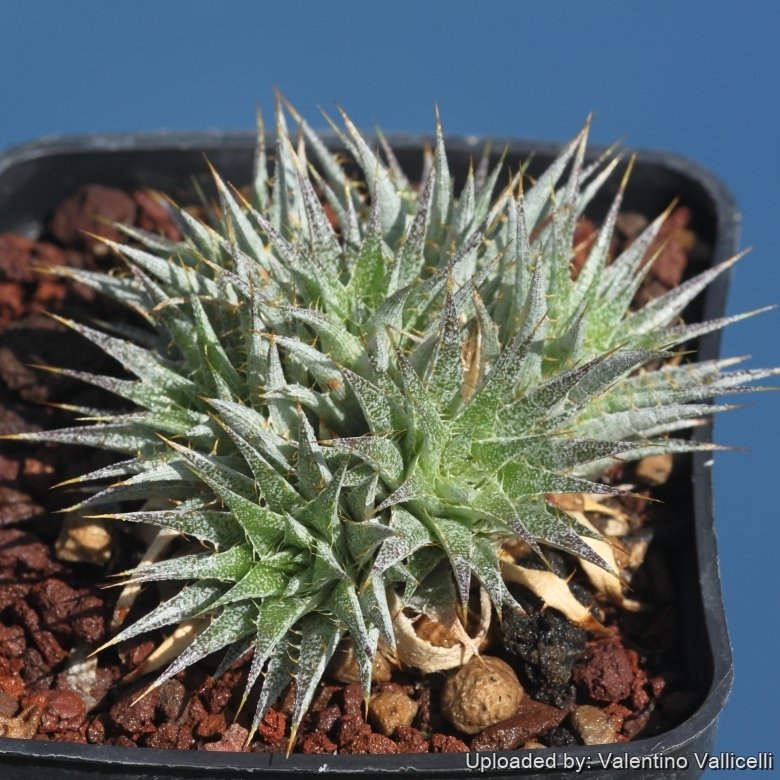
Deuterocohnia brevifolia (Abromeitiella brevifolia) is a dwarf, succulent, bromeliad growing terrestrially. It forms 3-5 cm wide rosettes of lance-shaped to triangular stiff, fleshy, leaves that proliferate via offsets to form a compact rounded ‘mound’ up to 90-180 cm in diameter. These colonies from a distance often look soft and moss-like but they are anything but soft and cushy and touching or sitting on a plant would but more like encountering a bed of nails. Inconspicuous green flowers are borne on short inflorescences. A. brevifolia, distinguished by its relatively smooth leaf margins, has both a large and a small form, the latter (often with many marginal teeth) sometimes sold under the synonym A. chlorantha.
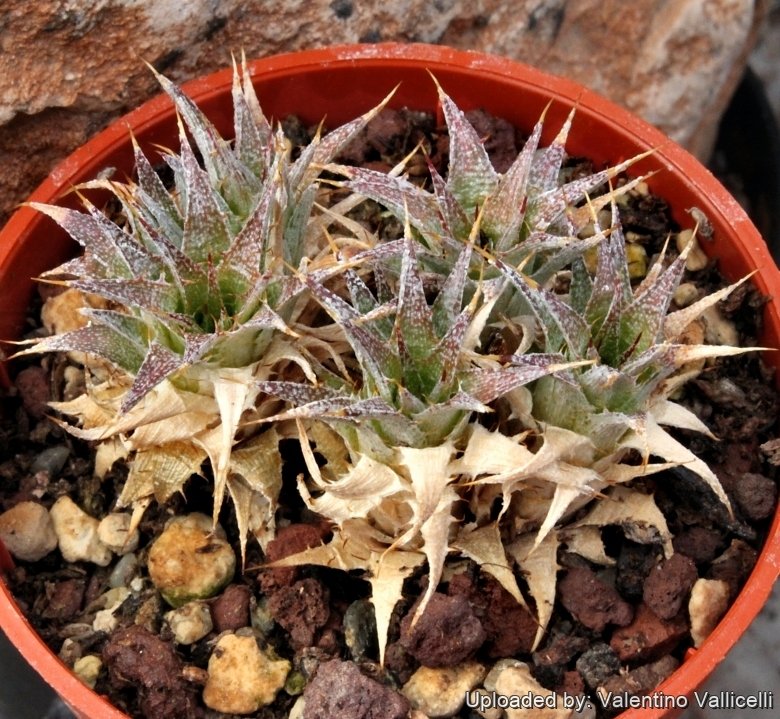
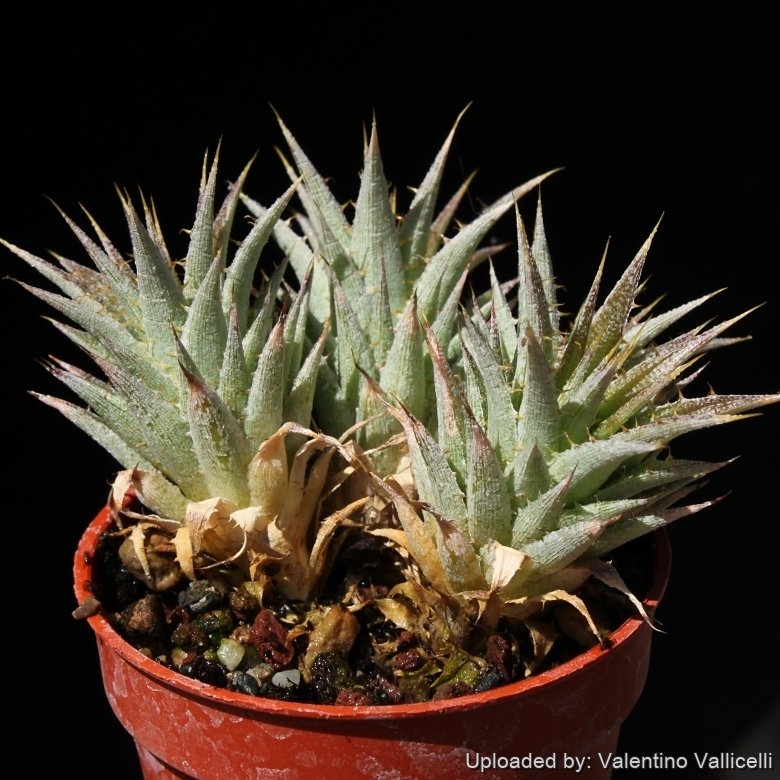
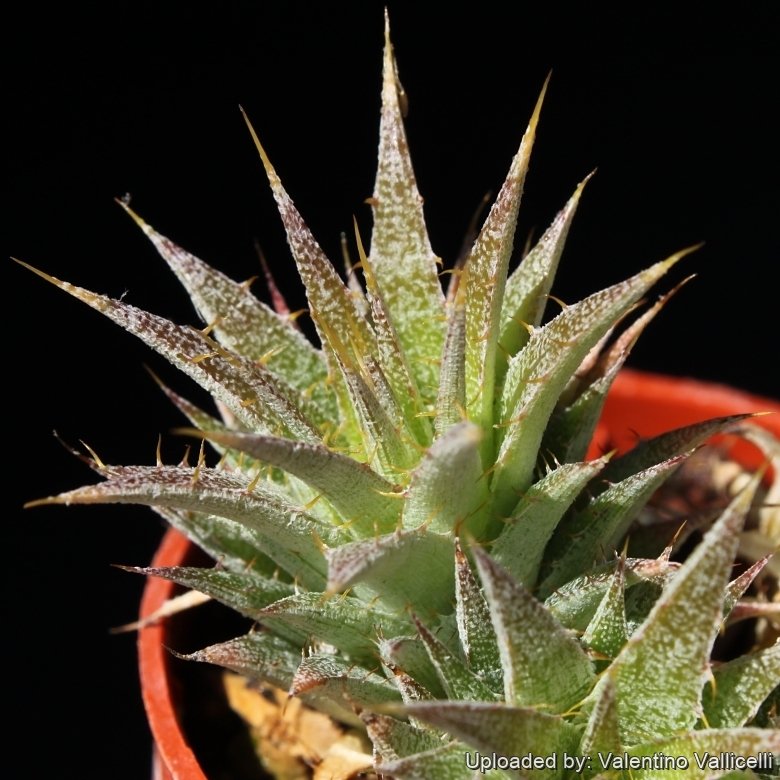
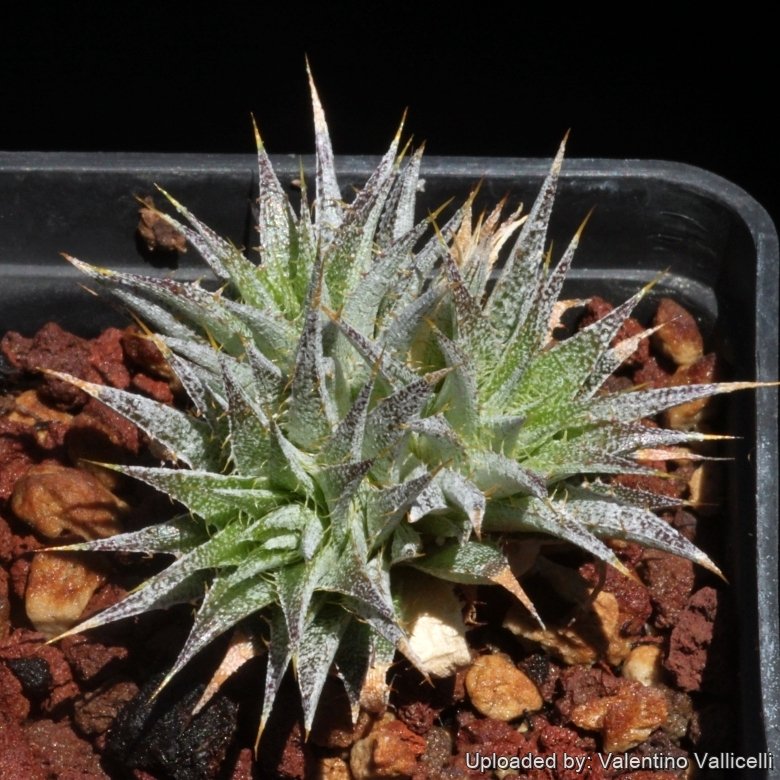
Rosettes: Small, star-like, compact of elongated triangular leaves about 3 cm long, thick and fleshy with spineless margins. It is a very variable species from quite variable habitats. In humid, seasonally wet areas the little rosettes can be green, glabrous and glossy but in more arid locations the plants leaf surfaces can posses varying amounts of trichomes giving the rosettes a greenish-gray appearance.
Leaves: Simple, basal, and sessile. Ovate-triangular, 2-3 cm long, at the base 8-14 mm wide, tapering, margins spineless or spiny (subsp. chlorantha), fleshy-thick.
Flowers: ‘cannon-shaped’ about 32-33 mm long, 6-7 mm wide, greenish to bright green.
Taxonomy: Deuterocohnia brevifolia was already described and the name validly published by August Heinrich Rudolf Grisebach. It was Michael A. Spencer and Lyman Bradford Smith, however, who reclassified it into todays valid botanical systematics in 1992.
Origin and Habitat
Deuterocohnia brevifolia is native to Argentina (Catamarea, Sierra de Anconguija; Tucuman, Quebrada de la Hoyada; Jujuy, El Volcani; Salta, Pampa Granda) and Bolivia: Valle de Tambo.
Habitat: Deuterocohnia brevifolia is a dense, cushion-like plant, clambering over the rocks on steep walls in a very arid area. As the plant grows and branches the mounding colony spreads outward covering rock and sloping hillsides helping to slow run-off and prevent soil erosion. In its environments it is watered perhaps only twice a year, finding all of its moisture from the air itself. The only water it ever gets is in the form of sea fog. It is a very variable species from quite variable habitats. In humid, seasonally
Cultivation and Propagation
Deuterocohnia brevifolia (Abromeitiella brevifolia) is a peculiar little plant occurring in dense, pillow-like clusters, suited to plant between stones or even into flat bowls into clayey ground in the greenhouse for succulent plants. Grow it like succulents in in full sun to light shade and well drained soil. They are slow growing and very drought tolerant. They should be watered regularly especially during summer months, keep dry in winter. It is probably one of the cold hardiest of the bromeliads, but detesting winter wet on its foliage, proves difficult to keep outside. When grown in pots it tends to spread out uniformly in all directions and given enough time makes a mound of foliage in the shape of a basketball cut in half that completely obscures the pot. ?
Propagation: Deuterocohnia brevifolia is propagated by division and from seed when available. Among the smaller species, it is a natural addition to a succulent collection.
Bibliography
Major references and further lectures
-
Hermann Jacobsen, “Abromeitiella to Euphorbia”, Blandford Press, 1960
-
Clive Innes “Complete Handbook of Cacti and Succulents”, Van Nostrand Reinhold Company, 01/Dec/1981
-
Smith, L.B. & Downs, R. J. Abrometiella in: “Flora Neotropica” 14:241-244 1974
-
“Dry Climate Gardening with Succulents”, Pantheon Books, 1995
-
Ulrich Baensch, Ursula Baensch, “Blooming bromeliads”, Tropic Beauty Publishers, 1994
-
Yucca Do Nursery, inc. “Deuterocohnia brevifolia f. Chlorantha” web: <https://www.yuccado.com/deuterocohnia-brevifolia-f-chlorantha.html\>
-
Gerald Klingaman, “Plant of the Week: Deuterocohnia brevifolia Bromeliad-02-20-15” web: <https://uaex.edu/yard-garden/resource-library/plant-week/Deuterocohnia%20brevifolia.aspx\>
From llifle page Abromeitiella chlorantha
Description
Deuterocohnia brevifolia f. chlorantha (Abromeitiella chlorantha) is a low densely caespitose perennial cushion forming sub-succulent herb, a very peculiar terrestrial bromeliad that forms a neat, ultimately large and compact rounded ‘mound’ up to 90 cm in diameter with hundreds of small narrowly standing rosettes of leaves.
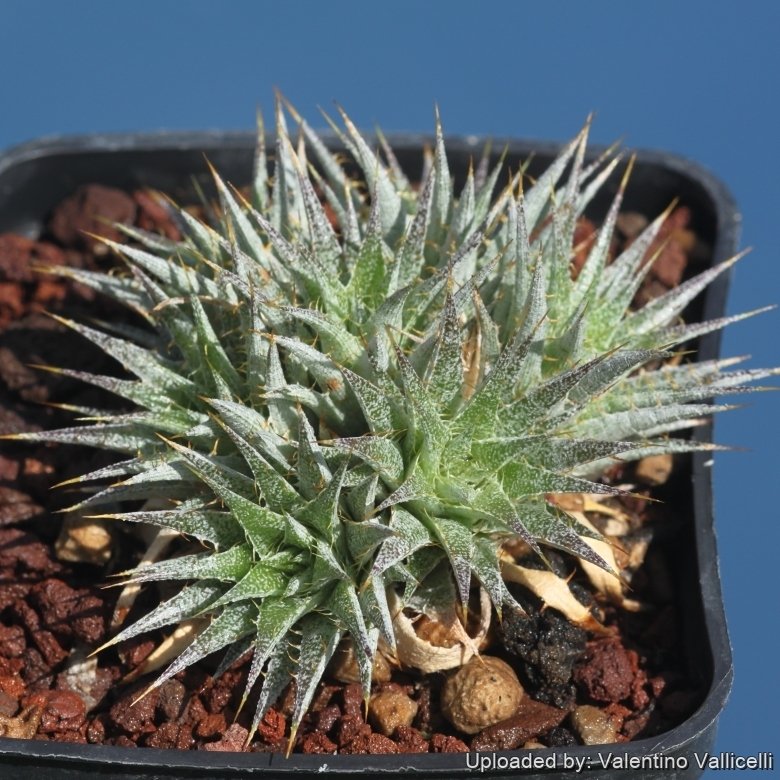
Rosettes: Very small, with individuals reaching from 3.5 to 6.5 cm across.
Leaves: Densely arranged, spreading, linear-lanceolate, triangular or ovate-triangular, up to 22 mm long and about 5 to 13 mm wide at the base, 2 to 3 mm thick, hard, fleshy, deep green and greyscaly, at the margins with small spines at the base or even spineless, and with sharp tips.
Flowers: Small and insignificant, solitary or several, lateral, out of rosettes, cylindrical, greenish to intensely green.
Blooming season: Early winter.
Note: Deuterocohnia brevifolia f. chlorantha has been a controversial subject: A. chlorantha was a very acceptable title for many years, and in fact is still upheld by some. It is now considered to be part of A. brevifolia.
Origin and Habitat
Argentina in the region of Tucuman and southern Bolivia.
Habitat: Abromeitiella brevifolia f. chlorantha is a dense, cushion-like plant, clambering over the rocks in a very arid area. In its environments it is watered perhaps only twice a year, finding all of its moisture from the air itself. The only water it ever gets is in the form of sea fog.
Cultivation and Propagation
Grow it like succulents in in full sun to light shade and well drained soil. They are slow growing and Plants very drought tolerant. They should be watered regularly especially during summer months, keep dry in winter. It is probably one of the cold hardiest of the bromeliads, but detesting winter wet on its foliage, proves difficult to keep outside.
Propagation: Deuterocohnia brevifolia ssp. chlorantha is propagated by division and from seed when available.
Bibliography
Major references and further lectures
-
“The Plantsman”, New Perspectives Pub., 1990
-
Hermann Jacobsen, “Abromeitiella to Euphorbia”, Blandford Press, 1960
-
Barbara Segall, “Botanica: the illustrated A-Z of over 10,000 garden plants and how to cultivate them”, Mynah, 1997
-
Debra Brown Folsom, Huntington Botanical Gardens, “Dry climate gardening with succulents”, Pantheon Books, 14/Mar/1995
-
Country Life, Volume 192 1998
-
Clive Innes “Complete Handbook of Cacti and Succulents”, Van Nostrand Reinhold Company, 01/Dec/1981
-
Wikipedia contributors. “Deuterocohnia brevifolia.” Wikipedia, The Free Encyclopedia. Wikipedia, The Free Encyclopedia, 11 Dec. 2016. Web. 29 Sep. 2017
Source: Abromeitiella chlorantha, LLIFLE - Encyclopedia of living forms, CC-BY-SA, retrieved 2026-10-25.
Cultivars and forms (1)
Subspecies (1)
Gallery