Publication: Kakteen Sukk. 44: 63 1993
Description
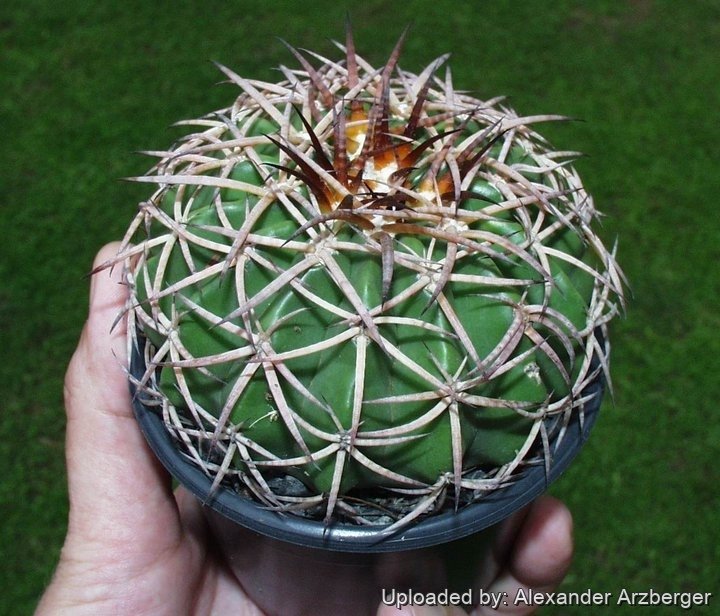
Discocactus bahiensis subs. subviridigriseus (Discocactus subviridigriseus) is a subspecies of Discocactus bahiensis distinguished by a larger grey-green stem with about 13—15 ribs, rather than the usual 10 ribs of the typical bahiensis.
Derivation of specific name: subviridigriseus Latin ‘sub-’, almost, more or less; Latin ‘viridis’, green; and Lat. ‘griseus’, grey; for the colour of the plant bodies.
Stems: ca. 12-14 cm, 8-10 cm tall (without cephalium) grey-green.
Ribs: 13 to 15.
Areoles: Round to oval. 4 to 6 per rib on plants with cephalium.
Radial spines: 4 to 7, straight to slightly bent inwards rose-white to grey. The upward one about 1 cm long, the side- and downwards spines are up to 3 cm.
Flowers. The position of the stigma is half-way up the secondary stamens.
Fruit: Yellow-green.
Origin and Habitat
Rio Sao Francisco near Sobradinho, west and east of Jazuaro Juremal to Curral Velho, also south of Sento Se and west of Juremal, Bahia, Brazil
Altitude range: Around 370 metres above sea level.
Habitat and ecology. Discocactus bahiensis subs. subviridigriseus was known from a single locality, although it may have had a more extensive range in the past, much of its area has disappeared beneath a great dam lake. The population was reported to count a few hundred individuals at most.
Cultivation and Propagation
Collectors consider this cactus genus from South America to be rarities as they are not the easiest plant to keep happy. it is rather difficult to grow and frost tender, should be kept at above 15° C if grown on its own roots (8°C if grafted) need full sun or afternoon shade. Young seedlings are generally grafted because they are slow growing and very rot prone when kept on their own roots and though they can’t endure long stretches of total dryness, too much water will rot them, as their weak root systems tend to be inefficient at sucking up water from wet soil. They generally resent being repotted and can take a long time to establish.
Propagation: Seed. Young seedlings are often grafted on a low stock to keep the plant in a good shape.
Bibliography
Major references and further lectures
-
Günter Königs “Discocactus subviridigriseus HU438” http://www.discocactus.nl/Engels/speciesE/woutersianusE.htm
-
Succulenta Nederlands nr 11 1977
-
Discocactus 1980 s. 115
-
Jonas M. Lüthy “Final Report - Review of the CITES Appendices on behalf of the Plants. Committee: Appendix I-Cactaceae” 2001
-
Urs Eggli, Leonard E. Newton “Etymological Dictionary of Succulent Plant Names” Springer Science & Business Media, 11 March 2004
Gallery