Publication: Nat. Pflanzenfam. Nachtr. [Engler & Prantl] iii. 6 a. (1894) 190.
Description
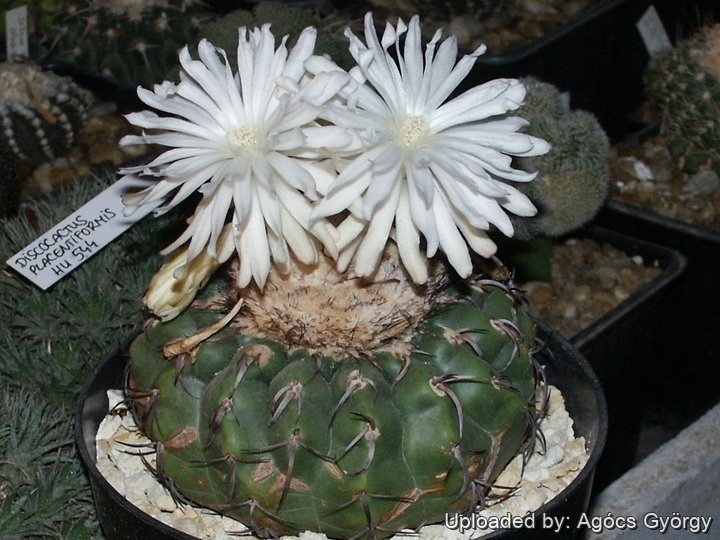
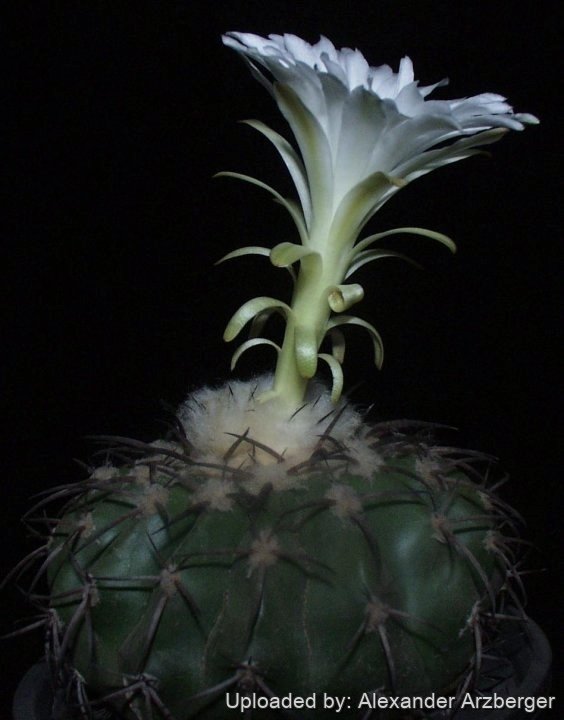
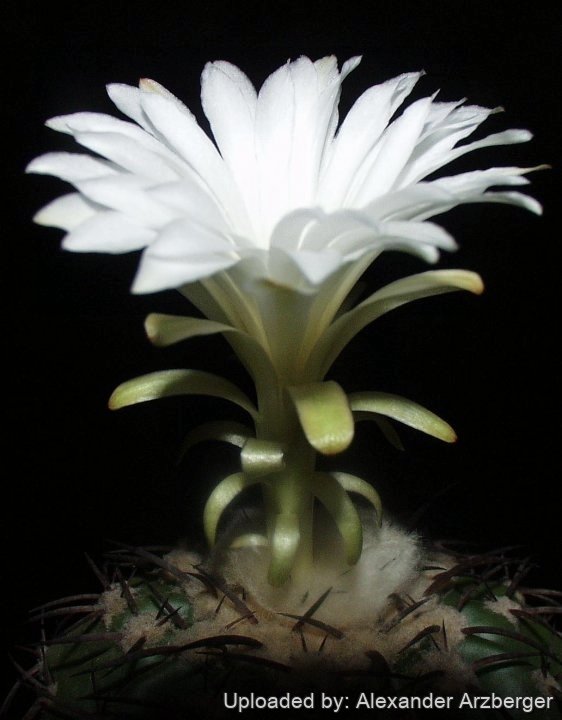
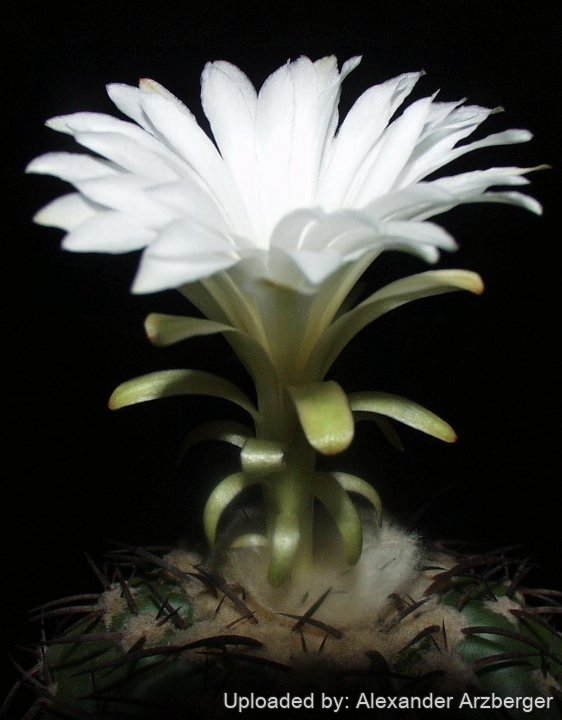
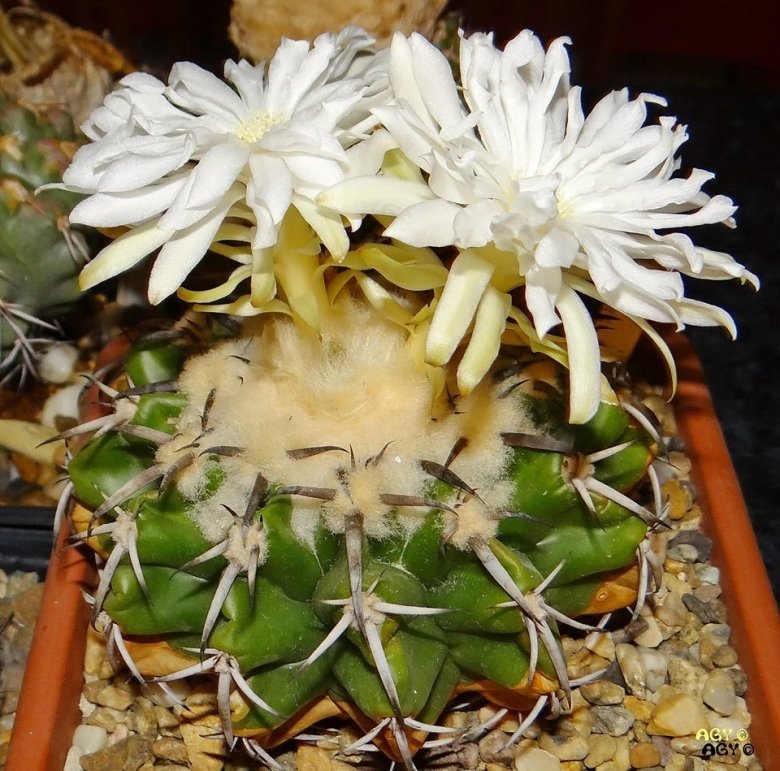
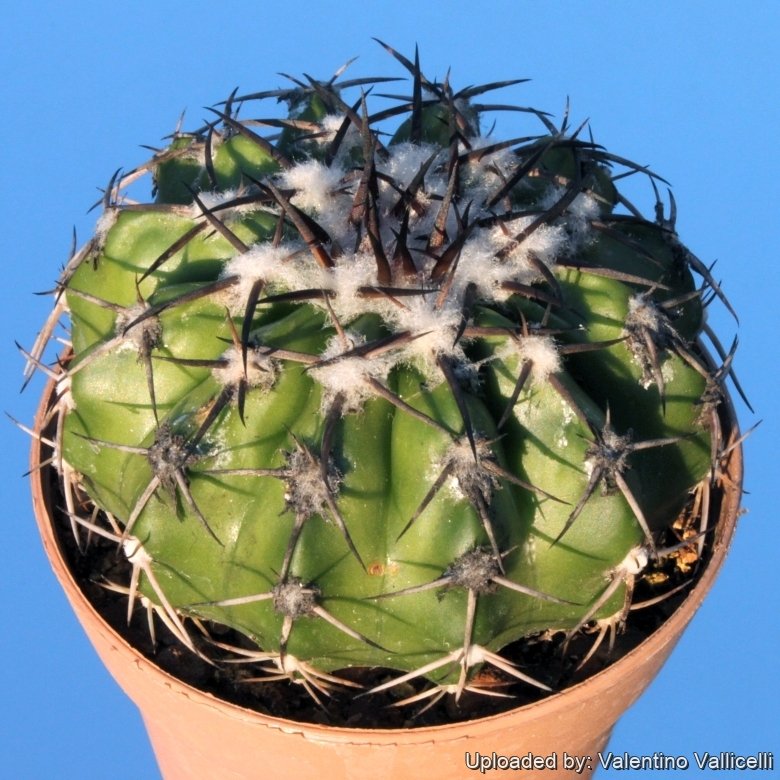
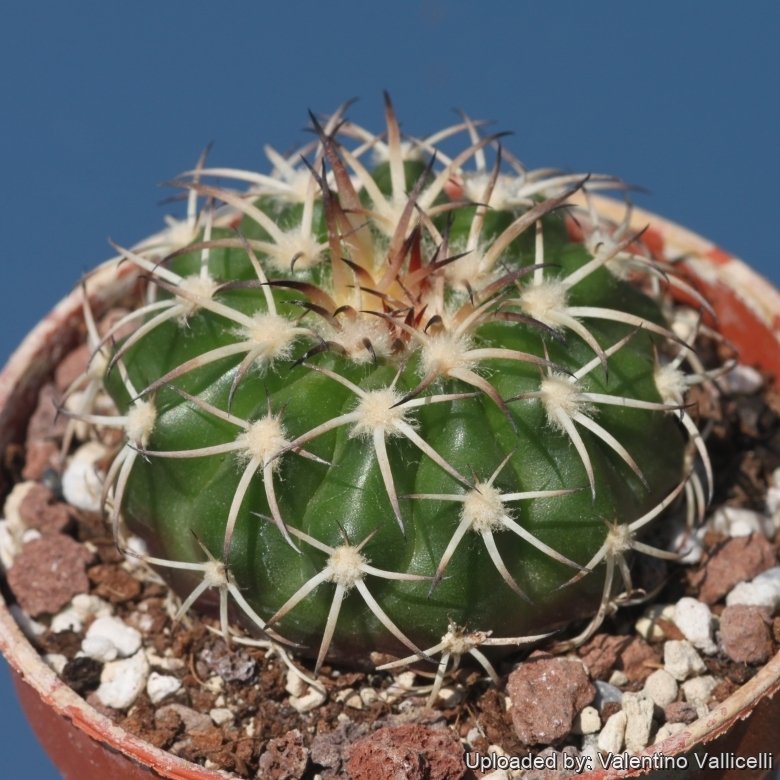
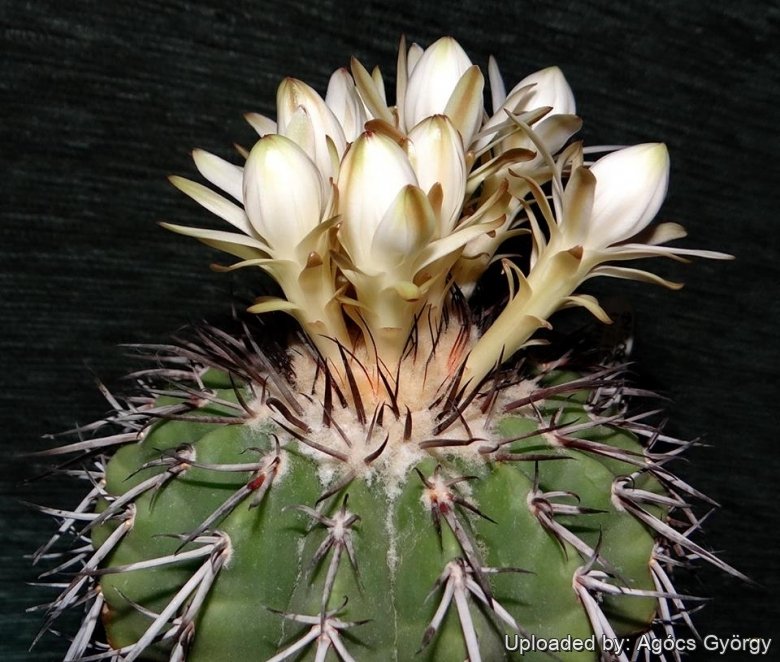
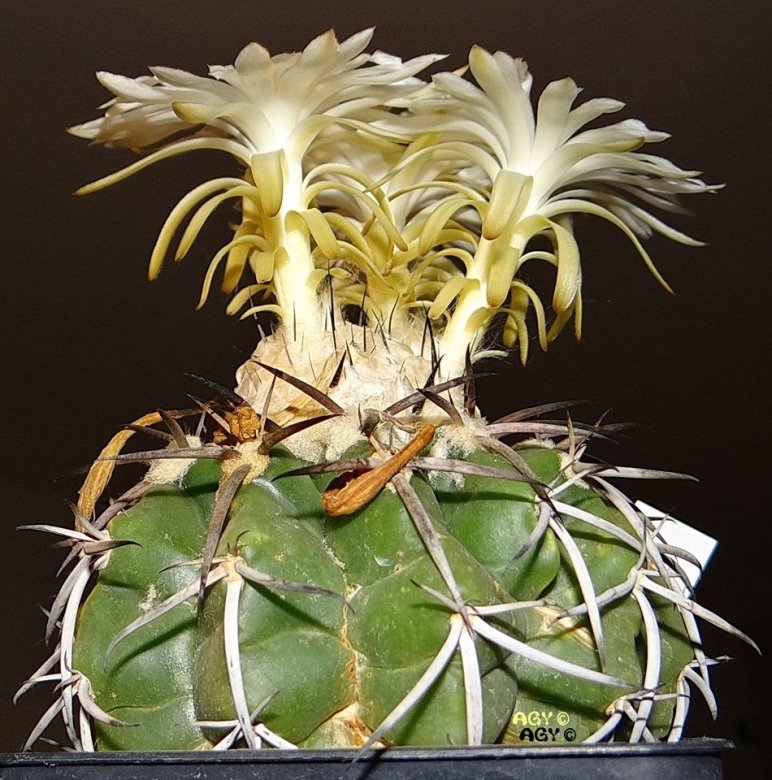
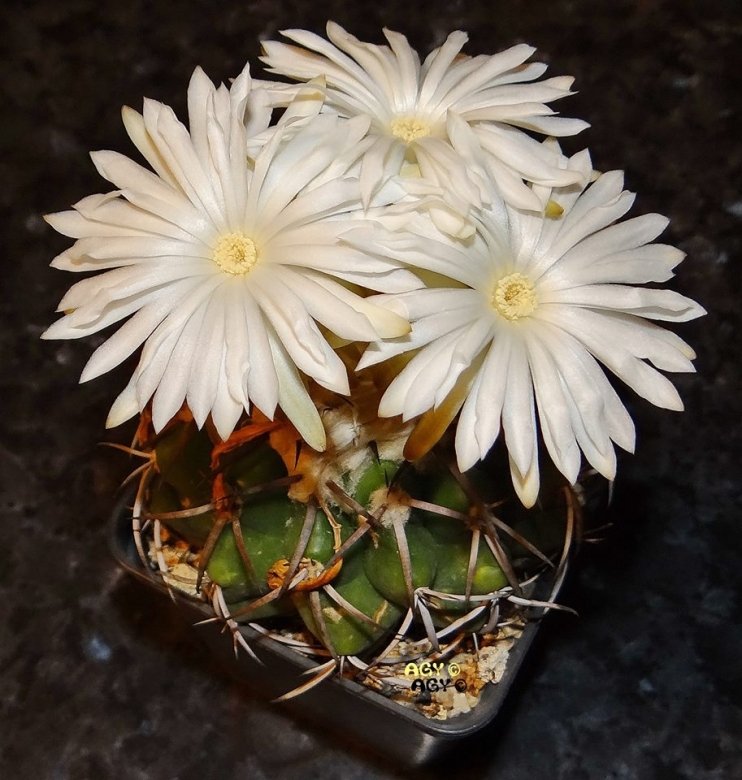
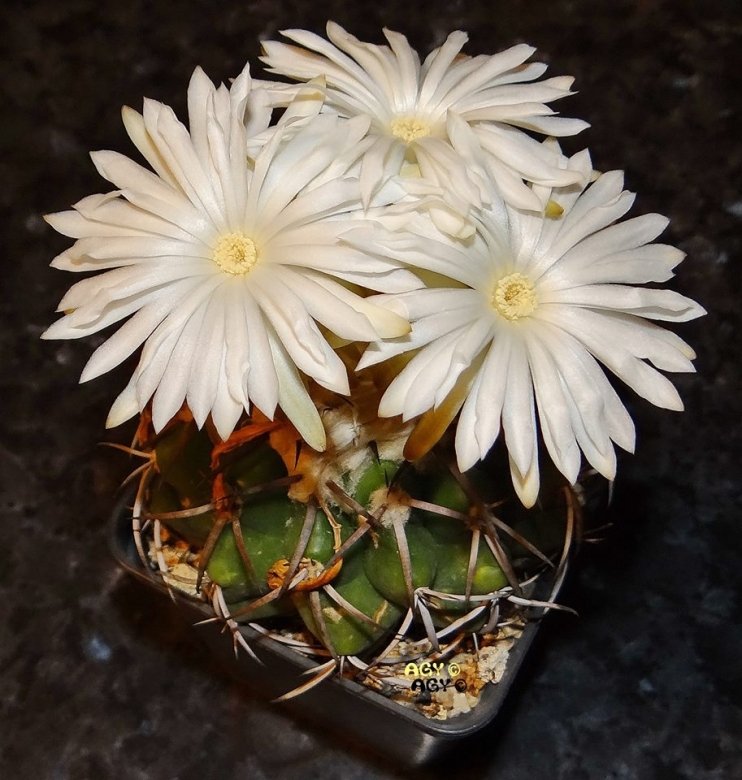
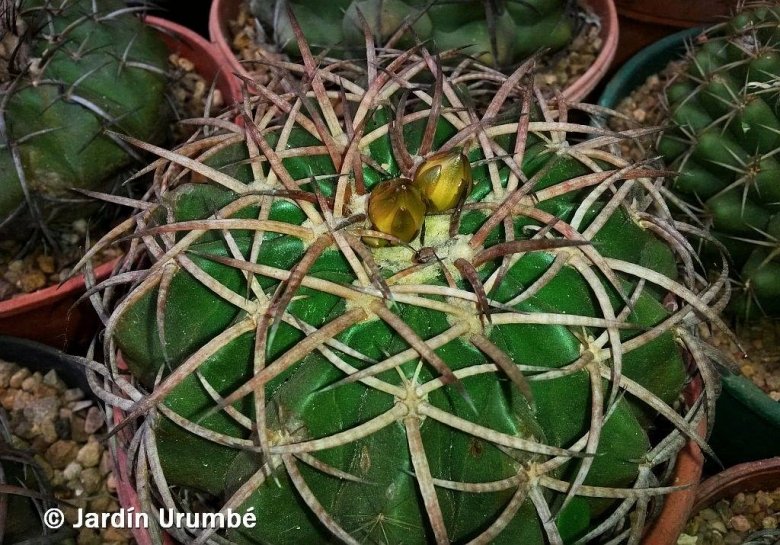
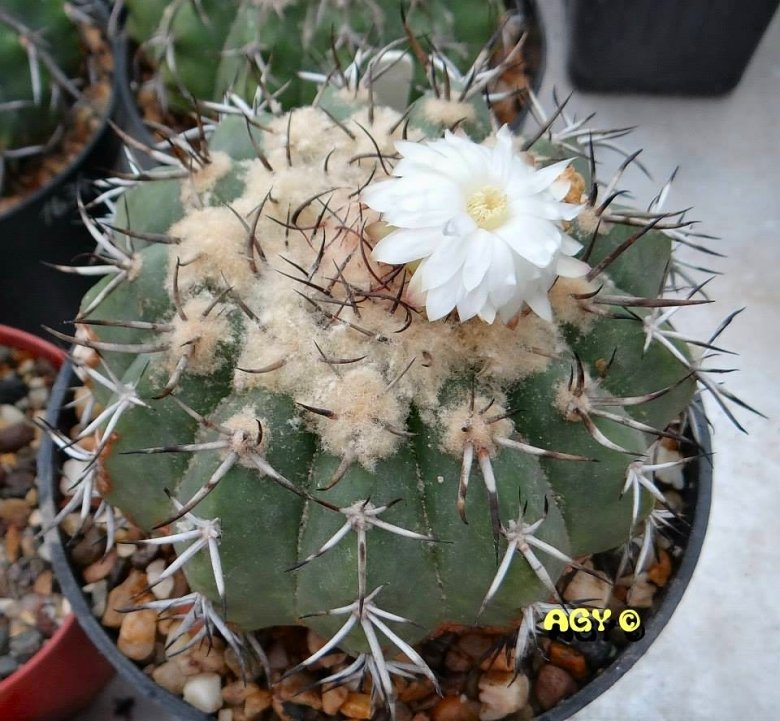
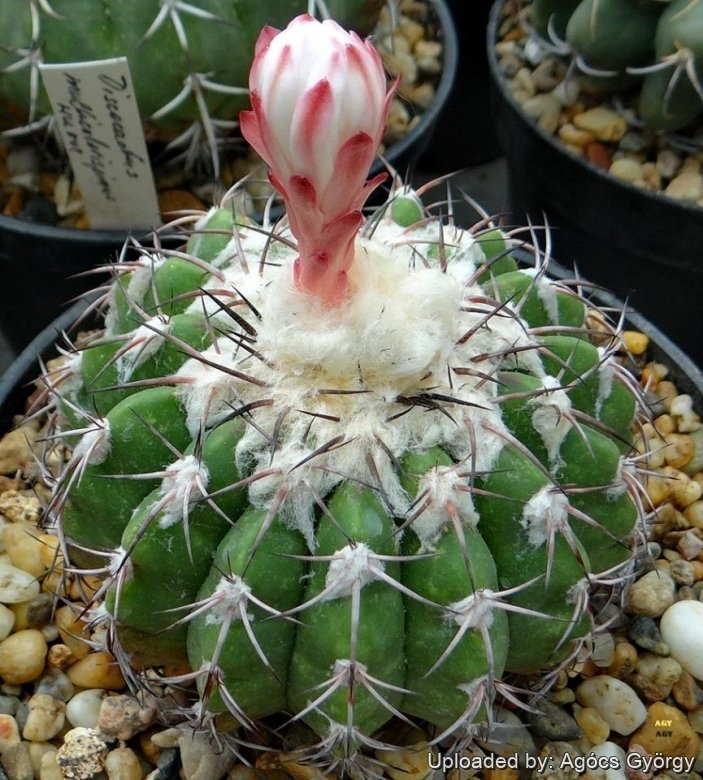
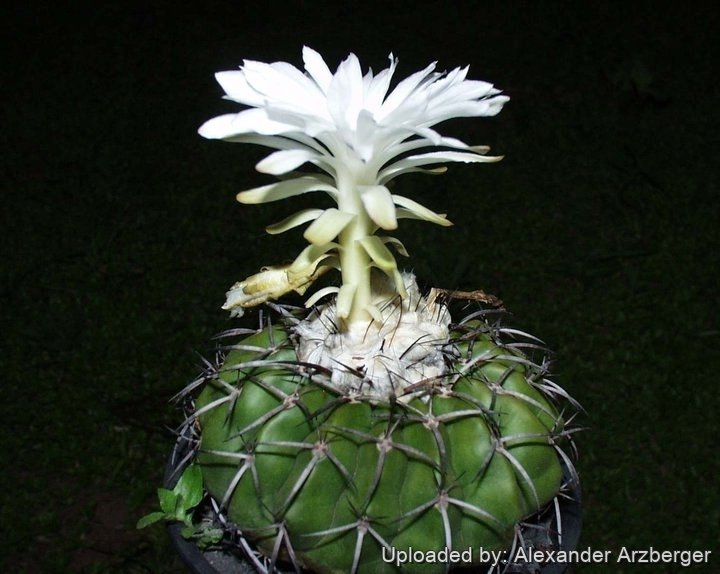
Discocactus placentiformis is a small flattish globular cactus from Brazil that flowers on warm summer nights. It is one of the most widely distributed and variable species with several unnecessary subspecies described.
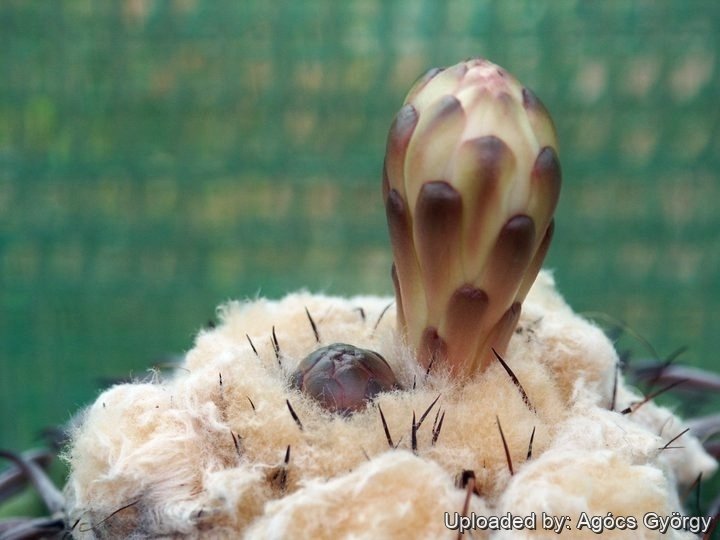
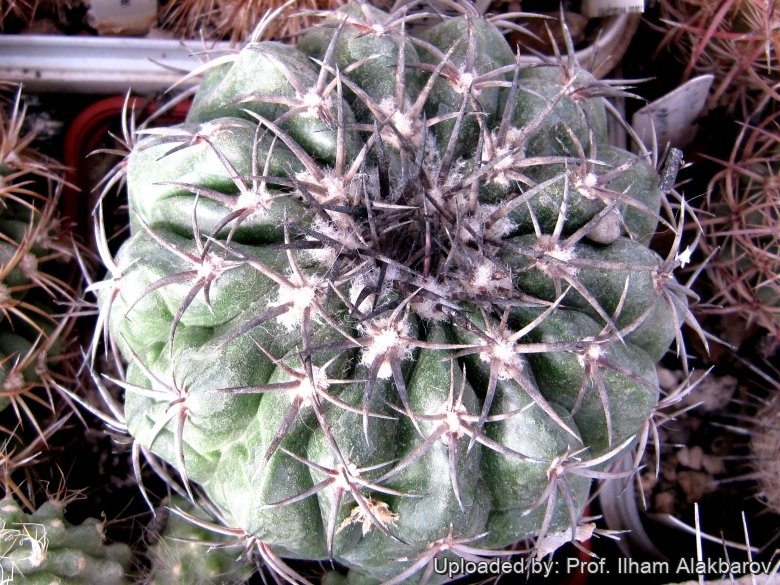
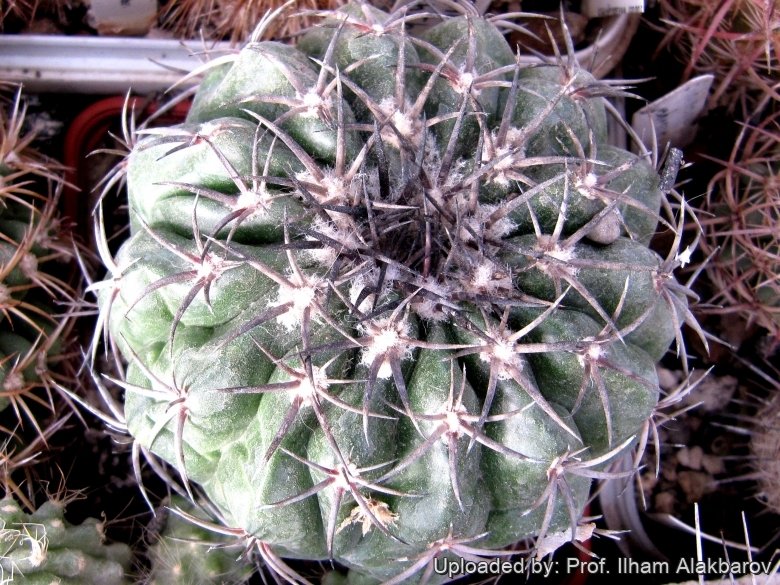
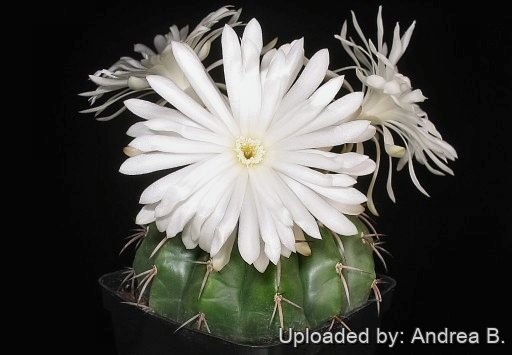
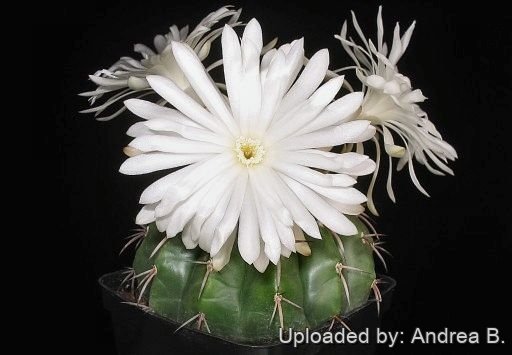
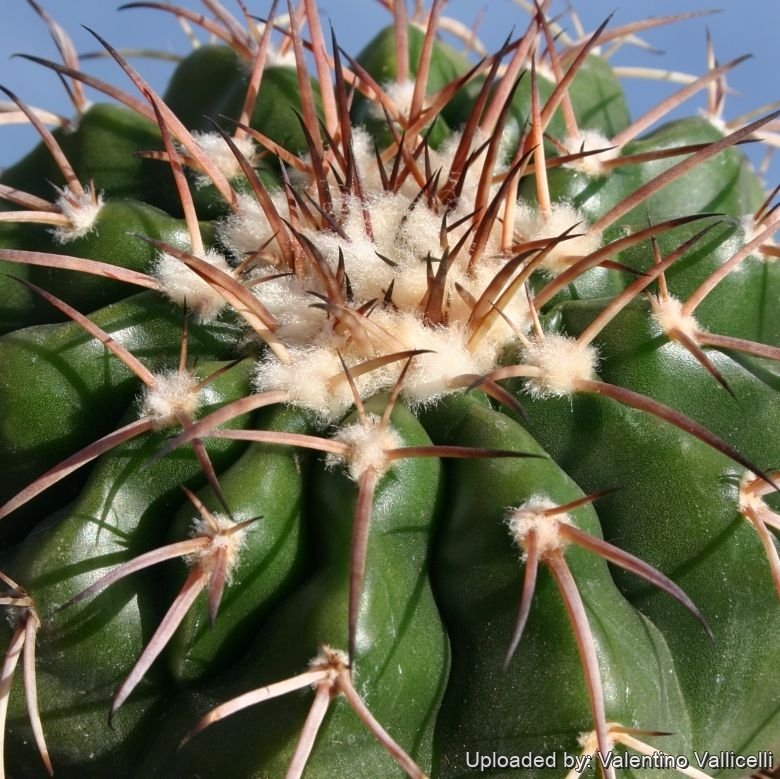
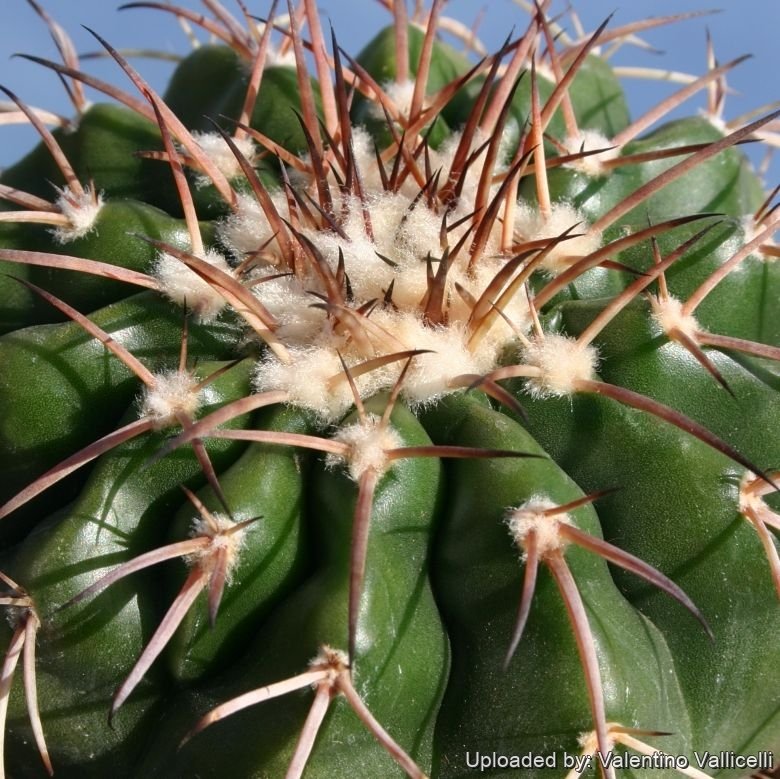
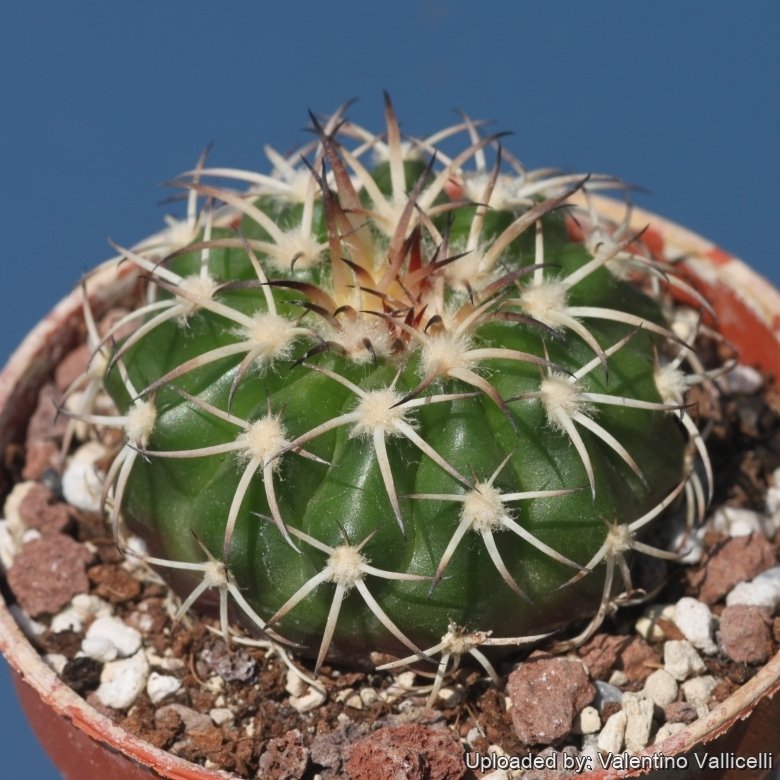
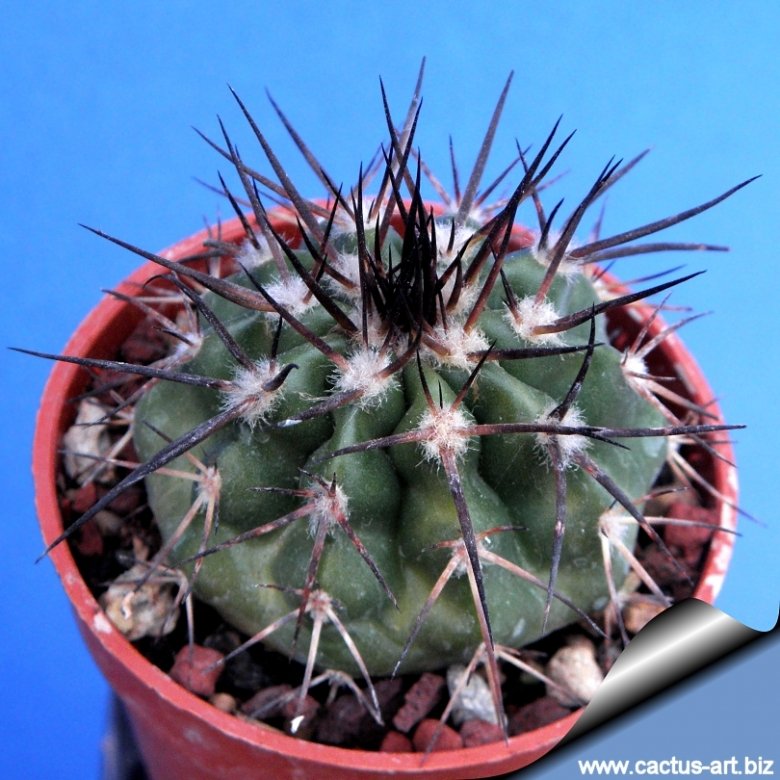
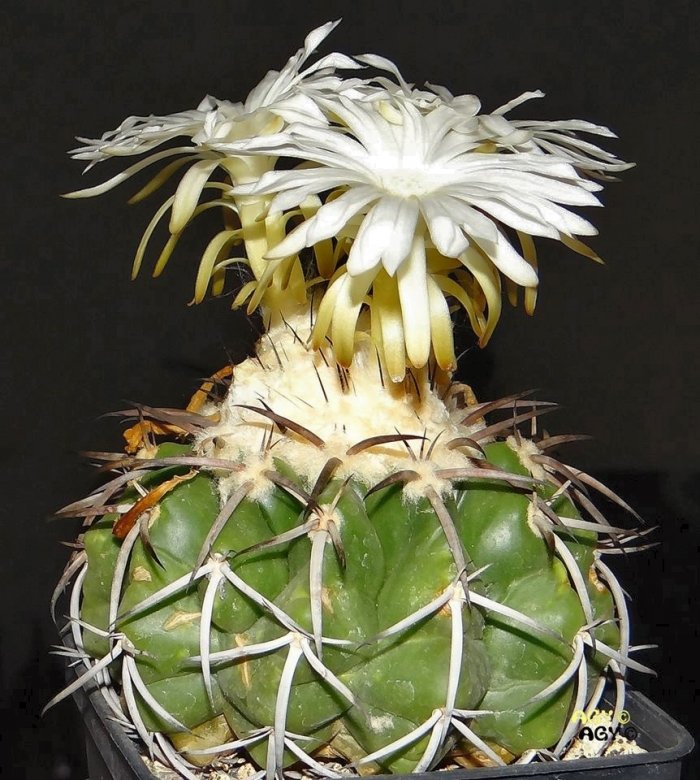
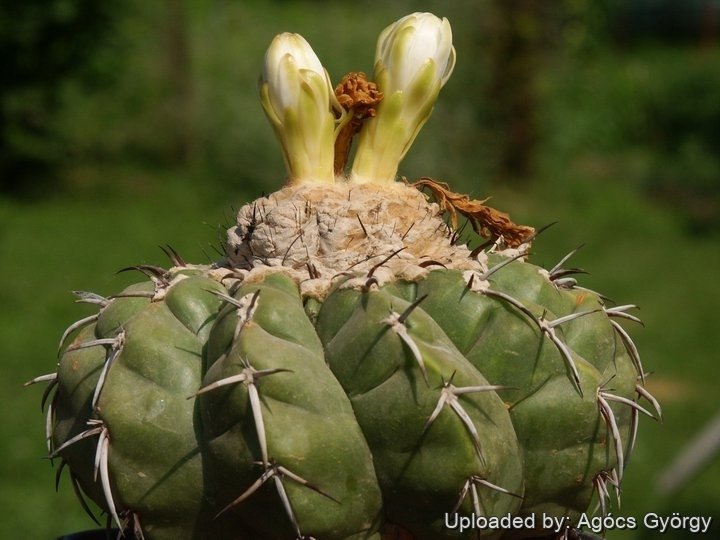
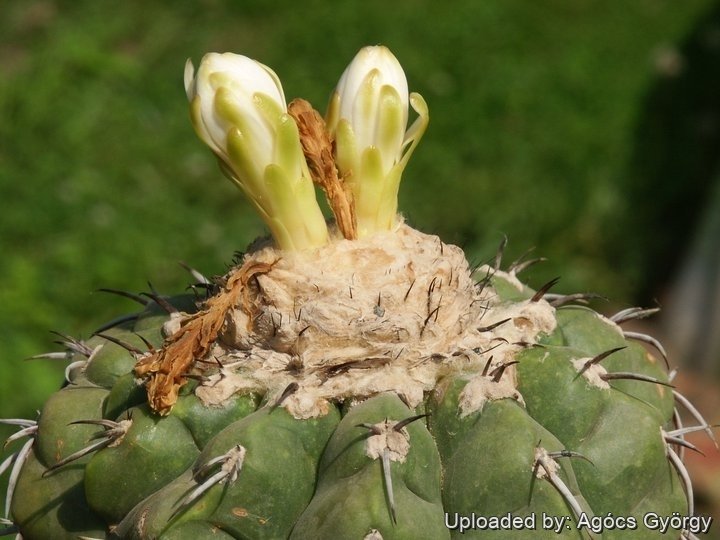
Stem: Low, flattened-globular, less than 10 cm tall (without cephalium about 3,5-8 cm), (6)-12-14(-22) cm in diameter light, dark or bluish green, with woolly cephalium.
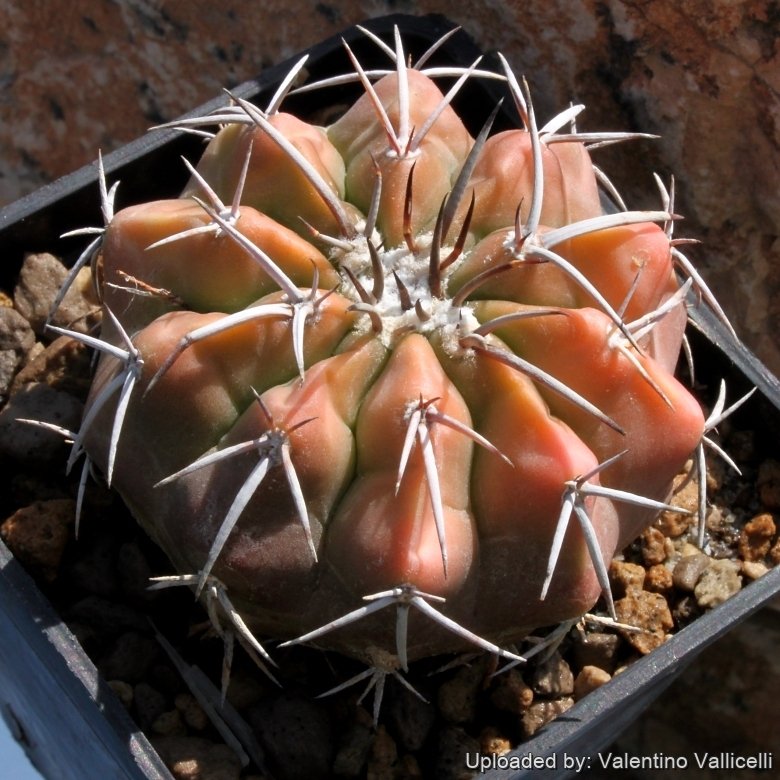
Ribs: mostly 10-16 low to acute up to 1,5 cm high, not or only slightly tuberculate, distinctly enlarged at the areoles and without acute sinuses between adjacent areoles on the same rib.
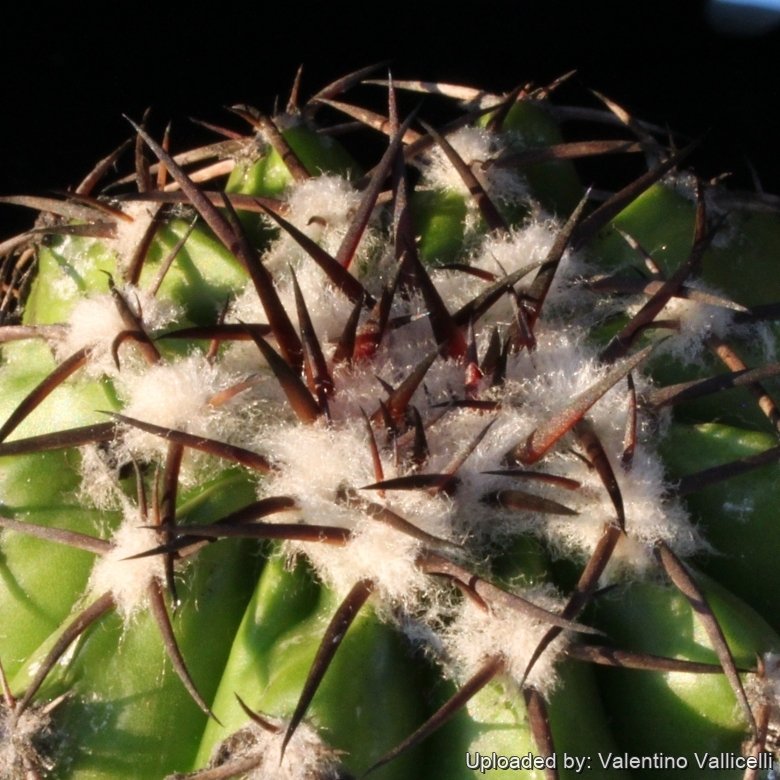
Areoles: Round to oval 5-8 on each rib on plants with cephalium.
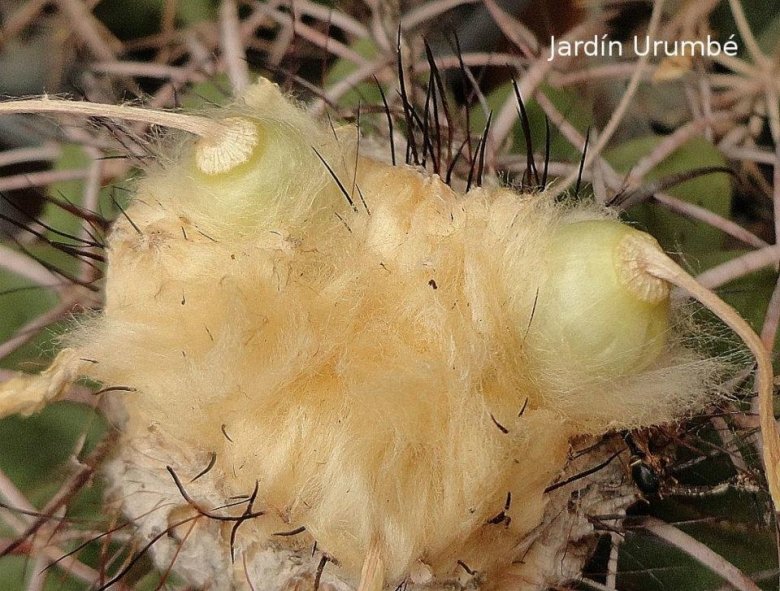
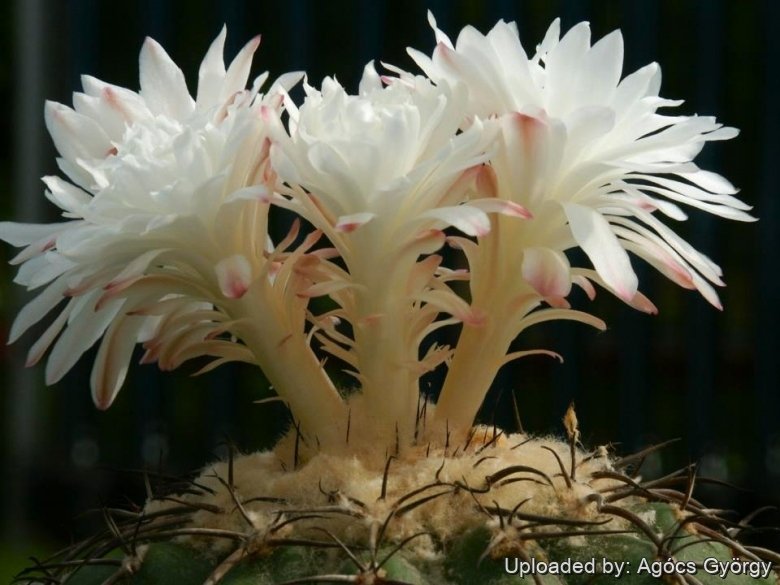
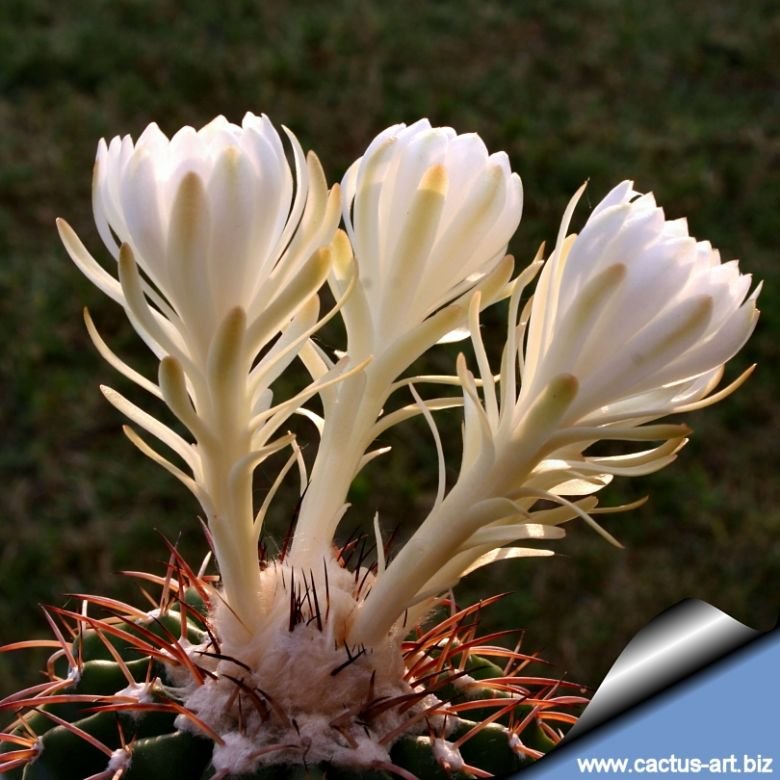
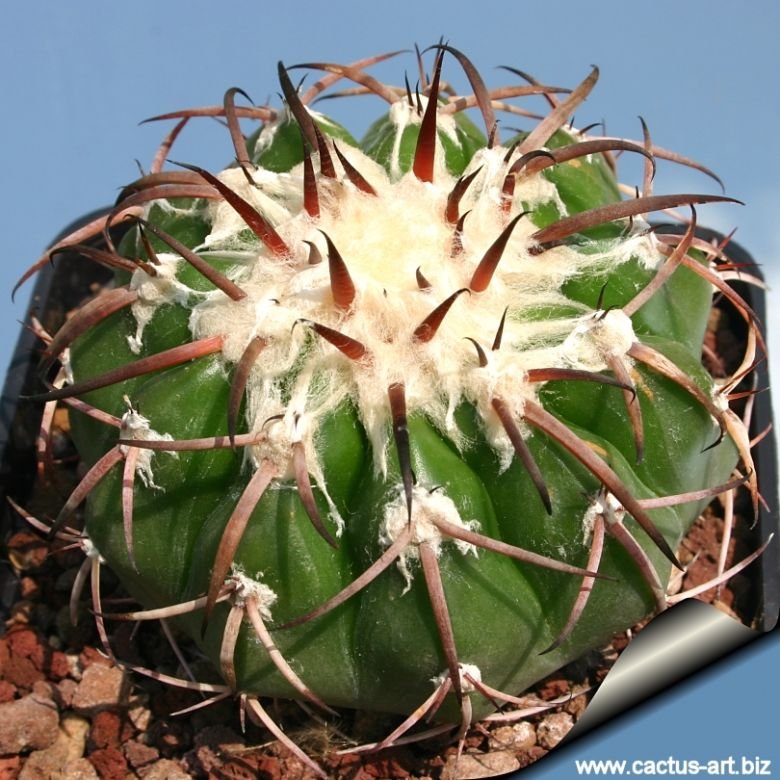
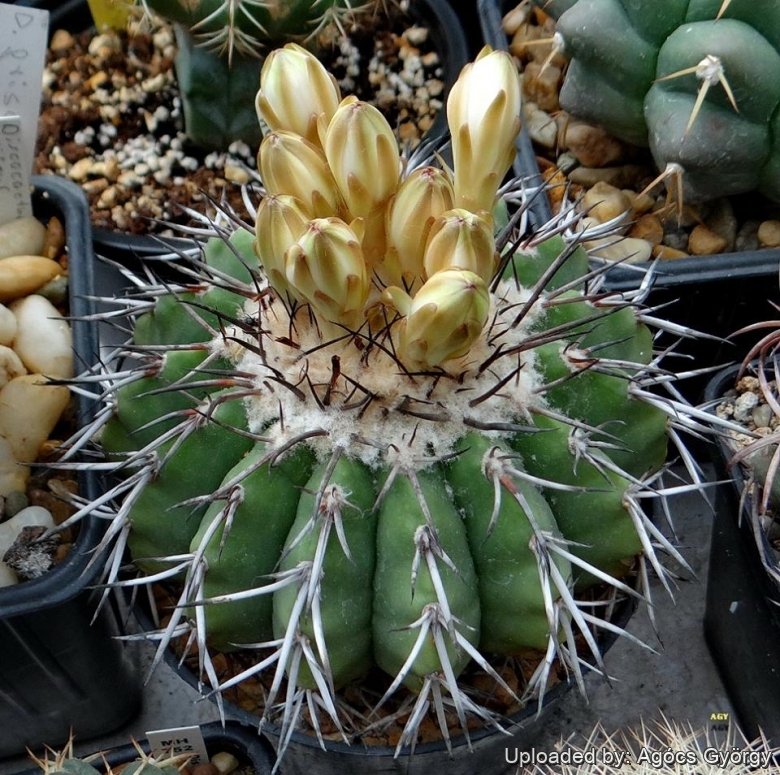
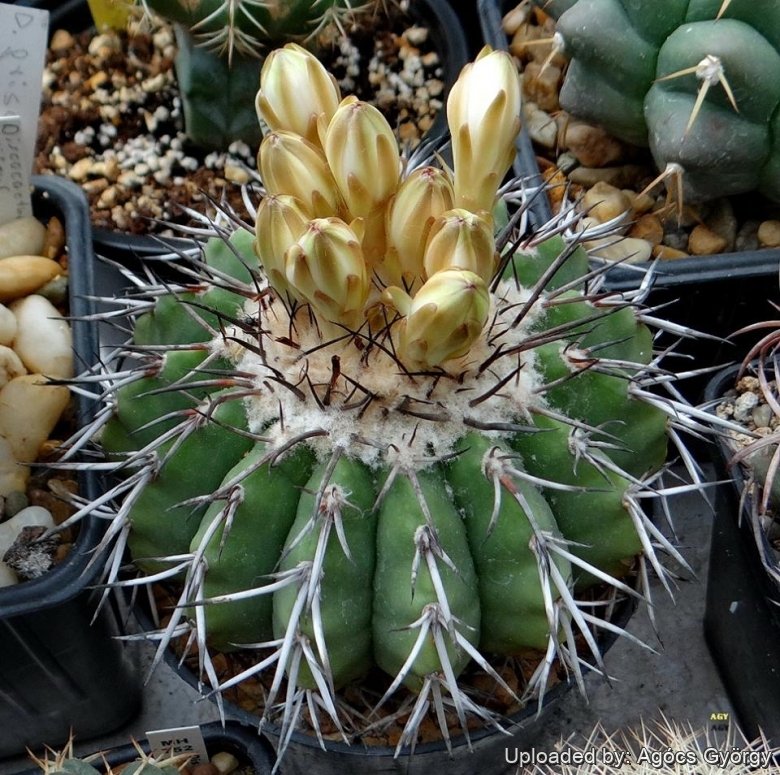
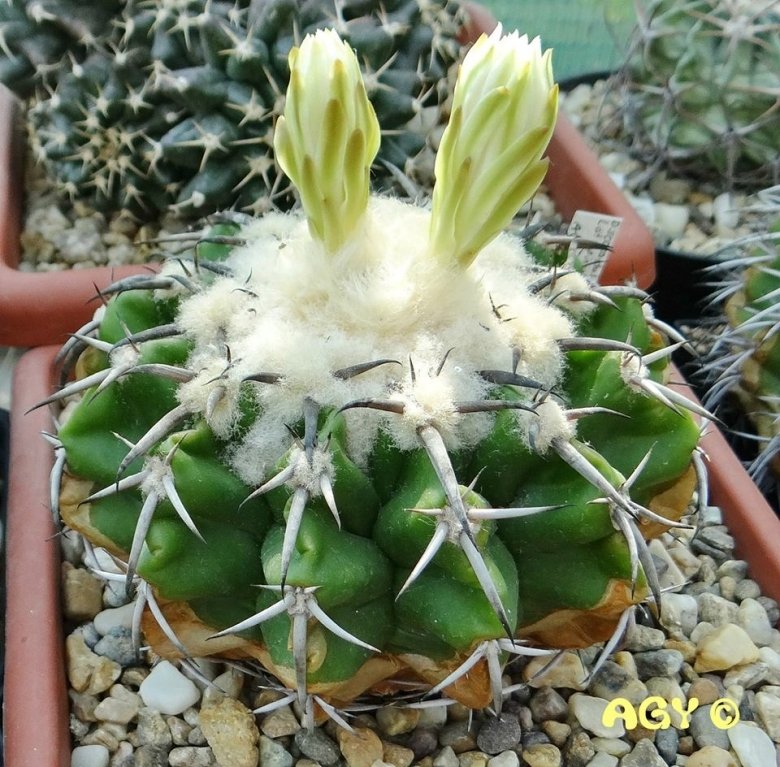
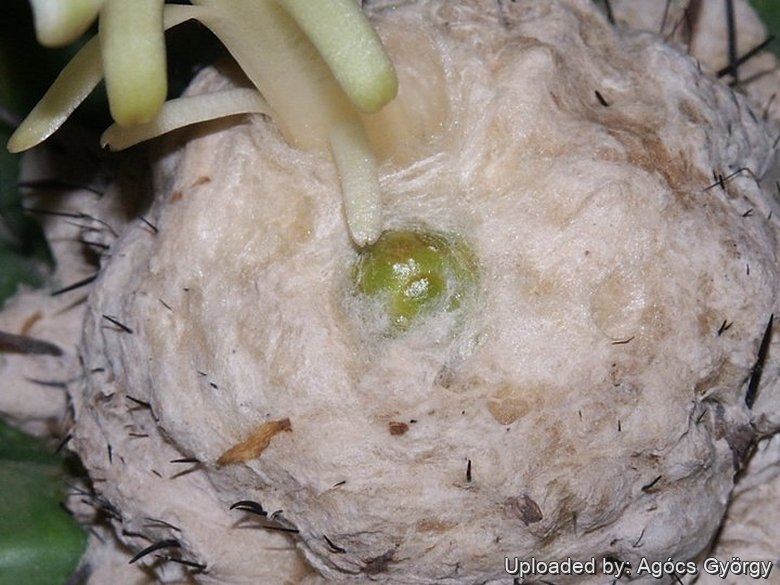
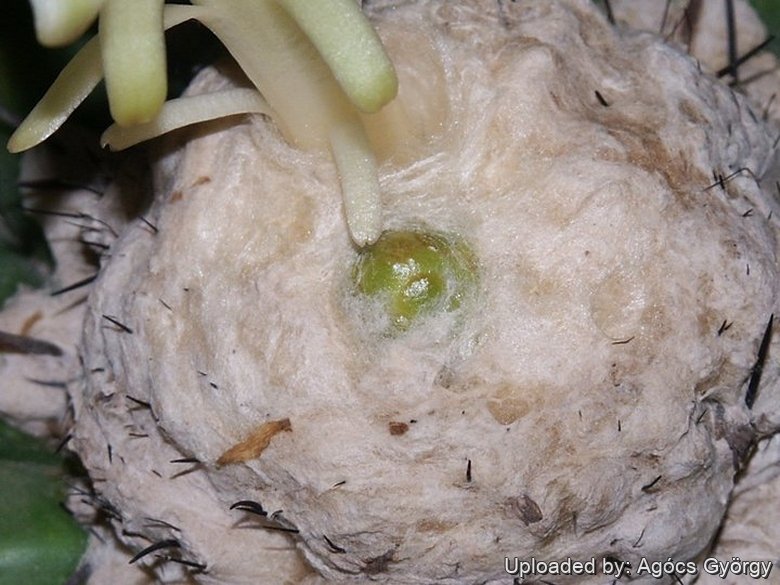
Cephalium: 3,5 cm tall, 4-6 cm in diameter, with cream-white, greyish-white or greyish-brown wool and black bristles 1,5-2,5 cm long.
Radial spines: 3-5(-9) conspicuous, pale gray, reddish, brown or blackish with a darker tip , becoming grey with age, 1-3 cm long and up to 2 mm thick, often flattened, clawlike, slightly recurved backwards to the plant, lateral spines longer and pointing downwards.
Central spine: In some plants one central spine appears, but is usually absent. It is erect, 1,5-2 cm long.
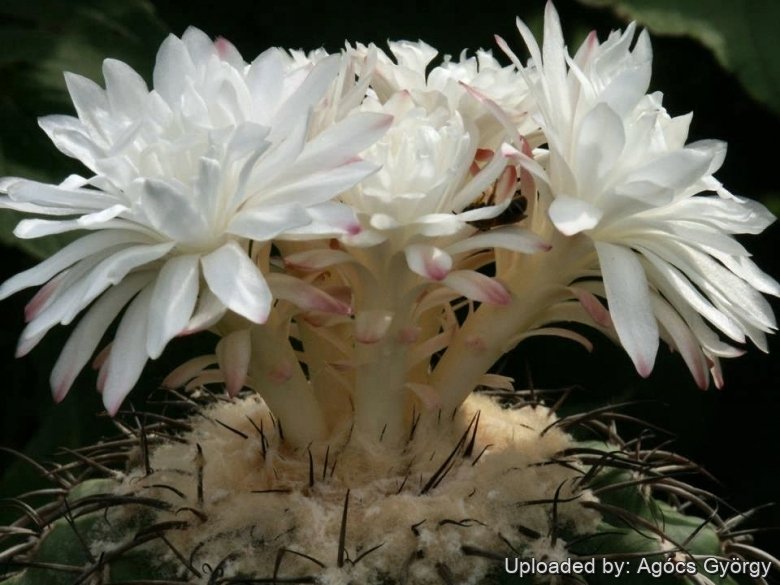
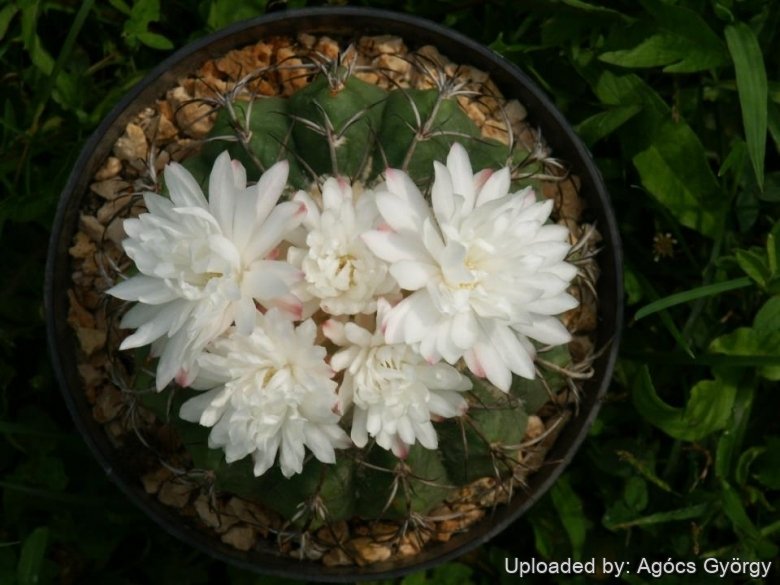
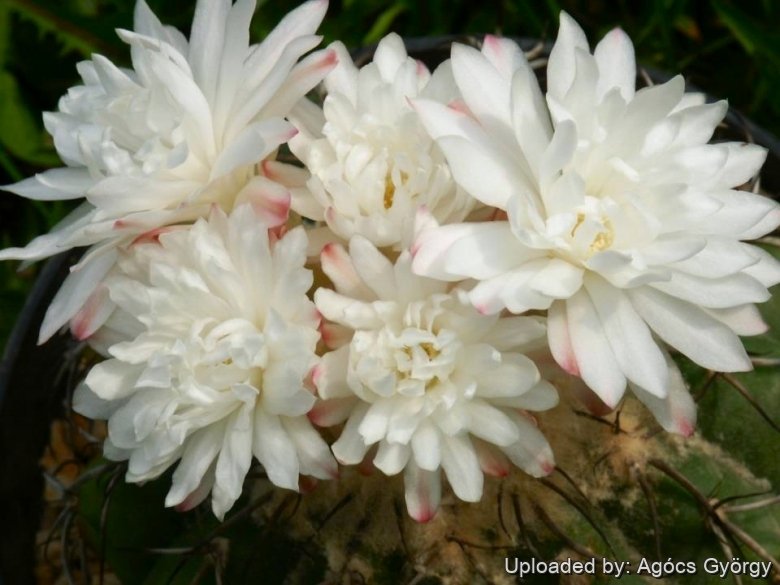
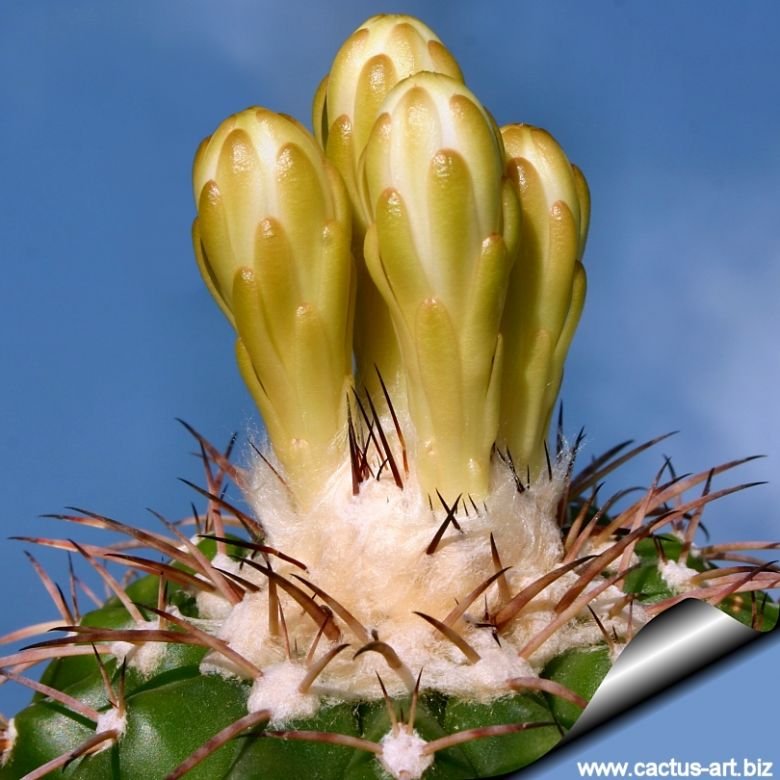
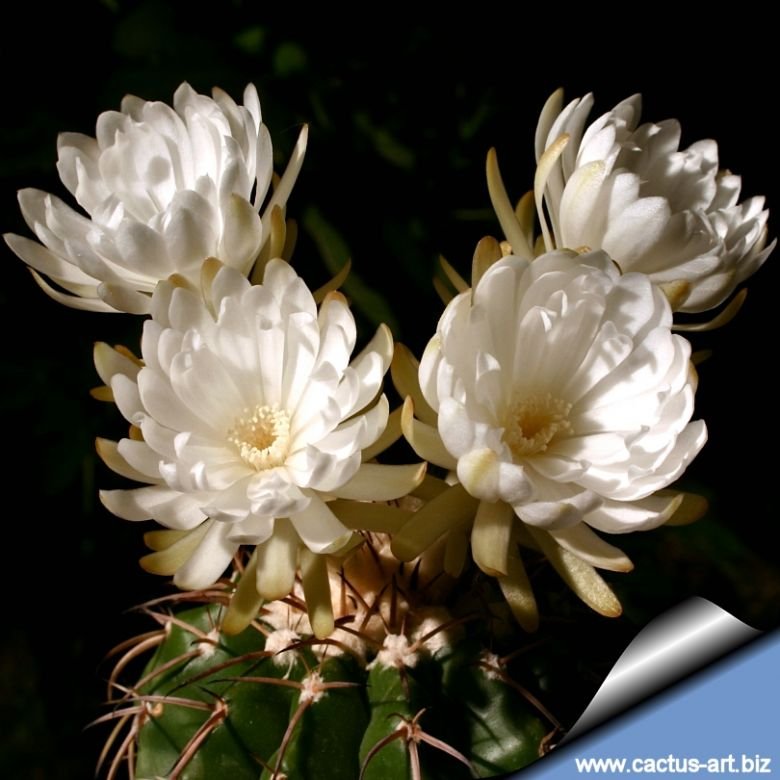
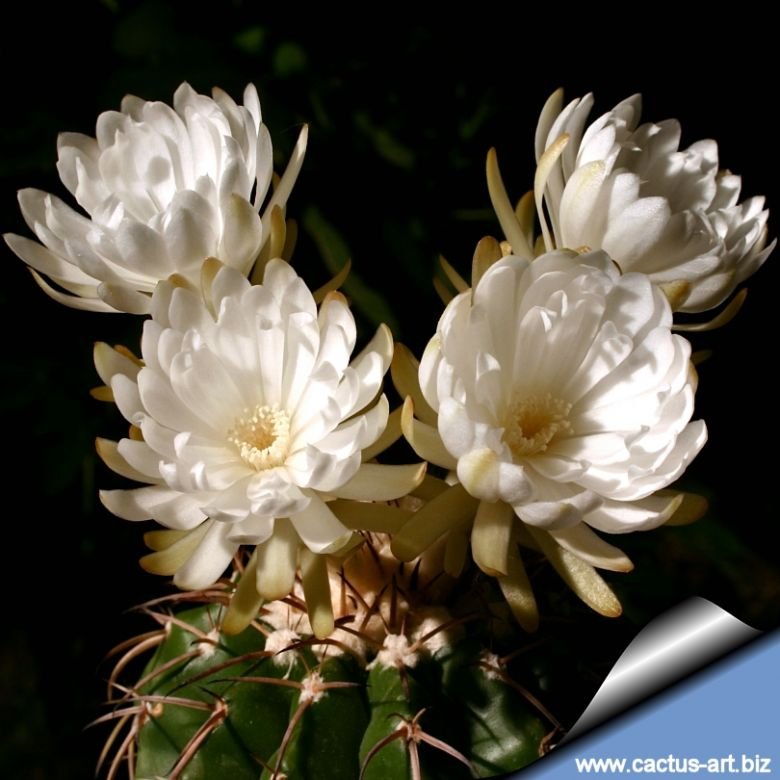
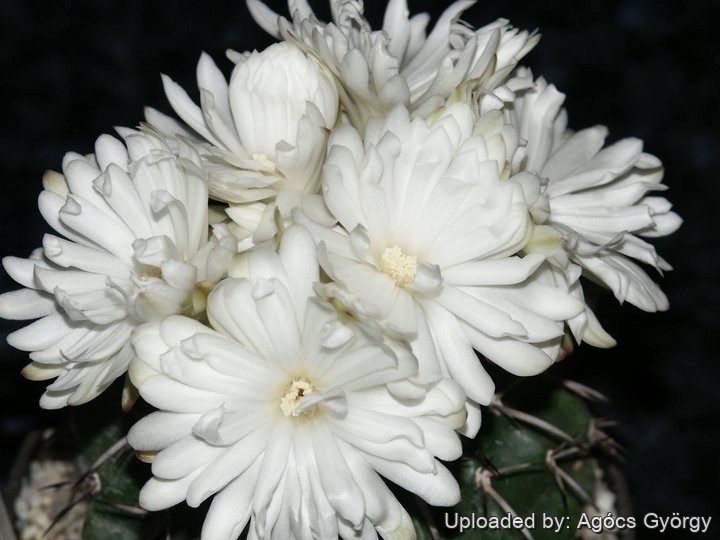
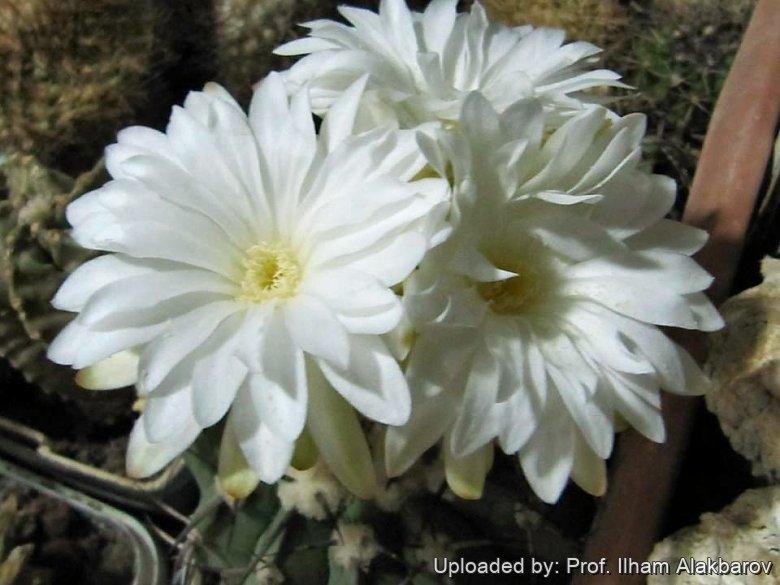
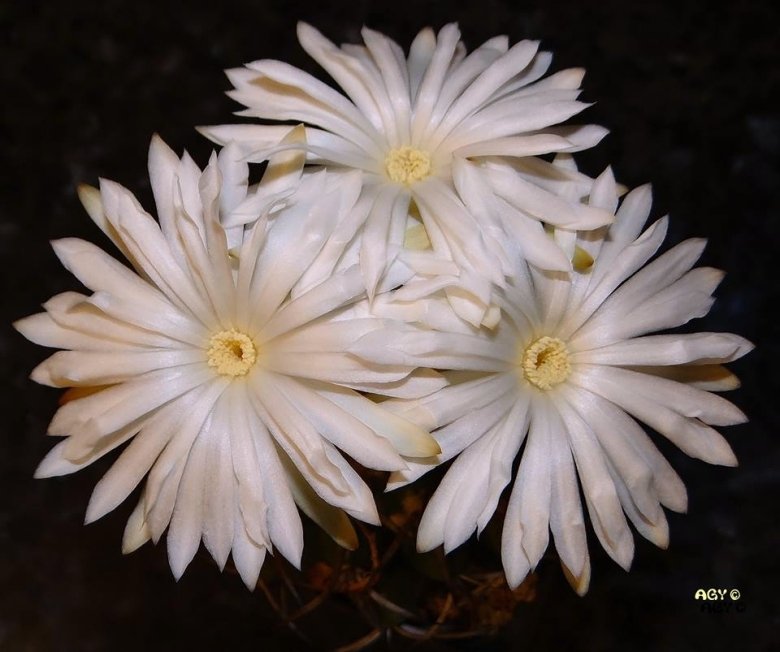
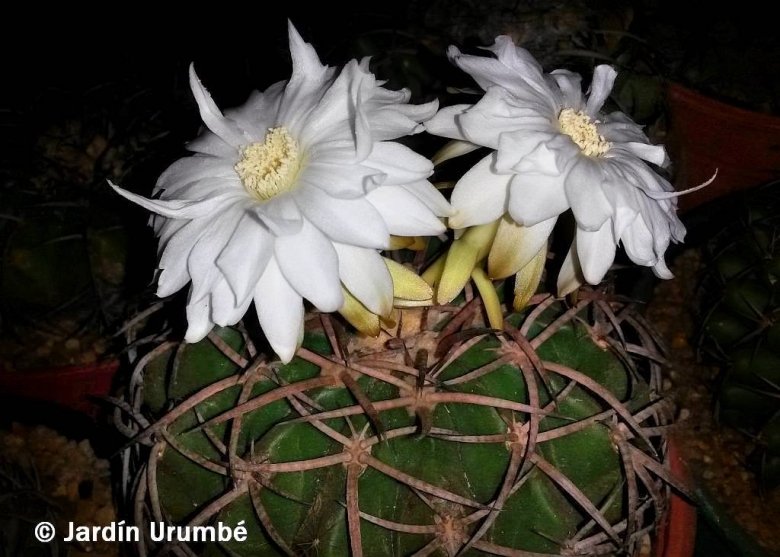
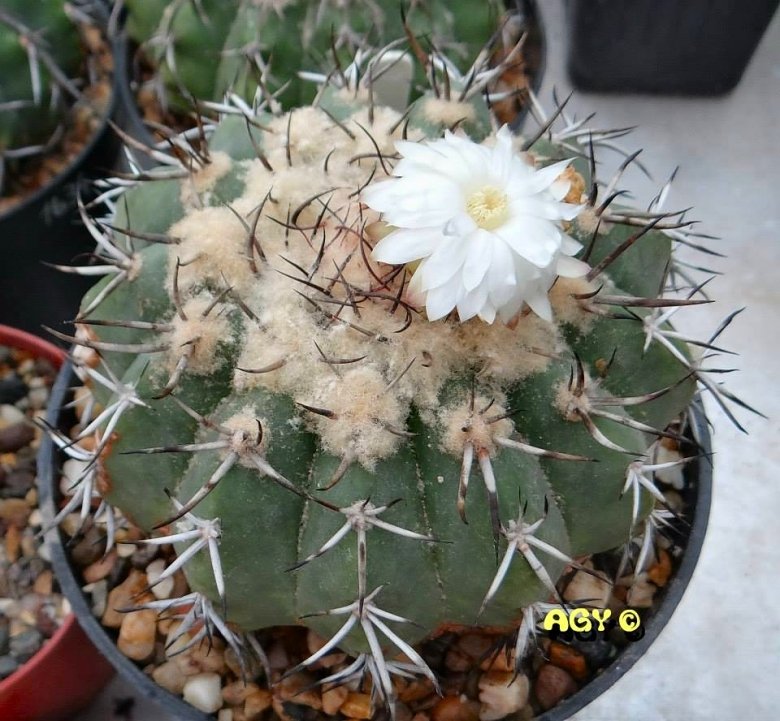
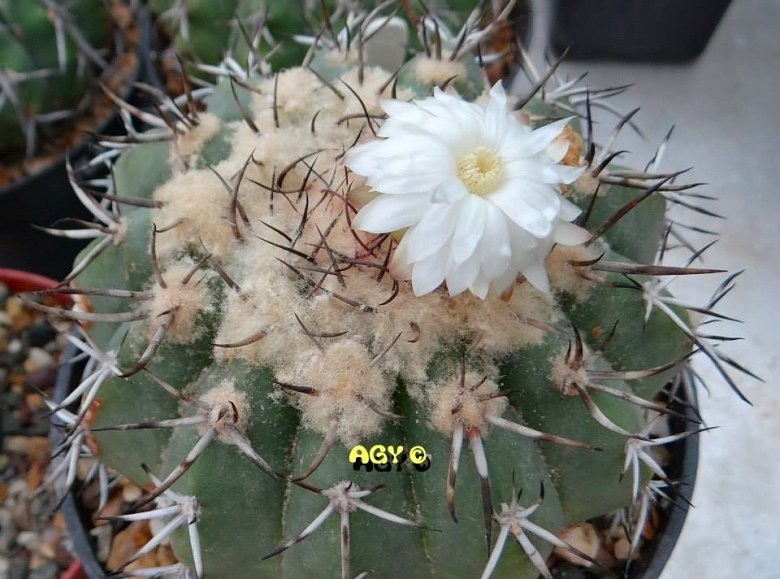
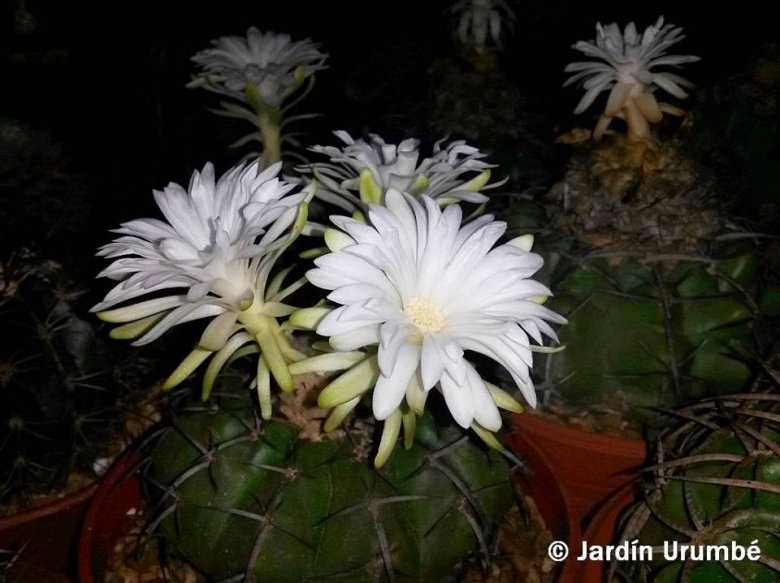
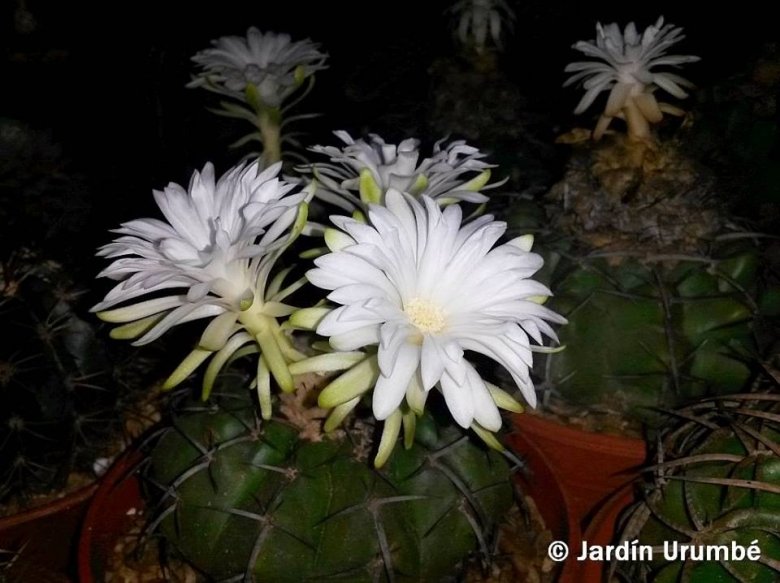
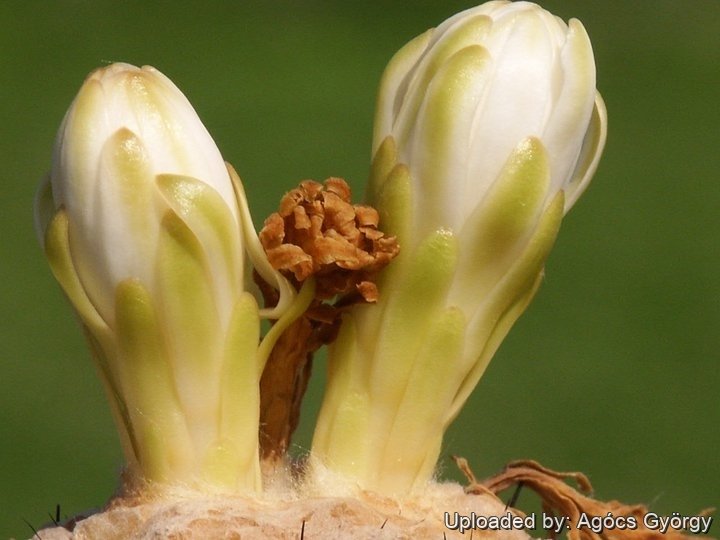
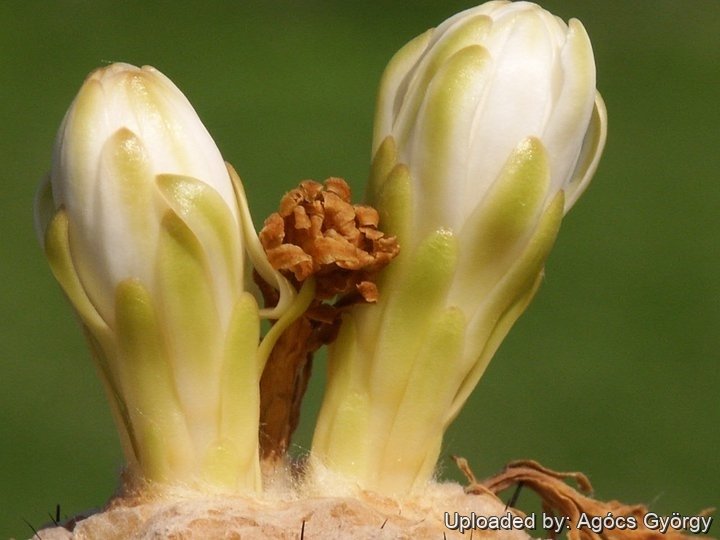
Flowers: Nocturnal lasting only a single night, and rapidly collapsing into mush the next morning, extremely fragrant, slender funnelform, up to to 7,5 cm long, white arising from the cephalium.
Blooming season: Summer, it needs a good exposure to with some sun to bloom , so it’s pretty rare to have blossoms when in cultivation in greenhouses. It is not unusual for this Melocactus to take 7 or more years before it starts blooming, but once it does, it should every year.
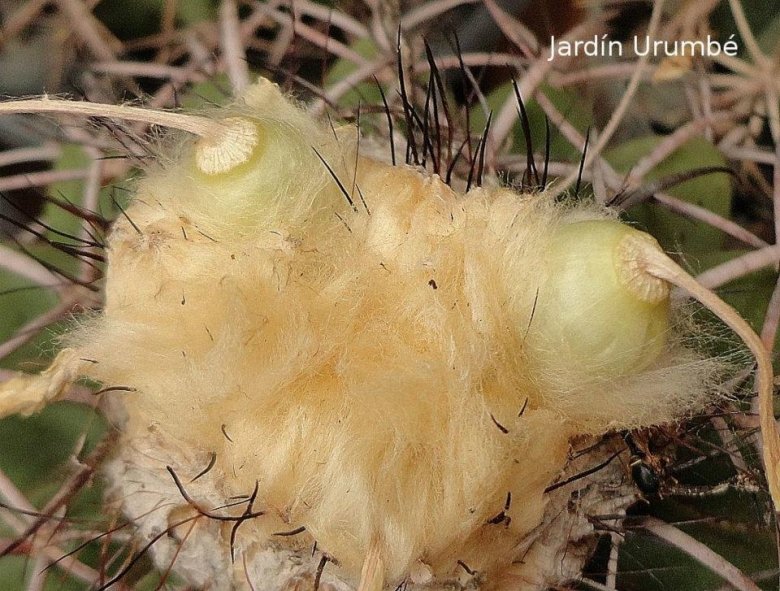
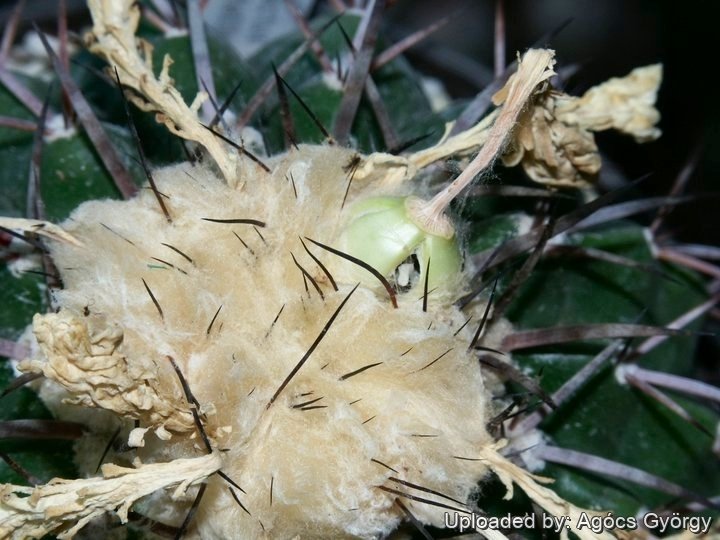
Fruit: Club shaped white or cream sometime with a pink tip, up to 3 cm long and 0,8 cm in diameter containing a few black seeds.
Origin and Habitat
North of Diamantina in Minas Gerais, Brasil, also further west near Vila Sopa and Barrao de Quacuy and adjacent areas.
Altitude: Altitude of 500 to 1000(-1350) metres above sea level.
Habitat: It grows in rocky soil, among rocks, grasses, often with Bromeliaceae or under low growing shrubs.
Cultivation and Propagation
Discocactus placentiformis is not the easiest plant to keep happy, so it isn’t a plants for beginners, in fact collectors consider the Discocactus to be rarities which requires skilful cultivation. Under glass, it isn’t difficult, but appreciates milder winter temperatures and more generous summer watering than most of the other genera of compact cacti. When grown to maturity, however, it possess an exotic look shared by no other cacti, and it generally attract a lot of attention.
Growing rate: It is slow growing.
Soil: It likes very porous standard cactus mix soil. Prefer a low pH compost, avoid substrata rich in limestone; otherwise growth will stop altogether.
Repotting: They generally resent being repotted and can take a long time to establish.
Fertilization: Feed with a high potassium fertilizer in summer.
Exposition: The plant tolerates bright situations but enjoys filtered sunlight or afternoon shade, inside it needs bright light, and some direct sun. Tends to bronze in strong light, which encourages flowering and heavy spine production.
Waterings: Discocacti are very rot prone when kept on their own roots and though they can’t endure long stretches of total dryness, too much water with cool will rot them, as their weak root systems tend to be inefficient at sucking up water from wet soil.
Hardiness: It is rather difficult to grow and frost tender, it can’t stand cold, or even fairly cool temperatures and should be kept at above 15° C if grown on its own roots (8°C if grafted).
Uses: It is an excellent plant for container growing. It always looks good and stays small.
Pests & diseases: It may be attractive to a variety of pests or diseases:
- Red spiders: Red spiders may be effectively rubbed up by watering the plants from above.
- Mealy bugs: Mealy bugs occasionally develop aerial into the new growth among the wool with disfiguring results, but the worst types develop underground on the roots and are invisible except by their effects.
- Scales: Scales are rarely a problem.
- Rot: Rot it is only a minor problem with cacti if the plants are watered and “aired” correctly. If they are not, fungicides won’t help all that much.
Propagation: Seeds or grafting. Seeds germinate in 7-14 days at 21-27° C in spring, remove gradually the glass cover as soon the plants will be well rooted (ca 1-2 weeks) and keep ventilated, no full sun for young plants! .Young seedlings are often grafted on a low stock to keep the plant in a good shape.
Bibliography
Major references and further lectures
-
Edward Anderson “The Cactus family” Timber Press, Incorporated, 2001
-
James Cullen, Sabina G. Knees, H. Suzanne Cubey “The European Garden Flora Flowering Plants: A Manual for the Identification of Plants Cultivated in Europe, Both Out-of-Doors and Under Glass” Cambridge University Press, 11/Aug/2011
-
David R Hunt; Nigel P Taylor; Graham Charles; International Cactaceae Systematics Group. “The New Cactus Lexicon” dh books, 2006
-
N. L. Britton, J. N. Rose “The Cactaceae. Descriptions and Illustrations of Plants of the Cactus Family.” Volume 4, The Carnegie Institution of Washington, Washington 1923
-
Urs Eggli, Leonard E. Newton “Etymological Dictionary of Succulent Plant Names” Birkhäuser 2004.
-
Clive Innes “Complete Handbook of Cacti and Succulents” Van Nostrand Reinhold Company, 01/Dec/1981
-
John Pilbeam “Cacti for the Connoisseur: A Guide for Growers & Collectors” Timber Press, 01/Jul/1987
-
Engler, Prantl: “Natürlichen Pflanzenfamilien” Volume 3, 6a, 1894, page. 190.
-
Pierre Josef Braun, Eddie Esteves Pereira “Aggregationen in Discocactus Pfeiffer (Cactaceae).” In: Kakteen und andere Sukkulenten. Volume 44, 1993, page. 62, page. 103, page. 112.
From llifle page Discocactus crystallophilus
Description
Discocactus crystallophilus is one of geographical or morphological forms of Discocactus placentiformis which is one of the most widespread and morphologically variable taxon. It is a solitary, flattened globose cactus that form a white cephalium at maturity. The names Discocactus crystallophilus is not accepted by many botanists that treat it as synonym, but it still has a value for a collector because they identify plants with particular characters.
Stem: Shaped like a cake up to 6 cm tall (8-9 cm with cephalium), 15 cm in diameter. The epidermis is light green to brownish-green.
Areoles: About 4-6 per ribs in plants with cephalium, round.
Spines: (3)5-7 (or more) brown-reddish to pale gray, slightly recurved backwards, lateral ones up to 2 cm long, lowermost one pointing downward up to 3 cm long. Uppermost spines (if present) shorter about 5 mm long.
Cephalia: Whitish.
Flowers: Nocturnal, very fragrant up to 7-8 cm long, 6 cm in diameter. Stigma about at anthers level.
Blooming season: Flowers come in profusion in summer, out of the cephalium.
Fruits: White or pale greenish-white.
Origin and Habitat
Brazil (Minas Gerais)
Altitude range: Altitude around 700 metres above sea level.
Habitat: This cactus grows in rocky soil, among grasses, in the shade of trees. It grows often in association with Bromeliaceae.
Cultivation and Propagation
Collectors consider this cactus genus from South America to be rarities as they are not the easiest plant to keep happy. it is rather difficult to grow and frost tender, should be kept at above 15° C if grown on its own roots (8°C if grafted) need full sun or afternoon shade. Young seedlings are generally grafted because they are slow growing and very rot prone when kept on their own roots and though they can’t endure long stretches of total dryness, too much water will rot them, as their weak root systems tend to be inefficient at sucking up water from wet soil. They generally resent being repotted and can take a long time to establish.
Propagation: Seed. Young seedlings are often grafted on a low stock to keep the plant in a good shape.
Notes
The species name is sometime misspelled: “cristallophylus”, “crystallophylus” or “cristallophilus” .
Bibliography
Major references and further lectures
-
L.Diers and E.Esteves K.u.a.S. 1981 page 258-262
-
James Cullen, Sabina G. Knees, H. Suzanne Cubey “The European Garden Flora Flowering Plants: A Manual for the Identification of Plants Cultivated in Europe, Both Out-of-Doors and Under Glass” Cambridge University Press, 11/Aug/2011
-
David R Hunt; Nigel P Taylor; Graham Charles; International Cactaceae Systematics Group. “The New Cactus Lexicon” dh books, 2006
-
N. L. Britton, J. N. Rose “The Cactaceae. Descriptions and Illustrations of Plants of the Cactus Family.” Volume 4, The Carnegie Institution of Washington, Washington 192
-
Edward Anderson “The Cactus family” Timber Press, Incorporated, 2001
-
Clive Innes “Complete Handbook of Cacti and Succulents” Van Nostrand Reinhold Company, 01/Dec/1981
-
John Pilbeam “Cacti for the Connoisseur: A Guide for Growers & Collectors” Timber Press, 01/Jul/1987
Source: Discocactus crystallophilus, LLIFLE - Encyclopedia of living forms, CC-BY-SA, retrieved 2026-10-25.
From llifle page Discocactus insignis
Description
Discocactus insignis is one of the several morphogical or local forms of the very variable Discocactus placentiformis and now fully synonymized with the latter. This plant looks similar to the other “placentiformis”, but with 5 to 7 spines of which the lowest one more long and recurved backwards to the plant. All the other characteristics show that they are congeneric, namely size and form of tubercles, flowers and fruits and the two plants are not readily distinguishable, if not for the geographical provenance. Discocactus latispinus blooms on warm summer nights. Its fragrant flowers are pollinated by moths.
Stem: Low, flattened-globular, less than 10 cm tall (without cephalium about 3,5-8 cm), about 14 cm in diameter, epidermis is dark green, with woolly cephalium.
Ribs: About 14, sharp up to 1,5 cm high, not or only slightly tuberculate, distinctly enlarged at the areoles and without acute sinuses between adjacent areoles on the same rib.
Areoles: Oval about 9 on each rib on plants with cephalium.
Cephalium: Up to 8 cm tall , 4-6 cm in diameter, with cream-white wool.
Radial spines: 5 to 7, grey with a black tip, becoming grey with age, about 6 mm long (upwards ones) and 16 mm long (downwards ones) and up to 2 mm thick, the lateral almost straight while the lowest pointing downwards, clawlike and recurved backwards to the plant.
Central spine: In some plants one central spine appears, but is usually absent. It is erect, 1,5-2 cm long.
Flowers: Nocturnal lasting only a single night, and rapidly collapsing into mush the next morning, extremely fragrant, slender funnelform, up to to 7,5 cm long, white arising from the cephalium. The position of the stigma is 3/4 up the secondary stamens.
Blooming season: Summer, it needs a good exposure to with some sun to bloom , so it’s pretty rare to have blossoms when in cultivation in greenhouses. It is not unusual for this Melocactus to take 7 or more years before it starts blooming, but once it does, it should every year.
Fruit: Club shaped pink/white, up to 3 cm long and 0,8 cm in diameter containing a few black seeds.
Origin and Habitat
Discocactus insignis occurs intermittently over a small area in the neighbourhood of Grao Mogol, Minas Gerais, Brazil.
Altitude range: 700-1000 metres above sea level.
Habitat and ecology: Plants grow mostly in pure quartzite sand and gravel down hill of the habitat of Discocactus horstii among shrubs like thorny Acacias and various kinds of small trees.
Cultivation and Propagation
Discocactus insignis (Discocactus placentiformis) is not the easiest plant to keep happy, so it isn’t a plants for beginners, in fact collectors consider the Discocactus to be rarities which requires skilful cultivation. Under glass, it isn’t difficult, but appreciates milder winter temperatures and more generous summer watering than most of the other genera of compact cacti. When grown to maturity, however, it possess an exotic look shared by no other cacti, and it generally attract a lot of attention.
Growing rate: It is slow growing. Seedlings up to one year grow very slowly. When the plants are older there are no problems in cultivation.
Soil: It likes very porous standard cactus mix soil. Prefer a low pH compost, avoid substrata rich in limestone; otherwise growth will stop altogether.
Repotting: They generally resent being repotted and can take a long time to establish.
Fertilization: Feed with a high potassium fertilizer in summer.
Exposition: The plant tolerates bright situations but enjoys filtered sunlight or afternoon shade, inside it needs bright light, and some direct sun. Tends to bronze in strong light, which encourages flowering and heavy spine production.
Waterings: Discocacti are very rot prone when kept on their own roots and though they can’t endure long stretches of total dryness, too much water with cool will rot them, as their weak root systems tend to be inefficient at sucking up water from wet soil.
Hardiness: It is rather difficult to grow and frost tender, it can’t stand cold, or even fairly cool temperatures and should be kept at above 15° C if grown on its own roots (8°C if grafted).
Uses: It is an excellent plant for container growing. It always looks good and stays small.
Pests & diseases: It may be attractive to a variety of pests or diseases:
- Red spiders: Red spiders may be effectively rubbed up by watering the plants from above.
- Mealy bugs: Mealy bugs occasionally develop aerial into the new growth among the wool with disfiguring results, but the worst types develop underground on the roots and are invisible except by their effects.
- Scales: Scales are rarely a problem.
- Rot: Rot it is only a minor problem with cacti if the plants are watered and “aired” correctly. If they are not, fungicides won’t help all that much.
Propagation: Seeds or grafting. Seeds germinate in 7-14 days at 21-27° C in spring, remove gradually the glass cover as soon the plants will be well rooted (ca 1-2 weeks) and keep ventilated, no full sun for young plants! Seedlings up to one year growth very slowly. When the plants are older there are no problems in cultivation. Young seedlings are often grafted on a low stock to keep the plant in a good shape.
Bibliography
Major references and further lectures
-
Edward Anderson “The Cactus family” Timber Press, Incorporated, 2001
-
James Cullen, Sabina G. Knees, H. Suzanne Cubey “The European Garden Flora Flowering Plants: A Manual for the Identification of Plants Cultivated in Europe, Both Out-of-Doors and Under Glass” Cambridge University Press, 11/August /2011
-
David R Hunt; Nigel P Taylor; Graham Charles; International Cactaceae Systematics Group. “The New Cactus Lexicon” dh books, 2006
-
Edgar Lamb, Brian Lamb “The Illustrated Reference on Cacti & Other Succulents” Volume 5 Blandford Press, 1978
-
Venlo “Discocactus” page 78-89 1980
-
Piet van der Laken “Discocactus insignis HU347” Discocactus South American Jewels. <http://www.discocactus.nl/Engels/speciesE/insignisE.htm\> Web. 20 Dec. 2014.
Source: Discocactus insignis, LLIFLE - Encyclopedia of living forms, CC-BY-SA, retrieved 2026-10-25.
From llifle page Discocactus latispinus
Description
Discocactus latispinus is one of the several local forms of the very variable Discocactus placentiformis. This plant can look similar to the other “placentiformis”, but with 5 spines of which the lowest one more long and characteristically flattened. All the other characteristics show that they are congeneric, namely size and form of tubercles, flowers and fruits. Discocactus latispinus blooms on warm summer nights. Its fragrant flowers are pollinated by moths.
Stem: Low, flattened-globular, less than 7 cm tall (without cephalium) and about 10-12 cm in diameter light to dark green, with woolly cephalium.
Ribs: mostly 13-15 low to acute up to 1,5 cm high, not or only slightly tuberculate, distinctly enlarged at the areoles and without acute sinuses between adjacent areoles on the same rib.
Areoles: Round to oval 5-8 on each rib on plants with cephalium.
Cephalium: 3,5 cm tall, 4-6 cm in diameter, with cream-white to greyish-white wool and black bristles 1,5-2.5 cm long.
Radial spines: 5(-6) conspicuous, pale grey to brown/black with darker tips, becoming grey with age, slightly recurved backwards, of which 2(-3) pointing upwards about 5 mm long, 2 lateral pointing dowmward about 1,5 cm long, and 1 lower spine up to 2,5 cm long, clawlike, somewat fleattened and up to 2 mm thick.
Central spine: Usually absent.
Flowers: Nocturnal lasting only a single night, and rapidly collapsing into mush the next morning, extremely fragrant, slender funnelform, up to to 7,5 cm long, white arising from the cephalium.
Blooming season: Summer, it needs a good exposure to with some sun to bloom , so it’s pretty rare to have blossoms when in cultivation in greenhouses. It is not unusual for this Melocactus to take 7 or more years before it starts blooming, but once it does, it should every year.
Fruit: Club shaped white or cream sometime with a pink tip, up to 3 cm long and 0,8 cm in diameter containing a few black seeds.
Origin and Habitat
Joaquim Felicio and adjacent areas, Minas Gerais, Brazil.
altitude: 500-700 metres above sea level.
Habitat: It grows among rocks and grasses often under low growing shrubs.
Cultivation and Propagation
Discocactus latispinus is not the easiest plant to keep happy, so it isn’t a plants for beginners, in fact collectors consider the Discocactus to be rarities which requires skilful cultivation. Under glass, it isn’t difficult, but appreciates milder winter temperatures and more generous summer watering than most of the other genera of compact cacti. When grown to maturity, however, it possess an exotic look shared by no other cacti, and it generally attract a lot of attention.
Growing rate: It is slow growing.
Soil: It likes very porous standard cactus mix soil. Prefer a low pH compost, avoid substrata rich in limestone; otherwise growth will stop altogether.
Repotting: They generally resent being repotted and can take a long time to establish.
Fertilization: Feed with a high potassium fertilizer in summer.
Exposition: The plant tolerates bright situations but enjoys filtered sunlight or afternoon shade, inside it needs bright light, and some direct sun. Tends to bronze in strong light, which encourages flowering and heavy spine production.
Waterings: Discocacti are very rot prone when kept on their own roots and though they can’t endure long stretches of total dryness, too much water with cool will rot them, as their weak root systems tend to be inefficient at sucking up water from wet soil.
Hardiness: It is rather difficult to grow and frost tender, it can’t stand cold, or even fairly cool temperatures and should be kept at above 15° C if grown on its own roots (8°C if grafted).
Uses: It is an excellent plant for container growing. It always looks good and stays small.
Pests & diseases: It may be attractive to a variety of pests or diseases:
- Red spiders: Red spiders may be effectively rubbed up by watering the plants from above.
- Mealy bugs: Mealy bugs occasionally develop aerial into the new growth among the wool with disfiguring results, but the worst types develop underground on the roots and are invisible except by their effects.
- Scales: Scales are rarely a problem.
- Rot: Rot it is only a minor problem with cacti if the plants are watered and “aired” correctly. If they are not, fungicides won’t help all that much.
Propagation: Seeds or grafting. Seeds germinate in 7-14 days at 21-27° C in spring, remove gradually the glass cover as soon the plants will be well rooted (ca 1-2 weeks) and keep ventilated, no full sun for young plants! .Young seedlings are often grafted on a low stock to keep the plant in a good shape.
Bibliography
Major references and further lectures
-
Edward Anderson “The Cactus family” Timber Press, Incorporated, 2001
-
James Cullen, Sabina G. Knees, H. Suzanne Cubey “The European Garden Flora Flowering Plants: A Manual for the Identification of Plants Cultivated in Europe, Both Out-of-Doors and Under Glass” Cambridge University Press, 11/Aug/2011
-
David R Hunt; Nigel P Taylor; Graham Charles; International Cactaceae Systematics Group. “The New Cactus Lexicon” dh books, 2006
-
N. L. Britton, J. N. Rose “The Cactaceae. Descriptions and Illustrations of Plants of the Cactus Family.” Volume 4, The Carnegie Institution of Washington, Washington 192
-
Urs Eggli, Leonard E. Newton “Etymological Dictionary of Succulent Plant Names” Birkhäuser 2004.
-
Clive Innes “Complete Handbook of Cacti and Succulents” Van Nostrand Reinhold Company, 01/Dec/1981
-
John Pilbeam “Cacti for the Connoisseur: A Guide for Growers & Collectors” Timber Press, 01/Jul/1987
Source: Discocactus latispinus, LLIFLE - Encyclopedia of living forms, CC-BY-SA, retrieved 2026-10-25.
From llifle page Discocactus latispinus subs. pulvinicapitatus
Description
Discocactus pulvinicapitatus is a solitary flattened cactus that forms a creamy-white to greyish cephalium at maturity and blooms on warm summer nights. It is very close, both morphological and geographically, to Discocactus latispinus in form and colour of the spines, but differs from the latter especially its larger size and larger cephalium. The names Discocactus pulvinicapitatus is not accepted by many botanists that treat it as synonym Discocactus placentiformis, but it still has a value for a collector because they identify plants with particular characters.
Roots: Consisting of 2-3 woody, long, main roots, branched distally in a network of thin fibrous roots.
Stem: Always single, flatted globular to globular, to 24(-35) cm in diameter, 7-8(-15) cm high (without Cephalium), greenish to green. The seedlings in the first two years, are purple.
Ribs: Vertical, 15-20 (rarely up to 32), 1-3 cm tall, 3,5-4(-5) cm wide at the base, rounded, sometimes with a constriction between the areoles so that the groove between the ribs appears to be wavy.
Areoles: Approx 5-8(-12) per rib (in plants with cephalium), slightly sunken in the tubercles, round to oval (8-)10-12(-13) mm long, (4-)8-7(-9) mm wide, 2-3 cm apart, at first with a creamy or grey-white tomentum, later naked and black.
Spines: Black-grey or black, turning a dark-grey as they age, roundish to somewhat flattened in older specimens.
Radial spines: 3-5 (rarely to 10), slightly curved inwards. The lowest one 3,5-4 cm long and 4 mm thick, the lateral pair directed obliquely downwards, up to 3 cm long and 3 mm thick at the base, and a second pair (if present) directed obliquely upward up to 2 cm long and 1,5 mm thick. Sometimes 1-3(-4) small spines (ca. 5 mm) pointing upwards, appears on the top of the areola.
Central spine. Usually absent, occasionally in older specimens 1, up to 2 cm long and only near the cephalium. Plants with a central spine are very rare.
Cephalium: Cylindrical, 7-13 across at the base, up to 9 cm tall, with creamy-white to greyish woolly hairs and, reddish to black black bristle protruding to 2,5-3(-5) cm above the wool.
Flowers: Buds lemon-yellow to white. Flowers nocturnal, funnel shaped up to 60 mm long and 40 mm wide. Pericacarpel 13 mm long, 5 mm wide nacked, white. Receptacle tubular up to 40-50 mm long, about 7-10 mm in breadth, with small lanceolate scales up to 4 mm long, 1-2 mm in width, yellowish, very pulpy, especially lower scales. Perianth segments in 3-4 whorls, inner ones lanceolate to 27 mm long and 4-7 mm broad, leathery, thin, white and the margin entire, outer perianth segments, lanceolate or spatulate to 25-33 mm long, 3 mm wide fleshy white, sometimes with a yellowish vein, and yellowish, especially on the lower side. Nectar camber tubular, 13-20 mm long, 2-7 mm across. Primary filaments variable in lengths from flower to flower from 2 to 7 mm long. Secondary stamens about 2.5-4 mm long in 10-14 whorls; anthers pale yellowish to golden yellow 1 mm long, 0.8 mm wide. Style creamy-white, about 20-30 mm long and 1 mm thick, stigma lobes 4-5, less than 4 mm in length, tapered upwards, slightly spreading white. The position of the stigma is at the primary stamens. The flowers are fragrant.
Fruit: White, 2 cm long and 1 cm wide.
Seeds: Helmet-shaped, about 1.5-2 mm long and 1.5-1.9 mm wide, brilliant-black, more thin towards hilum, with unevenly distributed papilliform tubercles.
Origin and Habitat
Central part of the state of Minas Gerais, west of the central massif Espinhaço Mountains, and Rio Jequitai to the east of the Serra do Cabral, Brazil.
Altitude range: 600-650 metres above sea level.
Habitat and ecology: Discocactus pulvinicapitatus grows among the rocks in the same area of Uebelmannia pectinifera ssp. horrida. Field numbers HU425, HU461.
Cultivation and Propagation
Discocactus pulvinicapitatus is a difficult plant to cultivate. This species is very sensitive to fungal diseases especially in the first two years, so it isn’t a plants for beginners, in fact collectors consider the discocacti to be rarities which requires skilful cultivation. Under glass it appreciates milder winter temperatures and more generous summer watering than most of the other genera of compact cacti. When grown to maturity, however, it possess an exotic look shared by no other cacti, and it generally attract a lot of attention.
Growing rate: It is slow growing.
Soil: It likes very porous standard cactus mix soil. Prefer a low pH compost, avoid substrata rich in limestone; otherwise growth will stop altogether.
Repotting: They generally resent being repotted and can take a long time to establish.
Fertilization: Feed with a high potassium fertilizer in summer.
Exposition: The plant tolerates bright situations but enjoys filtered sunlight or afternoon shade, inside it needs bright light, and some direct sun. Tends to bronze in strong light, which encourages flowering and heavy spine production.
Waterings: Discocacti are very rot prone when kept on their own roots and though they can’t endure long stretches of total dryness, too much water with cool will rot them, as their weak root systems tend to be inefficient at sucking up water from wet soil.
Hardiness: It is rather difficult to grow and frost tender, it can’t stand cold, or even fairly cool temperatures and should be kept at above 15° C if grown on its own roots (8°C if grafted).
Uses: It is an excellent plant for container growing. It always looks good and stays small.
Pests & diseases: It may be attractive to a variety of pests or diseases:
- Red spiders: Red spiders may be effectively rubbed up by watering the plants from above.
- Mealy bugs: Mealy bugs occasionally develop aerial into the new growth among the wool with disfiguring results, but the worst types develop underground on the roots and are invisible except by their effects.
- Scales: Scales are rarely a problem.
- Rot: Rot it is only a minor problem with cacti if the plants are watered and “aired” correctly. If they are not, fungicides won’t help all that much.
Propagation: Seeds or grafting. Seeds germinate in 7-14 days at 21-27° C in spring, remove gradually the glass cover as soon the plants will be well rooted (ca 1-2 weeks) and keep ventilated, no full sun for young plants! .Young seedlings are often grafted on a low stock to keep the plant in a good shape.
Bibliography
Major references and further lectures
-
KuaS, 1981, H. 11, S. 249-253.
-
KuaS, 1982, H. 7, S. 146-149.
-
Buining, A.F.H. “Die Gattung Discocactus Preiffer.” Venlo, O.J. 1980 page page 100
Source: Discocactus latispinus subs. pulvinicapitatus, LLIFLE - Encyclopedia of living forms, CC-BY-SA, retrieved 2026-10-25.
From llifle page Discocactus multicolorispinus
Description
Discocactus multicolorispinus is clearly another geographical form of Discocactus placentiformis (Lehm.) Schumann, a species first described in 1826! Discocactus placentiformis is a variable species that comprises several questionable varieties and its taxonomic history has undergone several changes. The differences usually concern the spination, however the colouring, size and density of spines is influenced by the conditions of culture, at lower light levels the spines are less numerous, delicate, while with strong solar radiation the spines are stronger with a darker tint. Minor differences can also be found in the colour of stems, ribs, cephalia and flowers. Discocactus multicolorispinus is distinguishable for the spines mostly amber like, but variable in colouration (multicolored) hence the name.
Stems: Flattened-globular, less than 8 cm tall and about 12 cm in diameter dark green green, with woolly cephalium.
Ribs: About 13. Number of areoles per rib is around 10 on plants with cephalium.
Areoles: Round.
radial spines: 5 to 8 of which the 2(-4) upper ones shorter pointing upwards about 5 mm long. The length of the spines on the sides and downwards is about 1.5 cm. Mostly amber like, but variable in colouration.
Central spines: In some plants one central spine appears, but is usually absent. It is erect, 1,5-2 cm long.
Cephalium: Cream-white.
Flowers: Nocturnal lasting only a single night, and rapidly collapsing into mush the next morning, extremely fragrant, slender funnelform, white arising from the cephalium. The position of the stigma is half-way up the stamens.
Blooming season: Summer, it needs a good exposure to with some sun to bloom, so it’s pretty rare to have blossoms when in cultivation in greenhouses. It is not unusual for this Melocactus to take 7 or more years before it starts blooming, but once it does, it should every year. Grafted plants may flower in 3 years.
Fruit: Club shaped white.
Origin and Habitat
Conselheiro Mata, Barao de Quacuy, and Datas, at the border of the Serra do Espinhaco in Minas Gerais. Brasil.
Altitude range: Around 1000 metres above sea level.
Cultivation and Propagation
Discocactus multicolorispinus is not the easiest plant to keep happy, so it isn’t a plants for beginners, in fact collectors consider the Discocactus to be rarities which requires skilful cultivation. Under glass, it isn’t difficult, but appreciates milder winter temperatures and more generous summer watering than most of the other genera of compact cacti. When grown to maturity, however, it possess an exotic look shared by no other cacti, and it generally attract a lot of attention.
Growing rate: It is slow growing.
Soil: It likes very porous standard cactus mix soil. Prefer a low pH compost, avoid substrata rich in limestone; otherwise growth will stop altogether.
Repotting: They generally resent being repotted and can take a long time to establish.
Fertilization: Feed with a high potassium fertilizer in summer.
Exposition: The plant tolerates bright situations but enjoys filtered sunlight or afternoon shade, inside it needs bright light, and some direct sun. Tends to bronze in strong light, which encourages flowering and heavy spine production.
Waterings: Discocacti are very rot prone when kept on their own roots and though they can’t endure long stretches of total dryness, too much water with cool will rot them, as their weak root systems tend to be inefficient at sucking up water from wet soil.
Hardiness: It is rather difficult to grow and frost tender, it can’t stand cold, or even fairly cool temperatures and should be kept at above 15° C if grown on its own roots (8°C if grafted).
Uses: It is an excellent plant for container growing. It always looks good and stays small.
Pests & diseases: It may be attractive to a variety of pests or diseases:
- Red spiders: Red spiders may be effectively rubbed up by watering the plants from above.
- Mealy bugs: Mealy bugs occasionally develop aerial into the new growth among the wool with disfiguring results, but the worst types develop underground on the roots and are invisible except by their effects.
- Scales: Scales are rarely a problem.
- Rot: Rot it is only a minor problem with cacti if the plants are watered and “aired” correctly. If they are not, fungicides won’t help all that much.
Propagation: Seeds or grafting. Seeds germinate in 7-14 days at 21-27° C in spring, remove gradually the glass cover as soon the plants will be well rooted (ca 1-2 weeks) and keep ventilated, no full sun for young plants! .Young seedlings are often grafted on a low stock to keep the plant in a good shape.
Bibliography
Major references and further lectures.
-
Cactus and Succulent Journal of Great Britain, Volume 44 Cactus and Succulent Society of Great Britain, 1982
-
Kakteen und andere Sukkulenten 1979 nr. 3 page 59
-
BRAUN, P.J.; BREDEROO, A. 1981. “D. multicolorispinus Braun et Brederoo.” Kakteen und andere Sukkulenten 16(4): 76-78.
Source: Discocactus multicolorispinus, LLIFLE - Encyclopedia of living forms, CC-BY-SA, retrieved 2026-10-25.
From llifle page Discocactus tricornis
Description
Discocactus tricornis is usually given as a synonym of Discocactus alteolens, which should have 5 or 6 radial spines instead of the 3 radial spines typical of D. tricornis. Possibly the plant bearing only 3 radial spines named D. tricornis is only a juvenile forms with fewer spines of the otherwise identical Discocactus placentiformis. Nowadays this plant name is not accepted by botanists that treat it as synonym of Discocactus placentiformis, but it still has a value for a collector because they identify plants with particular characters. A tree spined “D. tricornis” has been commercialized by the cactus collector Karel Kníže (field number KK 668).
Stem: Solitary, broader than high, dull gray, crowned by a broad cephalium.
Ribs: 9 or 10, broad at base, low.
Radial spines: Typically Discocactus alteolens has 5 or 6 radial spines (whereas Discocactus tricornis has mostly only 3), the 3 lowermost stout, one of which noticeably longer, bent downwards; the 2-3 upper ones (if present), very short, ascending.
Central spines: None or rarely solitary and porrect.
Flowers: Salverform; tube slender, bearing slender scales with naked axils; inner perianth-segments white, numerous, obtuse; ovary naked, glabrous.
Origin and Habitat
Eastern central Brazil (Mato Grosso?), Brazil
Cultivation and Propagation
Discocactus tricornis is not the easiest plant to keep happy, so it isn’t a plants for beginners, in fact collectors consider the Discocactus to be rarities which requires skilful cultivation. Under glass, it isn’t difficult, but appreciates milder winter temperatures and more generous summer watering than most of the other genera of compact cacti. When grown to maturity, however, it possess an exotic look shared by no other cacti, and it generally attract a lot of attention.
Growing rate: It is slow growing.
Soil: It likes very porous standard cactus mix soil. Prefer a low pH compost, avoid substrata rich in limestone; otherwise growth will stop altogether.
Repotting: They generally resent being repotted and can take a long time to establish.
Fertilization: Feed with a high potassium fertilizer in summer.
Exposition: The plant tolerates bright situations but enjoys filtered sunlight or afternoon shade, inside it needs bright light, and some direct sun. Tends to bronze in strong light, which encourages flowering and heavy spine production.
Waterings: Discocacti are very rot prone when kept on their own roots and though they can’t endure long stretches of total dryness, too much water with cool will rot them, as their weak root systems tend to be inefficient at sucking up water from wet soil.
Hardiness: It is rather difficult to grow and frost tender, it can’t stand cold, or even fairly cool temperatures and should be kept at above 15° C if grown on its own roots (8°C if grafted).
Uses: It is an excellent plant for container growing. It always looks good and stays small.
Pests & diseases: It may be attractive to a variety of pests or diseases:
- Red spiders: Red spiders may be effectively rubbed up by watering the plants from above.
- Mealy bugs: Mealy bugs occasionally develop aerial into the new growth among the wool with disfiguring results, but the worst types develop underground on the roots and are invisible except by their effects.
- Scales: Scales are rarely a problem.
- Rot: Rot it is only a minor problem with cacti if the plants are watered and “aired” correctly. If they are not, fungicides won’t help all that much.
Propagation: Seeds or grafting. Seeds germinate in 7-14 days at 21-27° C in spring, remove gradually the glass cover as soon the plants will be well rooted (ca 1-2 weeks) and keep ventilated, no full sun for young plants! .Young seedlings are often grafted on a low stock to keep the plant in a good shape.
Bibliography
Major references and further lectures
-
Curt Backeberg “Blätter für Kakteenforschung: Bulletin of cactus research” Bez. Hmb. Deutschland., 1934
-
N. L. Britton, J. N. Rose “The Cactaceae. Descriptions and Illustrations of Plants of the Cactus Family.” Volume 3, The Carnegie Institution of Washington, Washington 1922
Source: Discocactus tricornis, LLIFLE - Encyclopedia of living forms, CC-BY-SA, retrieved 2026-10-25.
Cultivars and forms (2)
Subspecies (1)
Varieties (1)
Gallery