Publication: Bradleya 9: 87 (1991)
Description
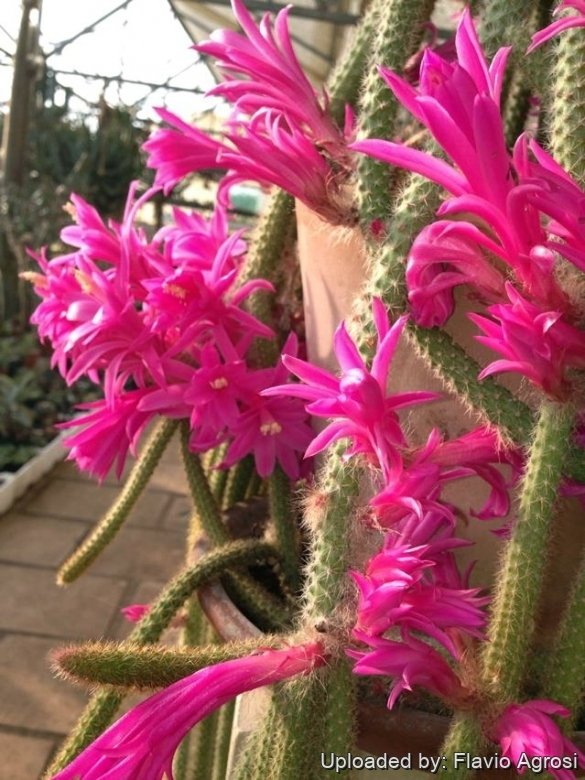
It is a slender, much-branched at base, creeping or epiphytic cactus cultivated as a houseplant for nearly 300 years. It one of the most popular of cacti for its ubiquity in modern collections and home use. The ‘Rat’s Tail’ is also very free-flowering, and its long, slender stems bear multitudes of crimson-pink blooms and makes a good hanging plant. A larger specimen can be quite impressive, tumbling out of a pot, suggesting a waterfall. It is said that it deserves first place among the Cacti of easy culture.
Stem: Slender, vine-like, weak, ascending at first, soon prostrate or pendulous (or climbing), fresh-green later grey-green, terete, up to 1,5(-2) m (or even more) long, round in cross-section about 1-2 cm in diameter.
Ribs: 7-12 Obtuse and inconspicuous, margins ± tuberculate
Areoles: Minute, whitish, close set 4-8 mm apart.
Spines: 9-14(-20), tiny, acicular, bristle-like, reddish brown or reddish yellow, 4-5(-10) mm long.
Flowers: Diurnal, borne laterally, red to purplish-pink usually 5-8(-10) cm long, 2,5-4(-7,5) cm wide, double-sided, symmetrical (zygomorphic) instead of perfectly regular and similar to that of the Christmas cactus Zygocactus truncatus), limb bilaterally symmetric, upcurved and slightly oblique, open for 3-5 days, scentless. Pericarpel almost straight greenish with acute bracteoles; receptacle 3 cm, long, curved just above pericarpel, bracteoles, brownish, acute; outer tepals linear-lanceolate, ± reflexed, 2-3 cm long, 6 mm wide, crimson; inner tepals narrowly oblong, to 10 mm wide, crimson, sometimes passing to pink along the margins; stamens white to pale pink, erect, excerted; style stigma lobes 5-7, white
Blooming season: It flowers in mid and late spring and blooms for several days.
Fruit: Globose, 10-12 mm long, 10 mm in diameter, red bristly, pulp yellowish.
Seeds: Ovoid, brownish red.
Remarks: This species, too, has cristate forms.
Origin and Habitat
Oaxaca and Hidalgo, Mexico (although suggestions have been made that it might be native of South America), and also reported as wild or naturalized elswhere.
Habitat: Dry forests. Lithophytic or epiphytic in dry forests.
Cultivation and Propagation
This is probably the easiest species to cultivate and relatively fast growing. A beautiful plant for a hanging basket, this cactus will grow happily in a window. It needs a well drained soil, requires strong sun to part sun. During the growing period the plants need frequent watering; from October to March and waterings should be rather abundant, so that the soil becomes completely soaked, but let dry between watering. Keep relatively dry in winter or when night temperatures remain below 10° C. It is hardy to -4°C for a short period. Assure a good ventilation.
Growing tips: It can be trained on a support, allowed to grow pendant, or grafted onto a straight stem of some other species to produce a beautiful small weeping tree. Older branches over two years old, which become brown and unsightly, can be cut away to the ground without disfiguring the plant.
Propagation: It can be reproduced both by seeds and cuttings. During spring sow seeds in pots and place in gentle warmth. Young seedlings are tiny and they need several years to reach adult size, and require very careful watering. Alternatively, in late spring and early summer take cuttings (allow to dry for week) and insert them in pots filled with a rich cactus-mix and place in gentle warmth.
Traditional uses: The flowers of this species are extensively used medicinally in Mexico. They are sold under the name “flor del cuerno” in the drug markets, for use as a medicine.
From llifle page Aporocactus flagelliformis var. pfeifferi
Description
It is a slender, much-branched, creeping or epiphytic cactus cultivated as a houseplant for nearly 300 years. It one of the most popular of cacti for its ubiquity in modern collections and home use. The ‘Rat’s Tail’ is also very free-flowering, and its long, slender stems bear multitudes of crimson-pink blooms and makes a good hanging plant. A larger specimen can be quite impressive, tumbling out of a pot, suggesting a waterfall. It is said that it deserves first place among the Cacti of easy culture.
Stem: Slender, vine-like, weak, ascending at first, soon prostrate or pendulous (or climbing), grey-green to fresh-green, terete, up to 1,5(-2) m (or even more) long, round in cross-section about 1-2 cm in diameter.
Ribs: 7-12 low
Areoles: Close set 4-8 mm apart.
**Spines: 9-14, tiny, bristle-like, reddish brown or reddish yellow, 4-5 mm long.
Flowers: Borne laterally, red to purplish-pink usually 5-8 cm long, 2,5-4 cm wide, double-sided, symmetrical (zygomorphic) instead of perfectly regular and similar to that of the Christmas cactus (Zygocactus truncatus), limb bilaterally symmetric, upcurved and slightly oblique. Tube almost straight.
Blooming season: It flowers in mid and late spring and bloom for several days,
Fruit:*** Globose, red bristly, 1 cm in diameter.
Origin and Habitat
Oaxaca and Hidalgo, Mexico (although suggestions have been made that it might be native of South America), and also reported as wild or naturalized elswhere.
Bibliography
This is probably one of the easiest species to cultivate and relatively fast growing. A beautiful plant for a hanging basket, this cactus will grow happily in a window. Need a well drained soil. Requires strong sun to part sun. During the growing period the plants need frequent watering; from October to March and waterings should be rather abundant, so that the soil becomes completely soaked, but let dry between watering. Keep relatively dry in winter or when night temperatures remain below 10° C. It is hardy to -4°C for a short period. Assure a good ventilation.
Growing tips: It can be trained on a support, allowed to grow pendant, or grafted onto a straight stem of some other species to produce a beautiful small weeping tree. Older branches over two years old, which become brown and unsightly, can be cut away to the ground without disfiguring the plant.
Propagation: It can be reproduced both by seeds and cuttings. During spring sow seeds in pots and place in gentle warmth. Young seedlings are tiny and they need several years to reach adult size, and require very careful watering. Alternatively, in late spring and early summer take cuttings (allow to dry for week) and insert them in pots filled with a rich cactus-mix and place in gentle warmth.
Traditional uses The flowers of this species are extensively used medicinally in Mexico. They are sold under the name “flor del cuerno” in the drug markets, for use as a medicine.
Source: Aporocactus flagelliformis var. pfeifferi, LLIFLE - Encyclopedia of living forms, CC-BY-SA, retrieved 2026-10-25.
From llifle page Cereus flagelliformis var. minor
Notes
Cereus minor (Weingart, Monatsschr. Kakteenk. 18: 49. 1908) doubtless refers to the variety minor given above.
[N. L. Britton & J. N. Rose - THE CACTACEAE - Descriptions and illustrations of plants of the cactus family - Volume 2, pag. 218]
Source: Cereus flagelliformis var. minor, LLIFLE - Encyclopedia of living forms, CC-BY-SA, retrieved 2026-10-25.
Cultivars and forms (1)
Varieties (1)
Gallery