Publication: Trans. Linn. Soc. London 27: 71 1869
Description
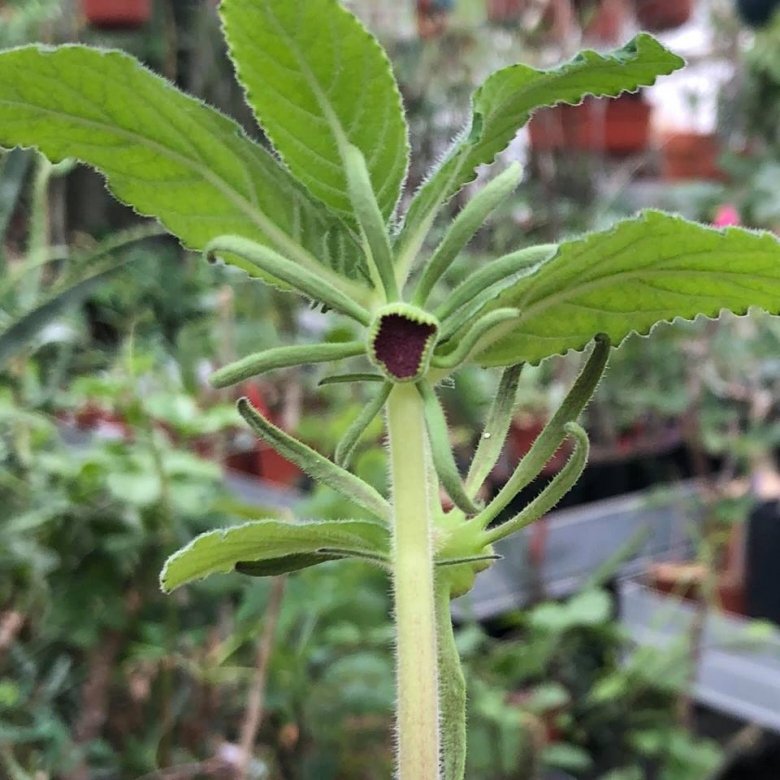
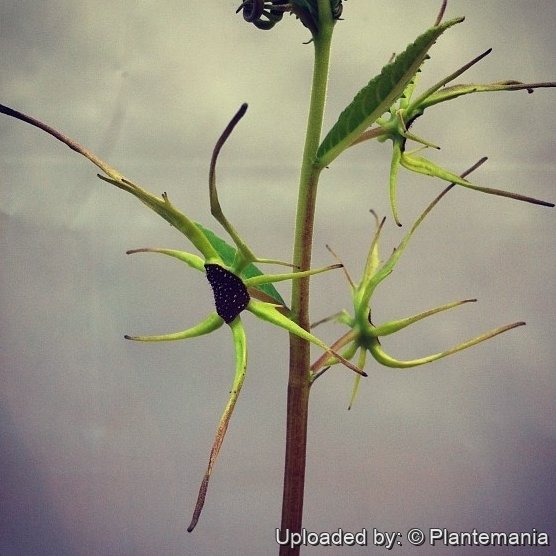
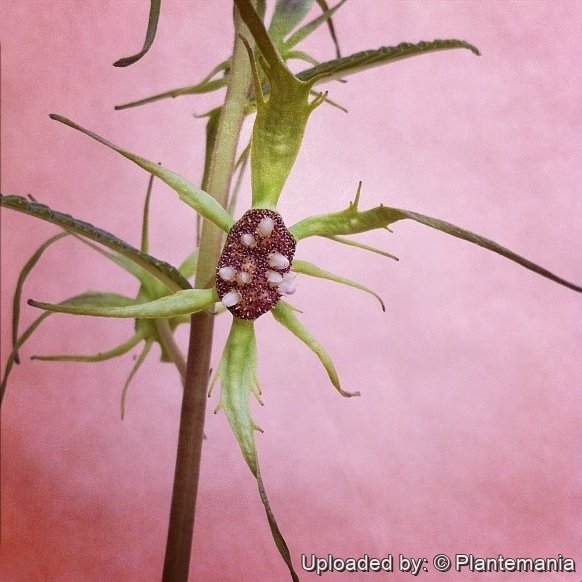
Dorstenia benguellensis is a shortly and densely hairy perennial herb, with a swollen rhizomatous or often pachycaul (caudiciform) base and annual aerial stems to 50(-60) cm tall; all parts with a milky latex. The leaves are minutely hairy. The flower has about 8 long and rather narrow receptacle appendages of various lengths. The receptacle is variously shaped, disc or cup shaped.
Derivation of specific name: Benguellensis: from Benguella in Angola.
Tuber (caudex): Fleshy, discoid to depressed-globose or placentiform, (1-)2-4(-12) cm across. rich in latex; surface warty and emitting fibrous roots.
Annual stems: Erect, solitary, cylindrical, herbaceous, sparsely hairy, leafy, subsucculent, 1.5-8 mm in diameter, covered when young with dense whitish pubescence, unbranched or branched (at least with a few short leafy branchlets with reduced leaves) internodes 2-3 cm long, becoming shorter towards the densely leaved apex. The lower part with scale-like reduced leaves (cataphylls) gradually passing into normal leaves.
Leaves: Subsessile or very shortly stalked, spirally arranged, thickish, oblong to subovate to linear or sometimes to subobovate, occasionally elliptic or ovate, (1-)5-7,5 (-15) cm long, (2- )4-16(-45) mm wide, more or less acuminate, apex blunt and obscurely mucronate, base more or less tapering, sometimes obtuse to rounded, margin finely to coarsely toothed, almost glabrous, finely hairy, sparsely hirtellous especially on the nerves; lateral nerves (7–)8-10(-12) on each side, ascending. Leaves on the lower pan of the stem scale-like and entire to tripartite. Stipules linear-tapering to linear-lanceolate, 2-3(-5) mm long, deciduous or persistent. Petiole (0)1–2(5) mm. long c. 1 mm. thick
Inflorescences: Solitary or sometimes in pairs in each leaf-axil; stalk stout, about (3-)5-25(-70) mm long ( increasing sometimes in the fruit), 1–1.5 mm. thick, minutely puberulous to hirtellous or hispidulous. Receptacle yellowish-green, glabrescent, outside convex; disc flat, turbinate, sometimes shallowly cup-shaped, orbicular to elliptic, in outline, (5-)7-8(-25) mm in diameter (increasing in the fruit), margin very narrow; denticulate, fringes triangular to subulate or filiform rather narrow (1-)5 (-7) mm) long or absent. Bract-arms, springing from below the margin, spreading in a whorl, subequal, slender linear, blunt, thickening and sparsely puberulous towards the apex, varying considerably in number and length in different specimens, 7 to 20 in number (rarely few or even 0), (1-)5-20(80) mm long, 0.1-3.5 (-8) mm wide, sometimes slightly dilated at the tip.
Flowers: Male flowers crowded, 2-androus with a bluntly 2-lobed perianth,stamens 2. Female flowers numerous, scattered over the disc, perianth shortly tubular; stigmas (1)2, style deeply 2-lobed.
Fruits: Elongating and forming a stalked 2-valved fleshy structure projecting above the male flowers.
Origin and Habitat
Angola, Sudan to Cameroon, Southwards to Angola, Zimbabwe and Mozambique.
Altitude range: up to 2450 metres above sea level.
Habitat and ecology: Dorstenia benguellensis grows in miombo and mixed deciduous woodlands, wooded or open grasslands, often in local water catchments or among rocks in slopes, in shallow or sandy soils, Kalahari Sand, and seasonally waterlogged grasslands (dambos), often associated with termite mounds, or in montane grassland.
Bibliography
Major references and further lectures
-
Urs Eggli “Illustrated Handbook of Succulent Plants: Dicotyledons” Springer Science & Business Media, 2002
-
J. Hutchinson & A. B. Rendle, “Flora of Tropical Africa”, Vol 6, 1916
-
C. C. Berg, “Flora Zambesiaca” FZ, Vol 9, 1991
-
Burrows, J.E. & Willis, C.K. (eds) (2005). “Plants of the Nyika Plateau” Southern African Botanical Diversity Network Report No. 31 SABONET, Pretoria Page 212.
-
Hyde, M.A., Wursten, B.T., Ballings, P. & Coates Palgrave, M. (2018). “Flora of Zimbabwe”: Species information: Dorstenia benguellensis.
https://www.zimbabweflora.co.zw/speciesdata/species.php?species\_id=120160, retrieved 20 August 2018
- Species accounts – SANBI, web: https://www.sanbi.org/wp-content/uploads/2018/04/sabonet-report-no-31-plants-nyika-plateau-part-3.pdf
From llifle page Dorstenia verdickii
Description
Dorstenia verdickii is one of the morphological or local forms of Dorstenia benguellensis, and not readily distinguishable, if not for the geographical provenance. It is a shortly and densely hairy herb to 50 cm tall, with a swollen rhizomatous or often pachycaul (caudiciform) base. The leaves are minutely hirsute. The flower has about 8 long and rather narrow receptacle appendages, lined with marginal rows of hairs.
Stem: Erect, herbaceous, hirtellous, leafy, internodes 2.5 cm long or less.
Leaves: Subsessile, thin and papery when dry, lanceolate, more or less acuminate, apex blunt and obscurely mucronate, margin obscurely denticulate, 5-7,5 cm long, 14-16 mm wide, scaberulous, sparsely hirtellous especially on the nerves; lateral nerves 8–12 on each side, ascending. Stipules linear-tapering to linear-lanceolate, 2-3 mm long.
Inflorescences: Solitary in each leaf-axil; stalk stout, about 5 mm long; receptacle glabrescent, disc flat, orbicular, 7-8 mm in diameter, margin denticulate, bract-arms springing from below the margin, spreading in a whorl, subequal, linear, blunt, thickening and sparsely puberulous towards the apex, 14-22 mm long, about 1 mm wide.
Flowers: Male flowers 2-androus with a bluntly 2-lobed perianth; female numerous; style deeply 2-lobed.
Origin and Habitat
Reported from Zambia (Solwei) and Zaire, Haut-Katanga (Plateau des Biano, Lubumbashi, Lukafu, Keyberg).
Cultivation and Propagation
Dorstenia verdickii (D. benguellensis) is an excellent caudiform plant and it should make an interesting addition to a collection.
Growth rate: It grows well, and fast. Providing adequate amount of water, warmth, and fertilizer seedling starts flowering when only 5 months old, but it’s susceptible to rotting if too wet.
Exposure: It needs light shade, but the caudex should be in the shade, while the leaves prefer some sun. Avoid direct blasting sun in summer. Bright light if grown indoors.
Soil: It needs a very porous potting medium (add pumice, vulcanite, and perlite). It does better in a rather acidic soil.
Waterings: During the growing season, the plants appreciate a fair amount of water but allow the soil to dry slightly between watering, making sure that they never dry out completely, but keep dry during the winter after the leaves have died back. It rot easily and do NOT like a lot of water when it has no leaves. They have to be kept in a rather high air humidity.
Fertilizer: They are fertilized once during the growing season with a balanced fertilizer diluted to ½ the strength recommended on the label.
Frost tolerance: Due to its African origin keep warm in winter, the minimum safe average temperature is 15°C, although it can go lower for short periods. It can be grown outdoors in frost-free climates, need anyway to kept above 10°C and dry in winter. It is very prone to rot in cool, wet conditions. USDA Zone 12, but does very well in containers.
Maintenance: Repot every two years. It like pots with generous drain holes.
Propagation: Seed, plants seem self fertile. Seed germinate readily at 21° C. They can also be propagated by cuttings.
Bibliography
Major references and further lectures
-
J. Hutchinson and A. B. Rendle “Flora of Tropical Africa”, Vol 6, 1916
-
Bull. Soc. Roy. Bot. Belgique 40: 26 (1901)
-
Aloe 46: 8 (2009)
Source: Dorstenia verdickii, LLIFLE - Encyclopedia of living forms, CC-BY-SA, retrieved 2026-10-25.