Publication: Cact. Succ. J. (Los Angeles) 44: 257 1972.
Description
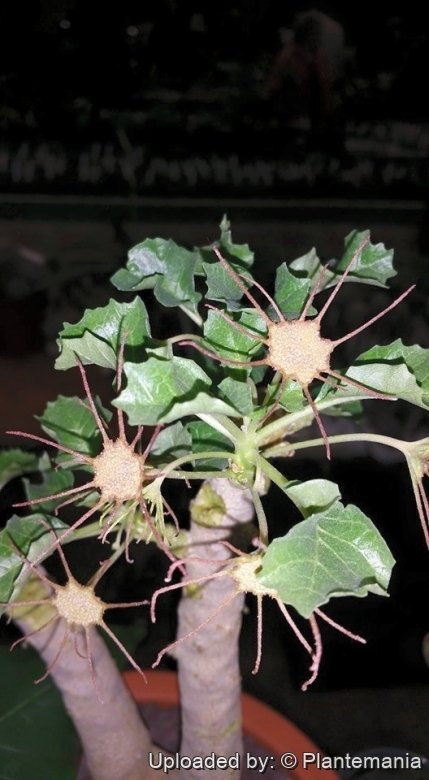
Dorstenia gypsophila is a remarkable monoecious caudiciform plant up to 1.20 m high, with a grotesquely swollen, trunk that gives rise to several irregularly arranged branches much thinner than the stem, each of which carries a sparse crown of simple leaves. Each plant has a unique shape with a withered looking appearance. D. gypsophila flowers are light brown and have luxuriant appendages. D. gypsophila is a vicariant form of the Socotran Dorstenia gigas, they are the two giants in the genus and the most prized species in cultivation. Both have persistent succulent branches and a thickened main trunk.
Note: Vicariance (from Latin vicarius, derived from vicis; change, alternation, stead) is a process by which the geographical range of a species is split into discontinuous parts by the formation of a physical or biotic barrier to gene flow or dispersal. The slow drifting apart of the Earth’s geotectonic plates (eg. Socotra–Somalia) creates physical separation between populations that once shared a gene pool, the result will be two closely related species living in similar parts of a formerly contiguous area (an area previously occupied by their common ancestor).
Stem: Swollen base (caudex), succulent, sometime up to 1-1.5(–2) m tall, and 50 cm thick (but usually much smaller), with thick, fissured, grey bark without leaf scars, usually with several irregularly arranged branches much thinner than the stem.
Leaves: alternate, crowded near the tip of the branches. Stipules very small, subulate, caducous. Petiole 0.5–1.5 cm long. Blade cordate, 0.6–1.5 x 0.4–1.5 cm, deeply cordate at the base, obtuse or acute at the apex, with coarsely crenate margins, smooth on both sides.
Inflorescences (receptacles): 1(–2) among the clustered leaves, on peduncles 1–2 cm long, circular in outline, 0.7–1.2 cm in diam. (excl. appendages), appendages 7–10, linear, up to 1.2 cm long. Male flowers numerous, tepals 2, stamens 2, rudimentary ovary inconspicuous. Female flowers numerous, scattered among the male ones, stigma unbranched.
Origin and Habitat
Burao Region, Somalia, not known elsewhere.
Altitude range: c. 700-950 metres above sea level.
Habitat and ecology: Dorstenia gypsophila grows in gypsum hills covered with dry vegetation together woth succulent euphorbias such as Euphorbia coluumnaris, Euphorbia sepulta, Euphorbia mosaica, Euphorbia ponderosa, Euphorbia hadramautica, as well as Aloe inermis, Pelargonium cristophoranum, Jatropha robecchii and other succulents.
Cultivation and Propagation
Dorstenia gypsophila is very slow growing and rare in cultivation. Nneeds bright light or partial to full shade, with warm temperatures and a well-drained soil mix that must not remain soggy for too long.
Waterings. During the growing season, the plants appreciate a fair amount of water but allow the soil to dry slightly between watering, making sure that they never dry out completely. Stop watering it completely in the autumn when it drops its leaves.
Fertilization. They are fertilized once during the growing season with a balanced fertilizer diluted to ½ the strength recommended on the label.
Overwintering: During the winter months they go dormant and will exhibit leaf loss. During this period, they should be keep it bone dry all winter. In the spring, at the first sign of life start watering it again.
Propagation: It is not a self-fertile plant. The flowers are light brown, and seeds are the only way of reproducing. Seed germinate readily at 21° C.
Bibliography
Major references and further lectures
-
I. Friis “Flora Somalia”, Vol 2, 1999 [updated by M. Thulin 2008]
-
Ahmad Hegazy, Jonathan Lovett-Doust “Plant Ecology in the Middle East” Oxford University Press, 14 January 2016
-
Wikipedia contributors. “Vicariance.” Wikipedia, The Free Encyclopedia. Wikipedia, The Free Encyclopedia, 6 Jun. 2016. Web. 6 Jun. 2016.
-
Münir Öztürk, Yoav Waisel, M. Ajman Khan, Güven Görk “Biosaline Agriculture and Salinity Tolerance in Plants” Springer Science & Business Media, 10 June 2007
-
“The Euphorbia Journal” Strawberry Press, 1994
-
Frank White, Unesco, United Nations Sudano-Sahelian Office “The vegetation of Africa: a descriptive memoir to accompany the Unesco/AETFAT/UNSO vegetation map of Africa” Unesco, 1983
-
Urs Eggli “Illustrated Handbook of Succulent Plants: Dicotyledons” Springer Science & Business Media, 2002
-
Stephen Jankalski “The succulent species of Dortenia” Espinas y Flores Newsletter of the San Diego Cactus and Succulent Society, Inc. Affiliated with the Cactus and Succulent Society of America Volume 37, Number 3, Saturday, March 9, 2002
Gallery