Publication: Syn. Pl. Succ. 45 1812
Description
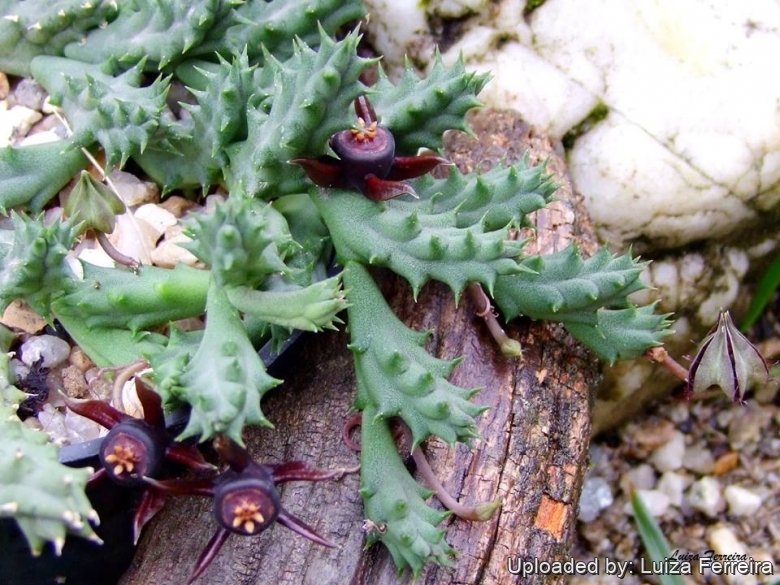
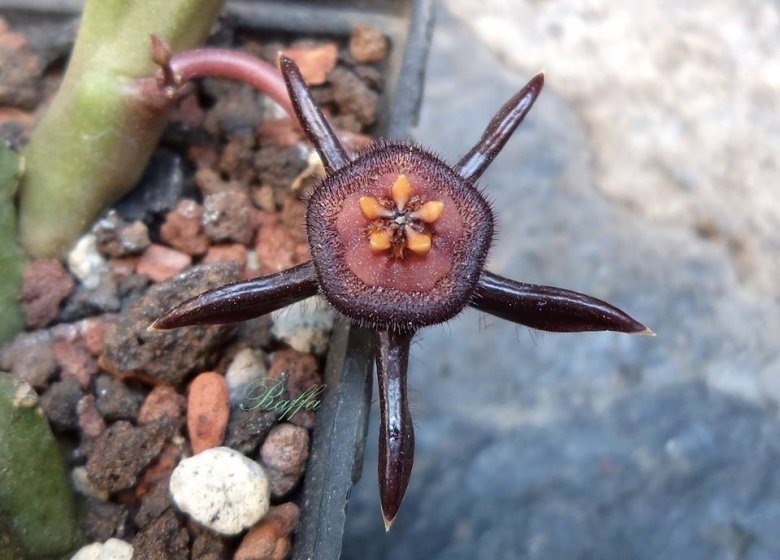
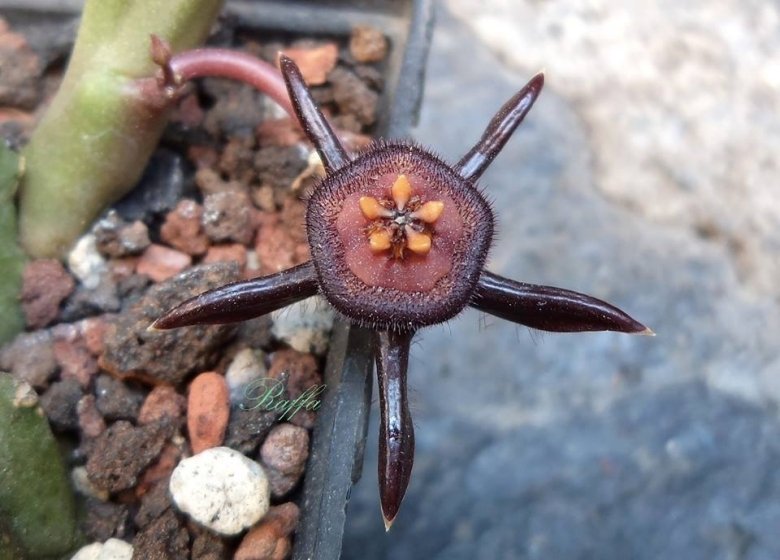
Duvalia caespitosa is a Stapelia-like plant with characteristic star shaped flowers with five fleshy, narrow ‘petals’. The species is extremely variable and forms a complex ( The several synonyms refers to previously described species, so similar and intermingled that it is almost impossible to name them accurately without knowing where they come from.) It is not surprising to have caused so much difficulty, because you can find plants with slightly different characteristics growing cheek by jowl in many parts of the areal. The species can easily be divided into 2 varieties by morphological characters: the nominate form (in summer-rainfall areas and transitional regions) and Duvalia caespitosa var. compacta (restricted to winter-rainfall areas of the Western Cape). Whatever they are called they are all lovely plants meriting a place in any succulent collection.
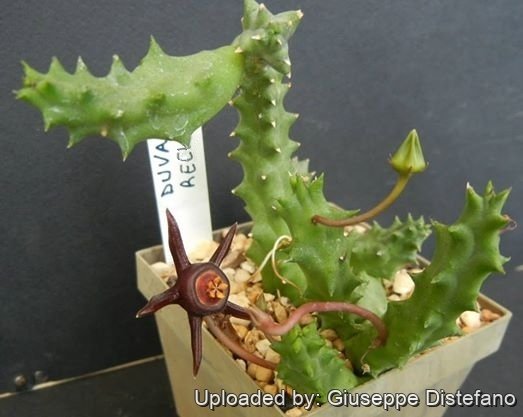
Habit: It is a small, perennial succulent with stems which creep along the ground. The plant branches much at the base to form low clumps or compact mats.
Stems: 1,5 to13 cm long 10-22 mm in diameter, 4- to 5- angled, ovoid to cylindrical, dull blue-green to pinkish, slightly toothed, densely crowded and leafless.
Leaves: Rudimentary about 2 mm long.
Inflorescence: 1 to several flowered from the middle or base of young growth, pedicels 1-2,5 cm long.
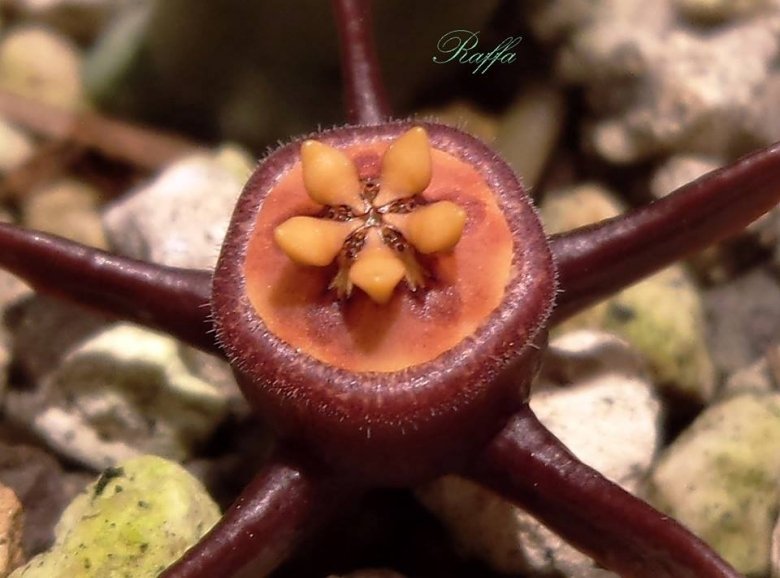
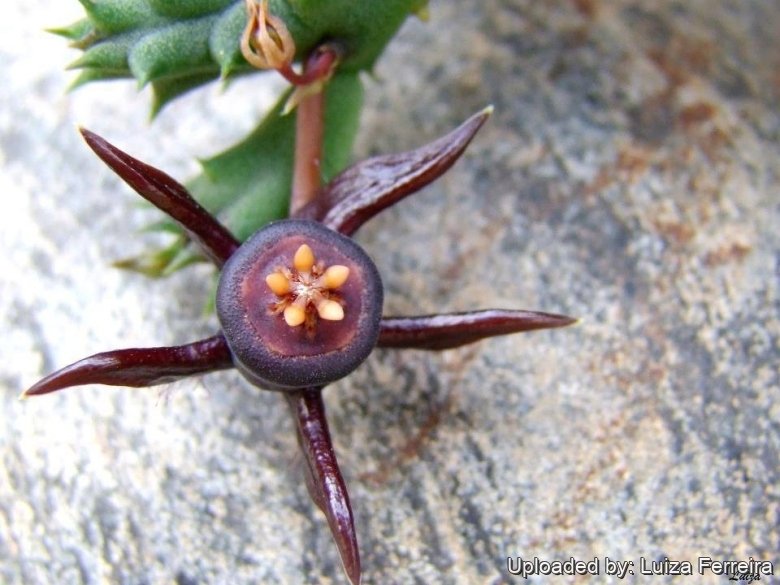
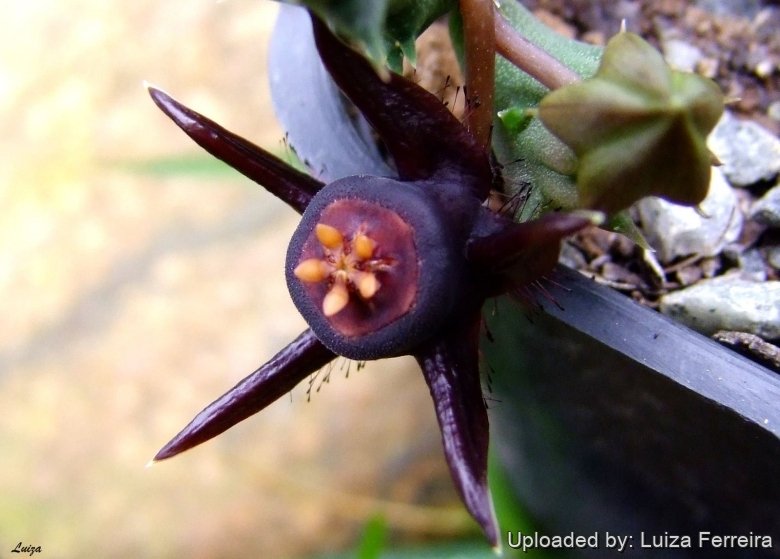
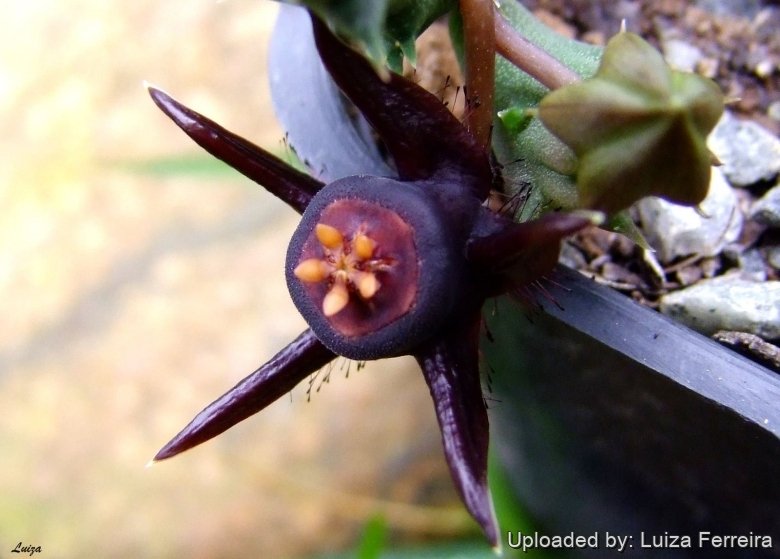
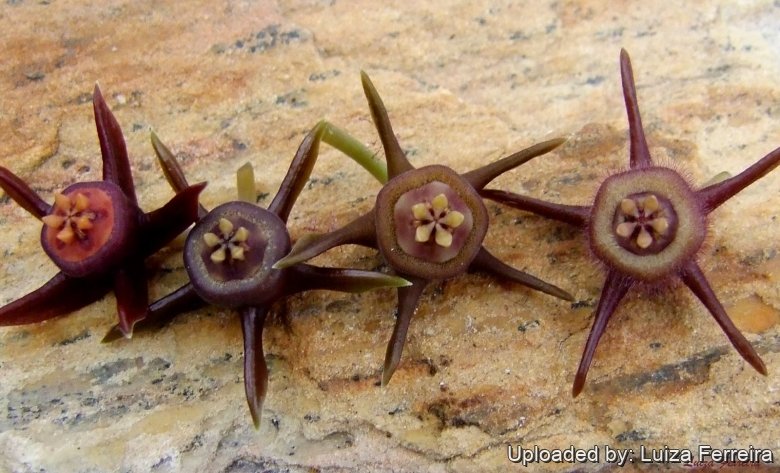
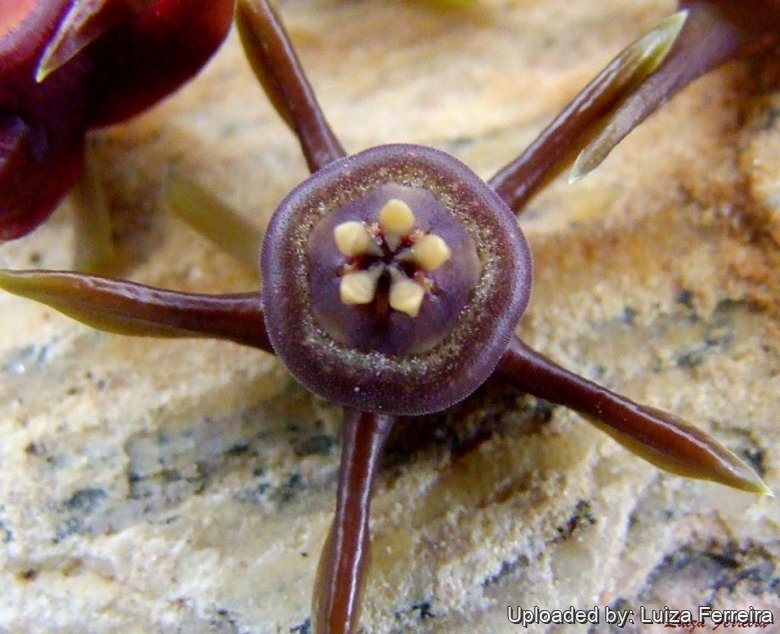
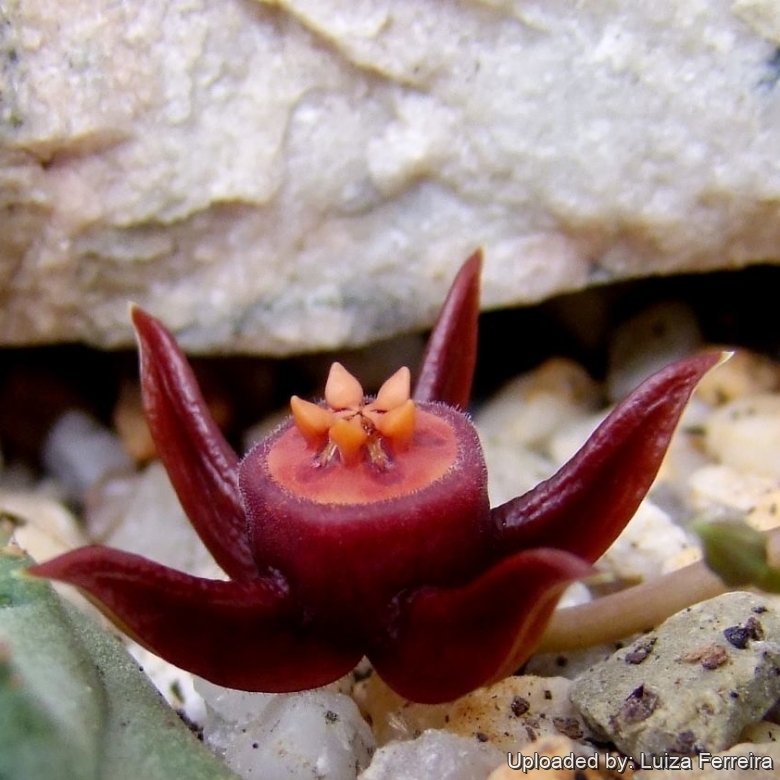
Flowers: Star shaped with five fleshy, narrow petal-like lobes. Sepals 2 - 6 mm long. Corolla about 2-3,5 cm in diameter, greenish,(pale) maroon, chocolate-brown, brownish-purple to dark purple, glossy, with strong foetid smell, variously compared to mature blue cheese, rotten meat, smelly socks and the like. The smell of carrion attracts flies which are known to attempt to lay their eggs on the flowers and in doing so, pollinate them. Corolla lobes 9-15 mm long, 6-9 mm broad, lamina reflexed, margins basally or entirely hairy, hairs very short-ciliate or clavate. Annulus fleshy, raised, circular to pentagonal, sometimes constricted basally, 7- 11 mm in diameter, 2-5 mm high, often spotted, papillate or with minute hairs. Corona yellow to (reddish-) brown, disc circular to pentagonal, 5-7 mm in diameter. Corona-lobes 1,5-2,2 long, 1,5-2,5 mm broad. Pollinia 0,35-0-5 mm long 0,23-0,3 mm across.
Fruits: Seed pods (follicles) 6-17 cm long, decorative, appearing as twin horns up to a year after flowering.
Seeds: 4-6 long by 3 mm in width.
Origin and Habitat
Northern Cape, Western Cape, Eastern Cape: Great and Little Karoo; Free State. Republic of South Africa.
Habitat Duvalia caespitosa grows on arid Karoo and semi-Karoo habitats, in rocky areas which receive mostly summer rainfall, amongst stones and in the cracks between large boulders, often shaded by scrub or grass.
Cultivation and Propagation
Duvalia caespitosa is an easy obliging blooming plant when mature, that it is happy in any average succulent house.
Potting: Since roots are quite shallow, use a soft and incoherent cactus mix or add extra perlite or pumice to regular soil potting soil, and clay pots help the plants to dry out between watering.
Waterings: Duvalia require moderately watering through the growing season but enjoy plenty of water and some fertiliser in hot weather, this helps them to flower freely. Water more sparingly in winter according to temperatures. But, as with most asclepiads, it is unwise to leave them wet in cold weather.
Fertilization: Fertilizers for succulent plants must be rich in potassium, but poor in nitrogen, to avoid the plants from developing excess vegetation, which is easily attacked by fungal diseases.
Sun Exposure: As with many succulents, they prefer to grow in the light shade of scrubby shrubs or between rocks where they get some shade during the day. In summer it is advisable to position this plant in a partially shady place, where it is exposed to direct sunlight only during the coolest hours of the day.
Hardiness: These plants don’t like cold weather, therefore in the Spring it is best to set them outside only when the temperatures are above 15°C. Can endure temperatures below 5°C for short period, but only if the soil stays completely dry.
Pest and diseases: Duvalia species vary in their susceptibility to rotting, but are generally fairly easy to grow, especially if kept pest-free. They are very susceptible to stem and root mealy bugs, and damage from these may well initiate fungal attack. If you do have problems with a stem or with basal rotting, you can reliably isolate the healthy parts, dry them off, and re-root them in moist compost.
Cultural Practices: Re-pot every 2 years.
Propagation: Easiest with stem cuttings. Allow cuttings to dry a day before planting. Stems must be laid (Not buried) on gritty compost and will then root from the underside of the stems. It can also be increased from seeds sowing in spring in moist, sandy peat moss. Barely cover seeds. Seeds germinate quickly.
Bibliography
Major references and further lectures:
-
Focke Albers, Ulrich Meve “Illustrated Handbook of Succulent Plants: Asclepiadaceae: Asclepiadaceae” Volume 4 Springer, 2002
-
Duvalia caespitosa on line: http://kumbulanursery.co.za/plants/duvalia-caespitosa-var-caespitosa#sthash.R2u6PyMV.dpuf
-
Focke Albers, Ulrich Meve “Illustrated Handbook of Succulent Plants: Asclepiadaceae: Asclepiadaceae” Volume 4 Springer, 2002
-
Doreen Court “Succulent Flora of Southern Africa” CRC Press, 01/giu/2000
-
Clive Innes “Complete Handbook of Cacti and Succulents” Van Nostrand Reinhold Company, 01/dic/1981
-
A.C.White & B.Sloane “Stapelieae” ( White & Sloane) ed. 2 3: 855 Abbey San Encino Press, 1937
-
Luckhoff “The Stapelieae of Southern Africa” Capetown, A.A. Balkema 1952
-
Bruyns, P.V. 2005. “Stapeliads of southern Africa and Madagascar.” Vol. II. Umdaus Press, Hatfield.
-
James Cullen, Sabina G. Knees, H. Suzanne Cubey “The European Garden Flora Flowering Plants: A Manual for the Identification of Plants Cultivated in Europe, Both Out-of-Doors and Under Glass” Cambridge University Press, 11/ago/2011
-
Gideon Smith, Neil R. Crouch “Guide to Succulents of Southern Africa” Struik Nature, 01/nov/2009
From llifle page Duvalia reclinata
Description
Duvalia reclinata is a Stapelia-like plant with characteristic star shaped flowers with five fleshy, narrow ‘petals’. It is a local or morphological form of the very variable Duvalia caespitosa not readily distinguishable from the type, if not for the geographical provenance. In the past there were a huge number of names amongst Duvalia caespitosa (at least 18 varieties), but all this varieties merge gradually one with another through a continuous series of transitional forms and it is almost impossible to tell them apart, so now they are all synonymized with Duvalia caespitosa. Whatever they are called they are all lovely plants meriting a place in any succulent collection.
Habit: It is a small, perennial succulent with stems which creep along the ground. The plant branches much at the base to form low clumps or compact mats.
Stems: 2 to13 cm (sometimes up to 30 cm) long 10-12 mm thick, 4- to 5- angled, with 4–5 obtuse tuberculate-toothed angles, dull green.
Leaves: Rudimentary about 2 mm long.
Flowers: 1–3 together near the base or middle of the young stems, pedicels 12-25 mm long Star shaped with five fleshy, narrow petal-like lobes. Sepals 3-5 mm long lanceolate-attenuate. Corolla about 2-3,5 cm in diameter, dark chocolate or with the rim of the annulus around the corona greenish, glossy, with strong foetid smell, variously compared to mature blue cheese, rotten meat, smelly socks and the like. The smell of carrion attracts flies which are known to attempt to lay their eggs on the flowers and in doing so, pollinate them. Corolla lobes very spreading, replicate to the base into vertical plates 3-4 deep, fringed on the basal half with vibratile clavate purple hairs 2-3 mm long, otherwise glabrous. Annulus 7-8 mm in diam. and about 3 mm high, obtusely pentagonal, glabrous, puberulous or very shortly pubescent on the rim; outer corona obtusely pentagonal, orange-brown or dull brownish-red; inner corona-lobes dull orange or brownish-orange.
Fruits: Seed pods (follicles) 6-17 cm long, decorative, appearing as twin horns up to a year after flowering.
Seeds: 4-6 long by 3 mm in width.
Origin and Habitat
Cape Province, South Africa. Duvalia reclinata is found in the central region ( Somerset, Karoo, Barkly, Mac Owan, Barkly, Graaff Reinet, Aberdeen, Glen Avon Estate) and in the coast region near Ladismith,
Cultivation and Propagation
Duvalia reclinata is an easy obliging blooming plant when mature, that it is happy in any average succulent house.
Potting:Since roots are quite shallow, use a soft and incoherent cactus mix or add extra perlite or pumice to regular soil potting soil, and clay pots help the plants to dry out between watering.
Waterings: Duvalia require moderately watering through the growing season but enjoy plenty of water and some fertiliser in hot weather, this helps them to flower freely. Water more sparingly in winter according to temperatures. But, as with most asclepiads, it is unwise to leave them wet in cold weather.
Fertilization: Fertilizers for succulent plants must be rich in potassium, but poor in nitrogen, to avoid the plants from developing excess vegetation, which is easily attacked by fungal diseases.
Sun Exposure: As with many succulents, they prefer to grow in the light shade of scrubby shrubs or between rocks where they get some shade during the day. In summer it is advisable to position this plant in a partially shady place, where it is exposed to direct sunlight only during the coolest hours of the day.
Hardiness: These plants don’t like cold weather, therefore in the Spring it is best to set them outside only when the temperatures are above 15°C. Can endure temperatures below 5°C for short period, but only if the soil stays completely dry.
Pest and diseases: Duvalia species vary in their susceptibility to rotting, but are generally fairly easy to grow, especially if kept pest-free. They are very susceptible to stem and root mealy bugs, and damage from these may well initiate fungal attack. If you do have problems with a stem or with basal rotting, you can reliably isolate the healthy parts, dry them off, and re-root them in moist compost.
Cultural Practices: Re-pot every 2 years.
Propagation: Easiest with stem cuttings. Allow cuttings to dry a day before planting. Stems must be laid (Not buried) on gritty compost and will then root from the underside of the stems. It can also be increased from seeds sowing in spring in moist, sandy peat moss. Barely cover seeds. Seeds germinate quickly.
Bibliography
Major references and further lectures:
-
N. E. Brown “Flora Capensis” Vol 4, page 518 1909
-
Focke Albers, Ulrich Meve “Illustrated Handbook of Succulent Plants: Asclepiadaceae: Asclepiadaceae” Volume 4 Springer, 2002
-
Duvalia caespitosa on line: http://kumbulanursery.co.za/plants/duvalia-caespitosa-var-caespitosa#sthash.R2u6PyMV.dpuf
-
Focke Albers, Ulrich Meve “Illustrated Handbook of Succulent Plants: Asclepiadaceae: Asclepiadaceae” Volume 4 Springer, 2002
-
Doreen Court “Succulent Flora of Southern Africa” CRC Press, 01/giu/2000
-
Clive Innes “Complete Handbook of Cacti and Succulents” Van Nostrand Reinhold Company, 01/dic/1981
-
A.C.White & B.Sloane “Stapelieae” ( White & Sloane) ed. 2 3: 855 Abbey San Encino Press, 1937
-
Luckhoff “The Stapelieae of Southern Africa” Capetown, A.A. Balkema 1952
-
Bruyns, P.V. 2005. “Stapeliads of southern Africa and Madagascar.” Vol. II. Umdaus Press, Hatfield.
-
James Cullen, Sabina G. Knees, H. Suzanne Cubey “The European Garden Flora Flowering Plants: A Manual for the Identification of Plants Cultivated in Europe, Both Out-of-Doors and Under Glass” Cambridge University Press, 11/ago/2011
-
Gideon Smith, Neil R. Crouch “Guide to Succulents of Southern Africa” Struik Nature, 01/nov/2009
Source: Duvalia reclinata, LLIFLE - Encyclopedia of living forms, CC-BY-SA, retrieved 2026-10-25.
Cultivars and forms (2)
Subspecies (1)
Varieties (1)
Gallery