Publication: N. Amer. Fl. 22: 22 1905
Description
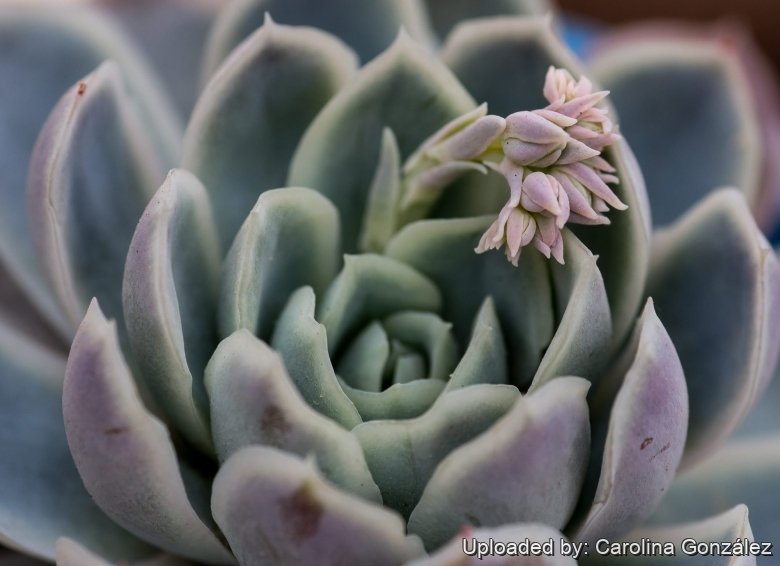
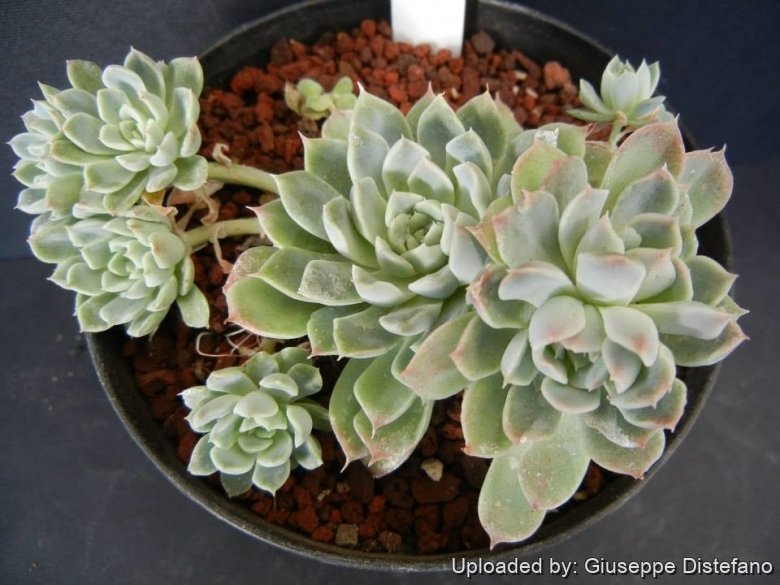
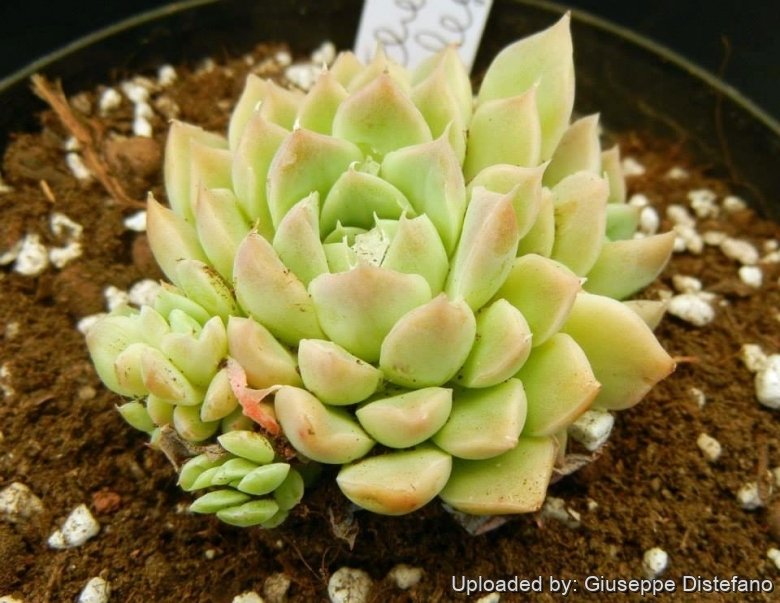
Echeveria elegans, called Mexican gem and Mexican snowball, is a stemless echeveria forming charming, symmetrical rosettes of neat, bluish-white, fleshy leaves close to the ground; some look like alabaster roses. It produces pink or red flowers, tipped yellow, from late winter to mid summer. It is very floriferous. This species has long been one of the most popular with collectors and in nurseries and gardens. It is a bit variable in nature, and collected extreme forms were early published as full species or as varieties, but these were too weak botanically to stand, so they are all combined in Echeveria elegans.
Habit: Echeveria elegans is a succulent, evergreen, perennial growing in dense mats because of the numerous “daughter” rosettes on long stolons which can be separated from the parents in spring, and grown separately - hence the common name “hen and chicks”, applied to several species within the genus Echeveria. Mats can rich a height of 5–10 cm and a diameter of 50 cm.
Rosettes: Densely leafed, geometrically perfect, up to 15 cm across, stemless.
Leaves: Obovate, rounded above, pointed, rather thick, fleshy strongly pruinose, alabaster-white, glabrous, 30-70 mm long, margins often reddish, sometimes also transparent, upper surface somewhat concave (spoon-shaped) or almost flat.
Inflorescence: Scape slender, pink, 10—25 cm. long, raceme bent to one side, with 5—10 florets.
Flowers: Corolla 10 12 mm. Long, coral-pink with yellow tips.
Chromosome number: n=31, 32, 34, 60, 62-63, 96, 120-130.
Origin and Habitat
Central Mexico, State Hidalgo, in the Mountains near Pachuca, Penas de Jacal and adjacent areas.
Habitat and ecology: It grows in rock crevices and on rocky outcroppings in semi-arid habitats in the Chihuahuan-Tehuacan Deserts.
Cultivation and Propagation
Echeveria elegans is certainly one of the most versatile neat, low-growing ground cover succulents. It is easy to care for and is a good starting point for beginning gardeners. Forms beautiful clumps.
Soil: It is essential in cultivation to use a very porous soil, with adequate drainage.
Exposition: Bright light is required to prevent “stretching” of Echeverias (“stretching” occurs when a moderately fast growing plant such as an Echeveria, is grown in dim light or over-fertilized, which causes overly lush growth that contributes to weak, pallid plants).
Watering: Water thoroughly when soil is dry to the touch, keep dryer in winter.
Hardiness: It thrives in subtropical climates. Protect from frost, in temperate regions it is grown under glass with heat. It is a bit more frost sensitive than most.
Uses: Echeveria elegans is cultivated as an ornamental plant for rock gardens planting, or as a potted plant. The low-growing clusters are very suitable to fill rock crevices and are occasionally used to cover the roof tiles of a house‐top. A layer of rosettes stapled to the roof overhang is used to hold an inch of peaty soil to the roof. It is also used to form silvery blue small borders and are believed to keep away evil spirits. Mature clusters of rosette cascading from containers provide sculptural forms of extreme elegance in the home and garden.
Propagation: Quite easy from seed or from cuttings, the latter either from individual leaves or from offset rosettes.
Bibliography
Major referencens and further lectures
-
Eric Walther “Echeveria” California Academy of Sciences, 1972
-
Hermann Jacobsen “A handbook of succulent plants: descriptions, synonyms, and cultural details for succulents other than Cactaceae, Volume 1” Blandford Press, 1960
-
John Pilbeam “The Genus Echeveria” British Cactus & Succulent Society, 2008
-
James Cullen, Sabina G. Knees, H. Suzanne Cubey “The European Garden Flora Flowering Plants:A Manual for the Identification of Plants Cultivated in Europe, Both Out-of-Doors and Under Glass” Cambridge University Press, 11/ago/2011
-
Werner Rauh “The Wonderful World of Succulents: Cultivation and Description of Selected Succulent Plants Other Than Cacti” Smithsonian Institution Press, 1984
-
Stephanie Donaldson “Container gardening: the complete practical guide to container gardening, indoors and outdoors” Barnes & Noble Books, 2008
-
Marjory Charlotte Jefcoate Thomas “My Wilderness Blossomed by Rosaline Redwood” A. H. & A. W. Reed, 1964
-
Rosemary McCreary “Houseplants” Sunset Books, 01/gen/1999
-
Attila Kapitany, “Knowing Echeverias” Cactus and Succulent Journal, Volume 81 Issue 2. 2009
-
“RHS A-Z encyclopedia of garden plants.” United Kingdom: Dorling Kindersley. 2008
-
CONABIO. “Catálogo taxonómico de especies de México” In Capital Nat. México. CONABIO, Mexico City.2009.
From llifle page Echeveria albicans
Description
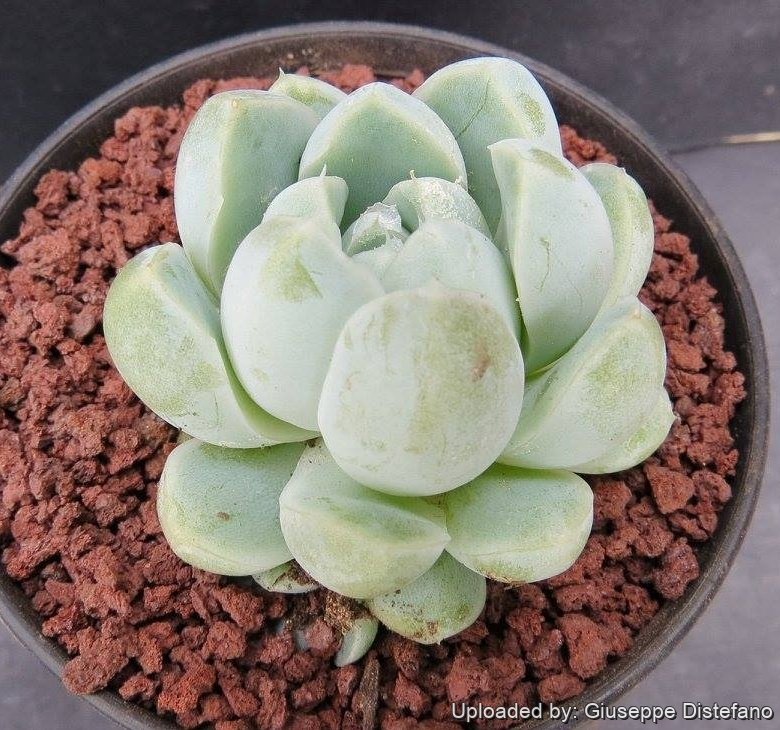
Echeveria albicans is one of the varieties of Echeveria elegans which is a somewhat variable taxon with several collected extreme forms that were early published as full species or as varieties, but these were too weak botanically to stand, so they are all combined in Echeveria elegans. It is a stemless, compact, clumping echeveria distinguished from the type by very thick, pale olive to white pruinose leaves in tight rosettes, about 10 cm across; some look like alabaster roses. The name Echeveria albicans is not accepted by many botanists that treat it as synonym, but it still has a value for a collector because they identify plants with particular characters. This species has long been one of the most popular with collectors and in nurseries and gardens.
Rosettes: Stem-less, glabrous, about 10 cm across, ultimately caespitose.
Leaves: Closely imbricated in bud, crowded, obovate oblong, obtuse to truncate, 3-5 cm long, 15-25 mm wide, thickest just below the tip, upcurved, with a small mucro, conspicuously pruinose, edges white somewhat translucent.
Inflorescence (raceme): Cincinnate, simple, rarely bifid, up to 25 cm long. Scape with sharp, apressed, lance-shaped leaves, 8-15 mm long. Pedicels 14 mm long.
Flowers: Sepals unequal, deltoid linear-oblong, acute, up to 10 mm long. Corolla broadly conoid to urceolate, 14-18 mm long and 10-12 mm in diameter at base, begonia-red or pink, to old-rose at base, greenish to light-yellow-green at apex, inside at apex oil-yellow. Nectaries, yellow.
Chromosome number: n = 120-130.
Origin and Habitat
Mexico, without definite locality.
Cultivation and Propagation
Echeveria albicans is certainly one of the most versatile neat, low-growing ground cover succulents. It is easy to care for and is a good starting point for beginning gardeners. Forms beautiful clumps.
Soil: It is essential in cultivation to use a very porous soil, with adequate drainage.
Exposition: Bright light is required to prevent “stretching” of Echeverias (“stretching” occurs when a moderately fast growing plant such as an Echeveria, is grown in dim light or over-fertilized, which causes overly lush growth that contributes to weak, pallid plants).
Watering: Water thoroughly when soil is dry to the touch, keep dryer in winter.
Hardiness: It thrives in subtropical climates. Protect from frost, in temperate regions it is grown under glass with heat. It is a bit more frost sensitive than most.
Uses: Echeveria albicans is cultivated as an ornamental plant for rock gardens planting, or as a potted plant. The low-growing clusters are very suitable to fill rock crevices and are occasionally used to cover the roof tiles of a house‐top. A layer of rosettes stapled to the roof overhang is used to hold an inch of peaty soil to the roof. It is also used to form silvery blue small borders and are believed to keep away evil spirits. Mature clusters of rosette cascading from containers provide sculptural forms of extreme elegance in the home and garden.
Propagation: Quite easy from seed or from cuttings, the latter either from individual leaves or from offset rosettes.
Bibliography
Major references and further lectures
-
Jorge Meyrán García, Lilián López Chávez “Las Crasuláceas de México” Sociedad Mexicana de Cactología, 2003
-
“Dry Climate Gardening with Succulents” Pantheon Books, 1995
-
Hermann Jacobsen “Abromeitiella to Euphorbia” Blandford Press, 1960
Source: Echeveria albicans, LLIFLE - Encyclopedia of living forms, CC-BY-SA, retrieved 2026-10-25.