Publication: Contr. U.S. Natl. Herb. 13: 45, pl. 10. 1910
Description
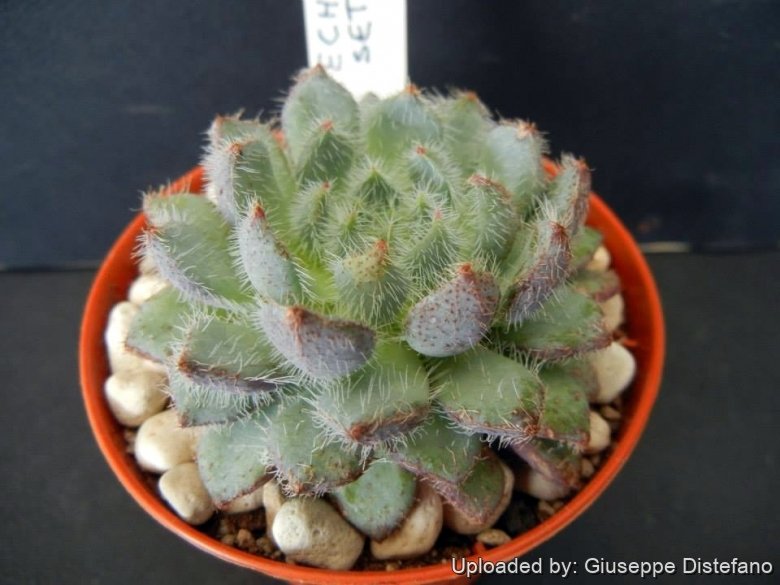
Echeveria setosa is an almost stemless, slowly clustering, rosette-succulent that forms in dense mounds. It is a very distinct echeveria, with a remarkable pubescence, but extremely variable. Plants varies from almost glabrous to very furry with stiff, glistening white hairs, depending on the variety. It clusters freely giving off offsets from the base and readily forming dense mounds.
Rosettes: Globose 5 to 15 cm depending on clones.
Leaves: Up to 100 per rosette, convex on both sides, narrow, densely packed spatulate-shaped, glabrous or hairy, depending on the variety, glaucous or green, that in the winter assumes a green-red colouring.
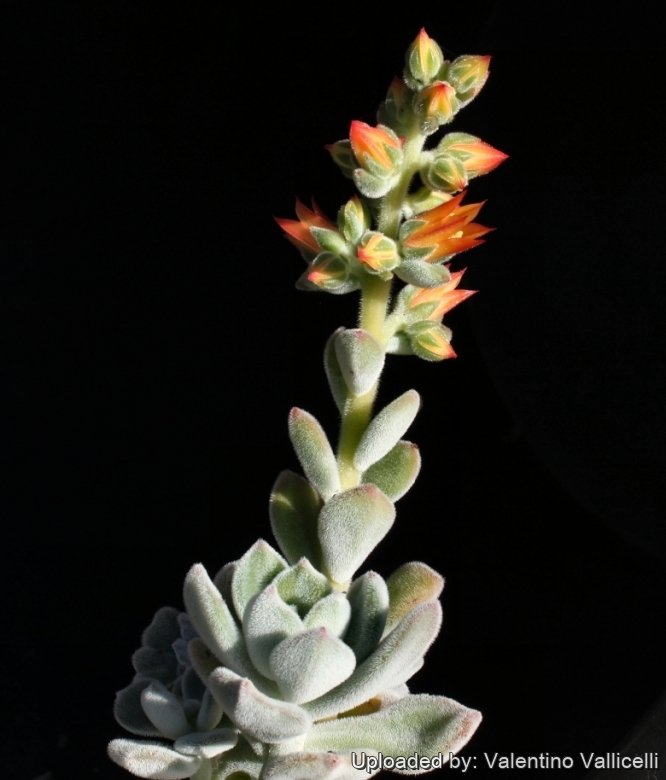
Inflorescence: Simple or 2 branched erect, arched helicoid second cincinni from each rosette.
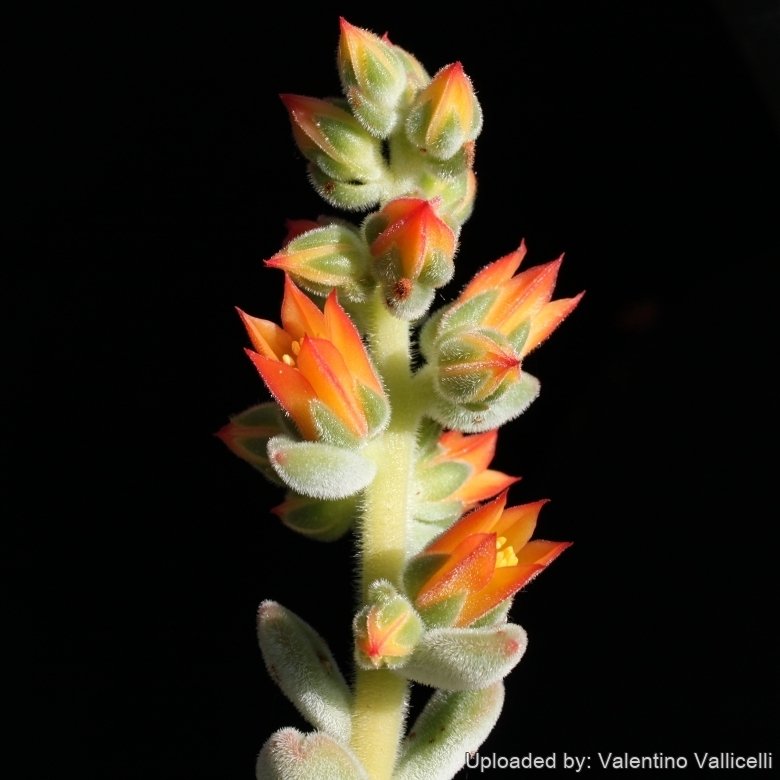
Flowers: The flowers are the most distinctive and recognisable feature of this species, they are displayed in erect, arched helicoid cymes from each rosette that reach from about 15 cm to 20 cm tall, each with about 6 to 9 florets. In larger groups of rosettes, often of the inflorescences are branched. The flowers are red and yellow simple or 2 branched second cincinni. The corolla campanulate or ovoid urceolate, prominently pentagonal.
Blooming season (Europe): Late April to early July.
Origin and Habitat
Mexico. (Puebla, Oxaca)
Cultivation and Propagation
It is essential in cultivation to use a very porous soil, with adequate drainage.
Exposition: Bright light is required to prevent “stretching” of Echeverias (“stretching” occurs when a moderately fast growing plant such as an Echeveria, is grown in dim light or over-fertilized, which causes overly lush growth that contributes to weak, pallid plants).
Watering: Water thoroughly when soil is dry to the touch.
Hardiness: Protect from frost.
Propagation: Quite easy from seed or from cuttings, the latter either from individual leaves or from offset rosettes.
Bibliography
Major references and further lectures.
-
Werner Rauh “The Wonderful World of Succulents: Cultivation and Description of Selected Succulent Plants Other Than Cacti” Smithsonian Institution Press, 1984
-
James Cullen, Sabina G. Knees, H. Suzanne Cubey “The European Garden Flora Flowering Plants: A Manual for the Identification of Plants Cultivated in Europe, Both Out-of-Doors and Under Glass” Cambridge University Press, 11/ago/2011
-
Hermann Jacobsen ”A Handbook of Succulent Plants: Abromeitiella to Euphorbia” Blandford Press, 1960