Publication: Gartenflora xxxvii. (1888) 633, t. 1286 [ et: Allg. Gartenzeitung (Otto & Dietrich) 10: 297. 1842 ]
Description
Echinocactus texensis, best known in cultivation as Homalocephala texensis, is a stout barrel cactus, which is solitary when young, very rarely slowly clustering in age.
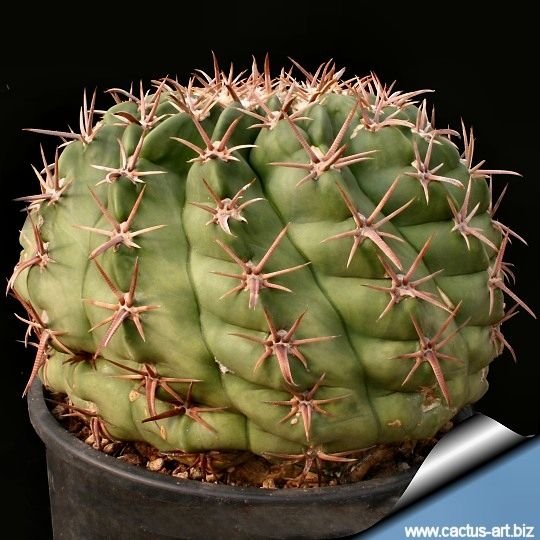
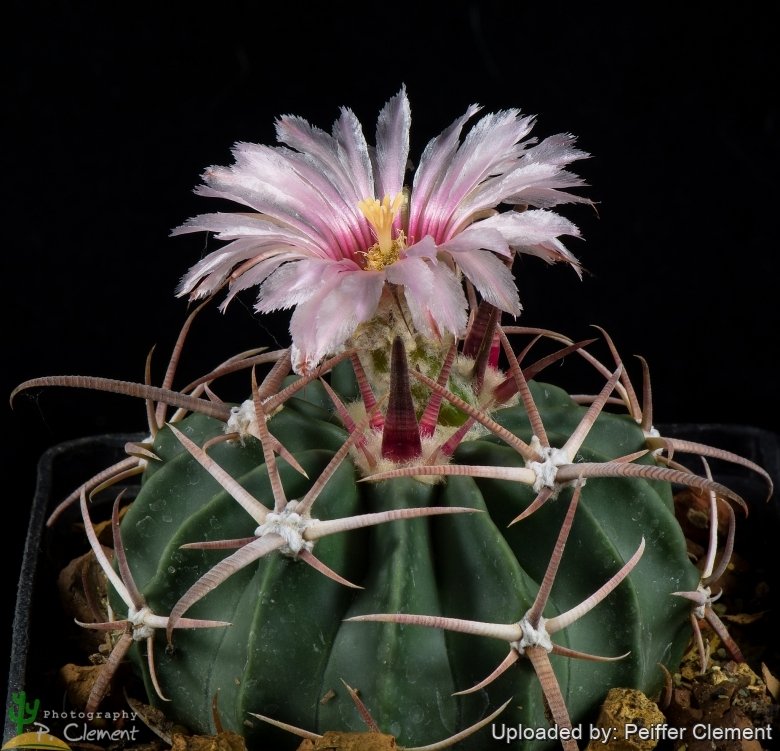
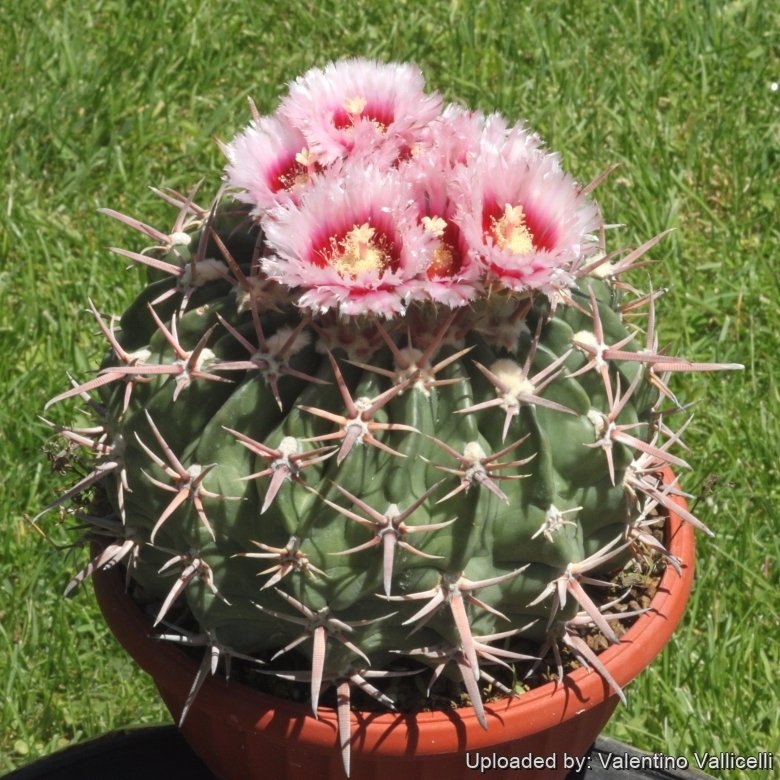
Stem: Pale grey-green (desert populations) to grass green (eastern populations) with numerous ribs , above-ground portion flat-topped, hemispheric in old age but usually deep-seated, flush with soil surface 30 cm in diameter, 20 cm high.
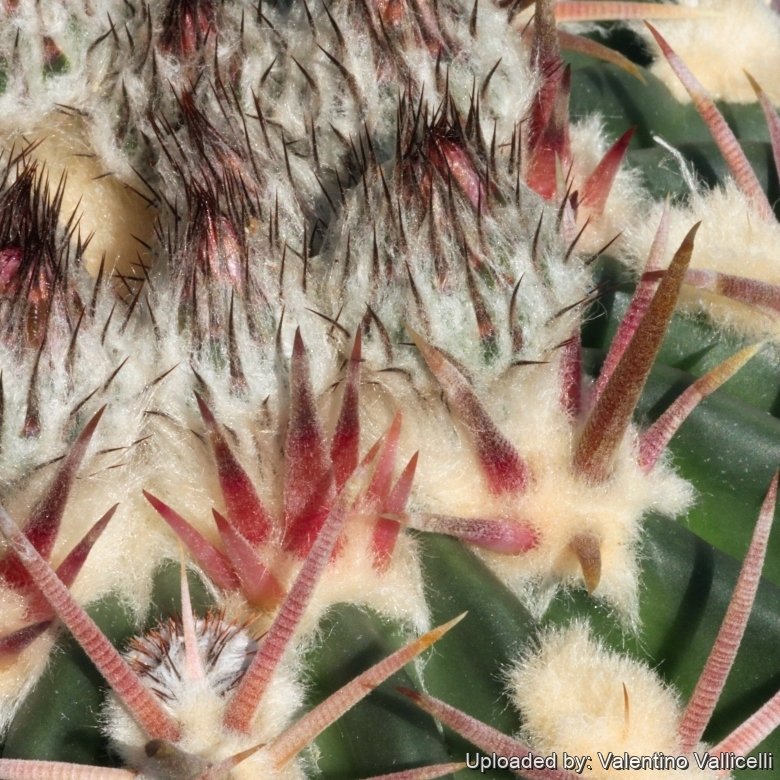
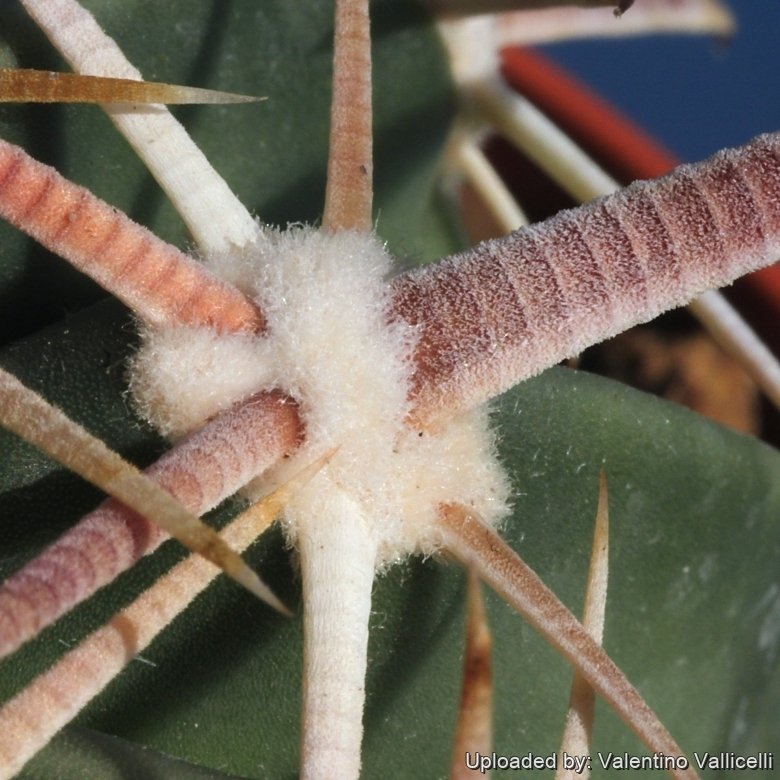
Spines: Small but strong pale tan, pink, reddish to grey, terete to flattened, annulated, not hiding stem surfaces.
Radial spines: (5-)6-7 per per areole, mostly decurved
Central spine: 1 porrect and straight.
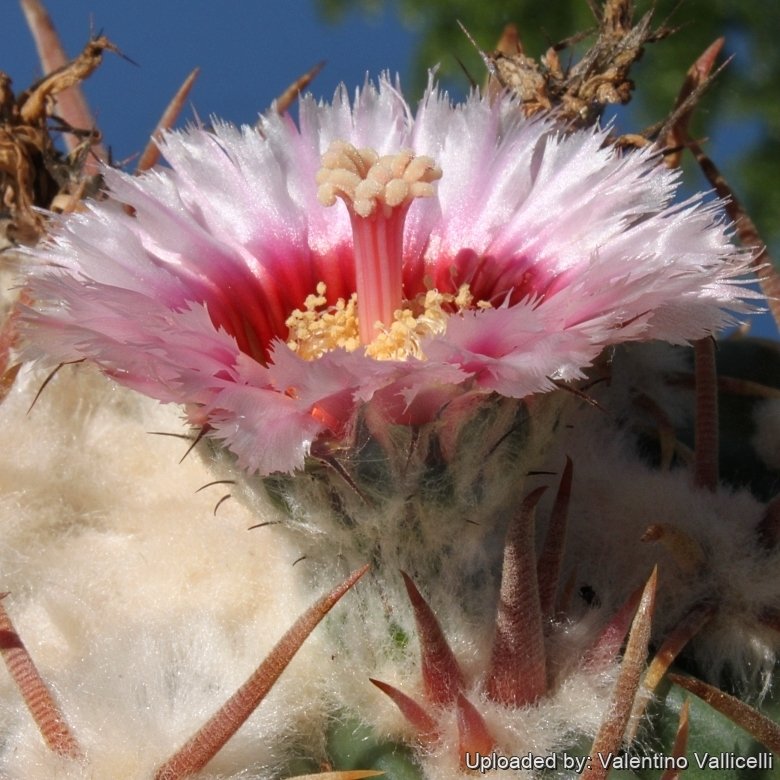
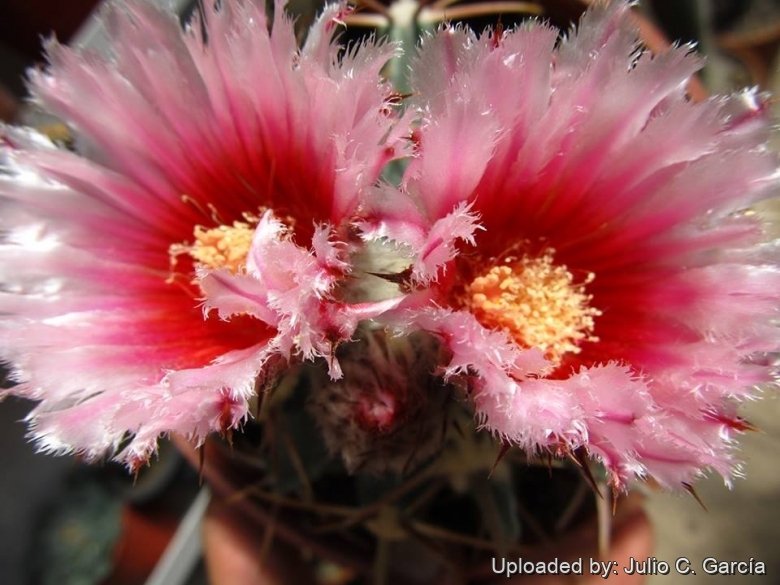
Flowers: 5-6 × 5-6 cm. Flowers range from white thru rose-pink to pale silvery-pink, with red throats in late spring and can appear on plants around 10cm in diameter.
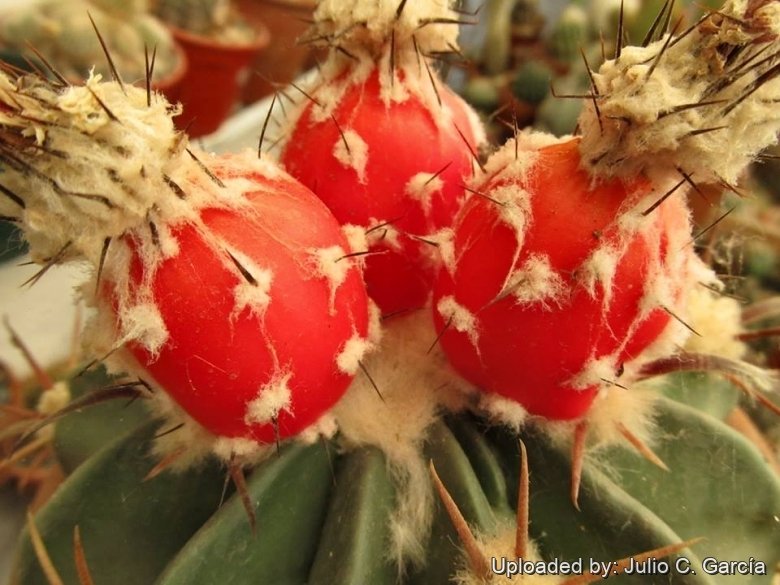
Fruits: Scarlet or crimson, spheric to ovoid, 15-50 × 15-40 mm, fleshy.
Remarks: Desert populations, unlike the eastern plants, have longer central spines that project stiffly outward.
Origin and Habitat
Echinocactus texensis is widespread and common in Texas, southeastern New Mexico, and Oklahoma (USA). It occurs also in northeastern Mexico (Chihuahua, Coahuila, southern Nuevo León, Durango, Tamaulipas and Zacatecas)
Altitude range: 0-1400 metres above sea level.
Habitat: Chihuahuan Desert, in xerophyllous scrub, grasslands, openings in oak woodlands, Tamaulipan thorn scrub, on deep soils, sandy soils of plains and valleys, saline flats, low limestone hills or limy gravel above Permian red dirt.
Ecology: It is a very hardy cactus that grows hidden in the grass. A dense cover of ephemeral herbs or shallow blanket of snow can hide this species completely from view. This species is wide-ranging, abundant, and there are no threats. Echinocactus texensis is used as an ornamental, however it is not common in trade.
Cultivation and Propagation
Echinocactus texensis is a summer grower species easy to cultivate, more cold tolerant than most. It flowers easily, but results will depend on a variety of growing conditions.
Growth rate: It is a slow growing and easily flowering species.
Soils: It likes very porous standard cactus mix soil, but can become too elongated if compost is too rich.
Repotting: This variety stores water in the parts of the plant which are above the soil leaving the root system small enough to fit into a proportionally sized flower pot. Use pot with good drainage.
Watering: Water regularly from Spring to Autumn, but do not overwater (Rot prone), keep dry in winter.
Fertilization: Feed with a high potassium fertilizer in summer.
Hardiness: It does well with cool winter time temperatures and will tolerate temperatures down below -18°C or less if the roots are kept dry.
Exposition: It will do its best with lots of sun, it becomes stressed with inadequate light which could result in weak spines, poor health or even death.
Uses: It is an excellent plant for container growing. It always looks good and stays small. It look fine in a cold greenhouse and frame or outdoor in a rockery.
Pests & diseases: It may be attractive to a variety of insects, but plants in good condition should be nearly pest-free, particularly if they are grown in a mineral potting-mix, with good exposure and ventilation. Nonetheless, there are several pests to watch for:
- Red spiders: Red spiders may be effectively rubbed up by watering the infested plants from above.
- Mealy bugs: Mealy bugs occasionally develop aerial into the new growth among the wool with disfiguring results, but the worst types develop underground on the roots and are invisible except by their effects.
- Sciara Flies: Sciara flies are one of the major problems for seedlings. It is a good practice to mulch your seedlings with a layer of grit, which will strongly discourage the flies.
- Scales: Scales are rarely a problem.
- Rot: Rot is only a minor problem with cacti if the plants are watered and “aired” correctly. If they are not, fungicides won’t help all that much.
Propagation: From seed, since the plant rarely produces plantlets. Seeds germinate in 7-14 days at 21-27° C in spring, remove gradually the glass cover as soon the plants will be well rooted (ca 1-2 weeks) and keep ventilated, no full sun for young plants!
Bibliography
Major references and further lectures
-
Edward F. Anderson “The Cactus Family” Timber Press, 2001
-
James Cullen, Sabina G. Knees, H. Suzanne Cubey “The European Garden Flora Flowering Plants: A Manual for the Identification of Plants Cultivated in Europe, Both Out-of-Doors and Under Glass” Cambridge University Press, 11/ago/2011
-
David Hunt, Nigel Taylor “The New Cactus Lexicon” DH Books, 2006
-
Gómez-Hinostrosa, C., Heil, K., Terry, M. & Corral-Díaz, R. 2013. “Echinocactus texensis.” The IUCN Red List of Threatened Species. Version 2014.3. <www.iucnredlist.org>. Downloaded on 13 December 2014.
From llifle page Homalocephala texensis var. gourgensii
Description
It is a stout barrel cactus, which is solitary when young, very rarely slowly clustering in age.
Stem: Pale grey-green (desert populations) to grass green (eastern populations) with numerous ribs , above-ground portion flat-topped, hemispheric in old age but usually deep-seated, flush with soil surface 30 cm in diameter, 20 cm high
Spines: Small but strong pale tan, pink, reddish to grey, terete to flattened, annulated, not hiding stem surfaces.
Radial spines: (5-)6-7 per per areole, mostly decurved
Central spine: 1 porrect and straight.
Flowers: 5-6 × 5-6 cm. Flowers range from white thru rose-pink to pale silvery-pink, with red throats in late spring and can appear on plants around 10cm in diameter.
Fruits: Scarlet or crimson, spheric to ovoid, 15-50 × 15-40 mm, fleshy.
Remarks: Desert populations, unlike the eastern plants, have longer central spines that project stiffly outward.
Origin and Habitat
This species is widespread and common in Texas, southeastern New Mexico, and Olkahoma (USA). It occurs also in northeastern Mexico (Coahuila, southern Nuevo León, Durango Tamaulipas)
Habitat: Chihuahuan Desert, grasslands, openings in oak woodlands, Tamaulipan thorn scrub, on deep soils, saline flats, low limestone hills or limy gravel above Permian red dirt. 0-1400 m.
Ecology: It is a very hardy cactus that grows hidden in the grass. A dense cover of ephemeral herbs or shallow blanket of snow can hide this species completely from view.
Cultivation and Propagation
It will do its best with lots of sun, it becomes stressed with inadequate light which could result in weak spines, poor health or even death. It does well with cool winter time temperatures and will tolerate temperatures down below -18°C or less if the roots are kept dry. This variety stores water in the parts of the plant which are above the soil leaving the root system small enough to fit into a proportionally sized flower pot. Needs well drained soil. It flowers easily, but results will depend on a variety of growing conditions.
Propagation: Relatively easy to propagate by seeds.
Source: Homalocephala texensis var. gourgensii, LLIFLE - Encyclopedia of living forms, CC-BY-SA, retrieved 2026-10-25.
From llifle page Homalocephala texensis f. variegata
Description
The typical Echinocactus texensis, best known in cultivation as Homalocephala texensis, is a stout barrel cactus that lies low to the ground, solitary when young, very rarely slowly clustering in age. It is distinguished by rather flattened, often very strong spines. They are a rich brown and form a pleasing contrast against the grey green body.
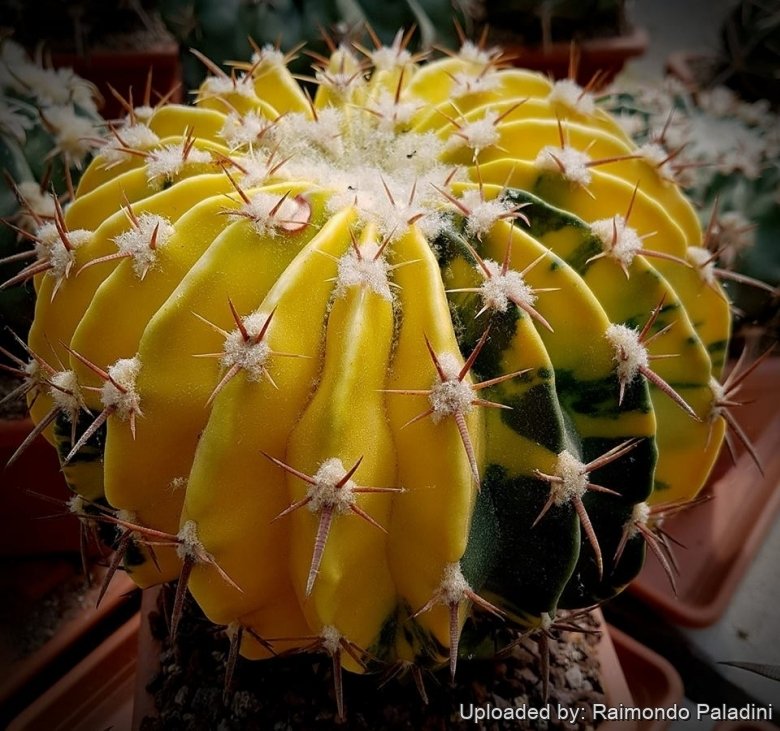
Variegated form: Variegated Echinocactus texensis are cultivated for their beautiful stems that have sectors, patches or stripes with two colours, yellow and green. There are several forms of variegation. The extent and nature of the variegation can vary, and sometimes the plant will return to the green form. In others it is stable and does not change under normal conditions. Flowers are produced only on the crown of mature specimens. Variegated specimens are sometime grafted on stronger species, called the stock, that can be any number of different columnar cactus.
Origin and Habitat
Garden origin (Nursery produced cultivar)
Cultivation and Propagation
Variegated cacti are regarded as choice and difficult in cultivation, but despite that many of them are relatively easy to grow. But be aware that they cannot tolerate prolonged exposure to direct sun light (especially during the hottest summer days), so grow them in half-shade or under filtered sun. They are sometime seen as grafted plants, but some of this colourful plants (those with some chlorophyll) are able to grow on their own roots and are priced by collectors.
Soil: Use mineral well-permeable substratum with little organic matter (peat, humus).
Watering: Water sparingly from March till October, and keep perfectly dry in winter, at temperatures from 5 to 15 degrees centigrade. (In general these plants are more tender and cannot endure freezing temperatures). In the rest period no high atmospheric humidity!!
Propagation: By seeds, grafting or cutting. Because the variegation is due to the presence of two kinds of plant tissue, propagating the plant must be by a vegetative method of propagation that preserves both types of tissue in relation to each other. A most common way way to cultivate this partially de-coloured cultivars is to graft them onto another cactus which has chlorophyll and which will provide sugar to the mutant scion. The chlorophyll containing bottom part of the graft, called the stock, can be any number of different columnar cactus species.
Remarks: Seeds from variegated parents often give raise to some variegated seedlings too.
Source: Homalocephala texensis f. variegata, LLIFLE - Encyclopedia of living forms, CC-BY-SA, retrieved 2026-10-25.
Cultivars and forms (12)
Varieties (3)
Forms (6)
Gallery