Publication: Mem. Tour N. Mexico [Wislizenus] 111-112. 1848.
Description
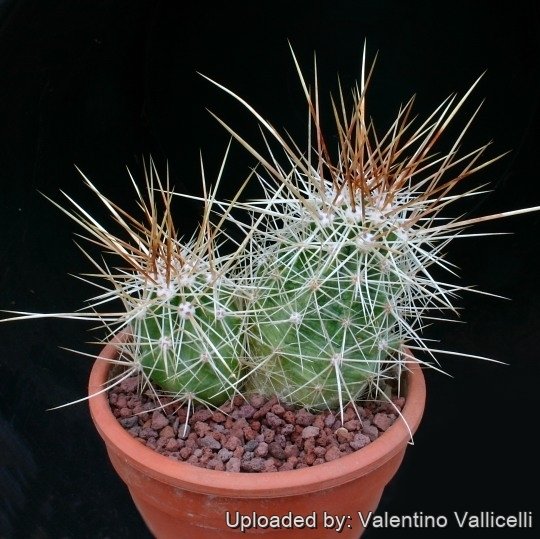
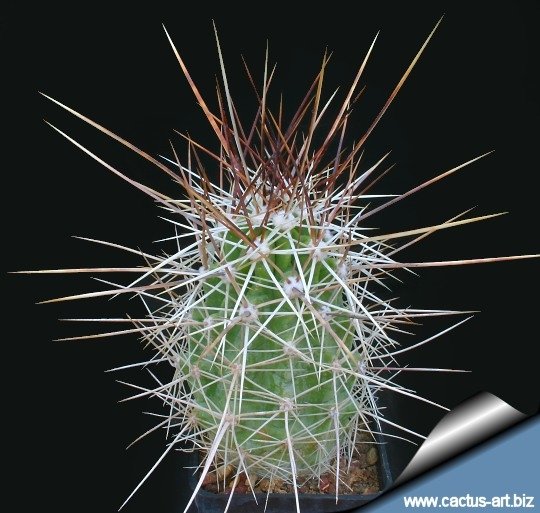
Echinocereus enneacanthus is a caespitose cactus forming dense or lax clumps either loose decumbent, or erect with 20-100(-500) branches, usually branching before flowering. There appears to be quite a variation in spination, at least in number and length of spines. Two subspecies are recognized, the nominate form and subsp. brevispinus.
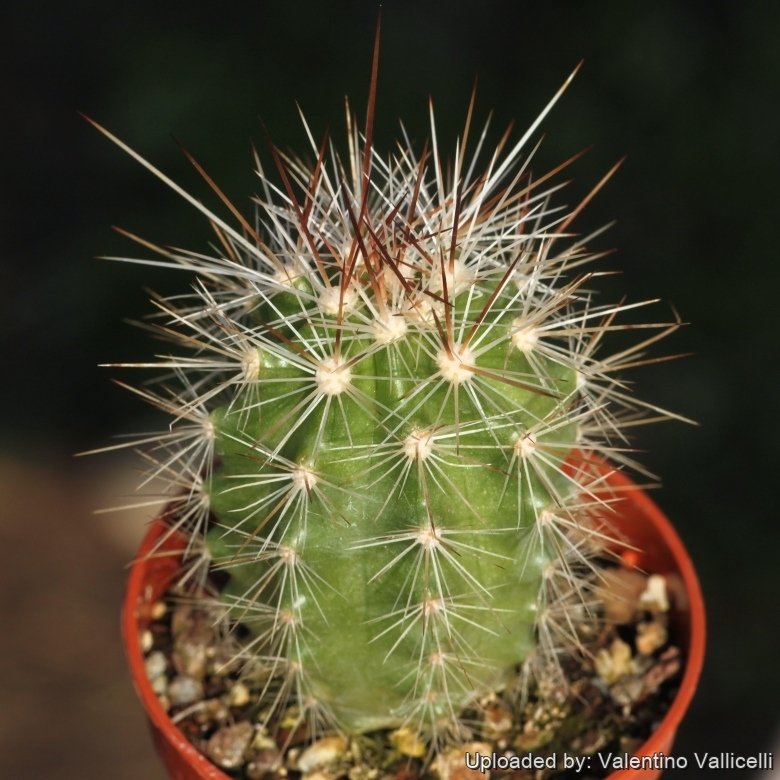
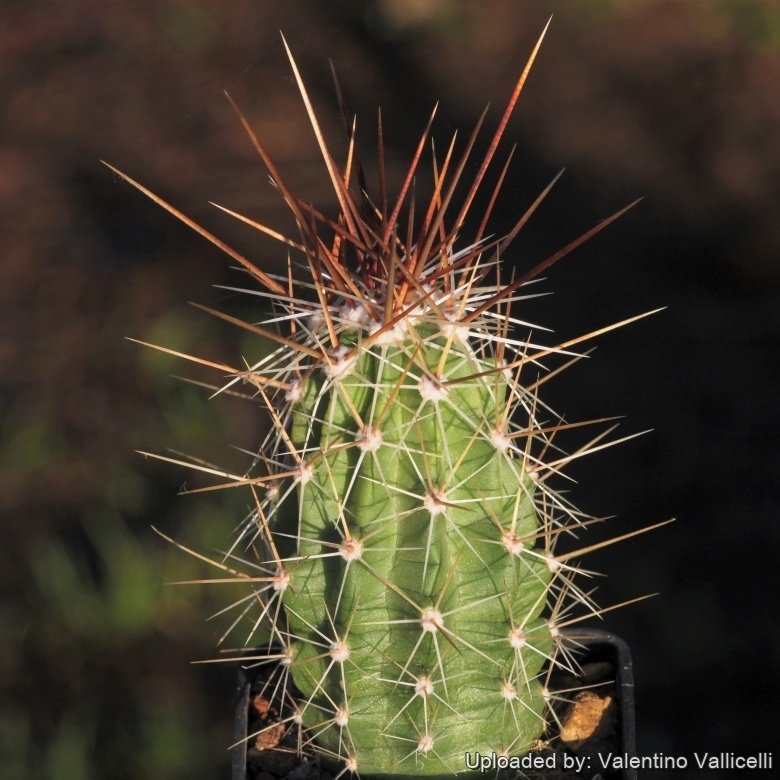
Stems: Cylindrical, the longest sometimes prostrate, 5-14 cm diameter up to over 100 cm long (but usually much shorter). The stems of this species are soft or flaccid, pale to bright green and often remain wrinkled.
Ribs: 7-12 with uninterrupted but prominent warty crests.
Areoles: Circular 18-52 mm apart.
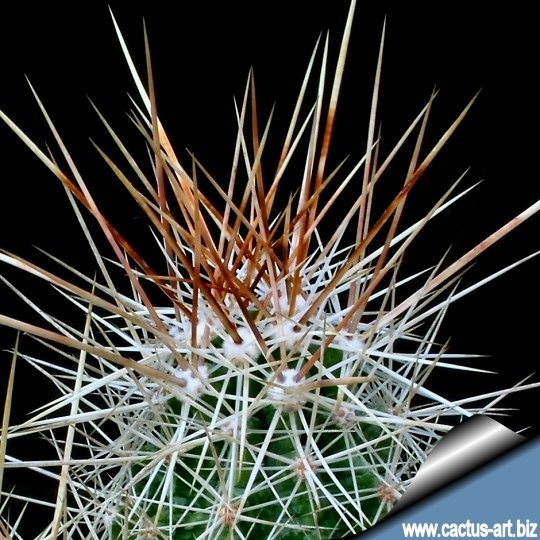
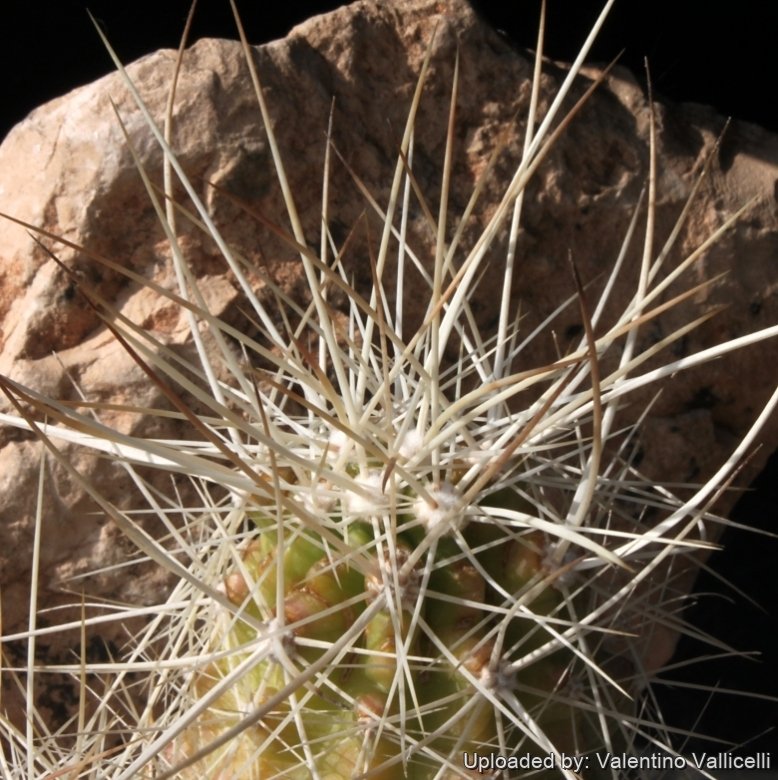
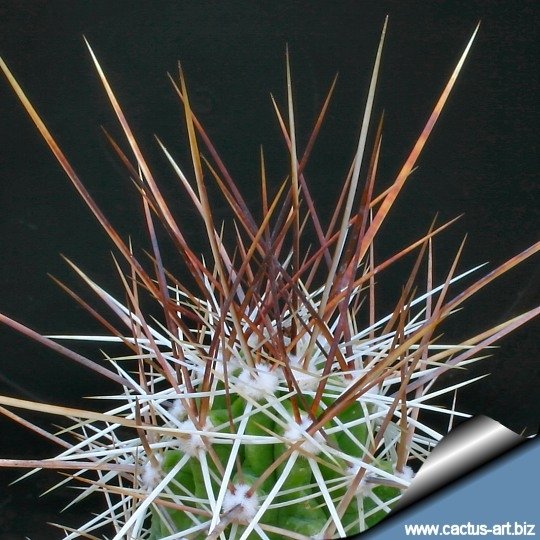
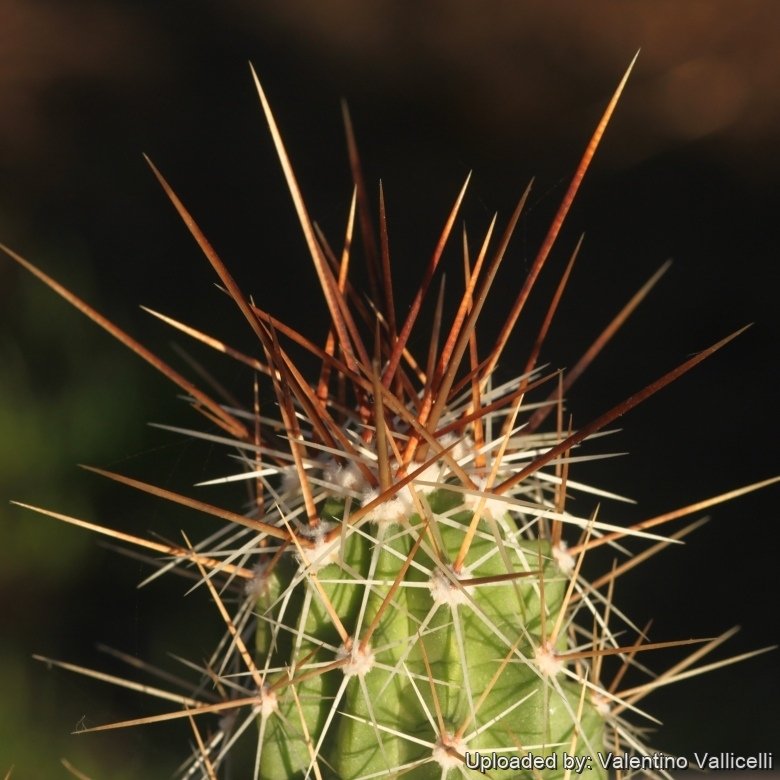
Radial spines: 5-9 per areole, 25-45 mm long, straight or slightly curved, needle-like, more or less flattened, bulbous at the base, brownish, often tipped or banded with darker brown.
Central spines: 1-5 per areole, 55-95 mm long, divergent, porrect, flattened, stout, and slightly curved, opaque, white, tan, brown or grey, often nearly black.
Flowers. Funnelform 7-11 cm in diameter, purple-red to pink in varying shades with deep reddish throat, and diurnal. Filaments greenish to pink. Anthers yellow. Stigma green. Style whitish.
Blooming season: It flowers in early spring (April through June in habitat) during mid-morning. Flowers close at night and reopen for 2-4 days. The fruits ripen in late summer.
Fruit: Round to ovoid pale yellow-green or dull reddish, , maturing to bright red, 20-30 mm, pulp white or pale pink. The fruit is edible. After the spines are removed from the green-brown flesh of the fruit, it can be eaten and tastes similar to strawberry, hence the name strawberry cactus.
Seeds: 1,0-1,4 mm, black irregular, globular, or ovoid tuberculate.
Origin and Habitat
Echinocereus enneacanthus is common and wide-spread species occuring in central, north and north-east of Mexico (Sonora, Chihuahua, Durango, Nuevo León, Tamaulipas, San Luis Potosí, Coahuila and Zacatecas), New Mexico, and Texas.
Altitude: (0-)600-1800 metres above sea level.
Habitat: Chihuahuan desert scrub and grasslands, on mineral and sandy-loamy limestone soils, sometimes clay loam soils, on flats, washes or rarely rocky or gravelly slopes. In the same area it is possible to find several cactus species like: Echinocereus stramineus, Echinocereus chisoensis, Echinocereus dasyacanthus, Mammillaria lasiacantha and Lophophora viridiscens. Echinocereus enneacanthus is abundant, and is not affected by any major threats.
Cultivation and Propagation
Rot easily it is sensitive to overwatering (rot prone) needs a very good drainage to avoid rotting, Keep drier and cool in winter. Need full sun. Very cold resistant It can withstand freezing temperatures but not too much water (resistant to approx -12C or less for short periods of time)
Propagation: Cuttings that are left out to callus off before planting ; Also can be grown from seeds.
Bibliography
Major references and further lectures
-
Goettsch, B.K., Gómez-Hinostrosa, C., Heil, K., Terry, M. & Corral-Díaz, R. 2013. Echinocereus enneacanthus. In: IUCN 2013. “IUCN Red List of Threatened Species.” Version 2013.2. <www.iucnredlist.org>. Downloaded on 16 January 2014.
-
Forrest Shreve, Ira Loren Wiggins “Vegetation and Flora of the Sonoran Desert” Volume 1 Stanford University Press, 1964
-
Edward Anderson “The Cactus family” Timber Press, Incorporated, 2001
-
James Cullen, Sabina G. Knees, H. Suzanne Cubey “The European Garden Flora Flowering Plants: A Manual for the Identification of Plants Cultivated in Europe, Both Out-of-Doors and Under Glass” Cambridge University Press, 11/Aug/2011
-
David R Hunt; Nigel P Taylor; Graham Charles; International Cactaceae Systematics Group. “The New Cactus Lexicon” dh books, 2006
-
Urs Eggli, Leonard E. Newton: “Etymological Dictionary of Succulent Plant Names” Springer, Berlin/Heidelberg 2010
-
Ulises Guzmán, Salvador Arias, Patricia Dávila “Catálogo de cactáceas mexicanas.” Universidad Nacional Autónoma de México, Mexiko-State 2003
-
Delena Tull “Edible and Useful Plants of Texas and the Southwest: A Practical Guide” University of Texas Press, 1999
-
Brian Loflin, Shirley Loflin “Texas Cacti: A Field Guide” Texas A&M University Press, 26/Oct/2009
From llifle page Echinocereus sarissophorus
Description
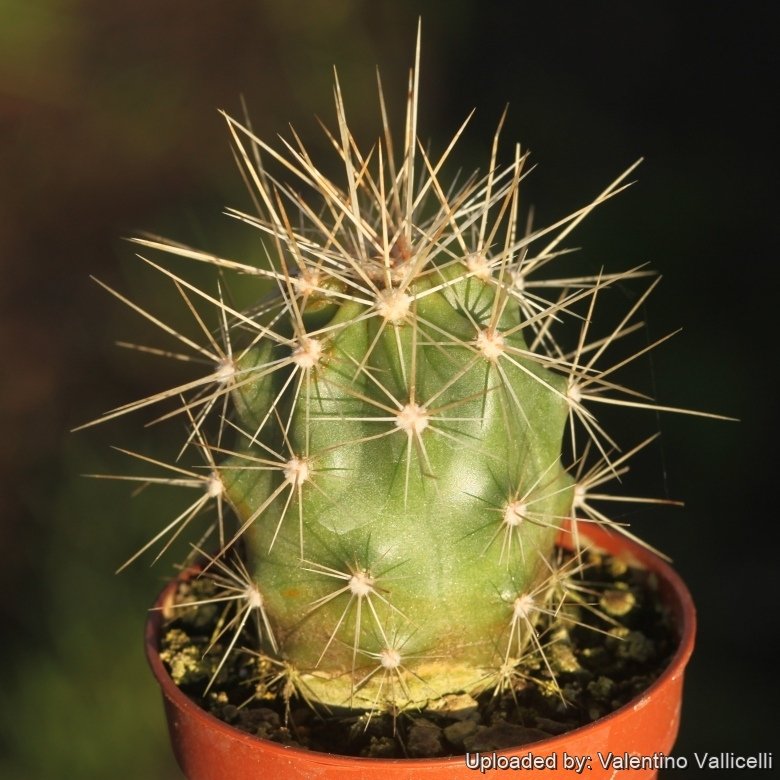
Echinocereus sarissophorus is a morphological form of the variable Echinocereus enneacanthus distinguishes for its stout, stubby habit and by its very long, usually stiff, often bluish spines. It is a particularly beautiful plant in flower. The differences with other “enneacanthus” are in reality very minimal (if none) and most botanist agree on the fact that “sarissophorus” should be included in the “enneacanthus”, and the two plants are not readily distinguishable, if not for the label.
Habit: Plants caespitose forming dense or lax clumps either loose decumbent, or erect, usually branching before flowering. Larger plants may have 50-100 or more stems.
Stems: Short, thick, pale green or somewhat yellow-green, about 10 cm thick and 15 cm long.
Ribs: 9 warty.
Areoles: that are 20-45 mm apart.
Radial spines: 7 to 10, slender.
Central spines: Several, 5 to 8 cm long, often bluish, somewhat angled, rather stout and divergent from the stem.
Flowers: Diurnal, funnelform, purplish, 7 to 8 cm long, and 7-9(-10) cm in diameter. Tepals in 2-3 series, inner ones broad oblanceolate up to 55 cm long and 1-2 cm wide, and acuminate-serrate at the apex; areoles on ovary and flower-tube bearing short, white wool and 3 to 5 long pale bristle-like spines.
Blooming season: Blooming in spring (April and May in habitat). Occasionally, plants produce single or a few flowers later in the year, possibly in autumn.
Fruit: Globular to ovoid, 2 to 3 cm. in diameter, covered with clusters of deciduous spines. The fruits are edible. After the spines are removed from the green-brown flesh of the fruit, it can be eaten and tastes similar to, hence the name strawberry cactus.
Seeds: Black, ovoid, tuberculate, and 1-1,4 mm long.
Chromosome number: 2n = 22.
Origin and Habitat
Echinocereus sarissophorus is common in Coahuila and Chihuahua, Mexico.
Habitat: Gravel hills and benches, alluvial outwash fans and bolsones, also desert mountains, exposed to the sun or under shrubs.
Bibliography
Major references and further lectures
-
David Hunt, Nigel Taylor “The New Cactus Lexicon” DH Books, 2006
-
John Pilbeam (1999) “Mammillaria The Cactus File Handbook” Nuffield Press.
-
Nathaniel Lord Britton, Joseph Nelson Rose “Cactaceae: Descriptions and Illustrations of Plants of the Cactus Family” vol. 4 The Carnegie Institution of Washington, Washington 1923
-
Stuart Max Walters “The European Garden Flora: Dicotyledons (Part I)” Cambridge University Press, 1989
-
Edward F. Anderson “The Cactus Family” Timber Press, 2001
-
A. Michael Powell, James F. Weedin “Cacti of the Trans-Pecos & Adjacent Areas” Texas Tech University Press, 2004
Source: Echinocereus sarissophorus, LLIFLE - Encyclopedia of living forms, CC-BY-SA, retrieved 2026-10-25.
From llifle page Echinocereus uspenskii
Description
Plants caespitose forming dense or lax clumps either loose decumbent, or erect with 20-100(-500) branches, usually branching before flowering. ,
Stems: 5-14 cm diameter up to over 100 cm long, The stems of this species are soft bright green and often remain wrinkled.
Ribs: 7-12 prominent warty.
Areoles: 18-52 mm apart.
Radial spines: Curved needle-like brownish, bulbous at the base 5-9 per areole, 25-45 mm;
Central spines: long and divergent 1-5 per areole, 55-95 mm.
Flowers; Purple-red to pink in varying shades, and diurnal. Blooming in spring.
Fruit: Round pale yellow-green or dull reddish, 20-30 mm, pulp white or pale pink. The fruit (especially var. stramineus) are edible. After the spines are removed from the green-brown flesh of the fruit, it can be eaten and tastes similar to, hence the name straswsberry cactus.
Origin and Habitat
New Mexico, Texas and Northeastern Mexico (Sonora, Chihuahua, Durango, Nuevo León, San Luis Potosí and Coahuila)
Habitat: Chihuahuan desert scrub, flats, rarely rocky slopes; 600-1800 m.
Source: Echinocereus uspenskii, LLIFLE - Encyclopedia of living forms, CC-BY-SA, retrieved 2026-10-25.
Cultivars and forms (4)
Subspecies (1)
Varieties (1)
Gallery