Publication: Cact. Succ. J. (Los Angeles) 70: 285 1998
Description
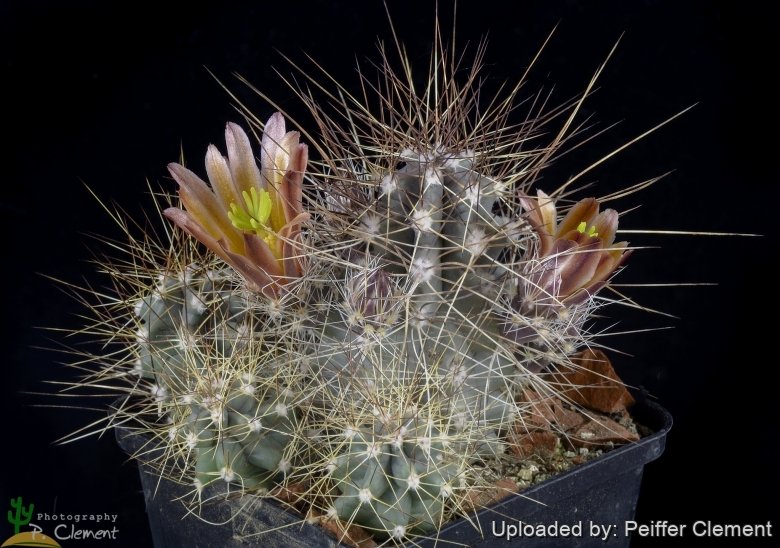
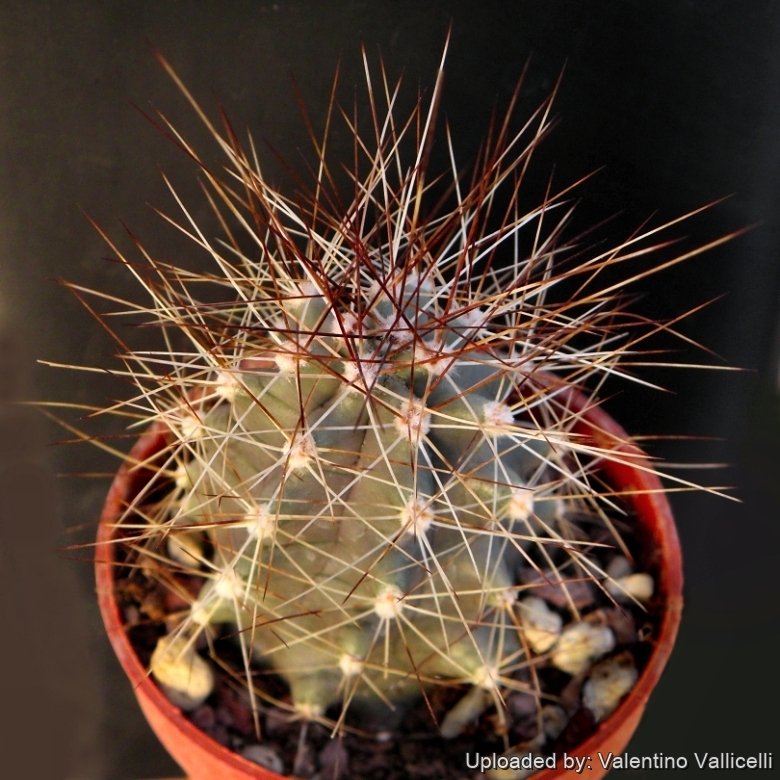
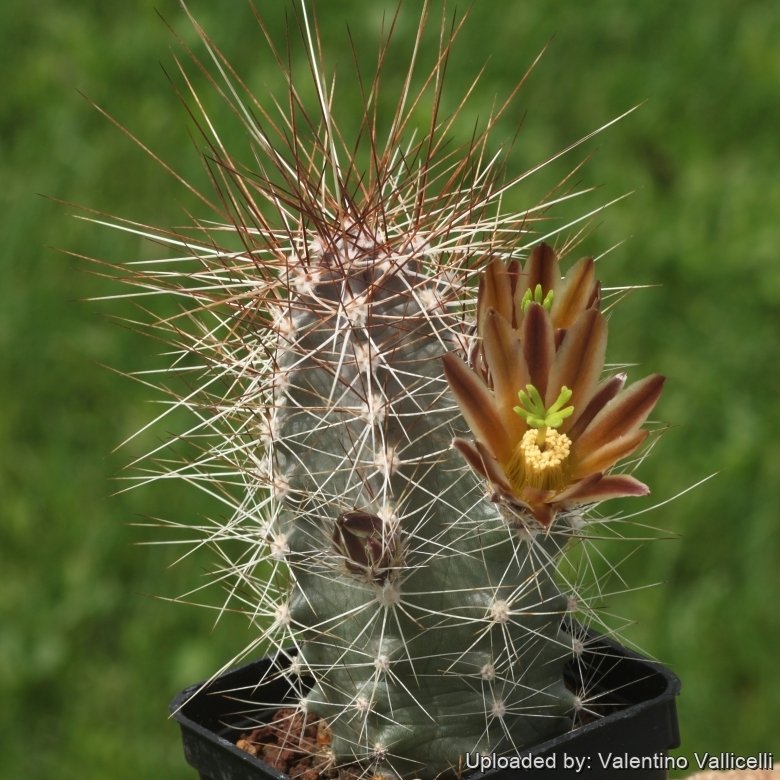
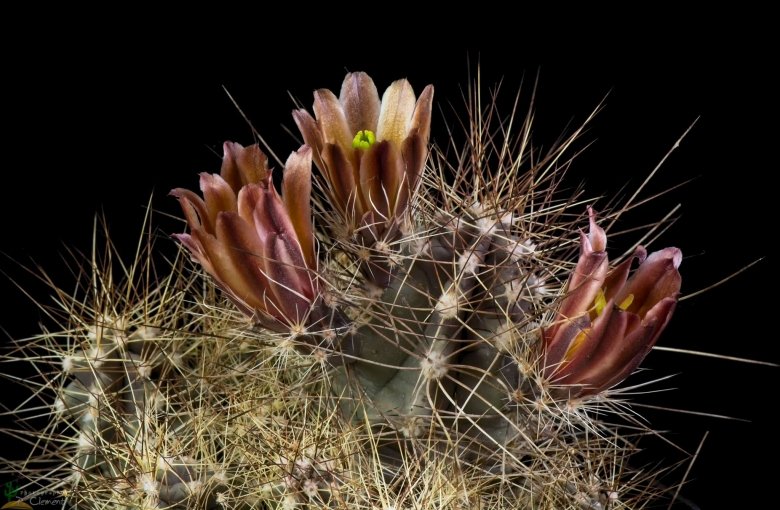
Echinocereus mapimiensis is a small offsetting cactus with white and caramel spines and small rusty flowers. It slowly forms open clumps up to 25 cm in diameter.
Stem: Cylindrical 6-30 cm tall, 1,5 to 3,5 cm across, erect or somewhat drooping with age, light green/grey/blue soft, not obscured by spines.
Ribs: Mostly 6, rounded, forming low tubercles.
Areoles: Round, white felted.
Spines: Thin, straight, aciculate, blackish to deep red, turning greyish-white as the olden.
Radial spines: 4 to 8 spreading, 9-18 mm long.
Central spines: 2 to 4 similar to the radials, 15-22 mm long.
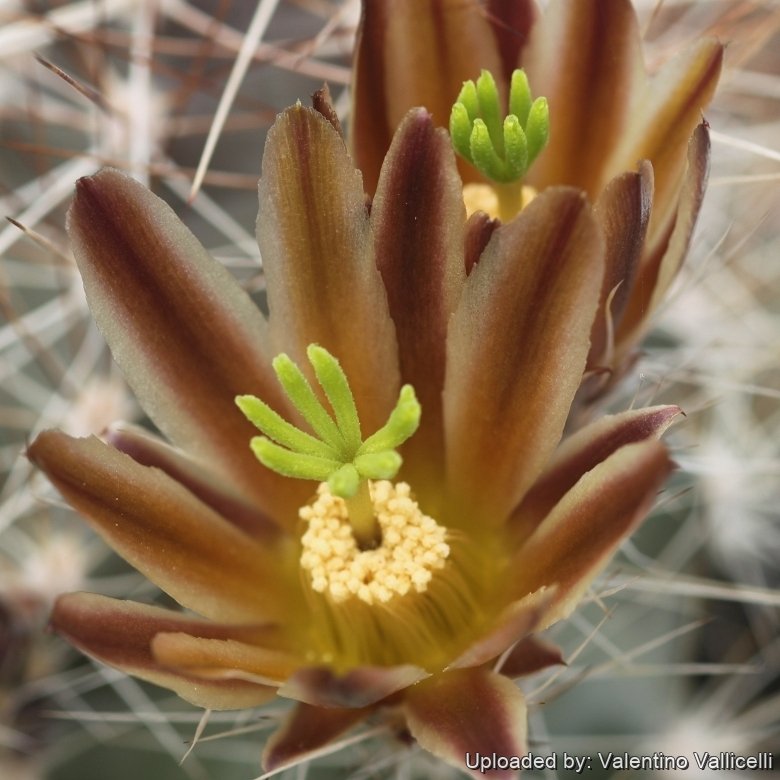
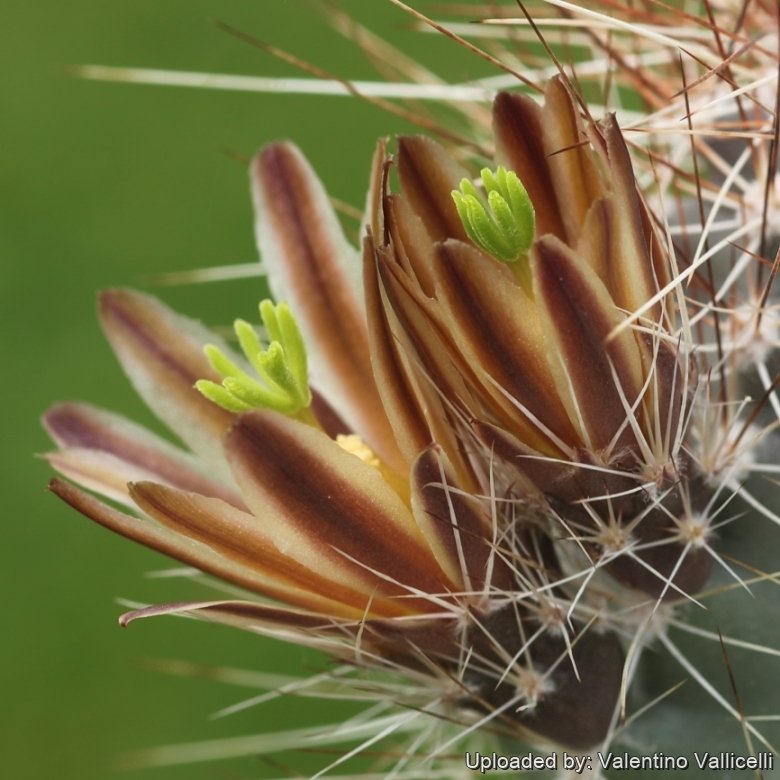
Flower: Funnel-shaped (30-)42-44(-45) mm long, (17-)25-29(-40) mm in diameter, outer perianth segments dark brownish-magenta/maroon/yellow with lighter cream colored margins, inner perianth segments rusty-red to brownish-magenta with lighter margins; stigma lobe number up to 9, stigma colour green.
Fruits: Spherical ovoid, green, 15-21 mm long, 12-15 mm broad spiny.
Origin and Habitat
Mexico (Coahuila: Bolsón de Mapimí)
Type Locality: Coahuila 366 m Mexico, Coahuila, Maricopa County, Bolson de Mapimi, 28,5 km Nort of Acatita. N 33 deg 27’ 33”, W 111 deg 56’ 35” Elevation: 366 meters
Habitat: Grows among scrubs. The area of the Bolsón de Mapimí harbour a rich succulent flora comprising: Grusonia bradtiana, Coryphantha poselgerii v. valida, Echinocactus horizonthalonius, Thelocactus bicolor, Epithelantha micromeris, Dasylirion longissinum, Mammillaria pottsii, Escobaria duncanii, Ibervillea sonorensis and Coryphantha runyonii.
Cultivation and Propagation
In culture Echinocereus mapimiensis is without problems, easy to grow, very attractive and regularly shows its beautiful flowers, if provided with an adequate winter rest period.
Moisture: It is sensitive to over-watering (rot prone), and needs good drainage. In the winter keep it cool, and absolutely dry conditions.In summer keep it well watered when it’s hot.
Exposure: Needs full sun. To achieve the best spine density give these plants lots of sun.
Hardiness: Very cold resistant above -12° C or less for short periods of time. In the summer they need an airy location in bright sun; In mild climate they grow well when planted freely outside in well-drained soil.
Propagation: Seeds (usually), it also can be grown from cuttings, as it can branch from the base.
Bibliography
Major references and further lectures
-
Edward Anderson “The Cactus family” Timber Press, Incorporated, 2001
-
James Cullen, Sabina G. Knees, H. Suzanne Cubey “The European Garden Flora Flowering Plants: A Manual for the Identification of Plants Cultivated in Europe, Both Out-of-Doors and Under Glass” Cambridge University Press, 11/Aug/2011
-
David R Hunt; Nigel P Taylor; Graham Charles; International Cactaceae Systematics Group. “The New Cactus Lexicon” dh books, 2006Jackie M. Poole, William R. Carr, Dana M. Price, Jason R. Singhurst “Rare plants of Texas: a field guide” Texas A&M University Press, 30/Dec/2007
-
Cact. Succ. J. (Los Angeles) 70: 285, fig. 1998
Gallery