Publication: Gen. Echinocereus 44. 1985
Description
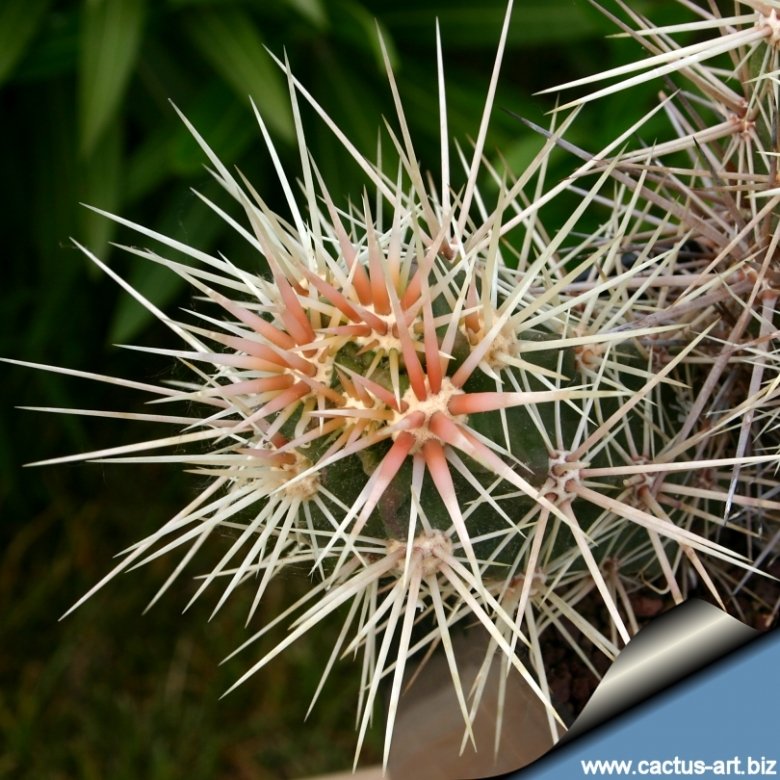
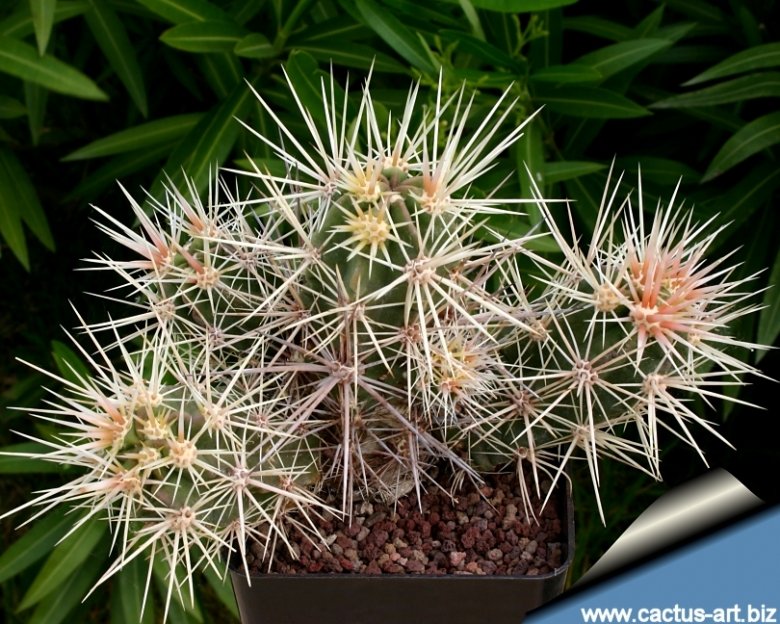
Echinoceres maritimus is a mounding cactus, forming colonies of spherical to cylindrical stems. In habitat they can grow up to 2 m in diameter and 40 cm tall, with as many as 300 stems! They may vary from long (usual) to short-spined. Some botanists recognize two subspecies of Echinocereus maritimus. Subspecies hancockii is much larger than subspecies maritimus, has larger stems 5.5-7 cm in diameter, much stronger spination and occurs in smaller clumps with as many as 30 stems, but otherwise is quite similar. Echinocereus hancockii was described in the American periodical Desert Plant Life in 1949 by Elmer Yale Dawson. Nigel Taylor (1985) reduced Echinocereus hancockii to a variety of E. maritimus. Later, Blum et al. (1998) considered it a subspecies of E. maritimus but more recently Hunt et al. (2006) declined to accept the name at any rank. E. maritimus produces smaller but more numerous heads and with spination that is not quite as strong as E. hancockii. This species resemble in habit with Opuntia invicta.
Stems: Globose or short-cylindrical, light to dark green 5-30 cm tall, 5.5-7 cm cm in diameter.
Ribs: 8 to 10, acute, 8-15 mm wide.
Roots: Fibrous.
Central spines: Central and upper spines 4, pinkish to bright red, becoming dirty yellow or grey, spreading, stiff, straight, strongly flattened and angled, erect, 2,5-6cm long. (up to 3 mm in diameter).
Radial spines: Radial and lower spines 7 to12, 1,5-2,5 cm long.
Flowers: Subterminal, infundibuliform, bright yellow, up to 6 cm long and in diameter. Buds reddish brown with a few weak spines. Stigma lobes pale yellow with barely a hint of green. This feature of yellow is shared with a few other Baja California species such as Echinoceres brandegeei, Echinoceres ferreirianus and Echinoceres pensilis.
Blooming season: E. hancockii is notorious for being shy to flower, and blooms may appear from spring to autumn.
Fruits: Globose, green, becoming red, spiny, drying up but not breaking. Ripens in 4-8 months.
Seeds: 1,2-1,3/1 mm dark/brown black.
Origin and Habitat
Echinoceres maritimus subsp. hancockii, occurs in the north side of San Hipolito (San Hipolito Bay), west coast of Baja California, Mexico. It is clearly related to Echinocereus maritimus, a much more common and widespread plant that grows further to the north on the Baja peninsula. Perhaps E. maritimus subsp. hancockii is best just considered a giant form of E. maritimus growing at the extreme southern end of the distribution.
Altitude range: About 50 metres above sea level.
Habitat: Echinocereus hancockii grows in a stony soil on fairly barren flat hills near the coast and on arid slopes within sight of the sea where they make clumps of chunky fiercely spined stems. In some part of its range it grows among Echinocereus brandegeei and Opuntia invicta this three species look remarkably like one to each other. The adaptive value of this convergence (if any) is unknown.
Cultivation and Propagation
This plant from Baja California needs warmer winter temperatures, and can resist only occasional light frost, above -2 C. It is sensitive to over-watering (rot prone) and needs good drainage. Fertilize with a half-strength liquid fertilizer in summer. Keep absolutely dry in winter. Needs full sun;
Propagation: Seeds or cutting (if available)
Bibliography
Major references and further lectures
-
Edward Anderson “The Cactus family” Timber Press, Incorporated, 2001
-
Forrest Shreve, Ira Loren Wiggins “Vegetation and Flora of the Sonoran Desert”, Volume 1 Stanford University Press, 1964
-
Blum, W.; Lange, M.; Rischer, W. & Rutow, J “Echinocereus” Selbstverlag, Aachen 1998
-
Dawson, E.Y. “A New Echinocereus from Baja California.” Desert Plant Life 21:89-93 1949
-
Taylor, N. “The Genus Echinocereus” Royal Botanic Gardens Kew 1985
-
Anderson, E.F. “The Cactus Family.” Timber Press, Portland.2001.
-
IUCN. 2013. “IUCN Red List of Threatened Species” (ver. 2013.1). Available at: http://www.iucnredlist.org. (Accessed: 12 June 2013).
-
Peinado, M., Alcaraz, F., Aguirre, J.L., and Delgadillo, J. “Major Plant Communities of Warm North American Deserts”. Journal of Vegetation Science 6(1): 79-94.1995.
-
Paul Hoxey “Flowering Echinocereus hancockii in the glasshouse” pp 13-15, Number 7 February 2013 ISSN 2048-0482 The Cactus Explorer