Publication: Mem. Tour N. Mexico [Wislizenus] 110, 1848.
Description
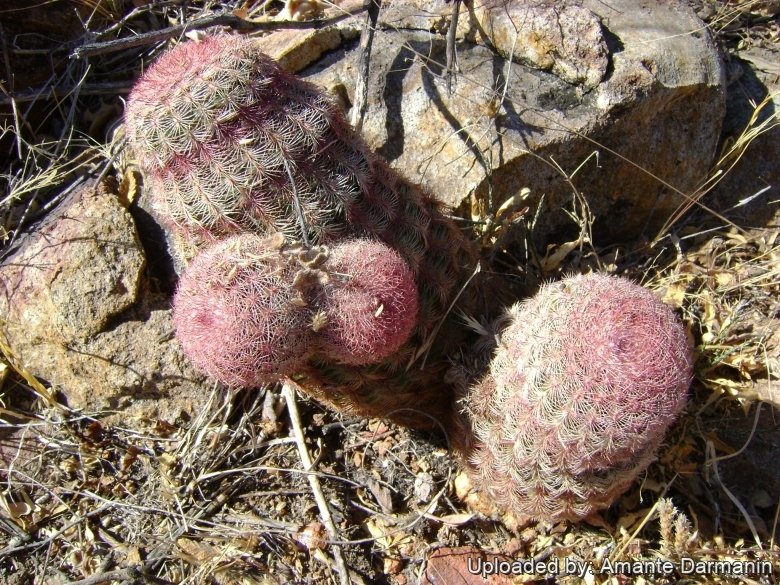
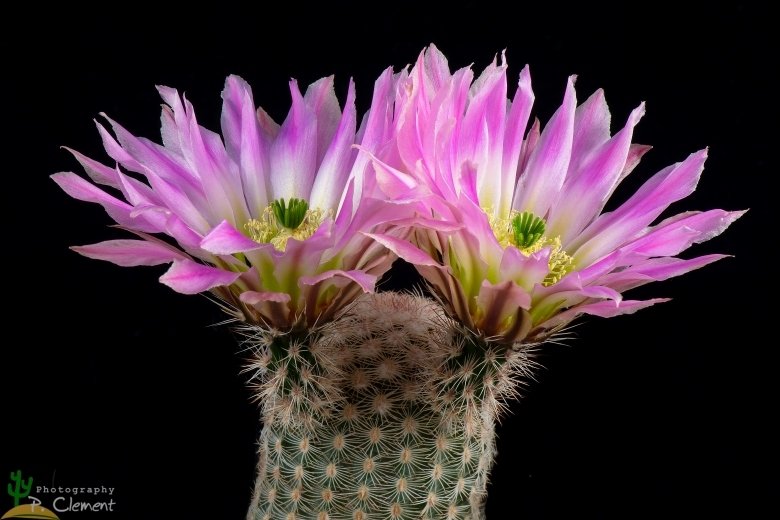
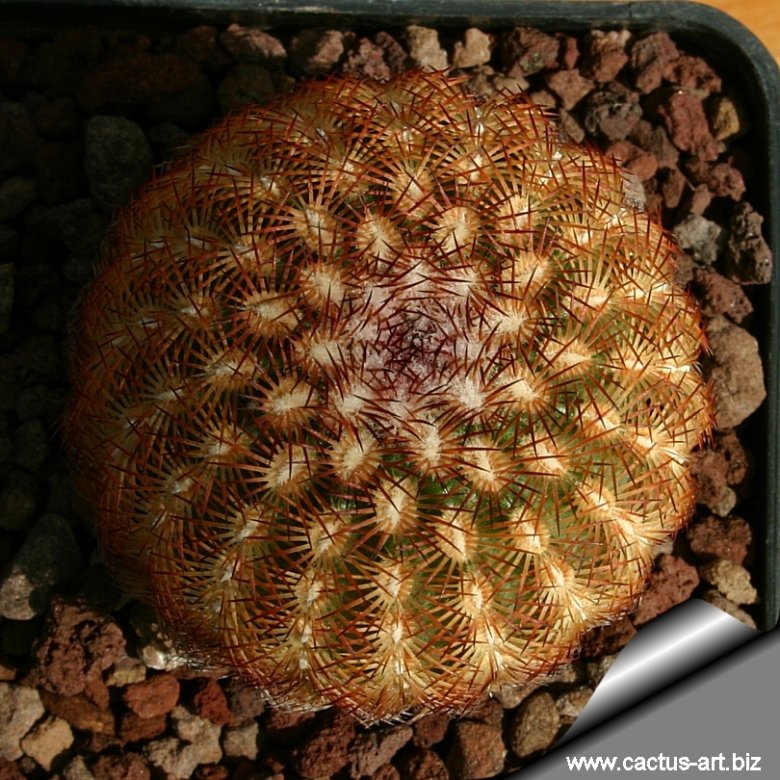
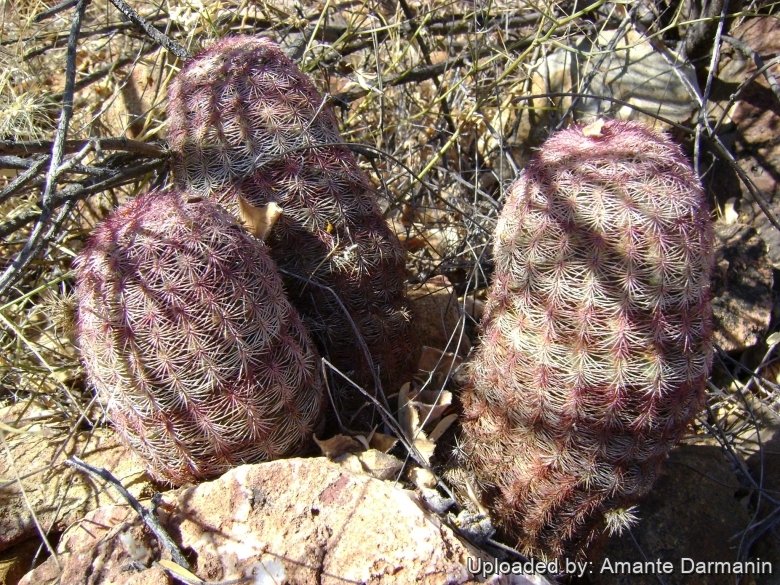
The rainbow cactus (Echinocereus pectinatus) commonly remains single, but old plants sometime branch and form a a loosely clumped cluster. It has yellow, pinkish or brownish spines loosely pressed to the surface or spreading widely, pectinate, and intertwining with those of the other areoles. It produces very beautiful, brilliantly coloured flowers with spiny tube, which later develop into Gooseberry-like fruits rich in sugar and said to be very delicious. Two subspecies are recognized by Anderson (2001 ), the nominate, and subsp. wenigeri (L.D.Benson) W.Blum & Rutow. A third supecies, subsp. ctenoides (Engelm.) G.Frank, is included here by Hunt et alt. (2006), but Anderson placed it in Echinocereus dasyacanthus Engelmann).
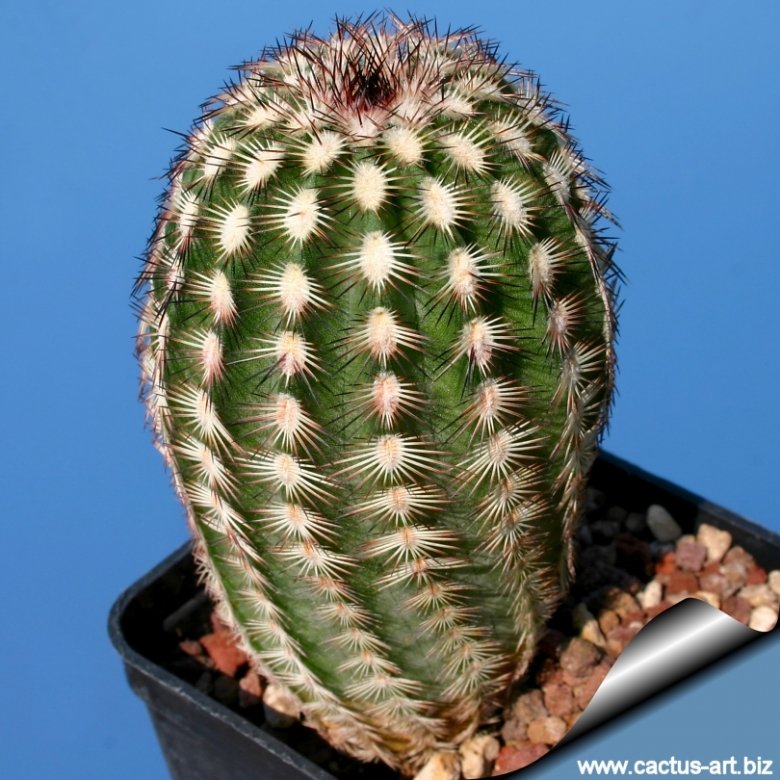
Stems: Usually solitary, globose to cylindrical (8-)10-20(-35) cm tall 3-6(-13) cm in diameter almost hidden by the short interlocking spines.
Ribs: (12-)20-23 obtuse, usually straight forming low tubercles.
Areoles: Approximate, but not touching one another, about 3 mm long, oval, young areoles with short white hair.
Central spines: Not present or (usually) 1 to 6 very short, yellow to pinkish to brownish, more or less erect or diverging, 1-25 mm long.
Radial spines: (12-)16-30 white or pinkish 5-10 mm long, usually closely pressed to the surface or spreading widely, pectinate, and intertwining with those of the other areoles pinkish to grayish, often in coloured bands.
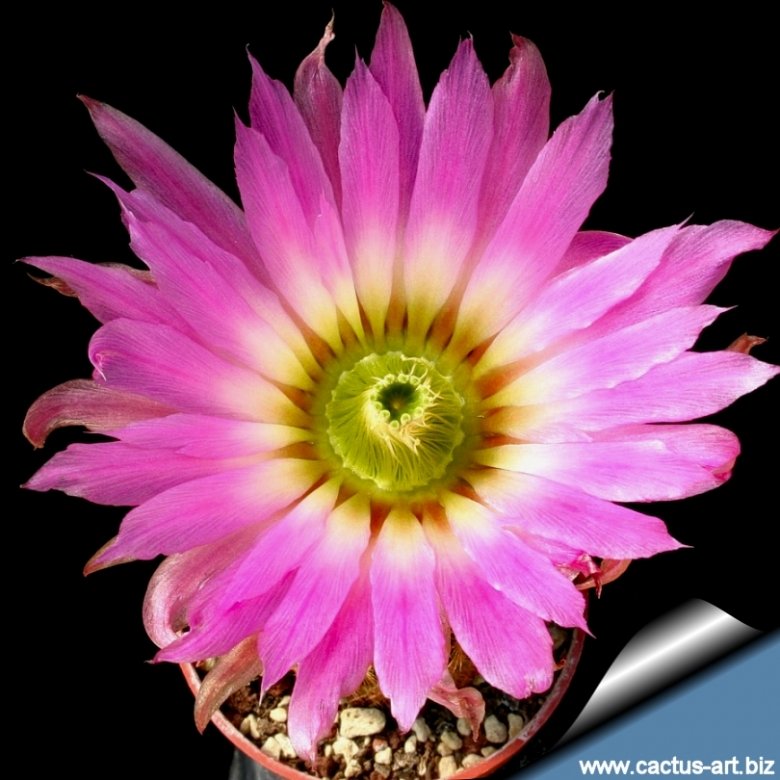
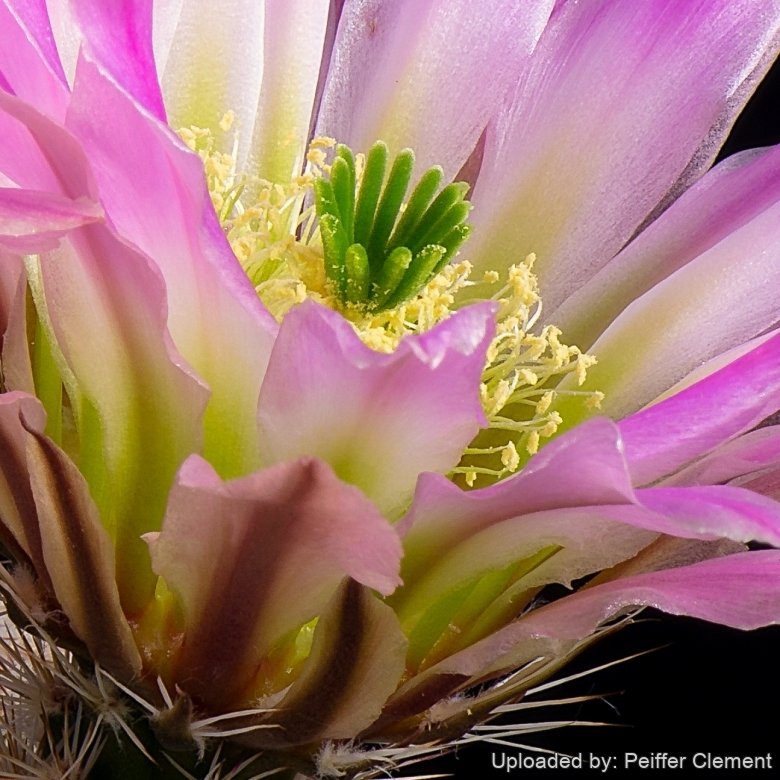
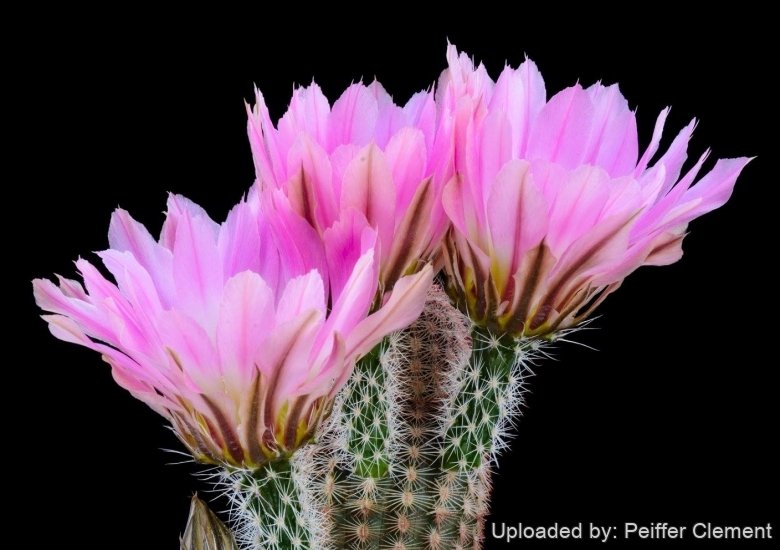
Flowers: Funnel-shaped, borne on the sides of the stems, diurnal, intense pink (but also magenta, lavender…or…yellow to near-whitish) with a white-greenish base, (5-)6-88-15) cm long and in diameter. Petals quite long and pointed, areoles very spiny with white hairs on the floral tube. Stamens usually cream coloured.
Blooming season. Spring—summer.
Fruits: Spiny, globose to elliptical, greenish-purple, fleshy, becoming naked, 2-3 cm in diameter. Gooseberry-like rich in sugar and said to be very delicious.
Similar species: E. pectinatus, with at least microscopically visible stubs of central spines is superficially similar to the unrelated Echinocereus rigidissimus, belonging to the Echinoceeus reichenbachii group, which always lacks central spines. Botanists sometimes lump this species with the yellow-flowered Texas rainbow hedgehog, Echinecereus dasyacanthus, or consider them varieties of a single species.
Origin and Habitat
Echinocereus pectinatus is wide-ranging species distributed in the Mexican states of Aguascalientes, Chihuahua, Coahuila, Durango, Guanajuato, Nuevo León, San Luis Potosí, Sonora, Tamaulipas and Zacatecas, and in the United States in the states of Arizona, New Mexico and Texas.
Altitude range: 400 to 1,900 metres above sea level.
Habitat and Ecology: The species grows in xerophyllous scrub, limestone hills and grasslands, is common in the Chihuahuan Desert Region, in many places it occurs at high densities, and although there are threats in places these are not sufficient to warrant any concern. The species is eaten by the larvae of a moth, many populations are devastated by this, however it is difficult to establish if this is major threat. In parts of its range the species is affected by fires.
Cultivation and Propagation
In culture Echinocereus pectinatus is without problems and regularly shows its beautiful flowers if we provide an adequate winter rest period. It is sensitive to overwatering (rot prone) needs good drainage, Keep drier and cool in winter. Need full sun; Very cold resistant hardy to -10° C or less for short periods of time.
Propagation: Seeds or cutting (if available)
Bibliography
Major references and further lectures
-
Edward Anderson “The Cactus family” Timber Press, Incorporated, 2001
-
Nathaniel Lord Britton, Joseph Nelson Rose “Cactaceae: Descriptions and Illustrations of Plants of the Cactus Family” vol. 4 The Carnegie Institution of Washington, Washington 1923
-
James Cullen, Sabina G. Knees, H. Suzanne Cubey “The European Garden Flora Flowering Plants: A Manual for the Identification of Plants Cultivated in Europe, Both Out-of-Doors and Under Glass” Cambridge University Press, 11/Aug/2011
-
David R Hunt; Nigel P Taylor; Graham Charles; International Cactaceae Systematics Group. “The New Cactus Lexicon” dh books, 2006
-
Goettsch, B.K., Gómez-Hinostrosa, C., Heil, K., Terry, M. & Corral-Díaz, R. 2013. Echinocereus pectinatus. The IUCN Red List of Threatened Species 2013: e.T152048A591134. http://dx.doi.org/10.2305/IUCN.UK.2013-1.RLTS.T152048A591134.en. Downloaded on 07 March 2016.
-
Bárcenas, R.T. “Chihuahuan Desert cacti in Mexico: an assessment of trade, management and conservation priorities”. In: Robbins, C.S. (ed.), “Prickly trade: trade and conservation of Chihuahuan Desert cacti”, pp. 1-65. Traffic North, Washington DC. 2003
-
Hernández, H.M., Gómez-Hinostrosa, C. and Goettsch, B. “Checklist of Chihuahuan Desert Cactaceae.” Harvard Papers in Botany 9(1): 51-68. 2004
-
Martínez-Ávalos, J.G. and Jurado, E. “Geographic distribution and conservation of Cactaceae from Tamaulipas Mexico.” Biodiversity and Conservation 14: 2483-2506. 2005
-
Taylor, N.P. “The Genus Echinocereus.” Collingridge Books, London. 1985
-
Thomas, P.A. “Mortality over 16 years of cacti in a burnt desert grassland.” Plant ecology 183: 9-17. 2006
-
George Oxford Miller “Landscaping with Native Plants of the Southwest” Voyageur Press 2007
From llifle page Echinocereus cernosus
Description
It commonly remains single, but old plants sometime branch and form several heads.
Stems: Cylindrical stems 10-20 cm tall 3-6 cm in diameter almost hidden by the short interlocking spines.
Ribs: (12-)20-23 obtuse, usually straight.
Areoles: Approximate, but not touching one another, about 3 mm long, oval, young areoles with short white hair.
Central spines: Not present or 1 to 6 and very short, more or less porrect.
Radial spines: 16 to 30 white or pinkish 5-10 mm long, spreading widely, pectinate, and intertwining with those of the other areoles often in coloured bands.
Flowers: Funnel-shaped, diurnal, intense pink (but also magenta, lavender…Or…Yellow to near-whitish) with a white-greenish base, 6-8 cm long , petals quite long and pointed, areoles very spiny with white hairs on the floral tube. Stamen usually cream coloured.
Fruits: Spiny, greenish-purple, becoming naked, 2-3 cm in diameter. Gooseberry-like rich in sugar and said to be very delicious.
Origin and Habitat
Southwestern US, northern Mexico
Cultivation and Propagation
In culture E. pectinatus is without problems and regularly shows its beautiful flowers if we provide an adequate winter rest period. It is sensitive to overwatering (rot prone) needs good drainage, Keep drier and cool in winter. Need full sun; Very cold resistant hardy to -10° C or less for short periods of time.
Propagation:* Seeds or cutting (if available)
Source: Echinocereus cernosus, LLIFLE - Encyclopedia of living forms, CC-BY-SA, retrieved 2026-10-25.
Cultivars and forms (2)
Varieties (1)
Forms (1)
Gallery