Publication: Gen. Echinocereus 140. 1985
Description
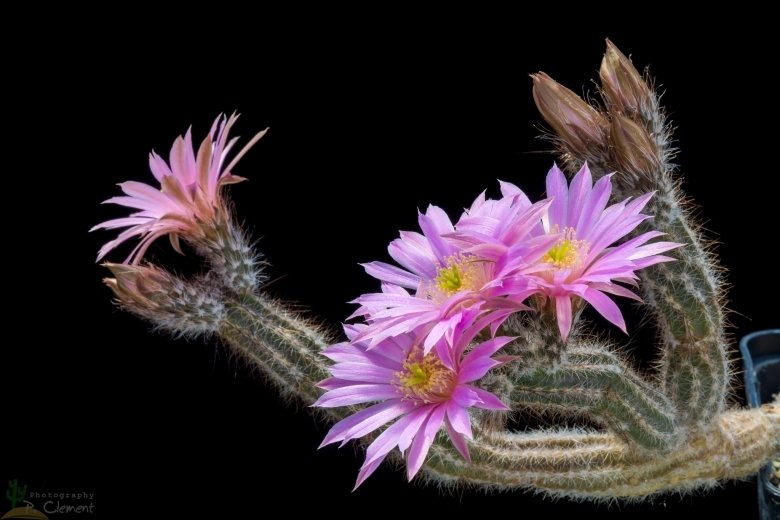
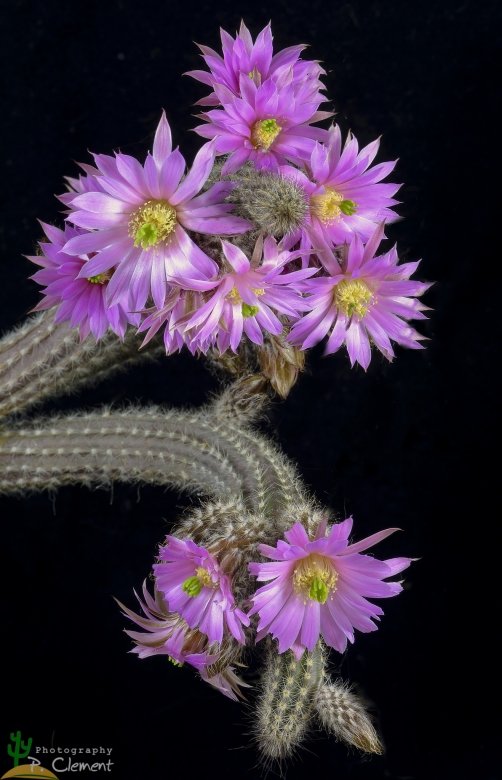
Echinocereus schmollii is a small usually solitary or scarcely branched cactus with tuberous roots and thin, limp stems that in the wild needs the support of some host bush branches, stem tend to snake around when plant is cultivated, if not supported with sticks. Echinocereus schmollii was originality named and for the long time called Wilcoxia schmollii.
Roots: Tuberous.
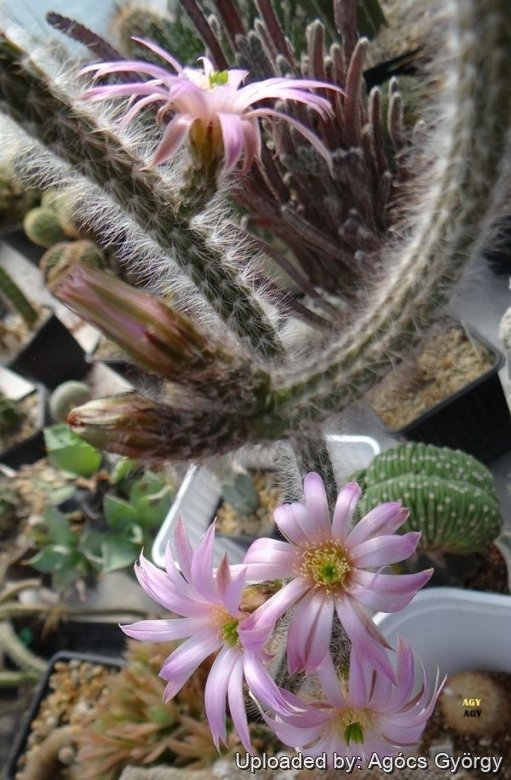
Stem: Pencil-like, thin, cylindrical, initially erect, later sprawling or clambering, purplish to blackish green, 25 cm long, 1 cm in diameter with 9-10 rounded tuberculate ribs.
Areoles:1.5 mm wide, 2 mm apart
Spines: Up to 35 very thin, 3-7 mm long, hairlike, pinkish to whitish-grey, reddish at the apex, giving the stem a woolly appearance.
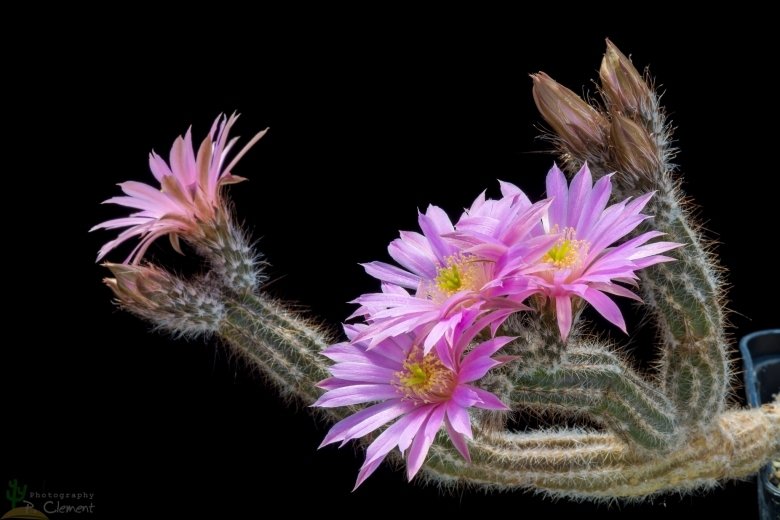
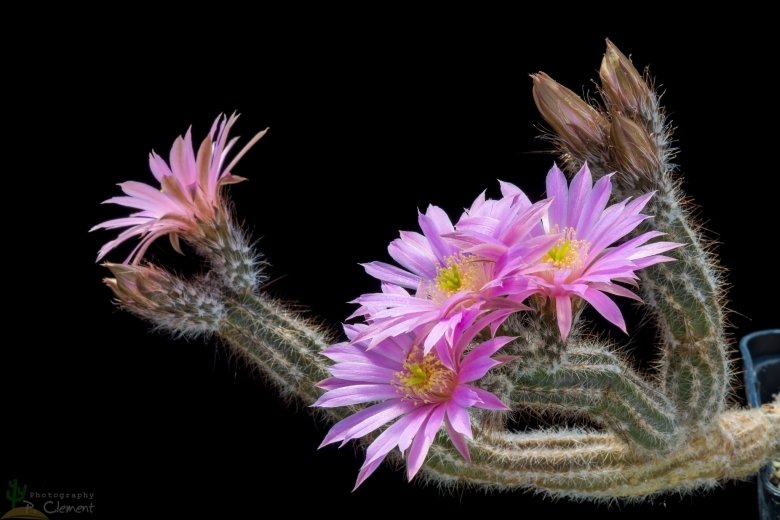
Flowers: Showy, funnelform pink to magenta near the tips of older stems, 3-5 cm long,5-6 cm in diameter.
Blooming season: Flowers are easily produced, usually several waves of blooms over the summer.
Fruit: Ovoid or roundish, purplish green and juicy.
Remarks: It apparently looks like some Peniocereus species. However the flowers, fruits, and seeds of Echinocereus schmollii are characteristic for Echinocereus, somewhat comparable to those of Echinocereus reichenbachi.
Origin and Habitat
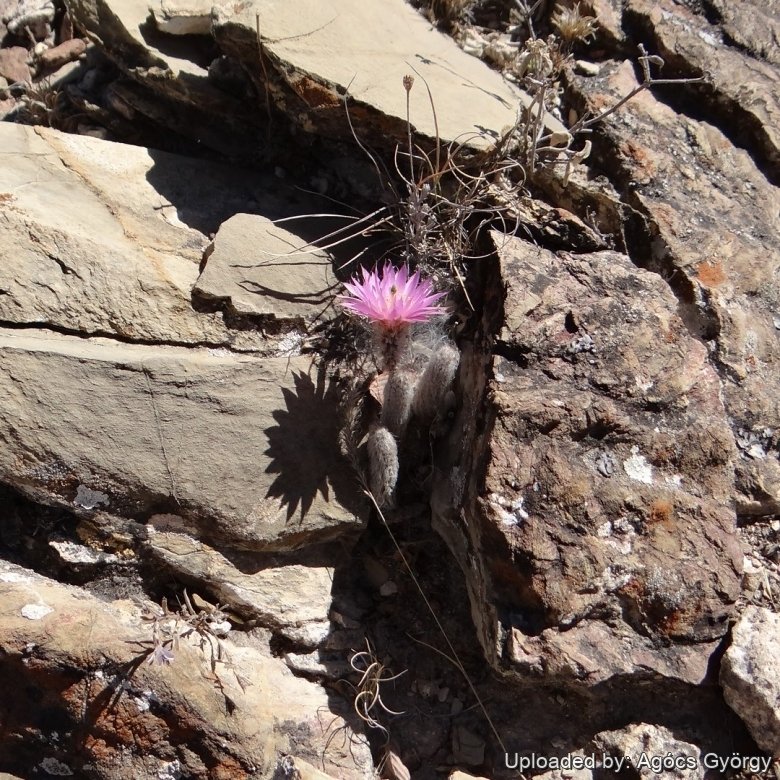
Mexico (Queretaro). The species is only found in two small disjunct areas. This species is considered to be Endangered due to a very small and restricted population (less than 250 mature individuals), and a small extent of occurrence (less than 1,000 km2), and its populations are in decline due to habitat degradation and illegal collecting.
Altitude range: It has a narrow elevational range, occurring on a mesa area (a flat area), at elevations of 1,660 to 1,890 m asl.
Habitat: This species occurs in semidesert, and has a narrow range of tolerance in soil type. Currently Echinocereus schmollii survives in eleven restricted and localized populations from two disjunct small areas in an isolated region in the south of the Chihuahuan Desert. Even when individuals reach an adequate size to produce flowers, flower and seed production is scarce. In the wild population regeneration is mainly driven by vegetative reproduction. It is sometime found growing together with Digitostigma caput-medusae. The populations of this species have been historically threatened by anthropogenic activities, such as road construction, fires, vegetation clearance, and also by farming and soil degradation (Hernández-Oria et al. 2006). Currently the predominant threat is habitat destruction due to mining practices, and there is more mining planned for the future. As it grows mainly in flat areas it is especially susceptible to agricultural activities.
Cultivation and Propagation
Echinocereus schmollii is used to be considered difficult and somewhat rare in cultivation. It likes regular irrigation at time of growth, but do not over water.
Sun Exposure: Best in full or partial sun exposure. In mild climate they grow well when planted freely outside in well-drained soil.
Frost hardiness: It is quite frost hardy -7 (-10)° C.
Maintenance: During the winter months it may become dormant, during which no moisture is required, and the plants should be grown cool and dry (at -5 +10°C). This is important for the flowers as well as for its health. Without this cool winter period it normally won’t get any buds.
Propagation: Seeds (usually), it also can be grown from stem and root cuttings.
Bibliography
Major references and further lectures
-
Sánchez , E., Guadalupe Martínez, J. & Bárcenas Luna, R. 2013. Echinocereus schmollii. The IUCN Red List of Threatened Species. Version 2015.1. <www.iucnredlist.org>. Downloaded on 22 June 2015.
-
Taylor, N.P. (1985): “The Genus Echinocereus”, A Kew Magazine Monograph: 64. Collingridge Books
-
Edward F. Anderson: The Cactus Family. Timber Press, Portland (Oregon) 2001
-
James Cullen, Sabina G. Knees, H. Suzanne Cubey “The European Garden Flora Flowering Plants: A Manual for the Identification of Plants Cultivated in Europe, Both Out-of-Doors and Under Glass” Cambridge University Press, 11/Aug/2011
-
David R Hunt; Nigel P Taylor; Graham Charles; International Cactaceae Systematics Group. “The New Cactus Lexicon” dh books, 2006
From llifle page Echinocereus schmolii var. nerispina
Description
Echinocereus schmolii v. nerispina (Wilcoxia nerispina) is generally included within (as a synonym of) Echinocereus schmollii, suggesting that there is not really a fundamental difference between the two, however it is sometimes considered distinct enough to be worthy of varietal status on the basis of darker, stiffer spination
Derivation of specific name. The name “nerispina”, meaning “black spined”, refers to the grey or black colouration of central spines. The usually darker colour or the spines helps distinguish this cactus from the otherwise identical Echinocereus schmollii
Stems: Cylindrical 1-2 cm in diameter.
Spines: Grey to blackish.
Flowers: For the most part lateral, lilac pink.
For more details see: Echinocereus schmollii
Origin and Habitat
Mexico (Queretaro).
Cultivation and Propagation
This cactus is used to be considered difficult and somewhat rare in cultivation. It likes regular irrigation at time of growth, but do not over water.
Sun Exposure: Best in full or partial sun exposure. In mild climate they grow well when planted freely outside in well-drained soil.
Frost hardiness: It is quite frost hardy -7 (-10)° C.
Maintenance: During the winter months it may become dormant, during which no moisture is required, and the plants should be grown cool and dry (at -5 +10°C). This is important for the flowers as well as for its health. Without this cool winter period it normally won’t get any buds.
Propagation: Seeds (usually), it also can be grown from stem and root cuttings.
Bibliography
Major references and further lectures
-
Willy Cullmann, Erich Götz (Dozent Dr.), Gerhard Gröner “The encyclopedia of cacti” Timber Press, 1987
-
British Cactus & Succulent Journal, Cactus & Succulent Society, 2001
Source: Echinocereus schmolii var. nerispina, LLIFLE - Encyclopedia of living forms, CC-BY-SA, retrieved 2026-10-25.
Gallery