Publication: Mem. Tour N. Mexico [Wislizenus] 93, adnot. 1848 [Apr 1848]
Description
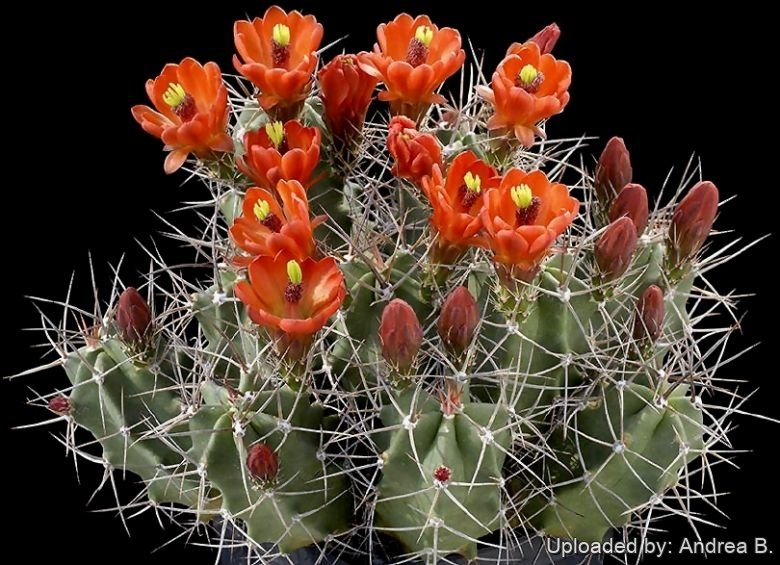
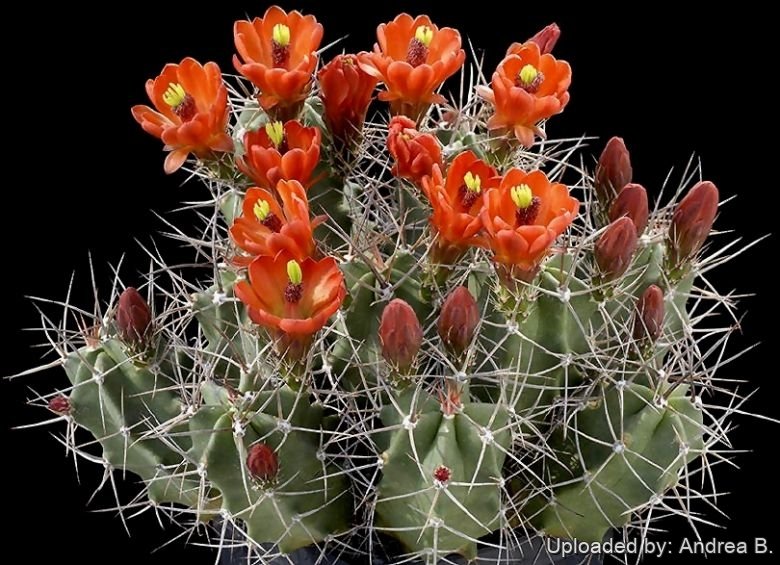
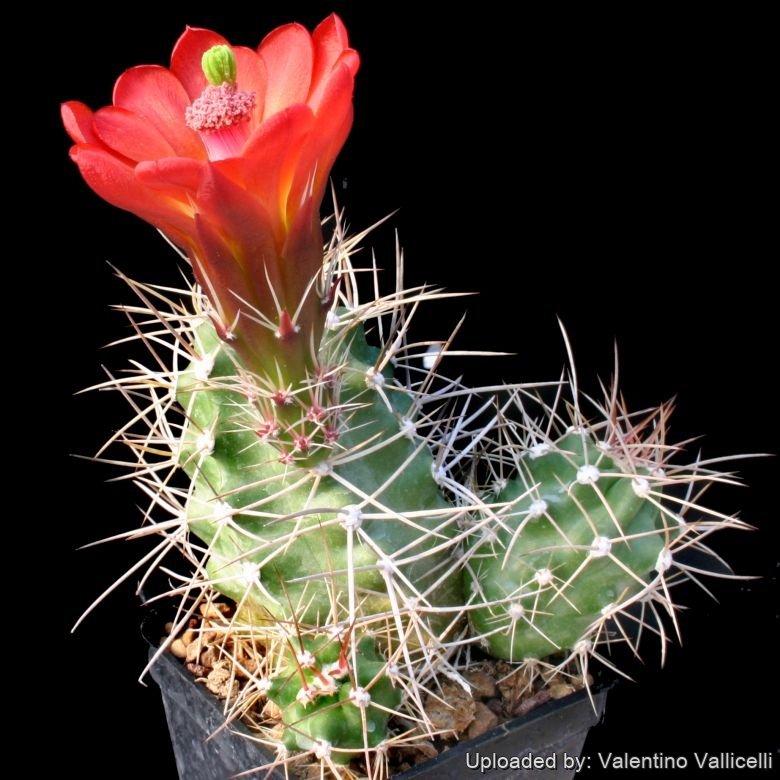
In general it is a mounding cactus, forming bulbous piles of from a few to hundreds of spherical to cylindrical stems. Plants may vary from densely spiny (usually) to no spines at all. Echinocereus triglochidiatus is the most wide-spread of the Echiniocereus species and is also the most variable in appearance. In fact, the several varieties are so different-looking that the only uniting factor is the bright red bloom and rounded petals.
Taxonomy: A distinct species with two subspecies, the nominate form and subsp. mojavensis (Engelm. & J.M.Bigelow) L.D.Benson.
Stems: Usually erect, spherical or cylindrical, 3-70 cm tall, 5-13 cm in diameter.
Ribs: 5-8 or 8-12, crests slightly undulate (some populations contain plants with strongly interrupted ribs).
Areoles: 10-40 mm apart, and somewhat woolly.
Spines (0-)3-11 per areole, with central spines being difficult to distinguish from the radial spines. Straight to curved or contorted, appressed (radial spines) or spreading to projecting outward (some radials, and central spines when present), white to yellow, grey, or sometimes nearly black, but those turn whitish-grey after their first season.
Radial spines: (0-)1-10 per areole, (0-)15-90 mm long; Spines are at first yellow, pink or black.
Central spines: 0-1(-4) per areole, angular, (0-)50-120 mm long.
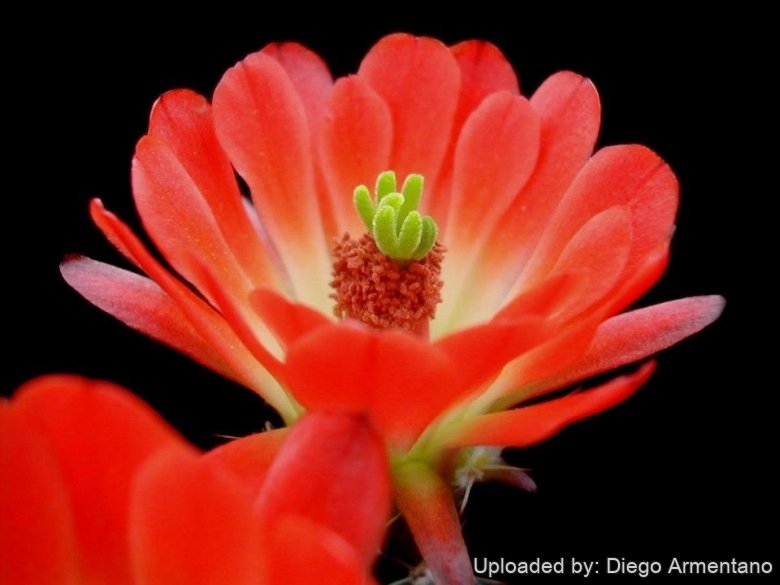
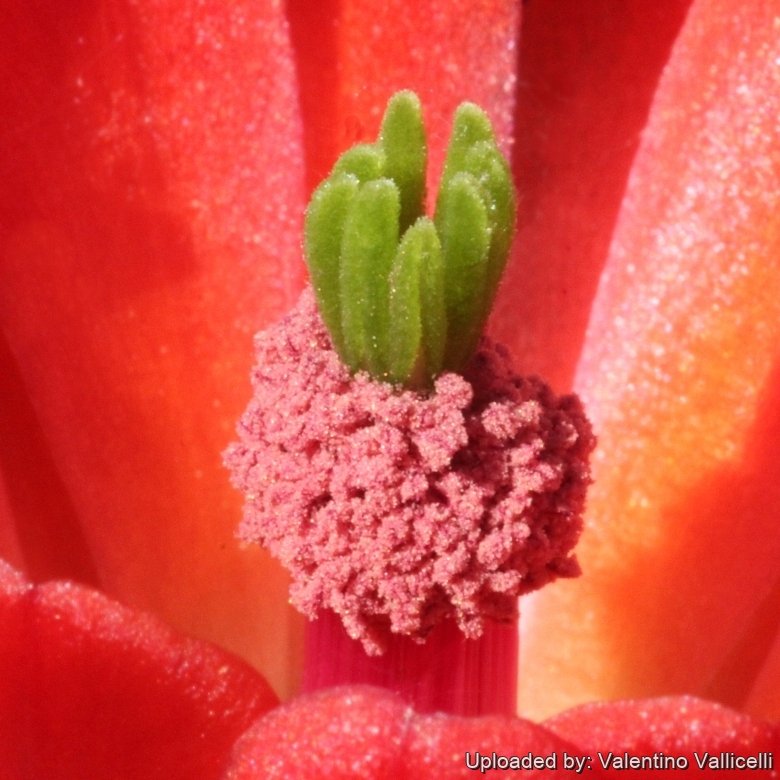
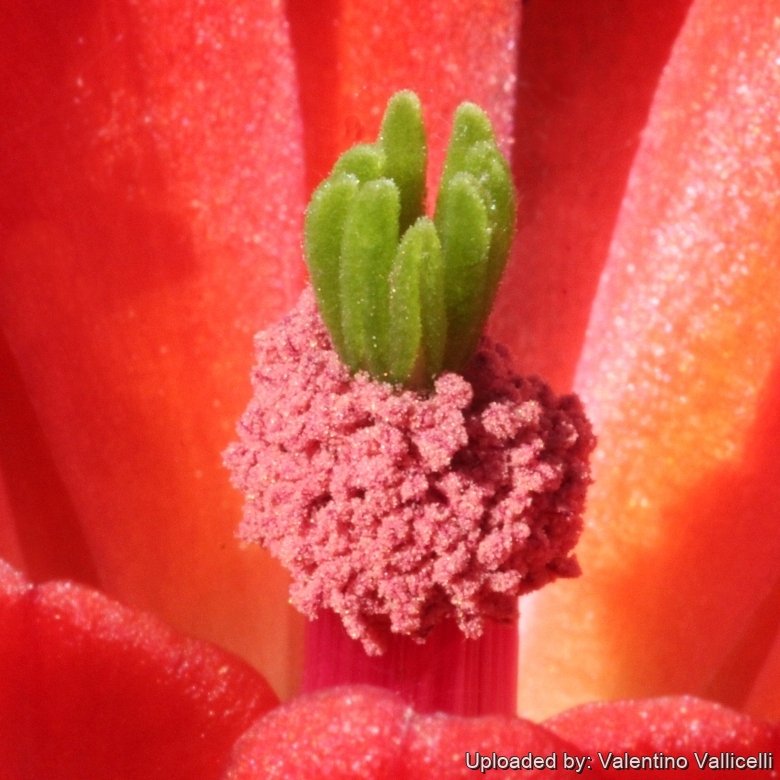
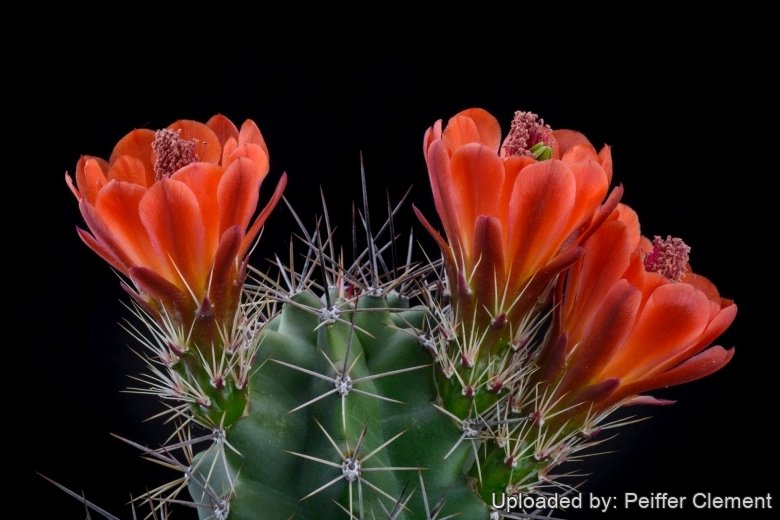
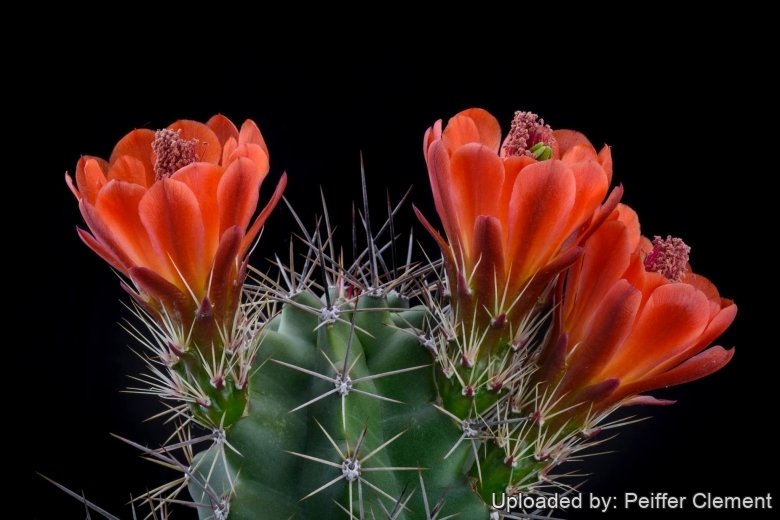
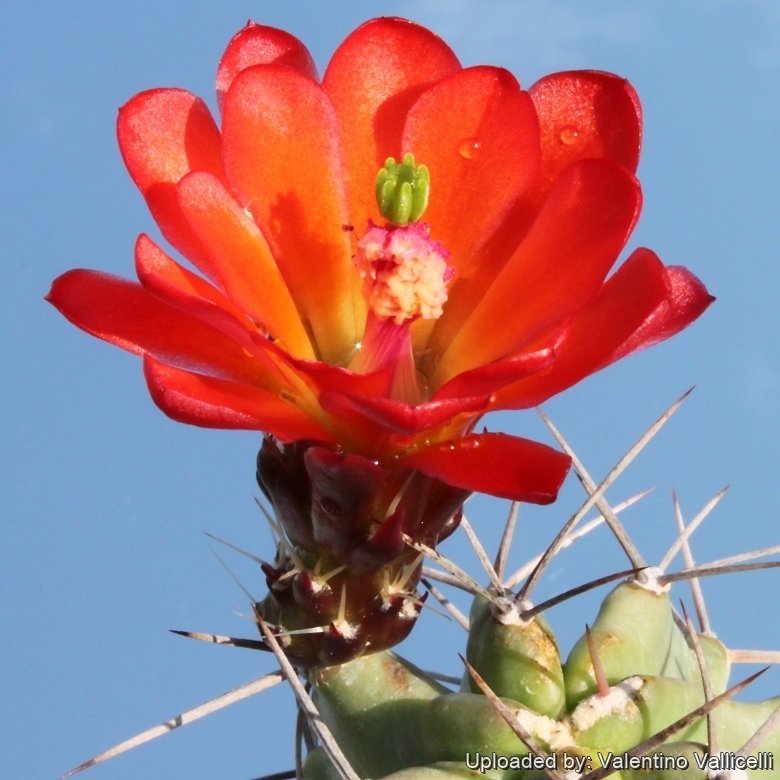
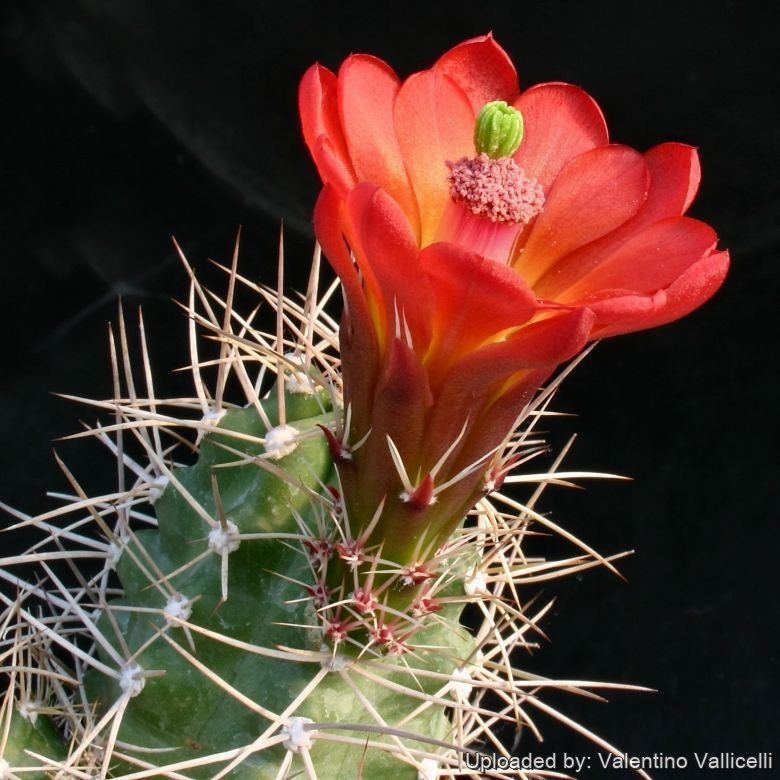
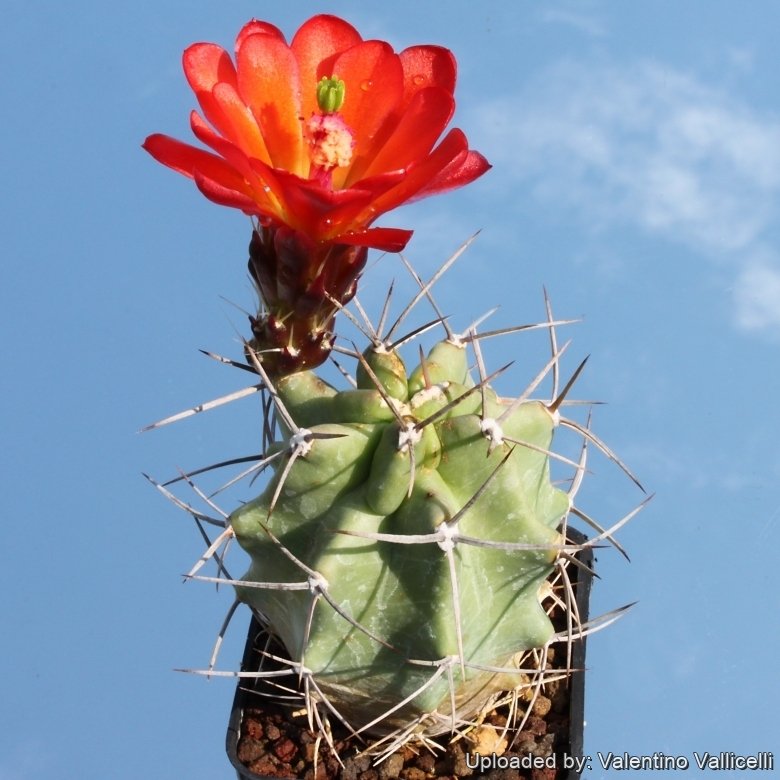
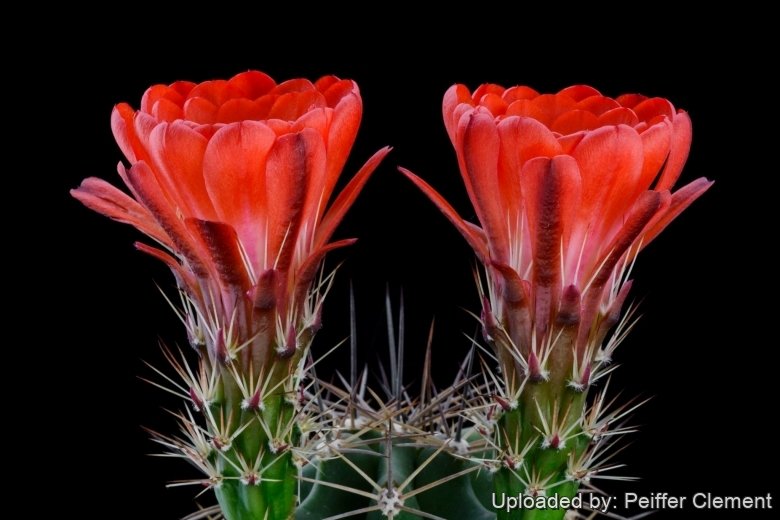
Flowers: Diurnal, funnel-shaped, 5-10 × 3-7 cm; flower tube 20-35 mm; flower tube hairs 1-2 mm; inner tepals bright orange-red to dark red, proximally paler (bases sometimes yellow or white), 25-40 × 10-15 mm, tips thick and rigid; anthers usually pink to purple. There is a thick nectar chamber and many thready pink stamens at the center of the corolla. The flowers are pollinated by hummingbirds.
Fruits: Juicy, with deciduous spines, and edible, green to yellow-green or pink (rarely red), (15-)20-35 mm, pulp white, fruiting 2-2.5 months after flowering.
Blooming season: Apr-June, the flowers remain open for 2 or 3 days. Blooming generally begins 5 to 10 years after sowing, as the plant matures.
Remarks: A spineless form (var. inermis) has been applied at various taxonomic ranks to individual plants with spines absent or nearly so in the eastern portion of var. mojavensis, mainly found in the mountains and mesas of western Colorado and eastern Utah. On these plants, areoles may have very few spines and some stems can be almost completely spineless, but the same plant will have spined stems and many spines per areole in another area.
Chromosome number: E. triglochidiatus is consistently diploid (2n = 22), apart from the tetraploid (2n = 44) Echinocereus coccineus Engelm., which has been treated as conspecific by some previous authors (Benson, 1982; Taylor, 1985). The var. triglochidiatus has been previously reported as var. gonacanthus (Engelm. & Bigelow) Boissevain and perhaps under other names as well.
Origin and Habitat
E. triglochidiatus is the most widespread species (Nevada, Utah, and Colorado south to southern California, Arizona, New Mexico, Texas, and Mexico).
Altitude range: It can grow in elevations from 150 to 3500 metres above sea level.
Habitat: It is a resident of many varied habitats in the upper edge of the Mojave Desert, from low desert to rocky slopes, xerophyllous scrub, pine-oak forests, coniferous forests, rocky or grassy hillsides, ledges, and canyons mostly igneous and sometimes calcareous rock outcrops and cliffs in loamy-sandy soil, in humus pockets and in red loam soil. It is most abundant in shady areas. These plants can grow in colder climates because the stems clump so closely together. This reduces surface area through which it can lose heat. The species is pollinated by hummingbirds and probably bees. Echinocereus triglochidiatus has a very wide range, is abundant, and there are no major threats.
Cultivation and Propagation
Cultivation: This cactus is widely cultivated for its flowers. It is among the easiest species to grow, flower and propagate. Water regularly from March to October. Rot prone in winter, it needs good drainage. Claret Cups require strong sunlight to maintain a healthy appearance, and a harsh “dry and cool” winter environment combined with maximum light exposure enhances spring flower production.
Frost Tolerance: Depends on the variety: Var. arizonicus is hardy to -6° C, the other varieties are much more cold resistant (some populations can tolerate temperatures down to -25° C or less)
Uses: Some Native Americans collect the stems, burn off the spines and mash them. Sugar is added and then it is baked to make sweet cakes.
Parts Used: pulp, flowers and stems
Notes
Echinocereus triglochidiatus is the earliest name for a large group of diploid and polyploid taxa treated as conspecific by L. D. Benson (1969, 1982). The tetraploids are now recognized as a distinct species: E. coccineus, including E. polyacanthus Engelmann of Mexico. A geographically distant tetraploid, Echinocereus coccineus var. paucispinus, superficially resembles some eastern E. triglochidiatus but may be distinguished by its relatively terete and more consistently straight spines.
Bibliography
Major references and further lectures
-
David Hunt, Nigel Taylor “The New Cactus Lexicon” DH Books, 2006
-
Edward F. Anderson “The Cactus Family” Timber Press, 2001
-
Terry, M., Heil, K., Gómez-Hinostrosa, C. & Corral-Díaz, R. 2013. Echinocereus coccineus. The IUCN Red List of Threatened Species. Version 2014.3. <www.iucnredlist.org>. Downloaded on 29 April 2015.
-
Stuart Max Walters “The European Garden Flora: Dicotyledons (Part I)” Cambridge University Press, 1989
-
Terry, M., Heil, K. & Corral-Díaz, R. 2013. Echinocereus triglochidiatus. The IUCN Red List of Threatened Species 2013: e.T152410A633801. http://dx.doi.org/10.2305/IUCN.UK.2013-1.RLTS.T152410A633801.en . Downloaded on 15 November 2015.
-
Taylor, N. P. “The genus Echinocereus.” Timber Press, Portland, Oregon, USA.1985.
-
Benson, L. “The cacti of the United States and Canada.” Stanford University Press, Stanford, California, USA. 1982.
-
Blum, W., M. Lange, R. Werner, and J. Rutow. “Echinocereus, Monographie.” Im Grüntal 19, D-52066, Aachen, Germany. 1998.
-
Ferguson, D. J. “Revision of the U.S. members of the Echinocereus triglochidiatus group.” Cactus and Succulent Journal (U.S.) 61: 217–224. 1989.
-
A. Michael Powell, and James F. Weedin “Chromosome numbers in Chihuahuan Desert Cactaceae. III. Trans-Pecos Texas” Am. J. Bot. March 2001 vol. 88 no. 3 481-485
-
Grant, K. A. “A hypothesis concerning the prevalence of red coloration in
California hummingbird flowers.” American Naturalist 100:85-98. 1966.
-
Grant, K. A., and V. Grant. “Hummingbirds and their flowers.” Columbia University Press, New York, USA. 1968.
-
James H. Brown and Astrid Kodric-Brown “Convergence, Competition, and Mimicry in a Temperate Community of Hummingbird-Pollinated Flowers” Ecology, Vol. 60, No. 5 (Oct., 1979), pp. 1022-1035
From llifle page Echinocereus coccineus var. octacanthus
Description
Echinocereus triglochidiatus var. octacanthus, frequently seen listed in nursery catalogues, is a doubtful species not easily distinguished by Echinocereus triglochidiatus. It seems to be vegetatively distinct from other recognised forms but with the typical orange-red blooms that are common to all Echinocereus triglochidiatus and its varieties. It is a cespitose cactus, with many simple joints, sometimes to 50.
Stems: Globular, ovoid, or cylindrical, loosely clustered, bright green or yellowish green, plump, with shiny surfaces 7 to 10(-12.5) cm long in northern range, 22-30 cm in southern part, 5 to 7(-12) cm in diameter.
Ribs: 7 to 9, obtuse, shallow, somewhat tubercled, only slight cross-furrows between areoles.
Areoles: Round, when young white-woolly, about 4-5 mm across, 8 to 16(-40) mm apart, in age naked and entirely filled by swollen bases of spines.
Spines: Rigid, round, straight, with very bulbous bases, yellowish to greyish brown, often with red streaks and shadings, especially toward bases.
Radial spines: (3-)7 or 8(-9), 10 to 24(-35) mm. Long.
Central spine: Solitary, stouter than the radials, standing out at right angle to stem, 2 to 3.5 cm long.
Flowers: As the species, red, but smaller only 1.2-5 cm long, remaining open for several days. Petals short, blunt. Ovary tube almost without no wool, with clusters of 2-6 slender spines up to 12 mm long. Stigma lobe 5 to 8 light green.
Fruits: Round, smooth, red, 12-18 mm in diameter; naked when ripe.
Origin and Habitat
This cactus is found in a wide band from central Texas west through Big Bend; northeastern limit near Lampasas, Texas; southeastern limit near Kerrville, Texas; westward past Del Rio, south to Davis Mountains; southern limit takes in all of Big Bend, but reported from New Mexico and Utah too.
Notes
Plants growing in the northeastern region have a weak growth due to wetter climate, while the spines in western range are more uniformly dark gray, and the plants are more resistant to rot than most others in this genus.
Source: Echinocereus coccineus var. octacanthus, LLIFLE - Encyclopedia of living forms, CC-BY-SA, retrieved 2026-10-25.
Cultivars and forms (7)
Subspecies (1)
Varieties (3)
Gallery