Publication: Cactaceae (Britton & Rose) 3: 148, fig. 154. 1922
Description
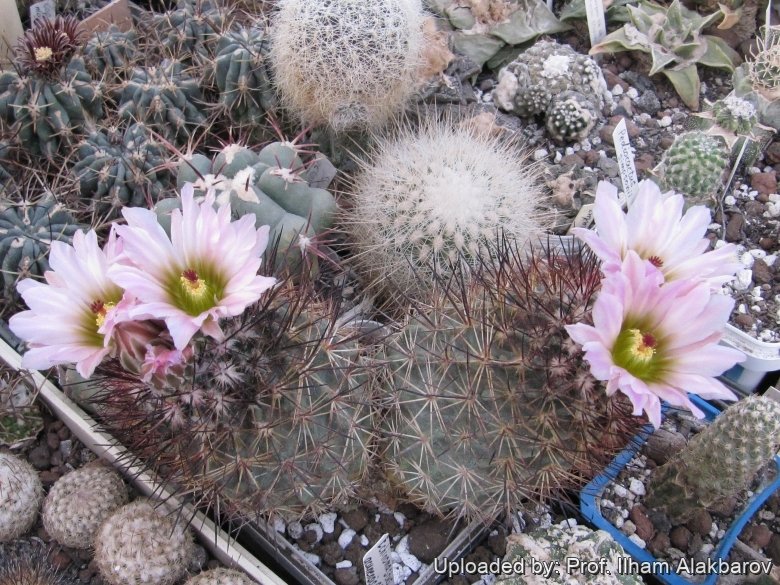
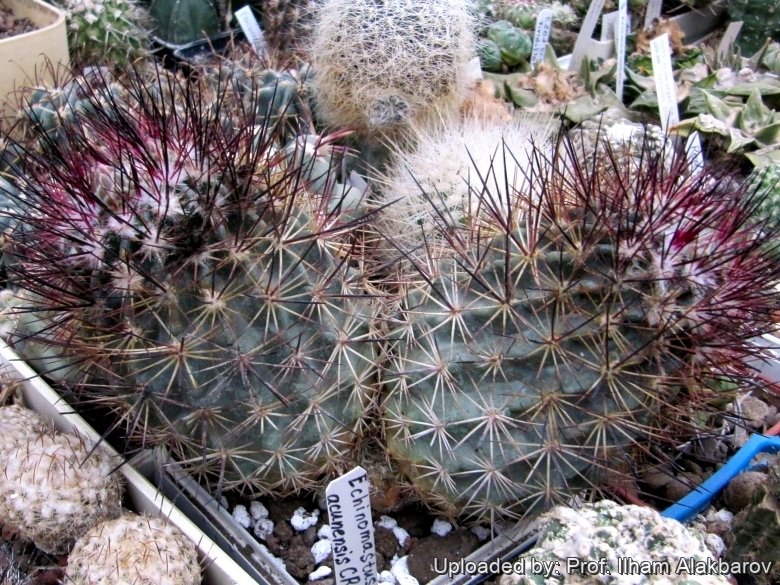
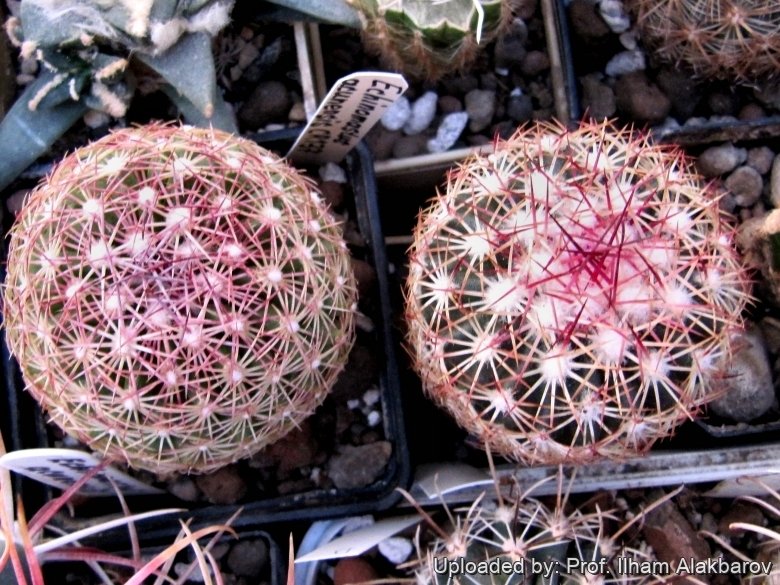
Echinomastus erectocentrus is a small solitary cactus heavily covered by spines. It is a distinct species, without varieties. Sometimes placed in genus Sclerocactus, Echinocactus, or Neolloydia. The varieties erectocentrus and acunensis are sometimes distinguished.
Stems: Broadly ovoid to short-cylindric, 8 to 14(-37) cm high, (4-)7-12 cm broad, pale bluish green.
Ribs: 15-21, somewhat oblique, very low, made up of closely set tubercles sharply divided by indentations.
Areoles: Broadly elliptical, 1.5-2 mm wide, 2.5-3.5 mm long.
Tubercles: Nipple-like, 2-6(-12) mm high with a narrow groove in the upper side.
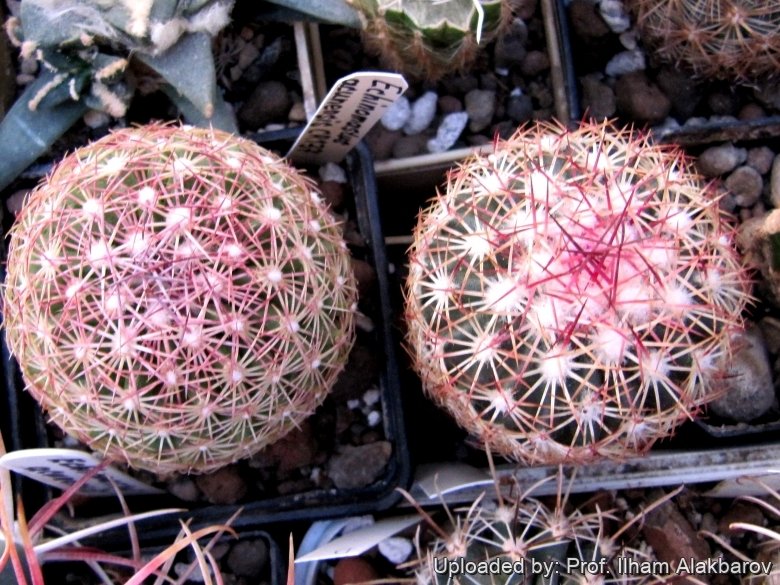
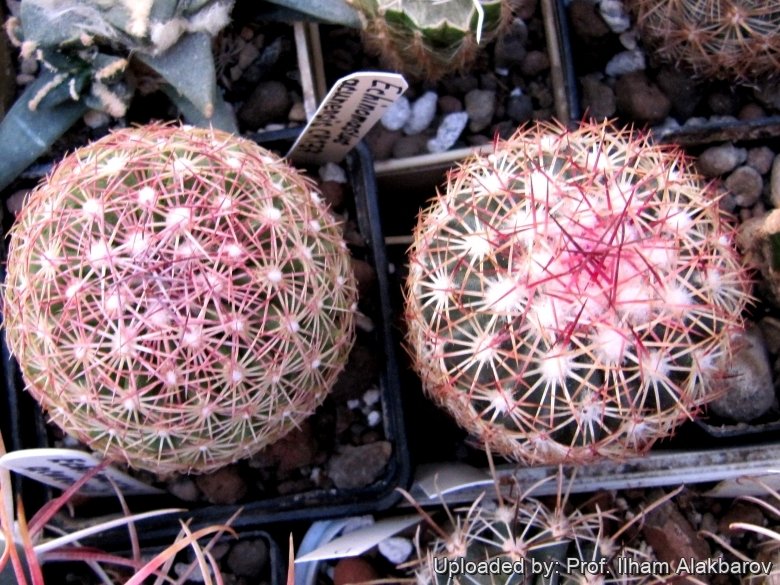
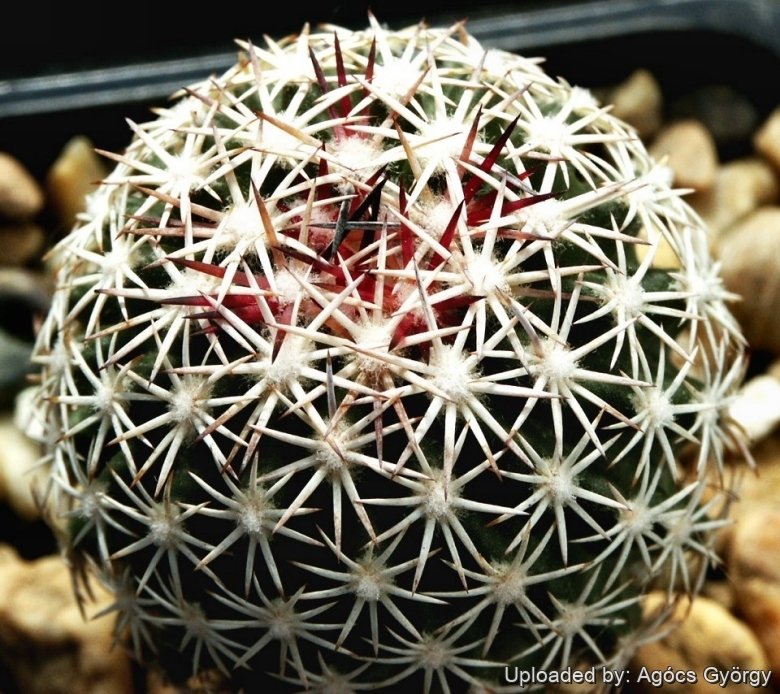
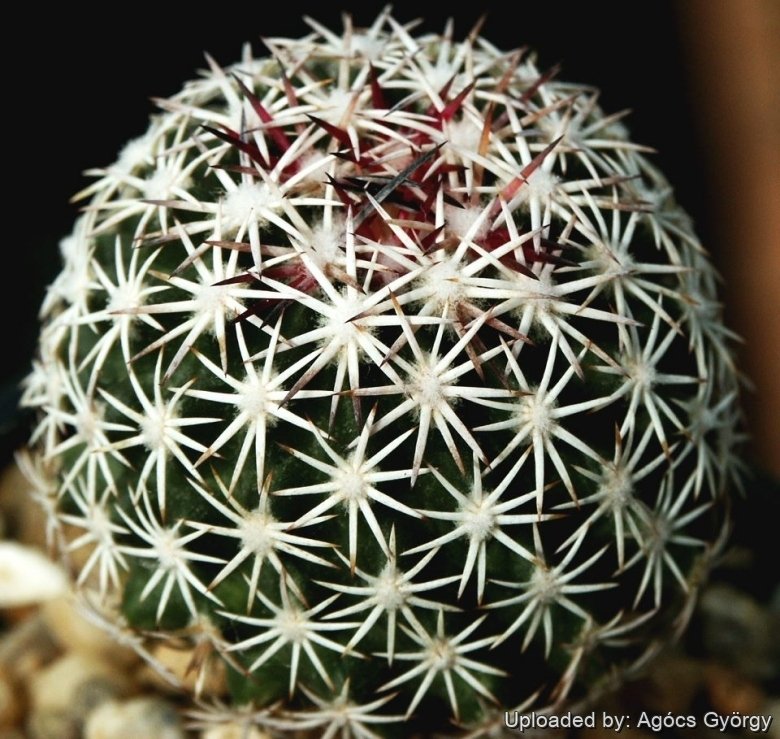
Radial spines: 11-17 (usually 13-14), ashy grey at base, grading into yellowish, pink, dull red or purplish toward the tips, round, straight, terete, 1.2-2.5 cm long, pale below, red above (in old dead plants dense and interwoven above but pectinate-appressed on lower part of plant).
Central spines: Solitary or 2(-4), round, straight, or slightly curving, 1.2-3.5 cm long, slightly bulbous at base, yellowish to purplish and dark tipped, uppermost one (or three) pointed upward sometimes very short, porrect, like the radials, lowermost one much longer pointing downward.
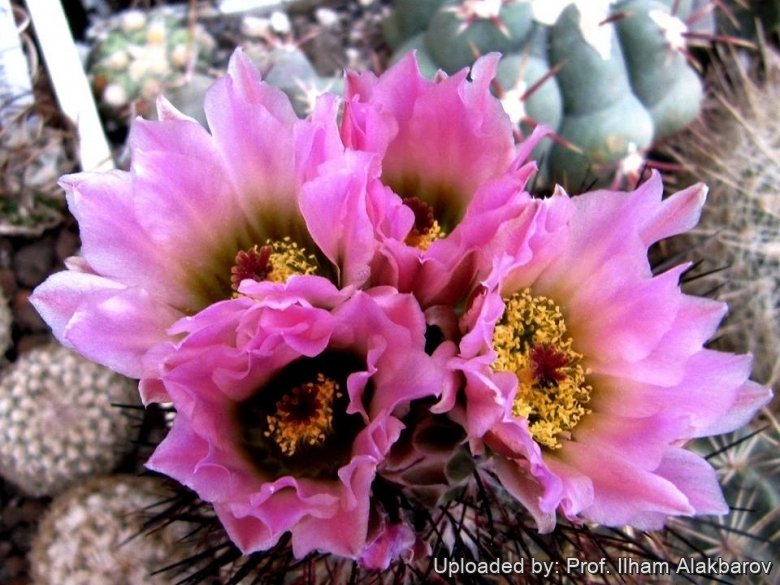
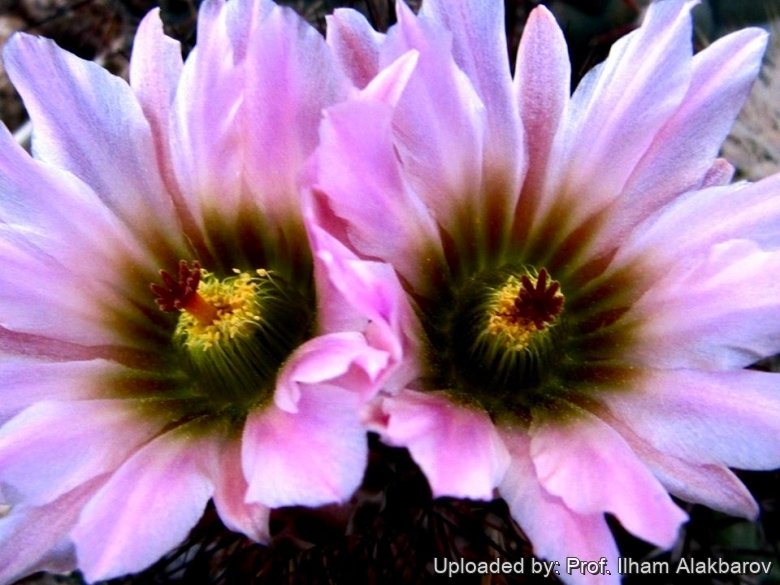
Flowers: Diurnal, short funnelform, pinkish to orange-pink (rarely white), (2-) 4 to 5 cm long, 3.8-5 cm across. Stamens short, greenish yellow. Style longer than the stamens, pale green. Stigma-lobes 6-8, pinkish to deep red. Ovary bearing a few ovate scarious scales.
Fruits; Green, drying to brown, dehiscing by slits, to 1 cm long and 7.5 mm in diameter.
Seeds: 1.5 x 2 mm.
Origin and Habitat
Sclerocactus erectocentrus is distributed in the Mexican state of Sonora and in the United States in southern Arizona.
Altitude range: It occurs at elevations of 450 to 1,500 metres above sea level.
Habitat and Ecology: The species occurs in granite soil hills, alluvial soil areas with chipping, and small rocks in Sonoran desert scrub. Sometimes it grows below small scrubs. In southeastern Arizona it occurs in rocky areas, in grasslands and desert scrub. The species occurs as a series of four isolated metapopulations. It grows in groups of 10 to 50 individuals, scattered on hill tops. A large portion of the population died approximately in 2005-2006, probably as a consequences of droughts, other subpopulations are very healthy and there are no major threats. Grazing is a threat in portions of the species range. Illegal collection takes place in some populations, however other populations are inaccessible.
Cultivation and Propagation
Echinomastus erectocentrus is a most beautiful cactus but rarely seen in cultivation. It is quite difficult to grow on its own roots. Very easily rot! It’s thought that’s better to watch this species in photo or in the natural habitat rather than to try to cultivate it. For this reasons the plant is often grafted on a frost hardy stock.
Soil: Use mineral well-permeable substratum with very little organic matter (peat, humus). It needs perfect drainage to flourish.
Repotting: Repotting every 2-3 years. As it is especially prone to rot under-pot in a smaller container filled with very porous compost. Use pot with good drainage.
Exposition: This plant need full sun and above all a very good ventilation, especially in winter. Tends to bronze in strong light, which encourages flowering and heavy spine production.
Watering: Water sparingly during the growing season and keep totally dry during winter. In the rest period no high atmospheric humidity!!Care must be taken with watering as they tends to become swollen and untidy in growth habit if given too much water and shade.
Fertilization: During the growing season enrich the soil using a fertilizer rich in potassium and phosphorous, but poor in nitrogen, because this chemical element doesn’t help the development of succulent plants, making them too soft and full of water.
Hardiness: It can tolerate temperature below zero (-15° C or less).
Pests & diseases: It may be attractive to a variety of insects to watch for:
- Red spiders: Sensitive to red spider mite. Overhead watering is helpful in controlling mites.
- Mealy bugs: Occasionally mealy bugs they develop aerial into the new growth among the wool with disfiguring results, but the worst types develop underground on the roots and are invisible except by their effects.
- Rot: Rot it is the major threat. If the plants are not watered and “aired” correctly, fungicides won’t help all that much. Mature individuals - if the growing conditions are not optimal, easily rot and die.
Remarks: Displaying your cacti on shelves has the added benefit of keeping them off the ground and away from potential rodent or snail damage.
Propagation: Seed or grafting. Seeds germinate in 7-14 days at 21-27° C in spring, remove the glass cover gradually as the plants develops and keep ventilated, no full sun for young plants! The seedlings should not be disturbed until they are well rooted, after which they can be planted separately in small pots. Seeds are relatively difficult to germinate (only a limited percentage of seeds germinate). Grafting is often used to speed growth rate and to create a back-up for plants in collection.
Bibliography
Major references and further lectures
-
Edward Anderson “The Cactus family” Timber Press, Incorporated, 2001
-
James Cullen, Sabina G. Knees, H. Suzanne Cubey “The European Garden Flora Flowering Plants: A Manual for the Identification of Plants Cultivated in Europe, Both Out-of-Doors and Under Glass” Cambridge University Press, 11/Aug/2011
-
David R Hunt; Nigel P Taylor; Graham Charles; International Cactaceae Systematics Group. “The New Cactus Lexicon” dh books, 2006
-
Butterworth, C. & Porter, J.M. 2013. Sclerocactus erectocentrus. The IUCN Red List of Threatened Species. Version 2015.1. <www.iucnredlist.org>. Downloaded on 19 June 2015.
-
Britton & Rose “Cactaceae” 3: 1922 [12 Oct 1922]
-
Lyman David Benson “The Cacti of Arizona” edn. 3 1969
-
Lyman David Benson “The Cacti of the United States and Canada.” Stanford, California: Stanford University Press. 1982.
-
H. Krainz “Die Kakteen: : eine Gesamtdarstellung der eingefuhrten Arten nebst Anzucht- und Pflege-Anweisungen Herausgegeben von H. Krainz.” Stuttgart 1973
-
- Forrest Shreve, Ira Loren Wiggins “Vegetation and Flora of the Sonoran Desert” Volume 1 Stanford University Press, 1964
From llifle page Echinomastus acunensis
Description
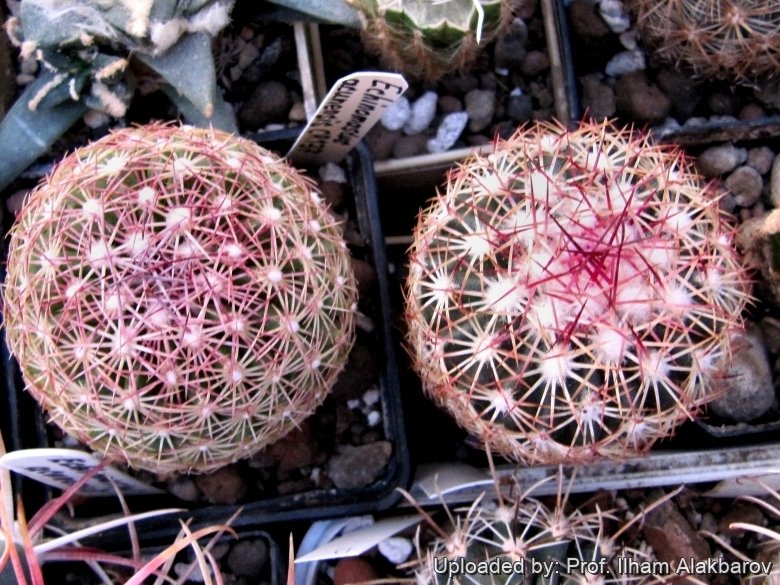
The acuna cactus, Echinomastus erectocentrus subs. acunensis, (Firstly described as Echinomastus acunensis by W.T.Marshall in 1953) is a solitary miniature barrel cactus named after the Acuna valley near Ajo in southwest Arizona where it was first discovered. As a juvenile plant, E. erectocentrus subs. acunensis resembles a young Echinomastus intertextus (the Woven-Spine Pineapple), but in growth the red pectinate spines grow upward, giving stems a distinctive appearance. Acuna cactus is also similar in appearance to fishhook cactus (Mammillaria microcarpa) and hedgehog cactus (Echinocereus spp.). Today this species is not accepted by many botanists that treat it as synonym of Echinomastus erectocentrus, but it still has a value for a collector because they identify plants with particular characters.
Stems: Ovoid or somewhat cylindricoid, (4-)10-22(-27) cm tall, 4-9(-10) cm in diameter.
Ribs: 15-21. the indentations between tubercles sharp and narrow.
Tubercles: Grooved in the upper side.
Areoles: 15-19 mm apart along ribs.
Spines: Dense, obscuring surface of stem 13-16 per areole, purplish pink or nearly white with brown tips.
Radial spines: 11-15 appressed. The lowermost the shortest 11-20 mm long; uppermost and lateral ones longest 22-25(-37) mm long, the lateral spines often pectinate.
Central spines: Dark-tipped, reddish, pink, ascending, (1-)2-3(-4) per areole, 19-44 mm long, uppermost ones longer often curved toward apex of plant, sometimes slightly so. The longest or only central spine 25-35 mm long.
Flowers: 3.5-5(-6) cm long, 4-5 cm in diameter. Outer perianth segments (sepaloids) with purplish-green midribs, to 7.5 mm broad and up to 30 mm long. Inner perianth segments (20-)30-43 mm long, 07-18 mm wide, pale to bright rose-pink, blotched at the base with orangish brown, chestnut, maroon, or greenish brown. Stigma lobes mostly 10, 1.5 mm long, stout red to brownish red, papillae red to green. Ovary in anthesis broadly obconical.
Phenology (in habitat): Flowering Mar-Apr; fruiting Apr-May.
Chromosome number: 2n = 22.
Origin and Habitat
Acuna valley near Ajo in southwest Arizona, Gila River, east of Florence in south central Arizona and adjacent Mexico (Sonora).
Altitude range: 200-800 metres above sea level.
Habitat: Arizona Upland Subdivision of Sonoran desert scrub, low gravelly hills, bajadas, and rocky hilltops, igneous substrates. This region receives low precipitation, often around 120 to 380 mm annually, low humidity, high insolation, and large fluctuations in daily and annual temperatures. Acuna cactus usually occurs on open, rocky sites. Accompanying species can be creosote-bush (Larrea tridentata), bursage (Franseria dumosa), wild buckwheat (Erioginum fasiculatum), ocotillo (Fouquieria splendens), white-thorn acacia (Acacia constricta), fairyduster (Calliandra eriophylla), jojoba (Simmondsia chinensis), Nicholžs turkžs head cactus (Echinocactus horizonthalonious var. nicholii), and Arizona hedgehog cactus (Echinocereus triglochidiatus var. arizonicus).
Ecology: The flowers are self-incompatible and are pollinated primarily by solitary, polyectic bee species. This cactus is threatened by mining, wildland fires, recreation, private development of scattered homesites, road building and maintenance, land development, illegal trafficking, illegal collection by cactophiles, and grazing along with natural factors, such as moth larvae and Opuntia borer insect predation.
Cultivation and Propagation
Echinomastus erectocentrus subs. acunensis is a most beautiful cactus but rarely seen in cultivation. It is quite difficult to grow on its own roots. Very easily rot! It’s thought that’s better to watch this species in photo or in the natural habitat rather than to try to cultivate it. For this reasons the plant is often grafted on a frost hardy stock.
Soil: Use mineral well-permeable substratum with very little organic matter (peat, humus). It needs perfect drainage to flourish.
Repotting: Repotting every 2-3 years. As it is especially prone to rot under-pot in a smaller container filled with very porous compost. Use pot with good drainage.
Exposition: This plant need full sun and above all a very good ventilation, especially in winter. Tends to bronze in strong light, which encourages flowering and heavy spine production.
Watering: Water sparingly during the growing season and keep totally dry during winter. In the rest period no high atmospheric humidity!!Care must be taken with watering as they tends to become swollen and untidy in growth habit if given too much water and shade.
Fertilization: During the growing season enrich the soil using a fertilizer rich in potassium and phosphorous, but poor in nitrogen, because this chemical element doesn’t help the development of succulent plants, making them too soft and full of water.
Hardiness: It can tolerate temperature below zero (-15° C or less).
Pests & diseases: It may be attractive to a variety of insects to watch for:
- Red spiders: Sensitive to red spider mite. Overhead watering is helpful in controlling mites.
- Mealy bugs: Occasionally mealy bugs they develop aerial into the new growth among the wool with disfiguring results, but the worst types develop underground on the roots and are invisible except by their effects.
- Rot: Rot it is the major threat. If the plants are not watered and “aired” correctly, fungicides won’t help all that much. Mature individuals - if the growing conditions are not optimal, easily rot and die.
Remarks: Displaying your cacti on shelves has the added benefit of keeping them off the ground and away from potential rodent or snail damage.
Propagation: Seed or grafting. Seeds germinate in 7-14 days at 21-27° C in spring, remove the glass cover gradually as the plants develops and keep ventilated, no full sun for young plants! The seedlings should not be disturbed until they are well rooted, after which they can be planted separately in small pots. Seeds are relatively difficult to germinate (only a limited percentage of seeds germinate). Grafting is often used to speed growth rate and to create a back-up for plants in collection.
Bibliography
Major references and further lectures
-
Echinomastus acunensis W. T. Marshall, Saguaroland Bull. 7: 33. 1953
-
“Echinomastus erectocentrus (J. M. Coulter) Britton & Rose var. acunensis (W. T. Marshall) Bravo” in Flora of North America on [http://www.efloras.org\] Downloaded on 19 June 2015.
-
Gail Norton, Steve Williams, Steve Spangle. “PETITION TO LIST THE ACUNA CACTUS (Echinomastus erectocentrus var. acunensis) AS AN ENDANGERED SPECIES” Center for Biological Diversity <http://www.biologicaldiversity.org/species/plants/acuna\_cactus/pdfs/acuna-petition.pdf\>
-
Anonymous. 1987. “Trip Report: Coffeepot Mountain Area Neolloydia erectrocentra var. acunensis Populations”, December 14-15, 1987. Fish and Wildlife Service Arizona Ecological Services Field Office, Phoenix, Arizona
-
“Arizona Rare Plant Guide.” 2001. A Collaboration of Agencies and Organizations.
-
Benson, Lyman. 1969. “The cacti of the United States and Canada-new names and nomenclatural combinations.” Cactus & Succulent Journal 41: 124-128, 185-190, 233-34.
-
Bravo, H. 1980. “Cactus & Succulents Mexico” 25 (3): 65
-
Earle, Hubert. 1980. “Cacti of the Southwest.” Desert Botanical Garden, Phoenix, Arizona.
-
Johnson, Robert. A. 1992. “Pollination and Reproductive Ecology of Acua Cactus, Echinomastus erectocentrus var. acunensis (Cactaceae).” Int. J. of Plant Science 153 (3):400-408.
-
Butterworth, C. & Porter, J.M. 2013. Sclerocactus erectocentrus. The IUCN Red List of Threatened Species. Version 2015.1. <www.iucnredlist.org>. Downloaded on 19 June 2015.
Source: Echinomastus acunensis, LLIFLE - Encyclopedia of living forms, CC-BY-SA, retrieved 2026-10-25.
Cultivars and forms (2)
Subspecies (1)
Varieties (1)
Gallery