Publication: Kaktusy (Brno) 26(1): 7. 1990
Description
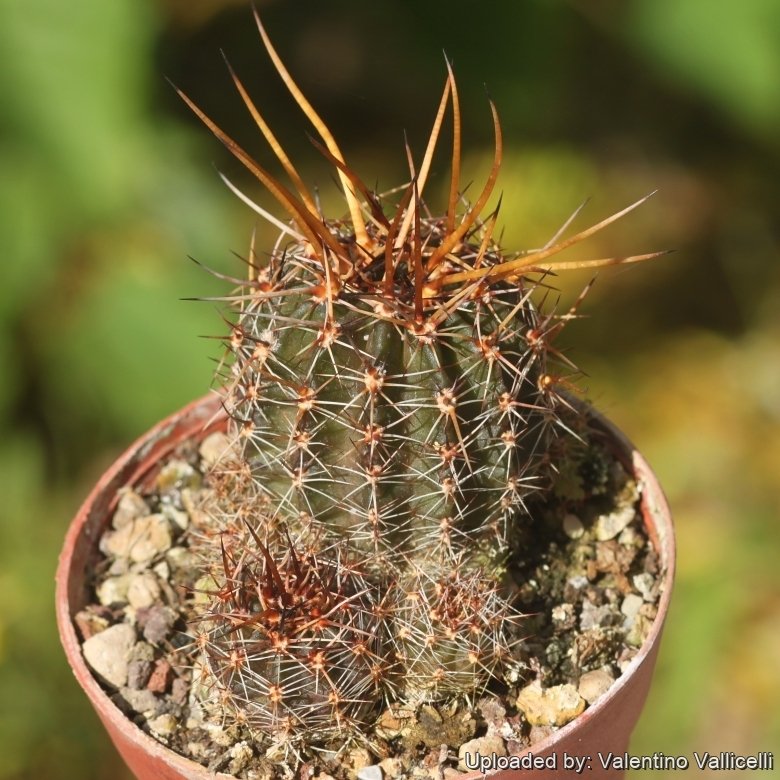
Echinopsis aurea var. dobeana better known as Lobivia dobeana, is a rather controversial plant which Rausch refers to the Echinopsis aurea complex, but Backberg says is a synonym of Lobivia andalgaiensis (Echinopsis huascha var. andalgalensis). Nowadays it is considered by most authors nothing else than one of the geographical forms of the very variable Echinopsis aurea (= Lobivia aurea) distinguished from the type for its red flowers (never yellow). If not in flower it look very similar to other varieties of Echinopsis aurea which are linked one to each others by populations of plants with intermediate characteristics. Nowadays all them are thought to belong to a unique polymorphic species with some individual producing red blooms, while others do not. Such variations has led to establishment of several unnecessary names for this species.
Habit: Solitary or with several basal and lateral offshoots.
Stems: Dark green globular or elongated reaching a height of 15 cm and a diameter of 5-6 cm or more.
Ribs: 14 to 15 sharp-edged separated by deep grooves.
Areoles: Whitish or brownish on young plants, closely set and oval.
Spines: The central spines are long and brown while the numerous radial spines are white and thinner.
Flowers: Very showy, nearly 10 cm long an up to 7 cm across, bright red. Buds are covered by long silky hairs and grow laterally from the centre of the stem. The tube is slightly curved, funnel-shaped, slender with green scales often red at the base, with abundant white and black hairs.
Blooming season: It flowers in mid spring on into summer. Sometimes it blooms profusely, especially on older plants.
Origin and Habitat
Sierra Ancasti and adjacent areas, Catamarca, Argentina Northwest
Altitude: 1000-2000 meters above sea level.
Habitat: Gently rolling grass covered hills together with Parodia malyana.
Cultivation and Propagation
Echinopsis aurea (and all its varieties) is one of the more common cacti ,extremely resistant to neglect. Nevertheless, it is appropriate to provide adequate growing conditions in order to obtain abundant blooms.
Growth rate: It is a relatively rapidly growing species that will make large clumps given the best conditions.
Soils: As most Echinopsis cultivated for their blossom, it needs a soil mixture a little richer than the average cactus with still an excellent drainage. Prefer a low pH compost, avoid substrata too rich in limestone.
Repotting: This plant needs plenty of space for its roots, repotting should be done every other year or when the it has outgrown its pot. It is rot prone and should be planted in a shallow pot. Use pot with good drainage.
Watering: Needs moderate to copious waterings in summer (it is more demanding than other cactus), but do not overwater, keep dry in winter at a minimum temperature of 0°C.
Fertilization: Feed with a high potassium fertilizer in summer.
Hardiness: It is quite frost resistant if kept dry and hardy to -5° C to -18° C or less for short periods (depending on varieties and growing conditions). However warmth throughout the year will increase the grower’s success (minimum 5° C during rest season).
Exposition: The plant tolerates bright situations which encourages flowering and heavy spine production, but is likely to suffer from sun scorch or stunted growth if over exposed to direct sunlight during the hottest part of the day in summer. It grows well with filtered sunlight or afternoon shade.
Uses: It is an excellent plant for container growing. It look fine in a cold greenhouse and frame or outdoor in a rockery. It is also used as a rootstock for grafting delicate and slow growing cactus species.
Pests & diseases: It may be attractive to a variety of insects, but plants in good condition should be nearly pest-free, particularly if they are grown in a mineral potting-mix, with good exposure and ventilation. Nonetheless, there are several pests to watch for:
- Red spiders: Red spiders may be effectively rubbed up by watering the plants from above.
- Mealy bugs: Mealy bugs occasionally develop aerial into the new growth among the wool with disfiguring results, but the worst types develop underground on the roots and are invisible except by their effects.
- Scales: Scales are rarely a problem.
- Rot: This species is particularly easy and accommodating, seldom suffer of cryptogamic diseases. Rot it is only a minor problem with Echinopsis if the plants are watered and “aired” correctly.
Propagation: Direct sow after last frost, offsets (if available) . Seeds germinate in 7-14 days at 21-27° C in spring, remove gradually the glass cover as soon the plants will be well rooted (ca 1-2 weeks) and keep ventilated, no full sun for young plants! To make a cutting twist off a branch and permit it to dry out a couple of weeks, lay it on the soil and insert the stem end partially into the soil. Try to keep the cutting somewhat upright so that the roots are able to grow downward.
Bibliography
Major references and further lectures
-
Walter Rausch “Lobivia: The Day Flowering Echinopsidinae from a Geographical Distribution Point of View” Volumes 1-3 R. Herzig, 1975
-
Edward Anderson “The Cactus family” Timber Press, Incorporated, 2001
-
James Cullen, Sabina G. Knees, H. Suzanne Cubey “The European Garden Flora Flowering Plants: A Manual for the Identification of Plants Cultivated in Europe, Both Out-of-Doors and Under Glass” Cambridge University Press, 11/Aug/2011
-
David R Hunt; Nigel P Taylor; Graham Charles; International Cactaceae Systematics Group. “The New Cactus Lexicon” dh books, 2006
-
Walter Rausch “Lobivia 85” Rudolf Herzig Vienna 1985/86 (text in German)
-
Curt Backeberg “Das Kakteenlexikon: Enumeratio diagnostica Cactacearum” Gustav Fischer Verlag, 1979 (text in German)
Gallery