Publication: Bradleya 1: 96. 1983
Description
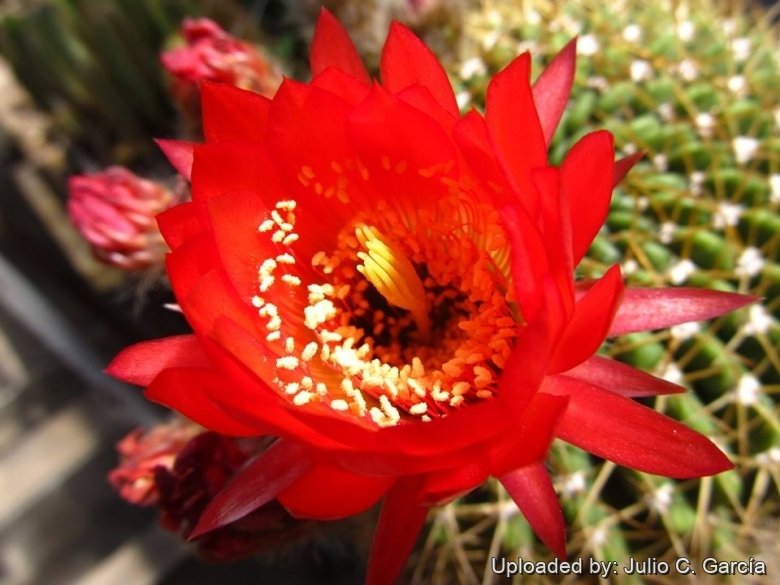
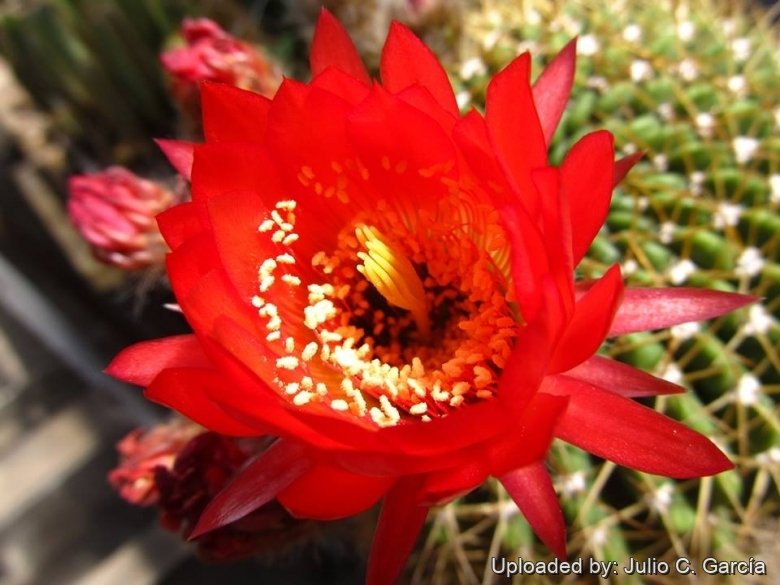
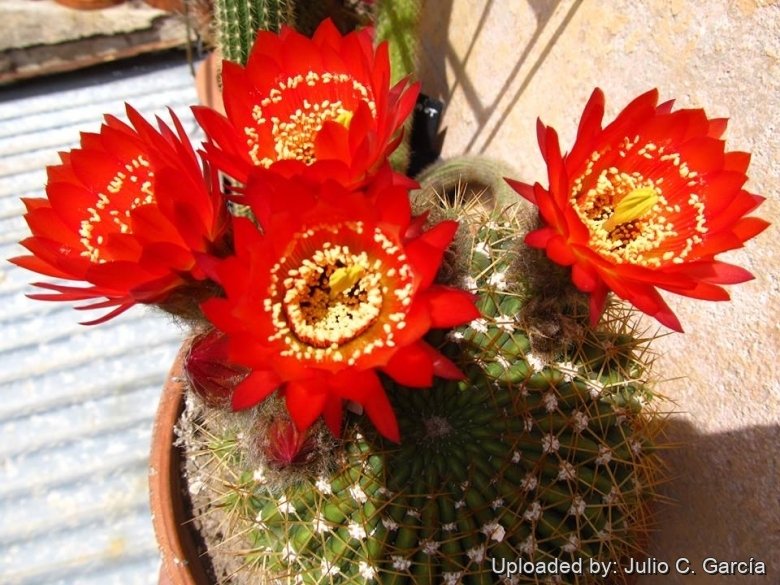
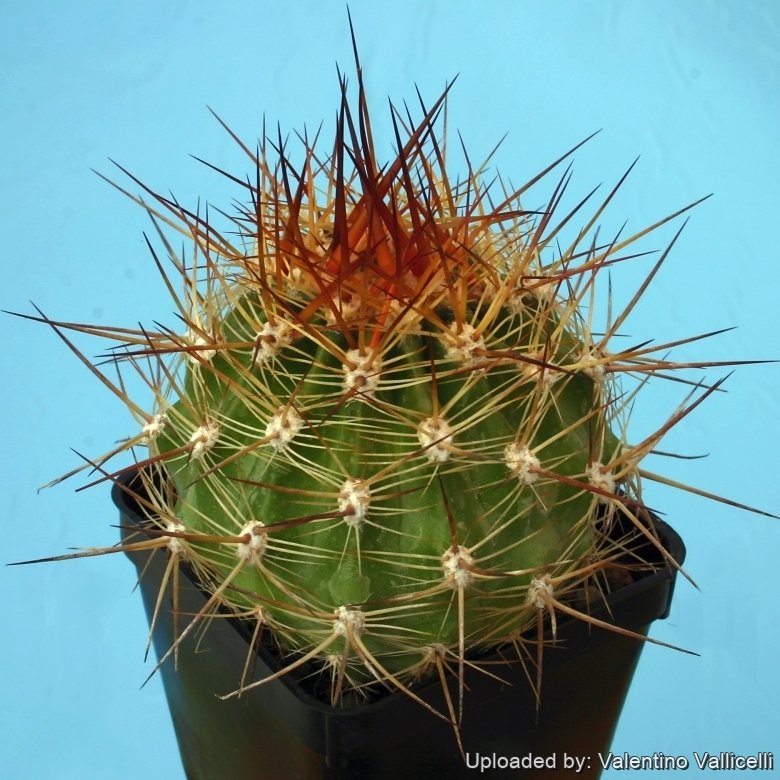
Echinopsis bruchii (still known in cultivation as Lobivia bruchii or Soehrensia bruchii) is one of the larger Echinopsis species, the multi-ribbed bodies grow to as much as 50 cm thick. It has yellow or brownish-orange spines and brilliantly red blossoms. It is a morphologically variable taxon growing widespread in the mountains of Argentina and has received numerous unnecessary names.
Similar species: The status of Echinopsis bruchii is controversial and some do not consider it an independent species, but a subspecies of Echinopsis formosa (Echinopsis formosa subs. Bruchii) which form a multiform complex, where each form is linked to others by populations of plants with intermediate characteristics.
Habit: Plants usually solitary round or barrel-shaped, occasionally clustering.
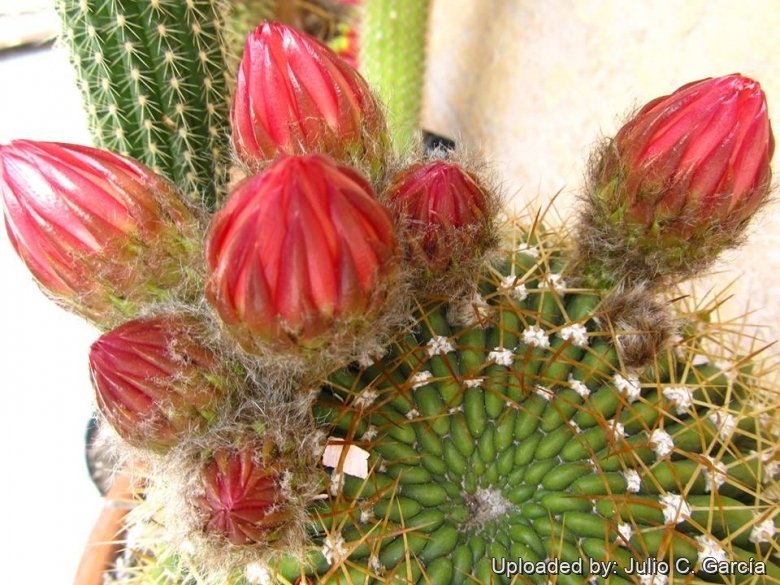
Stem: Globular, 20-30(-50) cm in diameter, becoming elongate or cylindrical with age 0,5-0,7(- 2) m tall, glossy dark green and more or less depressed in the centre.
Ribs: 15-50 or more, distinct but low, more or less inflated or tuberculate between areoles.
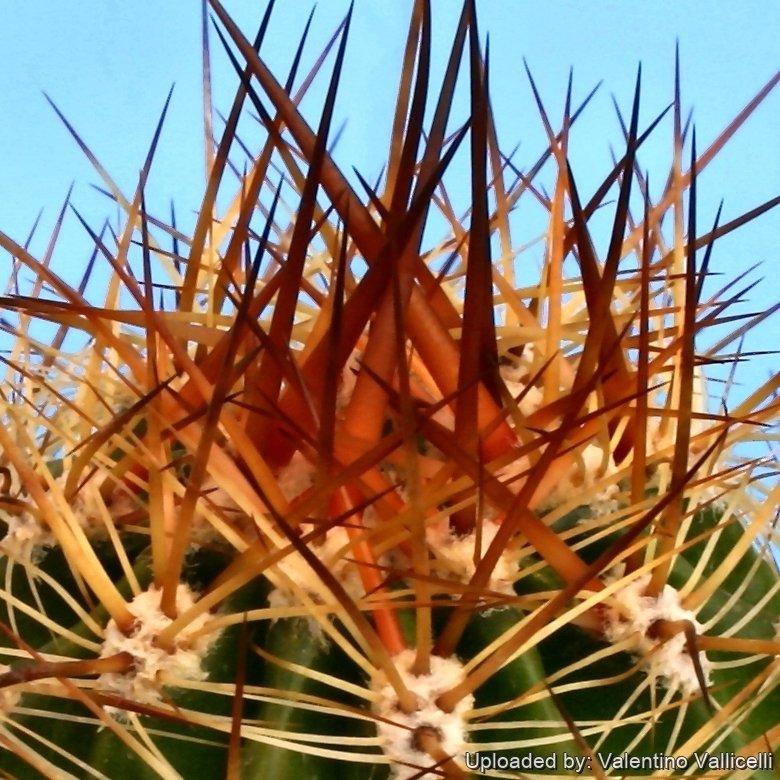
Areoles: Filled with short white wool.
Spines: Several, spreading, usually yellowish or brown, those of the upper areoles connivent.
Central spines: 2-4.
Raduial spines: 8-10
Flowers: Diurnal, small, at areoles below the apex of plant, 4-5(-8) cm long and 4-5 cm in diameter, deep red to orange; tube of flower short, its axils filled with wool; inner perianth-segments lanceolate, slightly spreading; filaments exserted beyond the throat, but shorter than the perianth-segments.
Blooming season: Spring to summer. Flowers last for 1 to 3 days (depending on weather condition).
Origin and Habitat
Northern Argentina (Catamarca, Jujuy, La Rioja, Mendoza, Salta, San Juan) .
Altitude: It grows at elevations of 1700-3500 meters above sea level.
Habitat: The species has a patchy distribution but is locally abundant in high altitude in puna and prepuna grasslands, monte shrubland, and altos andes among large boulders on flats, slopes and ridges, together with other succulent plants like Lobivia schreiteri and Parodia tafiensis.
Cultivation and Propagation
Echinopsis bruchii is one of the more cold hardy barrel cacti, that tolerates
in winter both, ice, snow, hail, and rain and temperatures down to – 12° C
Growth rate: It is a relatively rapidly growing species that will make clumps given the best conditions.
Soils: It likes very porous standard cactus mix soil. Prefer a low pH compost, avoid substrata rich in limestone; otherwise growth will stop altogether.
Repotting: This plant needs plenty of space for its roots, repotting should be done every other year or when the it has outgrown its pot. Use pot with good drainage.
Watering: Needs moderate to copious waterings in summer, but do not overwater (Rot prone), keep dry in winter at a minimum temperature of 0°C.
Fertilization: Feed with a high potassium fertilizer in summer.
Hardiness: Reputedly resistant to frost if kept on the dry side prior to, and during, cold weather (hardy to -12 C ° C, or less for short periods). Zone 8b to 10
Exposition: The plant tolerates extremely bright situations which encourages flowering and heavy spine production, but is likely to suffer from sun scorch or stunted growth if over exposed to direct sunlight during the hottest part of the day in summer. It may tolerate filtered sunlight or afternoon shade.
Uses: It is an excellent plant for container growing. It always looks good and stays small. It look fine in a cold greenhouse and frame or outdoor in a rockery.
Pests & diseases: It may be attractive to a variety of insects, but plants in good condition should be nearly pest-free, particularly if they are grown in a mineral potting-mix, with good exposure and ventilation. Nonetheless, there are several pests to watch for:
- Red spiders: Red spiders may be effectively rubbed up by watering the plants from above.
- Mealy bugs: Mealy bugs occasionally develop aerial into the new growth among the wool with disfiguring results, but the worst types develop underground on the roots and are invisible except by their effects.
- Scales: Scales are rarely a problem.
- Rot: This species is particularly easy and accommodating, seldom suffer of cryptogamic diseases. Rot it is only a minor problem with gymnocalyciums if the plants are watered and “aired” correctly. If they are not, fungicides won’t help all that much.
Propagation: Division of larger clumps, direct sow after last frost. Seeds germinate in 7-14 days at 21-27° C in spring, remove gradually the glass cover as soon the plants will be well rooted (ca 1-2 weeks) and keep ventilated, no full sun for young plants! To make a cutting twist off a branch and permit it to dry out a couple of weeks, lay it on the soil and insert the stem end partially into the soil. Try to keep the cutting somewhat upright so that the roots are able to grow downward.
Bibliography
Major references and further lectures
-
Edward Anderson “The Cactus family” Timber Press, Incorporated, 2001
-
James Cullen, Sabina G. Knees, H. Suzanne Cubey “The European Garden Flora Flowering Plants: A Manual for the Identification of Plants Cultivated in Europe, Both Out-of-Doors and Under Glass” Cambridge University Press, 11/Aug/2011
-
David R Hunt; Nigel P Taylor; Graham Charles; International Cactaceae Systematics Group. “The New Cactus Lexicon” dh books, 2006
-
Friedrich Ritter “Kakteen in Südamerika: Ergebnisse meiner 20jährigen” Volume 2, Argentinien/Bolivien, Volume 2 Selbstverlag, 1980
-
Curt Backeberg “Die Cactaceae: Handbuch der Kakteenkunde,” Volume 2 G. Fischer, 1959
-
N. L. Britton and J. N. Rose “The ‘Cactaceae’, Descriptions and Illustrations of Plants of the ‘Cactus’ Family” volume 2 Carnegie Institution, 1920
-
Hans Hecht “BLV-Handbuch der Kakteen” BLV-Verlagsgesellschaft, 1982
-
Haustein, Erik. “Der Kosmos-Kakteenführer.” Kosmos / Gesellschaft der Naturfreunde., Stuttgart, 1983
-
Urs Eggli, Leonard E. Newton “Etymological Dictionary of Succulent Plant Names.” Springer, Berlin/Heidelberg 2010
From llifle page Lobivia grandis
Cultivation and Propagation
It is very easy to grow and cold hardy as low as -12°C (or less). Need a fertile, well drained soil mix. Water the plants well and allow them to dry before watering again. During the growing season fertilize them monthly with a balanced fertilizer.
Sun Exposure: Outside full sun, but during hot summers, the cactus are subject to sun burning, so grow them in light shade, inside needs bright light, and some direct sun.. During winter month, put them in a cool luminous place and encourage them to enter winter dormancy by withholding water and fertiliser over the winter as they will etiolate, or become thin, due to lower levels of light. They are susceptible to fungal diseases if overwatered, but are not nearly as sensitive as many other cacti, especially in warm weather. If kept damp through cold periods, they will invariably suffer.
Source: Lobivia grandis, LLIFLE - Encyclopedia of living forms, CC-BY-SA, retrieved 2026-10-25.
From llifle page Lobivia bruchii var. nivalis
Description
Echinopsis bruchii var. nivalis firstly described as Lobivia bruchii var. nivalis by Frič is an hight altitude form of the wide ranging and very variable Echinopsis bruchii with mostly yellowish or whitish pines and red blooms. The differences with other Echinopsis bruchii are in reality very minimal and most botanist agree on the fact that both should all be included in the Echinopsis bruchii, and the two plants are not readily distinguishable, if not for the geographical provenance.
Similar species: Echinopsis bruchii var. nivalis is a controversial variety sometime considered by some a paler spined form of the brown spined Echinopsis formosa subs. Korethroides growing in the same or overlapping geographic areas. Intermediate forms with variable spine colour between the mentioned species will occur in habitat.
Habitat: It is a massive growing barrel cactus with a solid and spiny presence, solitary at first, but often branching basally to form colonies later. The dense yellowish or whitish spines would protect it from the extremes of cold and sunshine. The new spines are actually dark brown and appear in the spring.
Stem: Globular, 20-30(-50) cm in diameter, becoming elongate or cylindrical with age 0,5-0,7(- 2) m tall, glossy dark green and more or less depressed in the centre.
Ribs: 15-50 or more, distinct but low, more or less inflated or tuberculate between areoles.
Areoles: Filled with short white wool.
Spines: , those of the upper areoles connivent.
Central spines: 2-4.
Raduial spines: 8-10
Flowers: Diurnal, small, at areoles below the apex of plant, 4-5(-8) cm long and 4-5 cm in diameter, deep red to orange; tube of flower short, its axils filled with wool; inner perianth-segments lanceolate, slightly spreading ; filaments exserted beyond the throat, but shorter than the perianth-segments.
Blooming season: Spring to summer. Flowers last for 1 to 3 days (depending on weather condition).
Origin and Habitat
Northern Argentina (Jujuy, Salta) .
Altitude: It grows at elevations of 3800-4100 meters above sea level.
The species is locally abundant in high altitude in puna grasslands, monte shrubland, and altos andes among large boulders on flats, slopes and ridges.
Source: Lobivia bruchii var. nivalis, LLIFLE - Encyclopedia of living forms, CC-BY-SA, retrieved 2026-10-25.
Cultivars and forms (1)
Varieties (1)
Gallery