Publication: I.O.S. Bull. 3(3): 95 (1974).
Description
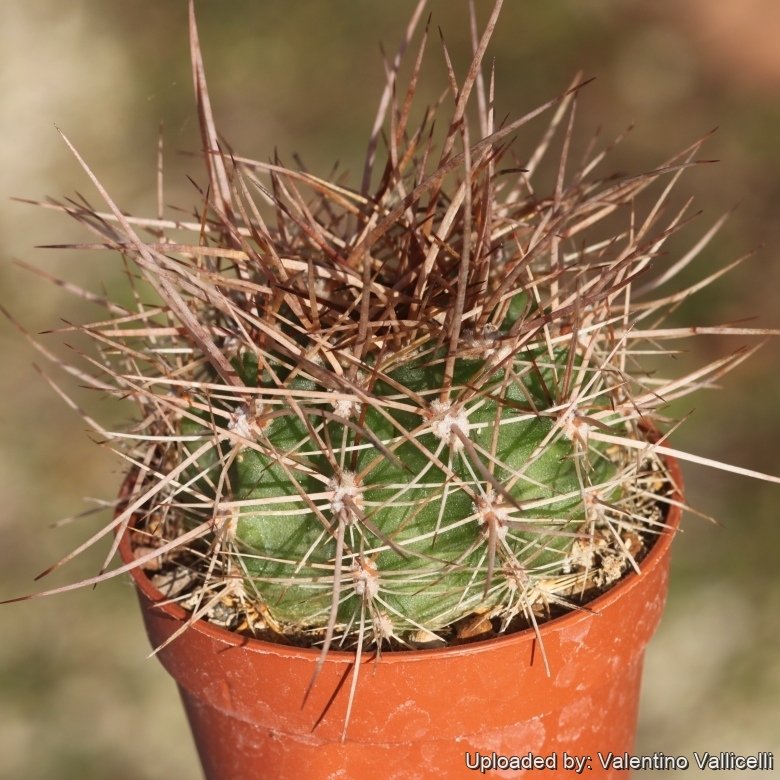
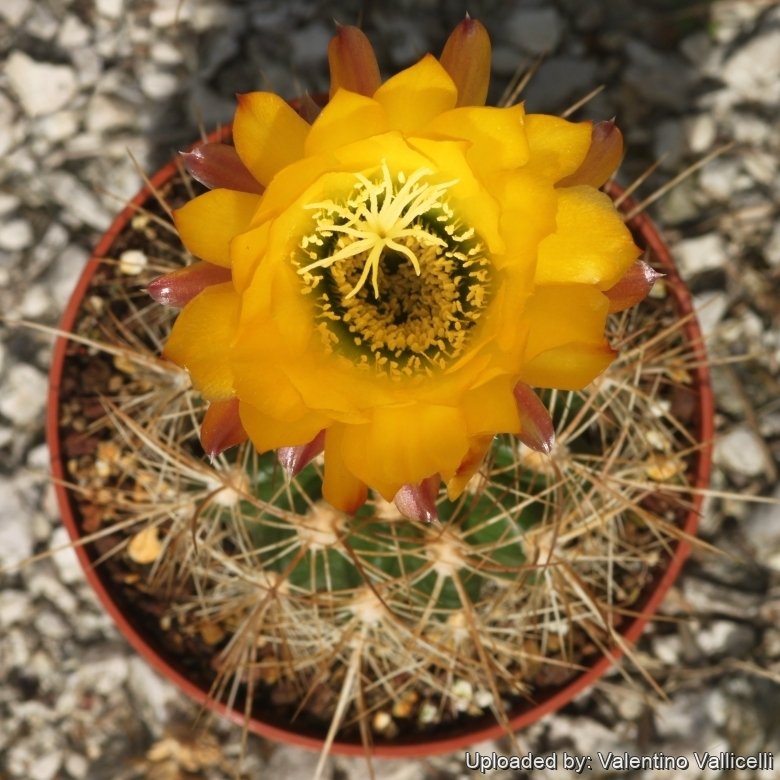
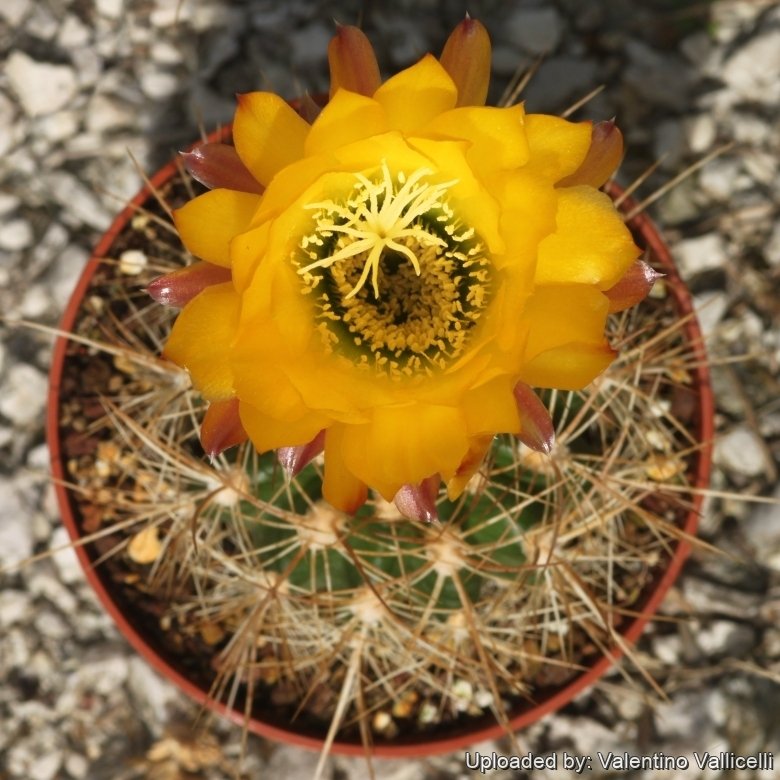
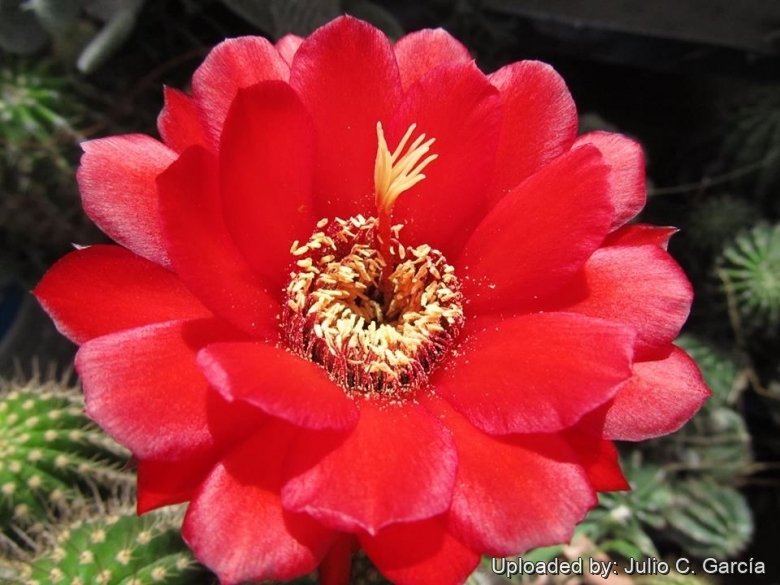
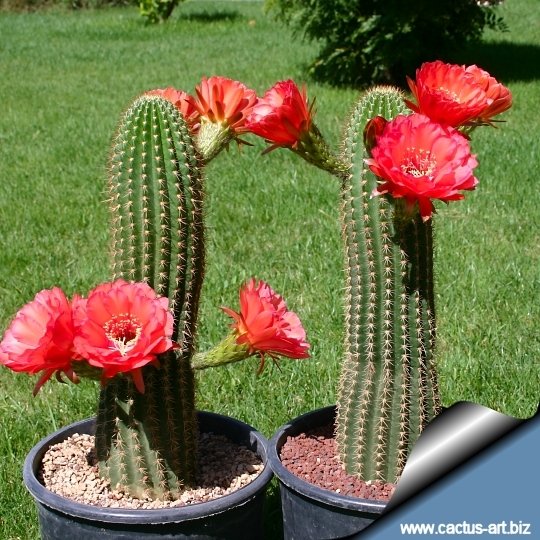
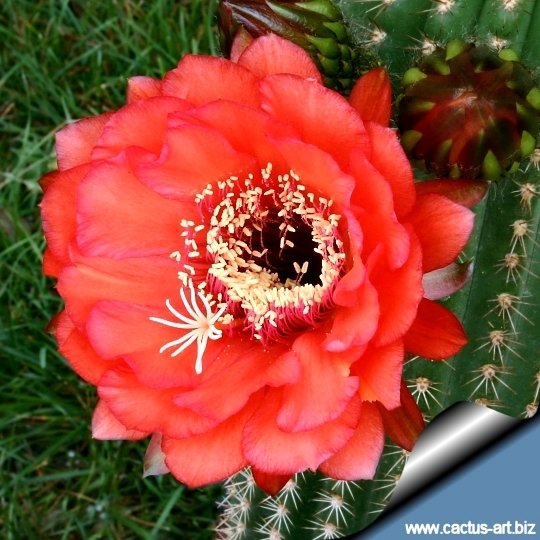
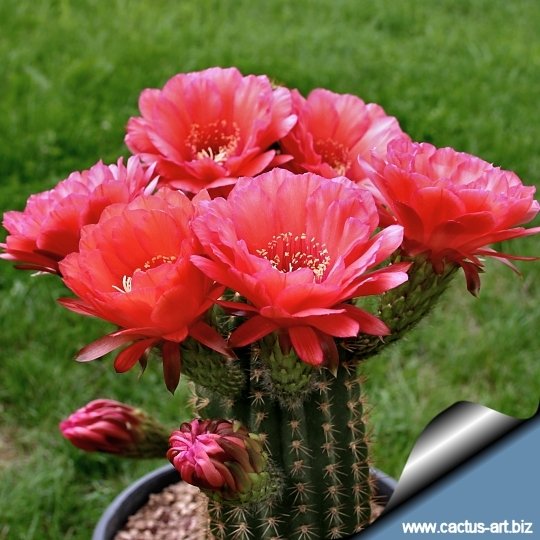
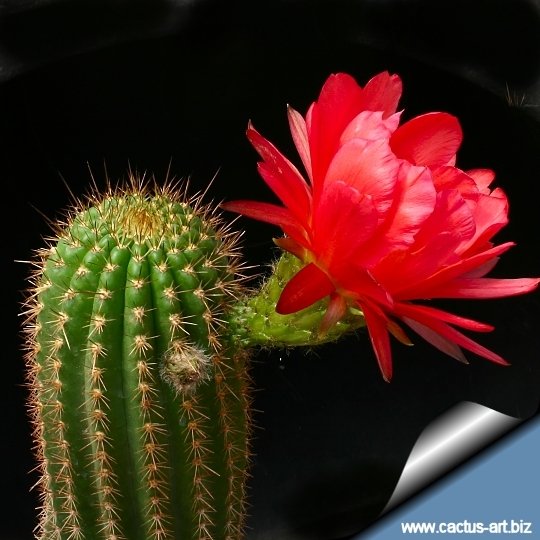
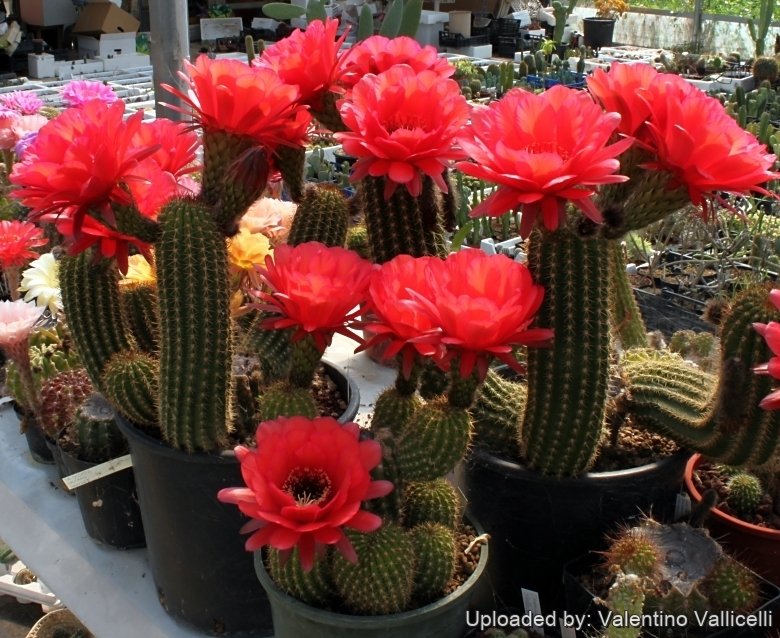
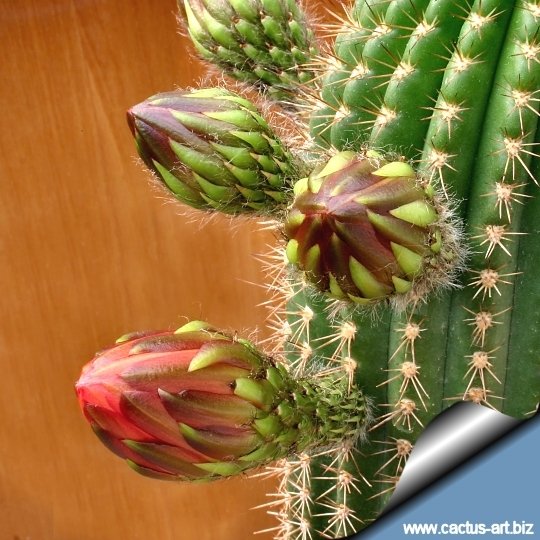
Echinopsis huascha still known in cultivation as Lobivia huascha or Trichocereus huascha is a a much decorative cactus easily found in cultivation and grows virtually anywhere. The beautiful large blooms are very variable in colour and size ( brilliant golden yellow to dark-red ), are about 10 cm long and cluster on top. Flowers have the shorter tube of Lobivia and are strictly diurnal while Trichocereus flowers are nocturnal.
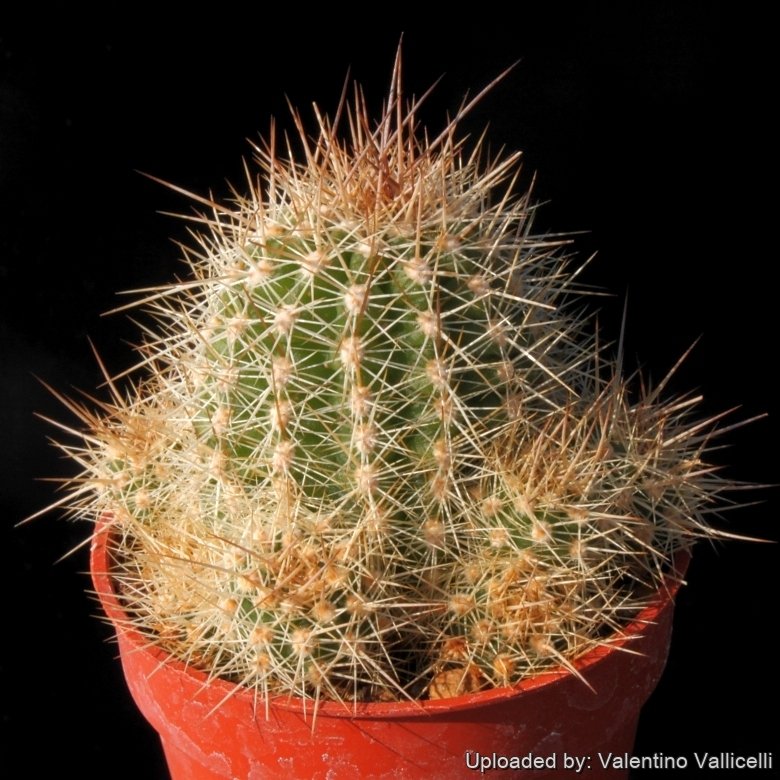
Habit: It is a basally branching columnar cactus, forming low clumps 0,8-1,6 m tall, 0,8-2 m broad, with few to several upright or sprawling, stems.
Stems: Cylindrical, stout, light green, 4 to 8 cm in diameter 30-90 cm long (or more) branching freely from the base.
Ribs: (12-)14-17(-18) symmetrical, obtuse, low and rounded.
Areoles: Whitish or brownish more or less approximate, 5-10 mm apart.
Spines: Needle-like, unequal, yellowish to brownish.
Central spines: 1 to 3 , the longest often 5 to 6 cm long, same colour but somewhat thicker than the radials, 2-7 cm long.
Radial spines: 9 to 11 up to 1,5 cm inches long.
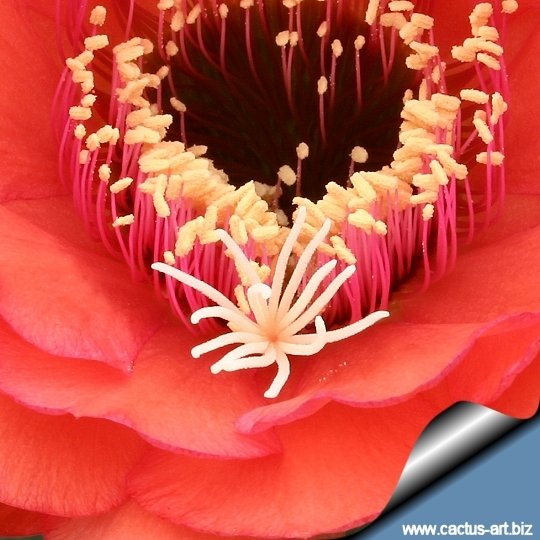
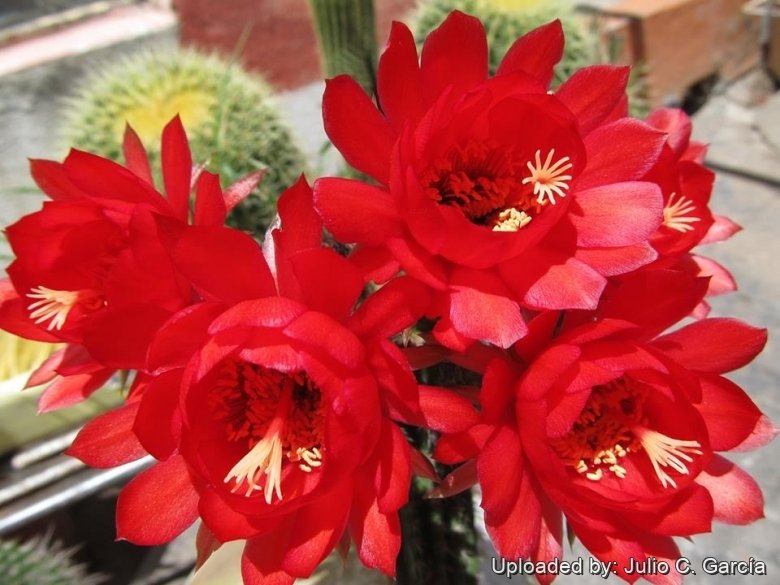
Flowers: Diurnal, scentless, very variable in color and size, funnel-form to bell shaped, red to yellow to orange, 7-10 cm long 6-7 (or more) cm in diameter, produced near the end of the stems. Pericarpel and floral tubes with dense
scales bearing long brown hairs. Anthers clear pastel and stigma white.
Blooming season: Spring to summer. Flowers last for 1 to 3 days (depending on weather condition).
Fruits: Globose to ovoid, yellowish green or reddish, to 3 cm in diameter.
Origin and Habitat
Echinopsis huascha has a relatively wide range and is abundant in northern Argentina in Catamarca and La Rioja.
Type locality: Yacutala, Catamarca, Argentina.
Altitude: 500 to 2100 metres above sea level.
Habitat and Ecology: The species grows in monte shrubland and chaco forest, on rocky grassy slopes. Where it grows the climate is dry and warm with both daily and seasonal remarkably wide temperature range, and poor rainfalls concentrated in the summer season. The major threat is small-holder agriculture.
Cultivation and Propagation
Echinopsis huascha (and its forms and varieties) is very easy to grow and cold hardy as low as -7°C (or less).
Growth rate This species produces noticeable amounts of growth each year if kept well fed and watered throughout the warmest months, particularly if it has been acclimatised to accept full sun. Once this cactus is established it can easily produce 10 cm of growth every year. Plants grown in the ground form soon imposing specimens.
Sun Exposure: Outside full sun, inside needs bright light, and some direct sun. During winter month, put them in a cool luminous place and encourage them to enter winter dormancy by withholding water and fertiliser over the winter as they will etiolate, or become thin, due to lower levels of light.
Soils: It needs a fertile, well drained soil mix.
Waterings: Water the plants well and allow them to dry before watering again. This species seems to do better with a little more water than most cacti. In fact, its cultivation requirements are really more like ‘normal’ plants than most other cacti.
Fertilization: During the growing season fertilize them monthly with a balanced fertilizer.
Pest and diseases: They are susceptible to fungal diseases if overwatered, but are not nearly as sensitive as many other cacti, especially in warm weather. They tend characteristically towards black rotted spots unless watering is moderate and only in hot weather, if kept damp through cold periods, they will invariably suffer.
Propagation: Cutting or from seed. The seeds are quite easy to germinate and grow. Their main requirements consist of high humidity levels, free-draining soil mix, and enough water, light, and nutrition. The flower colour is not always true from seeds.
Bibliography
Major references and further lectures
-
Edward Anderson “The Cactus family” Timber Press, Incorporated, 2001
-
James Cullen, Sabina G. Knees, H. Suzanne Cubey “The European Garden Flora Flowering Plants: A Manual for the Identification of Plants Cultivated in Europe, Both Out-of-Doors and Under Glass” Cambridge University Press, 11/Aug/2011
-
David R Hunt; Nigel P Taylor; Graham Charles; International Cactaceae Systematics Group. “The New Cactus Lexicon” dh books, 2006
-
Friedrich Ritter “Kakteen in Südamerika: Ergebnisse meiner 20jährigen” Volume 2, Argentinien/Bolivien, Volume 2 Selbstverlag, 1980
-
Curt Backeberg “Die Cactaceae: Handbuch der Kakteenkunde,” Volume 2 G. Fischer, 1959
-
N. L. Britton and J. N. Rose “The ‘Cactaceae’, Descriptions and Illustrations of Plants of the ‘Cactus’ Family” volume 2 Carnegie Institution, 1920
-
Gordon Douglas Rowley “Reunion of the genus Echinopsis”. In: IOS Bulletin. Journal of the International Organization for Succulent Plant Study. Volume 3, Nuber 3, page 94 , 1974
-
Perea, M., Trevisson, M. & Demaio, P. 2013. Echinopsis huascha. In: IUCN 2013. “IUCN Red List of Threatened Species.” Version 2013.1. <www.iucnredlist.org>. Downloaded on 01 November 2013.
-
John Borg “Cacti: a gardener’s handbook for their identification and cultivation” Blandford P., 1970
-
Walther Haage: “Kakteen von A bis Z.” Quelle & Meyer Verlag, Heidelberg 1986
-
Urs Eggli, Leonard E. Newton: “Etymological Dictionary of Succulent Plant Names.” Birkhäuser 2004
From llifle page Acanthocalycium hyalacanthum
Description
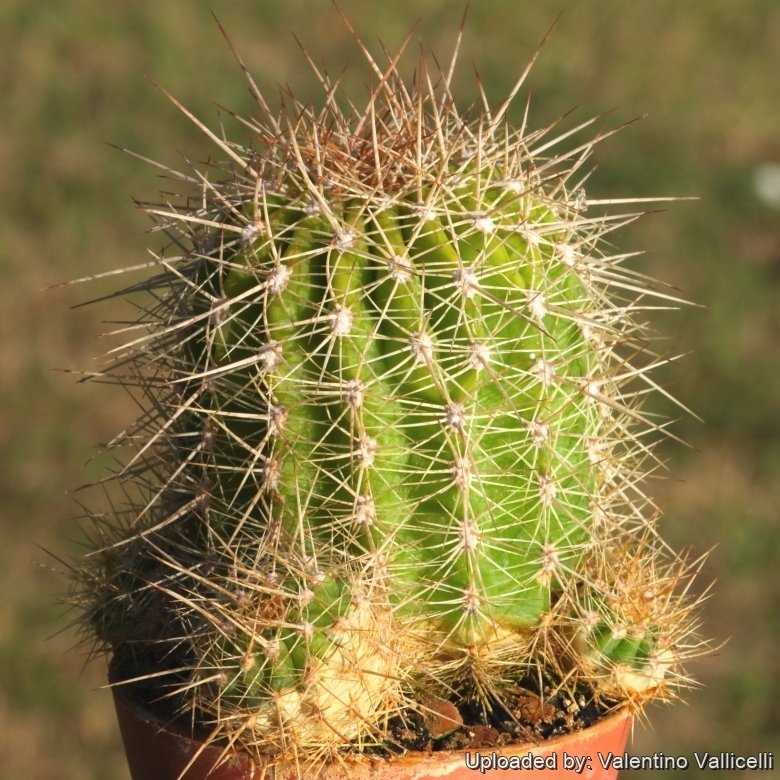
Echinopsis hyalacantha (more often listed under its old name Lobivia hyalacantha) is a controversial geographical or morphological form of the very variable Echinopsis huascha with a solid and spiny presence and big yellow flowers. The dense brown spines would protect them from the extremes of cold and sunshine. The new spines are actually dark brown and appear in the spring.
Habit: Solitary at first, later forming low clumps with few to several upright or sprawling, stems.
Stem: Cylindrical, stout, light green, branching from the base.
Ribs: 14-17 vertical, symmetrical, obtuse, low and rounded.
Areoles: Whitish or brownish more or less approximate, 5-10 mm apart.
Spines: Stout, needle-like, spreading, straight or slightly curved, reddish brown, up to 6 (or more)cm long.
Flowers: Fire yellow, funnel-shaped, diurnal, originating in the apical zone and are about 6-9 cm long and broad. Pericarpel and floral tubes with dense scales bearing long brown hairs.
Blooming period: Open in the day in the spring.
Fruits: Globose to ovoid, yellowish green or reddish.
Origin and Habitat
Pinchas, Argentina.
Altitude: 2400-2600 metres over sea level.
Source: Acanthocalycium hyalacanthum, LLIFLE - Encyclopedia of living forms, CC-BY-SA, retrieved 2026-10-25.
From llifle page Chamaecereus grandiflorus
Description
Echinopsis huascha var. grandiflora previously known as Lobivia grandiflora or Trichocereus grandiflorus somewhat resembles Echinopsis schickendantzii in habit, but has glorious crimson flowers. It has much shorter reddish spines (about 1 cm long) than standard Echinopsis huascha (not variety or cultivar) which is reported to have spines over 5 cm long.
Habit: It is a basally branching columnar cactus, 15-90 cm tall.
Stems: Globose to short-cylindric, 5-10 cm, in diameter.
Ribs: 12 to 18.
Areoles: Whitish brown about 1 cm apart.
Spines: Needle-like, subulate, unequal, yellowish to brownish.
Central spines: 1 to 2 rarely more than 1 cm long.
Radial spines: 9 to 11 brownish 5-10 mm long.
Flowers: Diurnal, funnelform, 7-10 cm long, mostly bright red produced near the end of the stems. Throat dark red, filaments fuchsia. Perianth-segments narrow, acuminate, 4 to 5 cm long, dark pink to dark red. Anthers clear pastel and stigma pure white. Scales on the ovary narrow, 10 to 12 mm long, a little hairy in their axils.
Origin and Habitat
Catamarca, Argentina.
Altitude: 1000-2100 meters above sea level.
Habitat: Argentina is a land erupting in volcanic fire, quickly changing to the glacial cold of the Andes. Nearby is the most arid desert in the world, the desolate Puna de Atacama. Inhabitants must be very rugged in order to tolerate such extremes in exposure. Echinopsis huascha var. grandiflora is such a robust individual often found growing on steep towering ridge and rocky grassy slopes.
Notes
The main form of Trichocereus grandiflorus has red flowers in summer, but forms with orange and yellow (Trichocereus huascha var. macrantha) flowers are also found.
This columnar species has been the subject for years of intensive selective hybridization with hybrids of Echinopsis. As a result hybrids (see: Trichopsis) now flower in a vast array of colours, including yellow, rose, crimson, orange, violet, white and even bicolour. Flowers can attain 22cm in diameter, rivalling even the giant flowers of the epiphytic “Orchid Cacti” (Epiphyllums). T. grandiflorus hybrids in time form attractive columns that explode yearly in vivid floral displays. Very few cacti can surpass the flowers of the T. grandiflorus hybrids for sheer flower power.
Source: Chamaecereus grandiflorus, LLIFLE - Encyclopedia of living forms, CC-BY-SA, retrieved 2026-10-25.
From llifle page Lobivia huascha var. purpureominiata
Description
Echinopsis huascha var. purpureominiata, firstly described as Lobivia purpureominiata by Ritter, is a local form of the wide ranging and very variable Echinopsis huascha. The differences with other Echinopsis huascha are in reality very minimal and most botanist agree on the fact that both should all be included in the Echinopsis huascha, and the two plants are not readily distinguishable, if not for the geographical provenance.
Origin and Habitat
Sierra ambato (Las Juntas y La Puerta), Catamarca, Argentina
Type locality: 112km West of La Puerta to Andalgala
Altitude: About 1600 metres above sea level.
Source: Lobivia huascha var. purpureominiata, LLIFLE - Encyclopedia of living forms, CC-BY-SA, retrieved 2026-10-25.
From llifle page Lobivia grandiflora var. herzogii
Description
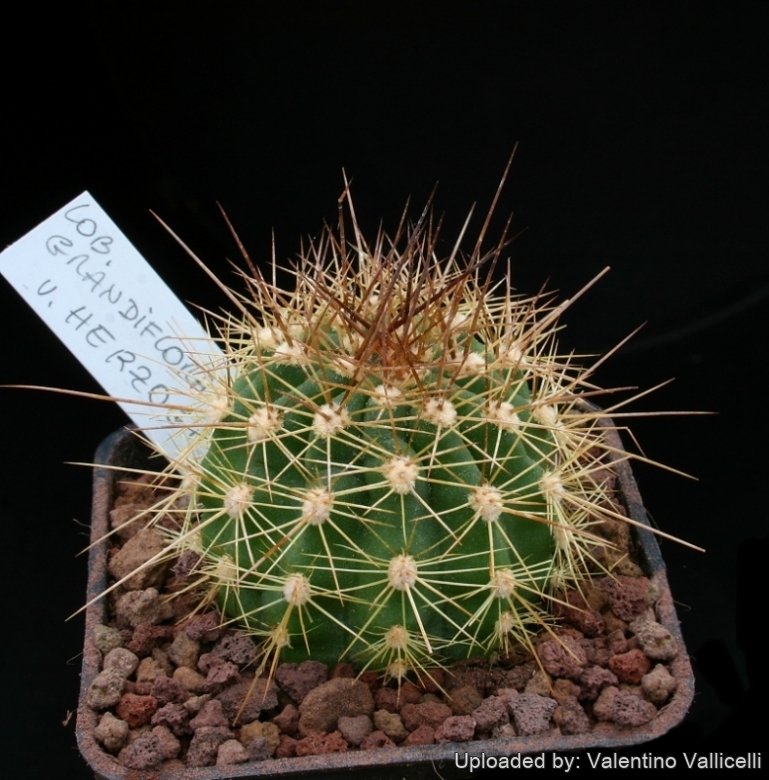
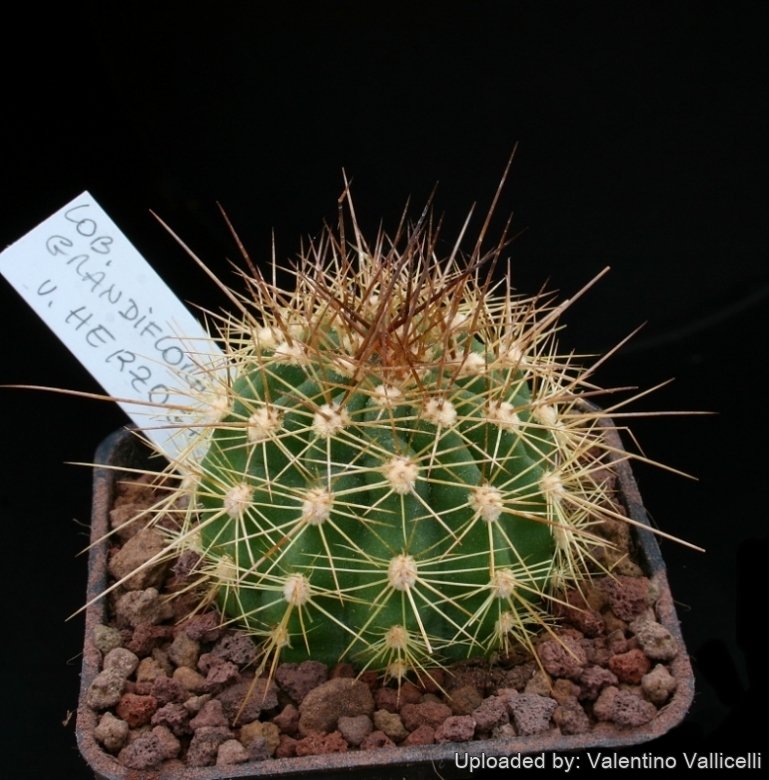
Echinopsis huascha var. grandiflora f. herzogii - previously known as Lobivia grandiflora var. herzogii - is a miniature form, with dark red flowers on dwarf plants, probably a natural hybrid.
Habit: It is a basally branching columnar cactus, less than 15 cm tall.
Stems: Globose to short-cylindric, 4-5(-7) cm, in diameter.
Ribs: 12 to 18.
Areoles: Whitish brown about 1 cm apart.
Spines: Needle-like, subulate, unequal, dull-creamy-white, yellowish or brownish.
Central spines: 1 to 2 rarely more up to 2,5 cm long.
Radial spines: 9 to 11, 5-10 mm long.
Flowers: Diurnal, funnelform, 7-10 cm long, dark red produced near the end of the stems. Throat dark red, filaments fuchsia. Scales on the ovary narrow a little hairy in their axils.
Origin and Habitat
Tucuman to Jujuy to Salta to Catamarca, Argentina
Altitude: 1900-2000 meters above sea level.
Source: Lobivia grandiflora var. herzogii, LLIFLE - Encyclopedia of living forms, CC-BY-SA, retrieved 2026-10-25.
Cultivars and forms (3)
Gallery