Publication: Abbild. Beschr. Cact. 2(i): sub t. 4. 1845 [Jan-Feb 1845]
Description
Echinopsis oxygona, the “Easter Lily Cactus”, is known for having gorgeous, night-blooming, pink flowers at the ends of long tubes often as large or larger than the whole plant, it is very popular. The flower has a sweet smell. It is very variable.
Habit: These cacti grow rapidly and usually forms big clumps up to 60 cm in diameter.
Stem: The stems is depressed globose, globose to elongate, eventually short cylindrical, clustering from near the base, green passing to greyish green or somewhat glaucous, (5-)10-15(-25) cm in diameter up to 30 cm high.
Ribs: 11-18, straight , broad at base, rounded on back .
Areoles: About 1 cm apart.
Spines: Very short to 2,5 cm long and stout, hard, blackish, yellowish-brown or horn coloured with dark tips, spreading and more or less curved.
Central spines: 1-5, sometimes absent, thick, needle-like 5-30 mm long, eventually up to 40 mm long.
Radial spines: The areoles have 3-15, more or less needle-like radial spines, 3 to 25 mm long.
Flowers: Usually from areoles halfway up the side of the plant, white, pink, pale red to lavender, funnel-shaped, fragrant with long tubes 15-22(-30) cm long, 5-10 cm in diameter, the tube slender, nearly cylindric, its scales numerous and small: Inner perianth-segments acute or acuminate. Old plant may have dozen of stunning flowers open at a time.
Blooming season: This species blooms from late spring to all summer long. The flower last only one day in full beauty, they open at evening and start to wither the next afternoon on hot days. On cool days they will last longer.
Fruit: Fruits green, to 4 cm long and 2 cm in diameter.
Remarks: This plant has been widely crossed with other species of Echinopsis and the number of cultivars seems unending. The flowers are lovely and are available in an assortment of bright colours ranging from magenta, red, orange, to yellow, and much sought-after by Cactophiles everywhere.
Origin and Habitat
Bolivia (Chuquisaca, Santa Cruz y Tarija), Argentina (Chaco, Corrientes, Entre Ríos, Formosa, Jujuy, Salta, Santa Fe andSantiago del Estero), Uruguay, Paraguay and Southern Brazil.
Altitude: Echinopsis oxygona occurs at elevations from 50 to 1,000 metres above sea level.
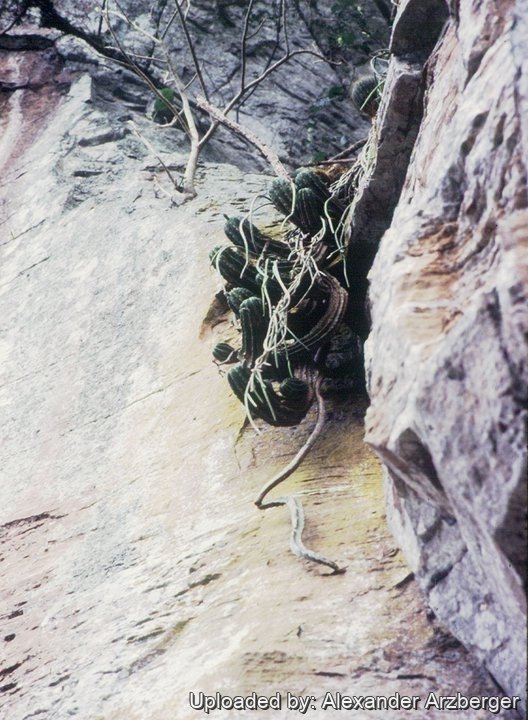
Habitat and Ecology: The species grows on walls and rocky outcrops in pampa grasslands and deciduous forests. It is abundant, but sparse and the subpopulations are generally stable and there are no major threats affecting it. Grazing, cattle trampling, agriculture, invasive grasses, and fire may represent threats. They are pollinated by insects or small animals, principally moths and bees.
Cultivation and Propagation
The Easter Lily cactus Echinopsis oxygona is one of the more common cacti ,extremely resistant to cultivation errors and easily reproduced by offshoots. The only thing that can kill this plant is cold. Nevertheless, it is appropriate to provide adequate growing conditions in order to obtain abundant blooms. It has very large fragrant nocturnal flowers and many plant lovers are willing to take care of it all year for one or a few magical nights with exotic charm.
Growth rate: It is a relatively rapidly growing species that will make large clumps given the best conditions.
Soils: It likes very porous standard cactus mix soil, but it is extremely adaptable to various growing media. Prefer a low pH compost, avoid substrata rich in limestone.
Repotting: This plant needs plenty of space for its roots, repotting should be done every other year or when the it has outgrown its pot. Use pot with good drainage.
Watering: Needs moderate to copious waterings in summer (it is more demanding than other cactus), but do not overwater, keep dry in winter at a minimum temperature of 0°C.
Fertilization: Feed with a high potassium fertilizer in summer.
Hardiness: Reputedly resistant to light frost if kept on the dry side prior to, and during, cold weather (hardy to -2 C ° C, or less for short periods). However warmth throughout the year will increase the grower’s success (5°-8° C during rest season).
Exposition: The plant tolerates bright situations which encourages flowering and heavy spine production, but is likely to suffer from sun scorch or stunted growth if over exposed to direct sunlight during the hottest part of the day in summer. It grows well with filtered sunlight or afternoon shade.
Uses: It is an excellent plant for container growing. It look fine in a cold greenhouse and frame or outdoor in a rockery. It is also used as a rootstock for grafting delicate and slow growing cactus species.
Pests & diseases: It may be attractive to a variety of insects, but plants in good condition should be nearly pest-free, particularly if they are grown in a mineral potting-mix, with good exposure and ventilation. Nonetheless, there are several pests to watch for:
- Red spiders: Red spiders may be effectively rubbed up by watering the plants from above.
- Mealy bugs: Mealy bugs occasionally develop aerial into the new growth among the wool with disfiguring results, but the worst types develop underground on the roots and are invisible except by their effects.
- Scales: Scales are rarely a problem.
- Rot: This species is particularly easy and accommodating, seldom suffer of cryptogamic diseases. Rot it is only a minor problem with Echinopsis if the plants are watered and “aired” correctly.
Propagation: Division of larger clumps, direct sow after last frost. Seeds germinate in 7-14 days at 21-27° C in spring, remove gradually the glass cover as soon the plants will be well rooted (ca 1-2 weeks) and keep ventilated, no full sun for young plants! To make a cutting twist off a branch and permit it to dry out a couple of weeks, lay it on the soil and insert the stem end partially into the soil. Try to keep the cutting somewhat upright so that the roots are able to grow downward.
Notes
The cacti that love hawkmoths pollination.
Many species of cacti utilize hawkmoth pollination and depend on hawkmoths for successful seed production. This species (Sphingophilous plants) are easily recognized for the white trumpet nocturnal flowers (e.g., Echinopsis multiplex, Acanthocereus tetragonus, and Hylocereus hundatus) whereas others are more tubular (species of Selenicereus and Stenocereus eruca). It is unlikely that only one moth species is pollinating only one flower species, so there will be mixed pollen grains of many species on the insect. That notwithstanding, hawkmoths are credited as fairly reliable long-distance cross-pollinators because they are able to carry even small amounts of pollen to isolated, self-incompatible plants in tropical areas to produce fruits with viable seeds.
Sphingophilous flowers are largely unused by other classes of pollinators. These nocturnal flowers are unavailable to day-active pollinators until the next morning, and, in fact, bees of various types sometimes arrive during morning hours to accomplish an even higher level of pollination success.
Bibliography
Major references and further lectures
-
Edward Anderson “The Cactus family” Timber Press, Incorporated, 2001
-
James Cullen, Sabina G. Knees, H. Suzanne Cubey “The European Garden Flora Flowering Plants: A Manual for the Identification of Plants Cultivated in Europe, Both Out-of-Doors and Under Glass” Cambridge University Press, 11/Aug/2011
-
David R Hunt; Nigel P Taylor; Graham Charles; International Cactaceae Systematics Group. “The New Cactus Lexicon” dh books, 2006
-
Friedrich Ritter “Kakteen in Südamerika: Ergebnisse meiner 20jährigen” Volume 2, Argentinien/Bolivien, Volume 2 Selbstverlag, 1980
-
Curt Backeberg “Die Cactaceae: Handbuch der Kakteenkunde,” Volume 2 G. Fischer, 1959
-
Curt Backeberg: “Descriptiones Cactearum Novarum.” 1957
-
Walter Rausch “Lobivia: The Day Flowering Echinopsidinae from a Geographical Distribution Point of View” Volumes 1-3 R. Herzig, 1975
-
Urs Eggli, Leonard E. Newton “Etymological Dictionary of Succulent Plant Names.” Springer, Berlin/Heidelberg 2010.
-
N. L. Britton and J. N. Rose “The ‘Cactaceae’, Descriptions and Illustrations of Plants of the ‘Cactus’ Family” volume 3 Carnegie Institution, 1922.
-
John Borg “Cacti: a gardener’s handbook for their identification and cultivation” Blandford P., 1970
-
H. Peter Loewer “The Evening Garden” Macmillan Pub., 1993
-
Vera Higgins “Cactus Growing for Beginners” Blandford Press, 1964
-
Willy Cullmann, Erich Götz (Dozent Dr.), Gerhard Gröner “The encyclopedia of cacti” Timber Press, 1987
-
Haustein, Erik. “Der Kosmos-Kakteenführer.” Kosmos / Gesellschaft der Naturfreunde., Stuttgart, 1983
-
Larocca, J., Machado, M., Kiesling, R., Oakley, L. & Pin, A. 2013. Echinopsis oxygona. In: IUCN 2013. “IUCN Red List of Threatened Species.” Version 2013.2. <www.iucnredlist.org>. Downloaded on 08 May 2014.
From llifle page Cereus multiplex
Description
Echinopsis multiplex is closely related to Echinopsis oxygona and may not be easily distinct from the latter, but flower-tube more enlarged above and its scales distant, large. Echinopsis oxygona is quite variable and has received numerous unnecessary names of no botanical value, representing no more than local phenotypes:Echinopsis multiplex is one of them, but it still has a value for a collector because they identify plants with particular characters.
In collections of cacti, plants apparently intermediate in character are frequently found, as well as many hybrids. This plant is common in cultivation.
Habit: These cacti grow rapidly and may simple or most often form big clumps up to 60 cm in diameter.
Stem: The stems is globose, globose to elongate, eventually short cylindrical to somewhat clavate, rounded or depressed at apex, clustering from near the base, green passing to greyish green or somewhat glaucous, (5-)10-15(-25) cm in diameter 15-30 cm high.
Ribs: 12-15, straight, broad at base, rounded on back, acute, slightly undulate.
Areoles: Large, filled with short white wool, about 1 cm apart.
Spines: 0.5 to 2.5 cm long subulate and stout, hard, blackish, yellowish-brown, brown, or horn coloured with darker tips, spreading and more or less curved.
Radial spines: The areoles have 13-15 radial spines, ascending, 2 cm long.
Central spines: 1-5, sometimes absent, thick, needle-like, eventually 20-45 mm long.
Flowers: Usually from areoles halfway up the side of the plant, white, pink, pale red to lavender, funnel-shaped, fragrant with long tubes 15-20(-30) cm long, 5-10 cm in diameter, its tube distinctly enlarged above, its scales large, distinct. Inner perianth-segments broad, rose-colored, acuminate. Stamens and style much shorter than perianth-segments, but exserted beyond the throat. Stigma-lobes white, slender, 6 or 7.Old plant may have dozen of stunning flowers open at a time.
Blooming season: This species blooms from late spring to all summer long. The flower last only one day in full beauty, they open at evening and start to wither the next afternoon on hot days. On cool days they will last longer.
Fruit: Fruits green, to 4 cm long and 2 cm in diameter.
Remarks: This plant has been widely crossed with other species of Echinopsis and the number of cultivars seems unending. The flowers are lovely and are available in an assortment of bright colours ranging from magenta, red, orange, to yellow, and much sought-after by Cactophiles everywhere.
Origin and Habitat
Bolivia, Argentina, Uruguay, and Paraguay
Cultivation and Propagation
The Easter Lily cactus is a summer grower species that offers no cultivation difficulties. Water regularly in summer (but do not overwater ) needs good drainage and very porous soil, keep rather dry in winter. Feed with a high potassium fertilizer in summer. It is quite frost resistant if kept dry (hardy to -7° C). Need a bright exposure, full sun or half shade in summer.
Propagation: Direct sow after last frost, offsets.
Notes
The cacti that love hawkmoths pollination.
This species is a sphingophilous plant (pollinated by hawkmoths) and is recognized for the white trumpet nocturnal flowers. Many species of cacti utilize hawkmoth pollination and depend on hawkmoths for successful seed production. (e.g., Echinopsis multiplex, Acanthocereus tetragonus, and Hylocereus hundatus) whereas others are more tubular (species of Selenicereus and Stenocereus eruca). It is unlikely that only one moth species is pollinating only one flower species, so there will be mixed pollen grains of many species on the insect. That notwithstanding, hawkmoths are credited as fairly reliable long-distance cross-pollinators because they are able to carry even small amounts of pollen to isolated, self-incompatible plants in tropical areas to produce fruits with viable seeds.
Sphingophilous flowers are largely unused by other classes of pollinators. These nocturnal flowers are unavailable to day-active pollinators until the next morning, and, in fact, bees of various types sometimes arrive during morning hours to accomplish an even higher level of pollination success.
Source: Cereus multiplex, LLIFLE - Encyclopedia of living forms, CC-BY-SA, retrieved 2026-10-25.
From llifle page Echinopsis paraguayensis
Description
Echinopsis paraguayensis is is a local or morphological form of the widespread and variable Echinopsis oxygona. It was briefly mentioned by Mundt (Monatsschr. Kakteenk. 13: 109. 1903) and described by Friedrich Ritter (Kakteen in Südamerika,Vol. 2, 1979). The key difference by which Echinopsis paraguayensis was separated, namely the thinner and longer stems (5-9 cm thick, 20-50 cm long), the very free clumping habit and the reduced number of ribs (8-12), seems entirely spurious. Echinopsis oxygona is quite variable and has received numerous unnecessary names of no botanical value, representing no more than local phenotypes: Echinopsis paraguayensis is one of them, but it still has a value for a collector because they identify plants with particular characters.
Stems: Green, 5-9 cm thick, elongated (20-50 cm long), branching profusely from the base.
Rib: 8-12, slightly tuberculated, 1,5-3 cm in height, triangular in cross section, sides sligly convex, separating grooves very close at their base .
Areoles: Nearly orbicular, white woolly, 2-4 mm in diameter, slightly recessed in the rib, 1-2 cm apart.
Spines: Brown or black, becoming grey, variable (depending on specimens).
Marginal ribs: 3-11, 2-25 mm long, more or less acicular.
Central spines: 0-4, 3-30 mm long, thicker, acicular.
Flowers: ca 22 cm long , fragrant. Nectar camber about 5 cm long. Tube funnel-shaped up to 13 cm long with small, narrow pointed scales filled by brown woolly hairs. Inner perianth segments 5 cm long, 2 cm wide, mucronate, white. Outer perianth segments narrower, white with green midrib. stigma-lobes 14, yellow, 1 cm long.
Fruit: Green, 4 cm long, 2 cm thick.
Seeds: Helmet-shaped, dorsally slightly keeled, 1,6 mm long, 1,2 mm wide, 1,0 mm thick, testa opaque with thin tubercules.
Origin and Habitat
Guairá and adjacent areas, Paraguay.
Type locality: Cerro Charará , Guairá, Paraguay.
Altitude range: Around 300 metres above sea level.
Cultivation and Propagation
Echinopsis paraguayensis is extremely resistant to cultivation errors and easily reproduced by offshoots. The only thing that can kill this plant is cold. Nevertheless, it is appropriate to provide adequate growing conditions in order to obtain abundant blooms. It has very large fragrant nocturnal flowers and many plant lovers are willing to take care of it all year for one or a few magical nights with exotic charm.
Growth rate: It is a relatively rapidly growing species that will make large clumps given the best conditions.
Soils: It likes very porous standard cactus mix soil, but it is extremely adaptable to various growing media. Prefer a low pH compost, avoid substrata rich in limestone.
Repotting: This plant needs plenty of space for its roots, repotting should be done every other year or when the it has outgrown its pot. Use pot with good drainage.
Watering: Needs moderate to copious waterings in summer (it is more demanding than other cactus), but do not overwater, keep dry in winter at a minimum temperature of 0°C.
Fertilization: Feed with a high potassium fertilizer in summer.
Hardiness: Reputedly resistant to light frost if kept on the dry side prior to, and during, cold weather (hardy to -2 C ° C, or less for short periods). However warmth throughout the year will increase the grower’s success (5°-8° C during rest season).
Exposition: The plant tolerates bright situations which encourages flowering and heavy spine production, but is likely to suffer from sun scorch or stunted growth if over exposed to direct sunlight during the hottest part of the day in summer. It grows well with filtered sunlight or afternoon shade.
Uses: It is an excellent plant for container growing. It look fine in a cold greenhouse and frame or outdoor in a rockery. It is also used as a rootstock for grafting delicate and slow growing cactus species.
Pests & diseases: It may be attractive to a variety of insects, but plants in good condition should be nearly pest-free, particularly if they are grown in a mineral potting-mix, with good exposure and ventilation. Nonetheless, there are several pests to watch for:
- Red spiders: Red spiders may be effectively rubbed up by watering the plants from above.
- Mealy bugs: Mealy bugs occasionally develop aerial into the new growth among the wool with disfiguring results, but the worst types develop underground on the roots and are invisible except by their effects.
- Scales: Scales are rarely a problem.
- Rot: This species is particularly easy and accommodating, seldom suffer of cryptogamic diseases. Rot it is only a minor problem with Echinopsis if the plants are watered and “aired” correctly.
Propagation: Division of larger clumps, direct sow after last frost. Seeds germinate in 7-14 days at 21-27° C in spring, remove gradually the glass cover as soon the plants will be well rooted (ca 1-2 weeks) and keep ventilated, no full sun for young plants! To make a cutting twist off a branch and permit it to dry out a couple of weeks, lay it on the soil and insert the stem end partially into the soil. Try to keep the cutting somewhat upright so that the roots are able to grow downward.
Bibliography
Major references and further lectures
- Friedrich Ritter “Kakteen in Südamerika: Ergebnisse meiner 20jährigen Volume 2, Brasilien / Uruguay / Paraguay”, Friedrich Ritter Selbsverlag 1979
Source: Echinopsis paraguayensis, LLIFLE - Encyclopedia of living forms, CC-BY-SA, retrieved 2026-10-25.
Gallery