Publication: Bradleya 5: 92 (1987)
Description
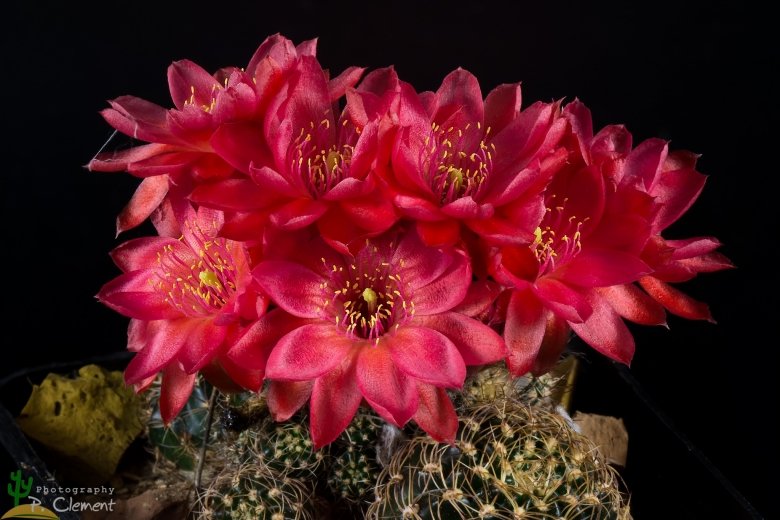
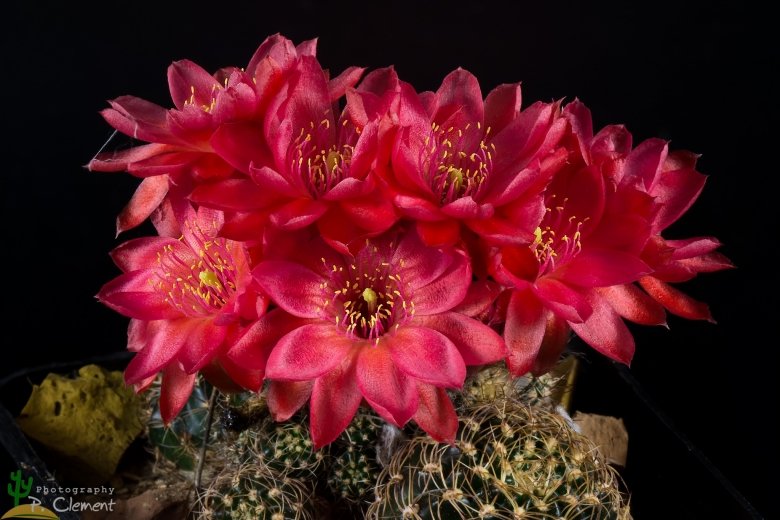
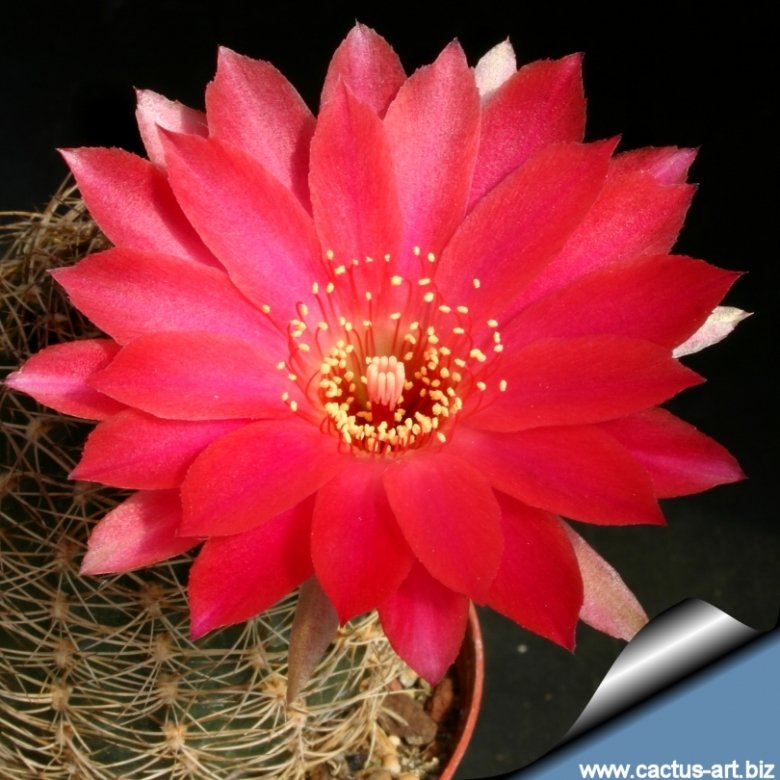
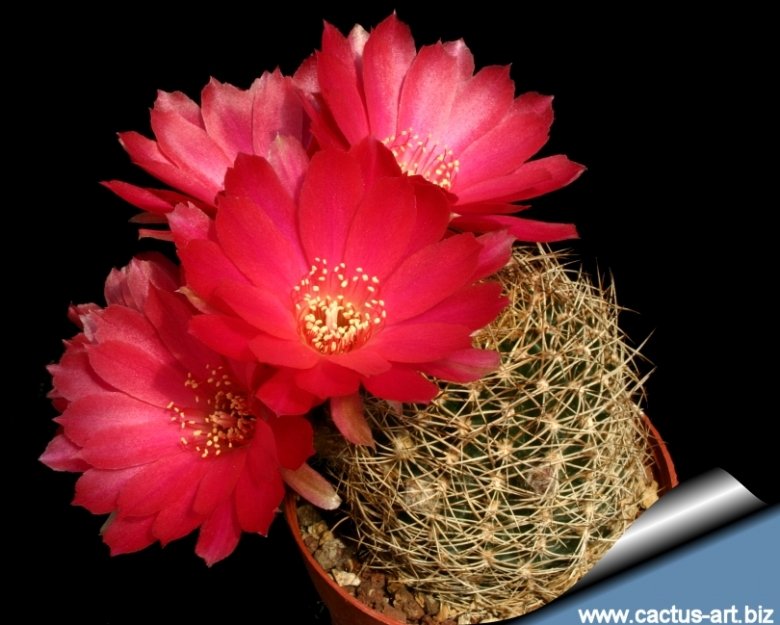
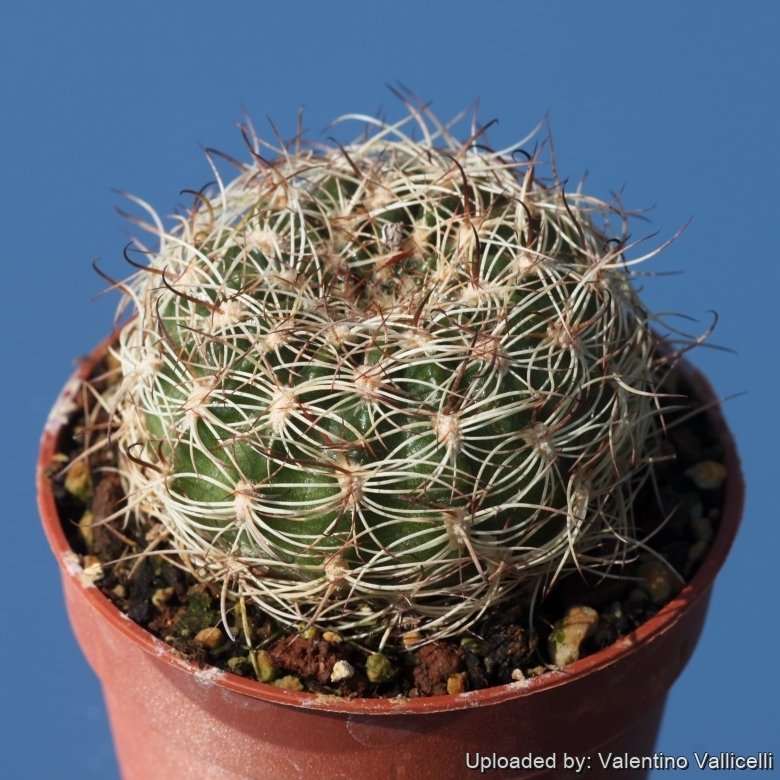
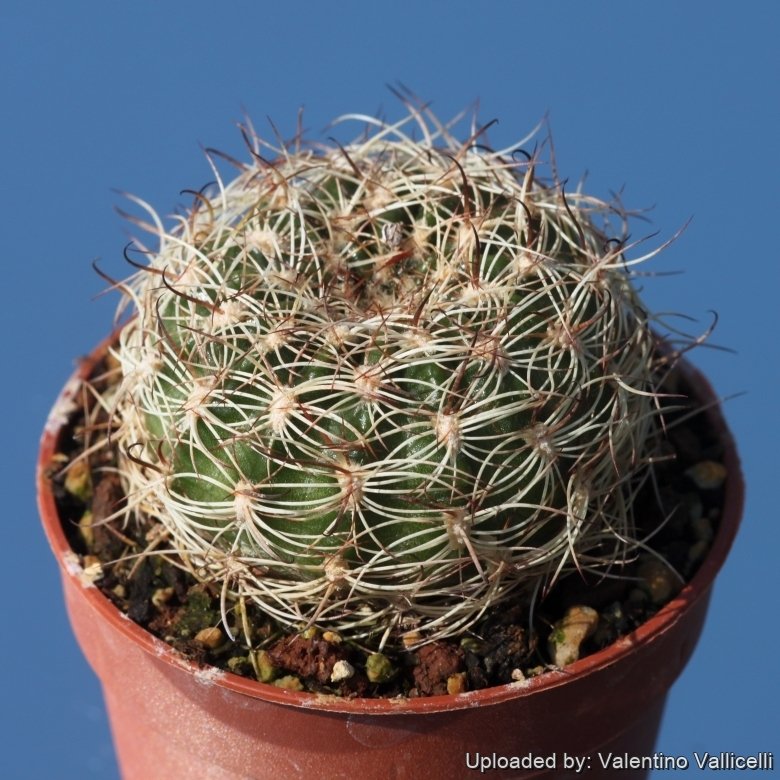
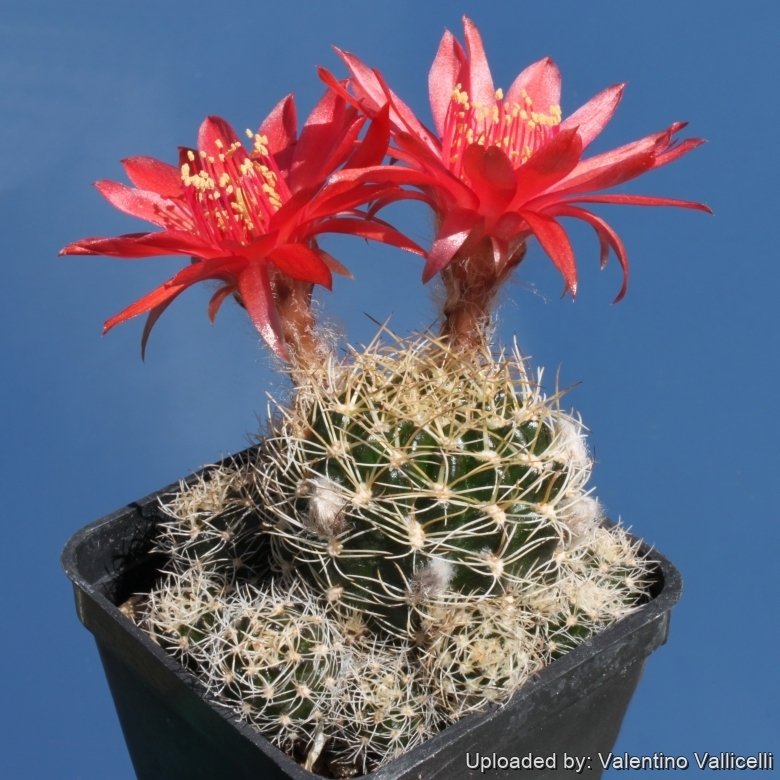
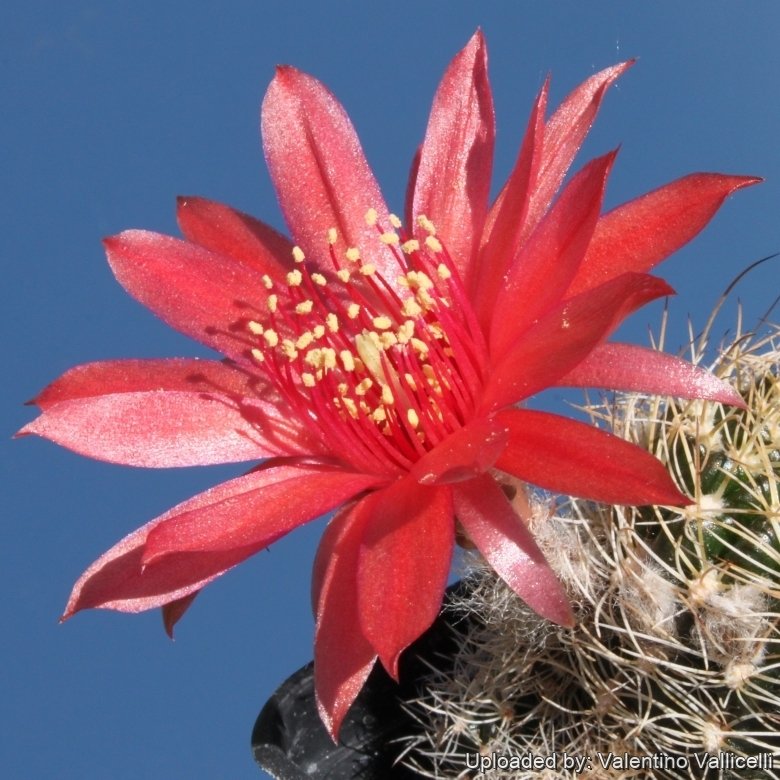
Echinopsis schieliana (best known as Lobivia schieliana) is a cute prolific clumper cactus with dark reddish-green stems underneath white or brownish spidery-spines, flowers are mostly a brilliant light-red and slender.
Habit: Plants generally forming clusters from basal branching.
Stems: Globose to cylindrical, often slender, to 4,5 cm long or more and 4-6 cm in diameter, dark reddish-green or blackish.
Ribs: 13-21 straight or somewhat spiralling 3-5 mm hight.
Areoles: 3-6 mm apart.
Spines: Creamy-white, yellowish or brownish, in age fading to grey.
Central spine: 1-4, often absent at first, similar to the radials but often darker, light brown to brown bent downward, 5-6 mm long.
Radial spines: 8-12(-14), pectinate to radiating, interlacing, light brown 2-15 mm long.
Flowers: orange-red to violet (or yellow) 3,5-4 cm in diameter floral bright; pericarpel 3-6 mm long and 3-6 mm in diameter, floral tubes slender 16-18 mm long, filaments violed red. Inner perianth segments violet-red with yellowish-orange or brownish-orange mid-stripe.
Fruit: Subglobose about 1 cm in diameter, dull-green to blackish, pulp white and juicy.
Seeds: 1,5 x 1 mm broad.
Origin and Habitat
The species was found in the valley of Río Consata, La Paz, Bolivia and spreads in the adjacent Tarija.
Altitude: It can be found at altitudes between 2400 and 3200 meters above sea level.
Habitat: Echinopsis schieliana is locally common among grasses and large boulders on flats, slopes and ridges, often together with Echinopsis maximiliana.
Cultivation and Propagation
It is a good beginner cactus and easy to grow and flower. It is quite resistant and occasionally gets covered by bright showy blossoms also neglected in a dry windowsill. Requires good drainage and very porous potting mix. Watering Needs Need regular water in spring to fall but do not water again until dry. Also, it is a species that is dormant in the winter and require very little water (maybe even none) during the cold months. Frost Tolerance: Light frost protection required. Minimum of 5ºC for safe growing (but hardy up to -5°C or less). Requires to be kept below 7°C in winter to flower well in the spring. Sun Exposure: Requires bright light (protect from strong midday sun). In shade the body colour will remain mostly green, while full sun will darken it and give it red/brown body colour. Can be sunburned if moved from shade/greenhouse into full sun too quickly. The amount of sunlight it can withstand without scorching depends upon the how hot it becomes in the summer in the locale in which it is planted. It will have more colour if it receives more light. During the spring it may be able to take full sun until the heat arrives at the end of spring. In an area that has hot afternoon sun, it may be able to take full morning sun, but requires afternoon shade or afternoon light shade.
Propagation: Seeds or offsets that appear at the base; leave them attached to form a cluster, or wait until they are 1/3 the size of the parent and then detach and plant.
Bibliography
Major references and further lectures
-
Edward Anderson “The Cactus family” Timber Press, Incorporated, 2001
-
James Cullen, Sabina G. Knees, H. Suzanne Cubey “The European Garden Flora Flowering Plants: A Manual for the Identification of Plants Cultivated in Europe, Both Out-of-Doors and Under Glass” Cambridge University Press, 11/Aug/2011
-
David R Hunt; Nigel P Taylor; Graham Charles; International Cactaceae Systematics Group. “The New Cactus Lexicon” dh books, 2006
-
Lowry, M. 2013. Echinopsis schieliana. In: IUCN 2013. “IUCN Red List of Threatened Species.” Version 2013.1. <www.iucnredlist.org>. Downloaded on 31 October 2013.
-
Friedrich Ritter “Kakteen in Südamerika: Ergebnisse meiner 20jährigen” Volume 2, Argentinien/Bolivien, Volume 2 Selbstverlag, 1980
-
Curt Backeberg “Die Cactaceae: Handbuch der Kakteenkunde,” Volume 2 G. Fischer, 1959
-
Curt Backeberg: “Descriptiones Cactearum Novarum.” 1957
-
Walter Rausch “Lobivia: The Day Flowering Echinopsidinae from a Geographical Distribution Point of View” Volumes 1-3 R. Herzig, 1975
-
Urs Eggli, Leonard E. Newton “Etymological Dictionary of Succulent Plant Names.” Springer, Berlin/Heidelberg 2010.
From llifle page Lobivia leptacantha
Description
Echinopsis schieliana subs. leptacantha, formerly known as Lobivia leptacantha, is one of the forms of Echinopsis schieliana which is a widespread and morphologically variable taxon. It is a small globular cactus distinguished from the type species for its straight ribs with mostly long soft spines and yellow, red or purple double sized flower, but most botanist agree on the fact that all the varieties described until now should all be included in the Echinopsis schieliana. Flowers appear most heavily in spring and summer. Echinopsis schieliana subs. leptacantha belongs to a group of very easily cultivated plants, decorative with pleasing appearance of stem and flower alike.
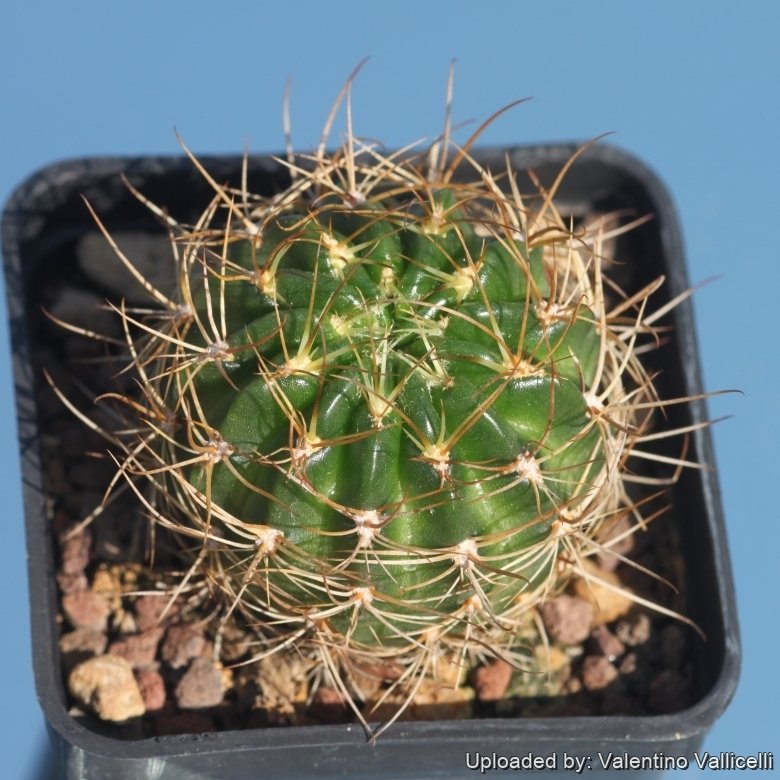
Stems: Bright green.
Spines: Long soft brownish-yellow.
Flowers: Larger than Echinopsis schieliana somewhat variable, 4 or more cm in diameter. Inner perianth segments reddish-orange, yellowish-orange or yellow.
Origin and Habitat
Paucartambo, Peru.
Altitude range: 2800-3050(-3750) metres above sea level.
Cultivation and Propagation
Echinopsis schieliana subs. leptacantha is a good beginner cactus and easy to grow and flower. It is quite resistant and occasionally gets covered by bright showy blossoms also neglected in a dry windowsill. Requires good drainage and very porous potting mix. Watering Needs Need regular water in spring to fall but do not water again until dry. Also, it is a species that is dormant in the winter and require very little water (maybe even none) during the cold months.
Frost Tolerance: Light frost protection required. Minimum of 5ºC for safe growing (but hardy up to -5°C or less). Requires to be kept below 7°C in winter to flower well in the spring.
Sun Exposure: Requires bright light (protect from strong midday sun). In shade the body colour will remain mostly green, while full sun will darken it and give it red/brown body colour. Can be sunburned if moved from shade/greenhouse into full sun too quickly. The amount of sunlight it can withstand without scorching depends upon the how hot it becomes in the summer in the locale in which it is planted. It will have more colour if it receives more light. During the spring it may be able to take full sun until the heat arrives at the end of spring. In an area that has hot afternoon sun, it may be able to take full morning sun, but requires afternoon shade or afternoon light shade.
Bibliography
Major references and further lectures
-
Clive Innes “Complete Handbook of Cacti and Succulents” Van Nostrand Reinhold Company, 01 December 1981
-
Walter Rausch “Lobivia: The Day Flowering Echinopsidinae from a Geographical Distribution Point of View” Volumes 1-3 R. Herzig, 1975
Source: Lobivia leptacantha, LLIFLE - Encyclopedia of living forms, CC-BY-SA, retrieved 2026-10-25.
From llifle page Lobivia schieliana var. longispina
Description
Echinopsis schieliana var. longispina is a morphological form of Echinopsis schieliana distinguished from the latter by longer white or brownish spines. The differences with other Echinopsis schieliana are in reality very minimal and the two plants are not readily distinguishable, if not for the spination. Best known as Lobivia schieliana var. longispina| it is a cute prolific clumping cactus with dark reddish-green stems concealed by the spines and flowers are mostly a brilliant light-red and slender.
Habit: Plants generally forming clusters from basal branching.
Stems: Globose to cylindrical, often slender, to 4,5 cm long or more and 4-6 cm in diameter, dark reddish-green or blackish.
Ribs: 13-21 straight or somewhat spiralling 3-5 mm hight.
Areoles: 3-6 mm apart.
Spines: Creamy-white, yellowish or brownish, in age fading to grey.
Central spine: 1-4, often absent at first, similar to the radials but often darker, light brown to brown bent downward, up to 20 mm long.
Radial spines: 8-12(-14), pectinate to radiating, interlacing, light brown 2-15 mm long.
Flowers: orange-red to violet (or yellow) 3,5-4 cm in diameter floral bright; pericarpel 3-6 mm long and 3-6 mm in diameter, floral tubes slender 16-18 mm long, filaments violed red. Inner perianth segments violet-red with yellowish-orange or brownish-orange mid-stripe.
Fruit: Subglobose about 1 cm in diameter, dull-green to blackish, pulp white and juicy.
Seeds: 1,5 x 1 mm broad.
Origin and Habitat
This plant is a selected form found in cultivation only, originated from standard Frailea pumila which occurs naturally the valley of Río Consata, La Paz, Bolivia and spreads in the adjacent Tarija.
Cultivation and Propagation
This is a a much decorative frost hardy cactus easily found in cultivation. It is a summer grower species that offers no cultivation difficulties.
Soil: Use a very a particularly draining substratum, as it is very sensitive to rottenness when in presence of humidity and low temperatures and let the soil dry out between waterings, since it’s natural habitat is in volcanic soil, it has adapted to more acidic conditions.
Repotting: Repot in the spring, when their roots become cramped. Generally, they should be repotted every other year in order to provide fresh soil. After repotting, do not water for a week or more. Needs a large pot to accommodate a large root system.
Water: In summer, during the vegetative period, it must be regularly watered, but allowing the substratum to completely dry up before irrigating again (but do not overwater ); in winter, it’s to be kept dry. Preferable not to water on overcast days, humid days or cold winter days.
Hardiness: It is a quite frost resistant cactus, hardy to -5° C (- 10° C if very dry). However in cultivation it is better not to expose it to temperatures lower than -0° C, even if in an aerated and protected location, in order to avoid the formation of anti-aesthetic spots on the epidermis. In presence of high atmospheric humidity avoid any frost as it is particularly sensitive to root rot.
Exposure: Outside full sun or afternoon shade, inside needs bright light, and some direct sun, but, as a former mountain dweller, does not care for extremely high temperatures in summer.
Use: It is suitable for small “desert” gardens, in association with other xerophytes. Where the open air cultivation is not possible due to the climate, it is to be cultivated in pot in order to shelter it in winter.
Propagation: By seeds and by cuttings, provided left drying up well, in summer.
Source: Lobivia schieliana var. longispina, LLIFLE - Encyclopedia of living forms, CC-BY-SA, retrieved 2026-10-25.
Cultivars and forms (2)
Subspecies (1)
Varieties (1)
Gallery