Publication: Bradleya 9: 88. 1991
Description
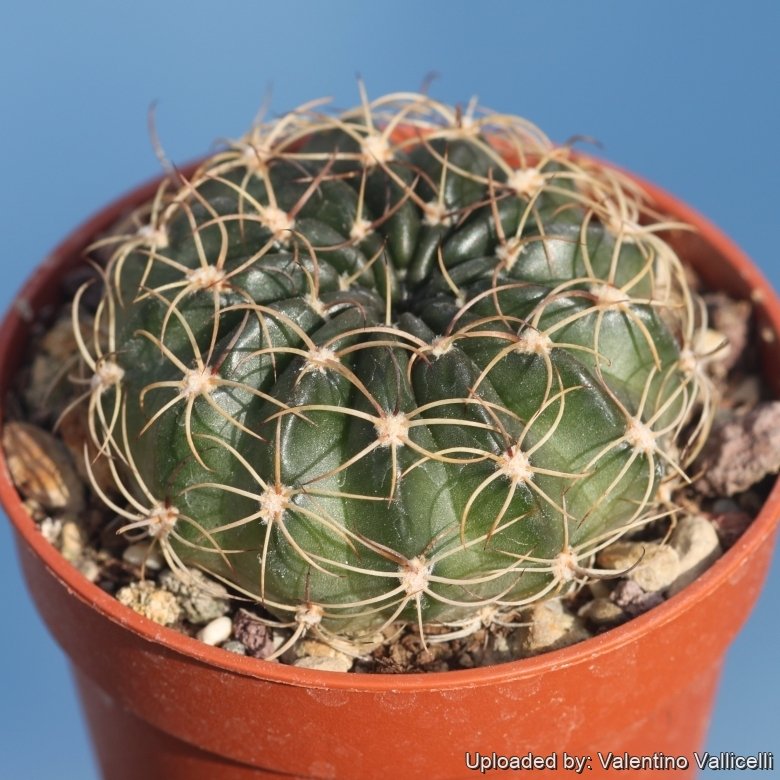
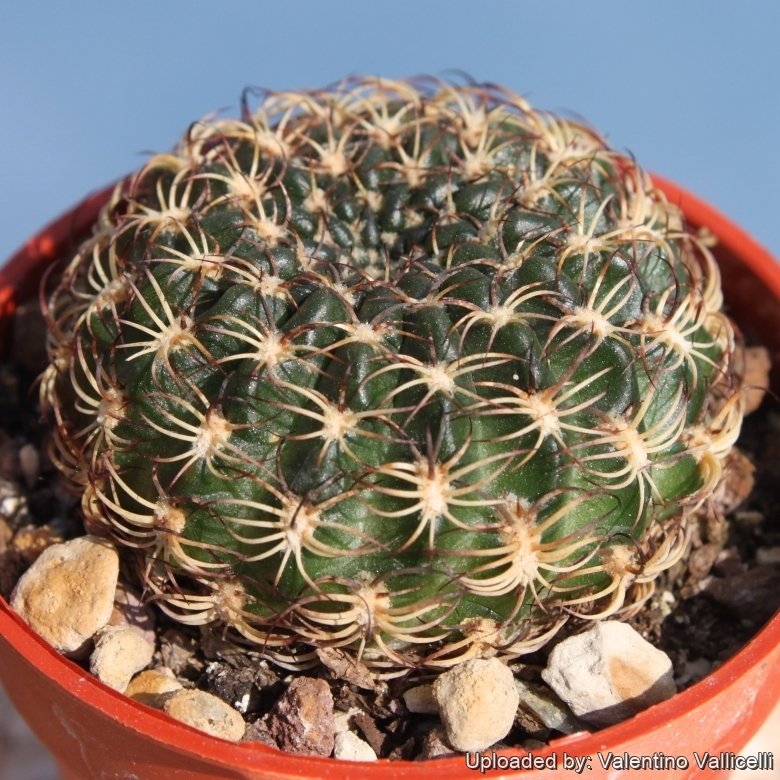
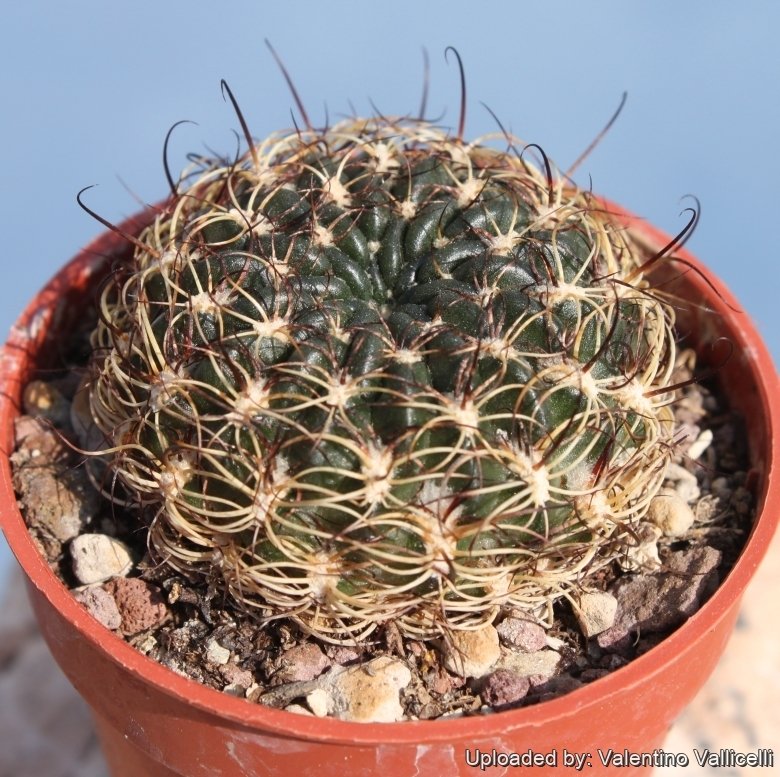
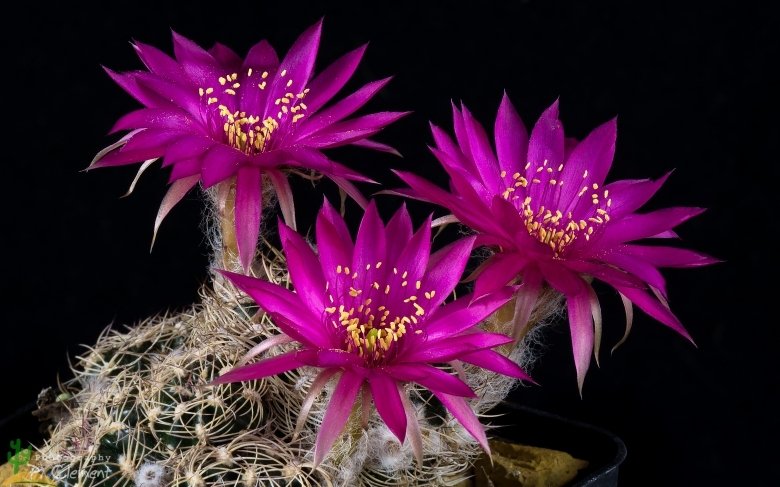
Echinopsis tiegeliana (Lobivia tiegeliana) is a small cactus, usually solitary, whose spines looks pectinate ( i.e., its spines are arranged like a comb). This species is very variable in colour and number of spines, size and colour of flowers. It comprises several questionable varieties and its taxonomic history has undergone several changes. The great variability of Echinopsis tiegeliana is due to the fact that cross pollination among different forms and different species (in habitat and especially in collections) is very frequent and it can be quite difficult to determine what is the “pure type” and the cross.
Roots: Large fleshy tap root.
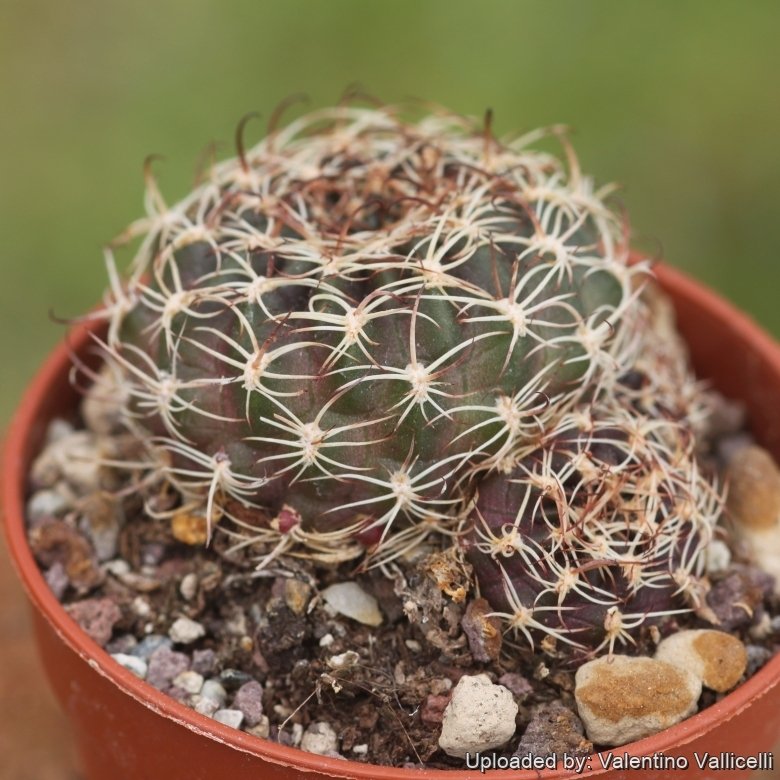
Stems: In nature plants usually grow flat with the ground most of the year, contracting under the soil to endure drought periods. In culture plants grow larger forming depressed or spherical stems up to 15 cm in diameter, but usually about 6 cm broad. Epidermis dark green, shiny, often purplish with strong light and in cold weather. The crown is sunken.
Ribs: Approx. 17-20, acute, spirally arranged with raised tubercles between which the areoles appear.
Areoles: White, to 1.5 cm apart.
Spines: Arranged like little spiders, awl shaped, pectinated, variable, reddish, black, brownish, honey or horn coloured , often darker at the tip, turning greyish eventually.
Central spines: As many as 3, pointing downward, to 5 cm long.
Radial spines: 8 to10, 4-6 cm long.
Blooming season: Mature plants produce several waves of blooms over the season. The flowers open during the day. It blooms abundantly since an early age.
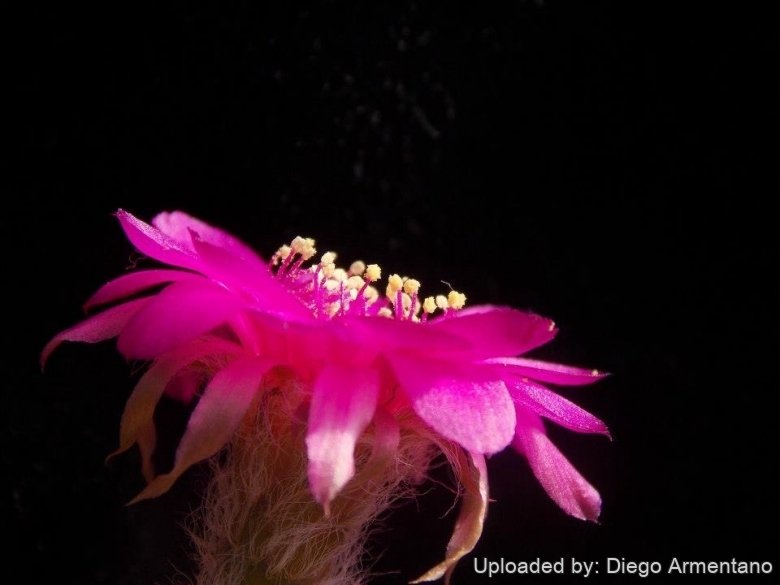
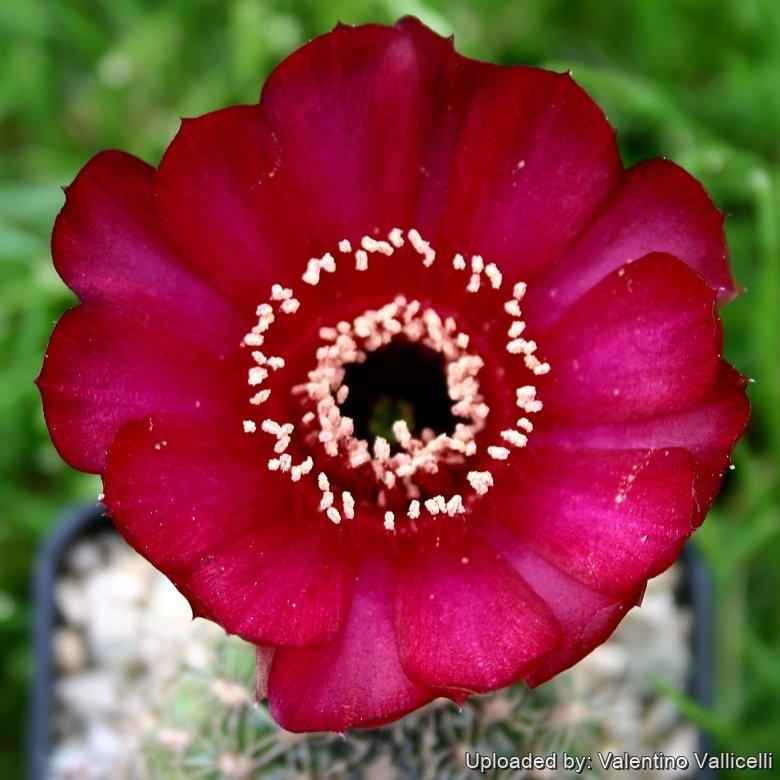
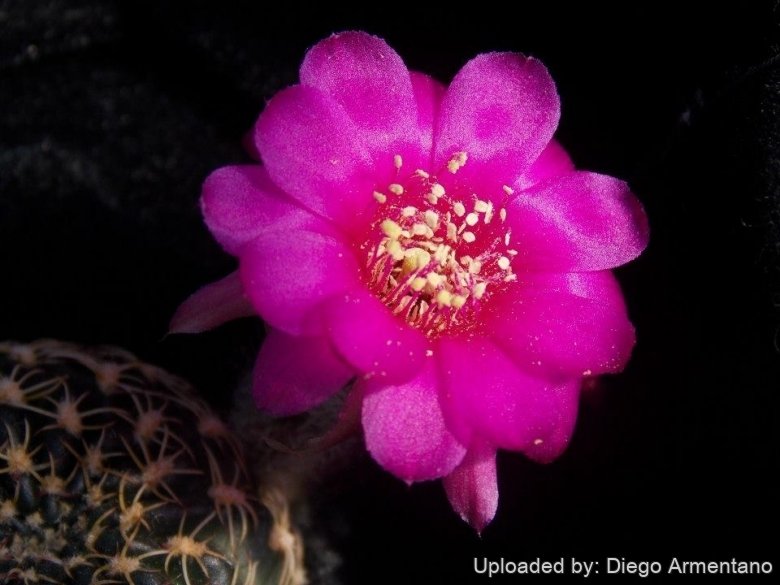
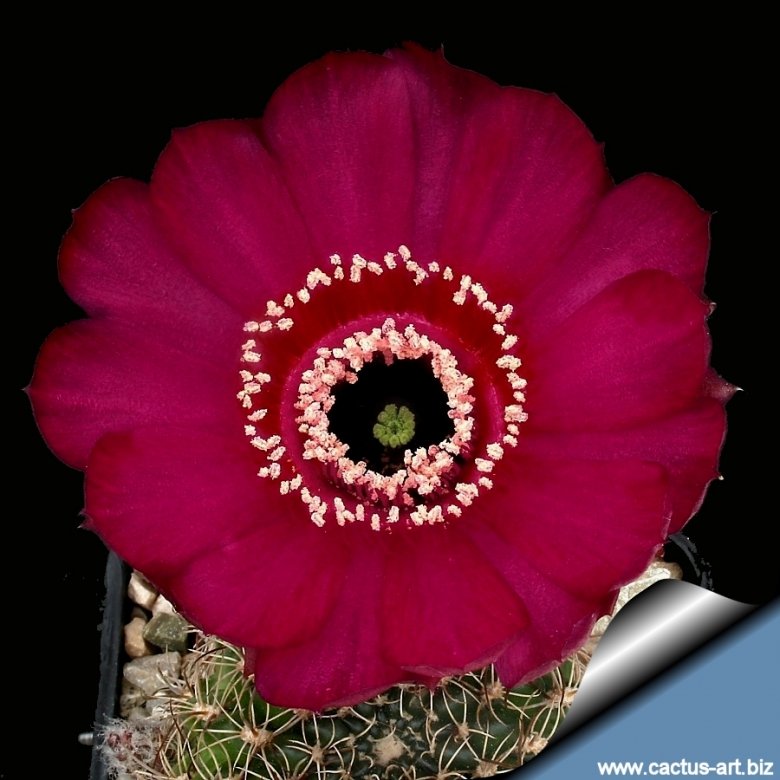
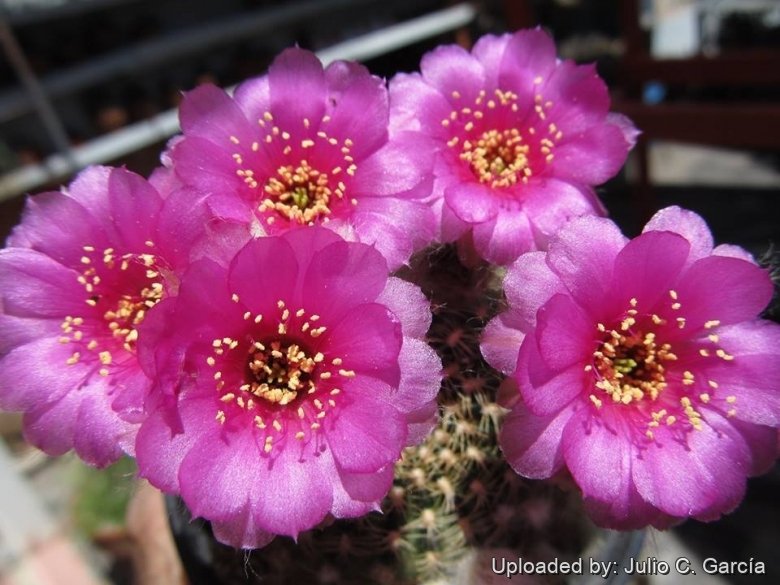
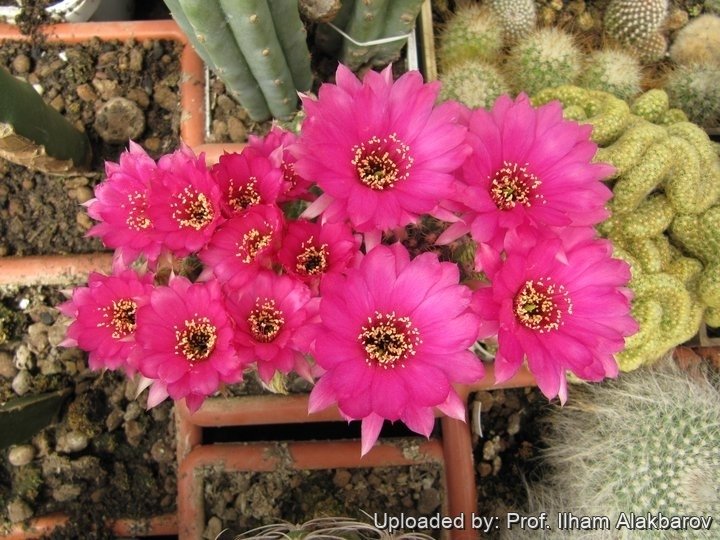
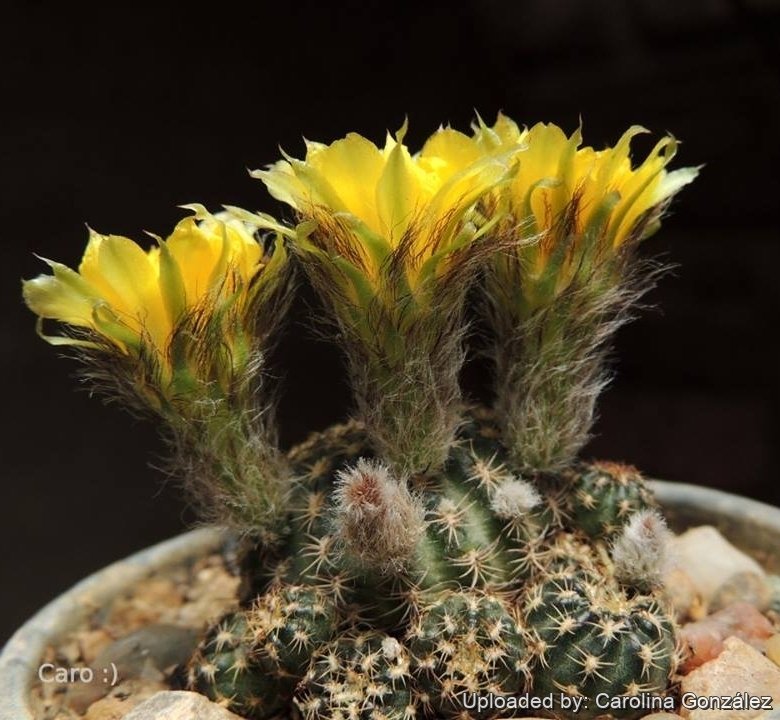
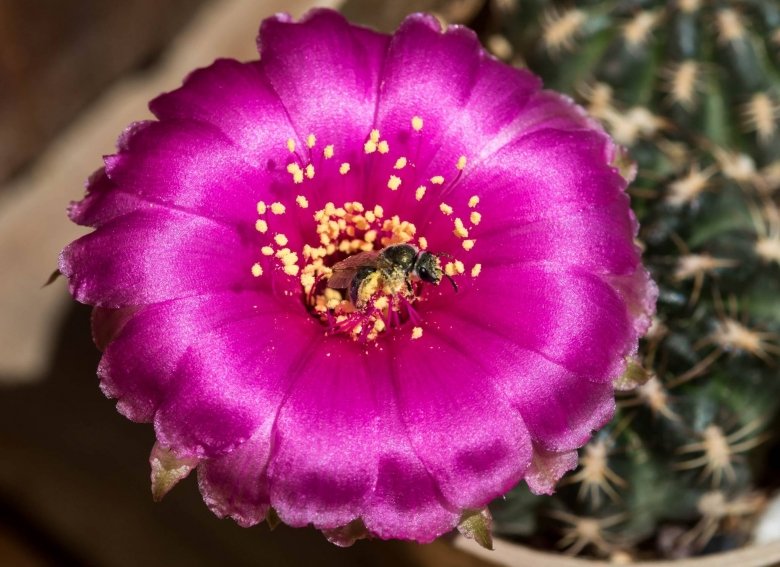
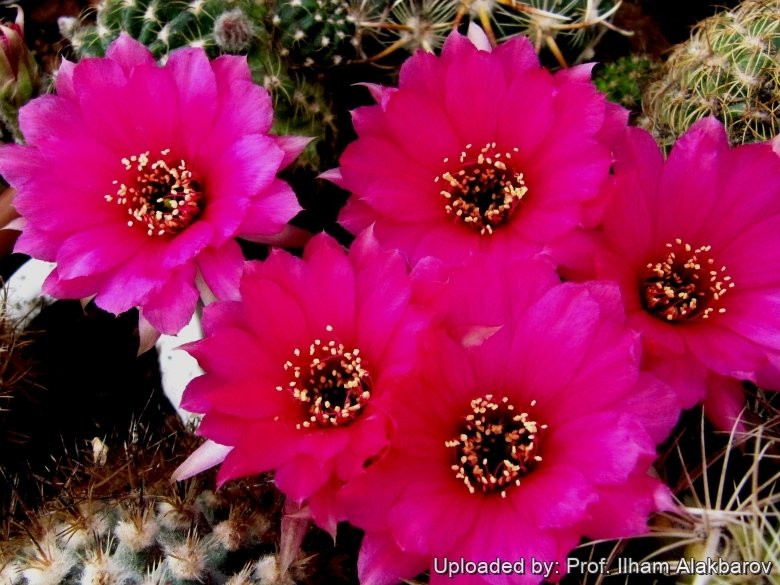
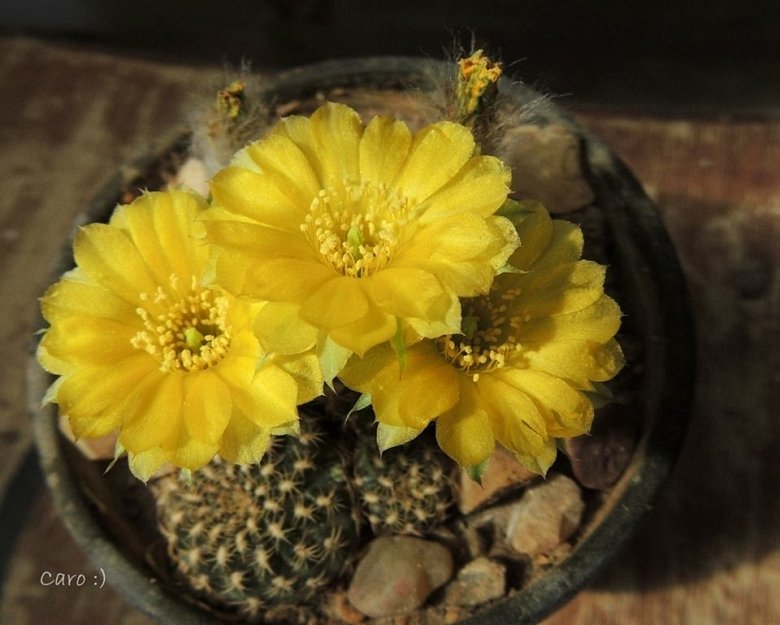
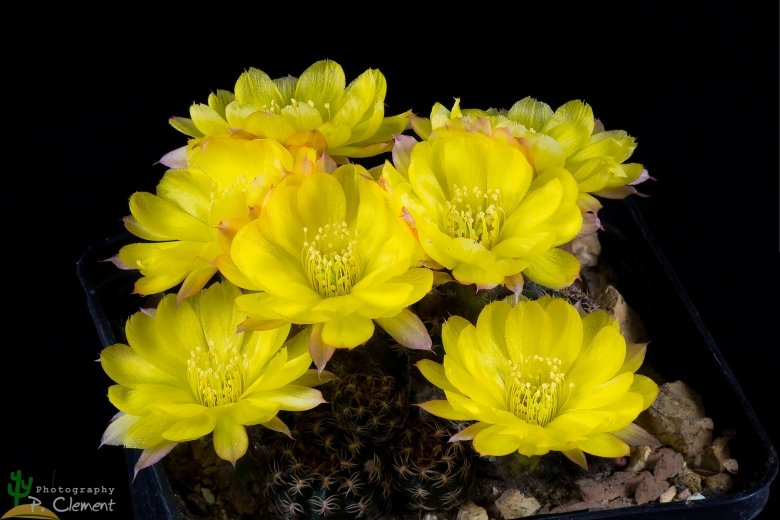
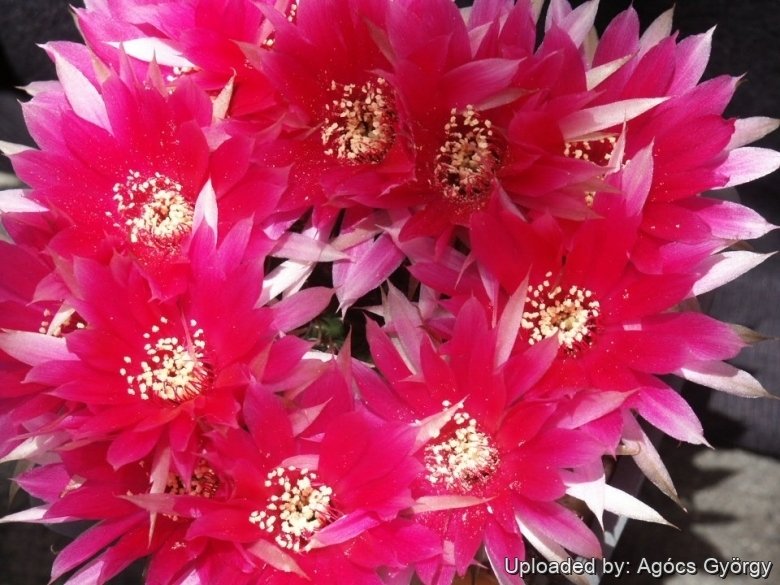
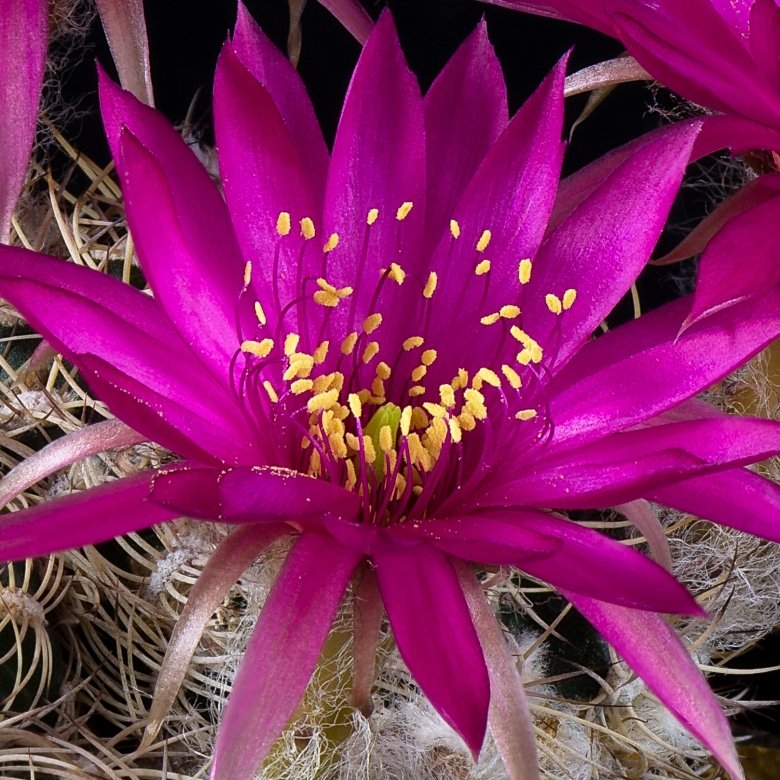
Flowers: Lateral 2,5-3 cm long and 4,2 cm in diameter, deep red to violet-pink, although there are varieties with yellow flowers as well.
Fruits: Globose to ovoid, semidry, dehiscent.
Origin and Habitat
Echinopsis tiegeliana is endemic to Bolivia, where it occurs in Tarija.
Altitude range: This species grows at altitudes between 1,800 to 2,700 metres above sea level.
Habitat and Ecology: This species occurs in rocky areas amongst shrubby vegetation. It is common where it occurs, but some populations are affected by low-impact subsistence farming and goat herding.
Cultivation and Propagation
This is a a much decorative frost hardy cactus easily found in cultivation. It is a summer grower species that offers no cultivation difficulties.
Soil: Use a very a particularly draining slightly acidic or neutral substratum, as it is very sensitive to rottenness when in presence of humidity and low temperatures and let the soil dry out between waterings.
Repotting: Repot in the spring, when their roots become cramped. Generally, they should be repotted every other year in order to provide fresh soil. After repotting, do not water for a week or more. Needs a large pot to accommodate a large root system.
Water: In summer, during the vegetative period, it must be regularly watered, but allowing the substratum to completely dry up before irrigating again (but do not overwater ); in winter, it’s to be kept dry. Preferable not to water on overcast days, humid days or cold winter days.
Hardiness: It is a quite frost resistant cactus, hardy to -5° C (- 12° C if very dry). However in cultivation it is better not to expose it to temperatures lower than -0° C, even if in an aerated and protected location, in order to avoid the formation of anti-aesthetic spots on the epidermis. In presence of high atmospheric humidity avoid any frost as it is particularly sensitive to root rot. As these are high-elevation plants, they don’t like to get overheated.
Exposure: Outside full sun or afternoon shade, inside needs bright light, and some direct sun, but, as a former mountain dweller, does not care for extremely high temperatures in summer.
Use: It is suitable for small “desert” gardens, in association with other xerophytes. Where the open air cultivation is not possible due to the climate, it is to be cultivated in pot in order to shelter it in winter.
Propagation: Direct sow after last frost or by offsets (if available), provided left drying up well, in summer.
Bibliography
Major references and further lectures
-
David Hunt, Nigel Taylor “The New Cactus Lexicon” DH Books, 2006
-
Edward F. Anderson “The Cactus Family” Timber Press, 2001
-
James Cullen, Sabina G. Knees, H. Suzanne Cubey “The European Garden Flora Flowering Plants: A Manual for the Identification of Plants Cultivated in Europe, Both Out-of-Doors and Under Glass” Cambridge University Press, 11/ago/2011
-
David Hunt, Nigel Taylor “The New Cactus Lexicon” DH Books, 2006 ISBN 0953813444, 9780953813445.
-
Walter Rausch “Lobivia 85” Rudolf Herzig Vienna 1985/86 (text in German)
-
Curt Backeberg “Das Kakteenlexikon: Enumeratio diagnostica Cactacearum” Gustav Fischer Verlag, 1979 (text in German).
-
Clive Innes, Clive Times, Charles Glass “The Illustrated Encyclopedia of Cacti” Chartwell Books, 01/apr/2001
-
Willy Cullmann, Erich Götz (Dozent Dr.), Gerhard Gröner “The encyclopedia of cacti” Timber Press, 1987.
-
Lowry, M. 2013. Echinopsis tiegeliana. The IUCN Red List of Threatened Species. Version 2014.3. <www.iucnredlist.org>. Downloaded on 07 May 2015.
From llifle page Hymenorebutia pusilla
Description
Echinopsis tiegeliana var. pusilla firstly described as Lobivia pusilla is an hight altitude form of the wide ranging and very variable Echinopsis tiegeliana distinguished by smaller stems only 40 mm tall and shorter spines. It is one of the smaller plants in the genus.
Taxonomy notes: The differences with other Echinopsis tiegeliana are in reality very minimal and most botanist agree on the fact that var. pusilla should be included in the Echinopsis tiegeliana. The segregation of the many forms, varieties, and subspecies on the basis of spines morphology and flowers colour, however, is difficult to support, given the continuous range of variation in spination and flower colour over its geographic range. The great variability of Echinopsis tiegeliana is due to the fact that cross pollination among different forms and different species (in habitat and in collections) is very frequent and it can be quite difficult to determine what is the “pure type” and the cross.
Stems: Green to dark green, spherical more or less flattened usually less than 4 cm tall in habitat (but often larger in cultivation). It has up to 20 ribs, with raised tubercles between which the areoles appear. The tubercles are spirally arranged on the stem’s surface. In nature plants usually grow flat with the ground most of the year, contracting under the soil to endure drought periods. In culture plants grow larger forming depressed round stems.
Root: Turnip-like, fleshy with numerous lateral fine fibrous roots.
Spines: Arranged like little spiders, cream coloured, yellowish or brownish, turning greyish eventually.
Flowers: Mostly deep pink, red, purple, but also yellow, orange or white.
Blooming season: Mature plants produce several waves of blooms over the growing season.
Origin and Habitat
Tarija, Bolivia
Altitude: around 1900 metres a.s.l.
Bibliography
Major references and further lectures
-
Nathaniel Lord Britton, Joseph Nelson Rose “Cactaceae: Descriptions and Illustrations of Plants of the Cactus Family” Courier Dover Publications, 1963
-
James Cullen, Sabina G. Knees, H. Suzanne Cubey “The European Garden Flora Flowering Plants: A Manual for the Identification of Plants Cultivated in Europe, Both Out-of-Doors and Under Glass” Cambridge University Press, 11/Aug./2011
-
David Hunt, Nigel Taylor “The New Cactus Lexicon” DH Books, 2006
-
Edward F. Anderson “The Cactus Family” Timber Press, 2001
-
Clive Innes, Charles Glass “Cacti” Portland House, 01/May/1991
Source: Hymenorebutia pusilla, LLIFLE - Encyclopedia of living forms, CC-BY-SA, retrieved 2026-10-25.
From llifle page Hymenorebutia pusilla f. flaviflora
Description
Lobivia tiegeliana var. flaviflora (firstly described as Lobivia pusilla f. flaviflora by F.Ritter 1966) is a local or morphological yellow flowering form of the widespread and variable Echinopsis tiegeliana. It is a tiny simple or clumping lobivia with distinguishing bright yellow blooms (not deep red nor violet-pink). This variety is not accepted by many botanists that treat it as synonym, but it still has a value for a collector because they identify plants with particular characters.
Stems: 1.5–4 cm in diameter, crown with spination.
Ribs: 11–17, barely notched, humps slightly developed.
Areoles: Elongate, 1–4 mm apart.
Radial spines: Numerous, 1–5 mm long, more or less pectinate and pointing sidewards.
Cetral spines: 1, to 5 mm long (often missing).
Flowers: 3,6–4 cm long, yellow.
Origin and Habitat
North of the Tarija Province, Bolivia
Altitude range: 1600-2000 metres above sea level.
Bibliography
Major references and further lectures
- Walther Haage “Kakteen von A bis Z” Neumann Verlag, 1981
Source: Hymenorebutia pusilla f. flaviflora, LLIFLE - Encyclopedia of living forms, CC-BY-SA, retrieved 2026-10-25.
From llifle page Lobivia peclardiana var. albiflora
Description
It is a compact highly branched succulent with a thickened storage root stock. It will form a dense mat with age.
Leaves: Fleshy organized in 2-6 pairs in each branch, smooth, light grey to bluish, trigonus narrowing toward the apiculate apex, keel ± oblique. Every year a few new leaves grow from the central stem.
Roots: Well developed, thickened tap-root.
Flowers: Daisy-like, organized in groups (cymes) of 1 to 3, but usually solitary, 20-30 mm in diameter, petals pure white to dark-pink with a white base, 1(-3) bracteolate. Filamentous staminodes white surrounding the stamens in a central cone. Stamens filament white, anthers yellow.
Blooming season: The long lasing flowers appears in spring.
Fruits: Dark-brown capsules, usually singles, bracteolates, base semi-globular with convex sides. Persisting for many year on the plants.
Seeds: 0.9-1 mm long, 0.6-08 mm wide.
Origin and Habitat
It is endemic to few sites in the Northern Cape, Griqualand West and Vredenfort, South Africa.
Habitat: Grows in grass land among sandstone rocks, in gravelly soil, often in pockets on rocks or or on pans. Rainfall/year: 300-500 mm in summer. This species look surprisingly like mesembs of the genus Hereroa that grow mixed together the same area but with yellow flowers in late summer.
Cultivation and Propagation
It is easy to grow and rewarding plants than can be grown in pots or in the rock-garden.. These plants grow on summer rain areas and were heading for winter dormancy. They can be watered year-round, water regularly from spring to Autumn but reduce watering frequency in winter, growth period is early Spring to late Summer, but is a very adaptable species that can grows opportunistically whenever the water availability and growing condition are favourable. Keep them cool, and half-shaded in summer, need full sun or light shade on the other seasons. Potted Ebracteola look best in a heavy soil and the same is true for plants in a rockery. Requires good drainage. Frost Tolerance: quite frost hardy and grows best where there are cold winters (it is reported to be hardy to at least -10° C if very dry).
Propagation: Seeds, cuttings.
Notes
Ebracteola has a gorgeous, thick root system and when it is potted up, the plant can be progressively raised over the ground so that some of the roots can be seen and is especially cultivated for their looks. Architecturally it is a real stunner. When the “caudex” shape of the raised roots is adequately in evidence this plant is incomparable. They also tend to grow more “heads” when they are raised.
Source: Lobivia peclardiana var. albiflora, LLIFLE - Encyclopedia of living forms, CC-BY-SA, retrieved 2026-10-25.
From llifle page Hymenorebutia tiegeliana var. ruberrima
Description
Echinopsis tiegeliana (Lobivia tiegeliana) is a very variable species for colour and number of spines, size and colour of flowers. It comprises several questionable varieties and its taxonomic history has undergone several changes. The great variability of Echinopsis tiegeliana is due to the fact that cross pollination among different forms and different species (in habitat and especially in collections) is very frequent and it can be quite difficult to determine what is the “pure type” and the cross. The var. ruberrima is distinguishable for the bright red blooms.
Origin and Habitat
Bolivia, Tarija, 3500 m.
Cultivation and Propagation
This is a a much decorative frost hardy cactus easily found in cultivation. It is a summer grower species that offers no cultivation difficulties.
Soil: Use a very a particularly draining slightly acidic or neutral substratum, as it is very sensitive to rottenness when in presence of humidity and low temperatures and let the soil dry out between waterings.
Repotting: Repot in the spring, when their roots become cramped. Generally, they should be repotted every other year in order to provide fresh soil. After repotting, do not water for a week or more. Needs a large pot to accommodate a large root system.
Water: In summer, during the vegetative period, it must be regularly watered, but allowing the substratum to completely dry up before irrigating again (but do not overwater); in winter, it’s to be kept dry. Preferable not to water on overcast days, humid days or cold winter days.
Hardiness: It is a quite frost resistant cactus, hardy to -5° C (- 12° C if very dry). However in cultivation it is better not to expose it to temperatures lower than -0° C, even if in an aerated and protected location, in order to avoid the formation of anti-aesthetic spots on the epidermis. In presence of high atmospheric humidity avoid any frost as it is particularly sensitive to root rot. As these are high-elevation plants, they don’t like to get overheated.
Exposure: Outside full sun or afternoon shade, inside needs bright light, and some direct sun, but, as a former mountain dweller, does not care for extremely high temperatures in summer.
Use: It is suitable for small “desert” gardens, in association with other xerophytes. Where the open air cultivation is not possible due to the climate, it is to be cultivated in pot in order to shelter it in winter.
Propagation: Direct sow after last frost or by offsets (if available), provided left drying up well, in summer.
Notes
A full sun exposure is indispensable to keep plant compact with strong and colourful spines. Without sun the stems elongate and remain green and don’t take the characteristic dark-purple colour.
Bibliography
Major references and further lectures
-
Nathaniel Lord Britton, Joseph Nelson Rose “Cactaceae: Descriptions and Illustrations of Plants of the Cactus Family” Courier Dover Publications, 1963
-
James Cullen, Sabina G. Knees, H. Suzanne Cubey “The European Garden Flora Flowering Plants: A Manual for the Identification of Plants Cultivated in Europe, Both Out-of-Doors and Under Glass” Cambridge University Press, 11/Aug./2011
-
David Hunt, Nigel Taylor “The New Cactus Lexicon” DH Books, 2006 ISBN 0953813444, 9780953813445.
-
Edward F. Anderson “The Cactus Family” Timber Press, 2001
-
Clive Innes, Charles Glass “Cacti” Portland House, 01/May/1991
Source: Hymenorebutia tiegeliana var. ruberrima, LLIFLE - Encyclopedia of living forms, CC-BY-SA, retrieved 2026-10-25.
From llifle page Lobivia tiegeliana
Description
Lobivia tiegeliana var. uriondoensis originally described by W. Rausch in 1979, is one of the many geographical or morphological form of Echinopsis tiegeliana. Many variants of {{E. tiegeliana were early classified as different independent species, form or varieties, but nowadays all this plants are considered part of a multiform species, where each form is linked to others by populations of plants with intermediate characteristics. Lobivia tiegeliana var. uriondoensis comes from the locality of Uriondo, in the Tarija province, Bolivia, hence the varietal name. It has distinctive dark pink-violet flowers up to 4 cm long and wide, fully open at anthesis. The stems are hemispherical with a large fleshy tap root. The spines are comb shaped quite flattened and slightly bent inward.
Origin and Habitat
Near Uriondo, Tarija, Bolivia
Altitude: Around 1700-1900 metres above sea level.
Cultivation and Propagation
This is a a much decorative frost hardy cactus. It is a summer grower species that offers no cultivation difficulties.
Soil: Use a very a particularly draining slightly acidic or neutral substratum, as it is very sensitive to rottenness when in presence of humidity and low temperatures and let the soil dry out between waterings.
Repotting: Repot in the spring, when their roots become cramped. Generally, they should be repotted every other year in order to provide fresh soil. After repotting, do not water for a week or more. Needs a large pot to accommodate a large root system.
Water: In summer, during the vegetative period, it must be regularly watered, but allowing the substratum to completely dry up before irrigating again (but do not overwater ); in winter, it’s to be kept dry. Preferable not to water on overcast days, humid days or cold winter days.
Hardiness: It is a quite frost resistant cactus, hardy to -5° C (- 12° C if very dry). However in cultivation it is better not to expose it to temperatures lower than -0° C, even if in an aerated and protected location, in order to avoid the formation of anti-aesthetic spots on the epidermis. In presence of high atmospheric humidity avoid any frost as it is particularly sensitive to root rot. As these are high-elevation plants, they don’t like to get overheated.
Exposure: Outside full sun or afternoon shade, inside needs bright light, and some direct sun, but, as a former mountain dweller, does not care for extremely high temperatures in summer.
Use: It is suitable for small “desert” gardens, in association with other xerophytes. Where the open air cultivation is not possible due to the climate, it is to be cultivated in pot in order to shelter it in winter.
Propagation: Direct sow after last frost or by offsets (if available), provided left drying up well, in summer.
Source: Lobivia tiegeliana, LLIFLE - Encyclopedia of living forms, CC-BY-SA, retrieved 2026-10-25.
From llifle page Lobivia tiegeliana f. cristata
Description
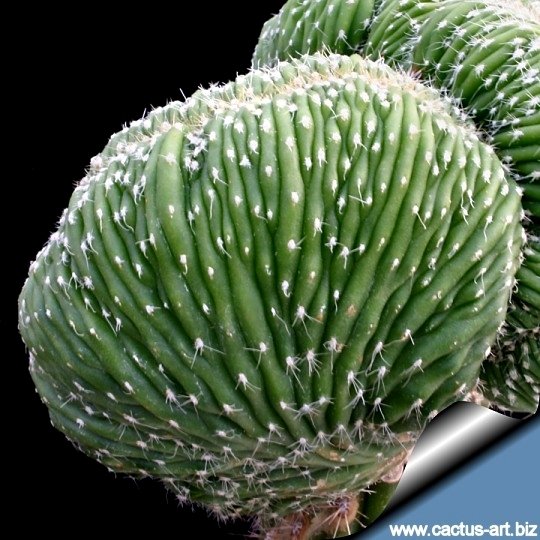
Dark green ribs with flat tubercles between which the areoles appear.
Spines: Arranged like little spiders, brownish, turn greyish eventually.
Flowers: Deep red.
Cultivation and Propagation
It is a summer grower species that offers no cultivation difficulties. Water regularly in summer (but do not overwater ) keep rather dry in winter. Feed with a high potassium fertilizer in summer. It is quite frost resistant if kept dry (hardy to -5° C). Need a bright exposure, full sun or half shade in summer. As these are high-elevation plants, they don’t like to get overheated.
Propagation: Grafting, cutting.
Source: Lobivia tiegeliana f. cristata, LLIFLE - Encyclopedia of living forms, CC-BY-SA, retrieved 2026-10-25.
From llifle page Lobivia tiegeliana f. variegata
Description
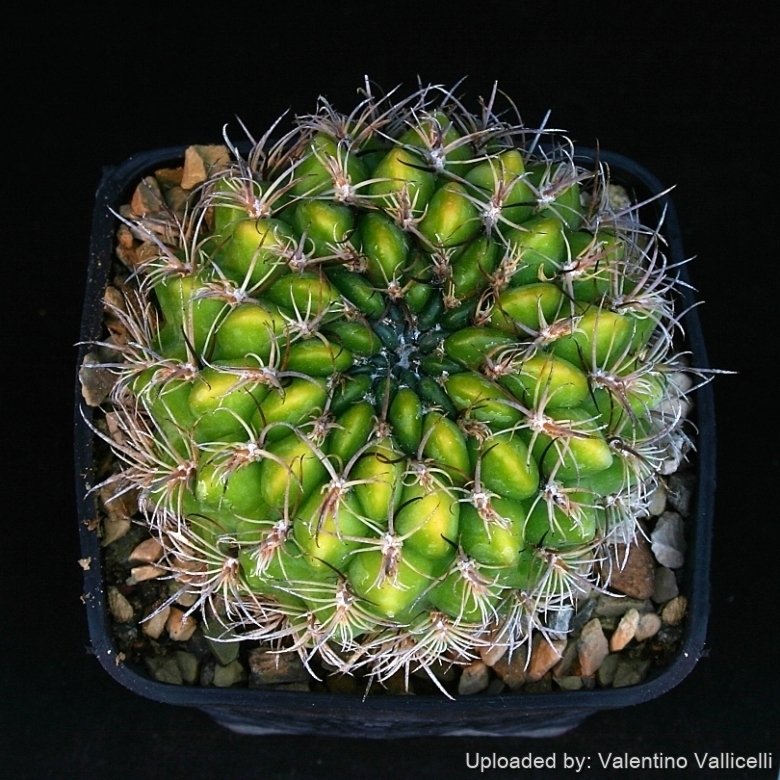
The classical Echinopsis tiegeliana (Lobivia tiegeliana) is a small cactus with a much flattened usually solitary body, whose spines looks pectinate ( i.e., its spines are arranged like a comb). The variegated form (Echinopsis tiegeliana f. variegata) has sectors, patches or stripes with distinct shades of yellow. A very few variegated plants sprout unpredictably time by time among normal green seedling and are very rare. Plants with variegated stems are often attractive and highly prized.
Roots: Large fleshy tap root.
Stems: Glossy green and yellow, often purplish with strong light and in cold weather, depressed or spherical up to 15 cm in diameter, but usually about 6 cm broad. The crown is sunken.
Ribs: 17-20, acute, spirally arranged with raised tubercles between which the areoles appear.
Areoles: White, to 1,5 cm apart.
Spines: Arranged like little spiders, awl shaped, pectinated, variable, reddish, black, brownish, honey or horn coloured , often darker at the tip, turning greyish eventually.
Central spines: As many as 3, pointing downward, to 5 cm long.
Radial spines: 8 to10, 4-6 cm long.
Flowers: Lateral 2,5-3 cm long and 4,2 cm in diameter, deep red to violet-pink, although there are varieties with yellow flowers as well.
Blooming season: Mature plants produce several waves of blooms over the season. The flowers open during the day. It blooms abundantly since an early age.
Fruits: Globose to ovoid, semidry, dehiscent.
Origin and Habitat
Garden origin (Nursery produced cultivar)
Cultivation and Propagation
Variegated cacti are regarded as choice and difficult in cultivation, but despite that many of them are relatively easy to grow. But be aware that they cannot tolerate prolonged exposure to direct sun light (especially during the hottest summer days), so grow them in half-shade or under filtered sun. They are sometime seen as grafted plants, but some of this colourful plants (those with some chlorophyll) are able to grow on their own roots and are priced by collectors.
Soil: Use mineral well-permeable substratum with little organic matter (peat, humus).
Watering: Water sparingly from March till October, and keep perfectly dry in winter, at temperatures from 5 to 15 degrees centigrade. (In general these plants are more tender and cannot endure freezing temperatures). In the rest period no high atmospheric humidity!!
Propagation: By seeds, grafting or cutting. Because the variegation is due to the presence of two kinds of plant tissue, propagating the plant must be by a vegetative method of propagation that preserves both types of tissue in relation to each other. A most common way way to cultivate this partially de-coloured cultivars is to graft them onto another cactus which has chlorophyll and which will provide sugar to the mutant scion. The chlorophyll containing bottom part of the graft, called the stock, can be any number of different columnar cactus species.
Remarks: Seeds from variegated parents often give raise to some variegated seedlings too.
Source: Lobivia tiegeliana f. variegata, LLIFLE - Encyclopedia of living forms, CC-BY-SA, retrieved 2026-10-25.
From llifle page Lobivia pusilla f. aurea
Description
Echinopsis tiegeliana var. pusilla firstly described as Lobivia pusilla is an hight altitude form of the wide ranging and very variable Echinopsis tiegeliana distinguished by smaller stems only 40 mm tall and shorter spines.
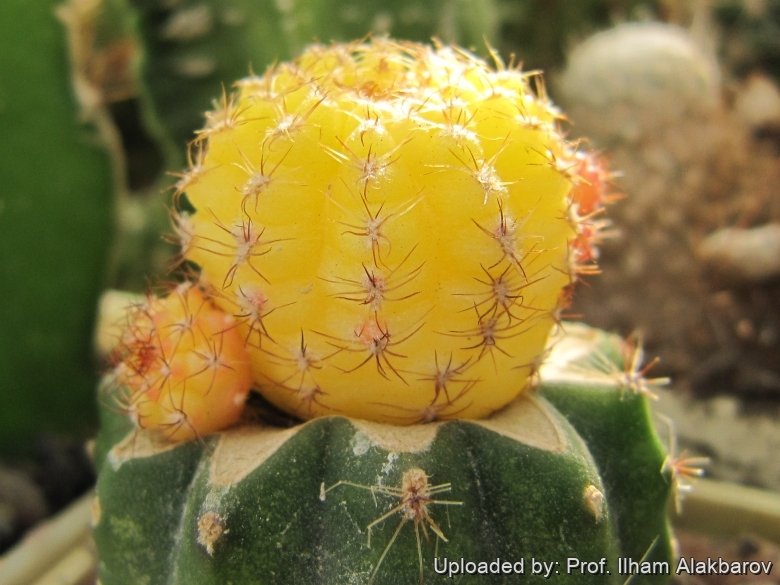
Forma aurea (yellow form): The schizochromic form (Echinopsis tiegeliana var. pusilla f. aurea|) has pale yellow stems due to the absence (or reduced production) of chlorophyll pigments: every other pigment is present at normal levels, the dominant green colouration is lost, but will still more than likely have normal other pigments that give the yellow overall appearance of the stem. This form with yellow stems is very attractive and highly prized. This schizochromic form is almost always seen grafted on stronger columnar species, and cannot can be grown on its own roots. However some clones have enough chlorophyll in their tissues and can be grown on they own roots too, but very slow growing.
Stems: Yellow, spherical more or less flattened usually less than 4 cm tall in habitat (but often larger in cultivation). It has up to 20 ribs, with raised tubercles between which the areoles appear. The tubercles are spirally arranged on the stem’s surface.
Spines: Arranged like little spiders, cream coloured, yellowish or brownish, turning greyish eventually.
Flowers: Mostly deep red.
Cultivation and Propagation
Variegated and albinous cacti are regarded as choice and difficult in cultivation, but despite that many of them are relatively easy to grow. But be aware that they cannot tolerate prolonged exposure to direct sun light (especially during the hottest summer days), so grow them in half-shade or under filtered sun. They are sometime seen as grafted plants, but many grow well on their own roots, too.
On the contrary, the albinos can survive only if grafted on a strong green base.
Use mineral well-permeable substratum with little organic matter (peat, humus). Water sparingly from March till October and keep perfectly dry in winter at temperatures from 5 to 15 degrees centigrade. (In general these plants are more tender and cannot endure freezing temperatures ) In the rest period no high atmospheric humidity!!
Propagation: Usually by seed. Plants are often grafted onto column-shaped cacti.
Source: Lobivia pusilla f. aurea, LLIFLE - Encyclopedia of living forms, CC-BY-SA, retrieved 2026-10-25.
From llifle page Lobivia pusilla f. cristata
Description
Echinopsis tiegeliana var. pusilla firstly described as Lobivia pusilla is an hight altitude form of the wide ranging and very variable Echinopsis tiegeliana distinguished by smaller stems only 40 mm tall and shorter spines.
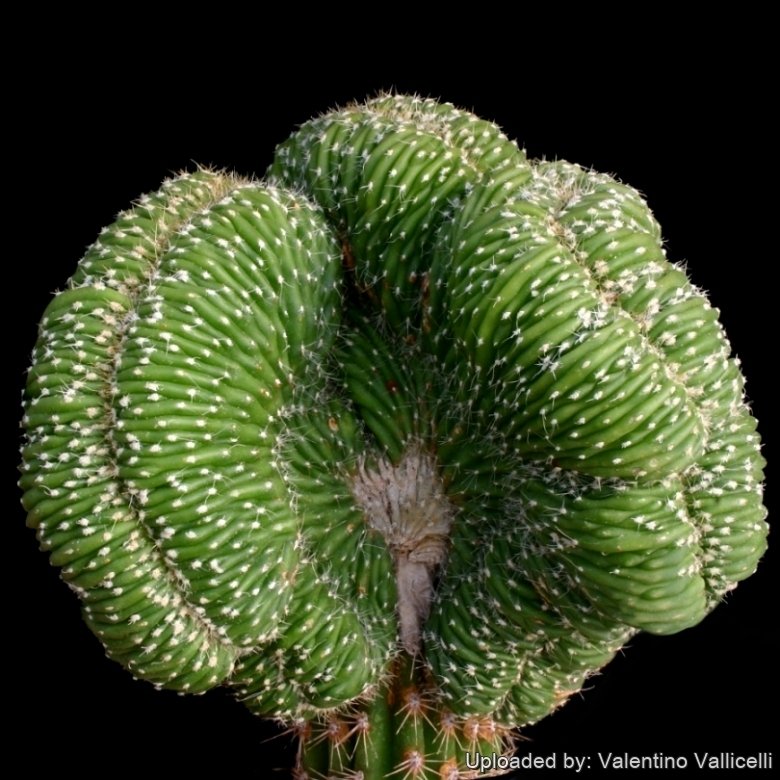
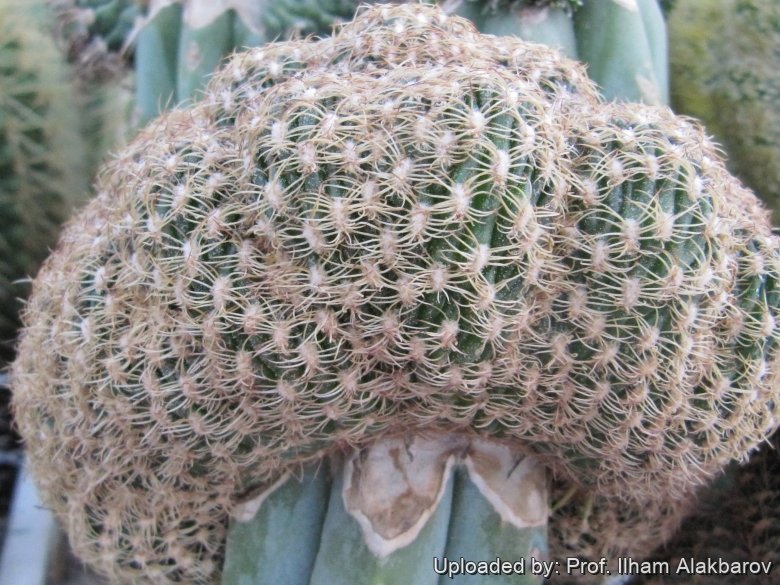
Crested form: The crested form (Echinopsis tiegeliana var. pusilla f. cristata|) - despite to its beauty - is very rare and sought after by collectors, for its unique features. It is a small low growing crested cactus that will slowly forms tangled groups up to 20 cm (or more ) in diameter with age. The plant tends to grow seated in substrate, but in cultivation it is almost always seen grafted on columnar cacti. There are several crested clones.
Stems: Yellow, spherical more or less flattened usually less than 4 cm tall in habitat (but often larger in cultivation). It has up to 20 ribs, with raised tubercles between which the areoles appear. The tubercles are spirally arranged on the stem’s surface.
Spines: Arranged like little spiders, cream coloured, yellowish or brownish, turning greyish eventually.
Flowers: Mostly deep red.
Cultivation and Propagation
Echinopsis tiegeliana var. pusilla f. cristata| is not too difficult in a greenhouse, although grows quite slowly. It is usually seen as a grafted plant but can grow on its own roots too.
Soil: Use a mineral well permeable soil with little organic matter (peat, humus).
Exposure: They need a good amount of light shade to full sun this help to keep the plants healthy, although slow growth.
Watering: Water sparingly from March till October (weekly during summertime, if the weather is sunny enough), with a little fertilizer added. Less or no water during cold winter months, or when night temperatures remain below 10° to prevent root loss. It is sensitive to overwatering (rot prone).
Fertilization: Feeding may not be necessary at all if the compost is fresh then, feed in summer only if the plant hasn’t been repotted recently. Do not feed the plants from September onwards as this can cause lush growth which can be fatal during the darker cold months.
Hardiness: Keep perfectly dry in winter at temperatures from 5 to 15 degrees centigrade. (but it is relatively cold resistant and hardy to -5° C, or possibly colder for short periods) In the rest period no high atmospheric humidity!! (Temperature Zone: USDA 9-11)
Crested growth: Unlike ‘monstrose’ varieties of plants, where the variation from normal growth is due to genetic mutation, crested growth can occur on normal plants. Sometimes it’s due to variances in light intensity, or damage, but generally the causes are unknown. A crested plant may have some areas growing normally, and a cresting plant that looks like a brain, may revert to normal growth for no apparent reason. If you have any of the crested part left you need to remove the normal growth and leave the crested part behind this will need to be done regularly.
Propagation: Grafting or cuttings. Plants are usually grafted onto column-shaped cacti but proved to be able to produce their own roots if degrafted. Cuttings will take root in a minimum temperature of 20° C (but better in hot weather). Cuttings of healthy shoots can be taken in the spring and summer. Cut the stem with a sharp, sterile knife, leave the cutting in a warm, dry place for a week or weeks (depending on how thick the cutting is) until a callus forms over the wound. Once the callus forms, the cutting may be inserted in a container filled with firmed cactus potting mix topped with a surface layer of coarse grit. They should be placed in the coarse grit only; this prevents the cut end from becoming too wet and allows the roots to penetrate the rich compost underneath. The cuttings should root in 2 to 6 weeks. Large crested piece must be placed on the soil surface without burying the plant base down in the soil.
Source: Lobivia pusilla f. cristata, LLIFLE - Encyclopedia of living forms, CC-BY-SA, retrieved 2026-10-25.
Cultivars and forms (2)
Gallery