Publication: Eriosyce (Cactac.) gen. revis. & ampl. (Succ. Pl. Res., 1) 119 (1994)
Description
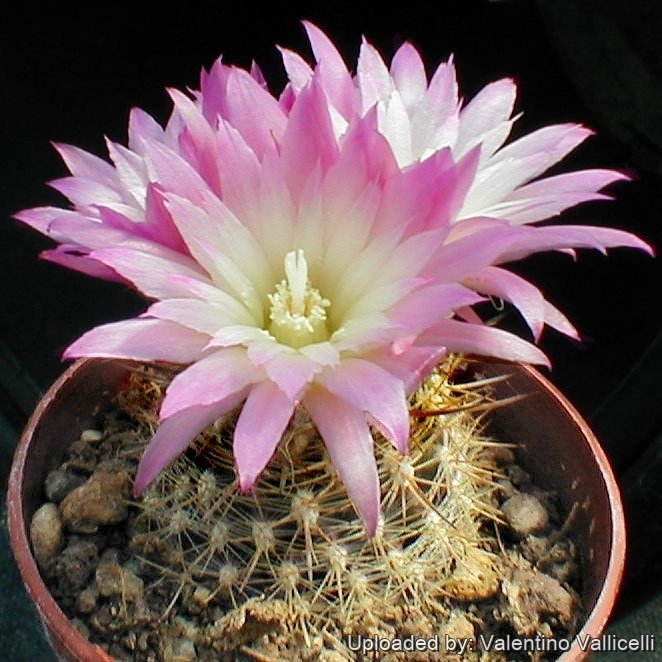
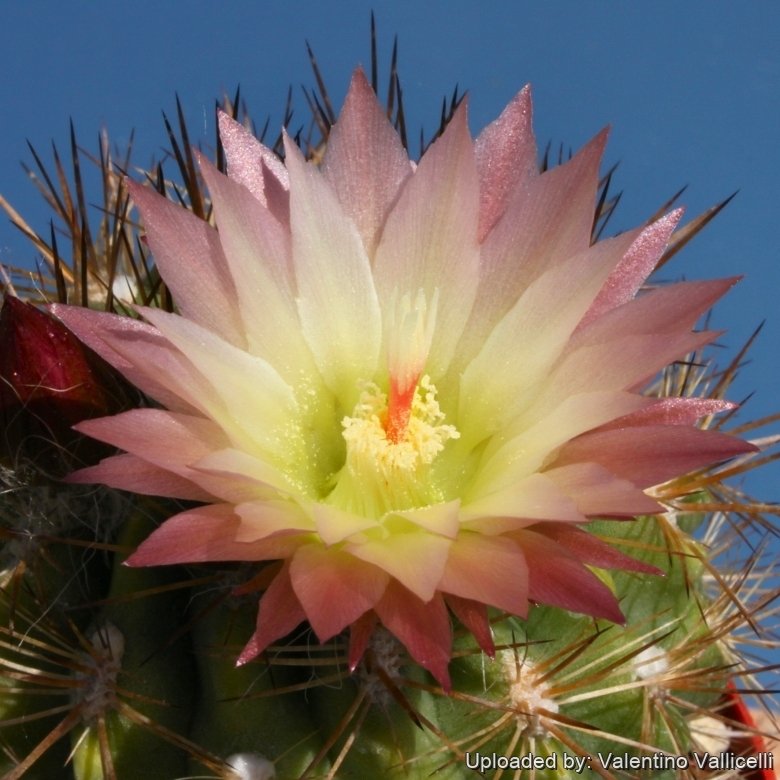
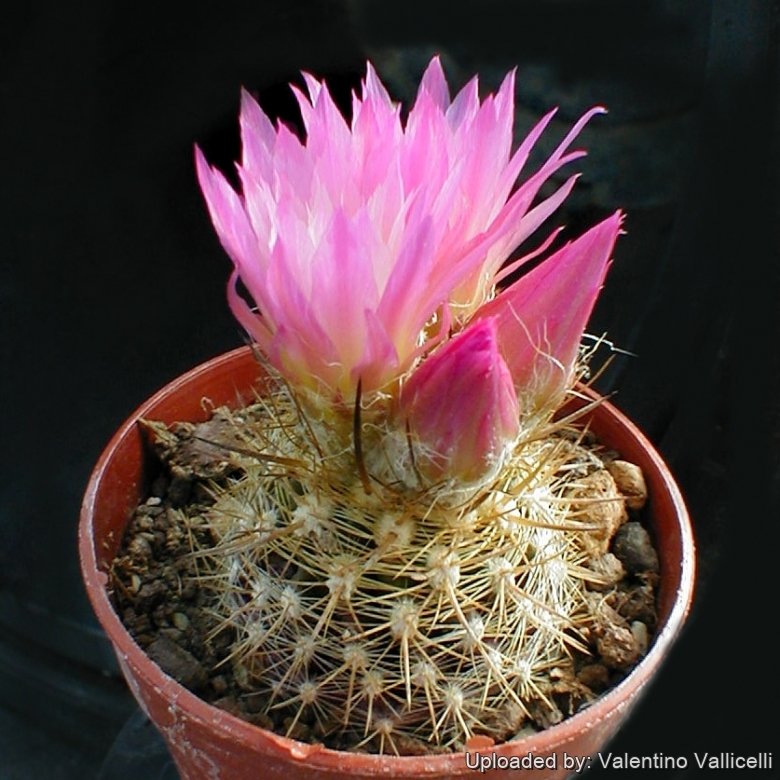
Eriosyce chilensis is a beautiful cactus with pale green stems cowered with dense stout spines. It produces very showy flowers in summer.
Habit: It is a mostly simple perennial cactus, rarely clustering at base, shortly cylindrical sometimes procumbent, to 100 cm high.
Stem: Spherical, then columnar, up to 30(-100) cm tall and 8-12 cm in diameter, woolly at apex.
Ribs: Ribs 14-16 (or more) closely spaced, crenate, deeply notched, tuberculate, yellowish to pale green.
Roots: fibrous.
Spines: Numerous whitish-yellow to brownish, stiff, needle-like, not readily distinguishable as centrals and radials up to 18 mm long.
Central spines: 6-8, 15-25 mm long.
Radial spines: 16-24, often bristly, 10-15 mm long.
Flowers: Few often closely packed apically from young areoles, flattish, usually creamy white, but also pink-orange or carmine red to 5 cm across , often developing in pairs, one on each side, from the same areole, with the inner petals erect. Ovary, tube and fruit almost bare, but with few small scales and few hairs. The frequent development of flowers buds in pairs from the same areola is a distinctive character of this species. Pericarpels and floral tubes with tufts of wool and glassy white bristles.
Fruits: Clavate/elongate, to 3 cm long, bright red at maturity, splitting open by basal pores.
Origin and Habitat
Eriosyce chilensis is restricted to a small coastal stretch just south of 32°S in the border between the regions of Coquimbo (Northern Chile) and Valparaiso (Argentina)
Habitat: It grows on coastal rocks and is severely threatened by housing construction.
Cultivation and Propagation
It is a summer grower species. Easy to cultivate but somewhat rot prone if kept in a non ventilated place. Require a very fast draining drying soil, water regularly in summer, but do not overwater.
Needs a full sun exposure (or light shade) Good heat tolerance. Hardy to at least -5°C ( but probably can tolerate - 10° C for brief periods).
Propagation: Usually propagated from Seeds. (seldom produces offsets)
Bibliography
Major references and further lectures
-
Fred Kattermann “Eriosyce (Cactaceae): The Genus Revised and Amplified” David Hunt, 1994
-
Sara Oldfield “Cactus and Succulent Plants: Status Survey and Conservation Action Plan” IUCN, 01/Jan/1997
-
Edward Anderson “The Cactus family” Timber Press, Incorporated, 2001
-
James Cullen, Sabina G. Knees, H. Suzanne Cubey “The European Garden Flora Flowering Plants: A Manual for the Identification of Plants Cultivated in Europe, Both Out-of-Doors and Under Glass” Cambridge University Press, 11/Aug/2011
-
David R Hunt; Nigel P Taylor; Graham Charles; International Cactaceae Systematics Group. “The New Cactus Lexicon” dh books, 2006
-
Urs Eggli, Leonard E. Newton: “Etymological Dictionary of Succulent Plant Names” Springer, Berlin/Heidelberg 2010
-
N. L. Britton, J. N. Rose: “The Cactaceae. Descriptions and Illustrations of Plants of the Cactus Family.” Volume III, The Carnegie Institution of Washington, Washington 1922
-
Christopher Brickell “RHS Encyclopedia of Plants and Flowers” Dorling Kindersley Ltd, 01/Sep/2010
-
John Borg “Cacti: a gardener’s handbook for their identification and cultivation” Blandford P., 1970