Publication: Eriosyce (Cactac.) gen. revis. & ampl. (Succ. Pl. Res., 1) 117 (1994)
Description
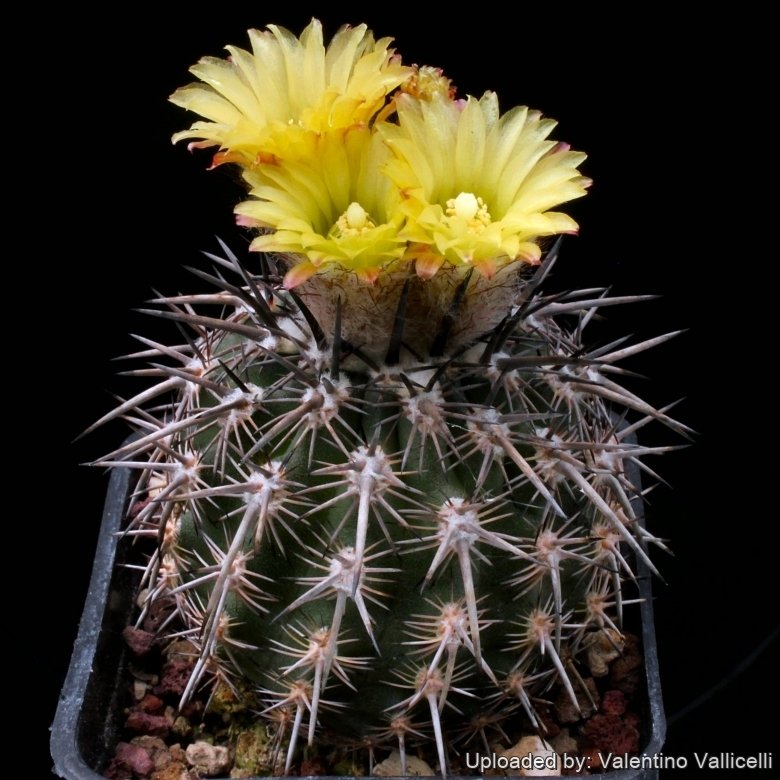
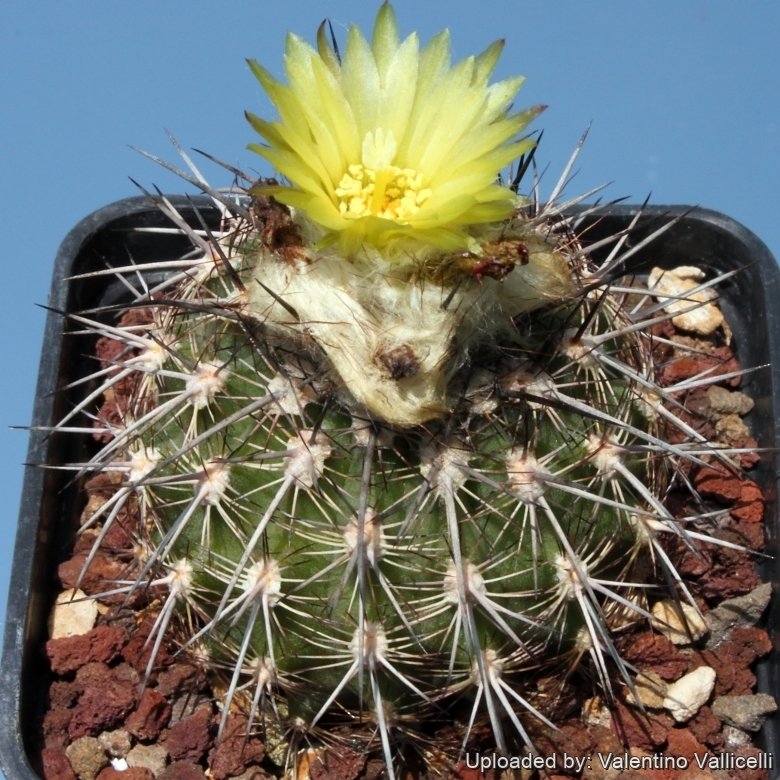
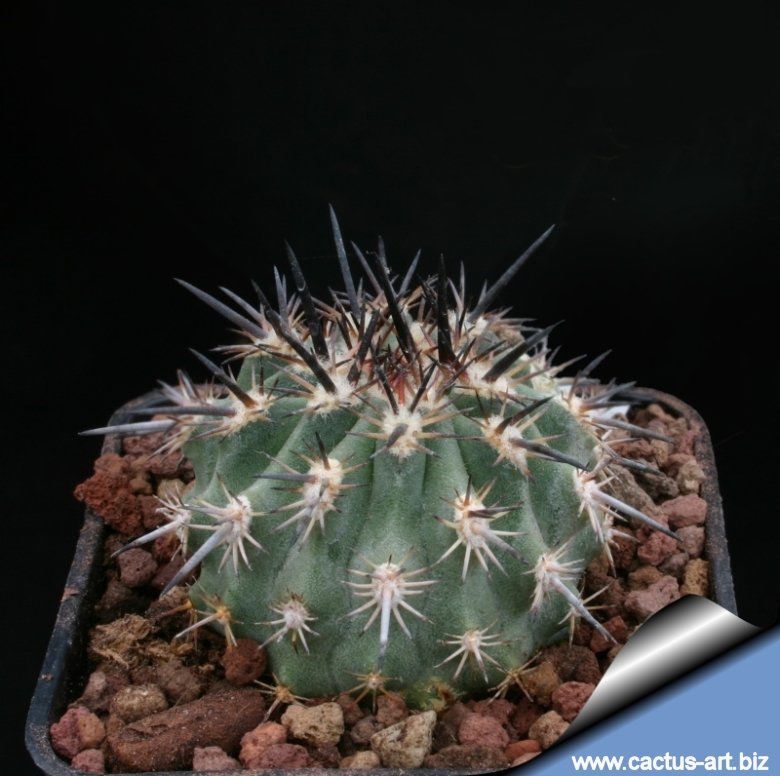
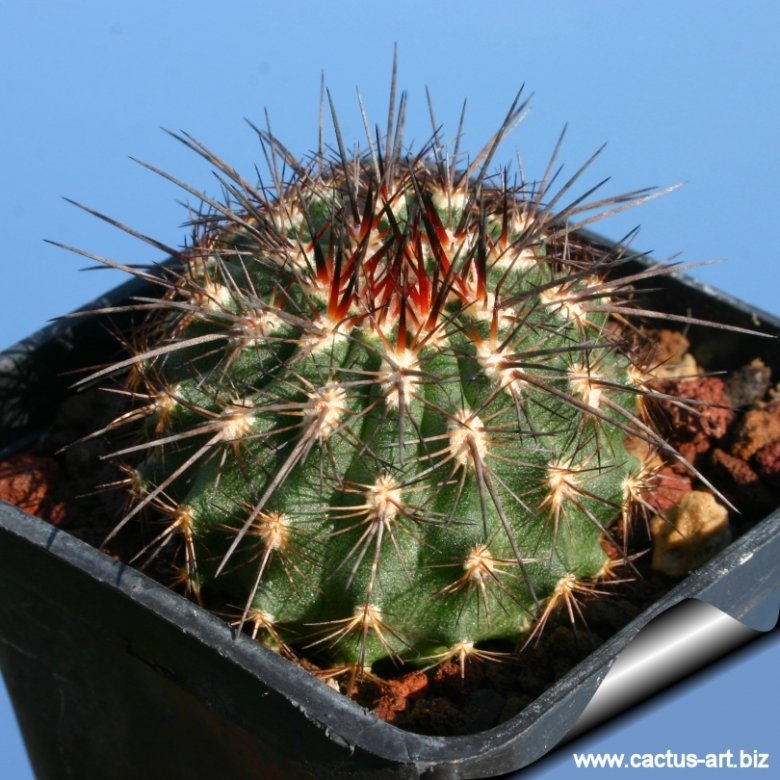
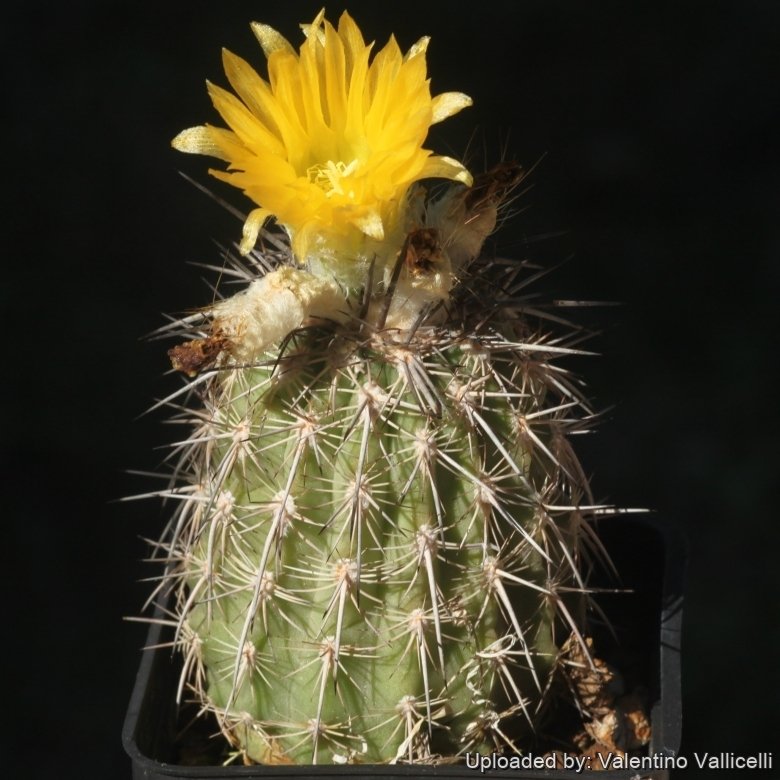
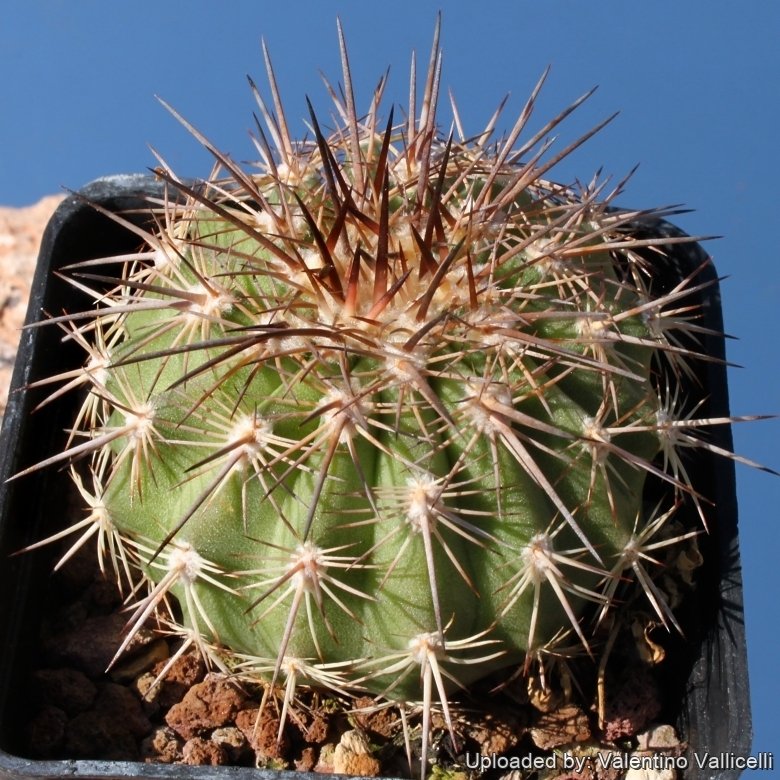
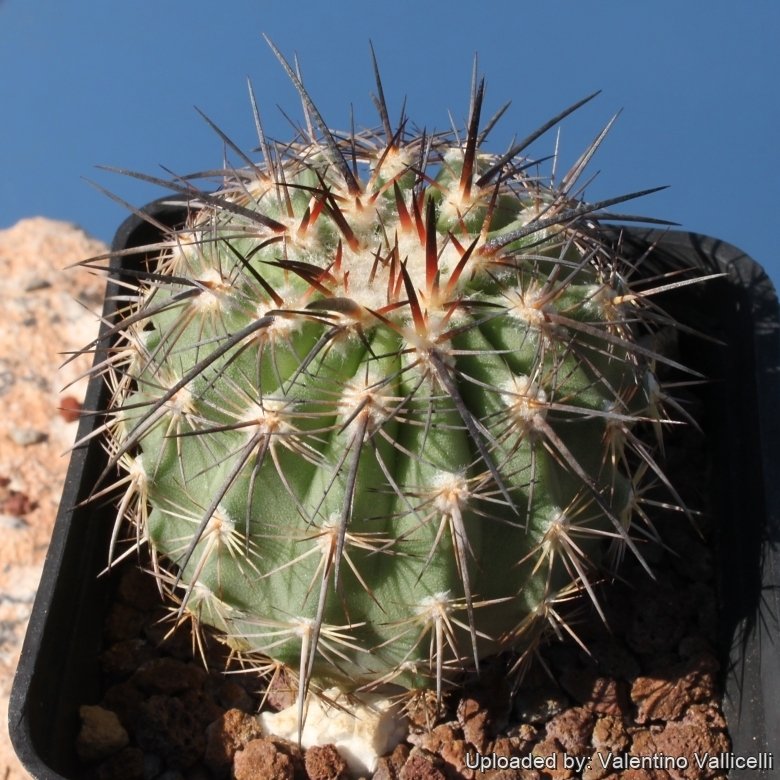
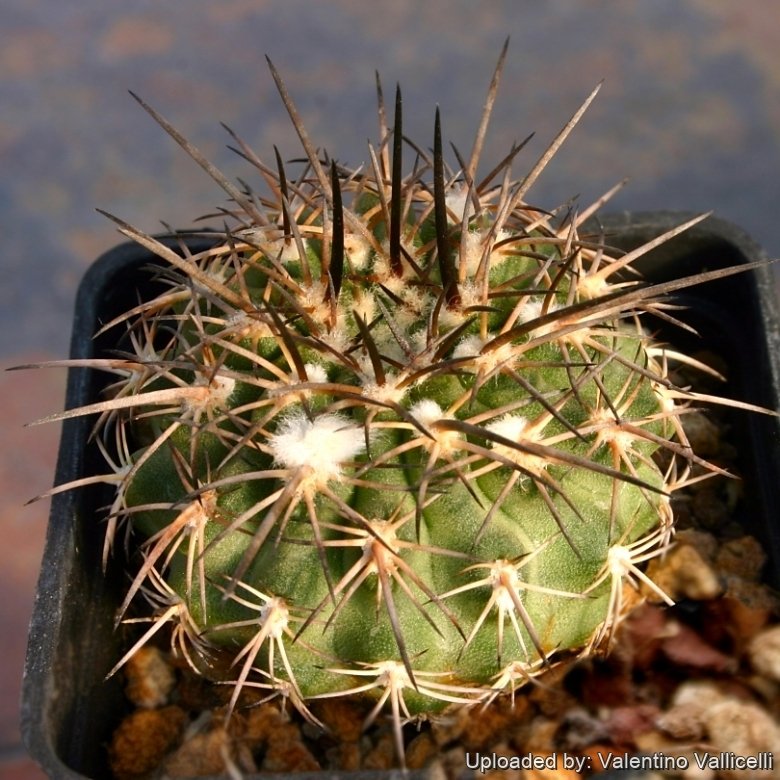
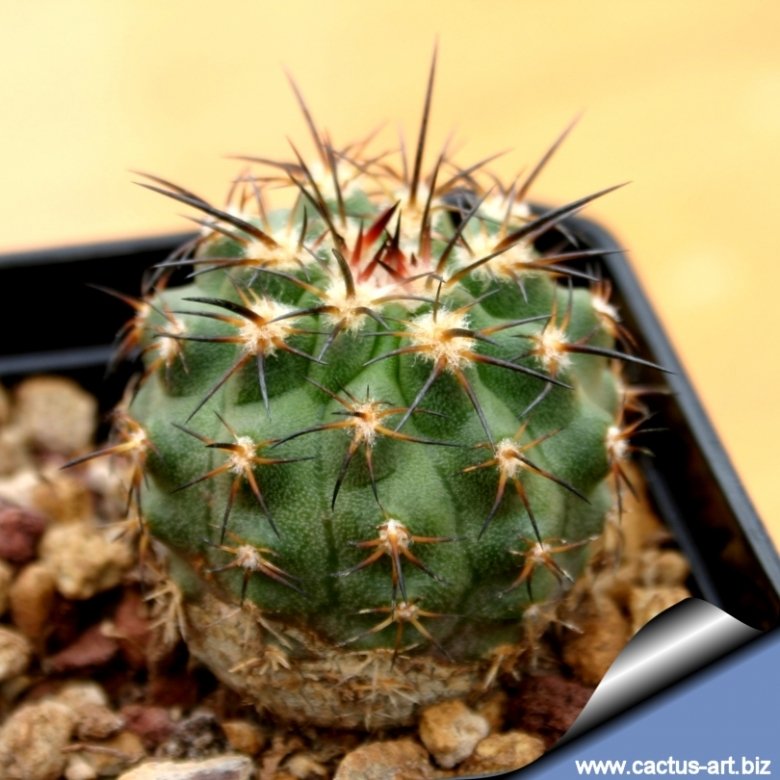
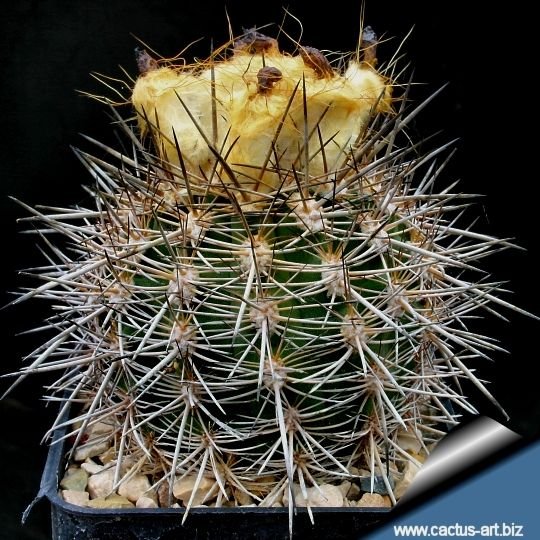
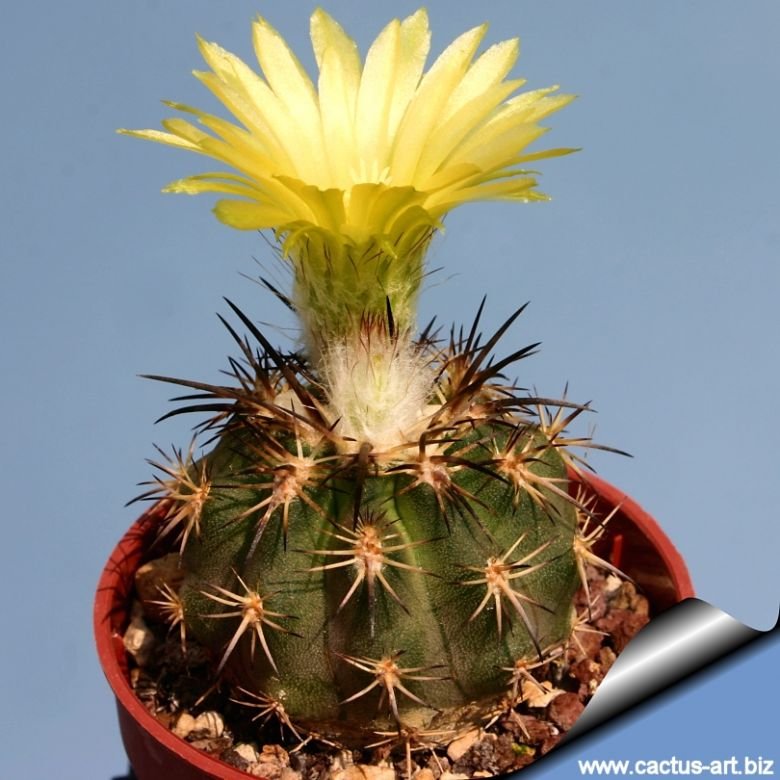
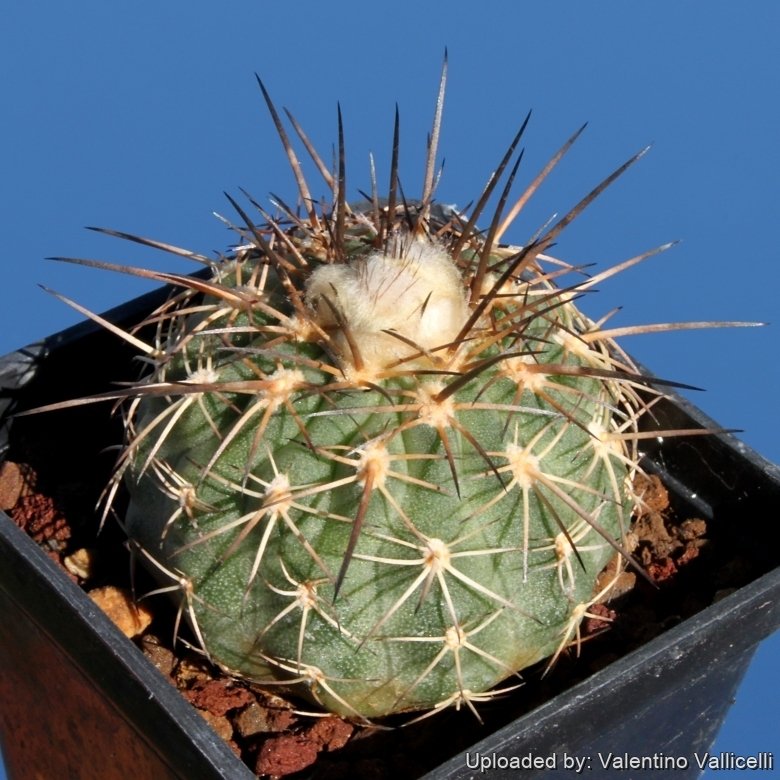
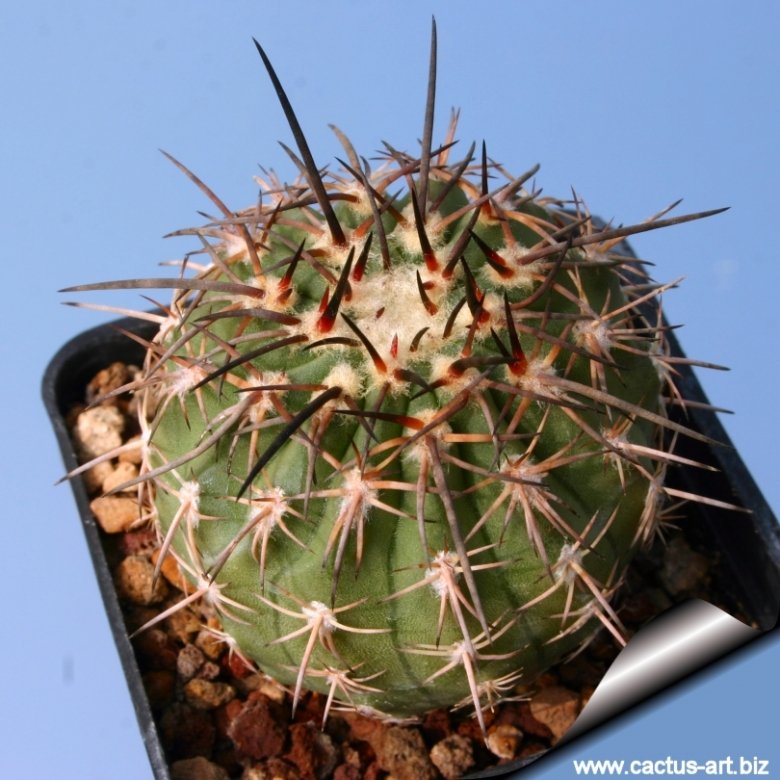
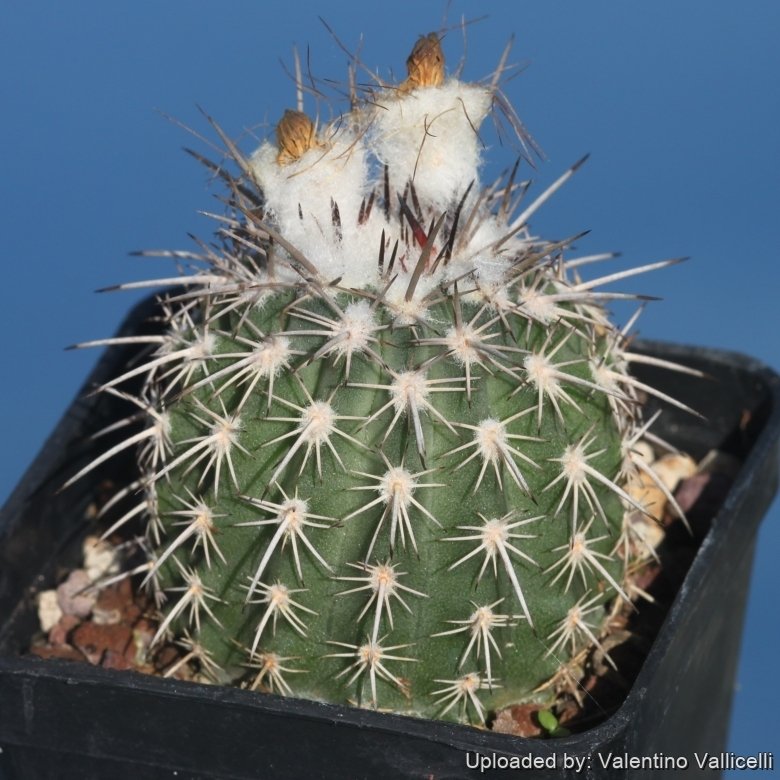
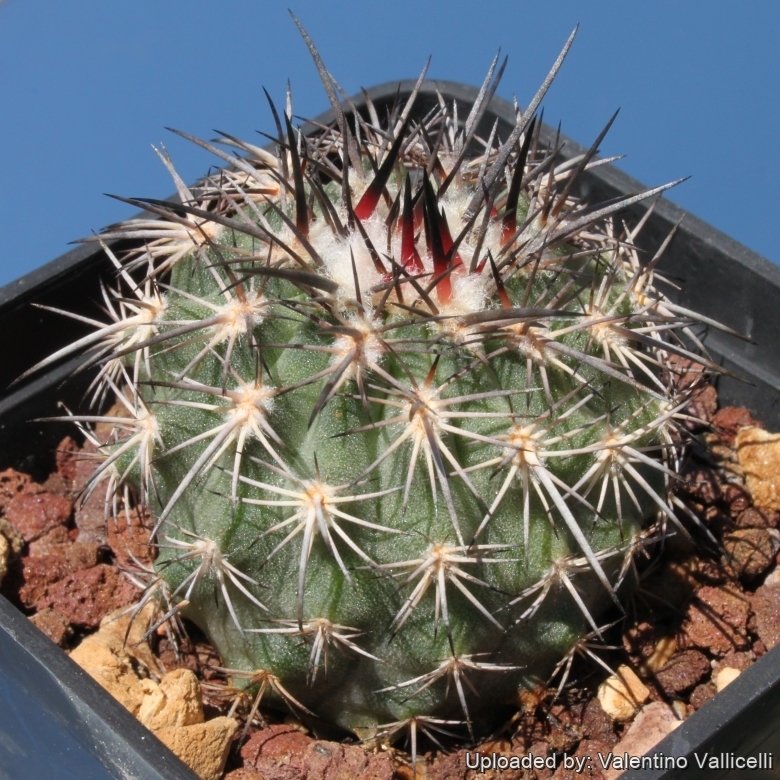
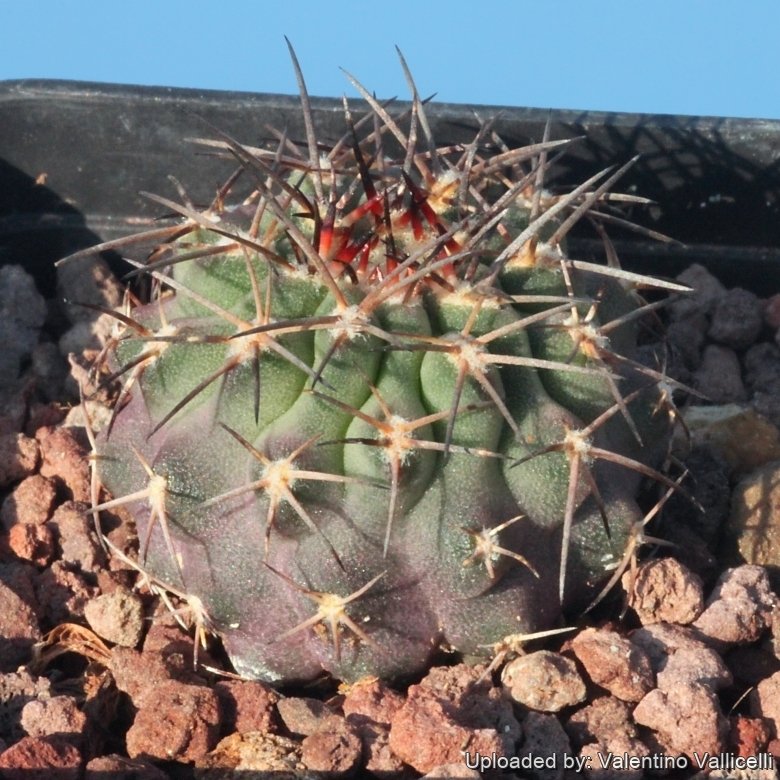
Eriosyce islayensis is a small cactus with very woolly areoles end dark spreading spines, it is indeed very variable and has received many names, but it is clear from fieldworks that the different wild populations constitute a single but multiform species.
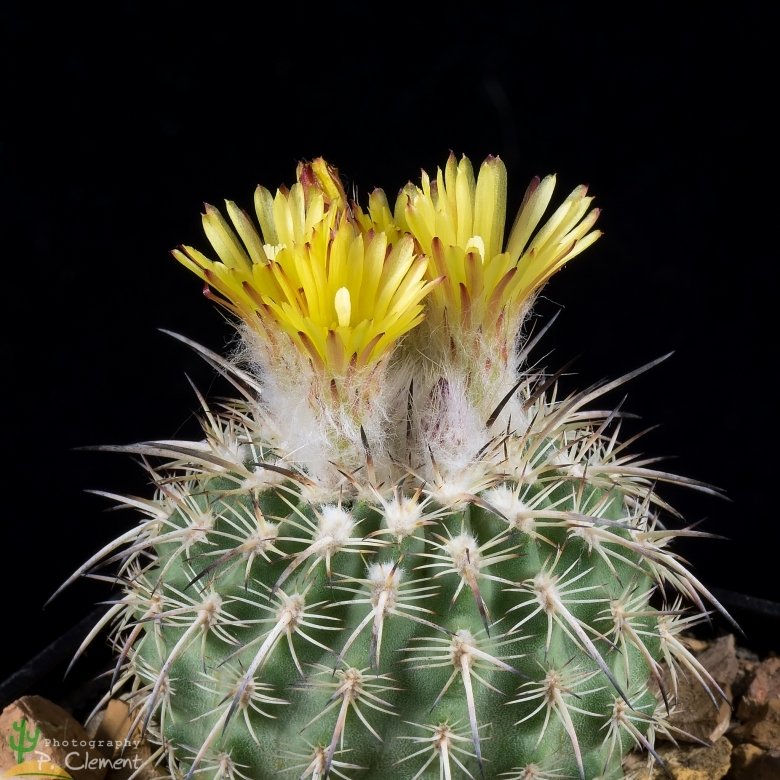
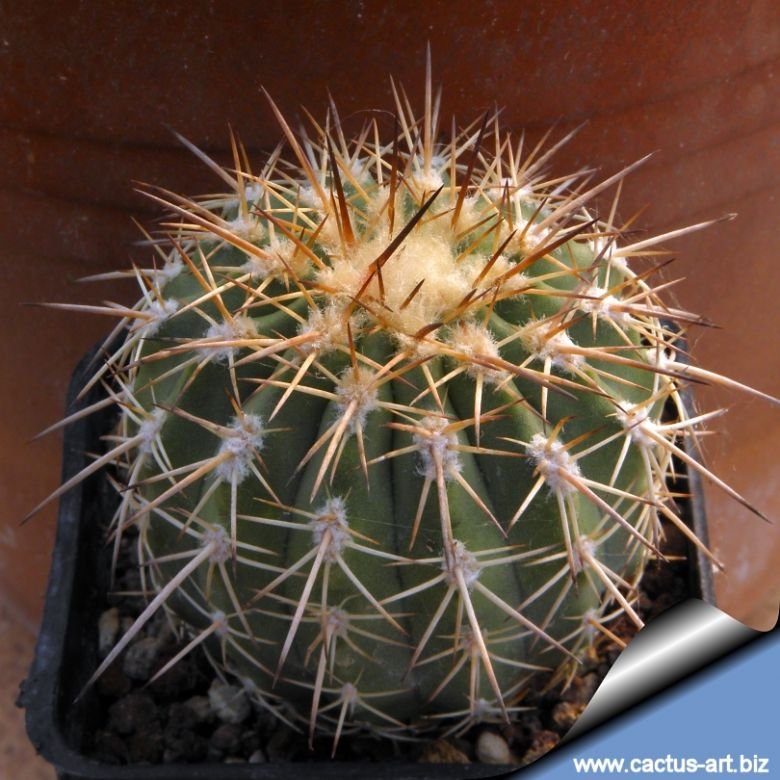
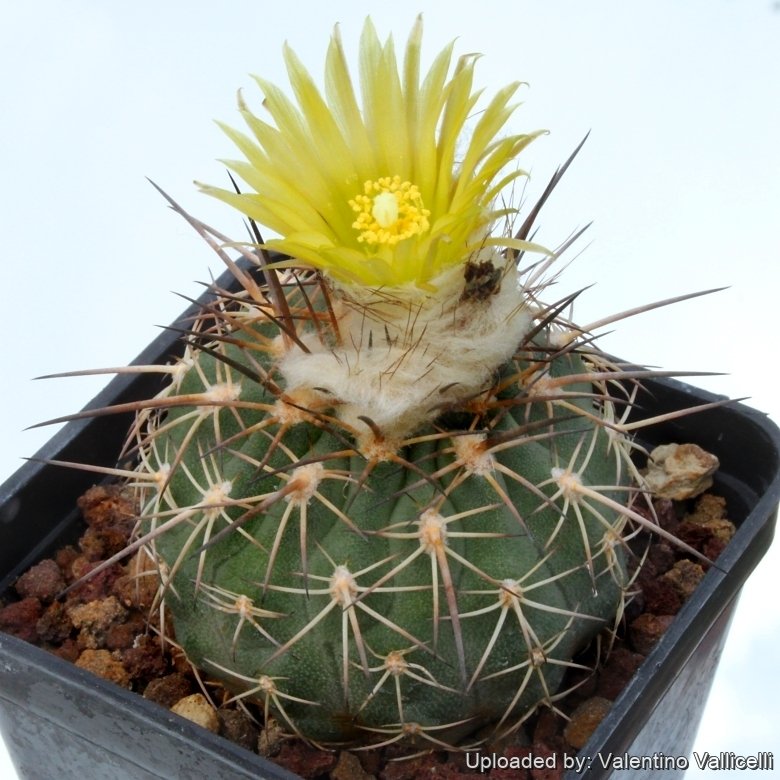
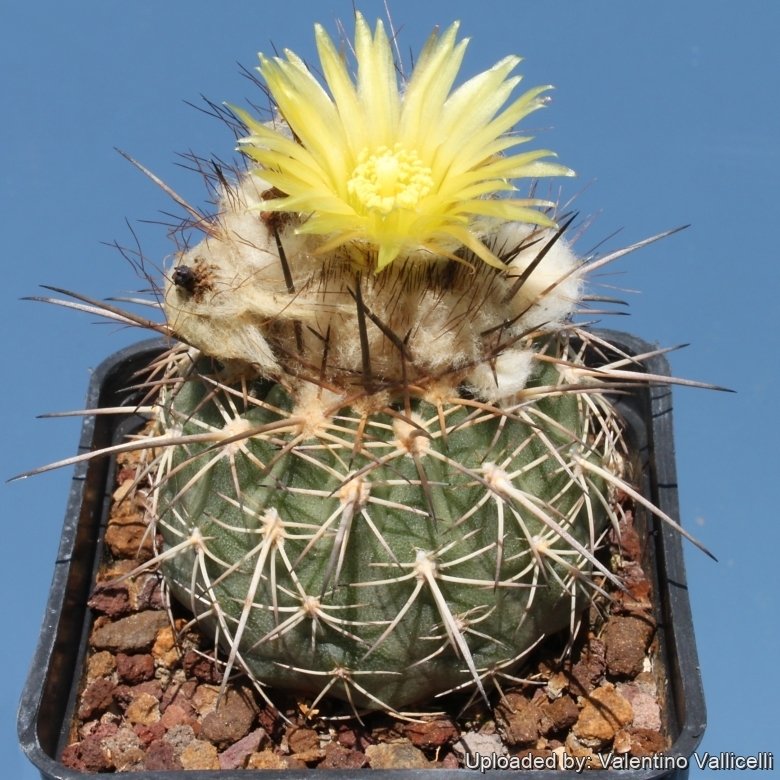
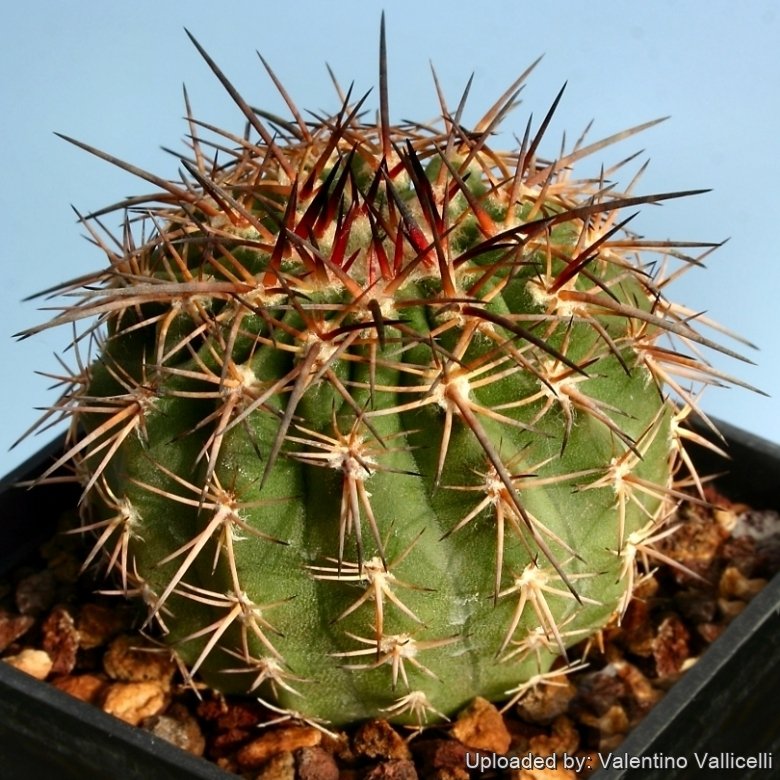
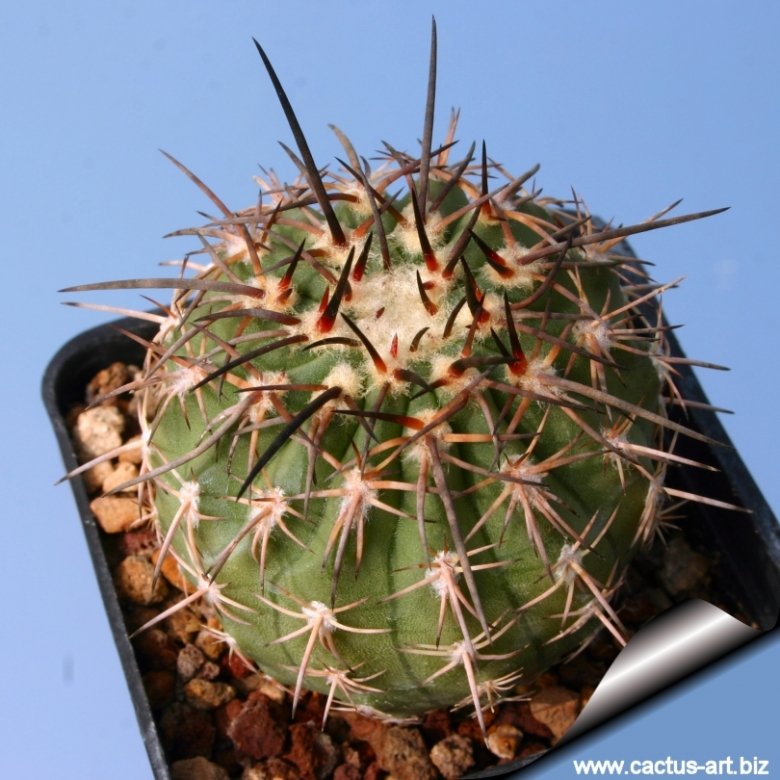
Stems: Globose to short-cylindrical, grey-green, 5 to15 cm tall (rarely up to 70 cm tall), 5-10(-20) cm in diameter. Apex densely woolly.
Ribs: (12-)19-21(-25) low and obtuse and more or less tuberculate.
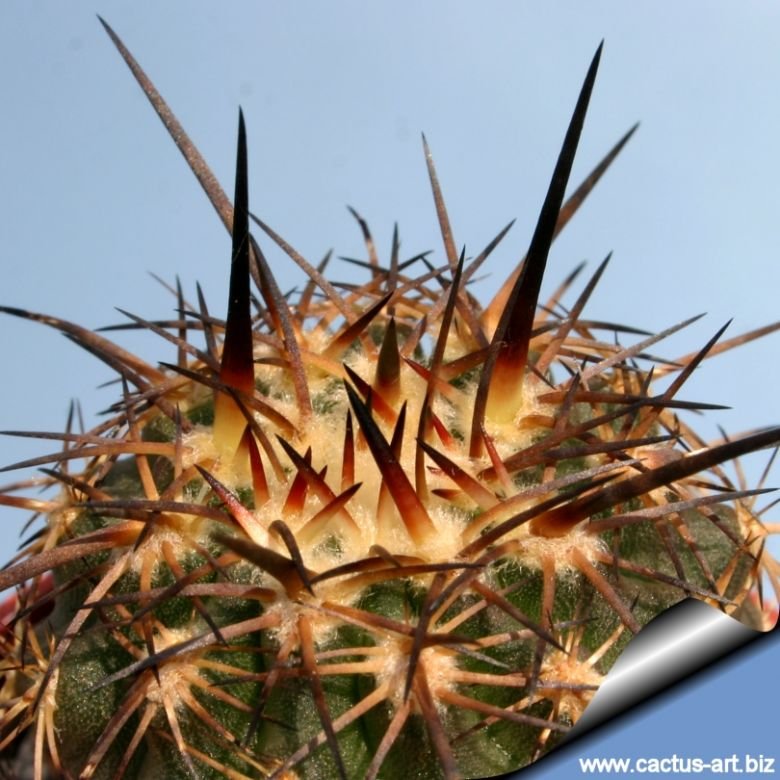
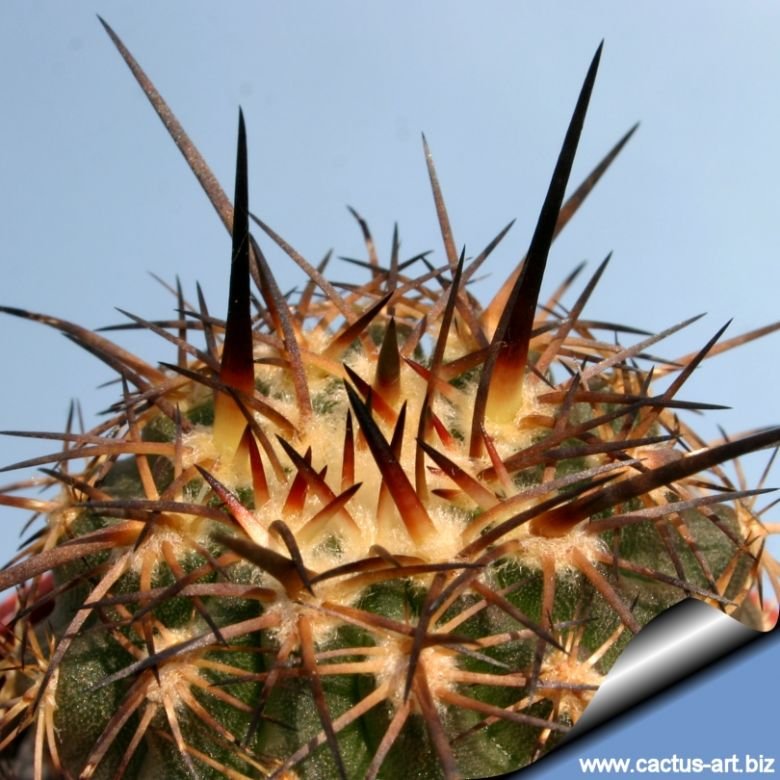
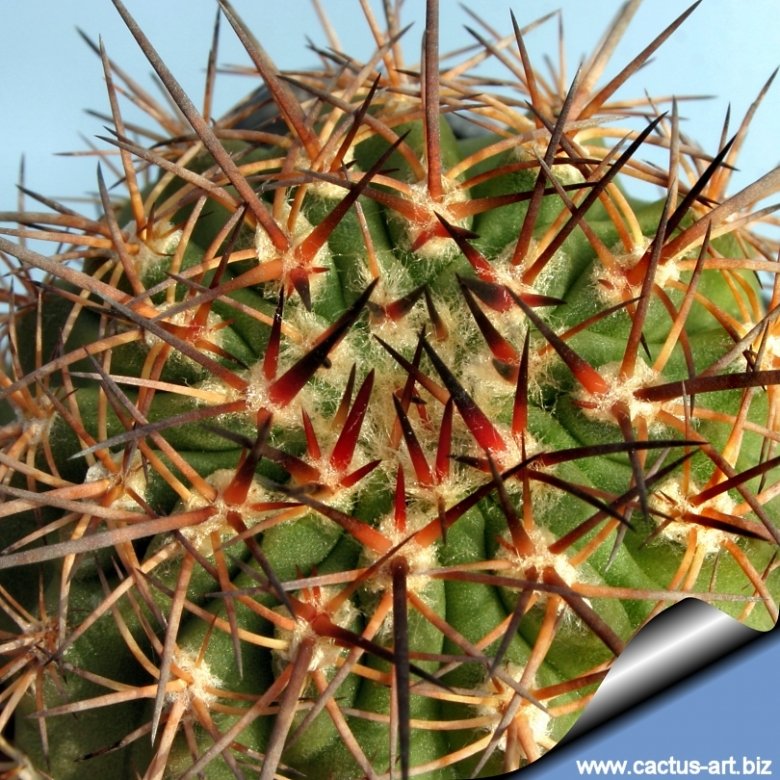
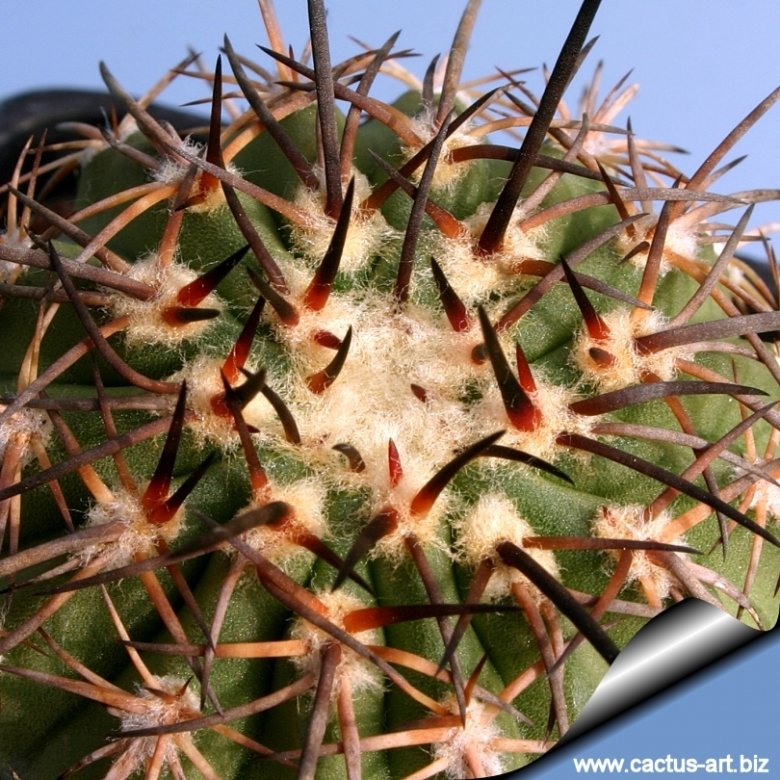
Areoles: Approximate, large, conspicuously woolly, with creamy-white to grey-brown felt.
Roots: Fibrous.
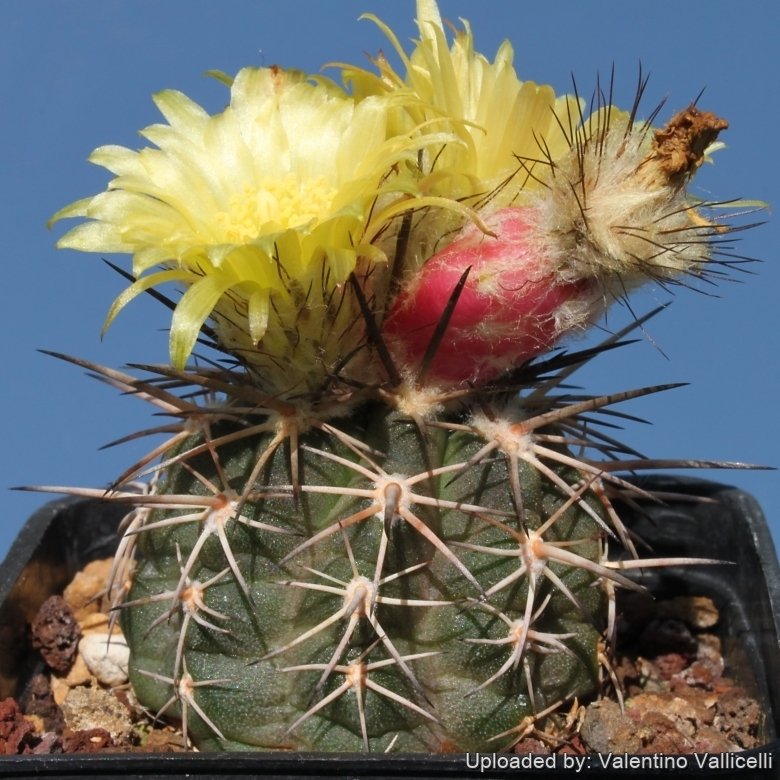
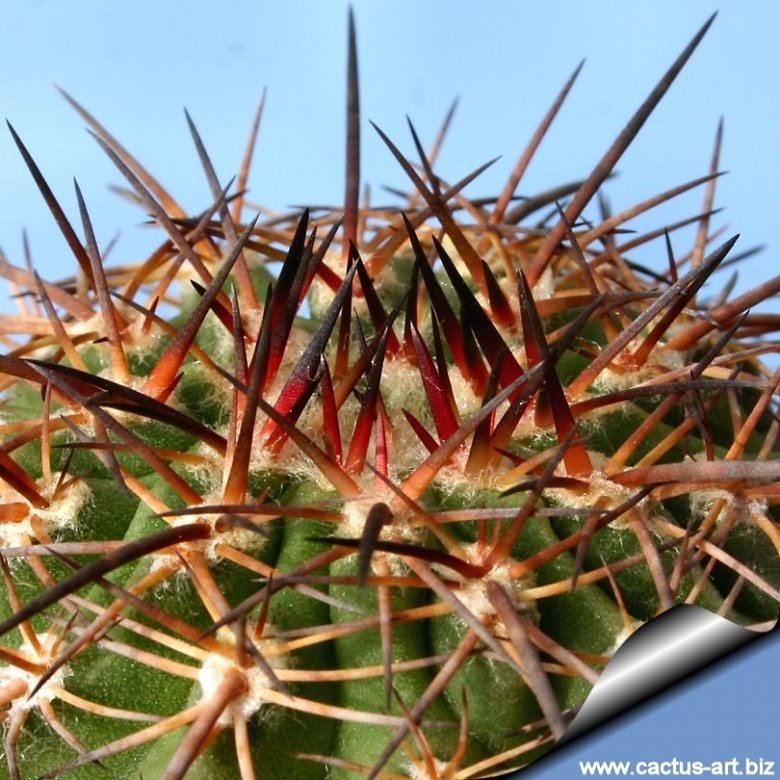
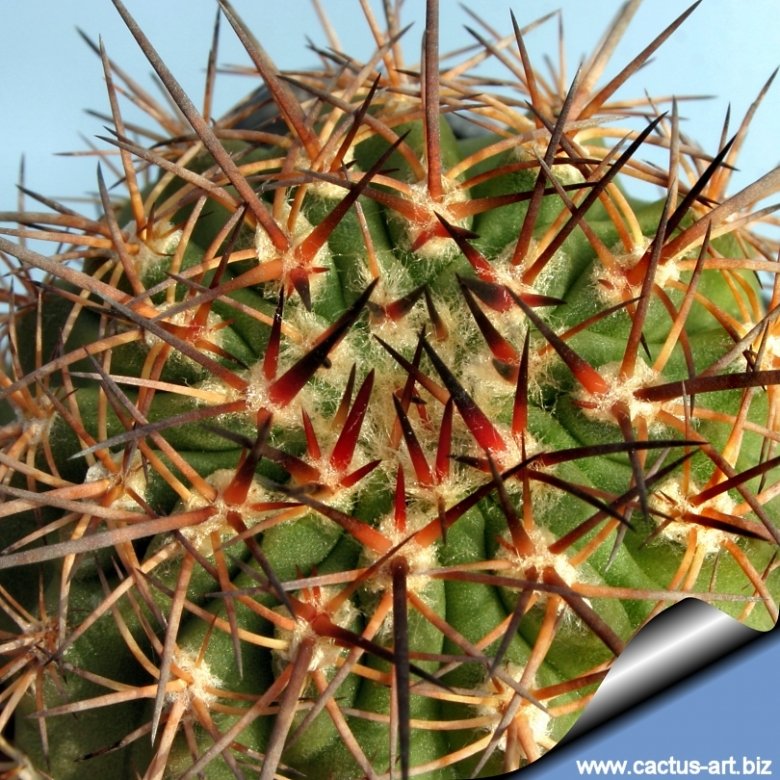
Spines: Variable in size and in colour and usually scarcely differentiated into centrals and radials, horn-coloured, dark reddish-brown to shiny black in the centre changing to grey with age, but shading to grey-black towards their tips.
Central spines: 4 to 7 spreading, thick, 12-16 mm long.
Radial spines: 12 to 22, shorter, radiating, (1-)6-10 mm long.
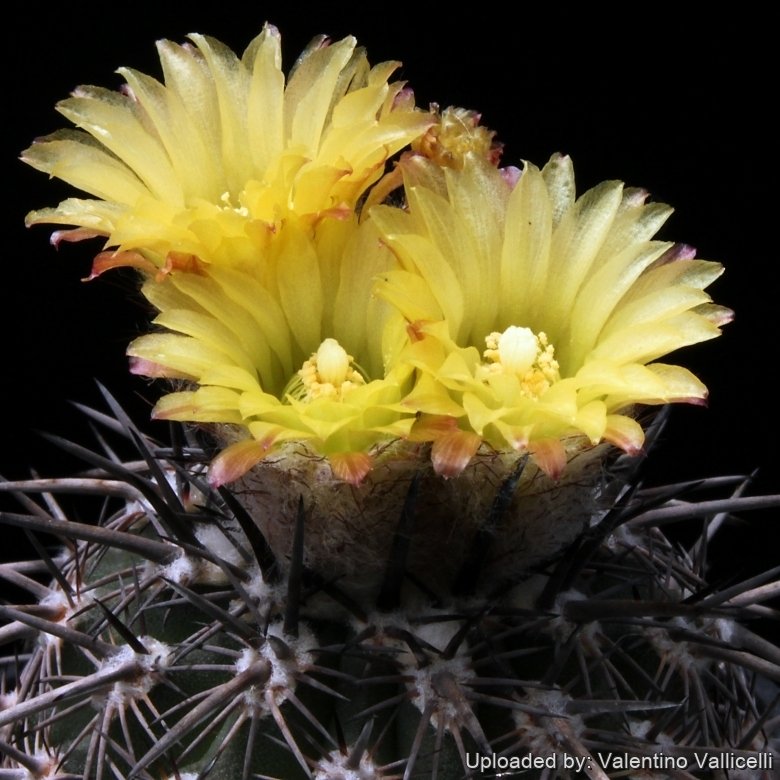
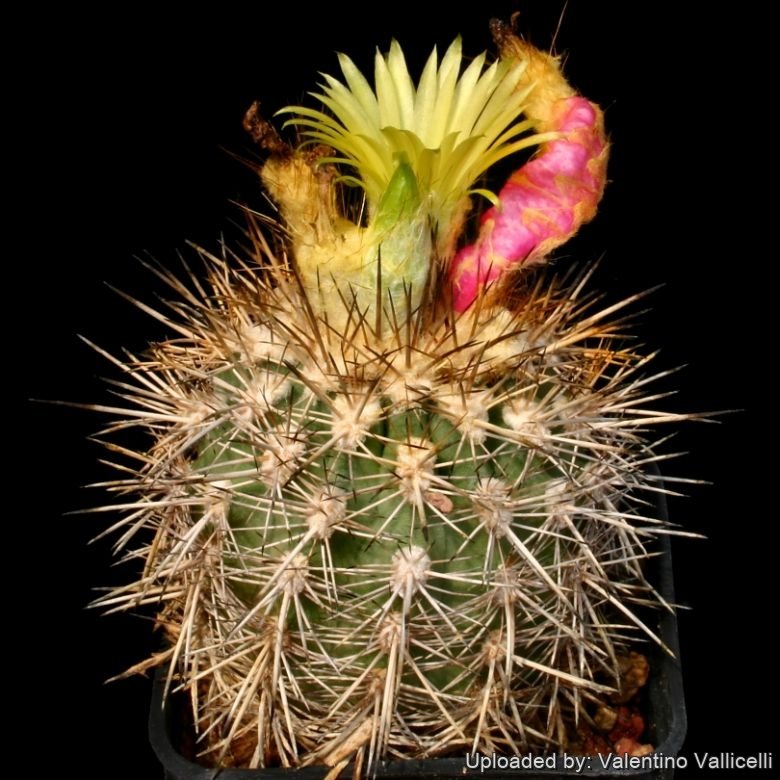
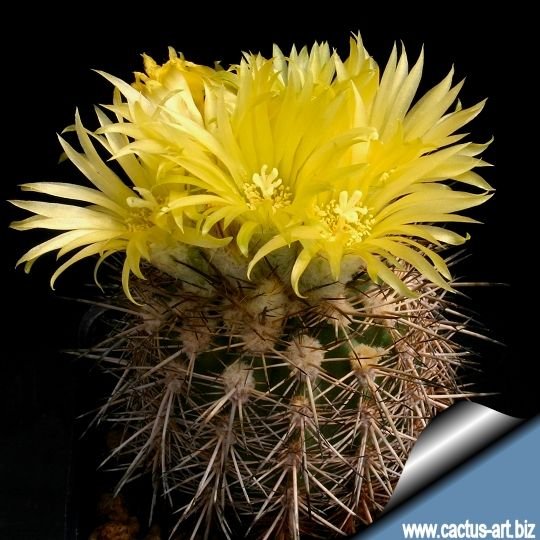
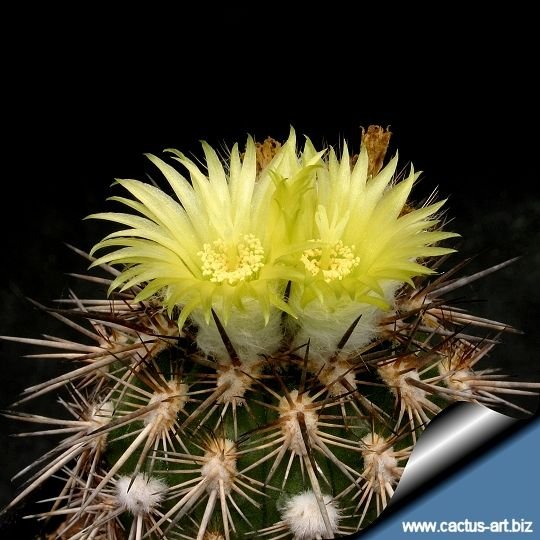
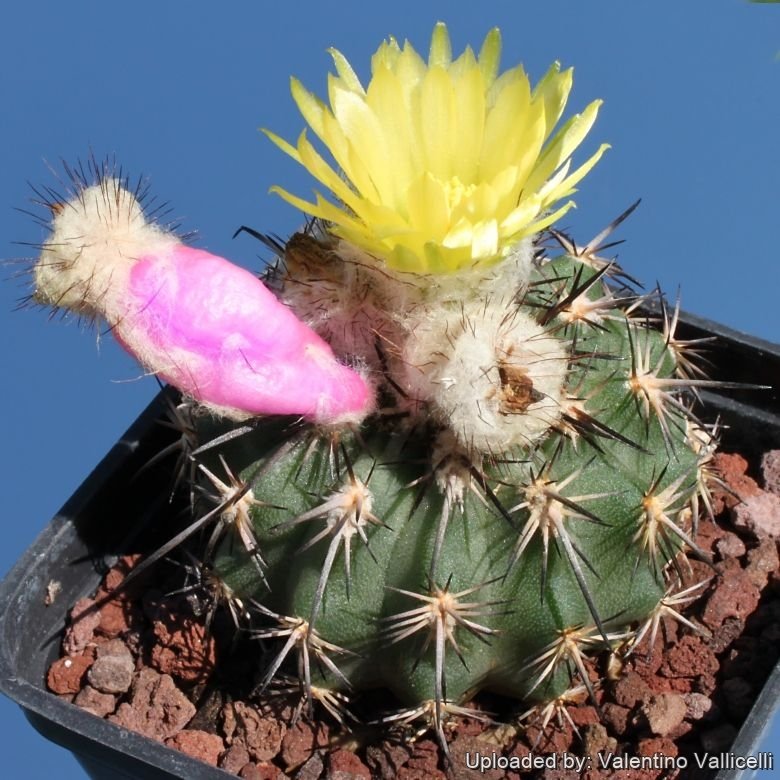
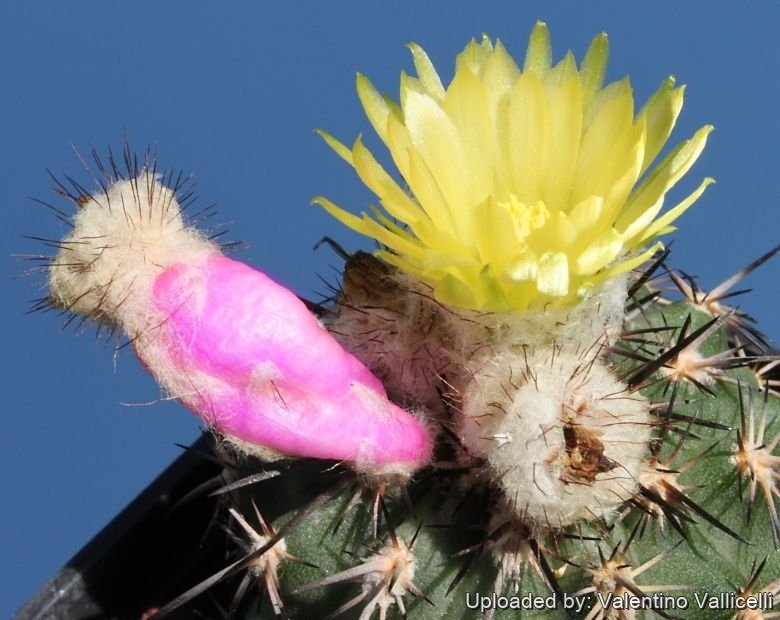
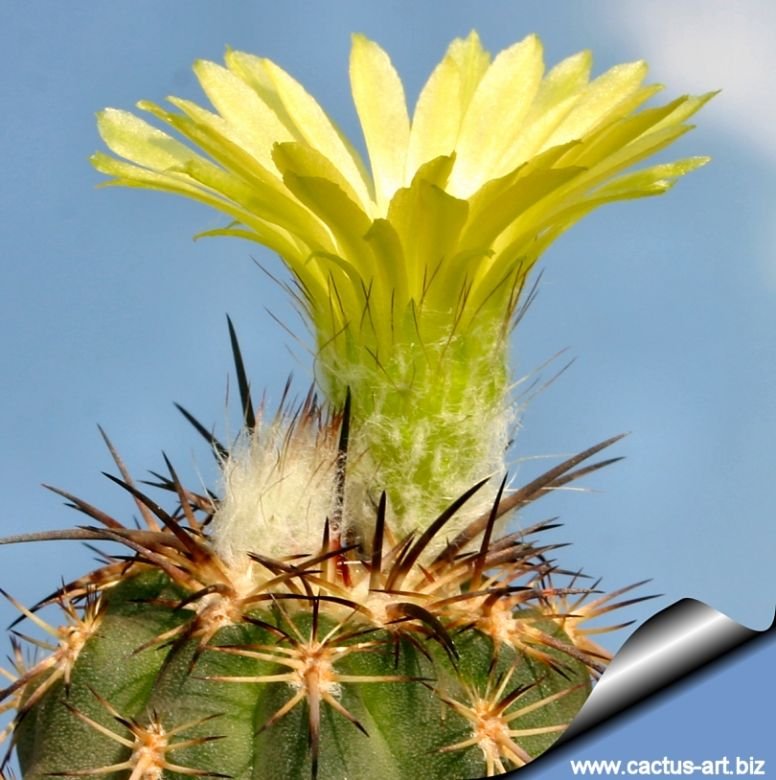
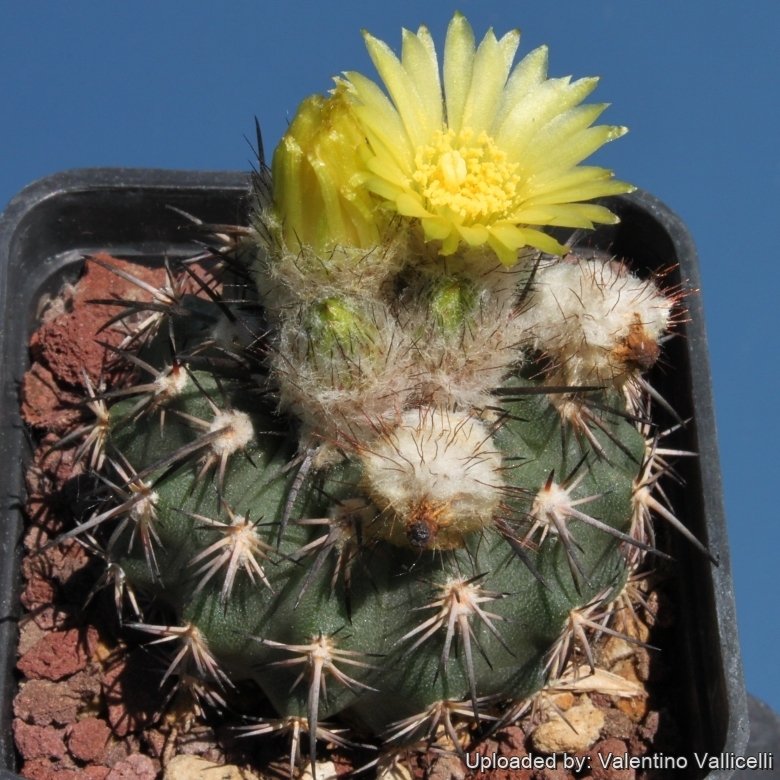
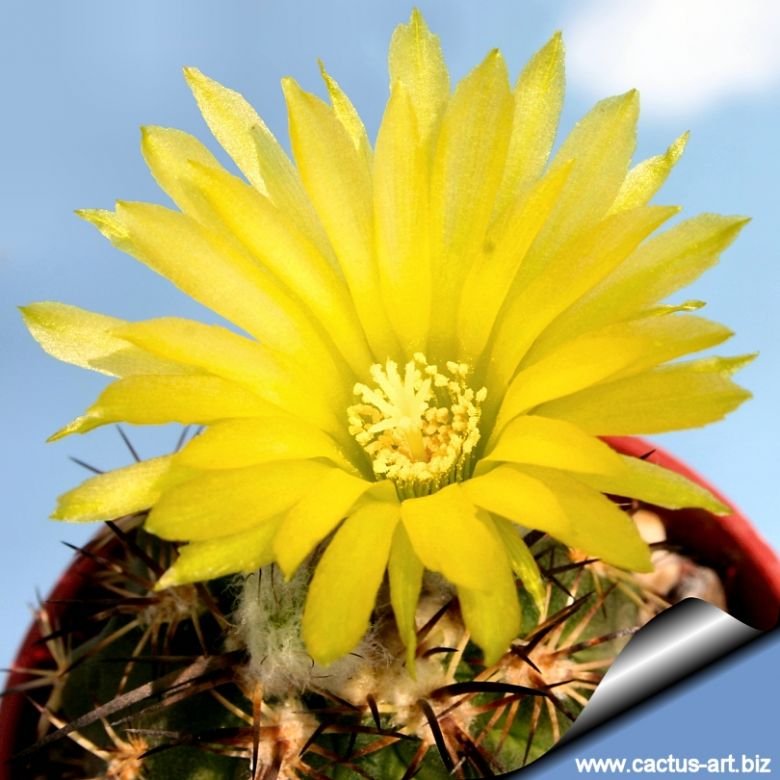
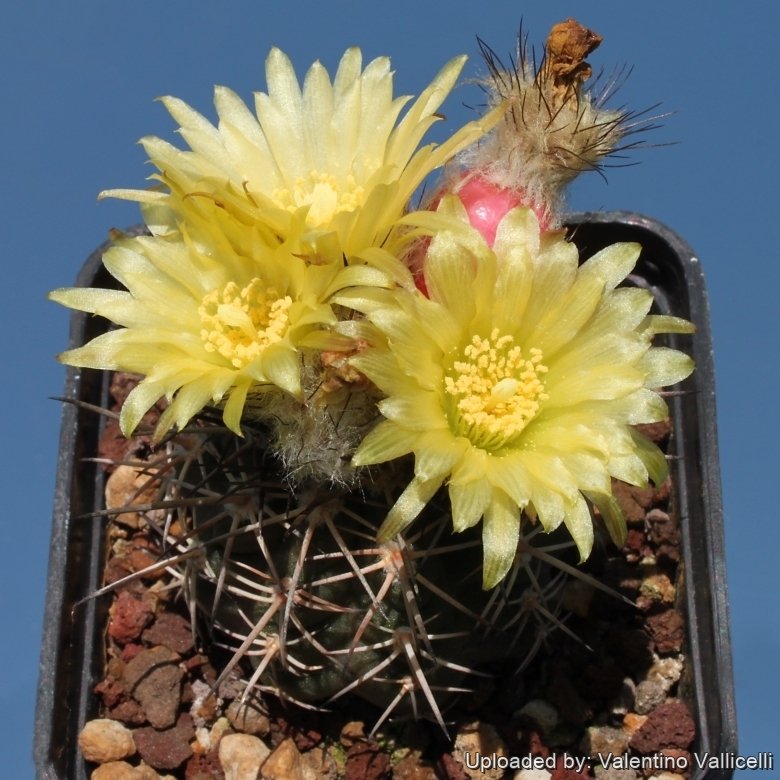
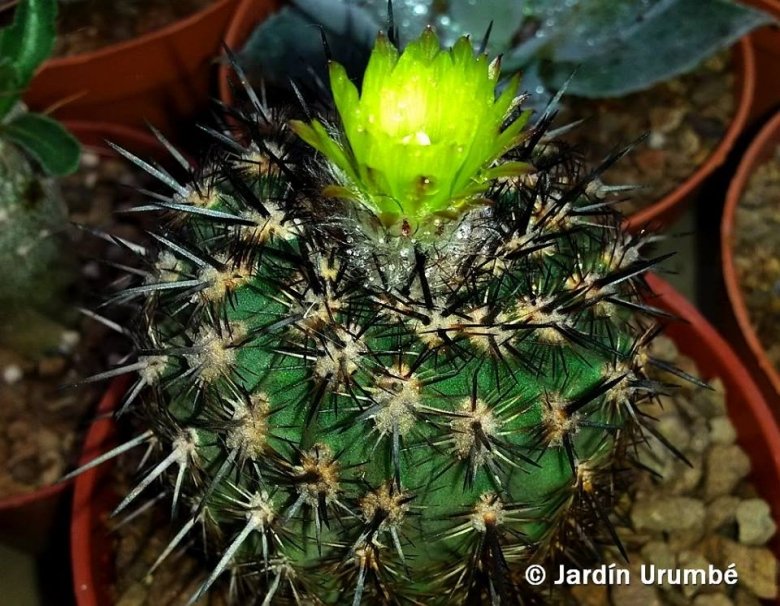
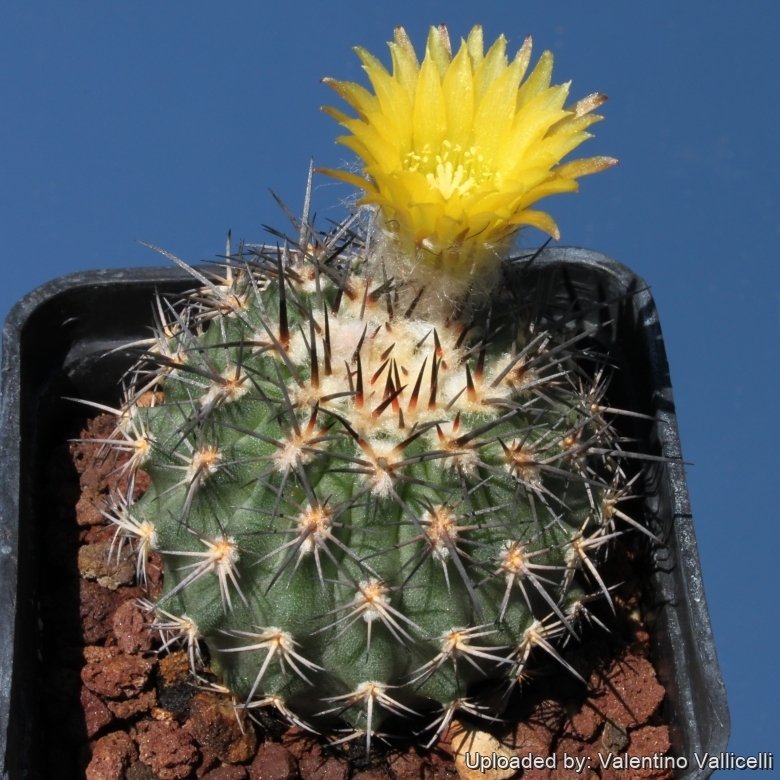
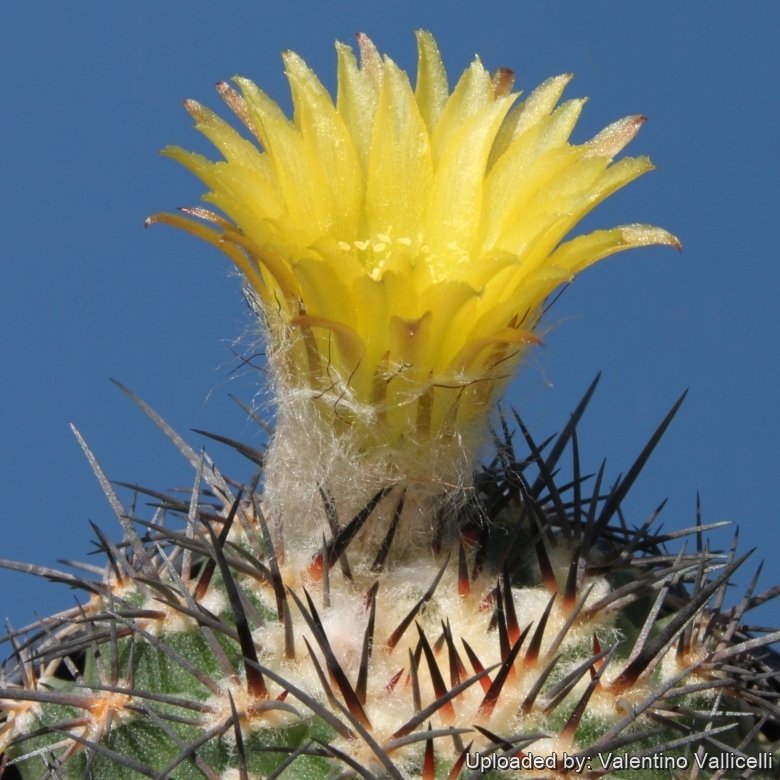
Flowers: Diurnal, wide funnelform, yellow 1,5-2,5 cm long and in diameter (up to 4 cm in the variant known as grandiflora), born on younger areoles from a yellowish woolly crown in summer. Pericarpel and floral tube short scaly. Scales with tufts of dense wool and long reddish bristles. Inner perianth segments yellow, outer perianth segments often reddish. Style yellow.
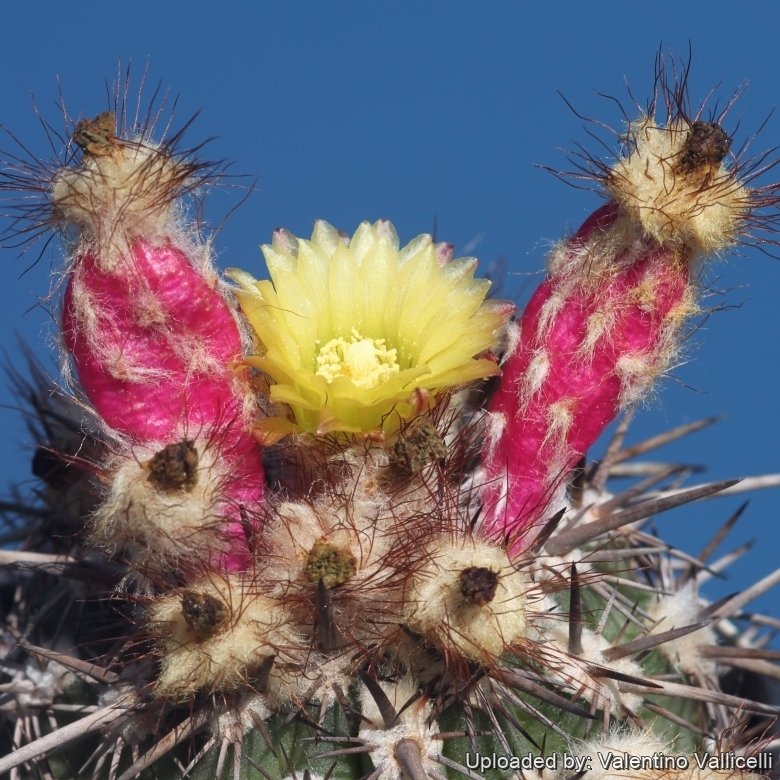
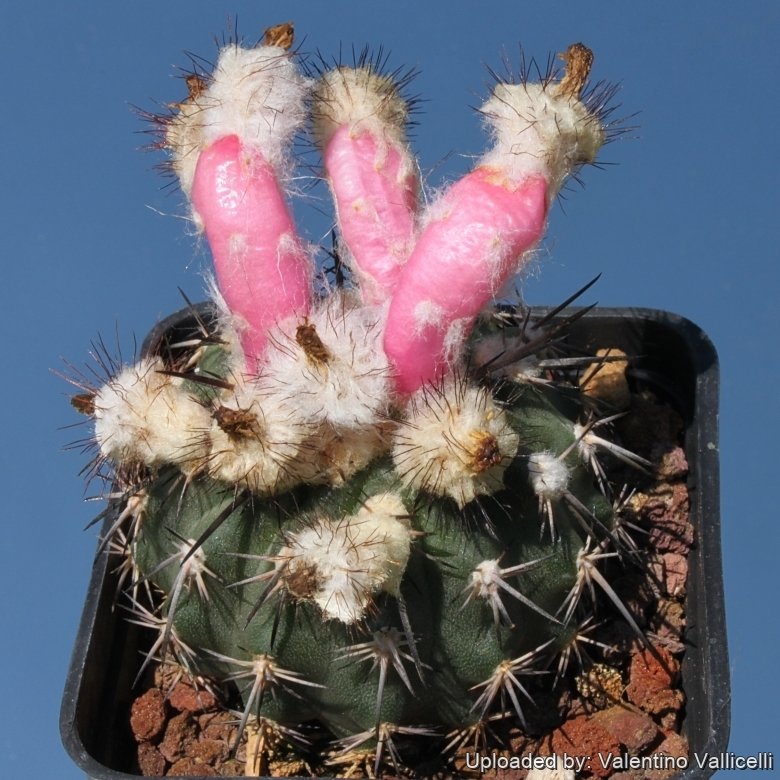
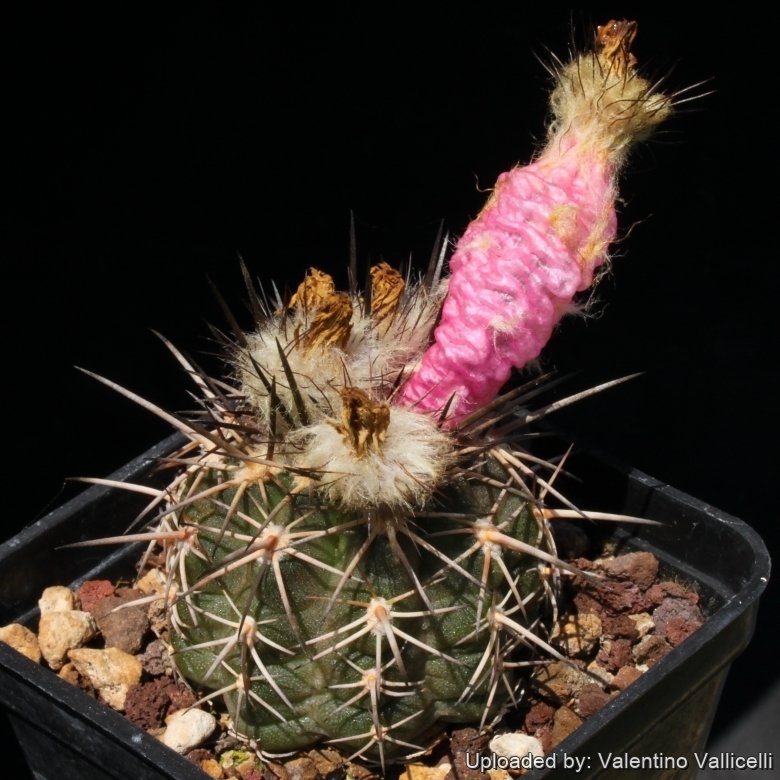
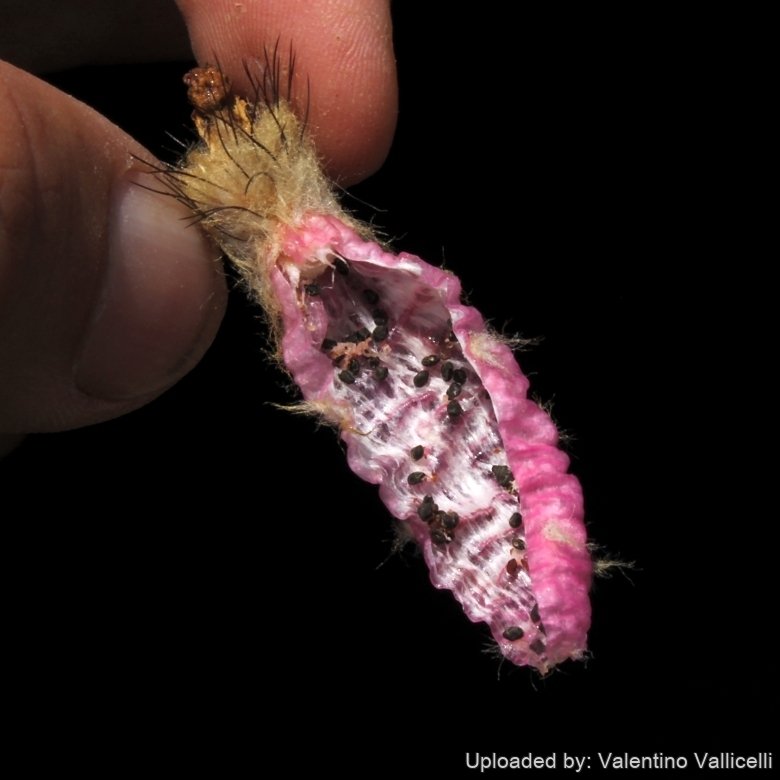
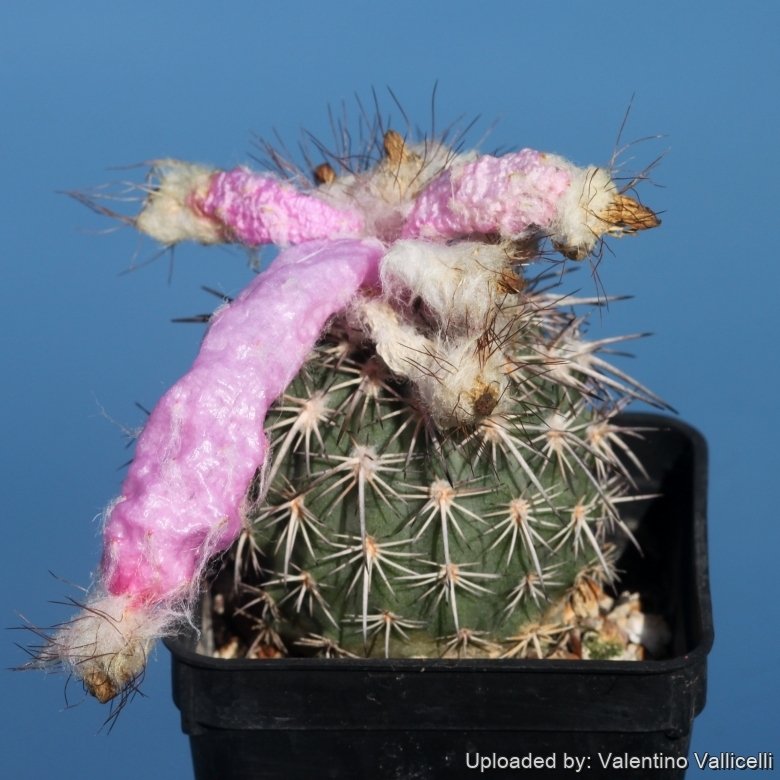
Fruits: Characteristic, up to 5 cm long, club shaped, balloon-like, pinkish to red, when mature inflated, openings by basal pores. Pericarp initially fleshy but the interior always dry when mature.
Seeds: Broadly oval.
Origin and Habitat
Northern Chile along the coast, to southern Peru (just south of Lima).
Habitat: It grows in very dry desert areas on mineral, sterile, alluvial sediments, sand dunes and exposed windy slopes above the Pacific Ocean where it almost never rains and where for many days of the year, the only source of humidity is the thick sea fog garua, which drift inland and condenses on the desert sand like dew. Eriosyce islayensis is found in Lomas communities (highly variable mixtures of annual, short-lived perennial, succulents and woody scrub ) that occur as islands of vegetation and are separated by varying distances of hyperarid habitat devoid of plant life. The thick and robust spination serves as a protection from overheating in the open plains and slopes exposed to sun and wind.
Cultivation and Propagation
It is an extremely xerophytic, summer-growing, species adapted to very dry soils that, like many cacti of the Peruvian deserts, present some problems in cultivation. It is in fact somewhat rot prone if kept in a non ventilated place.
Growth rate: Slow-growing.
Soil: It requires a very fast draining drying open mineral, sandy-gritty cactus composts. Provide a very good drainage.
Exposure: It is suited for sunny-brightly exposure, but can tolerate light shade. However it will do its best only with lots of sun and become stressed with inadequate light which could result in poor growth and unnatural shape. It has a good heat tolerance.
Watering: Water regularly in summer, but do not over-water and keep it completely dry during winter. Mature individuals easily rot and die especially after transplanting so be extremely cautious with watering. Keep dry in winter or when night temperatures remain below 10° C. Water it less than average if in bigger pots.
Fertilization: Feed them once during the growing season with a fertilizer specifically formulated for cactus and succulents (high potash fertilizer with a dilute low nitrogen), including all micro nutrients and trace elements diluted to ½ the strength recommended on the label. They thrive in poor soils and need a limited supplies of fertilizer to avoid the plants developing excess vegetation, which is easily attacked by fungal diseases.
Special need: It is suited for airy exposures. Provide very good ventilation. Nearly all problems occur as a result of overwatering and poor ventilation, especially when weather conditions are dull and cool or very humid. They must have very dry atmosphere.
Hardiness: It likes warmth (recommended minimum winter temperature 5° C), but hardy to at least -5°C (it can probably tolerate freezing temperatures down to -10° C for brief periods) It has a good heat tolerance.
Pests & diseases: These cacti may be attractive to a variety of insects, but plants in good condition should be nearly pest-free, particularly if they are grown in a mineral potting-mix, with good exposure and ventilation. Nonetheless, there are several pests to watch for.
- Red spiders: Red spiders may be effectively rubbed up by misting the plants from above.
- Mealy bugs: Mealy bugs occasionally develop aerial into the new leaves and flowers with disfiguring results, but the worst types develop underground on the roots and are invisible except by their effects.
- Scales, thrips and aphids: These insects are rarely a problem.
- Rot: Rot is only a minor problem if the plants are watered and “aired” correctly. If they are not, fungicides won’t help all that much.
Propagation: Usually propagated from seeds (seldom produces offsets) or graft. The seeds can be sown in pots of fine, well-drained sandy soil, any time during the spring when temperatures are warm. Cover the seeds with a fine layer of grit and water from below with a fungicide to prevent damping off. For the 1-2 weeks cover the pots with a sheet of glass/clear perspex to keep the humidity levels high. Remove the glass and replace it with light shade-cloth and mist once or twice a day for the next two weeks after which most seeds should have germinated. From then on mistings can be reduced to every second and then every third day as the little plants grow. The seedlings should not be disturbed until they are well rooted after which they can be planted separately in small pots. Sometimes it is grafted onto a strong grafting stock like Selenicereus sp. to avoid root rot problems as plants grafted on an hardy stock are easy to grow and no special skill is required. Such grafted seedlings can be been successfully cultivated for years. Mature plants imported from the native habitats usually did not take roots and dyes in a few months.
Notes
Eriosyce islayensis has a large area of distribution and is a very variable species. The difference between populations is the frequency of the appearance in which these forms do occur. So it is possible that two individuals of two different populations can look very similar and also, that two plants of the same population can look very different. However when you are looking at the whole population, you can see the difference between one population and another.
Bibliography
Major references and further lectures
-
Fred Kattermann “Eriosyce (Cactaceae): The Genus Revised and Amplified” David Hunt, 1994
-
Edward Anderson “The Cactus family” Timber Press, Incorporated, 2001
-
James Cullen, Sabina G. Knees, H. Suzanne Cubey “The European Garden Flora Flowering Plants: A Manual for the Identification of Plants Cultivated in Europe, Both Out-of-Doors and Under Glass” Cambridge University Press, 11/Aug/2011
-
David R Hunt; Nigel P Taylor; Graham Charles; International Cactaceae Systematics Group. “The New Cactus Lexicon” dh books, 2006
-
Edgar Lamb, Brian Lamb “The Illustrated Reference on Cacti & Other Succulents” Volume 5 Blandford Press, 1978
-
Jan Říha “Illustrated Encyclopedia of Cacti and Other Succulents” Book Sales, Incorporated, 01/set/1993
-
Curt Backeberg “Die Cactaceae: Handbuch der Kakteenkunde.” 2. ed.. Volume 2, Gustav Fischer Verlag, Stuttgart New York 1983
-
Dillon, M.O. “Lomas Formations - Peru” pp. 519-527. In: S. D Davis, V. H. Heywood, O. Herrera-McBryde, J. Villa-Lobos and A. C. Hamilton (eds.), Centres of Plant Diversity, A Guide and Strategy for their Conservation. WWF, Information Press, Oxford, U.K. 1997
-
Walther Haage “Kakteen von A bis Z” 3. ed. Quelle & Meyer Verlag, Heidelberg 1986
-
N. L. Britton, J. N. Rose: “The Cactaceae. Descriptions and Illustrations of Plants of the Cactus Family.” Volume III, The Carnegie Institution of Washington, Washington 1922
-
E Haustein “Der Kosmos Kakteenfuehrer (the Kosmos Cactus Guide)” United States, Balogh Scientific Books 01/Dec/1998
-
Dr Michael O. Dillon “Lomas formations, Peru” (Field Museum of Natural History, Center for Evolutionary and Environmental Biology, Department of Botany, Chicago, IL 60605- 2496, U.S.A.). http://botany.si.edu/projects/cpd/sa/sa42.htm
From llifle page Neoporteria krainziana
Description
Eriosyce islayensis, formerly known as Islaya islayensis, is a globose to cylindrical cactus with very woolly areoles and dark spreading spines, it is indeed very variable and has received many names, but it is clear from fieldworks that the different wild populations constitute a single but multiform species. Islaya krainziana has stronger somewhat columnar stems that can reach 75 cm high, and this size is rare in the genus Islaya. However Islaya krainziana is generally included within (as a synonym of) Eriosyce islayensis, suggesting that there is not really a fundamental difference between the two.
Stems: Cylindrical, dark grey-green, erect, 40-75 cm tall later prostrate, about 12 cm in diameter.
Ribs: 19 to 25 low and obtuse.
Areoles: Approximate, very woolly, with creamy-white to grey wool.
Roots: Fibrous.
Spines: Thick, dark reddish-brown to yellow in the centre changing to grey with age, but shading to grey-black towards their tips.
Central spines: 2 to 7 spreading, thick, 12-16 mm long.
Radial spines: 12 to 18, shorter, radiating, (1-)6-10 mm long.
Flowers: Diurnal, about 3 cm long and in diameter, born on younger areoles from a yellowish woolly crown in summer, wide funnelform, yellow, outer perianth segments often reddish, floral tube short with tufts of dense wool and long reddish bristles.
Fruits: Characteristic, up to 5 cm long, club shaped, balloon-like, pinkish to red, openings at maturity by basal pores. Pericarp initially fleshy but the interior always dry when mature.
Seeds: Broadly oval.
Origin and Habitat
Eriosyce islayensis (Sensu lato) is endemic to the northern Chile along the coast, to southern Peru (just south of Lima). The “krainziana” is the only Chilean population of “Islaya”, located around Poconchile above Arica, very near the Peruvian border.
Habitat: It grows in a rainless desert, where only wet coastal fogs served to moisten the loose sand and dust superficially. The roots of these cacti are located immediately below the soil surface surface. Soil is usually without humus and gravel.
Bibliography
Major references and further lectures
-
Fred Kattermann “Eriosyce (Cactaceae): The Genus Revised and Amplified” David Hunt, 1994
-
Edward Anderson “The Cactus family” Timber Press, Incorporated, 2001
-
James Cullen, Sabina G. Knees, H. Suzanne Cubey “The European Garden Flora Flowering Plants: A Manual for the Identification of Plants Cultivated in Europe, Both Out-of-Doors and Under Glass” Cambridge University Press, 11/Aug/2011
-
David R Hunt; Nigel P Taylor; Graham Charles; International Cactaceae Systematics Group. “The New Cactus Lexicon” dh books, 2006
-
Edgar Lamb, Brian Lamb “The Illustrated Reference on Cacti & Other Succulents” Volume 5 Blandford Press, 1978
-
Jan ?íha “Illustrated Encyclopedia of Cacti and Other Succulents” Book Sales, Incorporated, 01/set/1993
-
Curt Backeberg “Die Cactaceae: Handbuch der Kakteenkunde.” 2. ed.. Volume 2, Gustav Fischer Verlag, Stuttgart New York 1983
-
Dillon, M.O. “Lomas Formations - Peru” pp. 519-527. In: S. D Davis, V. H. Heywood, O. Herrera-McBryde, J. Villa-Lobos and A. C. Hamilton (eds.), Centres of Plant Diversity, A Guide and Strategy for their Conservation. WWF, Information Press, Oxford, U.K. 1997
-
Walther Haage “Kakteen von A bis Z” 3. ed. Quelle & Meyer Verlag, Heidelberg 1986
-
N. L. Britton, J. N. Rose: “The Cactaceae. Descriptions and Illustrations of Plants of the Cactus Family.” Volume III, The Carnegie Institution of Washington, Washington 1922
-
E Haustein “Der Kosmos Kakteenfuehrer (the Kosmos Cactus Guide)” United States, Balogh Scientific Books 01/Dec/1998
-
Dr Michael O. Dillon “Lomas formations, Peru” (Field Museum of Natural History, Center for Evolutionary and Environmental Biology, Department of Botany, Chicago, IL 60605- 2496, U.S.A.). http://botany.si.edu/projects/cpd/sa/sa42.htm
Source: Neoporteria krainziana, LLIFLE - Encyclopedia of living forms, CC-BY-SA, retrieved 2026-10-25.
From llifle page Neoporteria islayensis f. brevicylindrica
Description
Eriosyce islayensis, formerly known as Islaya islayensis, is a small cactus with very woolly areoles end dark spreading spines, it is indeed very variable and has received many names, but it is clear from fieldworks that the different wild populations constitute a single but multiform species. Islaya brevicylindrica has shorter grey green cylindrical stems, but similar short cylindrical individuals can be found in other populations too, and also two plants of the same population can look very different. Islaya brevicylindrica, is generally included within (as a synonym of) Eriosyce islayensis, suggesting that there is not really a fundamental difference between the two.
Stems: Initially globular, but slightly elongated to shortly cylindrical with age, grey-green, 5 to15 cm tall (rarely up to 70 cm tall), 5-10(-20) cm in diameter. Apex densely woolly.
Ribs: 19-22 low and obtuse and more or less tuberculate.
Areoles: Approximate, large, conspicuously woolly, with creamy-white to grey-brown felt.
Roots: Fibrous.
Spines: Variable in size and in colour whitish with reddish tips, changing to grey with age.
Central spines: 1-3 spreading and markedly directed downward, thick, about 20 mm long.
Radial spines: About 20, shorter, radiating, 7-10 mm long, but sometimes less than 3 mm long.
Flowers: Diurnal, wide funnelform, yellow 1,5-2,5 cm long and in diameter (up to 4 cm in the variant known as grandiflora), born on younger areoles from a yellowish woolly crown in summer. Pericarpel and floral tube short scaly. Scales with tufts of dense wool and long reddish bristles. Petals yellow, sepaloids often orange or reddish. Style yellow.
Fruits: Characteristic, up to 5 cm long, club shaped, balloon-like, pinkish to red, when mature inflated, openings by basal pores. Pericarp initially fleshy but the interior always dry when mature.
Seeds: Broadly oval.
Origin and Habitat
Rio Ocoña to Camana, Southern Coast of Arequipa, Peru.
Altitude: 20-300 metres above sea level.
Habitat: Grows together with Haageocereus decumbens in very dry desert areas where it almost never rains and where only the occasional sea fog drift inland.
Source: Neoporteria islayensis f. brevicylindrica, LLIFLE - Encyclopedia of living forms, CC-BY-SA, retrieved 2026-10-25.
From llifle page Neoporteria islayensis var. copiapoides
Description
Eriosyce islayensis, (syn: Islaya islayensis), is a small globose to cylindrical cactus with very woolly areoles end dark spreading spines, it is indeed very variable and has received many names, but it is clear from fieldworks that the different wild populations constitute a single but multiform species. Islaya copiapoides has fewer spines, but is generally included within (as a synonym of) Eriosyce islayensis, suggesting that there is not really a fundamental difference between the two.
Stems: Grey-green, 5 to 40 cm tall (or more long), 5 to 20 cm in diameter.
Ribs: 19 to 25 low and obtuse.
Areoles: Approximate, large, very woolly, with grey-brown felt.
Roots: Fibrous.
Spines: Variable in colour, horn-coloured, brow to shiny black, turning grey as they age.
Central spines: 4 to 7 spreading, thick, 12-16 mm long.
Radial spines: 12 to 22, shorter, radiating, (1-)6-10 mm long.
Flowers: Diurnal, 1,5 - 4 cm long and in diameter, born on younger areoles from a yellowish woolly crown in summer, wide funnelform, yellow, outer perianth segments often reddish, floral tube short with tufts of dense wool and long reddish bristles.
Fruits: Characteristic, up to 5 cm long, club shaped, balloon-like, pinkish to red, openings at maturity by basal pores. Pericarp initially fleshy but the interior always dry when mature.
Seeds: Broadly oval.
Origin and Habitat
Rio Ocoña to Camana, Southern Coast of Arequipa in the middle of Islaya territory, Peru.
Altitude: 100-300 metres above sea level.
Habitat: Grows together with Haageocereus decumbens in very dry desert areas where it almost never rains and where only the occasional sea fog drift inland.
Source: Neoporteria islayensis var. copiapoides, LLIFLE - Encyclopedia of living forms, CC-BY-SA, retrieved 2026-10-25.
From llifle page Neoporteria islayensis var. divaricatiflora
Description
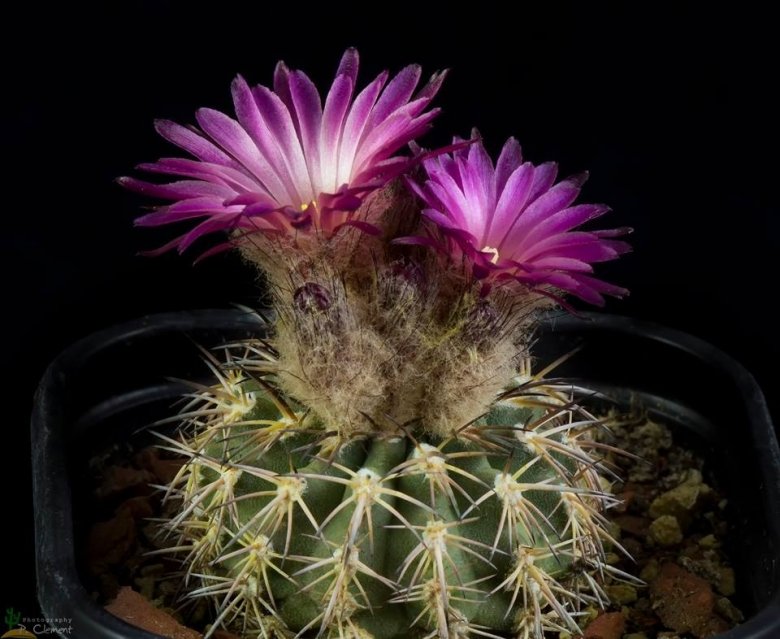
The red-flowered islaya, Islaya divaricatiflora (firstly described by F. Ritter in 1964) is a local or morphological form of the widespread and variable Eriosyce islayensis. It has mostly red-violet flowers and shorter spines that distinguishes it from the other spinier and usually yellow dowered forms, however in the original collect (Ritter FR 588) both reddish and greenish flowering plants where reported. The distinguishing characteristics of Islaya divaricatiflora, appear to fall within the natural variation of Eriosyce islayensis. and it should be synonymized with the latter. Islaya divaricatiflora is a good example of the range of variation of many Islaya species.
Radial spines: 3-7 mm long.
Central spines: 4-10 mm long.
Flower: Green yellow or red-violet.
Origin and Habitat
Camana and adjacent areas, Arequipa, Peru
Altitude: 300-1200 metres above sea level.
Habitat and ecology: Islaya divaricatiflora grows together with Pygmaeocereus bylesianus.
Bibliography
Major references and further lectures
-
Cactus and Succulent Field Number Finder <http://ralph.cs.cf.ac.uk/Cacti/finder.php?Plant=Islaya+divaricatiflora\>
-
Wolf Kinzel, “Die Gattung Islaya Backeberg (The genus Islaya Backeberg)” The Chileans, Yearbook 1968, Genus Islaya.
-
Zlatko Janeba, “Islaya divaricatiflora F. Ritter - the red-flowered islaya”, CactusWorld 01/2016
-
Carlos Ostolaza Nano “Todos los Cactus” Ministerio del Ambiente, Peru, 2014. <http://www.minam.gob.pe/diversidadbiologica/wp-content/uploads/sites/21/2014/02/document.pdf\>
Source: Neoporteria islayensis var. divaricatiflora, LLIFLE - Encyclopedia of living forms, CC-BY-SA, retrieved 2026-10-25.
From llifle page Neoporteria islayensis f. grandiflorens
Origin and Habitat
Arequipa (Atico, Chala, Camana, Islay ) Tacna (Quilca), Peru
Altitude: 30-250(-930?) metres above sea level.
Habitat: Grows together with Neoraimondia roseiflora in very dry desert areas where it almost never rains and where only the occasional sea fog drift inland.
Source: Neoporteria islayensis f. grandiflorens, LLIFLE - Encyclopedia of living forms, CC-BY-SA, retrieved 2026-10-25.
From llifle page Neoporteria islayensis f. spinosior
Description
Eriosyce islayensis, formerly known as Islaya islayensis, is a small globose to cylindrical cactus with very woolly areoles end dark spreading spines, it is indeed very variable and has received many names, but it is clear from fieldworks that the different wild populations constitute a single but multiform species. Islaya grandiflorens var. spinosior has large flowers (the larger of the islayas) and very strong spines. However Islaya grandiflorens var. spinosior, is generally included within (as a synonym of) Eriosyce islayensis, suggesting that there is not really a fundamental difference between the two.
Stems: Grey-green, 5 to 40 cm tall, 5 to 20 cm in diameter, apex very woolly.
Ribs: 19 to 25 low and obtuse.
Areoles: Approximate, very woolly, with grey-brown felt
Roots: Fibrous.
Spines: Variable in colour, horn-coloured, brow to shiny black, turning grey as they age.
Central spines: 4 to 7 spreading, thick, 12-16 (or more) mm long.
Radial spines: 12 to 22, shorter, radiating, (1-)6-10 mm long.
Flowers: Diurnal, about 4 cm long and in diameter, born on younger areoles from a yellowish woolly crown in summer, wide funnelform, yellow, outer perianth segments often reddish, floral tube short with tufts of dense wool and long reddish bristles.
Fruits: Characteristic, up to 5 cm long, club shaped, balloon-like, pinkish to red, openings at maturity by basal pores. Pericarp initially fleshy but the interior always dry when mature.
Seeds: Broadly oval.
Origin and Habitat
Chala, Southern Coast of Arequipa, Peru.
Altitude: 20-250 metres above sea level.
Habitat: Grows together with Haageocereus decumbens in very dry desert areas where it almost never rains and where only the occasional sea fog drift inland.
Source: Neoporteria islayensis f. spinosior, LLIFLE - Encyclopedia of living forms, CC-BY-SA, retrieved 2026-10-25.
From llifle page Echinocactus lindleyi
Description
It is a small globose to cylindrical cactus with very woolly areoles and dark spreading spines, it is indeed very variable and has received many names, but it is clear from fieldworks that the different wild populations constitute a single but multiform species. The var. lindleyi has fewer spines.
Stems: Grey-green, 5 to 40 cm tall (or more long), 5 to 20 cm in diameter.
Ribs: 19 to 25 low and obtuse.
Areoles: Approximate, very woolly, with grey-brown felt
Roots: Fibrous.
Spines: Variable in colour, horn-coloured with brow to shiny black tips, turning grey as they age.
Central spines: 4 to 7 spreading, thick, 12-16 (or more) mm long.
Radial spines: 12 to 22, shorter but stout, radiating, 6-10 mm long.
Flowers: Diurnal, 1,5-2 cm long and in diameter, born on younger areoles from a yellowish woolly crown in summer, wide funnelform, yellow, outer perianth segments often reddish, floral tube short with tufts of dense wool and long reddish bristles.
Fruits: Characteristic, up to 5 cm long, club shaped, balloon-like, pinkish to red, openings at maturity by basal pores. Pericarp initially fleshy but the interior always dry when mature.
Seeds: Broadly oval.
Origin and Habitat
Eriosyce islayensis (Sensu lato) is endemic to the northern Chile along the coast, to southern Peru (just south of Lima).
Habitat: It grows in very dry desert areas where it almost never rains and where only the occasional sea fog drift inland.
Source: Echinocactus lindleyi, LLIFLE - Encyclopedia of living forms, CC-BY-SA, retrieved 2026-10-25.
From llifle page Islaya chalaensis
Description
Eriosyce islayensis, formerly known as Islaya islayensis, is a small cactus with very woolly areoles end dark spreading spines, it is indeed very variable and has received many names, but it is clear from fieldworks that the different wild populations constitute a single but multiform species. Islaya copiapoides var. chalaensis has few but very strong spines, but similar individuals with few and strong spines can be found in other populations too, and also two plants of the same population can have different spine patterns.
Islaya copiapoides var. chalaensis, is generally included within (as a synonym of) Eriosyce islayensis, suggesting that there is not really a fundamental difference between the two.
Stems: Initially globular, but slightly elongated to shortly cylindrical with age, grey-green, 5 to 15 cm tall, 5-10 cm in diameter. Apex densely woolly.
Ribs: 19-22 low and obtuse and more or less tuberculate.
Areoles: Approximate, large, conspicuously woolly, with creamy-white to grey-brown felt.
Roots: Fibrous.
Spines: Variable in size and in colour whitish with reddish tips, changing to grey with age.
Central spines: 1-3 spreading and markedly directed downward, thick, about 20 mm long.
Radial spines: About 20, shorter, radiating, 7-10 mm long, but sometimes less than 3 mm long.
Flowers: Diurnal, wide funnelform, yellow 1,5-2,5 cm long and in diameter (up to 4 cm in the variant known as grandiflora), born on younger areoles from a yellowish woolly crown in summer. Pericarpel and floral tube short scaly. Scales with tufts of dense wool and long reddish bristles. Petals yellow, sepaloids often orange or reddish. Style yellow.
Fruits: Characteristic, up to 5 cm long, club shaped, balloon-like, pinkish to red, when mature inflated, openings by basal pores. Pericarp initially fleshy but the interior always dry when mature.
Seeds: Broadly oval.
Origin and Habitat
Entrance to Río Cháparra to Chala Viejo, Arequipa, Peru.
Altitude: 150-220 metres above sea level.
Habitat: Grows in very dry desert areas where it almost never rains and where only the occasional sea fog drift inland.
Source: Islaya chalaensis, LLIFLE - Encyclopedia of living forms, CC-BY-SA, retrieved 2026-10-25.
From llifle page Islaya maritima
Description
Islaya maritima is an invalid name (nom. nov.) proposed by F.Ritter in 1981 to replace Islaya grandiflorens Rauh 1958” (non Islaya grandiflorens Rauh & Backeb. 1957). Islaya maritima is merely one of the variable forms of the widespread and variable Eriosyce islayensis which is a small cactus with very woolly areoles and dark spreading spines. Eriosyce islayensis has received many names, but it is clear from fieldworks that the different wild populations constitute a single but multiform species. Islaya maritima should be included within (as a synonym of) Eriosyce islayensis, suggesting that there is not a fundamental difference between the two.
Stem: Solitary, spherical becoming cylindrical to 20 cm (or more) tall and 5-12 cm thick, bluish-green, apex woolly even in young specimens.
Ribs: Usually 14-18, notched where the areoles grow, 7-15 mm high.
Areoles: Oval, white to brownish woolly 5-10 mm long, 5-12 mm apart.
Spines: Needle-shaped, brown, with dark tips, greying with age.
Radial spines: 8-17, nearly straight not exceed a length of 5-15 mm.
Central spines: 3 to 14, depending on specimen and age, on the first start of flowering 2-7, nearly straight or slightly bent downwards, 10-30 mm long.
Flowers: Yellow, wide opening, about 27 mm long, and 32 mm.
Blooming season: Spring to summer, flowers opens during the warmer hours for several days.
Fruits: Green or reddish, with 2-3 mm long scales and ample white wool.
Seeds: Ca 2x1 mm.
Origin and Habitat
Atico, Peru.
Altitude range: 30-300 metres above sea level.
Cultivation and Propagation
Islaya maritima It is an extremely xerophytic, summer-growing, species adapted to very dry soils that, like many cacti of the Peruvian deserts, present some problems in cultivation. It is in fact somewhat rot prone if kept in a non ventilated place.
Growth rate: Slow-growing.
Soil: It requires a very fast draining drying open mineral, sandy-gritty cactus composts. Provide a very good drainage.
Exposure: It is suited for sunny-brightly exposure, but can tolerate light shade. However it will do its best only with lots of sun and become stressed with inadequate light which could result in poor growth and unnatural shape. It has a good heat tolerance.
Watering: Water regularly in summer, but do not over-water and keep it completely dry during winter. Mature individuals easily rot and die especially after transplanting so be extremely cautious with watering. Keep dry in winter or when night temperatures remain below 10° C. Water it less than average if in bigger pots.
Fertilization: Feed them once during the growing season with a fertilizer specifically formulated for cactus and succulents (high potash fertilizer with a dilute low nitrogen), including all micro nutrients and trace elements diluted to ½ the strength recommended on the label. They thrive in poor soils and need a limited supplies of fertilizer to avoid the plants developing excess vegetation, which is easily attacked by fungal diseases.
Special need: It is suited for airy exposures. Provide very good ventilation. Nearly all problems occur as a result of overwatering and poor ventilation, especially when weather conditions are dull and cool or very humid. They must have very dry atmosphere.
Hardiness: It likes warmth (recommended minimum winter temperature 5° C), but hardy to at least -5°C (it can probably tolerate freezing temperatures down to -10° C for brief periods) It has a good heat tolerance.
Propagation: Usually propagated from seeds (seldom produces offsets) or graft. The seeds can be sown in pots of fine, well-drained sandy soil, any time during the spring when temperatures are warm. Cover the seeds with a fine layer of grit and water from below with a fungicide to prevent damping off. For the 1-2 weeks cover the pots with a sheet of glass/clear perspex to keep the humidity levels high. Remove the glass and replace it with light shade-cloth and mist once or twice a day for the next two weeks after which most seeds should have germinated. From then on mistings can be reduced to every second and then every third day as the little plants grow. The seedlings should not be disturbed until they are well rooted after which they can be planted separately in small pots. Sometimes it is grafted onto a strong grafting stock like Selenicereus sp. to avoid root rot problems as plants grafted on an hardy stock are easy to grow and no special skill is required. Such grafted seedlings can be been successfully cultivated for years. Mature plants imported from the native habitats usually did not take roots and dyes in a few months.
Bibliography
Major references and further lectures
- Friedrich Ritter “Kakteen in Südamerika: Ergebnisse meiner 20jährigen Band 4 - Peru”, Friedrich Ritter Selbsverlag 1981.
Source: Islaya maritima, LLIFLE - Encyclopedia of living forms, CC-BY-SA, retrieved 2026-10-25.
From llifle page Islaya paucispina
Description
Eriosyce islayensis, formerly known as Islaya islayensis, is a small globose to cylindrical cactus with very woolly areoles and dark spreading spines, it is indeed very variable and has received many names, but it is clear from fieldworks that the different wild populations constitute a single but multiform species. Islaya paucispina has fewer spines, the var. lindleyi “paucispina” is somewhat intermediate between the Neoporteria lindleyi (Islaya) and Islaya chalaensis (if not the same) but usually has stronger spines. However similar strong spined islayas can be found in other populations too, and also two plants of the same population can look very different. Up to date Islaya paucispina is generally included within (as a synonym of) Eriosyce islayensis, suggesting that there is not really a fundamental difference between the two.
Stems: Grey-green, 5 to 40 cm tall, 5 to 20 cm in diameter.
Ribs: 19 to 25 low and obtuse.
Areoles: Approximate, very woolly, with grey-brown felt.
Roots: Fibrous.
Spines: Variable in colour, horn-coloured, brow to shiny black, turning grey as they age.
Central spines: 4 to 7 spreading, thick, 12-16 mm long.
Radial spines: 12 to 22, shorter, radiating, (1-)6-10 mm long.
Flowers: Diurnal, 1,5 - 4 cm long and in diameter, born on younger areoles from a yellowish woolly crown in summer, wide funnelform, yellow, outer perianth segments often reddish, floral tube short with tufts of dense wool and long reddish bristles.
Fruits: Characteristic, up to 5 cm long, club shaped, balloon-like, pinkish to red, openings at maturity by basal pores. Pericarp initially fleshy but the interior always dry when mature.
Seeds: Broadly oval.
Origin and Habitat
Chala, Peru
Altitude: 20-250 metres above sea level.
Habitat: Grows together with Haageocereus decumbens in very dry desert areas where it almost never rains and where only the occasional sea fog drift inland.
Source: Islaya paucispina, LLIFLE - Encyclopedia of living forms, CC-BY-SA, retrieved 2026-10-25.
From llifle page Islaya longicarpa
Description
Eriosyce islayensis, formerly known as Islaya islayensis, is a small globose to cylindrical cactus with very woolly areoles end dark spreading spines, it is indeed very variable and has received many names, but it is clear from fieldworks that the different wild populations constitute a single but multiform species. Islaya longicarpa is a nomen nudum (undescribed name) sometimes encountered in European nurseries. The key difference by which Islaya longicarpa was separated, namely the presence of very long fruits, seems entirely spurious, and it is generally included within (as a synonym of) Eriosyce islayensis, suggesting that there is not really a fundamental difference between the two.
Stems: Grey-green, 5 to 40 cm tall (or more long), 5 to 20 cm in diameter.
Ribs: 19 to 25 low and obtuse.
Areoles: Approximate, large, very woolly, with grey-brown felt.
Roots: Fibrous.
Spines: Variable in colour, horn-coloured, brow to shiny black, turning grey as they age.
Central spines: 4 to 7 spreading, thick, 12-16 mm long.
Radial spines: 12 to 22, shorter, radiating, (1-)6-10 mm long.
Flowers: Diurnal, 1,5 - 4 cm long and in diameter, born on younger areoles from a yellowish woolly crown in summer, wide funnelform, yellow, outer perianth segments often reddish, floral tube short with tufts of dense wool and long reddish bristles.
Fruits: Islaya longicarpa distinguish for its comparatively very long fruits, up to 10 cm long, club shaped, pinkish, openings at maturity by basal pores. Pericarp initially fleshy but the interior always dry when mature.
Seeds: Broadly oval.
Origin and Habitat
Eriosyce islayensis is endemic to the northern Chile along the coast, to southern Peru (just south of Lima). Islaya longicarpa is found along the coast near Atico, Peru.
Altitude: 300 metres above sea level.
Habitat: It grows in very dry desert areas where it almost never rains and where only the occasional sea fog drift inland.
Cultivation and Propagation
It is a summer grower species that, like many cacti of the Peruvian deserts, present some problems in cultivation. It is in fact somewhat rot prone if kept in a non ventilated place.
Soil: Require a very fast draining drying soil
Water: Water regularly in summer, but do not overwater.
Exposition: Needs a full sun exposure (or light shade)
Heat tolerance: Good.
Hardyness: Hardy to at least -5°C ( but probably can tolerate - 10° C for brief periods)
Propagation: Usually propagated from Seeds. (seldom produces offsets) or by grafting onto a strong grafting stock like Selenicereus sp. Such grafted seedlings can be been successfully cultivated for years.
Source: Islaya longicarpa, LLIFLE - Encyclopedia of living forms, CC-BY-SA, retrieved 2026-10-25.
From llifle page Islaya solitaria
Description
Islaya solitaria n.n. is an undescribed name used commercially to indicate one of the local forms of Eriosyce islayensis, which is a small cactus with very woolly areoles and dark spreading spines. The morphological or geographical form labelled Islaya solitaria is a often solitary (hence the specific name), spherical or short cylindrical plant up to 20 cm tall and about 10 cm in diameter. It has been found by the commercial collector Karel Kníže who spread it under no. KK 677. Eriosyce islayensis is indeed very variable and has received many names, but it is clear from fieldworks that the different wild populations constitute a single but multiform species. Islaya solitaria should be included within (as a synonym of) Eriosyce islayensis, suggesting that there is not really a fundamental difference between the two.
Stem: Solitary, spherical or cylindrical to 20 cm tall and 10 cm thick, lime-blue or grey-green.
**Ribs: Usually 15-20, swollen where the areoles grow.
Areoles: White woolly.
Spines; White to brown with dark tips, not exceed a length of 12 mm.
Flowers: All shades of yellow about 2.5 cm in diameter, outer perianth segments often brownish-red.
Fruits:*** 2.5 to 5 cm long, bright pink colour, ripen within a few weeks after the end of flowering.
Origin and Habitat
Camana Pampa, Peru.
Altitude range: 400-600 metres above sea level.
Bibliography
Major references and further lectures:
- Ислайя (Islaya) retrieved 19 March 2016 from <http://m.cvetki.org/cvetki\_islaya.php\> [Russian]
Source: Islaya solitaria, LLIFLE - Encyclopedia of living forms, CC-BY-SA, retrieved 2026-10-25.
Cultivars and forms (1)
Cultivars (1)
Gallery