Publication: Eriosyce (Cactac.) gen. revis. & ampl. (Succ. Pl. Res., 1) 117 (1994)
Description
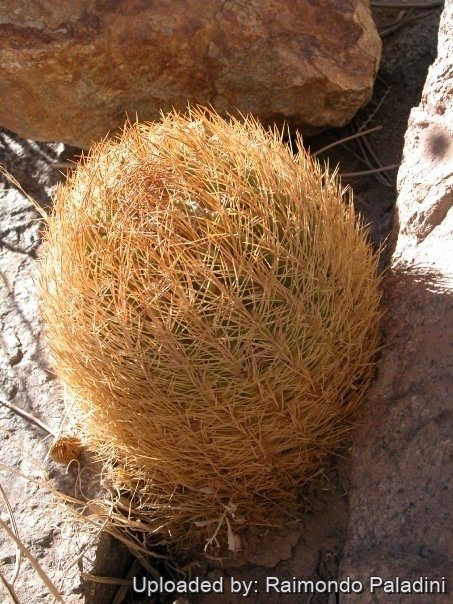
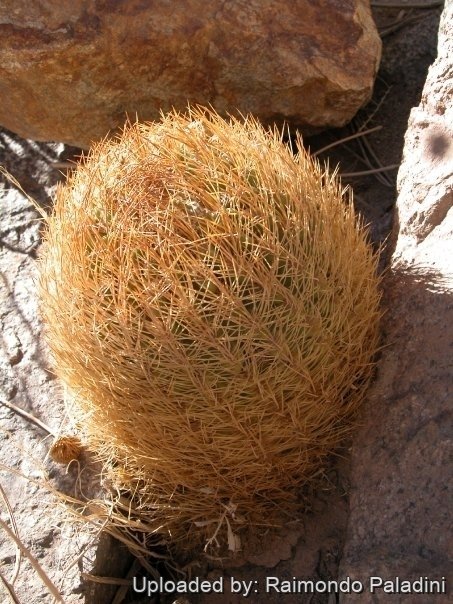
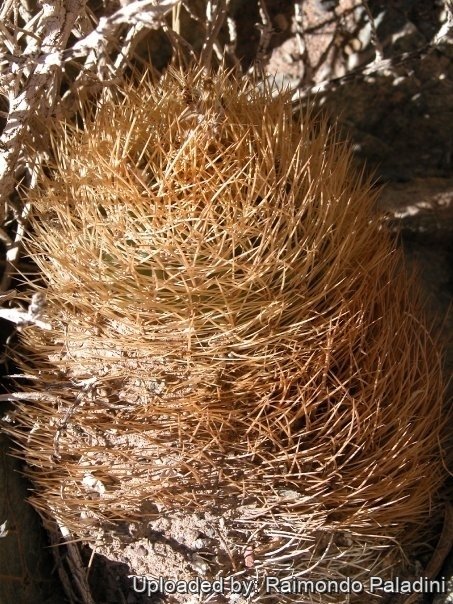
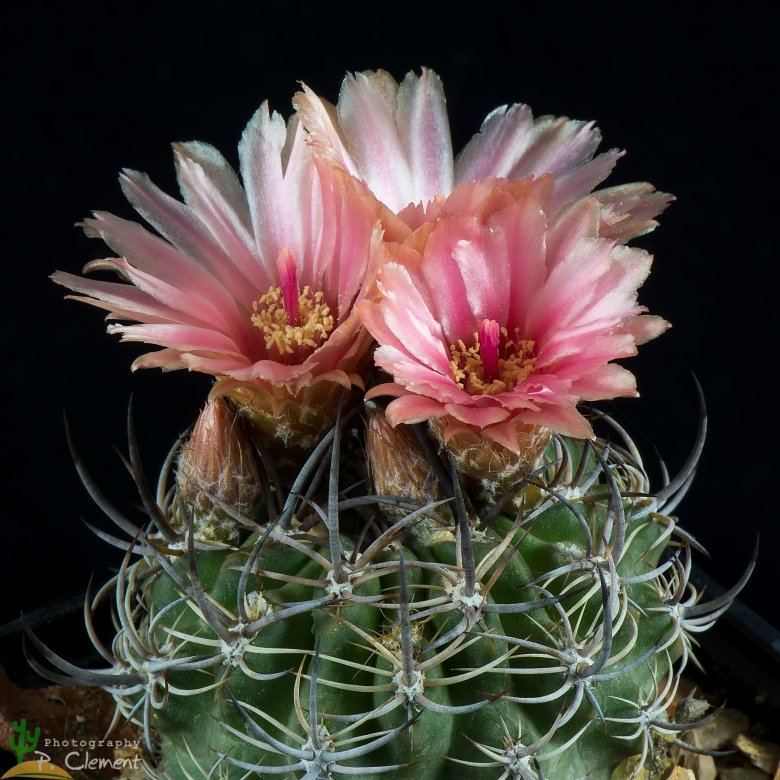
Eriosyce kunzei, (syn: Eriosyce eriosyzoides), is a spherical to columnar, perennial cactus up to 20 cm tall and 14 cm in diameter. Long, thin, yellow or grey spines curved upwards and inward completely encircle a green stem. Plants are usually solitary. During spring or autumn the crown produces broadly funnelform flowers up to 3-5 cm long, ivory white, with a reddish mid-strip, and open only at the tips. It is also highly variable in appearance. In fact, there are a number of different looking forms, so that only some authorities recognize the different populations as segregate varieties. Two varieties are recognized, the nominate form ( var. kunzei) and var. transitensis.
Derivation of specific name: This member of the Cactaceae family was given this name in honor of the German physician and botanist Gustav Kunze.
Stem: Globose or flattened to cylindrical, 10-20 cm tall, 13-14 cm in diameter. The apex is depressed and often deprived of spines, but spines covering the stems. Epidermis green or blue-green, rarely tan-green to dark violet-green .
Ribs: 13 to 20 cm, about 7 to12 mm tall in adult specimens, 13-17 mm apart, obtuse, enlarged at areoles and tubercled.
Areoles: 5-20 mm apart.
Spines: Strong, stiff and curved upwards and inward, pale yellowish to straw yellow (rarely brownish or blackish) later grey. The var. kunzei is described with very thin, needle-shaped spines but it grows and merges with the thick spined form (var. transitensis). And in cultivation it is possible to find both thick and thin spined specimens.
Central spines: (1-)2-4(-7), thicker, 20-50 mm long with a darker tip.
Radial spines: 10-12(-15) about 13-45 mm long straighter, mostly directed downward, the upper of them are longer than other.
Roots: Fibrous or tuberose.
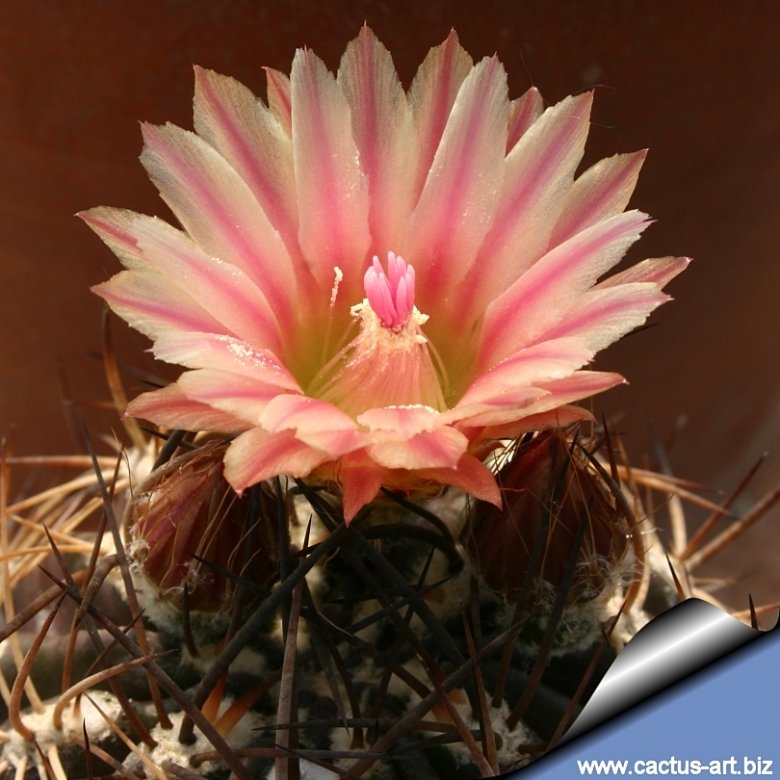
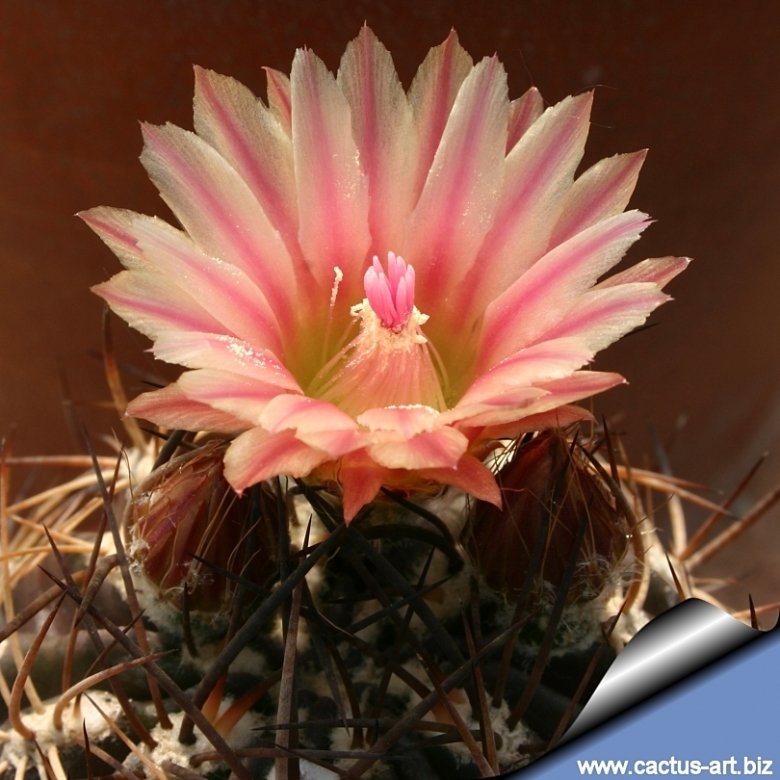
Flowers: Broadly funnelform, widely opened, up to 3,5 cm long and in diameter. Sepalois tepals ivory white, with a reddish mid-strip; petaloid tepals whitish yellow with a darker reddish mid-line, tips serrated or fringed. Flower tube woolly white with some black bristles. Perikarpell glossy green covered with brownish reddish scales. Stamens whitish, greenish-white or pinkish; anthers creamy white. Style flesh coloured and stigma lobes somewhat brighter.
Fruits: About 2 cm long and 1,5 cm oval, fleshy, hollow, dull-green, tan, to reddish that opens at maturity by a basal pore.
Seeds: 1,25 mm.
Origin and Habitat
Chile Coquimbo and Atacama regions. Low Andes mountain on the north and south Of Río Elqui Valley down to near the ocean cost.
Cultivation and Propagation
It is a summer-growing species. Easy to cultivate but somewhat rot prone if kept in a non-ventilated place. It requires a very fast draining drying soil. Water regularly in summer, but place. It requires a very fast draining drying soil. Water regularly in summer, but do not over-water.
Needs a full sun exposure (or light shade). Good heat tolerance. Hardy to at least -5°C (but it can probably tolerate
-10° C for brief periods)
Propagation: Usually propagated from Seeds. ( It seldom produces offsets)
Bibliography
Major references and further lectures
-
Fred Kattermann “Eriosyce (Cactaceae): The Genus Revised and Amplified” David Hunt, 1994
-
Urs Eggli, Leonard E. Newton: “Etymological Dictionary of Succulent Plant Names” Springer, Berlin/Heidelberg 2010
-
Christopher Brickell “RHS Encyclopedia of Plants and Flowers” Dorling Kindersley Ltd, 01 set 2010
-
Urs Eggli, Leonard E. Newton “Etymological Dictionary of Succulent Plant Names” Birkhäuser 2004
From llifle page Eriosyce eriosyzoides
Description
Eriosyce eriosyzoides, is one of the many geographical or morphological form of Eriosyce kunzei. Many variant of Eriosyce kunzei was early classified as different independent species, but nowadays all this plants are considered part of a multiform species, where each form is linked to others by populations of plants with intermediate characteristics. Eriosyce eriosyzoides, has distinctive brownish-yellow to salmon silk-shining flowers with a darker purple middle stripe at the base of the petals. The stems are armed by strong spines curved inward and upward. This latter feature is the distinctive characteristic of Eriosyce kunzei var. transitensis. Probably Eriosyce eriosyzoides is only another name for E. kunzei var. transitensis, and it should, more properly, synonymized with the latter.
Stem: Solitary, globose, later elongated, ca 9-12 cm thick, bluish-grey-
green.
Roots: Short, with a thick tap-root beet with sometimes a thinner neck.
Ribs: 13-17, about 10-12 mm high,often curved, blunt, at the areole, laterally compressed, with clear chins under the areloes. Often tuching each other in the longitudinally.
Areoles: 7-10 mm long, 3-5 mm wide, white felt, 5-10 mm free distance.
Spines: Strongly curved, rigid, never flexuose and noticeably thickened at the base. Radial spines 10-15, 15-40 mm long, curved inward and upward light at first greyish-brown to greyish-yellowish, tips darker, grey with age. Central spines about 4-7, bent upwards, 2-5 cm long.
Flowers: Apical, odorless, approx 33 mm long, 30mm wide open, funnel-form to campanulate. Pericarpel ca. 7 mm long, grass green, with tiny narrow yellowish scales and dull white wool. Nectary pale green, tubular, 3 mm high, 4 mm wide, half closed by the stamens bases.
Tube funnel-form, about 1 cm high, inside pale green, outside grass green, richly scaled to the top with whitish, straight, almost piercing bristles. Stamens pale greenish-yellowish, the lowest ones 6 mm long, the uppermost ca 10 mm. Anther lemon yellow. Style 2 cm long, bottom white, top
salmon coloured, stigma lobes about 11, nearly smooth, yellow, 3-4 mm long. Tepals lanceolate, ca. 15 mm long, 5 mm broad, base slightly narrower, rounded, apex toothed, strongly silk-shining, light brownish-yellow to salmon-coloured with purple middle stripe, which is wide down and does not go up to the tip.
Fruits: About 20 mm long, 15 mm thick, reddish-green to almost red, with a lot of white woolly flakes. The seeds fall from the fruit through a round basal pore (hole) opening after the detachment of the fruit from the areola.
Seeds: Frosted black, about 1.2 mm long, 0.8 mm wide, 0.5 mm thick, dorsally strong-
bulges; Testa very fine grained and roughly ribbed. Hilum oval, white.
Origin and Habitat
Huanta, Elquí Depart.up to the border of the province of Atacama.
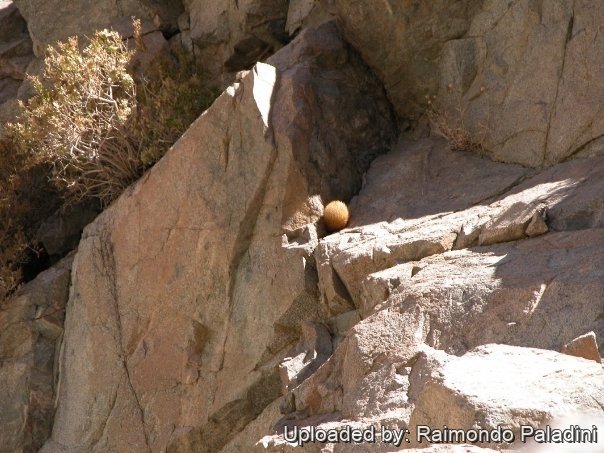
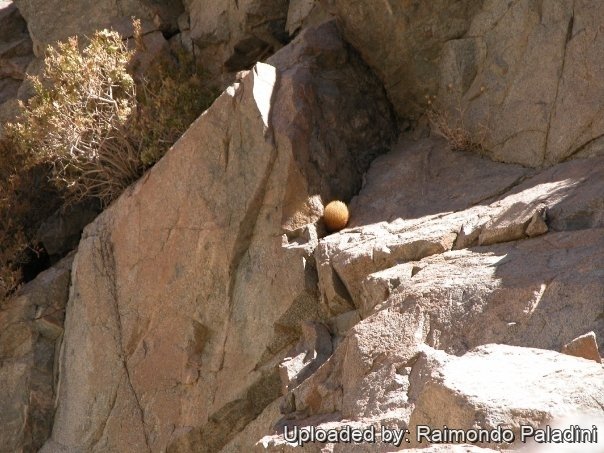
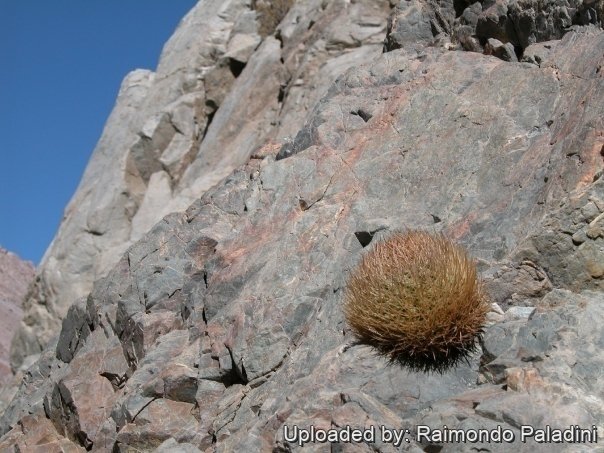
Habitat and ecology: Eriosyce eriosyzoides grows on rocky outcrops. It rare due its restricted distribution.
Bibliography
Major references and further lectures
-
Fred Kattermann “Eriosyce (Cactaceae): The Genus Revised and Amplified” David Hunt, 1994
-
“Boletín - Museo Nacional de Historia Natural”, Edizioni 46-48 1997
-
“Plantas altoandinas en la flora silvestre de Chile” Ediciones Fundación Claudio Gay, 1998
-
F. Ritter “Kakteen in Südamerika” volume 3 Chile. Spangenberg. 857-1238 1980
Source: Eriosyce eriosyzoides, LLIFLE - Encyclopedia of living forms, CC-BY-SA, retrieved 2026-10-25.
Gallery