Publication: Eriosyce (Cactac.) gen. revis. & ampl. (Succ. Pl. Res., 1) 117 (1994)
Description
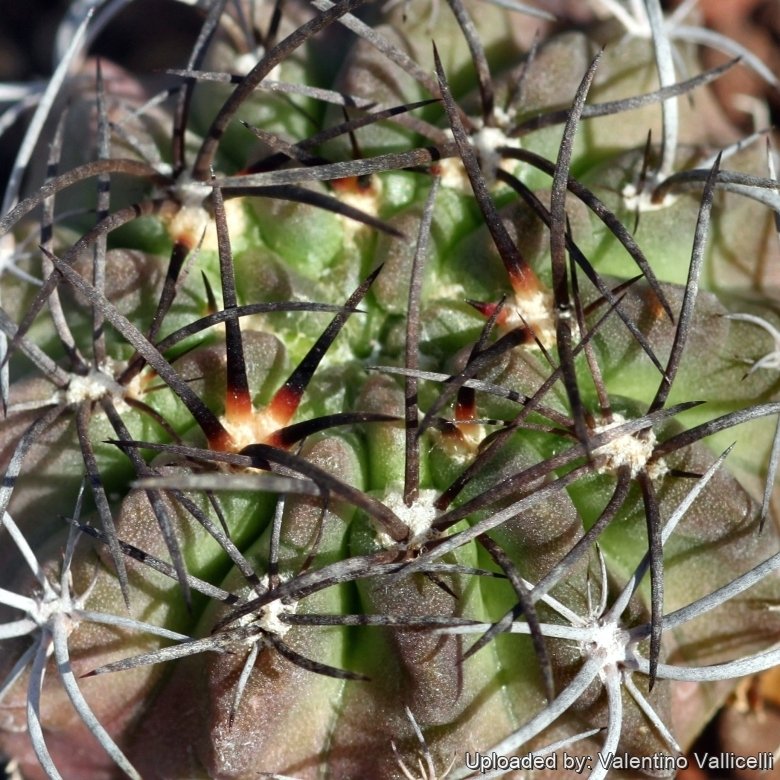
Eriosyce recondita is a spherical, sometimes branching cactus species. Two subspecies of Eriosyce recondita are recognized, the nominate form and subs. iquiquensis.
Stem: Subglobose to globose grey to dark green, 2-10 cm in diameter, with sunken stem tips.
Root: Taproots expanded, often with necks.
Ribs: 10-13, notched and forming tubercles and often with sunken areoles.
Spines: Thin, needle-like, black.
Central spines: 1-2,10-15 mm long.
Radial spines: 6-10,5-10 mm long.
Flowers: Borne on young areoles, funnelform, white to pinkish to yellow, 1.5-4 cm long, 2-3.5 cm in diameter; pericarpels and floral tubes with wool and sometimes bristles.
Fruits: Club-shaped, elongate, hollow, dehiscing by basal pores.
Origin and Habitat
Eriosyce recondita is endemic to Chile, where it occurs in the region of Antofagasta in Morro Moreno and Quebrada la Chimba in the close vicinity of Antofagasta. The population seems stable, but the species is scarce. It is known from two localities where it is stable, however the population size is way less than 1,000 individuals.
Altitude range: This species grows at elevations of 600 to 1,000 metres above sea level.
Habitat and Ecology: The species occurs in coastal hills (lomas costeras) on rocky and sandy soils together with Copiapoa boliviana and Eulychnia morromorenoensis. It occurs very mimicked, barely protruding from the ground surface. It’s a very drought tolerant species. Despite the lack of rain where it lives, the extreme aridity is attenuated by the frequent, often dense, coastal fogs. The fog tends to concentrate in the form of a cloud band at an estimated height of 500 to 850 m. It shows a recurrent pattern; usually it is overcast in the early mornings, the clouds dissipating during the late morning and returning during the late afternoons. This species is anemochorous ((has seeds adapted for dispersal via wind) and resembles in this respect Chileorebutia and Islaya. The presence in habitat of multiple-branched specimens is the result of a previous serial of predation, by an overpopulation of camelids now disappeared by anthropic action. The only major threat known for Eriosyce recondita is illegal collection.
Bibliography
Major references and further lectures
-
Guerrero, P., Saldivia, P., Faundez, L. & Walter, H.E. 2013. Eriosyce recondita. The IUCN Red List of Threatened Species. Version 2015.2. <www.iucnredlist.org>. Downloaded on 22 July 2015.
-
Fred Kattermann “Eriosyce (Cactaceae): The Genus Revised and Amplified” David Hunt, 1994
-
Edward Anderson “The Cactus family” Timber Press, Incorporated, 2001
-
James Cullen, Sabina G. Knees, H. Suzanne Cubey “The European Garden Flora Flowering Plants: A Manual for the Identification of Plants Cultivated in Europe, Both Out-of-Doors and Under Glass” Cambridge University Press, 11/August /2011
-
David R Hunt; Nigel P Taylor; Graham Charles; International Cactaceae Systematics Group. “The New Cactus Lexicon” dh books, 2006
-
“Bosque” Vol. 8, N. 1, page 25, 1987 ISSN 0304-8799
-
G. Fischer “Excerpta botanica: Taxonomica et chorologica. Sectio A”, 1963
-
Curt Backeberg “Die Cactaceae: Handbuch der Kakteenkunde” Volume 6 G. Fischer, 1962
9)Ritter, “Kakteen in Sudamerika” 1980
From llifle page Neochilenia aricensis
Description
Neoporteria aricensis is a form of Eriosyce recondita, but not sufficiently differentiated and considered merely a local variant of the latter (if not the same). It is a spherical, sometimes branching cactus species, eventually cylindric and decumbent with time.
Stem: to 5,5 cm across.
Ribs: 13-21. 5- 10 mm high.
Spines: Yellow-brown or rarely blackish brown, becoming grey; centrals 5-12. 1-3 cm long. Upcurved;radials 10-16, 8-15 mm long.
Flowers: 2 x 2 cm, scales of pericarpel and tube with dense woolly hairs, tube very short. Perianth pale yellow. Style and stigmas yellow.
Fruit: 1-2 x 1-1.5 cm, dark red or reddish brown.
Origin and Habitat
South of Arica, coastal region, 01 Tarapacá, Chile.
Source: Neochilenia aricensis, LLIFLE - Encyclopedia of living forms, CC-BY-SA, retrieved 2026-10-25.
From llifle page Pyrrhocactus vexatus
Description
Eriosyce recondita var. vexata (formerly Pyrrhocactus vexatus), appears to be a dwarf, weakly spined ally of Neoporteria aricensis (syn: Eriosyce recondita), but not sufficiently differentiated and considered merely a local variant of the latter (if not the same) and it is hard to tell apart one from the others, if not for the geographical provenance. It is a spherical, sometimes branching cactus species barely protruding from the ground surface.
Stem: Grey to dark green about 5,5 cm across.
Root: Taproots expanded, often with necks.
Ribs: About 13, 5- 10 mm high, notched and forming tubercles and often with sunken areoles.
Spines: Thin, needle-like, yellow-brown to black, becoming grey; centrals 1-2, 1-3 cm long, upcurved; radial s 10-16, 8-15 mm long.
Flowers: Borne on young areoles, funnelform, 2 x 2 cm, scales of pericarpel and tube with dense woolly hairs and sometimes bristles, tube very short. Perianth pale yellow. Style and stigmas yellow.
Fruit: Club-shaped, elongate, hollow 1-2 (or more) cm long, 1-1.5 cm, dark red or reddish brown, dehiscing by basal pores.
Origin and Habitat
Morro Moreno, Antofagasta, Chile
Altitude range: 600-950 metres above sea level.
Source: Pyrrhocactus vexatus, LLIFLE - Encyclopedia of living forms, CC-BY-SA, retrieved 2026-10-25.
Cultivars and forms (1)
Varieties (1)
Gallery