Publication: Eriosyce (Cactac.) gen. revis. & ampl. (Succ. Pl. Res., 1) 119 (1994)
Description
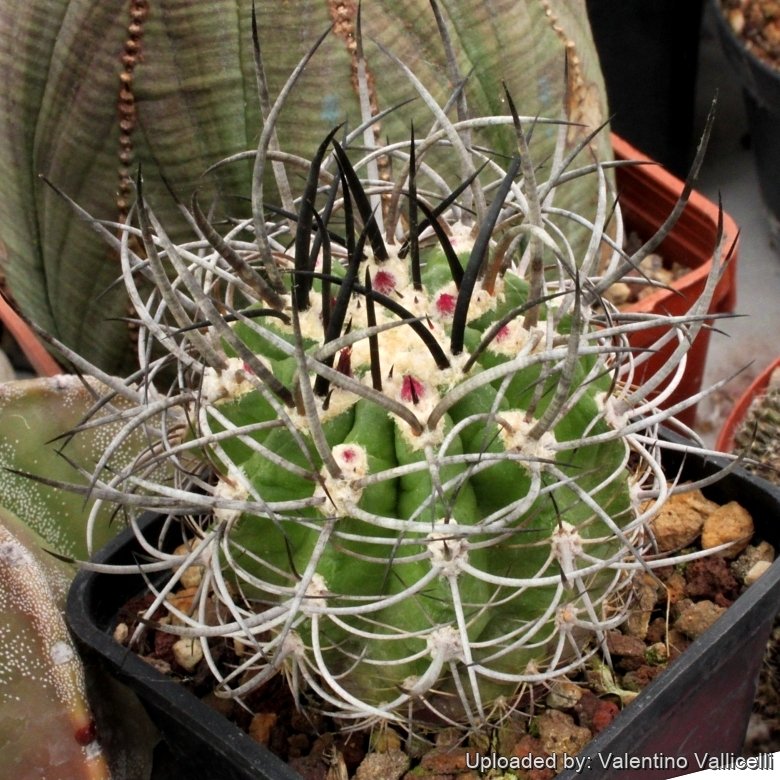
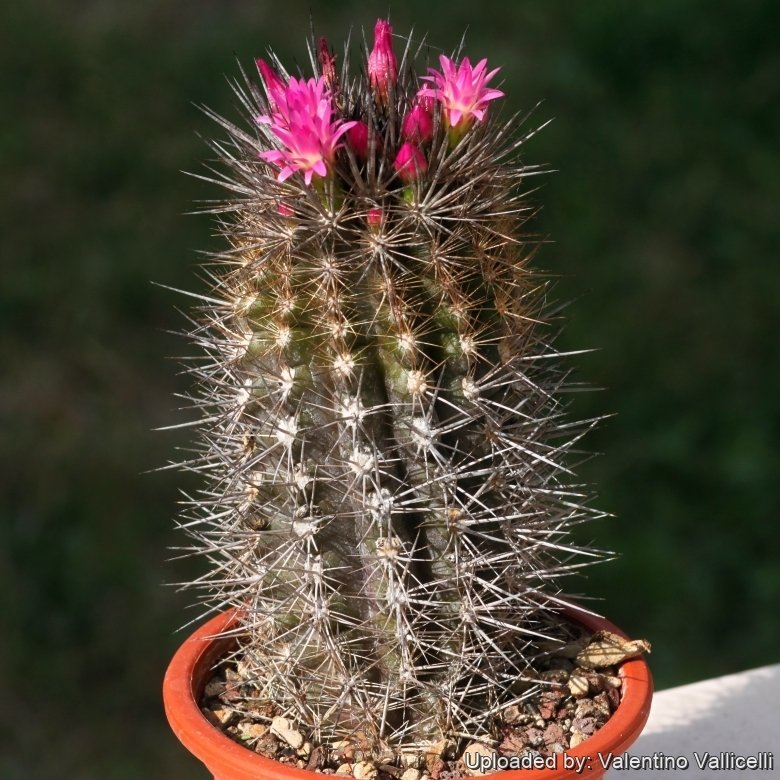
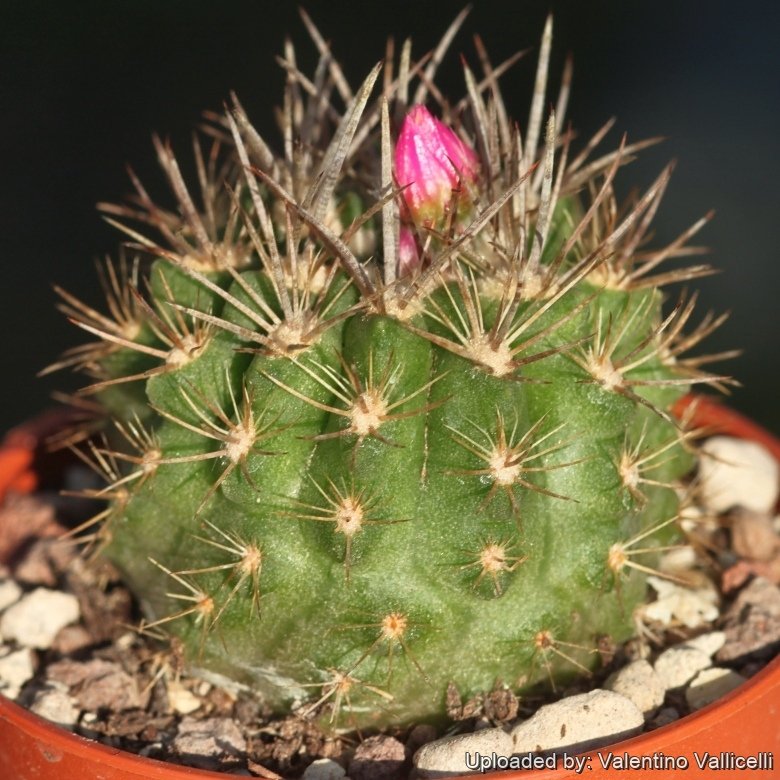
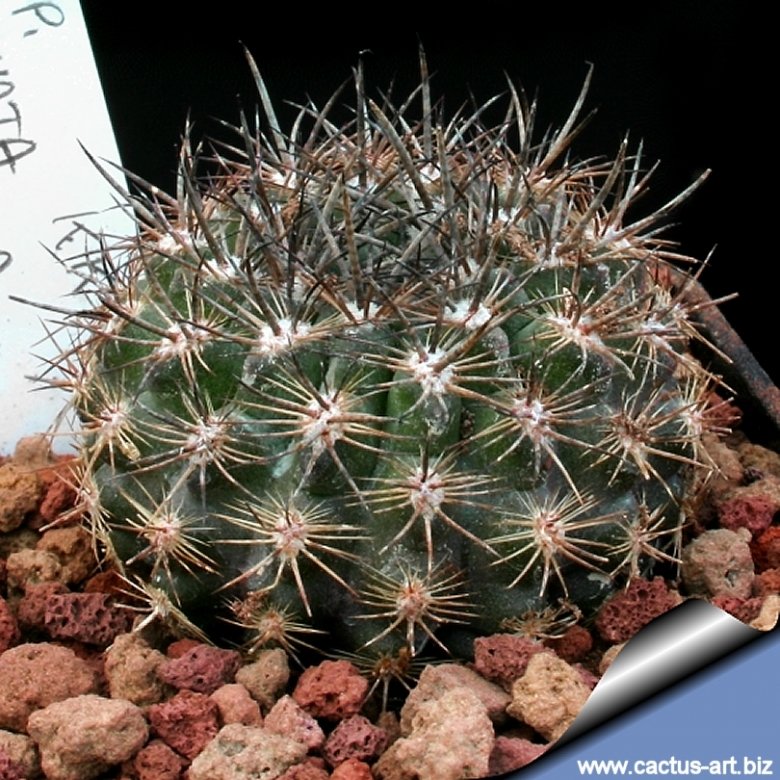
The Eriosyce subgibbosa subs. clavata, much better known under its old name Neoporteria clavata, is one of the recognized subspecies of Eriosyce subgibbosa which is a very variable plant that and has received numerous names. Eriosyce subgibbosa subs. clavata is one of the few Eriosyce that forms cylindrical stems.
Stem: Solitary, but sometimes branched, globular to columnar, up to 90 cm tall (or more), up to 10 cm wide. Grey-green, brownish-green or blackish-green. (“clavata” means “club shaped” and refers to the usually cylindrical stem shape of this form)
Ribs: up to 20
Spines: Nearly hiding the ribs, acicular, more or less long and dense, white, yellowish, golden yellow, brown, or nearly black, while older one became greyish.
Radial spines: 8-30, radiating,
Central spines: 4 (or more) stronger, straight or recurved and spreading, often darker at the tips..
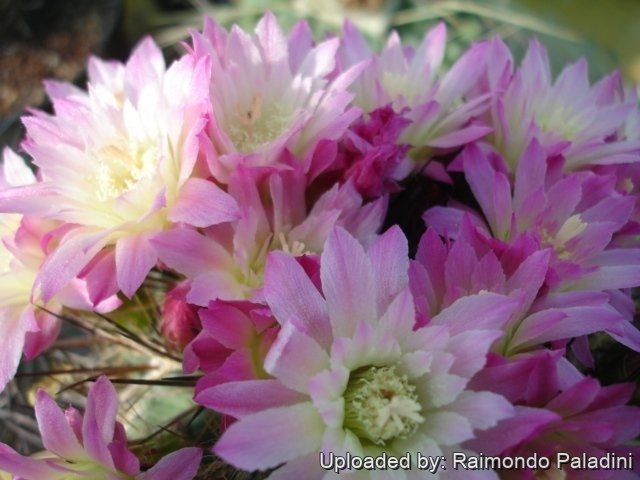
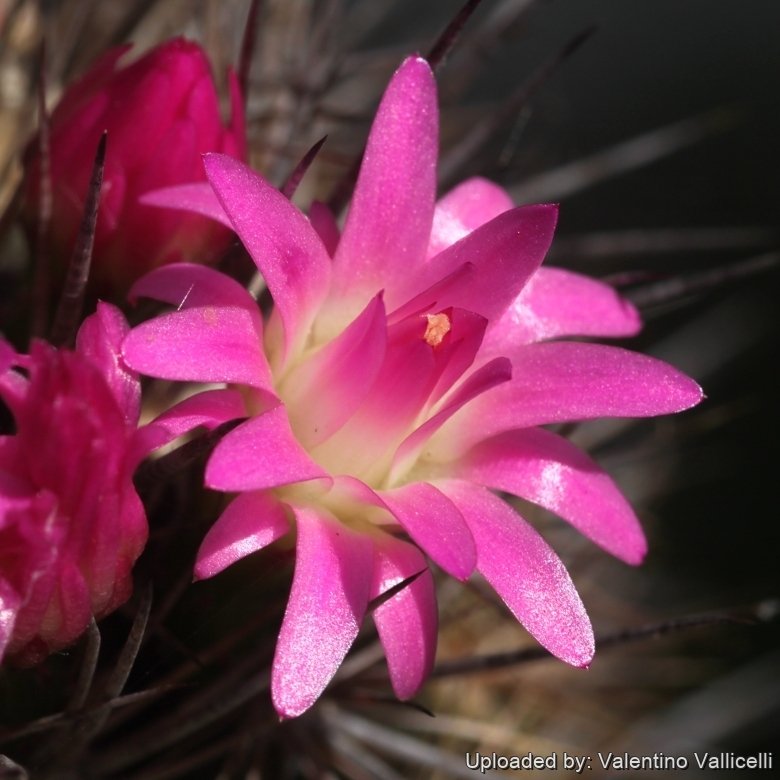
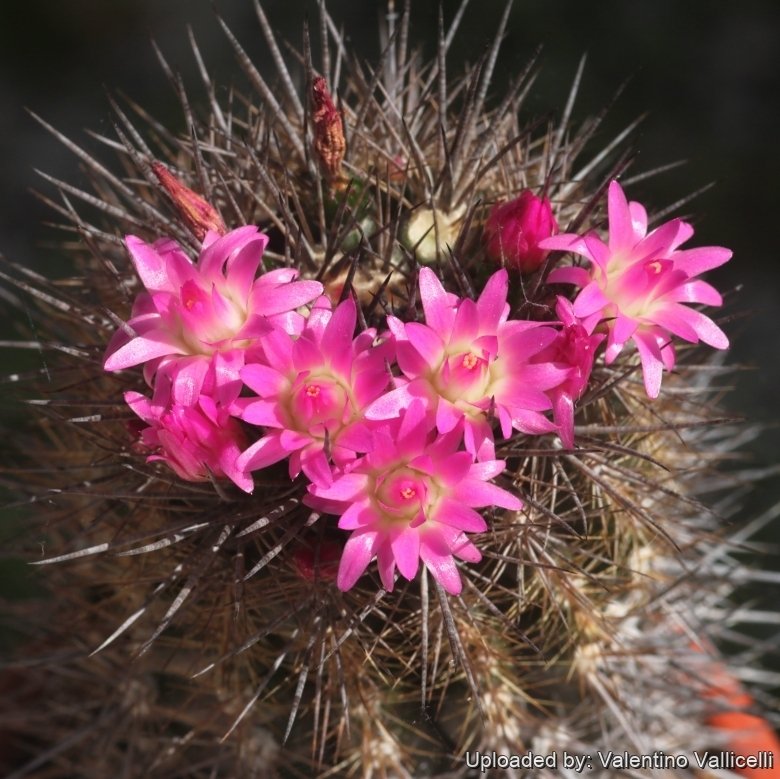
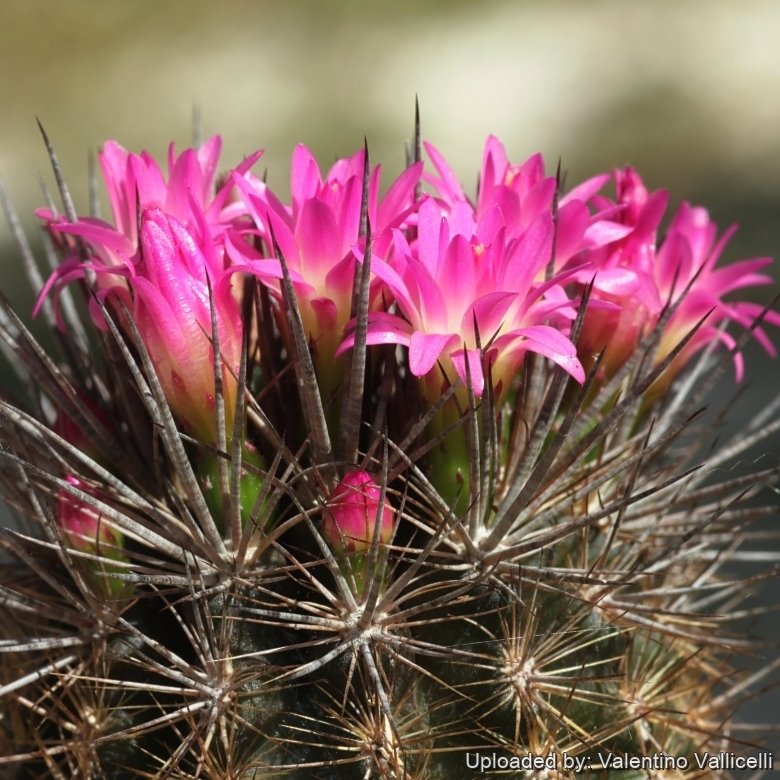
Flower: Pretty relatively small up to about 4 cm long, bi-coloured with magenta, rose to the violet petal tips and pinkish-white, white or yellowish-white throat, giving the sensation of being fluorescent and being very difficult to photograph in good conditions because that particularity.
Blooming season: Blooms early in late winter to spring. It is advisable to leave them dry from middle of November to obtain fantastic flowering later in January/March.
Fruits: Ovoid to cylindrical, partly hollow at maturity, only scarcely woolly, apical areoles not spinescent.
Origin and Habitat
Coastal Chile (Approx from Valparaiso to Maule)
Habitat: Grows on rocky outcrop on costal terraces cliffs, slopes, often hanging from rocks, from areas with very arid Mediterranean climate to areas of transition between Mediterranean climate and humid forest. The species is common and abundant, and the population seems to be stable. The major threat is illegal collection and urbanization in tourism areas, but these are localized impacts.
Cultivation and Propagation
It is a summer grower species. Easy to cultivate but somewhat rot prone if kept in a non ventilated place. Require a very fast draining drying soil, water regularly in summer, but do not over-water.
Needs a full sun exposure (or light shade) Good heat tolerance. Hardy to at least -5°C ( but probably can tolerate - 10° C for brief periods).
Propagation: Usually propagated from Seeds. (seldom produces offsets)
Bibliography
Major references and further lectures
-
Edward Anderson “The Cactus family” Timber Press, Incorporated, 2001
-
Nathaniel Lord Britton, Joseph Nelson Rose “Cactaceae: Descriptions and Illustrations of Plants of the Cactus Family” vol. 4 The Carnegie Institution of Washington, Washington 1923
-
James Cullen, Sabina G. Knees, H. Suzanne Cubey “The European Garden Flora Flowering Plants: A Manual for the Identification of Plants Cultivated in Europe, Both Out-of-Doors and Under Glass” Cambridge University Press, 11/Aug/2011
-
David R Hunt; Nigel P Taylor; Graham Charles; International Cactaceae Systematics Group. “The New Cactus Lexicon” dh books, 2006
-
Fred Kattermann “Eriosyce (Cactaceae): The Genus Revised and Amplified” David Hunt, 1994
-
Faundez, L., Guerrero, P., Saldivia, P. & Walter, H.E. 2013. Eriosyce subgibbosa. In: IUCN 2013. “IUCN Red List of Threatened Species.” Version 2013.2. <www.iucnredlist.org>. Downloaded on 16 January 2014.
From llifle page Chilenia nigrihorrida
Description
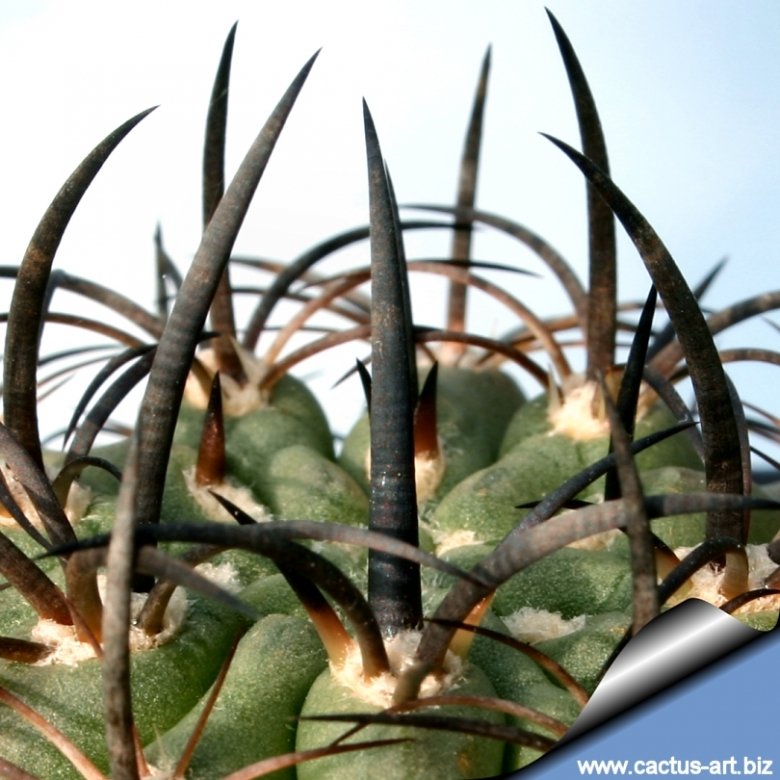
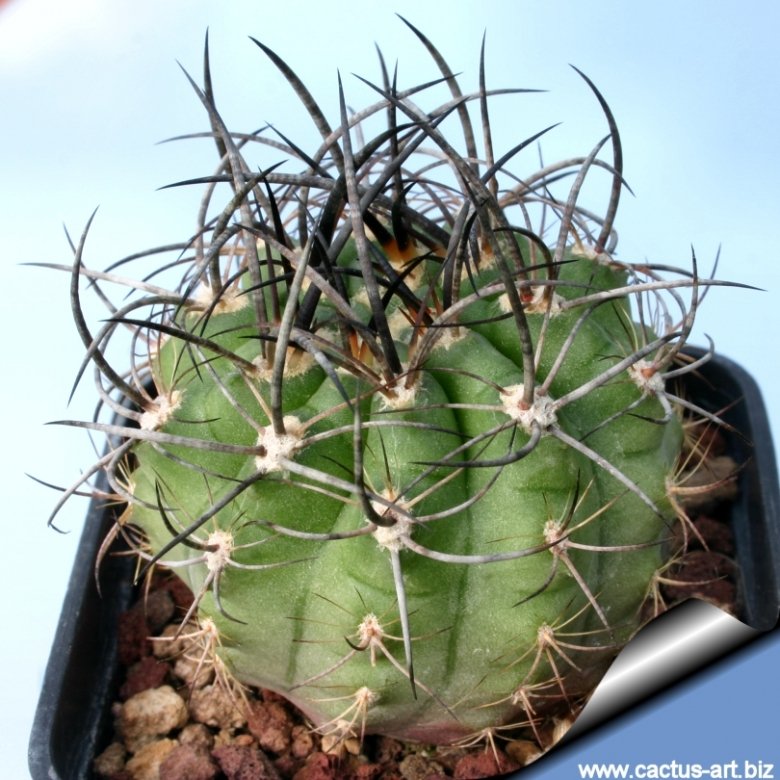
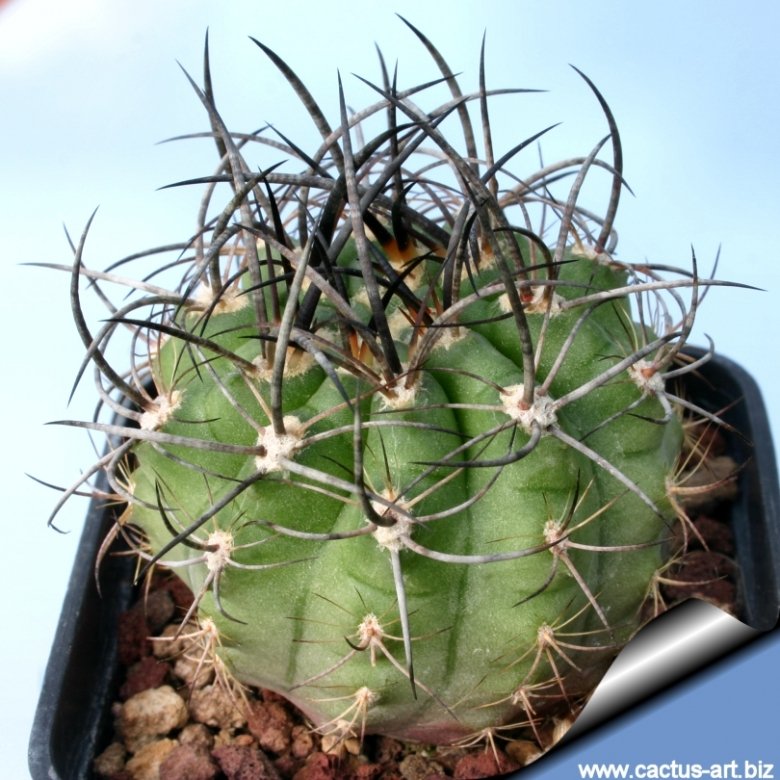
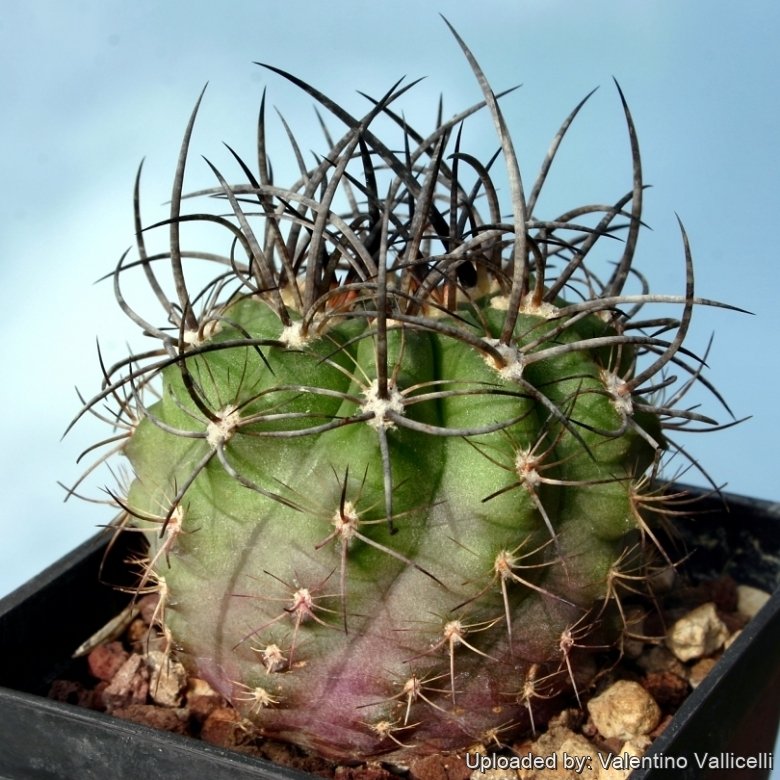
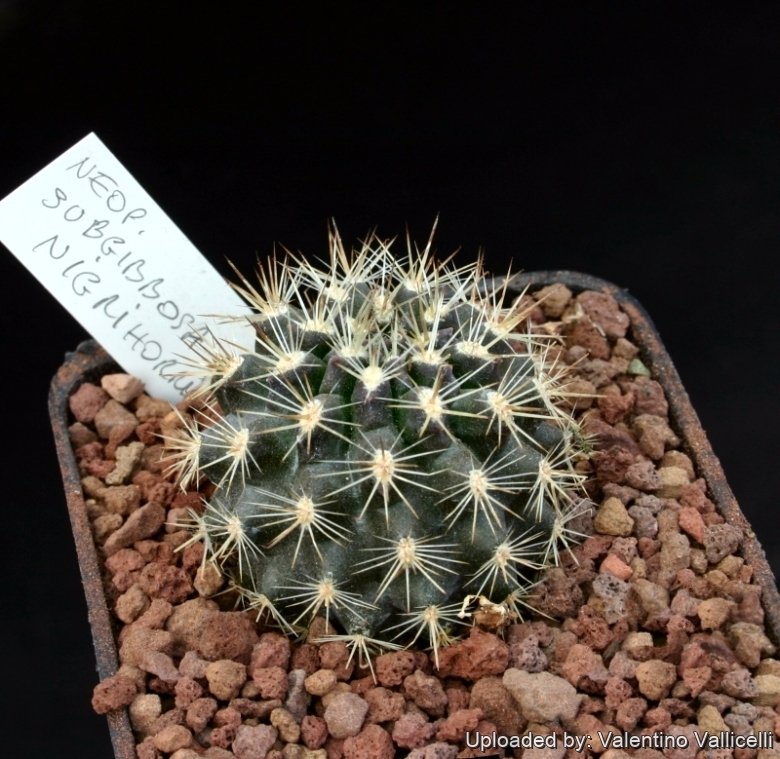
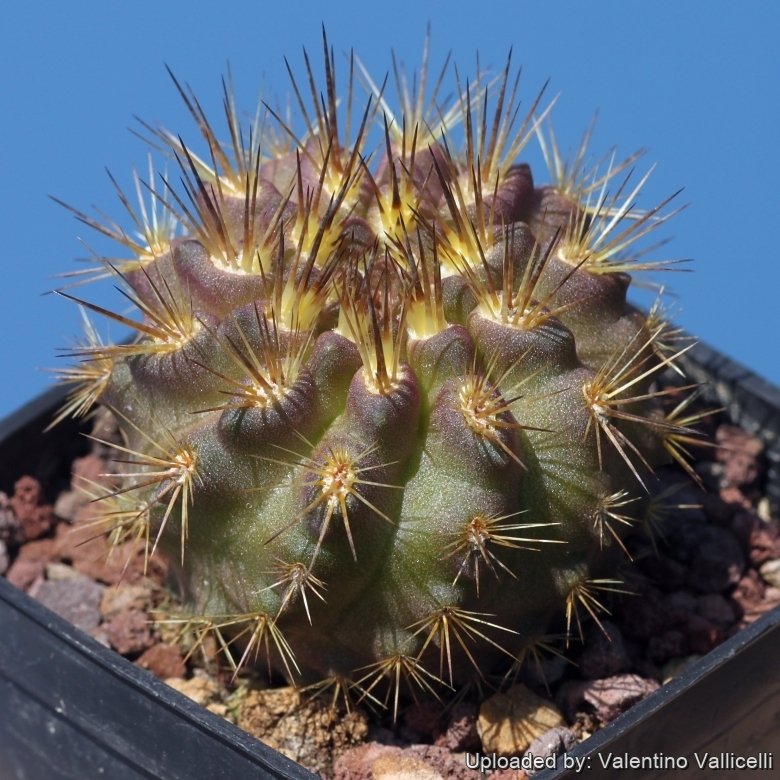
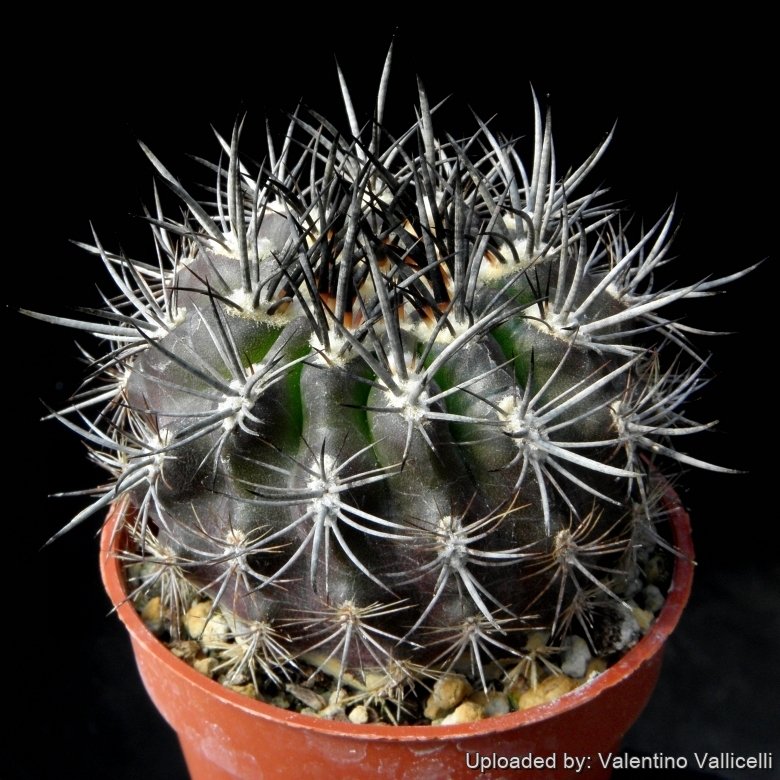
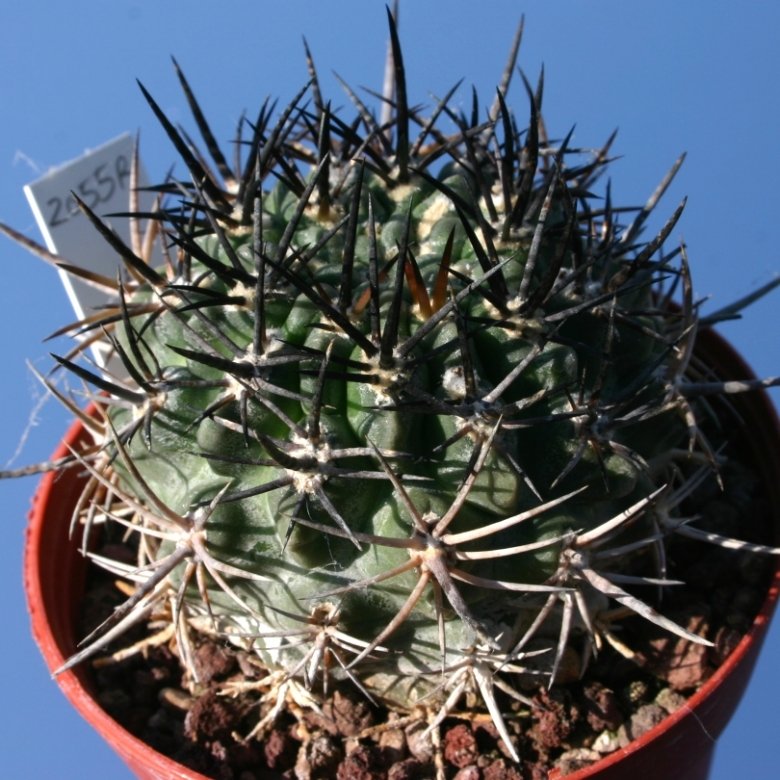
The Eriosyce subgibbosa var. nigrihorrida much better known under its old name, Neoporteria nigrihorrida is one of the innumerable and controversial form and variety of Eriosyce subgibbosa which is a very variable species. The “nigrihorrida” has mostly globose dark grey-green to blackish-green body and very stout straight spines which are pitch-black in the crown The flowers are bi-coloured with carmine petal tips and yellowish-white throat.
Stem: Solitary mostly globular, up to 90 cm tall (or more), up to 10 cm wide. Grey-green, yellowish-green, brownish-green or blackish-green.
Ribs: (11-)16-20(-22) more or less notched with chinlike protrusions.
Areoles: Large and woolly.
Spines: Partially hiding the ribs, needle like, more or less long and dense, white, yellowish, golden yellow, brown, or nearly black, while older one became greyish.
Radial spines: (8-)16-24(-40), 1-2(-3) cm long, radiating.
Central spines: 4 to 8, occasionally up to 16, stronger, up to 4 cm long,straight or recurved and spreading, often darker at the tips..
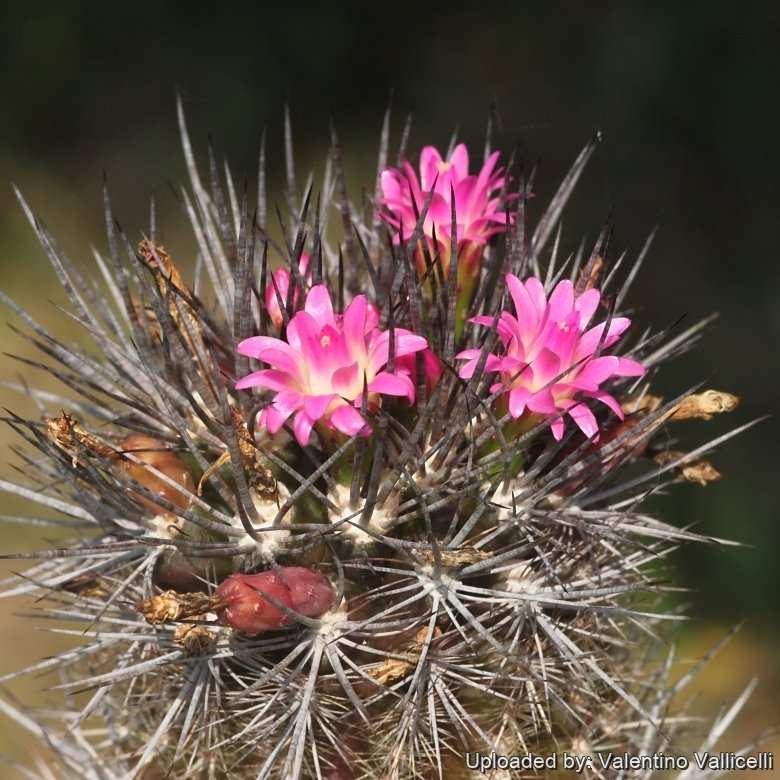
Flower: Pretty relatively small, tubular, up to about 3-5 cm long, bi-coloured with carmine petal tips and pinkish-white, white or yellowish-white throat, giving the sensation of being fluorescent and being very difficult to photograph in good conditions because that particularity. Inner tepals erect, acute, concealing the stamens.
Blooming season: Blooms early in late winter to spring. It is advisable to leave them dry from middle of November to obtain fantastic flowering later in January/March.
Fruits: Ovoid to cylindrical, 1,5-2 cm long, 1 cm in diameter, red or reddish-green partly hollow at maturity, only scarcely woolly, apical areoles not spinescent.
Remarks: This species as many (very controversial) varieties.
Origin and Habitat
South Coquimbo, Chile.
Cultivation and Propagation
It is a summer-growing species of relatively easy cultivation that continues to be, a particular prize among collectors. This plant is extremely xerophytic, adapted to very dry soils and is quite susceptible to over-watering if kept in a non ventilated place.
Growth rate: Slow-growing.
Soil: Grow it in an open mineral, sandy-gritty cactus compost and provide a very good drainage.
Exposure: It is suited for sunny-brightly exposure, but can tolerate light shade. However it will do its best only with lots of sun and become stressed with inadequate light which could result in poor growth and unnatural shape. It has a good heat tolerance.
Watering: Water sparingly and keep it completely dry during winter. Mature individuals easily rot and die especially after transplanting so be extremely cautious with watering. Keep dry in winter or when night temperatures remain below 10° C. Water it less than average if in bigger pots.
Fertilization: Feed them once during the growing season with a fertilizer specifically formulated for cactus and succulents (high potash fertilizer with a dilute low nitrogen), including all micro nutrients and trace elements diluted to ½ the strength recommended on the label. They thrive in poor soils and need a limited supplies of fertilizer to avoid the plants developing excess vegetation, which is easily attacked by fungal diseases.
Special need: It is suited for airy exposures. Provide very good ventilation. Nearly all problems occur as a result of overwatering and poor ventilation, especially when weather conditions are dull and cool or very humid. They must have very dry atmosphere.
Hardiness: It likes warmth (recommended minimum winter temperature 5° C) But plants kept perfectly dry can easily survive to winter night temperatures below 0° C.
Pests & diseases: These cacti may be attractive to a variety of insects, but plants in good condition should be nearly pest-free, particularly if they are grown in a mineral potting-mix, with good exposure and ventilation. Nonetheless, there are several pests to watch for:
- Red spiders: Red spiders may be effectively rubbed up by misting the plants from above.
- Mealy bugs: Mealy bugs occasionally develop aerial into the new leaves and flowers with disfiguring results, but the worst types develop underground on the roots and are invisible except by their effects.
- Scales, thrips and aphids: These insects are rarely a problem.
- Rot: Rot is only a minor problem if the plants are watered and “aired” correctly. If they are not, fungicides won’t help all that much.
Propagation: Usually propagated from seeds (seldom produces offsets) or graft. The seeds can be sown in pots of fine, well-drained sandy soil, any time during the spring when temperatures are warm. Cover the seeds with a fine layer of grit and water from below with a fungicide to prevent damping off. For the 1-2 weeks cover the pots with a sheet of glass/clear perspex to keep the humidity levels high. Remove the glass and replace it with light shade-cloth and mist once or twice a day for the next two weeks after which most seeds should have germinated. From then on mistings can be reduced to every second and then every third day as the little plants grow. The seedlings should not be disturbed until they are well rooted after which they can be planted separately in small pots. Sometimes it is grafted to avoid root rot problems as plants grafted on an hardy stock are easy to grow and no special skill is required.
Bibliography
Major references and further lectures
-
Edward Anderson “The Cactus family” Timber Press, Incorporated, 2001
-
Nathaniel Lord Britton, Joseph Nelson Rose “Cactaceae: Descriptions and Illustrations of Plants of the Cactus Family” vol. 4 The Carnegie Institution of Washington, Washington 1923
-
James Cullen, Sabina G. Knees, H. Suzanne Cubey “The European Garden Flora Flowering Plants: A Manual for the Identification of Plants Cultivated in Europe, Both Out-of-Doors and Under Glass” Cambridge University Press, 11/Aug/2011
-
David R Hunt; Nigel P Taylor; Graham Charles; International Cactaceae Systematics Group. “The New Cactus Lexicon” dh books, 2006
-
“Succulent Plant Research” Volume 1, David Hunt, Richmond 1994, page. 117.
-
Fred Kattermann “Eriosyce (Cactaceae): The Genus Revised and Amplified” David Hunt, 1994
-
E Haustein “Der Kosmos Kakteenfuehrer (the Kosmos Cactus Guide)” Balogh Scientific Books 01 December 1998
-
Hans Hecht “BLV-Handbuch der Kakteen” BLV-Verlagsgesellschaft, 1982
-
Terry Hewitt “Cacti” Lorenz Books, 01/Apr/1998
Source: Chilenia nigrihorrida, LLIFLE - Encyclopedia of living forms, CC-BY-SA, retrieved 2026-10-25.
From llifle page Neochilenia wagenknechtii
Description
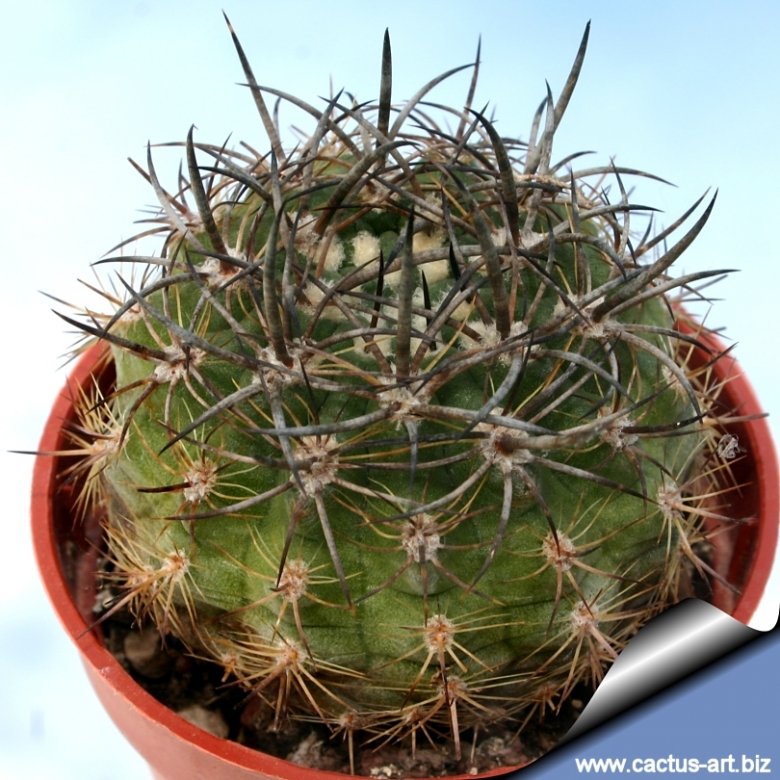
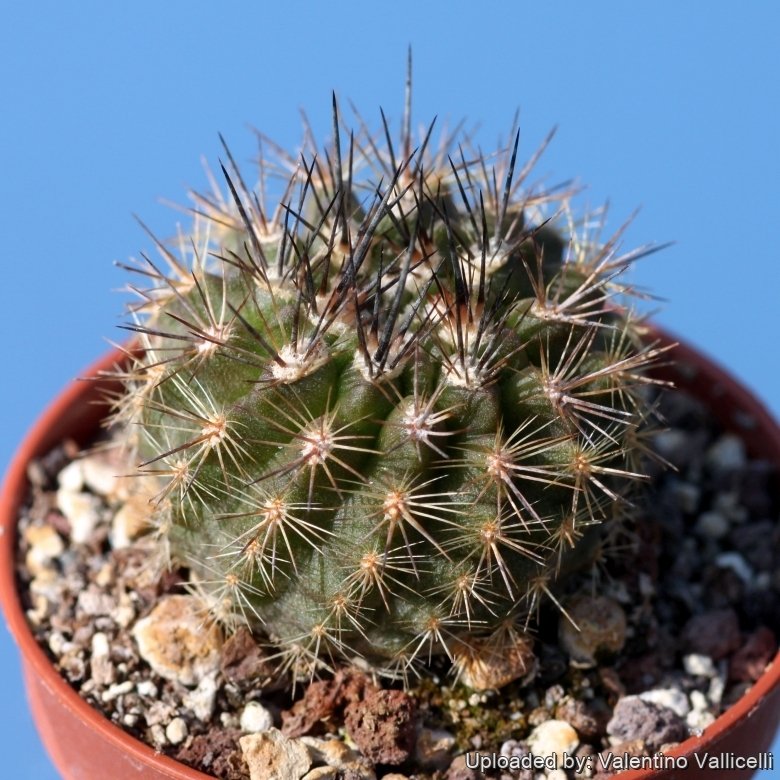
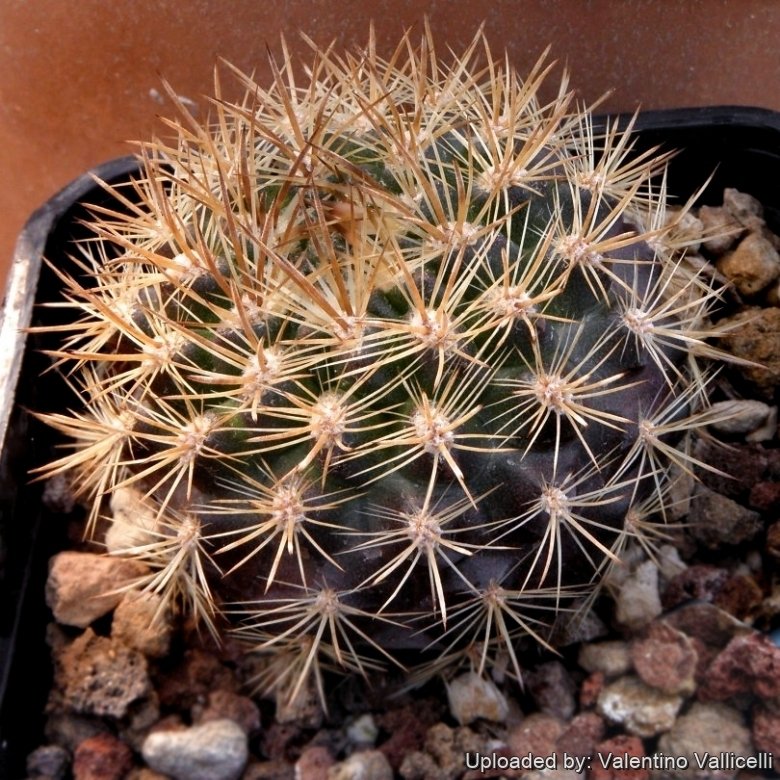
Eriosyce subgibbosa var. wagenknechtii much better known under its old name, Neoporteria wagenknechtii is one of the morphological or local form of the very variable Eriosyce subgibbosa. It distinguishes mostly in having fewer ribs and smaller flowers less tha 3 cm long. It also has more dark spines.
Habit: Solitary, but sometimes branched, columnar perennial cactus erect or somewhat procumbent when long.
Roots: Swollen carrot like often more or less branched.
Stem: Globular to columnar, up to 30 cm tall (or more), up to 11 cm wide. Grey-green.
Ribs: 11-17 very obtuse, more or less notched with chinlike protrusions.
Areoles: Large, 6-13 mm long and 7 mm broad, woolly, 3-10 mm apart.
Spines: Partially hiding the ribs, needle like, more or less long and dense, white, yellowish, golden yellow, brown, or nearly black, while older one became greyish.
Radial spines: 10-20, 1,5-2,5 cm long, stright, spreading, dark grey to tan.
Central spines: 3 to 6, stronger, up to 4 cm long, straight or recurved and spreading, almost black, becoming grey with age.
Flower: Pretty small up to about 2,5 cm long, bi-coloured with magenta, rose to the violet petal tips and pinkish-white, white or yellowish-white throat.
Blooming season: Blooms late summer.
Fruits: Barrel shaped, 1,5-2 cm long, 1 cm in diameter, red or reddish-green partly hollow at maturity, only scarcely woolly, apical areoles not spinescent.
Seeds: Brown.
Origin and Habitat
Chile, la Serena and adjacent areas.
Altitude 10-500(-700) metres above sea level.
Habitat: It grows in a very dry area on rocky outcrop on coastal terraces, cliffs, slopes, often hanging from rocks. The species is common and abundant, and the population seems to be stable. The major threat is illegal collection and urbanization in tourism areas, but these are localized impacts.
Bibliography
Major references and further lectures
-
Edward Anderson “The Cactus family” Timber Press, Incorporated, 2001
-
Nathaniel Lord Britton, Joseph Nelson Rose “Cactaceae: Descriptions and Illustrations of Plants of the Cactus Family” vol. 4 The Carnegie Institution of Washington, Washington 1923
-
James Cullen, Sabina G. Knees, H. Suzanne Cubey “The European Garden Flora Flowering Plants: A Manual for the Identification of Plants Cultivated in Europe, Both Out-of-Doors and Under Glass” Cambridge University Press, 11/Aug/2011
-
David R Hunt; Nigel P Taylor; Graham Charles; International Cactaceae Systematics Group. “The New Cactus Lexicon” dh books, 2006
-
“Succulent Plant Research” Volume 1, David Hunt, Richmond page 107, 1994
-
Fred Kattermann “Eriosyce (Cactaceae): The Genus Revised and Amplified” David Hunt, 1994
-
E Haustein “Der Kosmos Kakteenfuehrer (the Kosmos Cactus Guide)” Balogh Scientific Books 01 December 1998
-
Hans Hecht “BLV-Handbuch der Kakteen” BLV-Verlagsgesellschaft, 1982
-
Terry Hewitt “Cacti” Lorenz Books, 01/Apr/1998
-
Backeberg C. “Das Kakteenlexikon” P. 299, 1966
-
A E. Hoffmann, J. “Cactaceas en la Flora silvestre de Chile” 174, 1989
J. Jelinek, cacti, 1972
-
V. Köhler “Neoporteria rapifera” Ritter, KAKT. and und. Sukke., 29: 230, 1978 13) F. Ritter, “Kakteen in Südamerika” 3: 1034, 1980
-
Voldán M., “Cactus” 65, 1: 103, 1965
-
Biology Digest, Volume 18 Plexus Pub., 1992
-
Faundez, L., Guerrero, P., Saldivia, P. & Walter, H.E. 2013. Eriosyce subgibbosa. In: IUCN 2013. “IUCN Red List of Threatened Species.” Version 2013.2. <www.iucnredlist.org>. Downloaded on 16 January 2014.
Source: Neochilenia wagenknechtii, LLIFLE - Encyclopedia of living forms, CC-BY-SA, retrieved 2026-10-25.
From llifle page Neoporteria rapifera
Description
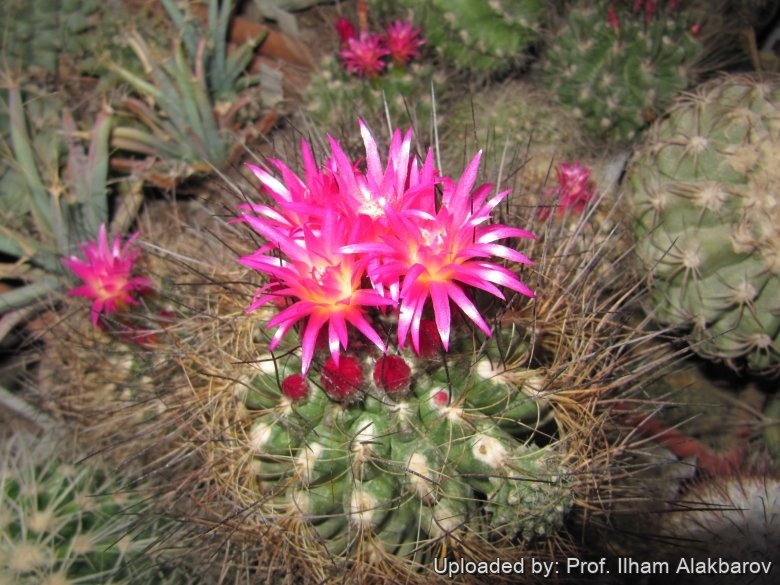
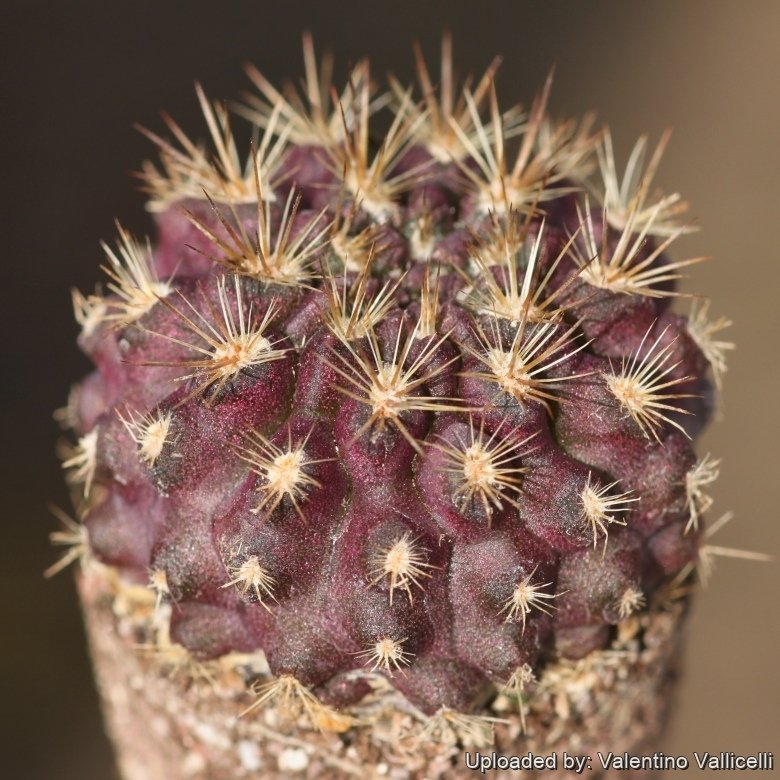
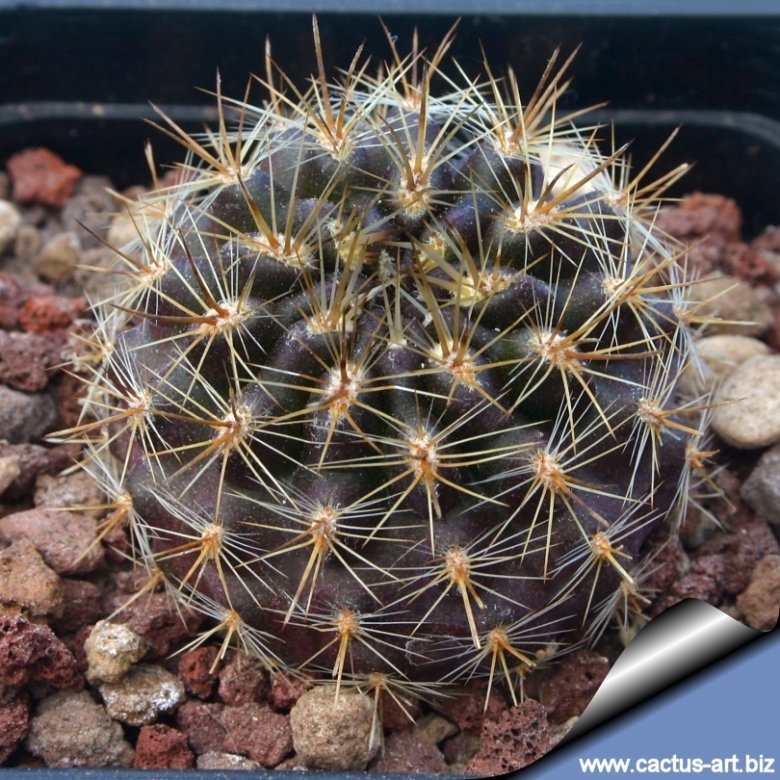
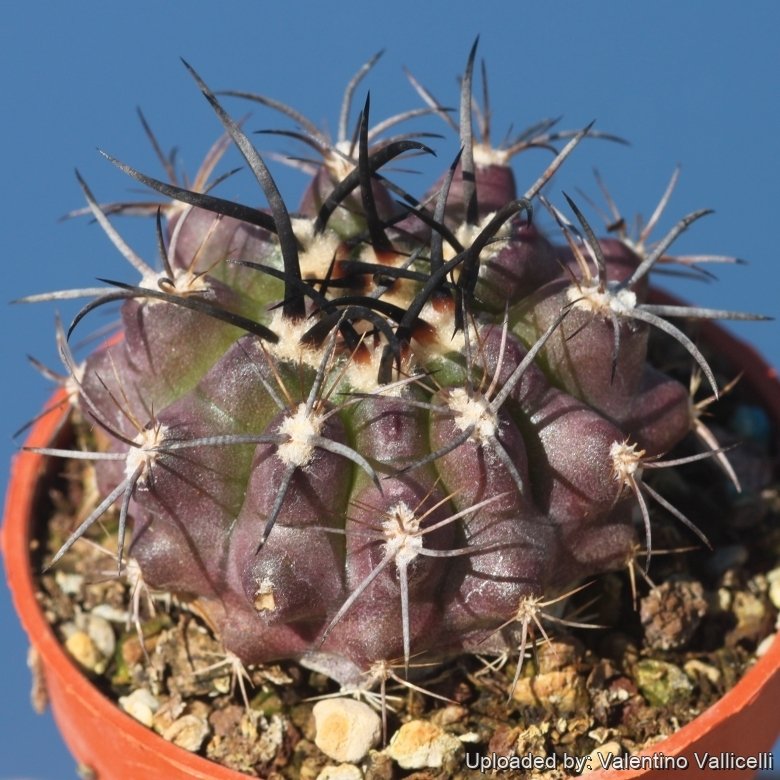
Eriosyce subgibbosa f. rapifera|, much better known under its old name, Neoporteria rapifera is one of the morphological or local form of the very variable Eriosyce subgibbosa. It distinguishes mostly in having dark purple body with black spines emphasizing the white woolly crown from which numerous magenta blooms come forth. It is very similar to Eriosyce subgibbosa var. wagenknechtii f. napina (F.Ritter) and not readily distinguishable from it, if not for the label. The” rapifera” has a swollen carrot like root often much larger than the stem, while standard Eriosyce subgibbosa var. wagenknechtii tends to have more branched roots, however most authors consider both them the same species as this differences are often determinate by growing conditions, and the number of root-branches varies greatly from plant to plant even within the same population.
Habit: Solitary, but sometimes branched, columnar perennial cactus erect or somewhat procumbent when long.
Roots: Swollen often much larger than the stem.
Stem: Globular to columnar, up to 30 cm tall (or more), up to 11 cm wide. Grey-green.
Ribs: 11-17 very obtuse, more or less notched with chinlike protrusions.
Areoles: Large, 6-13 mm long and 7 mm broad, woolly, 3-10 mm apart.
Spines: Partially hiding the ribs, needle like, more or less long and dense, white, yellowish, golden yellow, brown, or nearly black, while older one became greyish.
Radial spines: 10-20, 1,5-2,5 cm long, stright, spreading, dark grey to tan.
Central spines: 3 to 6, stronger, up to 4 cm long, straight or recurved and spreading, almost black, becoming grey with age.
Flower: Pretty small up to about 2,5 cm long, bi-coloured with magenta, rose to the violet petal tips and pinkish-white, white or yellowish-white throat.
Blooming season: Blooms late summer.
Fruits: Barrel shaped, 1,5-2 cm long, 1 cm in diameter, red or reddish-green partly hollow at maturity, only scarcely woolly, apical areoles not spinescent.
Seeds: Brown.
Origin and Habitat
La Serena and adjacent areas (Peunte Pelicana, Rio Elqui, etc.) Coquimbo, Chile
Altitude: 300-500 metres above sea level.
Habitat: It grows in a very dry area on rocky outcrop on coastal terraces, cliffs and slopes.
Cultivation and Propagation
Eriosyce subgibbosa f. rapifera| is a summer-growing species of relatively easy cultivation that continues to be, a particular prize among collectors. This plant is extremely xerophytic, adapted to very dry soils and is quite susceptible to over-watering if kept in a non ventilated place.
Growth rate: Slow-growing.
Soil: Grow it in an open mineral, sandy-gritty cactus compost and provide a very good drainage.
Exposure: It is suited for sunny-brightly exposure, but can tolerate light shade. However it will do its best only with lots of sun and become stressed with inadequate light which could result in poor growth and unnatural shape. It has a good heat tolerance.
Watering: Water sparingly and keep it completely dry during winter. Mature individuals easily rot and die especially after transplanting so be extremely cautious with watering. Keep dry in winter or when night temperatures remain below 10° C. Water it less than average if in bigger pots.
Fertilization: Feed them once during the growing season with a fertilizer specifically formulated for cactus and succulents (high potash fertilizer with a dilute low nitrogen), including all micro nutrients and trace elements diluted to ½ the strength recommended on the label. They thrive in poor soils and need a limited supplies of fertilizer to avoid the plants developing excess vegetation, which is easily attacked by fungal diseases.
Special need: It is suited for airy exposures. Provide very good ventilation. Nearly all problems occur as a result of overwatering and poor ventilation, especially when weather conditions are dull and cool or very humid. They must have very dry atmosphere.
Hardiness: It likes warmth (recommended minimum winter temperature 5° C) But plants kept perfectly dry can easily survive to winter night temperatures below 0° C.
Pests & diseases: These cacti may be attractive to a variety of insects, but plants in good condition should be nearly pest-free, particularly if they are grown in a mineral potting-mix, with good exposure and ventilation. Nonetheless, there are several pests to watch for:
- Red spiders: Red spiders may be effectively rubbed up by misting the plants from above.
- Mealy bugs: Mealy bugs occasionally develop aerial into the new leaves and flowers with disfiguring results, but the worst types develop underground on the roots and are invisible except by their effects.
- Scales, thrips and aphids: These insects are rarely a problem.
- Rot: Rot is only a minor problem if the plants are watered and “aired” correctly. If they are not, fungicides won’t help all that much.
Propagation: Usually propagated from seeds (seldom produces offsets) or graft. The seeds can be sown in pots of fine, well-drained sandy soil, any time during the spring when temperatures are warm. Cover the seeds with a fine layer of grit and water from below with a fungicide to prevent damping off. For the 1-2 weeks cover the pots with a sheet of glass/clear perspex to keep the humidity levels high. Remove the glass and replace it with light shade-cloth and mist once or twice a day for the next two weeks after which most seeds should have germinated. From then on mistings can be reduced to every second and then every third day as the little plants grow. The seedlings should not be disturbed until they are well rooted after which they can be planted separately in small pots. Sometimes it is grafted to avoid root rot problems as plants grafted on an hardy stock are easy to grow and no special skill is required.
Bibliography
Major references and further lectures
-
Edward Anderson “The Cactus family” Timber Press, Incorporated, 2001
-
Nathaniel Lord Britton, Joseph Nelson Rose “Cactaceae: Descriptions and Illustrations of Plants of the Cactus Family” vol. 4 The Carnegie Institution of Washington, Washington 1923
-
James Cullen, Sabina G. Knees, H. Suzanne Cubey “The European Garden Flora Flowering Plants: A Manual for the Identification of Plants Cultivated in Europe, Both Out-of-Doors and Under Glass” Cambridge University Press, 11/Aug/2011
-
David R Hunt; Nigel P Taylor; Graham Charles; International Cactaceae Systematics Group. “The New Cactus Lexicon” dh books, 2006
-
“Succulent Plant Research” Volume 1, David Hunt, Richmond page 107, 1994
-
Fred Kattermann “Eriosyce (Cactaceae): The Genus Revised and Amplified” David Hunt, 1994
-
E Haustein “Der Kosmos Kakteenfuehrer (the Kosmos Cactus Guide)” Balogh Scientific Books 01 December 1998
-
Hans Hecht “BLV-Handbuch der Kakteen” BLV-Verlagsgesellschaft, 1982
-
Terry Hewitt “Cacti” Lorenz Books, 01/Apr/1998
-
Backeberg C. “Das Kakteenlexikon” P. 299, 1966
-
A E. Hoffmann, J. “Cactaceas en la Flora silvestre de Chile” 174, 1989
J. Jelinek, cacti, 1972
-
V. Köhler “Neoporteria rapifera” Ritter, KAKT. and und. Sukke., 29: 230, 1978 13) F. Ritter, “Kakteen in Südamerika” 3: 1034, 1980
-
Voldán M., “Cactus” 65, 1: 103, 1965
-
Biology Digest, Volume 18 Plexus Pub., 1992
Source: Neoporteria rapifera, LLIFLE - Encyclopedia of living forms, CC-BY-SA, retrieved 2026-10-25.
From llifle page Neoporteria wagenknechtii var. napina
Description
Eriosyce subgibbosa var. wagenknechtii f. napina much better known under its old name, Neoporteria wagenknechtii v. napina is one of the morphological or local form of the very variable Eriosyce subgibbosa. It distinguishes mostly in having fewer ribs and smaller flowers less than 3 cm long. The var. napina has a swollen carrot like root often much larger than the standard stem, while Eriosyce subgibbosa var. wagenknechtii tends to have more branched roots, however most authors consider both them the same species as this differences are often determinate by growing conditions, and the number of root-branches varies greatly from plant to plant even within the same population.
Habit: Solitary, but sometimes branched, columnar perennial cactus erect or somewhat procumbent when long.
Roots: Swollen often much larger than the stem.
Stem: Globular to columnar, up to 30 cm tall (or more), up to 11 cm wide. Grey-green.
Ribs: 11-17 very obtuse, more or less notched with chinlike protrusions.
Areoles: Large, 6-13 mm long and 7 mm broad, woolly, 3-10 mm apart.
Spines: Partially hiding the ribs, needle like, more or less long and dense, white, yellowish, golden yellow, brown, or nearly black, while older one became greyish.
Radial spines: 10-20, 1,5-2,5 cm long, stright, spreading, dark grey to tan.
Central spines: 3 to 6, stronger, up to 4 cm long, straight or recurved and spreading, almost black, becoming grey with age.
Flower: Pretty small up to about 2,5 cm long, bi-coloured with magenta, rose to the violet petal tips and pinkish-white, white or yellowish-white throat.
Blooming season: Blooms late summer.
Fruits: Barrel shaped, 1,5-2 cm long, 1 cm in diameter, red or reddish-green partly hollow at maturity, only scarcely woolly, apical areoles not spinescent.
Seeds: Brown.
Origin and Habitat
Chile, la Serena and adjacent areas.
Altitude 10-500(-700) metres above sea level.
Habitat: It grows in a very dry area on rocky outcrop on costal terraces cliffs, slopes, often hanging from rocks.
Source: Neoporteria wagenknechtii var. napina, LLIFLE - Encyclopedia of living forms, CC-BY-SA, retrieved 2026-10-25.
From llifle page Neoporteria clavata f. parviflora
Description
Eriosyce subgibbosa var. clavata f. grandiflora| is one of the innumerable and controversial form and variety of Eriosyce subgibbosa which is a very variable species forming cylindrical stems. Eriosyce subgibbosa var. clavata has flowers of variable size, the large flowered form is sometime classified as forma “grandiflora” while the small flowered one is named forma “parviflora”. However the extent of variation in Eriosyce subgibbosa has led most authors to conclude that “grandiflora” and “parviflora” are not sufficiently distinct to deserve their own formal status.
Stem: Solitary, but sometimes branched, globular to columnar, up to 90 cm tall (or more), up to 10 cm wide. Grey-green, brownish-green or blackish-green. (“clavata” means “club shaped” and refers to the usually cylindrical stem shape of this form)
Ribs: up to 20
Spines: Nearly hiding the ribs, acicular, more or less long and dense, white, yellowish, golden yellow, brown, or nearly black, while older one became greyish.
Radial spines: 8-30, radiating,
Central spines: 4 (or more) stronger, straight or recurved and spreading, often darker at the tips..
Flower: Pretty relatively small up to about 4 cm long, bi-coloured with magenta, rose to the violet petal tips and pinkish-white, white or yellowish-white throat, giving the sensation of being fluorescent and being very difficult to photograph in good conditions because that particularity.
Blooming season: Blooms early in late winter to spring. It is advisable to leave them dry from middle of November to obtain fantastic flowering later in January/March.
Fruits: Ovoid to cylindrical, partly hollow at maturity, only scarcely woolly, apical areoles not spinescent.
Origin and Habitat
Coastal Chile (Approx from Valparaiso to Maule)
Habitat: Grows on rocky outcrop on costal terraces cliffs, slopes, often hanging from rocks, from areas with very arid Mediterranean climate to areas of transition between Mediterranean climate and humid forest.
Bibliography
Major references and further lectures
-
Edward Anderson “The Cactus family” Timber Press, Incorporated, 2001
-
Nathaniel Lord Britton, Joseph Nelson Rose “Cactaceae: Descriptions and Illustrations of Plants of the Cactus Family” vol. 4 The Carnegie Institution of Washington, Washington 1923
-
James Cullen, Sabina G. Knees, H. Suzanne Cubey “The European Garden Flora Flowering Plants: A Manual for the Identification of Plants Cultivated in Europe, Both Out-of-Doors and Under Glass” Cambridge University Press, 11/Aug/2011
-
David R Hunt; Nigel P Taylor; Graham Charles; International Cactaceae Systematics Group. “The New Cactus Lexicon” dh books, 2006 ISBN 0953813444, 9780953813445
-
Fred Kattermann “Eriosyce (Cactaceae): The Genus Revised and Amplified” David Hunt, 1994
Source: Neoporteria clavata f. parviflora, LLIFLE - Encyclopedia of living forms, CC-BY-SA, retrieved 2026-10-25.
From llifle page Neoporteria clavata f. procera
Description
The Eriosyce clavata is one of the innumerable and controversial form and variety of Eriosyce subgibbosa which is a very variable species which has received numerous names. It is one of the few species that forms cylindrical stems with age.
The form procera is spherical when young and elongated with time, growing up to 60 cm in habitat and has stouter curved spines.
At first glance it may be confused with Echinopsis coquimbana.
Stem: Solitary, but sometimes branched, globular to columnar, up to 60, up to 10 cm wide. Grey-green, brownish-green or blackish-green. (“clavata” means “club shaped” and refers to the usually cylindrical stem shape of this form).
Ribs: About 20
Spines: Nearly hiding the ribs, subulate, more or less long, brown, or nearly black, while older one became greyish.
Radial spines: 8-15, radiating.
Central spines: 4 or more strong, recurved and spreading, often darker at the tips.
Flower: Pretty relatively small up to about 4 cm long, bi-coloured with magenta, rose to the violet petal tips and pinkish-white, white or yellowish-white throat, giving the sensation of being fluorescent and being very difficult to photograph in good conditions because that particularity.
Blooming season: Blooms early in late winter to spring. It is advisable to leave them dry from middle of November to obtain fantastic flowering later in January/March.
Fruits: Ovoid to cylindrical, partly hollow at maturity, only scarcely woolly, apical areoles not spinescent.
Origin and Habitat
Cerro Grande, Coastal Chile (Approx from Valparaiso to Maule)
Altitude: 300-500 metres above sea level.
Habitat: Grows on rocky outcrop on costal terraces cliffs, slopes, often hanging from rocks, from areas with very arid Mediterranean climate to areas of transition between Mediterranean climate and humid forest.
Source: Neoporteria clavata f. procera, LLIFLE - Encyclopedia of living forms, CC-BY-SA, retrieved 2026-10-25.
From llifle page Neoporteria clavata f. grandiflora
Origin and Habitat
42km East of La Serena, 25km West of Vicuña, 04 Coquimbo, Chile.
Source: Neoporteria clavata f. grandiflora, LLIFLE - Encyclopedia of living forms, CC-BY-SA, retrieved 2026-10-25.
Gallery