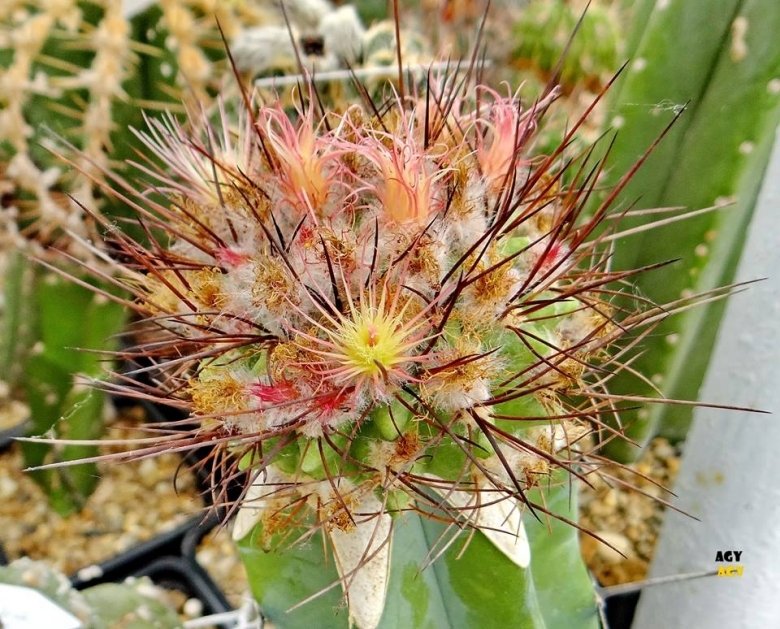
Publication: Eriosyce (Cactac.) gen. revis. & ampl. (Succ. Pl. Res., 1) (Succ. Pl. Res., 1): 119 (1994)
Description
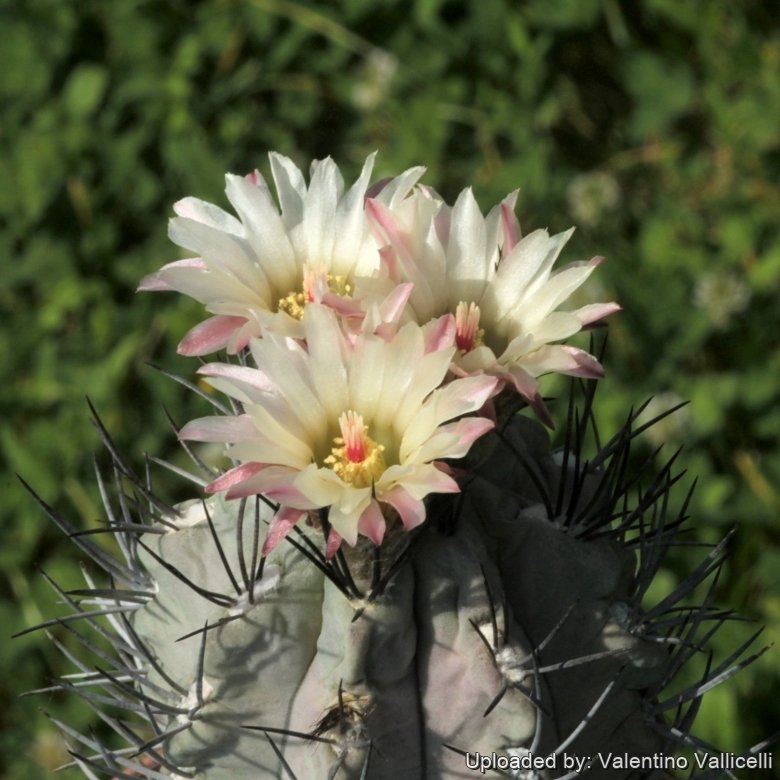
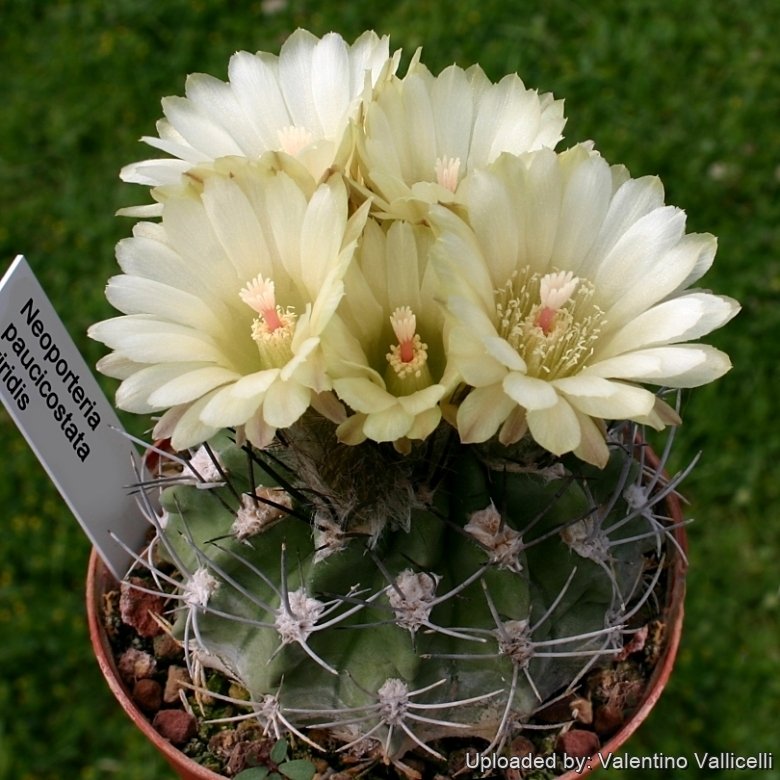
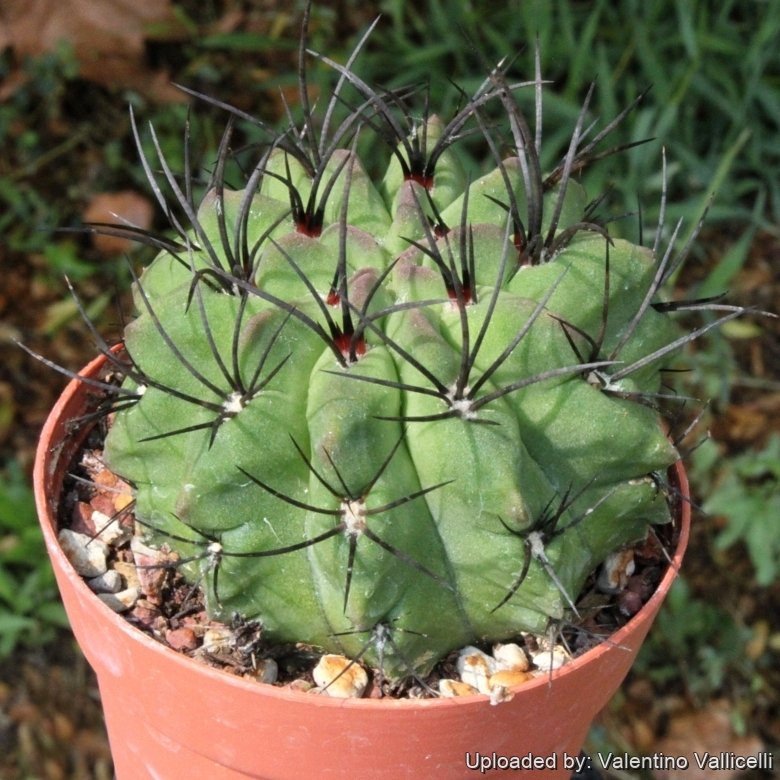
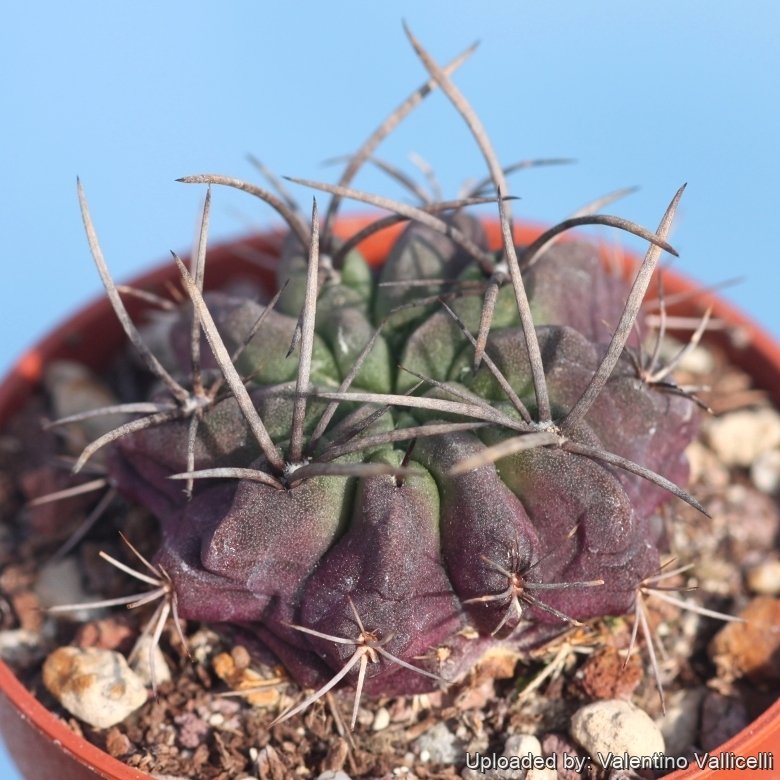
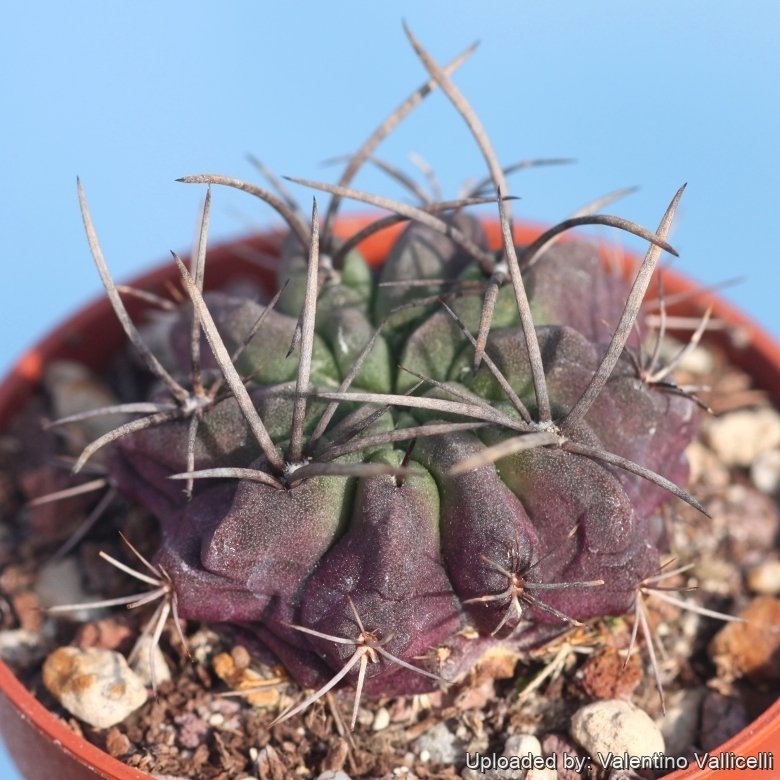
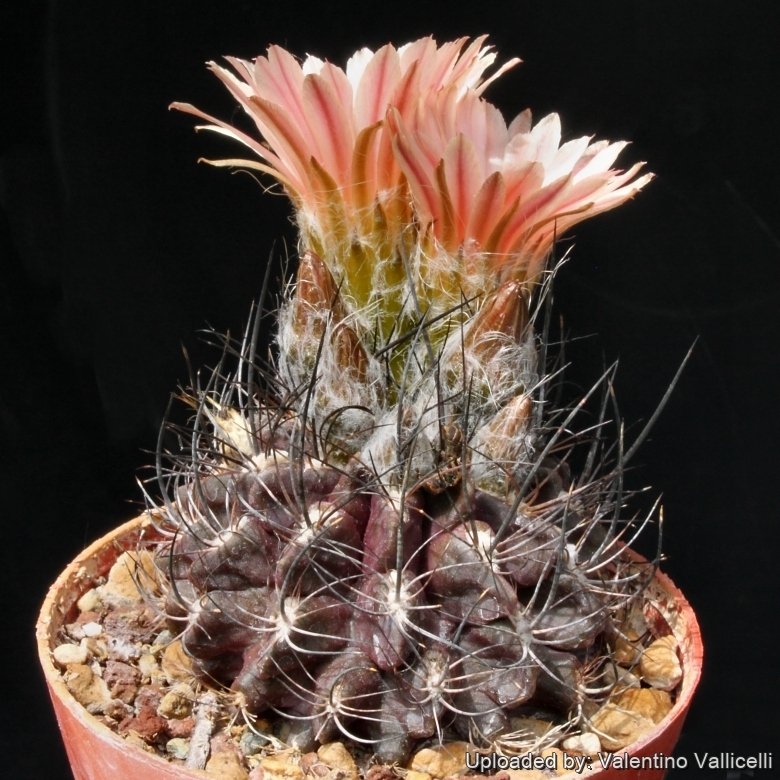
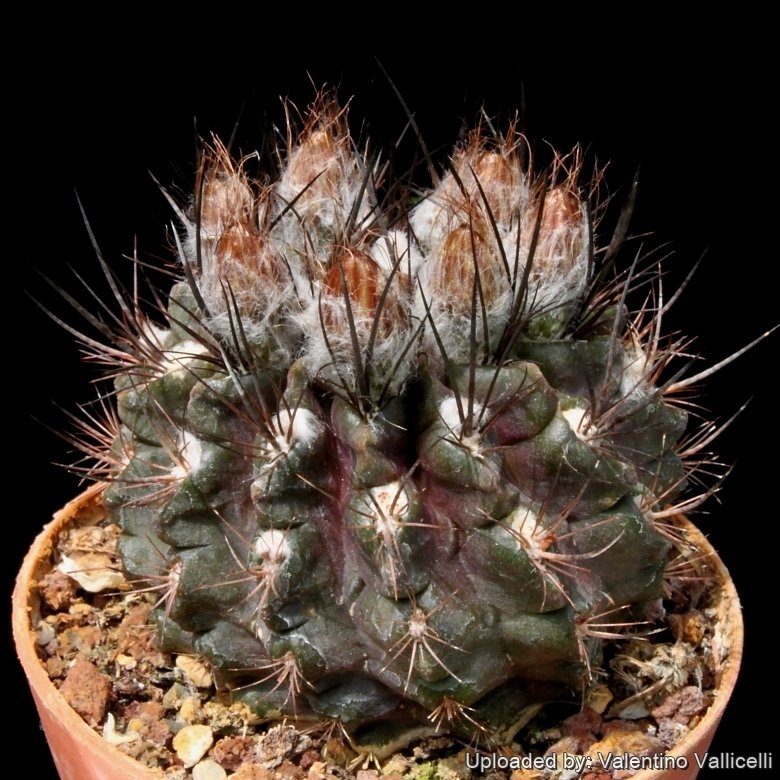
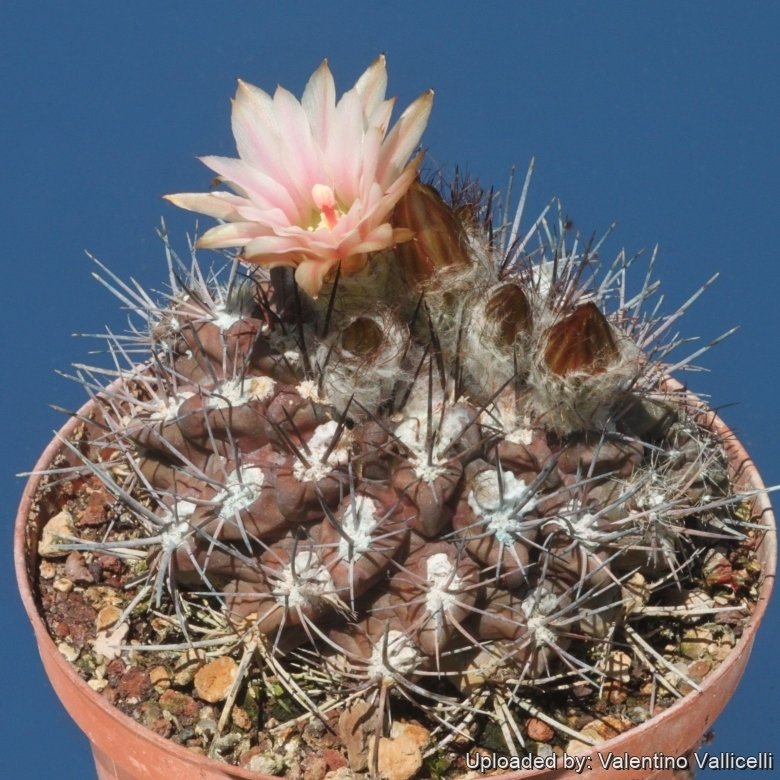
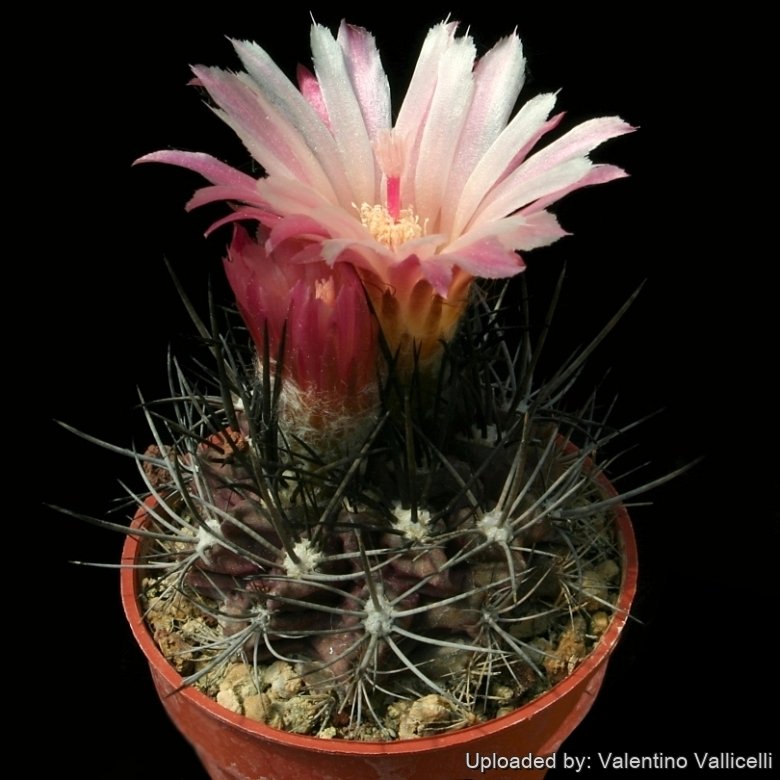
Eriosyce taltalensis subs. paucicostata is a very variable species for size and number of spines, colour of epidermis, number and form of ribs, etc. It comprises several questionable varieties and its taxonomic history has undergone several changes. The great variability of Eriosyce paucicostata is due to the fact that cross pollination among different forms and different species (in habitat and especially in collections) is very frequent and it can be quite difficult to determine what is the “pure type” and the cross. The form “viridis” is distinguishable for the grass green body (whereas the standard form generally has grey-blue-green often grey-purple tinged stem), but even the “viridis” plants tend to take some purple in strong light during colder months or under stress conditions, and the differences among individuals may be remarkable. It can happen that two individuals of two different populations can look very similar and also, two plants of the same population can look very different.
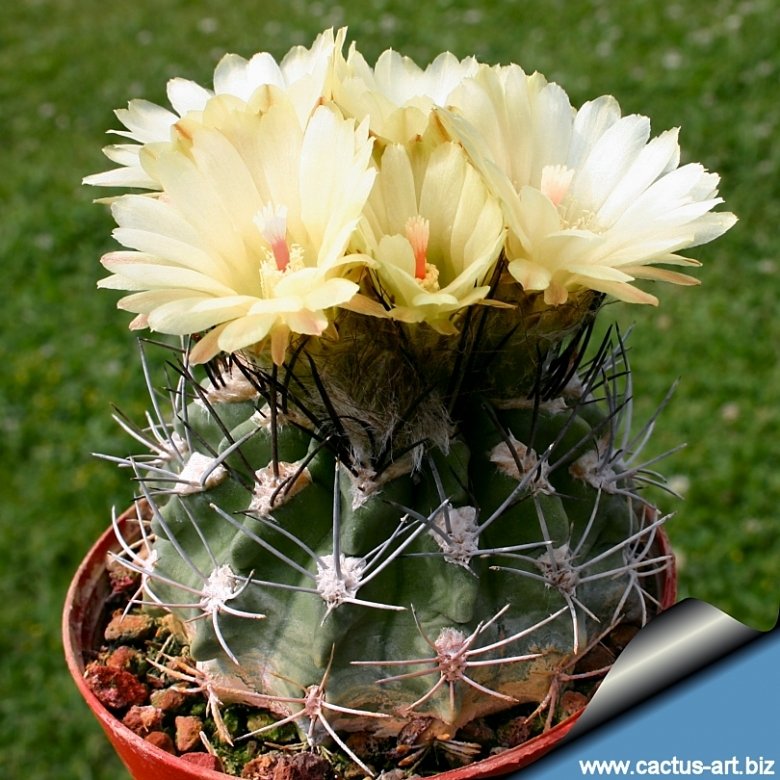
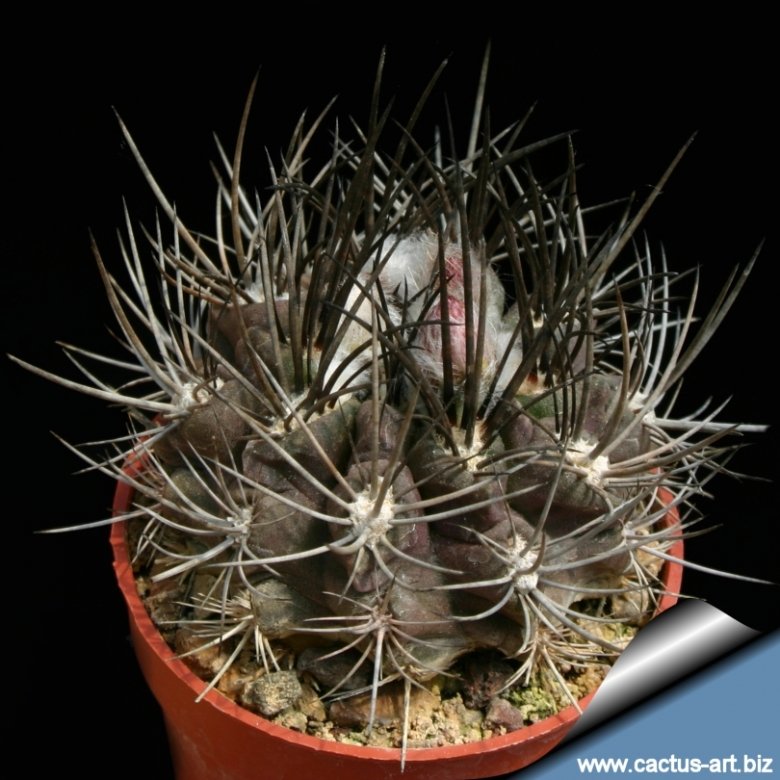
Stem: Solitary, later columnar ca. 6-8 cm in diameter and 15-30cm long and then half recumbent, strikingly grey-blue-green often grey-purple tinged , with barely developed or virtually absent tap root with abundant white wool on top.
Root: Conical taproot.
Ribs: Adult specimens have only 8-12 ribs very pronounced, even in young plants, later to nearly 2cm high, fairly acute, at the base much broader, with very small cross grooves above the sunken areoles, but a strong chin under the areoles.
Spines: Juvenile specimens have 1 central spine and 8 radials, but the numbers increase as they get older, and areoles can have over 20 spines on mature specimens.
Central spines: Dark brown to black, soon becoming chalky-white or greyish, up to 20 mm long.
Radial spines: 6-12, up to 1 cm long.
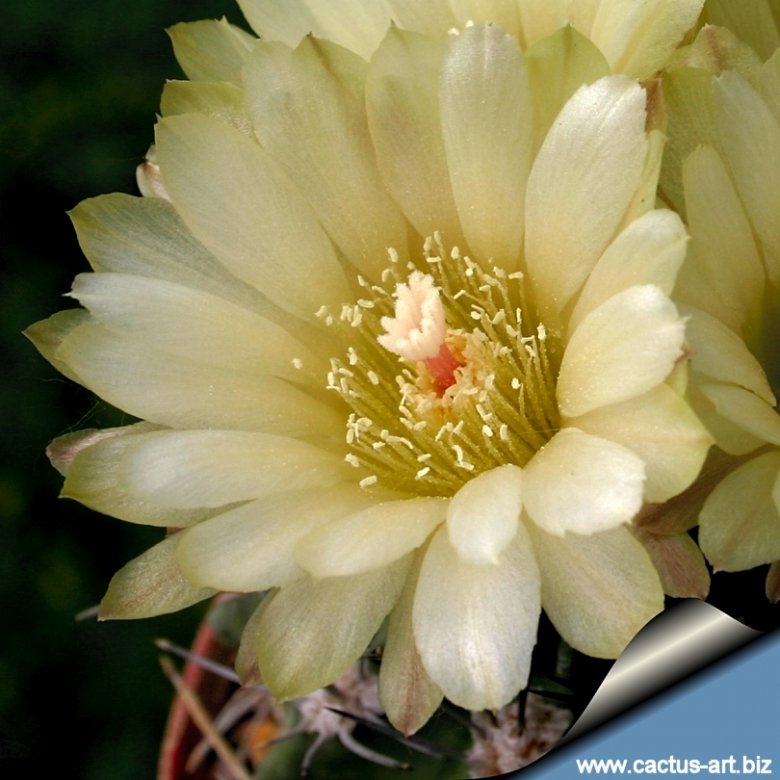
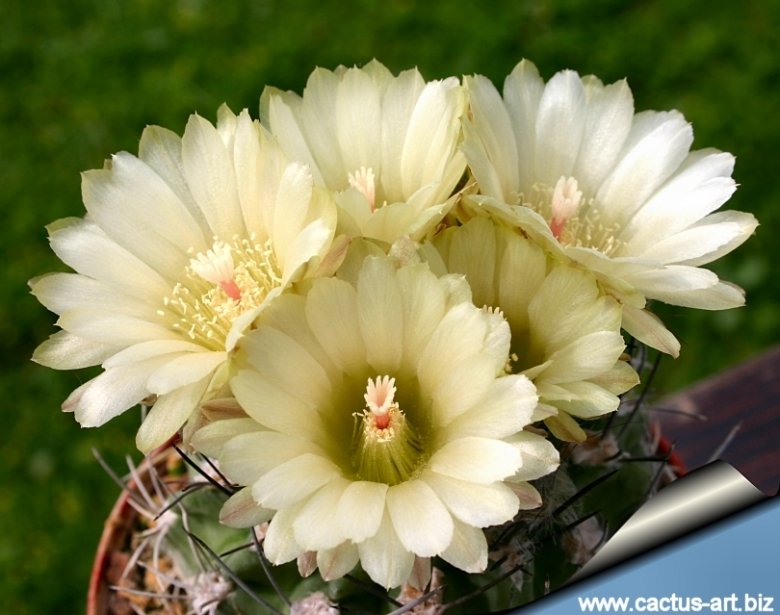
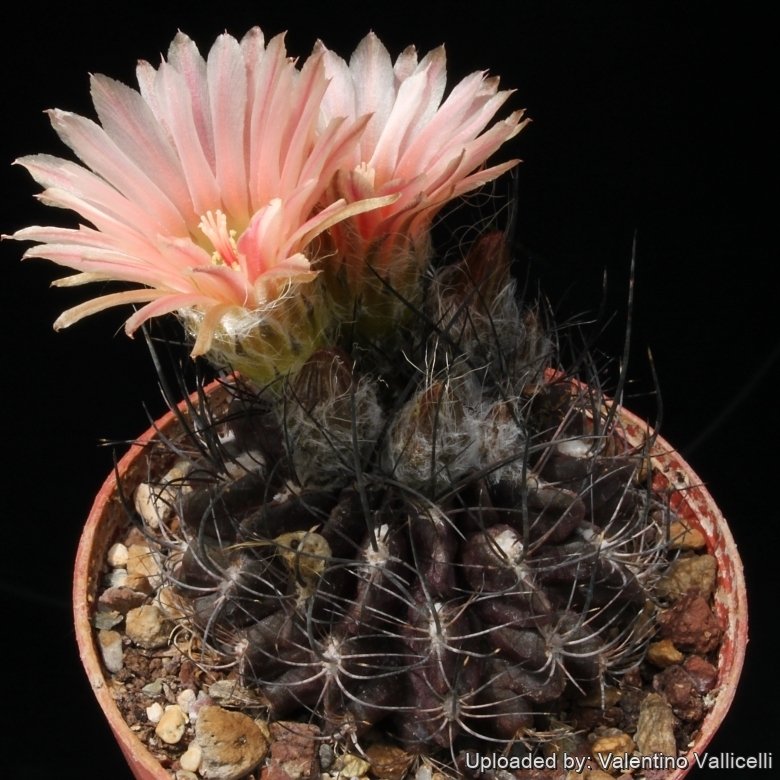
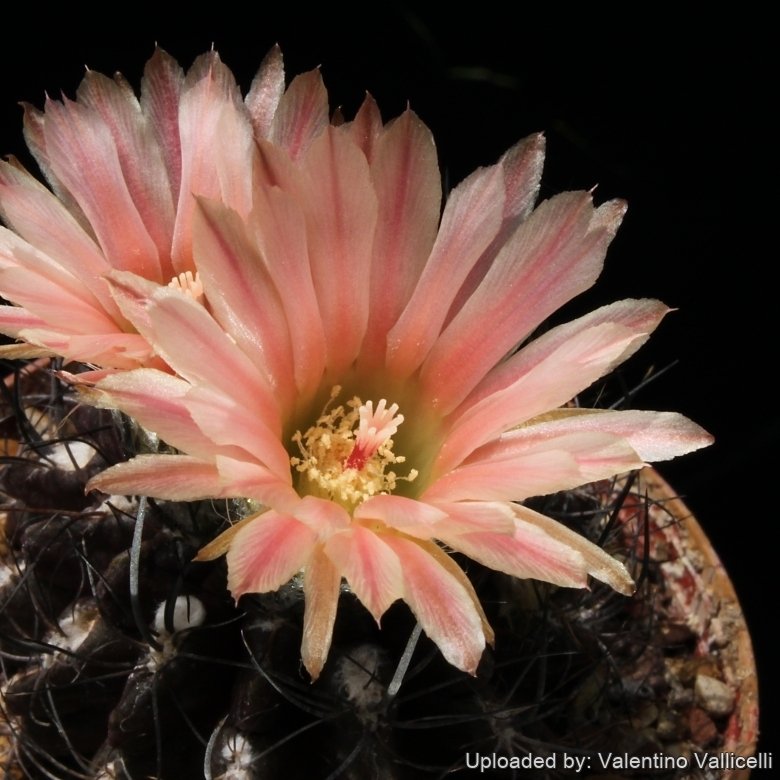
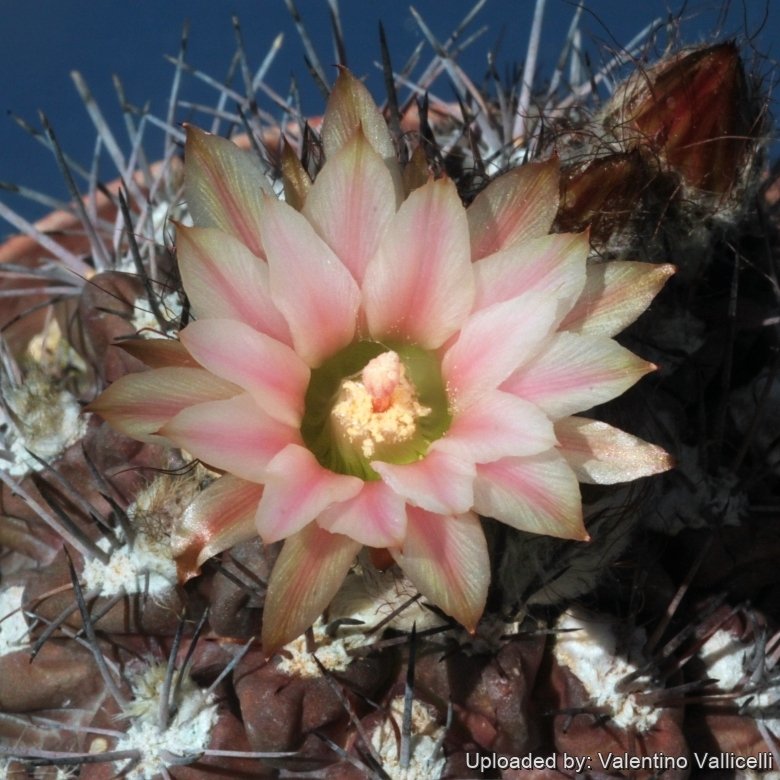
Flowers: From young areoles, campanulate or funnel-shaped, very pale pink, cream-white or pale yellowish with a vague green nuance (rarely reddish). About 3-5cm long, opening 3-5cm broad, scentless. Floral tube with abundant white wool and bristles. Ovary; green to brownish, with white flecks of wool in the axils of the very small brownish scales. Flower Tube; tubular up to the nectar chamber, above that funnel shaped to bell shaped, 1.4-2.2cm long, opening to 1.3-1.7cm broad, on the outside like the ovary, with however in the axils a single stiff brown or black bristly spine, interior practically white. Nectar Chamber; 2.25-4mm long, 3-4mm broad, half open. Stamens; white, more or less tinged green, the lowermost 0.75-1cm long, the uppermost 1-1.5 cm long; anthers small, pale citron-colour, extending not altogether as far as halfway up the flower. Style; carmine colour, 2.2-2.4cm long, 1.5mm thick, with 8-10 cream coloured 3mm long stigma lobes, that approximately equal the anthers or slightly exceed these. Petals; 1.7-2cm long, 3-5mm broad, shorter or longer the innermost white, the outermost more pink, with white margin. There might be over 50 flowers on a mature specimen (only mature specimens bloom).
Fruit: Reddish, elongate, opening by a basal pore.
Origin and Habitat
Eriosyce taltalensis subs. paucicostata is endemic to Chile, where it occurs in the region of Antofagasta, between Antofagosta and Caldera (extent of occurrence is approximately 11,000 km2). It grows at
Altitude range: It dwells at elevations between 50 and1,000 metres above sea level.
Habitat and Ecology: The species occurs in coastal hills (lomas costeras) on rocky soils, exposed, but with protection from direct sun through coastal fog (camanchaca).The plants obtain water mainly from condensation. The species is frequent and overall the population is stable.
Cultivation and Propagation
Eriosyce taltalensis subs. paucicostata is a slow growing but relatively easy to grow species, providing they are kept dry during autumn and winter and rot prone if kept in a non ventilated place.
Soils: Require a very fast mineral draining drying soil (70-80% grit and 20-30% of land soil). To prevent rottenness it is also advisable to surround its root neck by very rough sand or grit, this help a fast water drainage and an appropriate air circulation.
Watering Needs: Root prone it needs good drainage, waterings should regular in summer (do not overwater), to keep the plant compact and not become excessively elongated and unnatural in appearance. During the winter quiescent period, or when night temperatures remain below 10° C, it must be strictly kept dry since it is very sensitive to any moisture excesses.
Fertilization: During the beautiful season it’s good to enrich the soil using a fertilizer rich in potassium and phosphorous, but poor in nitrogen, because this chemical element doesn’t help the development of succulent plants, making them too soft and full of water.
Exposure: Requires strong sun exposure to develop good spinal growth (maximum brightness, sunlight accepted), but tolerate light shade. Some light shadow my be useful in the hottest summer days.
Frost Tolerance: Hardy to at least -5°C for a short period but cannot tolerate long standing freezing temperature, and for an healthy cultivation ensure a minimum temperature of 5° C. Assure a good ventilation. USDA Hardiness Zone 9b and 11.
Heat tolerance: Good heat tolerance, but in warmer climates it should be protected from excessive heat and too much sun sun in summer.
Maintenance: Repot in the spring, when its roots become cramped. Generally, it should be repotted every other year in order to provide fresh soil. After repotting, do not water for a week or more.
Propagation: Usually propagated from Seeds. (seldom produces offsets). Sow the seeds in spring in a well-aerated compost at a temperatures of 22-24°C . Stand the pots in water, moisten thoroughly and drain. Scatter and press lightly the seed onto the top of the compost. But do not cover the small seeds with compost. Secure a polythene bag around the pot or cover the container with glass or and place in a warm shaded place. If possible, germinate in a propagator. Some seedlings may appear within a week or 10 days others will take longer. At lower temperatures, germination usually takes considerably longer. Once germination has taken place, remove gradually the glass or plastic and move into a good light but not in direct sun. If the young plants are exposed to too much sun, or the compost dries out, they may stop growing and often turn red; once they stop, it is often difficult to persuade them to start growing again. Never let the pots dry out-but don’t saturate them either. A sodden compost is as harmful as a dry one. The seedling growth is rapid. But the seedling are often grafted because the plants on their own roots (especially the bigger ones) are extremely prone to root rot. In fact the best and older specimens are the grafted ones.
Bibliography
Major references and further lectures
-
Edward Anderson “The Cactus family” Timber Press, Incorporated, 2001
-
James Cullen, Sabina G. Knees, H. Suzanne Cubey “The European Garden Flora Flowering Plants: A Manual for the Identification of Plants Cultivated in Europe, Both Out-of-Doors and Under Glass” Cambridge University Press, 11/Aug/2011
-
David R Hunt; Nigel P Taylor; Graham Charles; International Cactaceae Systematics Group. “The New Cactus Lexicon” dh books, 2006
-
David Hunt “Succulent Plant Research” Volume 1, Richmond page 1994.
-
Fred Kattermann “Eriosyce (Cactaceae): The Genus Revised and Amplified” David Hunt, 1994
-
Hutchison, Cactus & Succulent Journal of America (Los Angeles) 27: 181-182 1955.
-
Faundez, L., Guerrero, P., Saldivia, P. & Walter, H.E. 2013. Eriosyce paucicostata. In: IUCN 2013. “IUCN Red List of Threatened Species.” Version 2013.2. <www.iucnredlist.org>. Downloaded on 07 June 2014.
From llifle page Horridocactus paucicostatus var. viridis
Description
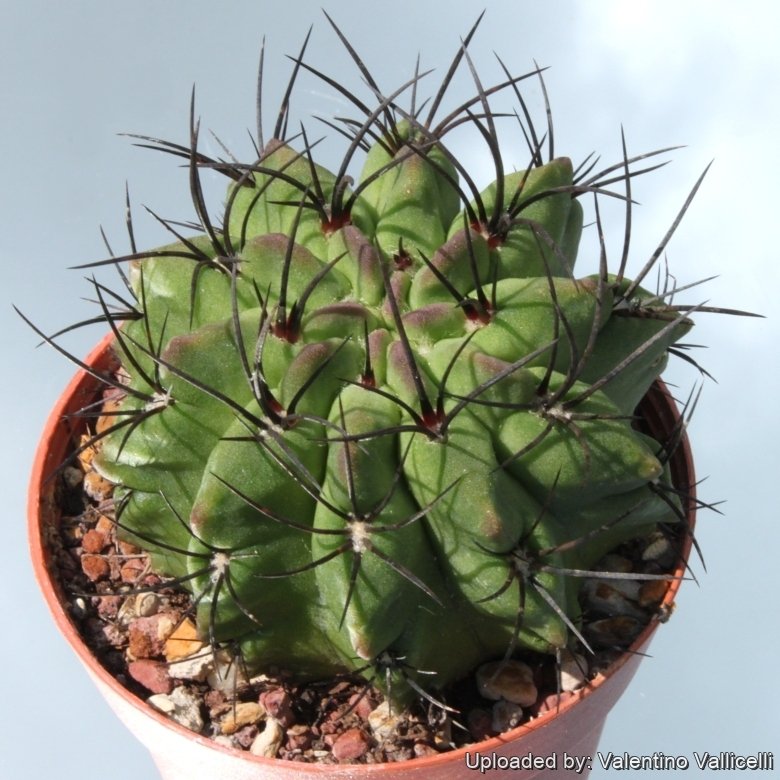
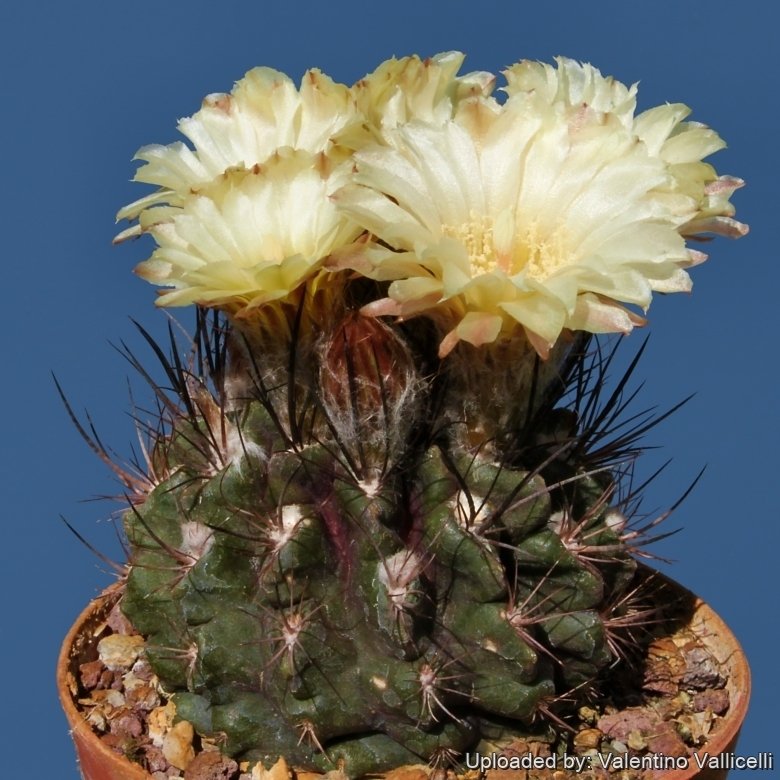
Eriosyce taltalensis subs. paucicostata is a very variable species for size and number of spines, colour of epidermis, number and form of ribs, etc. It comprises several questionable varieties and its taxonomic history has undergone several changes. The great variability of Eriosyce taltalensis subs. paucicostata is due to the fact that cross pollination among different forms and different species (in habitat and especially in collections) is very frequent and it can be quite difficult to determine what is the “pure type” and the cross. The form “viridis” is distinguishable for the green body (whereas the standard form generally has a blue-grey or grey-purple tinged stem), but even the “viridis” plants tend to take some purple in strong light during colder months or under stress conditions, and the differences among individuals may be remarkable. It can happen that two individuals of two different populations can look very similar and also, two plants of the same population can look very different.
Stem: Solitary, subglobose to elongate, up to 15 cm in diameter with abundant white wool on top.
Root: Conical taproot.
Ribs: Adult specimens have around 8-13 notched ribs, forming tubercles with sunken areoles.
Spines: Juvenile specimens have 1 central spine and 8 radials, but the numbers increase as they get older, and areoles can have over 20 spines on mature specimens.
Central spines: Dark brown to black, soon becoming chalky-white or greyish, up to 20 mm long.
Radial spines: 6-12, up to 1 cm long.
Flowers: From young areoles, campanulate or funnel-shaped, very pale pink, cream-white or pale yellowish with a vague green nuance. About 3 cm in diameter. Floral tube with abundant white wool and bristles. There might be over 50 flowers on a mature specimen (only mature specimens bloom).
Fruit: Reddish, elongate, opening by a basal pore.
Origin and Habitat
Eriosyce taltalensis subs. paucicostata f. viridis is endemic to Chile, where it occurs in the region of Antofagasta, between between Taltal and Antofagasta (extent of occurrence is approximately 11,000 km2).
Altitude range: It dwells at elevations between 50 and1,000 metres above sea level.
Habitat and Ecology: The species occurs in coastal hills (lomas costeras) on rocky soils. The species is frequent and overall the population is stable.
Cultivation and Propagation
Eriosyce taltalensis subs. paucicostata f. viridis is a slow growing but relatively easy to grow species, providing they are kept dry during autumn and winter and rot prone if kept in a non ventilated place.
Soils: Require a very fast mineral draining drying soil (70-80% grit and 20-30% of land soil). To prevent rottenness it is also advisable to surround its root neck by very rough sand or grit, this help a fast water drainage and an appropriate air circulation.
Watering Needs: Root prone it needs good drainage, waterings should regular in summer (do not overwater), to keep the plant compact and not become excessively elongated and unnatural in appearance. During the winter quiescent period, or when night temperatures remain below 10° C, it must be strictly kept dry since it is very sensitive to any moisture excesses.
Fertilization: During the beautiful season it’s good to enrich the soil using a fertilizer rich in potassium and phosphorous, but poor in nitrogen, because this chemical element doesn’t help the development of succulent plants, making them too soft and full of water.
Exposure: Requires strong sun exposure to develop good spinal growth (maximum brightness, sunlight accepted), but tolerate light shade. Some light shadow my be useful in the hottest summer days.
Frost Tolerance: Hardy to at least -5°C for a short period but cannot tolerate long standing freezing temperature, and for an healthy cultivation ensure a minimum temperature of 5° C. Assure a good ventilation. USDA Hardiness Zone 9b and 11.
Heat tolerance: Good heat tolerance, but in warmer climates it should be protected from excessive heat and too much sun sun in summer.
Maintenance: Repot in the spring, when its roots become cramped. Generally, it should be repotted every other year in order to provide fresh soil. After repotting, do not water for a week or more.
Propagation: Usually propagated from Seeds. (seldom produces offsets). Sow the seeds in spring in a well-aerated compost at a temperatures of 22-24°C . Stand the pots in water, moisten thoroughly and drain. Scatter and press lightly the seed onto the top of the compost. But do not cover the small seeds with compost. Secure a polythene bag around the pot or cover the container with glass or and place in a warm shaded place. If possible, germinate in a propagator. Some seedlings may appear within a week or 10 days others will take longer. At lower temperatures, germination usually takes considerably longer. Once germination has taken place, remove gradually the glass or plastic and move into a good light but not in direct sun. If the young plants are exposed to too much sun, or the compost dries out, they may stop growing and often turn red; once they stop, it is often difficult to persuade them to start growing again. Never let the pots dry out-but don’t saturate them either. A sodden compost is as harmful as a dry one. The seedling growth is rapid. But the seedling are often grafted because the plants on their own roots (especially the bigger ones) are extremely prone to root rot. In fact the best and older specimens are the grafted ones.
Bibliography
Major references and further lectures
-
Edward Anderson “The Cactus family” Timber Press, Incorporated, 2001
-
James Cullen, Sabina G. Knees, H. Suzanne Cubey “The European Garden Flora Flowering Plants: A Manual for the Identification of Plants Cultivated in Europe, Both Out-of-Doors and Under Glass” Cambridge University Press, 11/Aug/2011
-
David R Hunt; Nigel P Taylor; Graham Charles; International Cactaceae Systematics Group. “The New Cactus Lexicon” dh books, 2006
-
“Succulent Plant Research” Volume 1, David Hunt, Richmond 1994, page. 117.
-
Fred Kattermann “Eriosyce (Cactaceae): The Genus Revised and Amplified” David Hunt, 1994
-
Hutchison, Cactus & Succulent Journal of America (Los Angeles) 27: 181-182 1955.
-
Faundez, L., Guerrero, P., Saldivia, P. & Walter, H.E. 2013. Eriosyce paucicostata. In: IUCN 2013. “IUCN Red List of Threatened Species.” Version 2013.2. <www.iucnredlist.org>. Downloaded on 07 June 2014.
Source: Horridocactus paucicostatus var. viridis, LLIFLE - Encyclopedia of living forms, CC-BY-SA, retrieved 2026-10-25.
From llifle page Neoporteria woutersiana
Description
Delaetia woutersiana (syn: Neoporteria woutersiana) is an old controversial plant name, now referred to Eriosyce taltalensis subs. paucicostata, which is a widespread and morphologically variable taxon. Delaetia woutersiana produces grey-green stems with distinct radial and central spines. Spines are hair-like and tortuous, but the plants found in cultivation shows a high degree of variability. The names Delaetia woutersiana is not accepted by botanists that treat it as synonym, but it still has a value for a collector because they identify plants with particular characters.
Stem: Roundish, grey-green, with finely dotted epidermis.
Ribs: about 13 strongly tuberculated.
Areoles: Large, round to somewhat elongated white.
Central spines: 4 black soon turning grey, bristly more or less tortuous, lowest 1-1,5 cm long, upper up to 2,5 cm long.
Flowers: About 2 cm in diameter pink with a yellow throat. Outer petals with a brownish-yellow darker midrib. Tube very hairy.
Fruit: Opening basally.
Origin and Habitat
Antofagasta?
Cultivation and Propagation
Eriosyce woutersiana is a slow growing but relatively easy to grow species, providing they are kept dry during autumn and winter and rot prone if kept in a non ventilated place.
Soils: Require a very fast mineral draining drying soil (70-80% grit and 20-30% of land soil). To prevent rottenness it is also advisable to surround its root neck by very rough sand or grit, this help a fast water drainage and an appropriate air circulation.
Watering Needs: Root prone it needs good drainage, waterings should regular in summer (do not overwater), to keep the plant compact and not become excessively elongated and unnatural in appearance. During the winter quiescent period, or when night temperatures remain below 10° C, it must be strictly kept dry since it is very sensitive to any moisture excesses.
Fertilization: During the beautiful season it’s good to enrich the soil using a fertilizer rich in potassium and phosphorous, but poor in nitrogen, because this chemical element doesn’t help the development of succulent plants, making them too soft and full of water.
Exposure: Requires strong sun exposure to develop good spinal growth (maximum brightness, sunlight accepted), but tolerate light shade. Some light shadow my be useful in the hottest summer days.
Frost Tolerance: Hardy to at least -5°C for a short period but cannot tolerate long standing freezing temperature, and for an healthy cultivation ensure a minimum temperature of 5° C. Assure a good ventilation. USDA Hardiness Zone 9b and 11.
Heat tolerance: Good heat tolerance, but in warmer climates it should be protected from excessive heat and too much sun sun in summer.
Maintenance: Repot in the spring, when its roots become cramped. Generally, it should be repotted every other year in order to provide fresh soil. After repotting, do not water for a week or more.
Propagation: Usually propagated from Seeds. (seldom produces offsets). Sow the seeds in spring in a well-aerated compost at a temperatures of 22-24°C . Stand the pots in water, moisten thoroughly and drain. Scatter and press lightly the seed onto the top of the compost. But do not cover the small seeds with compost. Secure a polythene bag around the pot or cover the container with glass or and place in a warm shaded place. If possible, germinate in a propagator. Some seedlings may appear within a week or 10 days others will take longer. At lower temperatures, germination usually takes considerably longer. Once germination has taken place, remove gradually the glass or plastic and move into a good light but not in direct sun. If the young plants are exposed to too much sun, or the compost dries out, they may stop growing and often turn red; once they stop, it is often difficult to persuade them to start growing again. Never let the pots dry out-but don’t saturate them either. A sodden compost is as harmful as a dry one. The seedling growth is rapid. But the seedling are often grafted because the plants on their own roots (especially the bigger ones) are extremely prone to root rot. In fact the best and older specimens are the grafted ones.
Bibliography
Major references and further lectures
-
Edward Anderson “The Cactus family” Timber Press, Incorporated, 2001
-
James Cullen, Sabina G. Knees, H. Suzanne Cubey “The European Garden Flora Flowering Plants: A Manual for the Identification of Plants Cultivated in Europe, Both Out-of-Doors and Under Glass” Cambridge University Press, 11/Aug/2011
-
David R Hunt; Nigel P Taylor; Graham Charles; International Cactaceae Systematics Group. “The New Cactus Lexicon” dh books, 2006
-
“Succulent Plant Research” Volume 1, David Hunt, Richmond 1994, page. 117.
-
Fred Kattermann “Eriosyce (Cactaceae): The Genus Revised and Amplified” David Hunt, 1994
Source: Neoporteria woutersiana, LLIFLE - Encyclopedia of living forms, CC-BY-SA, retrieved 2026-10-25.
From llifle page Eriosyce cachytayensis
Description
The correct spelling is cachytayensis. You might find it listed as Neoporteria, Pyrrhocactus or Eriosyce. The name is invalid and it was not published at all. Possibly it was just showed up from one of the European nurseries? It is often considered a synonym of Eriosyce taltalensis, Erisyce paucicostata or Eriosyce neohankeana. Without knowing where it is from or even if it is a hybrid, it is difficult to classify it positively.
Origin and Habitat
Unkmowm.
Cultivation and Propagation
Eriosyce cachytayensis is a slow growing but relatively easy to grow species, providing they are kept dry during autumn and winter and rot prone if kept in a non ventilated place.
Soils: Require a very fast mineral draining drying soil (70-80% grit and 20-30% of land soil). To prevent rottenness it is also advisable to surround its root neck by very rough sand or grit, this help a fast water drainage and an appropriate air circulation.
Watering Needs: Root prone it needs good drainage, waterings should regular in summer (do not overwater), to keep the plant compact and not become excessively elongated and unnatural in appearance. During the winter quiescent period, or when night temperatures remain below 10° C, it must be strictly kept dry since it is very sensitive to any moisture excesses.
Fertilization: During the beautiful season it’s good to enrich the soil using a fertilizer rich in potassium and phosphorous, but poor in nitrogen, because this chemical element doesn’t help the development of succulent plants, making them too soft and full of water.
Exposure: Requires strong sun exposure to develop good spinal growth (maximum brightness, sunlight accepted), but tolerate light shade. Some light shadow my be useful in the hottest summer days.
Frost Tolerance: Hardy to at least -5°C for a short period but cannot tolerate long standing freezing temperature, and for an healthy cultivation ensure a minimum temperature of 5° C. Assure a good ventilation. USDA Hardiness Zone 9b and 11.
Heat tolerance: Good heat tolerance, but in warmer climates it should be protected from excessive heat and too much sun sun in summer.
Maintenance: Repot in the spring, when its roots become cramped. Generally, it should be repotted every other year in order to provide fresh soil. After repotting, do not water for a week or more.
Propagation: Usually propagated from Seeds. (seldom produces offsets). Sow the seeds in spring in a well-aerated compost at a temperatures of 22-24°C . Stand the pots in water, moisten thoroughly and drain. Scatter and press lightly the seed onto the top of the compost. But do not cover the small seeds with compost. Secure a polythene bag around the pot or cover the container with glass or and place in a warm shaded place. If possible, germinate in a propagator. Some seedlings may appear within a week or 10 days others will take longer. At lower temperatures, germination usually takes considerably longer. Once germination has taken place, remove gradually the glass or plastic and move into a good light but not in direct sun. If the young plants are exposed to too much sun, or the compost dries out, they may stop growing and often turn red; once they stop, it is often difficult to persuade them to start growing again. Never let the pots dry out-but don’t saturate them either. A sodden compost is as harmful as a dry one. The seedling growth is rapid. But the seedling are often grafted because the plants on their own roots (especially the bigger ones) are extremely prone to root rot. In fact the best and older specimens are the grafted ones.
Source: Eriosyce cachytayensis, LLIFLE - Encyclopedia of living forms, CC-BY-SA, retrieved 2026-10-25.
From llifle page Delaetia woutersiana cv. Thin Petals
Description
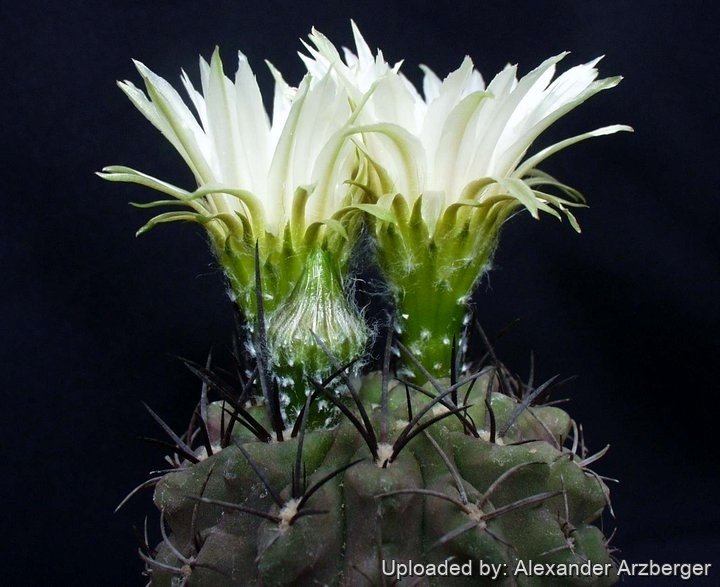
Delaetia woutersiana cv. Thin Petas is an odd (monstrous) cultivars with very fine petals, cut into shreds. The flowers look quite different, but nice and bi-coloured, yellow and orange-red. Similar mutant having thin petals are found in other cactus species species (see: Astrophytum asterias cv. Showa and Lobivia cv. Stern von Lorsch). This plants are sterile and are often grafted on stronger species, called the stock, that can be any number of different columnar cactus.
Stem: Roundish, grey-green, with finely dotted epidermis, apex often very wooly.
Ribs: About 13 strongly tuberculated.
Areoles: Large, round to somewhat elongated with white woolliness.
Spines: Dark-brown soon turning grey, thin bristly and slightly tortuous.
Flowers: Diurnal, radial, about 2 cm in diameter opening widely, yellow with orange/red throats. Petals long, very fine, shred-like, from narrow yellow bases; upper parts orange-red, edges entire, tips entire and pointed. Filaments yellow at bases, yellow above, anthers abortive. Style pink-orange with pink stigma lobes.
Blooming season: It may flower at any time during the warmer months of the year if adequate water is provided and each flower lasts for one or two days only.
Note: The name Delaetia woutersiana is not accepted by botanists that treat it as synonym of Eriosyce taltalensis subs. paucicostata, but it still has a value for a collector because they identify plants with particular characters.
Origin and Habitat
Garden origin.
Cultivation and Propagation
It is a summer grower species that offers no cultivation difficulties, but it is slow growing.
Fertilization: Feed with a high potassium fertilizer in summer.
Moisture: Water regularly in summer (but do not overwater), keep dry as soon as the temperature starts dropping in October and keep it perfectly dry in winter at temperatures from 5 to 15 degrees centigrade.
Exposure: Need a bright exposure, full sun or half shade in summer.
Propagation: Grafting (usually used to speed the discouraging slow growing rate of this plant), cutting.
Source: Delaetia woutersiana cv. Thin Petals, LLIFLE - Encyclopedia of living forms, CC-BY-SA, retrieved 2026-10-25.
Gallery