Publication: Eriosyce (Cactac.) gen. revis. & ampl. (Succ. Pl. Res., 1) 119 (1994)
Description
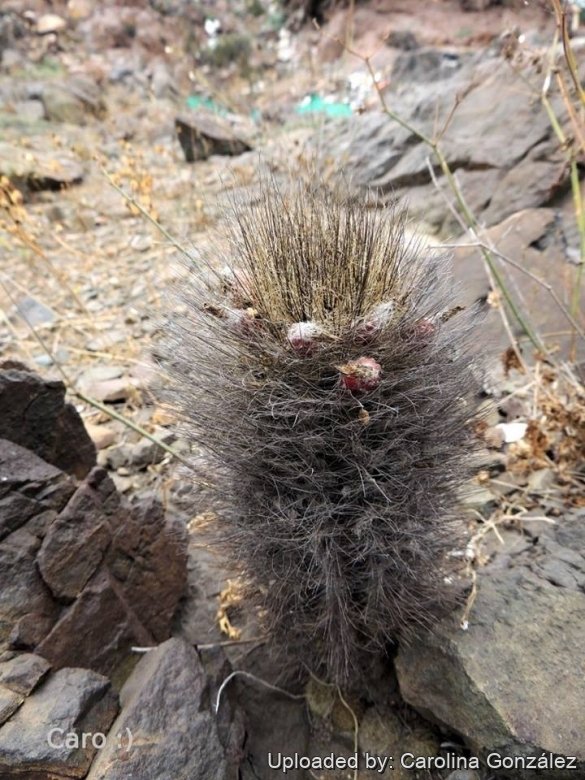
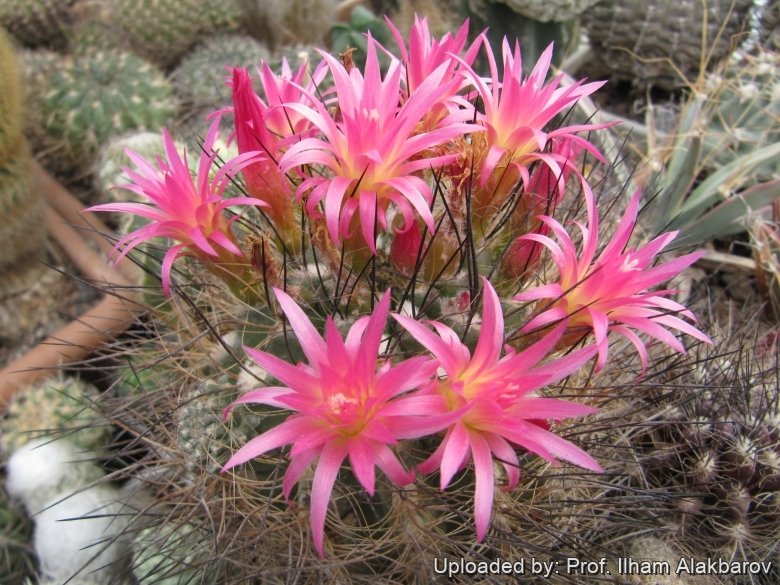
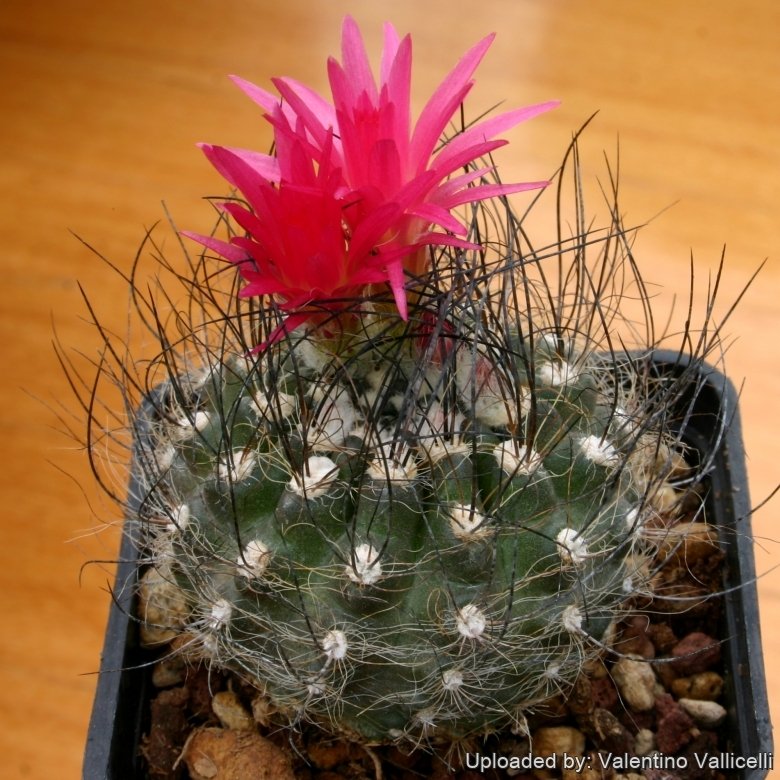
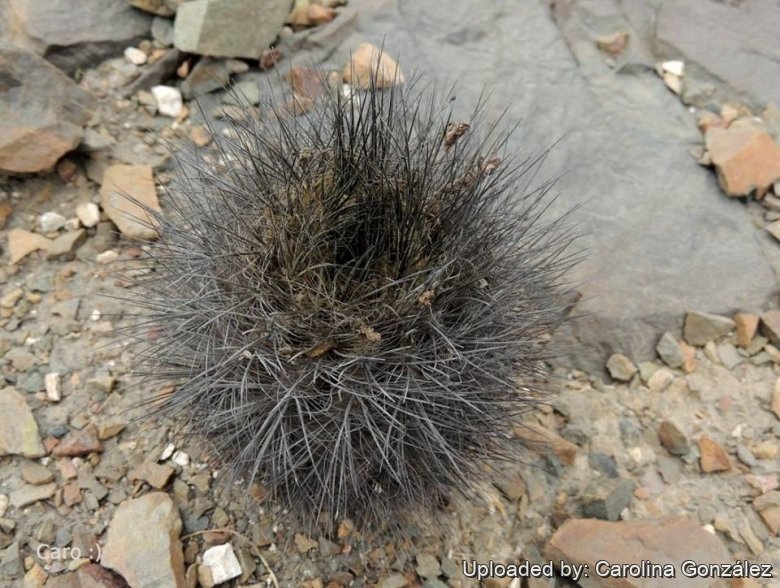
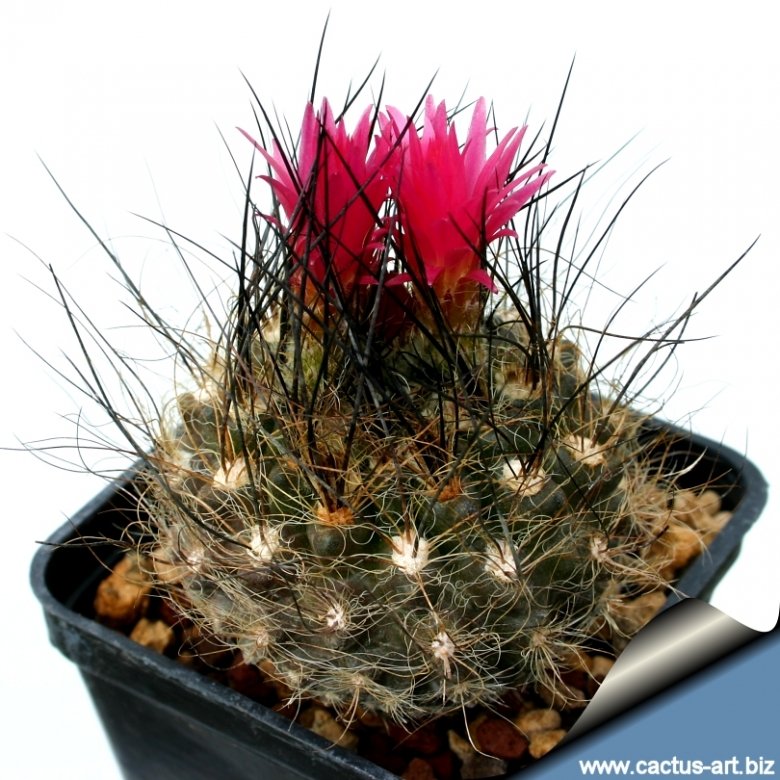
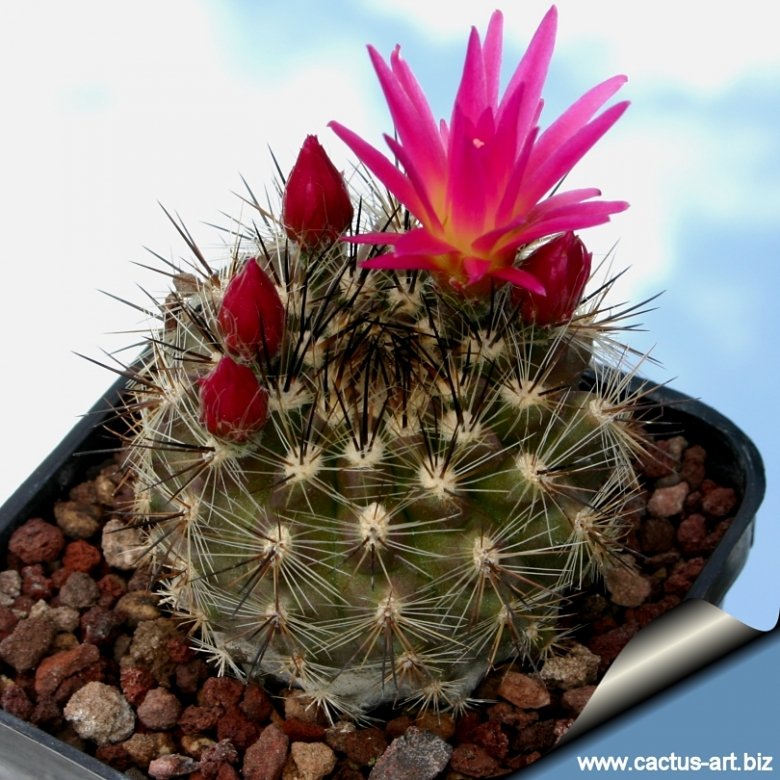
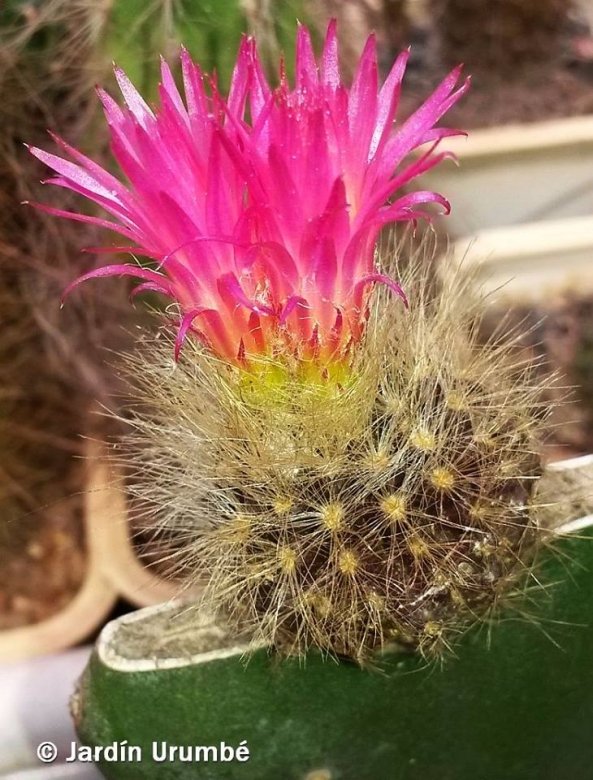
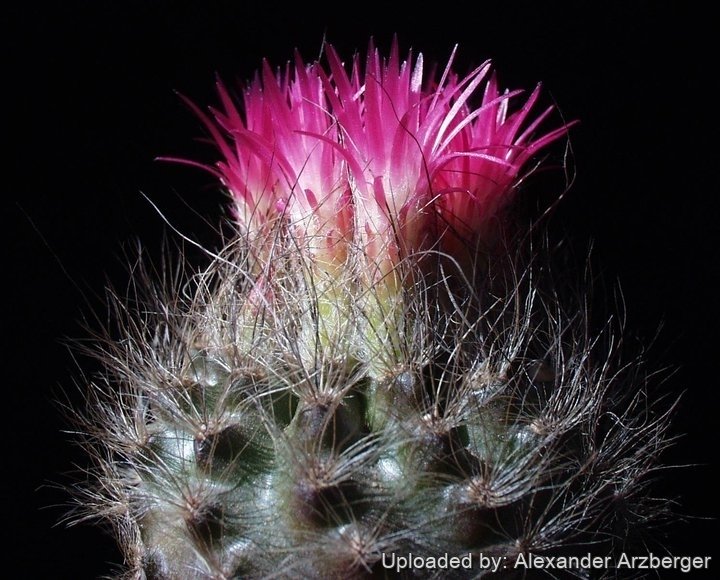
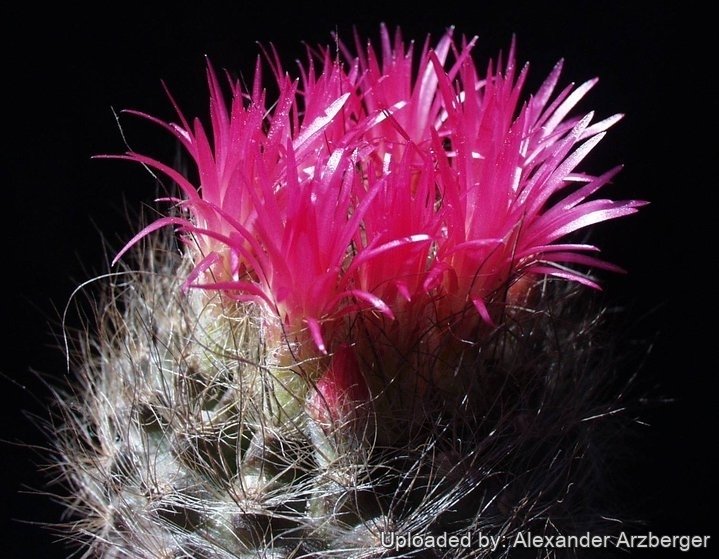
Eriosyce villosa is a small solitary cactus typically with long hair-like radial spines and several small magenta flowers at a time. It becomes shortly columnar in age.
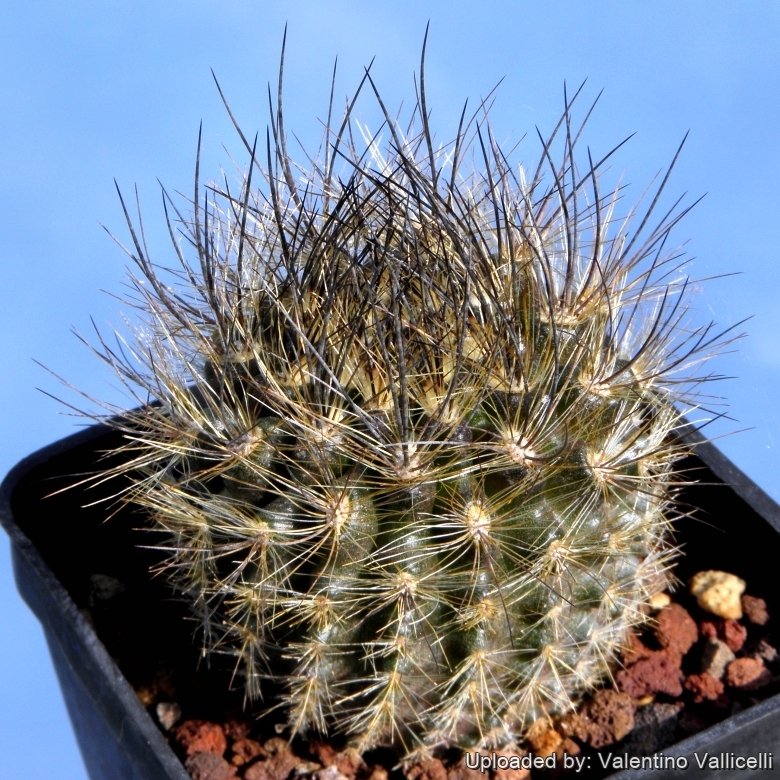
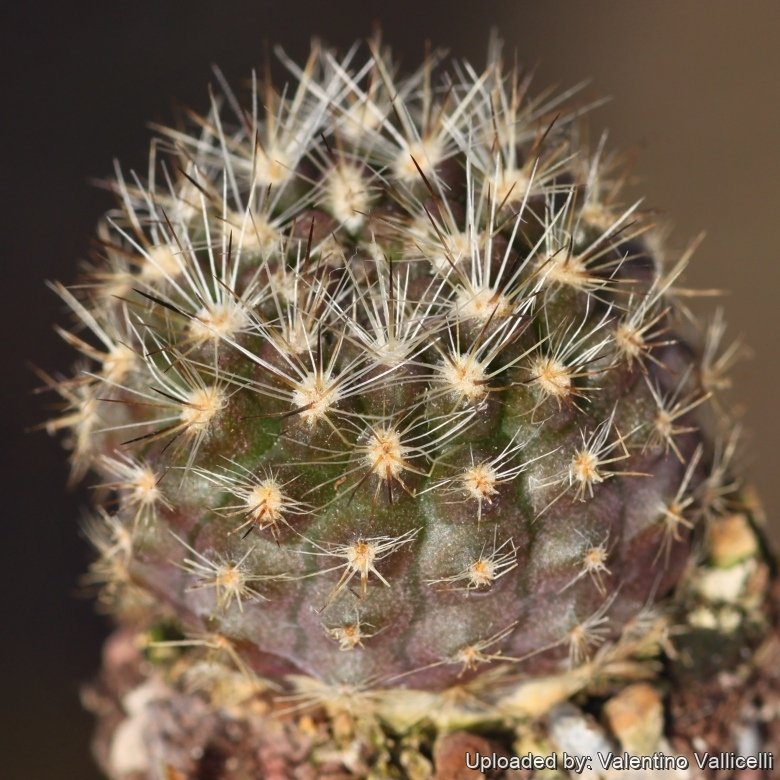
Stem: Subglobose to globose, becoming elongated or short cylindrical, greyish-green to very dark green or dark blackish-purple, up to 15 cm tall, 8 cm in diameter.
Roots: Large tuberose tap-root.
Ribs: 13-15 prominent, large, deeply notched between areoles.
Areoles: Large felted.
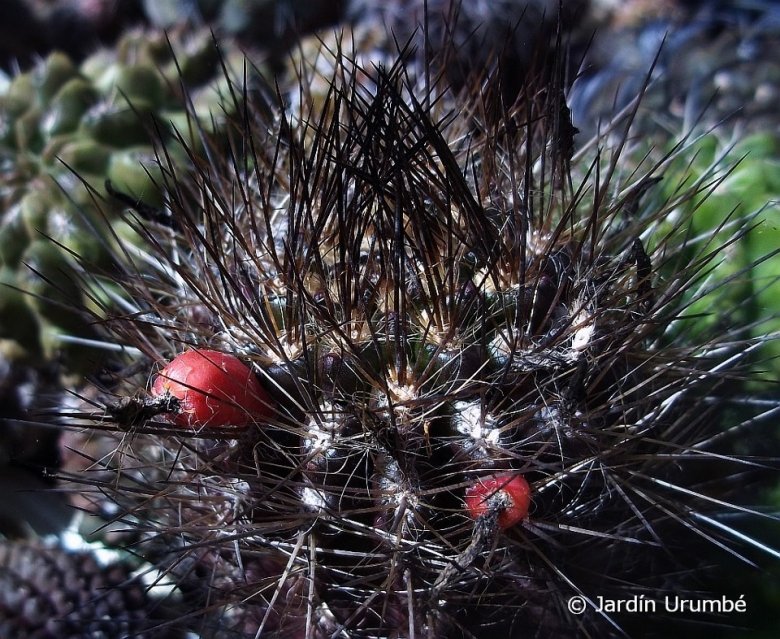
Spines: More or less dense, the number of spines (especially the bristly radials) is quite variable.
Central spines: 3-4 cm long, bristle like, usually darker than radials, glassy gold-brownish to black.
Radial spines: 12-20, thin, grading from bristle- to hair-like, whitish, grey or brownish.
Flowers: Borne at plant apex on young areoles, 2-2,5 cm in diameter, tubular to narrow funnel-form, bright magenta, showing various shades of purple-pink with clearer throat, pericarpels and floral tubes with long wool and gassy white bristles.
Blooming time: Blooms early in the year. Occasionally forms some buds late in the previous year, and it can sometimes flower during the winter, although the main burst of flowering is in April.
Fruits: Elongate, red, dehiscing by basal pores.
Origin and Habitat
Totoral Bajo to Carrizallilo, Huasco, Coquimbo and Atacama regions, Chile (extent of occurrence about 5,000 km2)
Altitude: It grows at elevations of 0 to 800 m asl.
Habitat and Ecology: Eriosyce villosa occurs in coastal hills (lomas costeras) on rocky soils. It is frequent and the population stable. The major threats are illegal collection and industrialization to process steel. The coastal formations in this region have vegetation corresponding to the Desierto Costero Huasco (Huasco coastal desert). Due to occasional precipitation, this vegetation has more permanence and continuity than the vegetation occurring farther north. The endemics include Copiapoa echinoides, Copiapoa malletiana, Eriosyce napina and Neoporteria villosa var. laniceps. At times this region is dominated by geophytes, which can cover expanses of the desert spectacularly.
Cultivation and Propagation
It is a summer grower species. Easy to cultivate but somewhat rot prone if kept in a non ventilated place. Requires a very fast draining drying soil Water regularly in summer, but do not overwater.
Needs a full sun exposure (or light shade) Good heat tolerance. Hardy to at down to -5°C for brief periods.
Propagation: Usually propagated from Seeds. (seldom produces offsets)
Bibliography
Major references and further lectures
-
Faundez, L., Guerrero, P., Saldivia, P. & Walter, H.E. 2013. Eriosyce villosa. In: IUCN 2013. “IUCN Red List of Threatened Species.” Version 2013.2. <www.iucnredlist.org>. Downloaded on 16 January 2014.
-
Fred Kattermann “Eriosyce (Cactaceae): The Genus Revised and Amplified” David Hunt, 1994
-
Edward Anderson “The Cactus family” Timber Press, Incorporated, 2001
-
James Cullen, Sabina G. Knees, H. Suzanne Cubey “The European Garden Flora Flowering Plants: A Manual for the Identification of Plants Cultivated in Europe, Both Out-of-Doors and Under Glass” Cambridge University Press, 11/Aug/2011
-
David R Hunt; Nigel P Taylor; Graham Charles; International Cactaceae Systematics Group. “The New Cactus Lexicon” dh books, 2006
-
Hans Hecht “BLV-Handbuch der Kakteen” BLV-Verlagsgesellschaft, 1982
-
Stephen D. Davis “Centres of Plant Diversity: The Americas” World Wide Fund for Nature (WWF) and ICUN - World Conservation Union, 01 January 1994
From llifle page Bridgesia polyraphis
Description
Eriosyce villosa var. polyraphis much better known under its old name, Neoporteria polyraphis, is now considered nothing else than Eriosyce villosa, but the plants in cultivation are not exactly the same, the spines are a little shorter and the flowers are a bit more pointed.
Note: The number of spines (especially the bristly or hairy radials) in Eriosyce villosa shows a certain degree of variability depending on origin. The otherwise similar features of “var. villosa” and “var. polyraphis”, namely size and form of stems, flowers, fruit, etc., prove, that is impossible to differentiate between these taxa.
Habit: It is a small solitary cactus densely folded by bristly spines.
Stem: Subglobose to Globose becoming elongated, green or very dark green (almost black) or dark red, up to 15 cm tall, 8 cm in diameter.
Roots: Large tuberose tap-root.
Ribs: 13-15 Deeply notched between areoles.
Spines: ± dense, long, glassy gold-brownish to black central spines with thin bristle like grey radials.
Flowers: Bright magenta, borne on young areoles, 2-2,5 cm in diameter, Pericarpels and floral tubes with long wool and gassy white bristles.
Blooming time: Blooms early in the year. Occasionally forms some buds late in the previous year, and it can sometimes flower during the winter, although the main burst of flowering is in April.
Fruits: Elongate, red, dehiscing by basal pores.
Origin and Habitat
Totoral Bajo to Carrizallilo, Huasco, Coquimbo and Atacama regions, Chile (extent of occurrence about 5,000 km2)
Altitude: It grows at elevations of 0 to 800 m asl.
Habitat and Ecology: Eriosyce villosa occurs in coastal hills (lomas costeras) on rocky soils together with Neochilenia napina. It is frequent and the population stable. The major threats are illegal collection and industrialization to process steel.
Cultivation and Propagation
It is a summer grower species. Easy to cultivate but somewhat rot prone if kept in a non ventilated place. Requires a very fast draining drying soil. Water regularly in summer, but do not overwater.
Needs a full sun exposure (or light shade) Good heat tolerance. Hardy to at down to -5°C for brief periods.
Propagation: Usually propagated from Seeds. (seldom produces offsets)
Bibliography
Major references and further lectures
-
Faundez, L., Guerrero, P., Saldivia, P. & Walter, H.E. 2013. Eriosyce villosa. In: IUCN 2013. “IUCN Red List of Threatened Species.” Version 2013.2. <www.iucnredlist.org>. Downloaded on 16 January 2014.
-
Fred Kattermann “Eriosyce (Cactaceae): The Genus Revised and Amplified” David Hunt, 1994
-
Edward Anderson “The Cactus family” Timber Press, Incorporated, 2001
-
James Cullen, Sabina G. Knees, H. Suzanne Cubey “The European Garden Flora Flowering Plants: A Manual for the Identification of Plants Cultivated in Europe, Both Out-of-Doors and Under Glass” Cambridge University Press, 11/Aug/2011
-
David R Hunt; Nigel P Taylor; Graham Charles; International Cactaceae Systematics Group. “The New Cactus Lexicon” dh books, 2006
-
Hans Hecht “BLV-Handbuch der Kakteen” BLV-Verlagsgesellschaft, 1982
Source: Bridgesia polyraphis, LLIFLE - Encyclopedia of living forms, CC-BY-SA, retrieved 2026-10-25.
From llifle page Neoporteria laniceps
Description
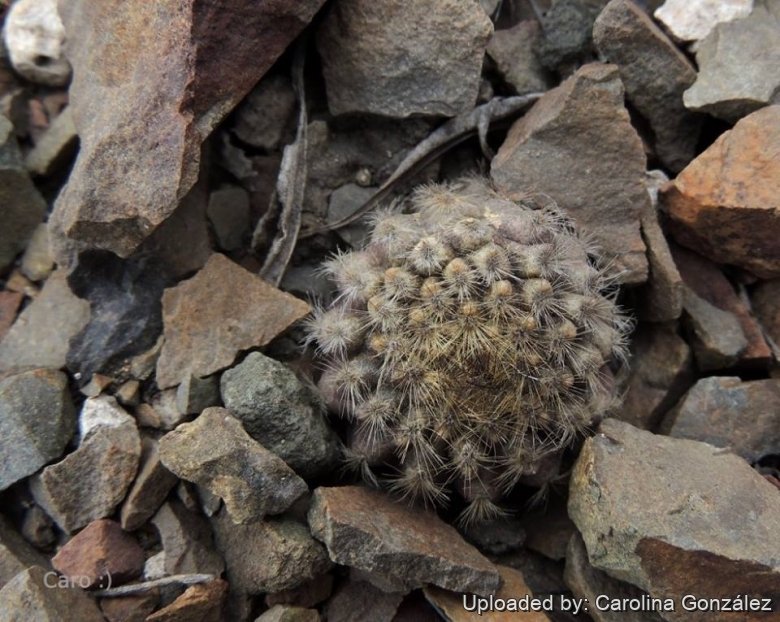
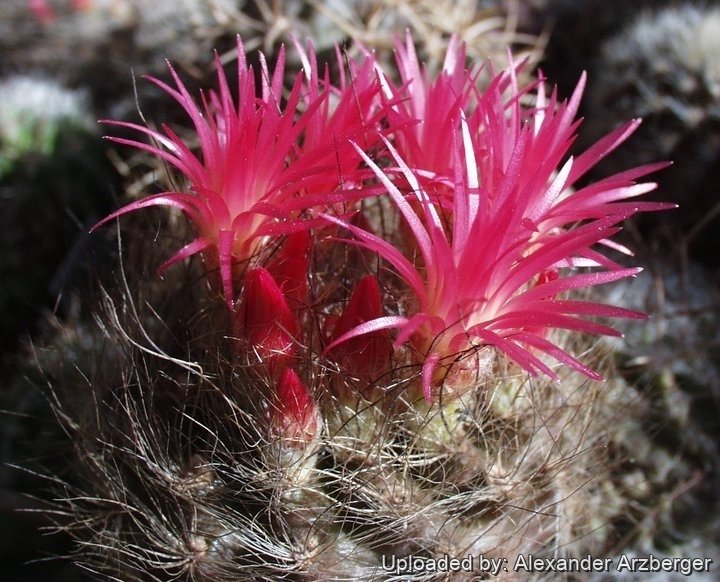
Neoporteria laniceps, also known as Neoporteria planiceps, is a small plant with a brownish-green body; this is surrounded by long thin straw-coloured to brown spines which are twisted and interwoven, producing a bird’s nest effect. The freely-produced tubular deep pink flowers are not very large and have inner petals which remain upright around the style. Neoporteria laniceps is generally included within (as a synonym of) Eriosyce villosa, suggesting that there is not really a fundamental difference between the two.
Stems: In shadow green, tanned in the sun, 3-4 cm thick, up to 20 cm tall, depressed and woolly at apex.
Root: Large tuberose yellowish constricted at neck.
Rib: In juvenile plants the ribs are fully dissolved in tubercles, while mature specimens form 13-17 deeply notched, slightly spiralling ribs. The notches have a strong rounded chin just below the areole and are flattened on the sides, in young plants they are ca 3 mm long, in old plants they are up to 8 mm long and wide, and not noticeably broadened at the base.
Areoles. Sunk into the flat exterior surface of the notches, 2-4 mm long, about 2 mm wide, with white hairs, 2-5 mm apart.
Spines: Strong or fine hair-like, straw-coloured to brown, more or less curved or frizzy. Radial and central spines almost indistinguishable, but centrals often brown to black, rough, 2-4 cm long, and radials a little shorter and lighter or grey, or of the same colour, about 20-40 per areole, tuft-like and spreading. Often in older plants the radial spines are all transformed in delicate protruding tufts of wool.
Flowers: Borne at plant apex on young areoles, up to 28 mm long, and 2 cm in diameter when widely open. Ovary, green, globular, 4.5 mm in diameter, with very little red scales and dense white woolly flakes. Nectar-chamber 2 mm high. Tube narrow, funnel shaped, 10 mm long, 5 mm wide at the top, outside reddish, with a few pointed red scales, white woolly flakes and some yellow hairy curled bristles. Inner perianth segments deep pink, held upright around the style, outer perianth segments spreading outward, and curved back, all about 12 mm long, and 2 mm wide, and pointed at apex. Stamens, white, erect, all about the same length; pollen pale yellow. Pistil white, ca. 21 mm long with about 7 pale yellow stigma lobes.
Blooming season: In habitat Neoporteria laniceps is a winter flowering plant. Summer is warm and arid, and the winter is cool but frost free. On the contrary in Europe this plants are usually kept dry in winter and moist in summer and flowering appears copiously in late summer. Flowers remain open for several days, both at day and night.
Fruits: Carmine red, about 12 mm long, 7 mm thick, barrel-shaped, very constricted at base, covered with very little red scales and dense white woolly flakes, with some white hairy curly bristles in the upper end, and retaining shrivelled floral remnants at apex. The fruits split open at maturity by a circular bottom hole.
Seeds: 1 mm long, 0.7 mm wide, 0.5 mm thick, strongly arched in the back. Testa matt black, with extremely fine flat tubercles; hilum sub-basal, white, roundish.
Origin and Habitat
Carrizal Bajo, 03 Atacama, Chile.
Habitat and ecology: This species occurs in coastal hills (lomas costeras) on rocky soils. The coastal formations in this region have vegetation corresponding to the Desierto Costero Huasco (Huasco coastal desert). Due to occasional precipitation, this vegetation has more permanence and continuity than the vegetation occurring farther north. The endemics include Copiapoa echinoides, Copiapoa malletiana, and Neoporteria carrizalensis. At times this region is dominated by geophytes, which can cover expanses of the desert spectacularly.
Bibliography
Major references and further lectures
-
Friedrich Ritter “Kakteen in Südamerika: Ergebnisse meiner 20jährigen Band 3 - Chile”, Friedrich Ritter Selbsverlag 1980
-
The Cactus and Succulent Journal of Great Britain, Cactus and Succulent Society of Great Britain, 1977
-
“Cactos – Guia prático” NBL Editora, 1998
-
Stephen D. Davis “Centres of Plant Diversity: The Americas” World Wide Fund for Nature (WWF) and ICUN - World Conservation Union, 01 January 1994
Source: Neoporteria laniceps, LLIFLE - Encyclopedia of living forms, CC-BY-SA, retrieved 2026-10-25.
Gallery