Publication: Oesterr. Bot. Z. 98: 78. 1951
Description
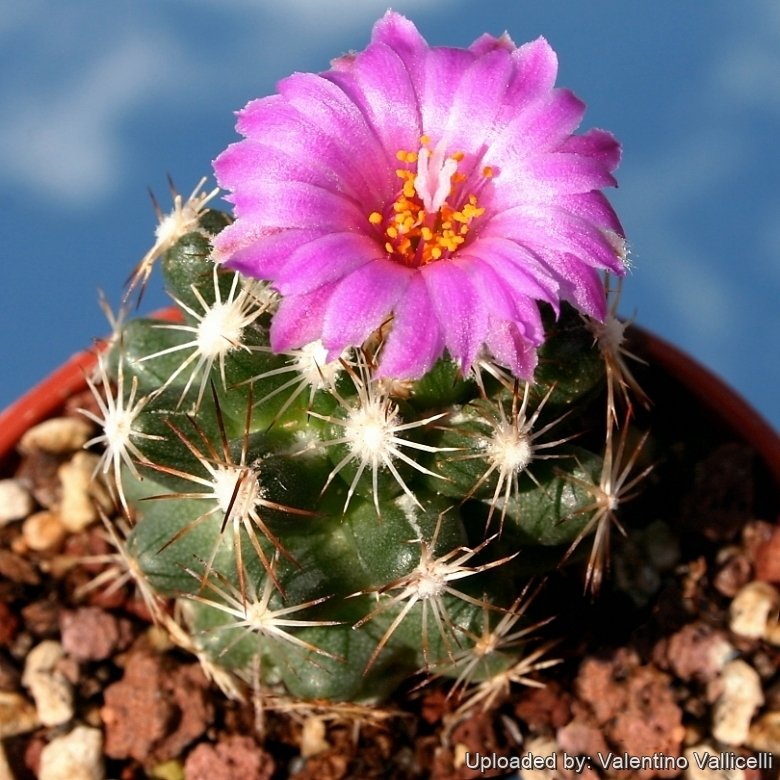
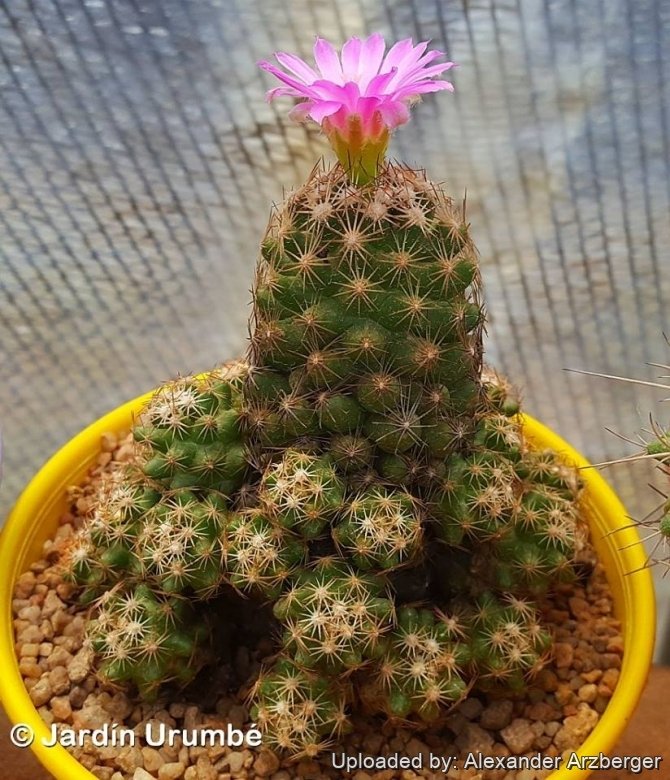
Escobaria hesteri is a dwarf cactus unbranched, except in old age, ultimately offsetting to form clusters & eventually, low many-stemmed mounds 5-20(-30) cm in diameter.
Stems: Short spherical to egg-shaped 5-9 cm long, (1.5-)2.5-4(4.5) cm in diameter, above-ground portion 1-6.5 tall (Usually less than 3 cm), not obscured by spines when hydrated, obscured when desiccated. In nature the stem is deep-seated in the soil, the aerial aerial parts are inconspicuous, flat-topped to hemispheric (to ovoid or spheric in horticulture), almost completely withdrawing into substrate when desiccated.
Tubercles: 5-9 long, 4-6 mm, in diameter, cylindrical when young, then tapering and turning upward from broad fattened base to 12 mm wide when old.
Areoles: Roundish elongating to form groves when mature. Short tuft of wool soon disappearing. Areolar glands absent.
Roots: Short, fleshy, enlarged taproots merging with the stem.
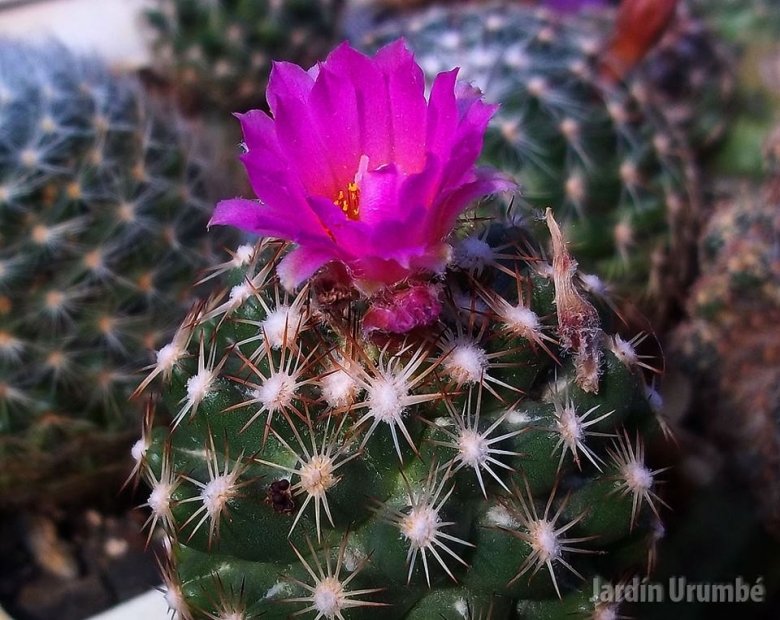
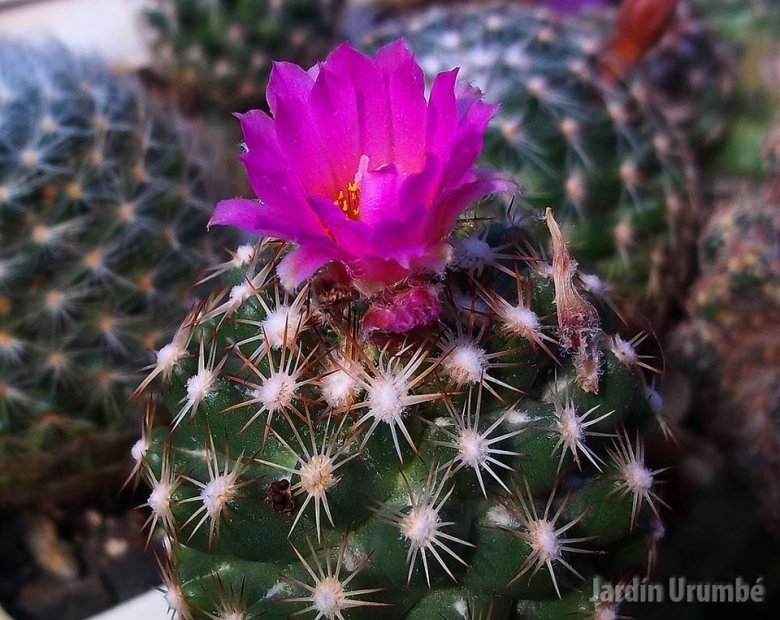
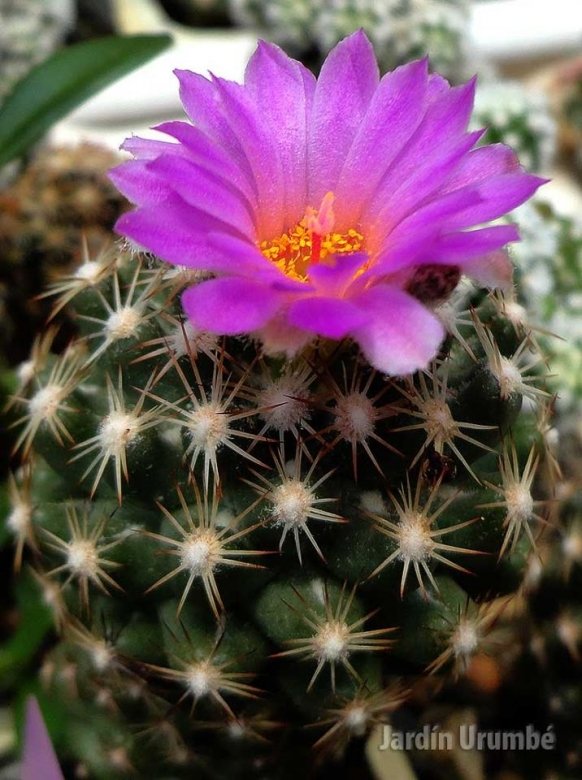
Spines: (5-)12-20 per areole, 3-6 mm, long all radial equal or slightly unequal, with the upper 1-3 longer and heavier than other (up to 13 mm long), sometime interpreted as central. Very thin and white with brown tips (quickly weathering to grey) creating a decorative starry effect against the deep green stems. Appressed, straight, laterally compressed at base, 6-13 mm long.
Central spines: Absent (the 1 to 3 upper radials are often interpreted as centrals, but they are not).
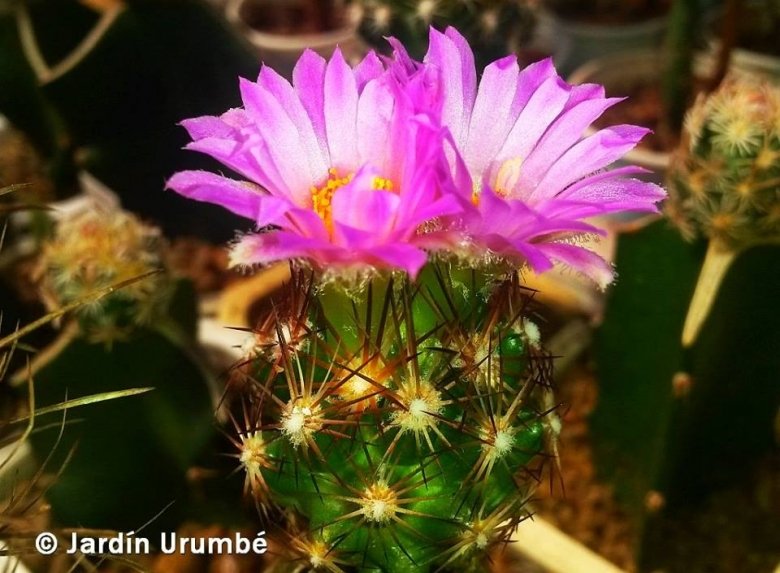
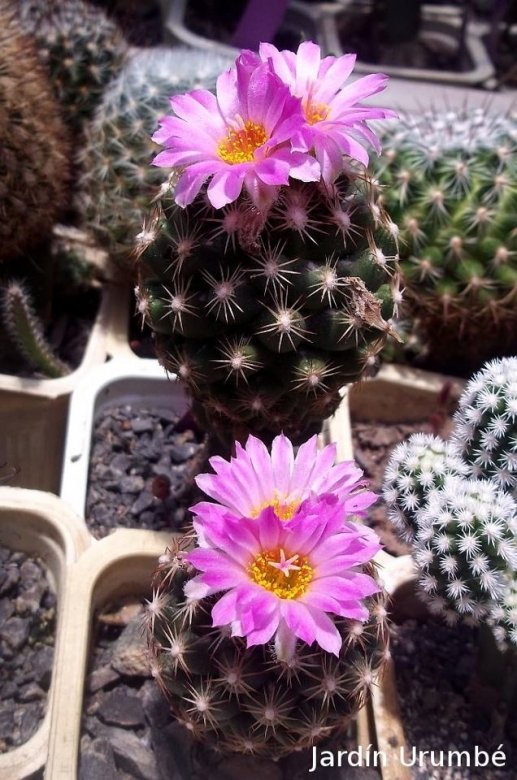
Flowers: Small but showy near the top of the stems (18-25 long, 20-34 mm in diameter), gorgeous deep rose-purple to magenta with a paler throat. Outer perianth segments about 9, greenish to pinkish, fringed with long white hairs. Inner perianth segments 22-27 per flower paler at the base, 10-17 ling, 2-4 mm wide. Outer filaments colourless or white to rose. Anthers orange-yellow. Style greenish or yellowish, slightly longer than stamens. Stigma lobes 3-6, stout, rough, white, cream, or pale pink, 1-3 mm long.
Blooming season: It is a prolific bloomer, it blooms intermittently in spring between April and early June & occasionally in summer and autumn.
Fruits: Remaining green until drying, spherical or obovoid, 5-8 long, 3-6 mm wide, quickly drying. Floral remnant usually persistent.
Fruiting time: August-October or in January.
Seeds: Dark brown, spheric, 0.75-1.1 mm long, pitted.
Origin and Habitat
Southwestern USA, Texas: It is endemic to a small area (extent of occurrence 2,600 km2) south west of Alpine in the Maraton basin (North Brewster County) and west of Sanderson (Terrel county). The species is often abundant where it occurs.
Altitude range: Elevational range is 1200-1600 metres.
Habitat: Semidesert grasslands and oak-juniper-pinyon woodlands on dry, gravely limestone hills, alluvial fans, rock crevices, and often on outcrops of novaculite (a hard, fine-grained, silica-rich rock), sandstone, limestone and several other types of sedimentary and igneous substrates. No significant differences have been reported in plant from the different substrates. Even though Escobaria hesteri has a very limited range, the species has no threats and it occurs in a small number of large ranches to which people have no access. Illegal collection is a threat for one subpopulation found by a roadside.
Cultivation and Propagation
Very slow-growing, but easy to cultivate. Water regularly in summer, but do not over-water. It prefers a completely dry place during winter with much drainage. An unheated greenhouse would be perfect. It can survive low temperatures (approx. -12 C). Full sun to light shade
Propagation: Easy to propagate from seed, cuttings and grafting.
Notes
E. hesteri and Escobaria minima (From an adjacent hill) are two miniature plant which resemble dwarf races of Escobaria vivipara, to wich they shares some characteristic, but much smaller in all parts. They can survive to –25°C in dry-winter regions.
Bibliography
Major references and further lectures
-
Edward Anderson “The Cactus family” Timber Press, Incorporated, 2001
-
Carr, W. “An Annotated List of the G3/T3 and Rarer Plant Taxa of Texas”. The Nature Conservancy Texas. 2004.
-
Hernández, H.M., Gómez-Hinostrosa, C. and Goettsch, B. “Checklist of Chihuahuan Desert Cactaceae.” Harvard Papers in Botany 9(1): 51-68. 2004.
-
Robbins, C.S. (ed.). “Prickly Trade: Trade and Conservation of Chihuahuan Desert Cacti.” Fondo Mundial para la Naturaleza, Washington D.C. 2003.
-
Heil, K. & Terry, M. 2013. Escobaria hesteri. The IUCN Red List of Threatened Species 2013: e.T151766A559131. http://dx.doi.org/10.2305/IUCN.UK.2013-1.RLTS.T151766A559131.en. Downloaded on 24 November 2016.
-
Jackie M. Poole “Rare Plants of Texas: A Field Guide” Texas A&M University Press, 2007
-
Brian Loflin, Shirley Loflin “Texas Cacti: A Field Guide” Texas A&M University Press, 26 October 2009
-
Leo J. Chance “Cacti and Succulents for Cold Climates: 274 Outstanding Species for Challenging Conditions” Timber Press, 19 June 2012
-
A. Michael Powell, James F. Weedin “Cacti of the Trans-Pecos & Adjacent Areas” Texas Tech University Press, 2004
-
Graham Charles “Cacti and Succulents: An illustrated guide to the plants and their cultivation” Crowood, 30 April 2014
-
Cyrus Longworth Lundell “Flora of Texas”, Volume 2 University Press, Southern Methodist University, 1969
-
Flora of North America Editorial Committee “Flora of North America: North of Mexico. Magnoliophyta: Caryophyllidae”, part 1 Oxford University Press, 1993
-
Del Weniger “Cacti of the Southwest: Texas, New Mexico, Oklahoma, Arkansas, and Louisiana” University of Texas Press, 1969
-
James Cullen, Sabina G. Knees, H. Suzanne Cubey “The European Garden Flora Flowering Plants: A Manual for the Identification of Plants Cultivated in Europe, Both Out-of-Doors and Under Glass” Cambridge University Press, 11 August 2011
-
Lyman David Benson “The Cacti of the United States and Canada” Stanford University Press, 1982
-
Kakteen und andere sukkulenten 34:154 (1983)
Gallery