Publication: Oesterr. Bot. Z. 106: 155. 1959 nom. inval.
Description
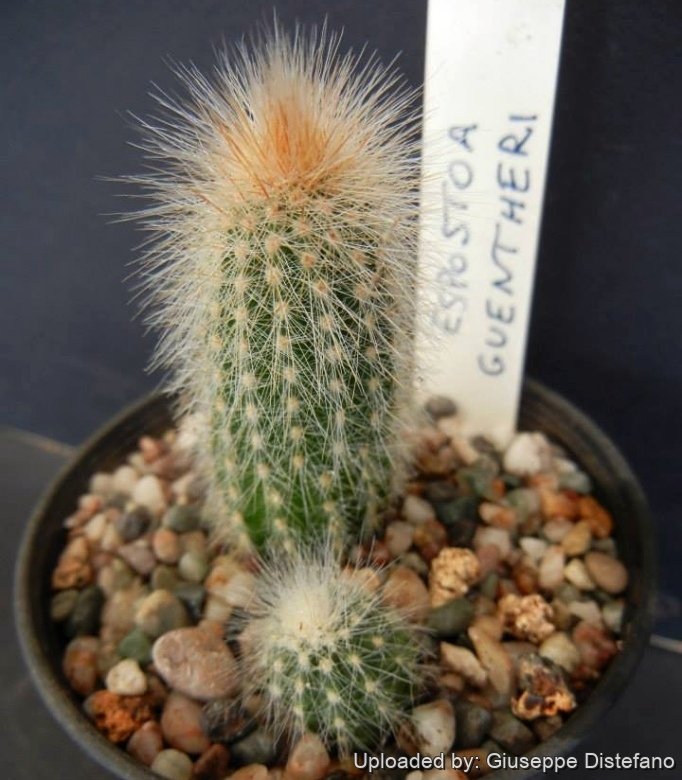
Espostoa guentheri (syn: Vatricania guentheri) is a shrubby columnar cactus with attractive golden-spined stems that exhibit varying densities of fox-red lateral cephalia; that is, beds of woolly hairs grown on the sides of the branches from which comes flowers and fruits. Any impassioned cactophile would like to see Espostoa guentheri in habitat. There is no sight quite like it.
Habit: It grows in habitat to about 2 m high and will branch in age from the base and may have as many as fifteen branches.
Stems: Pale green, erect, up to 2(-3) m tall and 10 cm in diameter.
Ribs: 27, barely tuberculate.
Areoles: Yellowish white, woolly, spaced about 1 cm on the rib.
Spines: 15-25 spines, 5-22 mm long straw yellow.
Cephalium: Lateral, up to 50 cm long, and 6-7 cm thick, that on average in mature specimens, occupies about half of the ribs, brownish, with reddish-brown to grey wool, reddish bristles and many spines 4-6 cm long. The cephalium, which is a zone of long, fine spines, first occurs superficially on one side of the stem but eventually grows to completely encircle the top of the plant often making them resemble elongated leeches. This can he achieved in a glasshouse but takes many years since the plant tends to he slow growing in cultivation. The cephalium is often oriented in only one direction, but now and then different branches will have cephalia facing in different directions. Given that this species inhabits proximity to the equator, where there is no evident advantage to orientation in any particular direction.
Flowers: Campanulate to tubular, yellowish or whitish up to 8 cm long, 2,5-3 cm in diameter pericarpels and floral tubes with fine pinkish wool.
Fruits: Roundish, scaly edible but not particularly tasty or sweet of odd texture and a flavour that ranges from indifferent to strange.
Blooming period: The flowers come in early summer.
Remarks: Espostoa guentheri was placed in its own genus Vatricania because it occurs in eastern Bolivia whereas all the Espostoas occur in Peru. It is probably polyphyletic because it is more closely related to Cleistocactus and Echinopsis huotii than to the other Espostoa species.
Origin and Habitat
Eastern Bolivia (Río Grande valley in Chuquisaca and Santa Cruz, and probably in extreme southeastern Cochabamba). The species is known from a rather small area (extent of occurrence <500 km2)
Altitude: 800-1300 metres above sea level.
Habitat and Ecology: Espostoa guentheri occurs in seasonally dry forest vegetation within an inter-Andean valley, often covering a hillside, or forming a cactus forest with other species. The the area is dry and hot at times, but wet enough to support leafy trees and shrubs. Espostoa guentheri is quite common where it occurs. Ongoing road construction in the southern end of its range is reducing the population, but there are currently no other known threats.
Cultivation and Propagation
It is easy to grow. Need a fertile, well drained soil mix. Water the plants well and allow them to dry before watering again. This species seems to do better with a little more water than most cacti. During the growing season fertilize them monthly with a balanced fertilizer. Espostoa produces noticeable amounts of growth each year if kept well fed and watered throughout the warmest months, particularly if it has been acclimatised to accept full sun. Once this cactus is established it can easily produce 20 cm of growth every year.
Sun Exposure: Outside full sun, inside needs bright light, and some direct sun.
Winter rest: During winter month, put them in a cool luminous place and encourage them to enter winter dormancy by withholding water and fertiliser over the winter as they will etiolate, or become thin, due to lower levels of light. It is hard as low as 0 °C (or less) but it is best a warm habitat means that a minimum of 10°C should be maintained to avoid marking of the stem.
Pests and disease: They are susceptible to fungal diseases if overwatered, but are not nearly as sensitive as many other cacti, especially in warm weather. If kept damp through cold periods, they will invariably suffer.
Propagation: Cutting or seeds. The seeds are quite easy to germinate and grow. Their main requirements consist of high humidity levels, free-draining soil mix, and enough water, light, and nutrition.
Bibliography
Major references and further lectures.
-
Lowry, M. 2013. Espostoa guentheri. In: IUCN 2013. “IUCN Red List of Threatened Species.” Version 2013.2. <www.iucnredlist.org>. Downloaded on 23 March 2014.
-
Edward Anderson “The Cactus family” Timber Press, Incorporated, 2001
-
James Cullen, Sabina G. Knees, H. Suzanne Cubey “The European Garden Flora Flowering Plants: A Manual for the Identification of Plants Cultivated in Europe, Both Out-of-Doors and Under Glass” Cambridge University Press, 11/Aug/2011
-
David R Hunt; Nigel P Taylor; Graham Charles; International Cactaceae Systematics Group. “The New Cactus Lexicon” dh books, 2006
-
Backeberg, C “Die Cactaceae” volumes IV, VI. Fischer-Verlag, Jena, Germany 1960
-
Kranz, H. Die Kakteen Lieferung 33, Stuttgart, Germany 1966
-
Kupper, W. “Cephalocereus guentheri n.sp.” in: Monatschrift der DKG 3:159, Berlin, Germany 1931
8)Rritter, F. “Kakteen in Südamerika” volume 2 Self-Published 1980
From llifle page Cephalocereus guentheri f. cristatus
Cultivation and Propagation
It is not too difficult in a greenhouse, although grows quite slowly. It is usually seen as a grafted plant but can grow on its own roots too.
Soil: Use a mineral well permeable soil with little organic matter (peat, humus).
Exposure: They need a good amount of light shade to full sun this help to keep the plants healthy, although slow growth.
Watering: Water sparingly from March till October (weekly during summertime, if the weather is sunny enough), with a little fertilizer added. Less or no water during cold winter months, or when night temperatures remain below 10° to prevent root loss. It is sensitive to overwatering (rot prone).
Fertilization: Feeding may not be necessary at all if the compost is fresh then, feed in summer only if the plant hasn’t been repotted recently. Do not feed the plants from September onwards as this can cause lush growth which can be fatal during the darker cold months.
Hardiness: Keep perfectly dry in winter at temperatures from 5 to 15 degrees centigrade. (but it is relatively cold resistant and hardy to -5° C, or possibly colder for short periods) In the rest period no high atmospheric humidity!! (Temperature Zone: USDA 9-11)
Crested growth: Unlike ‘monstrose’ varieties of plants, where the variation from normal growth is due to genetic mutation, crested growth can occur on normal plants. Sometimes it’s due to variances in light intensity, or damage, but generally the causes are unknown. A crested plant may have some areas growing normally, and a cresting plant that looks like a brain, may revert to normal growth for no apparent reason. If you have any of the crested part left you need to remove the normal growth and leave the crested part behind this will need to be done regularly.
Propagation: Grafting or cuttings. Plants are usually grafted onto column-shaped cacti but proved to be able to produce their own roots if degrafted. Cuttings will take root in a minimum temperature of 20° C (but better in hot weather). Cuttings of healthy shoots can be taken in the spring and summer. Cut the stem with a sharp, sterile knife, leave the cutting in a warm, dry place for a week or weeks (depending on how thick the cutting is) until a callus forms over the wound. Once the callus forms, the cutting may be inserted in a container filled with firmed cactus potting mix topped with a surface layer of coarse grit. They should be placed in the coarse grit only; this prevents the cut end from becoming too wet and allows the roots to penetrate the rich compost underneath. The cuttings should root in 2 to 6 weeks. Large crested piece must be placed on the soil surface without burying the plant base down in the soil.
Source: Cephalocereus guentheri f. cristatus, LLIFLE - Encyclopedia of living forms, CC-BY-SA, retrieved 2026-10-25.
From llifle page Cephalocereus guentheri f. monstruosus
Description
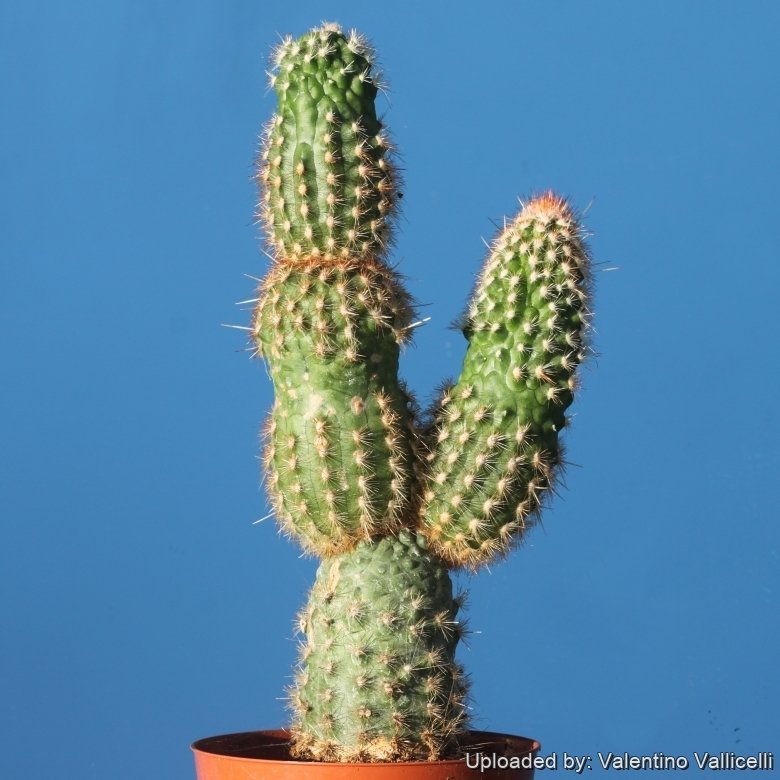
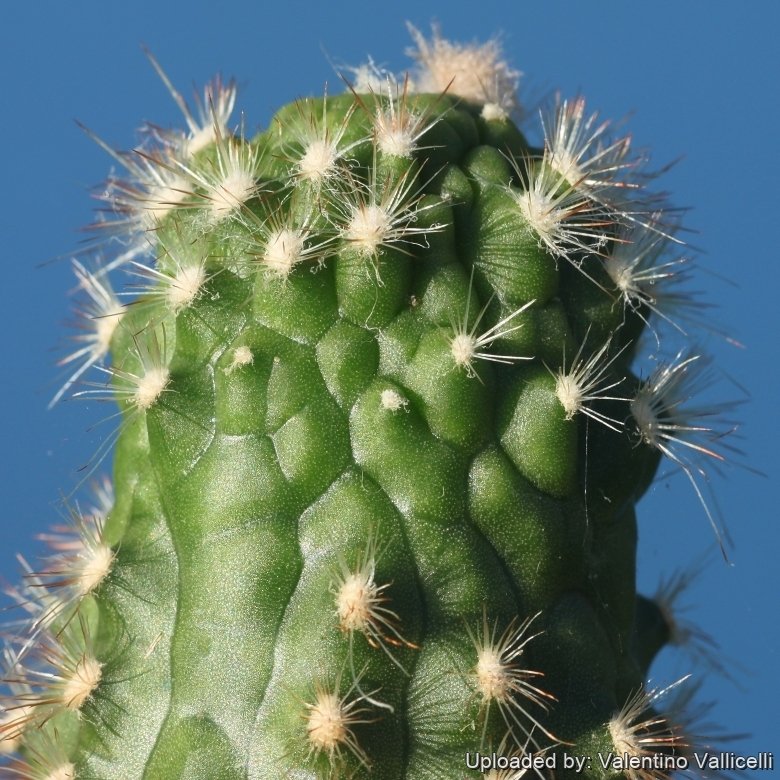
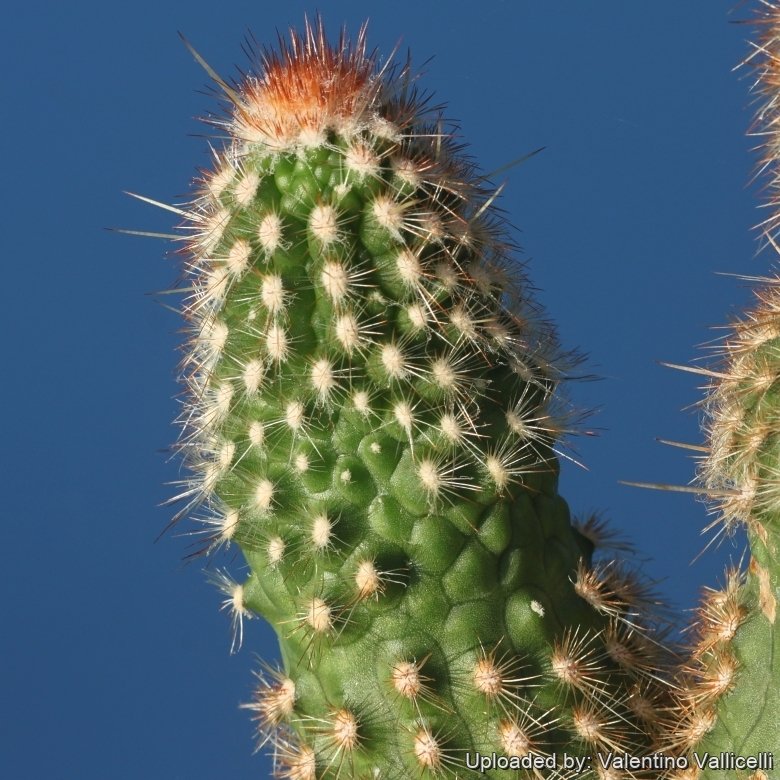
This is a monstrous form with stems constricted in irregular segments. The ribs structure varies from part to part of the stems, in some areas the ribs are almost normal, vertical with standard spiny areoles, while in other places the ribs disappear and the surface is formed by flattened, polygonal, spineles, tubercles, whit transitional parts between.
The standard Espostoa guentheri (Vatricania) is a shrubby columnar cactus with attractive golden-spined stems that exhibit varying densities of lateral cephalia; that is, beds of woolly hairs grow on the sides of the branches from which comes flowers and fruits. It grows in habitat to about 2 m high and will branch in age from the base. This species was placed in its own genus Vatricania because it occurs in eastern Bolivia whereas all the Espostoas occur in Peru.
Stems: Pale green, erect, up to 2(-3) m tall and 10 cm in diameter.
Ribs: 27, barely tuberculate.
Areoles: Yellowish white, woolly, spaced about 1 cm on the rib.
Spines: 15-25 spines, 5-22 mm long straw yellow to reddish.
Cephalium: Lateral up to to 50 cm long, and 6-7 cm thick, brownish, with reddish-brown to grey wool, reddish bristles and many spines 4-6 cm long. The cephalium, which is a zone of long, fine spines, first occurs superficially on one side of the stem but eventually grows to completely encircle the top of the plant often making them resemble elongated leeches. This can he achieved in a glasshouse but takes many years since the plant tends to he slow growing in cultivation. The cephalium is often oriented in only one direction, but now and then different branches will have cephalia facing in different directions. Given that this species inhabits proximity to the equator, where there is no evident advantage to orientation in any particular direction.
Flowers: Campanulate to tubular, yellowish or whitish up to 8 cm long, 2,5-3 cm in diameter pericarpels and floral tubes with fine pinkish wool.
Fruits: Roundish, scaly edible but not particularly tasty or sweet of odd texture and a flavour that ranges from indifferent to strange.
Blooming period: The flowers come in early summer.
Origin and Habitat
Garden origin (Nursery produced cultivar)
Cultivation and Propagation
It is easy to grow. Need a fertile, well drained soil mix. Water the plants well and allow them to dry before watering again. This species seems to do better with a little more water than most cacti. During the growing season fertilize them monthly with a balanced fertilizer. Espostoa produces noticeable amounts of growth each year if kept well fed and watered throughout the warmest months, particularly if it has been acclimatised to accept full sun.
Sun Exposure: Outside full sun, inside needs bright light, and some direct sun.
Winter rest: During winter month, put them in a cool luminous place and encourage them to enter winter dormancy by withholding water and fertiliser over the winter as they will etiolate, or become thin, due to lower levels of light. It is hard as low as 0 °C (or less) but it is best a warm habitat means that a minimum of 10°C should be maintained to avoid marking of the stem.
Pests and disease: They are susceptible to fungal diseases if overwatered, but are not nearly as sensitive as many other cacti, especially in warm weather. If kept damp through cold periods, they will invariably suffer.
Propagation: Cutting or from seed. The seeds are quite easy to germinate and grow. Their main requirements consist of high humidity levels, free-draining soil mix, and enough water, light, and nutrition.
Source: Cephalocereus guentheri f. monstruosus, LLIFLE - Encyclopedia of living forms, CC-BY-SA, retrieved 2026-10-25.
Cultivars and forms (2)
Gallery