Publication: Enum. Pl. (Willdenow) 501 1809.
Description
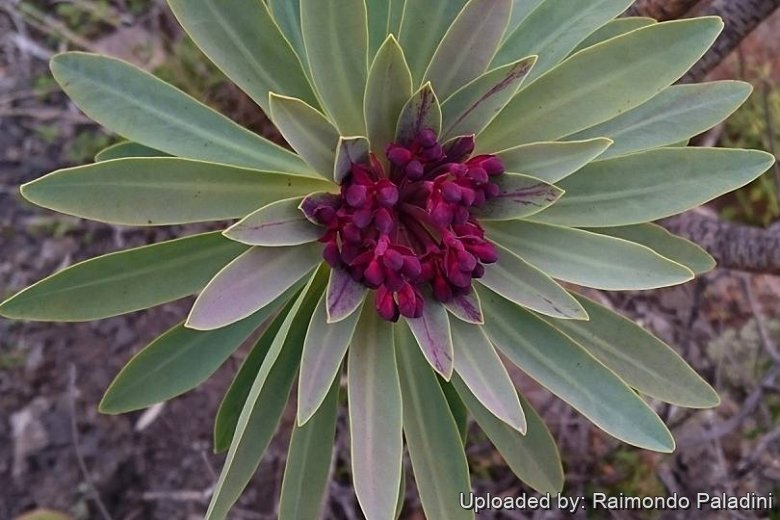
Euphorbia atropurpurea comes from the Canary Isles and is hence one of the hardier species from this genus. It is a shrub that can reach 1.5-2 metres in height or more, with dichotomous fleshy branches with long pointed leaves and the inflorescence is in the form of a mass of bronze-purple or rarely yellowish (f. Lutea) bracts greater than 1 cm in size. It should not be confused with E. bravoana, which is endemic to the nearby island of La Gomera and also has purple-red bracts.
Derivation of specific name: The flowers have dark red bracts. These bracts lend the plant its name, atropurpurea (from the Latin ater or “black”, and purple).
Branches: Fleshy, cinnamon-brown without spines, to 1 cm in diameter, covered with leaf-scars.
Leaves: Large forming a rosette at the end of the branches. Lanceolate, spatulate to oblong bluish green, to 7.5(-15) cm long and 1.5 cm wide, sessile, in dense rosettes at branches tips. After leaves wilting, the branches remain bare.
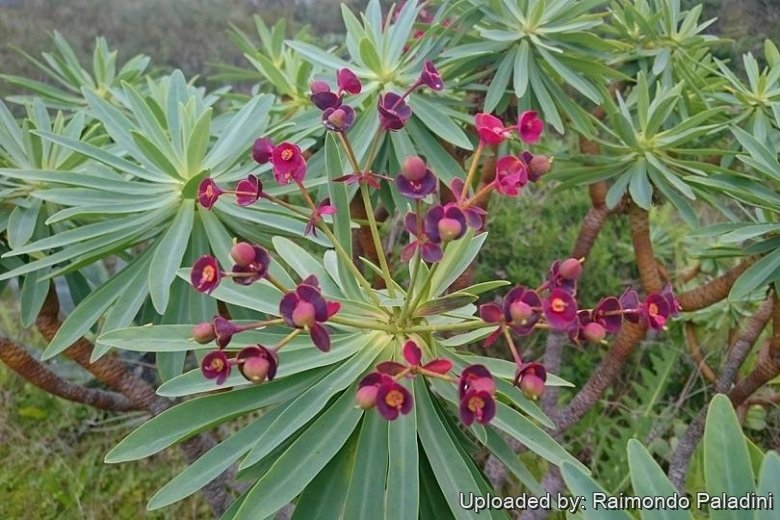
Inflorescences: Terminal, equal to leaves with cymes in 5- to 15-rayed umbels, each ray with 3-5 secondary rays. Bracts broadly ovate or kidney shaped, 1 cm in diameter or more, dark bronze-purple/violet bracts.
Flowers (Cyathia): Subsessile, shortly hairy. The nectar-glands are 4, elliptic, and vary in colour from yellow-green to (usually) dark purple.
Blooming season: The plant flowers from winter to spring (December to May).
Fruits: The fruit is a smooth, 3-celled, dull-green to reddish-brown, obtusely lobed capsule with three seeds. The capsule protrudes from the cyathium on a recurved stalk.
***Seeds:** The seeds are elongated, dark brown, finely wrinkled and bear appendages (caruncules).
Origin and Habitat
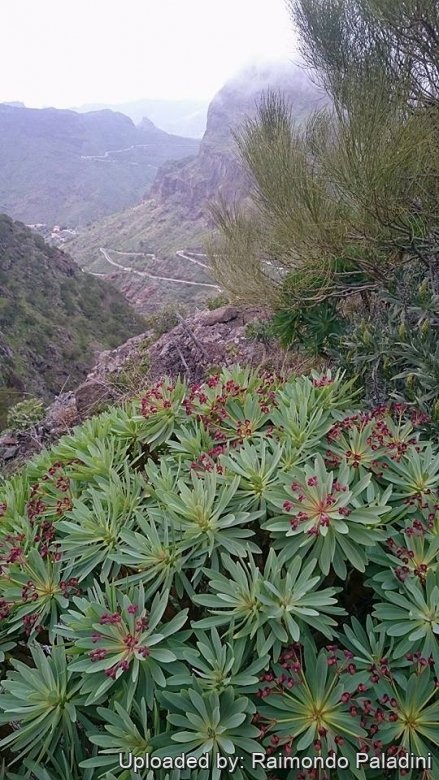
Euphorbia atropurpurea is native to Tenerife in the Canary Islands. The plant grows best in humid conditions in mid to low altitudes (300-1,200 m) on the south and west parts of the island. It is plentiful in the towns of Teno, Santiago del Teide, and the slope of Güímar.
Habitat and ecology: This species grows in ravines, and on slopes and terraces. In the area of Masca, in Tenerife, hybrids between E. atropurpurea and Euphorbia regisjubae occur, which the Swedish botanist Eric Ragnor Sventenius named Euphorbia navae.
Cultivation and Propagation
Euphorbiaa atropurpurea is used as an ornamental plant in gardens for its eye-catching appearance and flowers. It requires little care, but requires sunlight and a certain amount of environmental humidity. In cultivation it appears often as a very long thin stem, probably because people get so fed up with it that they throw it out.
Warnings: Like other plants in the genus Euphorbia, it produces a toxic white latex if cut.
Propagation: It generally spreads by seeds, or more rarely by simply branching out.
Bibliography
Major references and further lectures
-
Urs Eggli “Illustrated Handbook of Succulent Plants: Dicotyledons” Springer Science & Business Media, 2002
-
“The Cactus and Succulent Journal of Great Britain”, Volumi 32-35 Cactus and Succulent Society of Great Britain, 1970
-
Wikipedia contributors. “Euphorbia atropurpurea.” Wikipedia, The Free Encyclopedia. Wikipedia, The Free Encyclopedia, 5 Mar. 2017. Web. 6 Mar. 2017.
-
Bramwell, D.; Bramwell, Z. “Wild flowers of the Canary Islands.” Madrid, Spain: Editorial Rueda. 2001.
-
Euphorbia atropurpurea in: “Flora de Canarias” http://www.floradecanarias.com/euphorbia\_atropurpurea.html
-
Arnoldo Santos Guerra: “Notas sobre Euphorbia bourgaeana Gay ex Boiss. in DC. y especies afines.” In: Botánica Macaronésica. Volume16, 1988, http://mdc.ulpgc.es/utils/getfile/collection/botmaca/id/214/filename/215.pdf
-
Peter Schönfelder, Ingrid Schönfelder “Die Kosmos-Kanarenflora (= Kosmos-Naturführer)”. Franckh-Kosmos, Stuttgart, 1997
-
Adalbert Hohenester, Walter Weiß: “Exkursionsflora für die Kanarischen Inseln”. Ulmer, Stuttgart 1993
Gallery