Publication: Prodr. [A. P. de Candolle] 15(2): 11 (1862)
Description
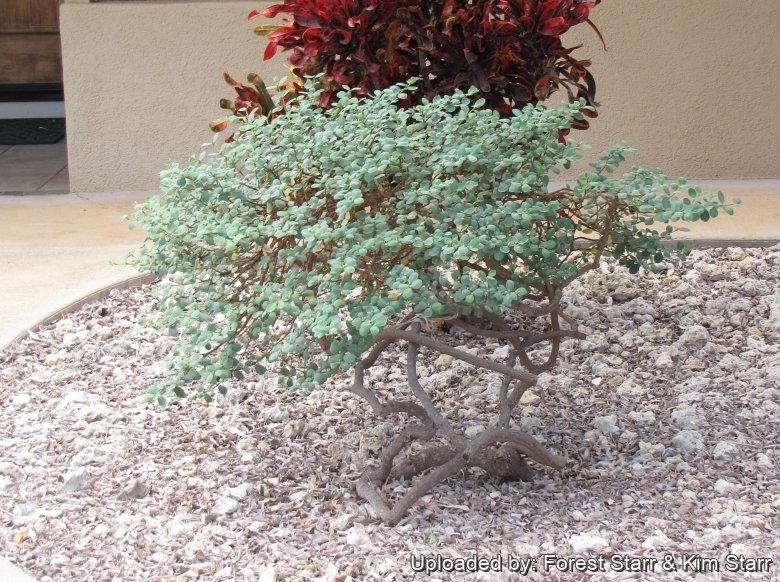
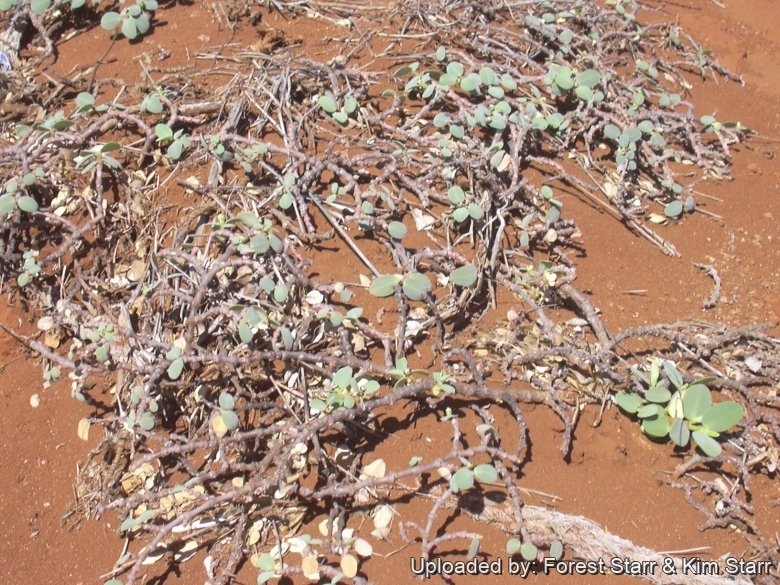
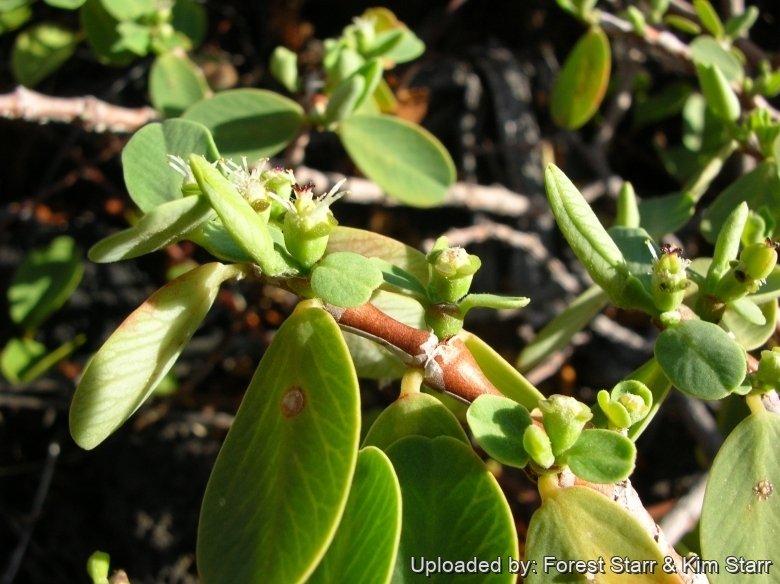
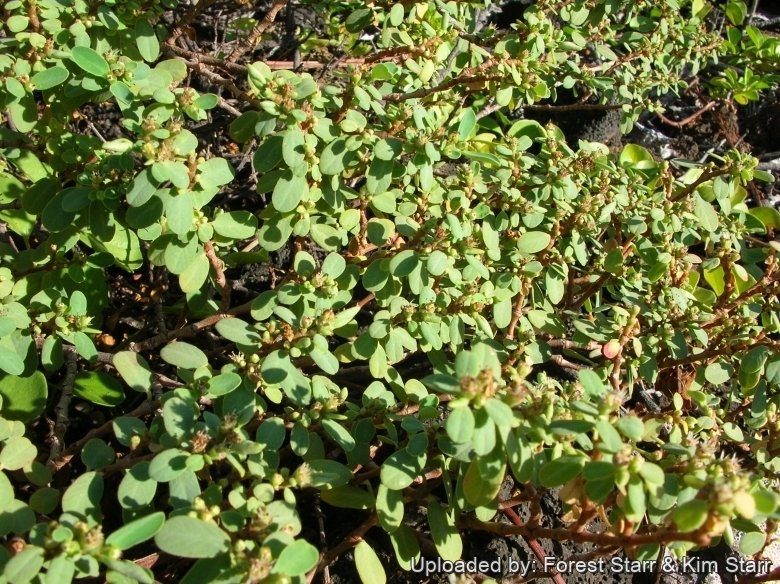
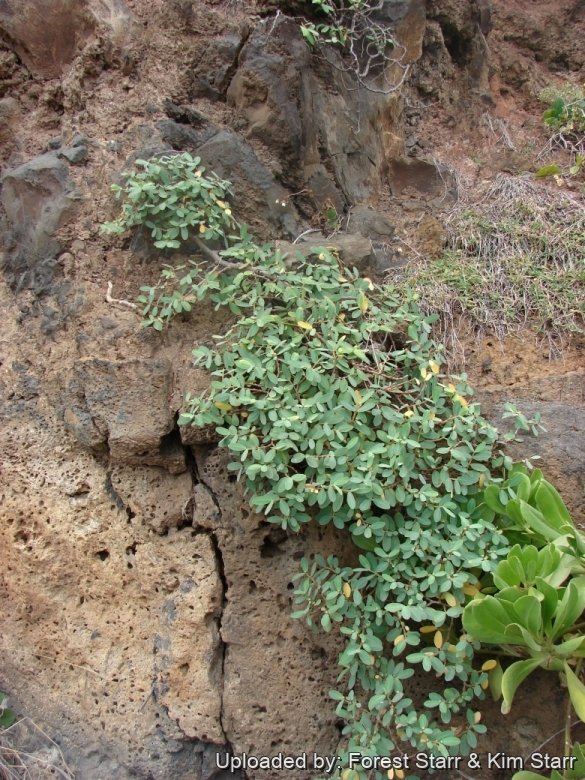
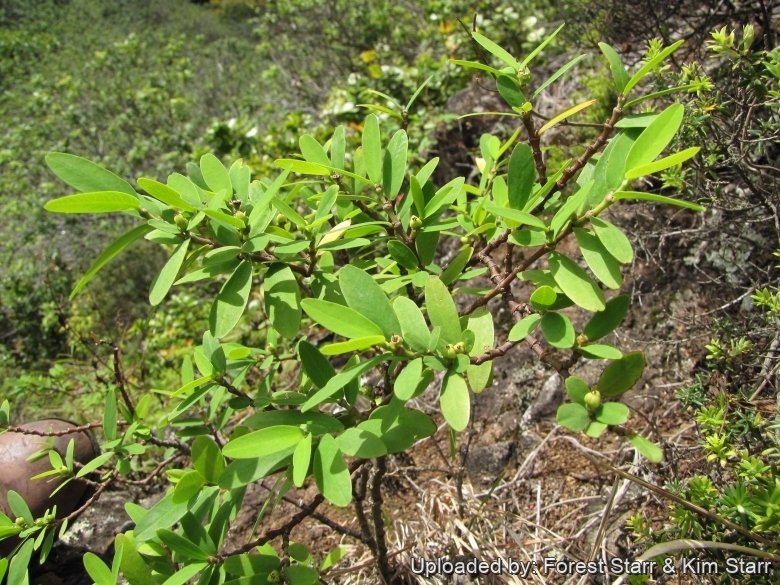
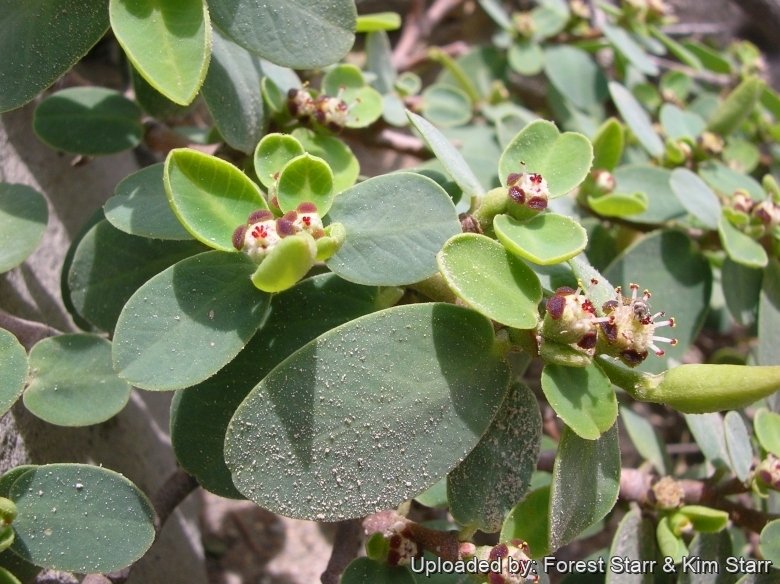
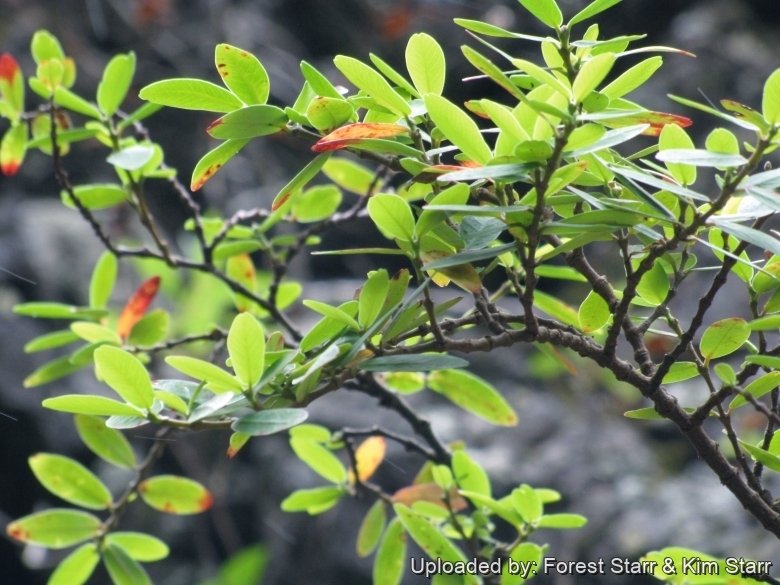
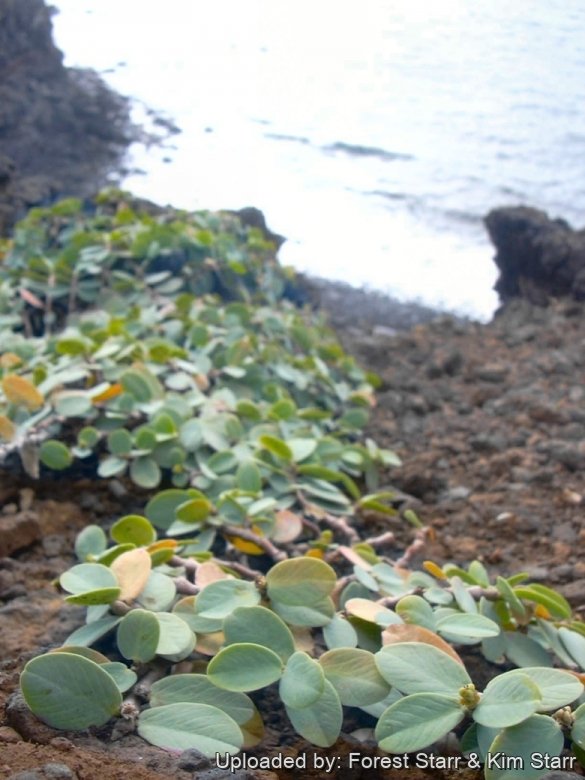
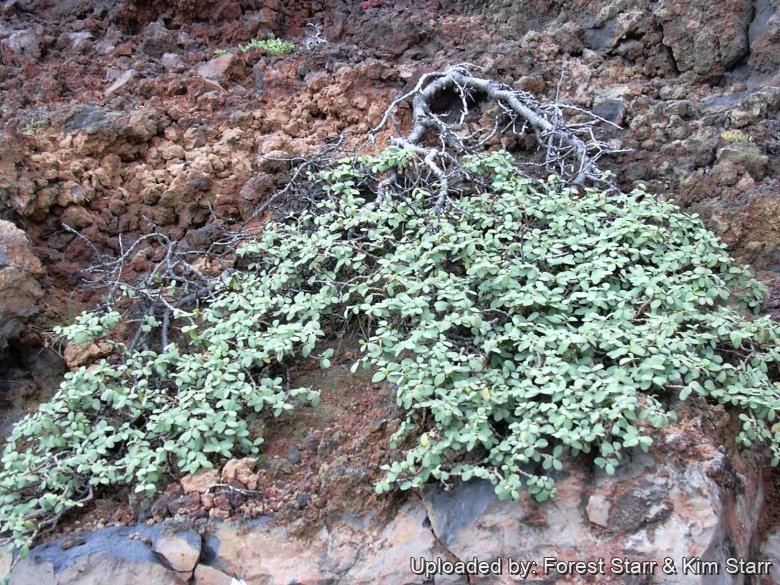
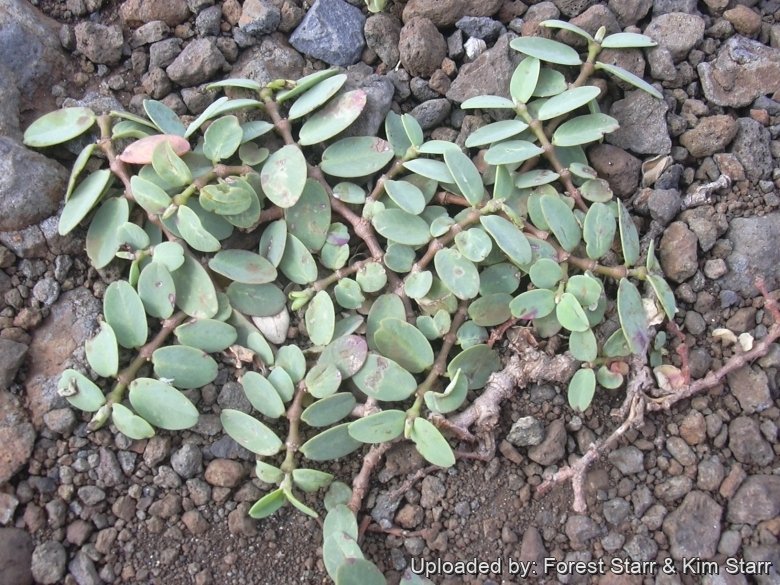
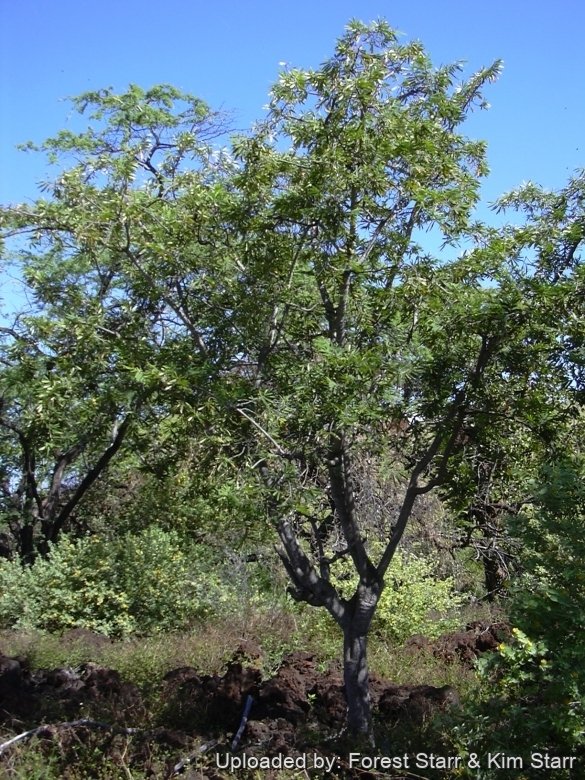
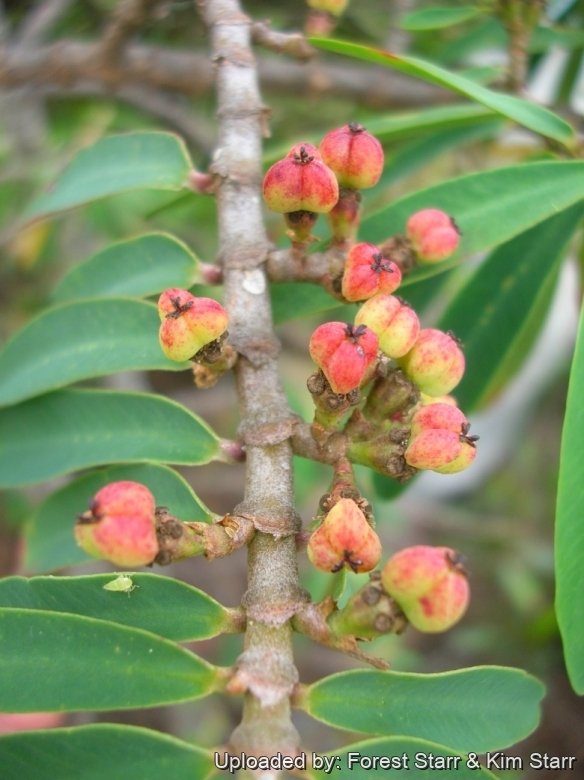
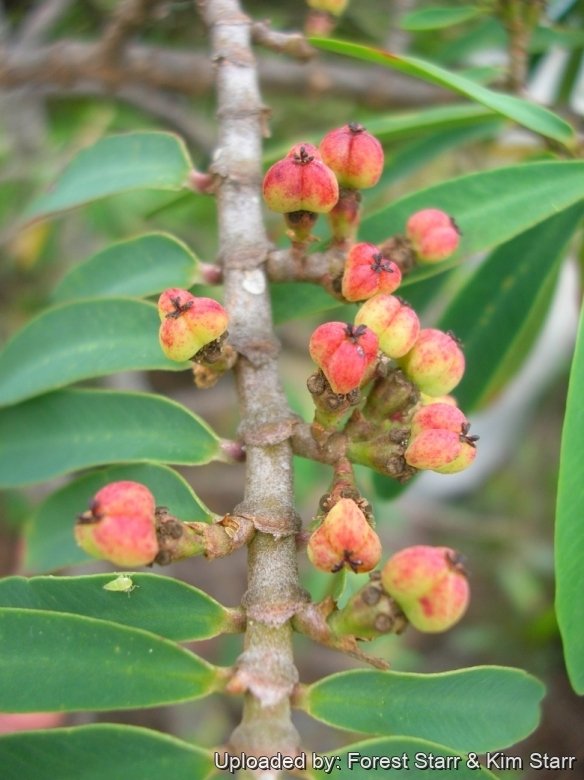
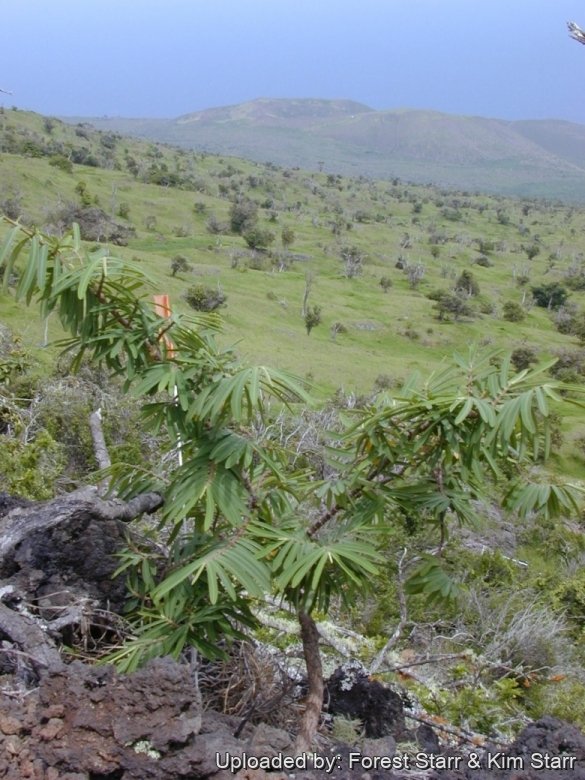
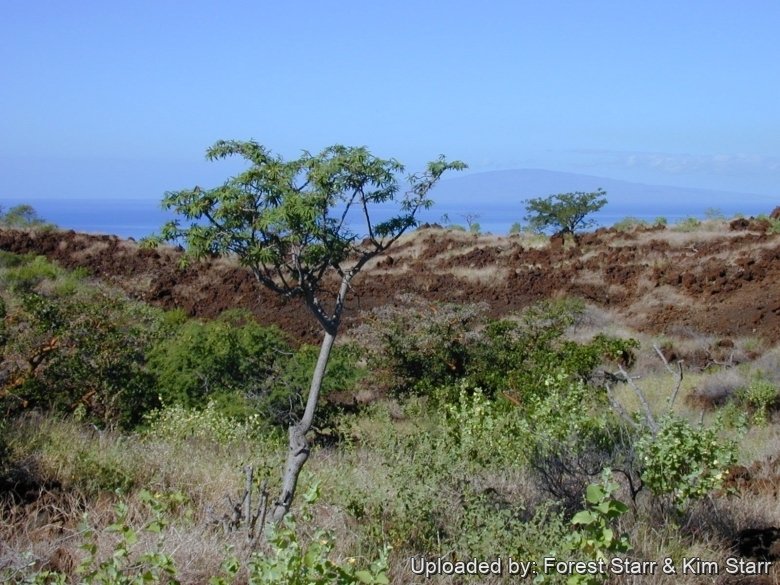
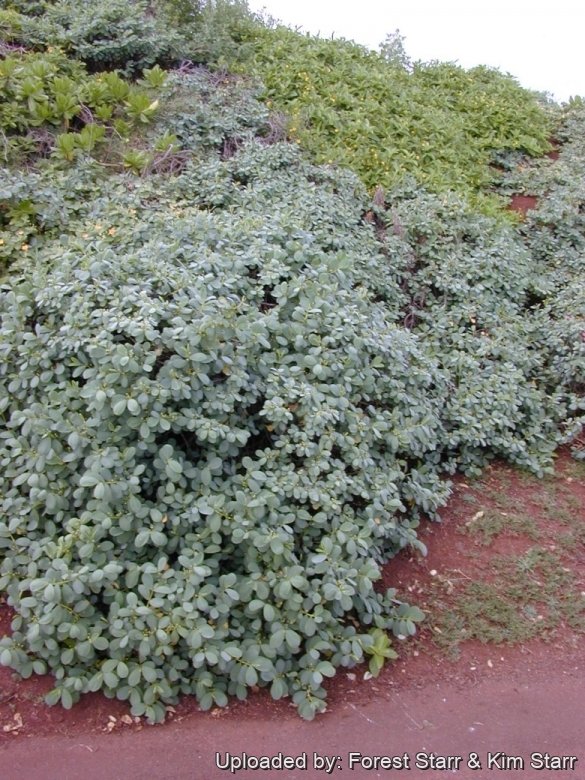
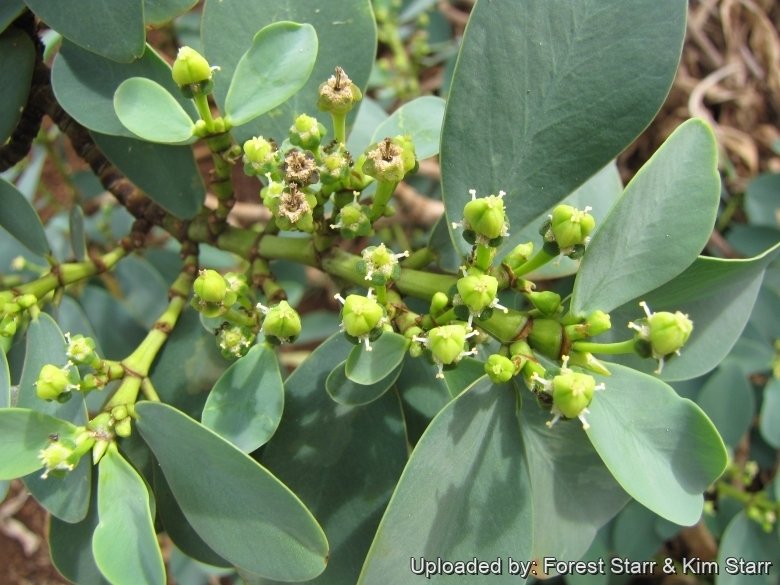
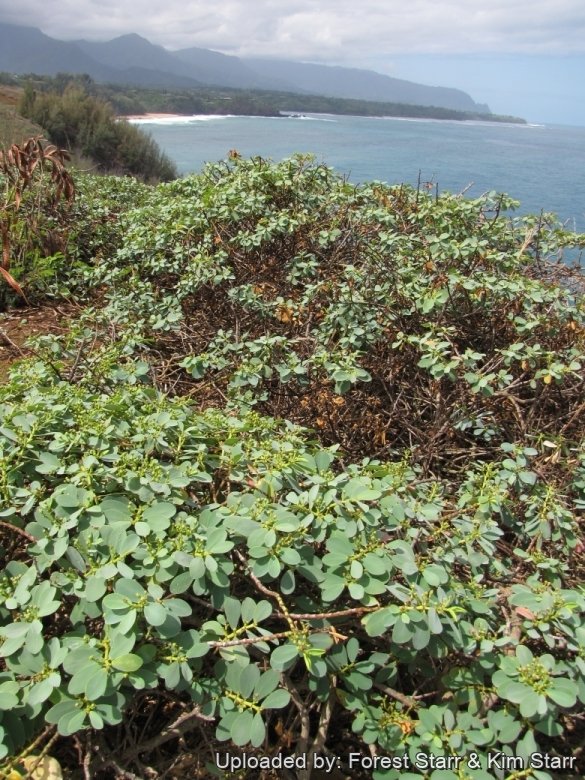
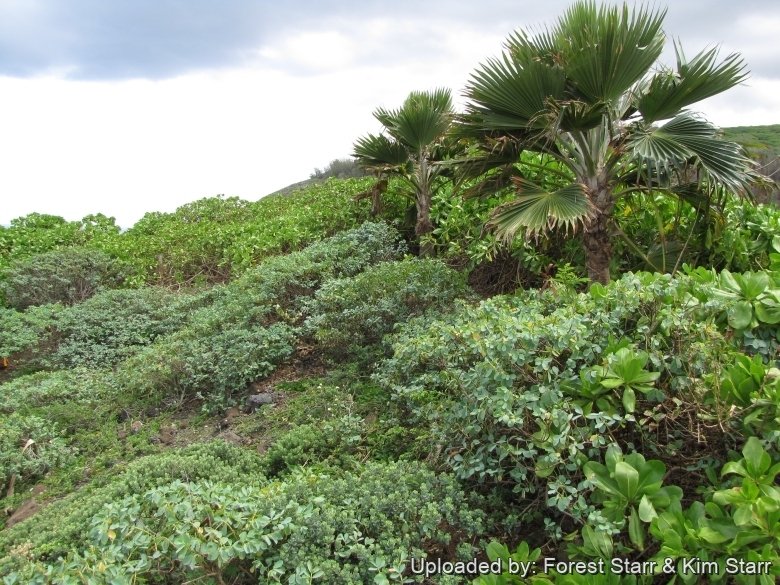
Euphorbia celastroides, previously also known as Chamaesyce celastroides, is a species of spurge that grows as a medium-sized evergreen shrub or small tree reaching at most 1-2 m in height and diameter. This species develops into a round-shape shrub, both glabrous and pubescent forms are known. While the flowers are not showy, the bright pinkish to red fruits can be uniquely appealing en masse. It is by far the most variable and widespread of all Hawaiian Chamaesyce and there are at least 30 described varieties that in all probability they can all be included within the variation of the one species. The erectly held capsules distinguish it from all other Hawaian Chamaesyce except Chamaesyce herbstii and Chamaesyce rockii, which have distinctive large fruit.
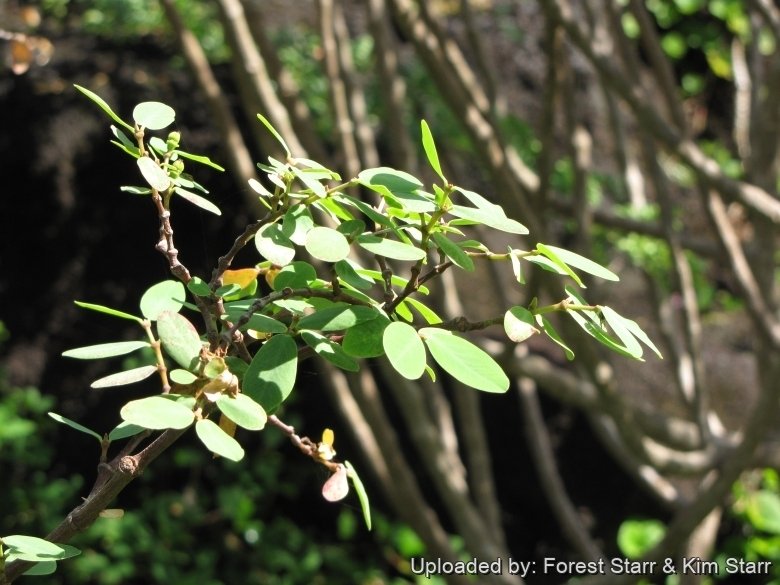
Euphorbia celastroides var. celastroides The leaves are of this variety are glabrous (without hairs) and narrow.
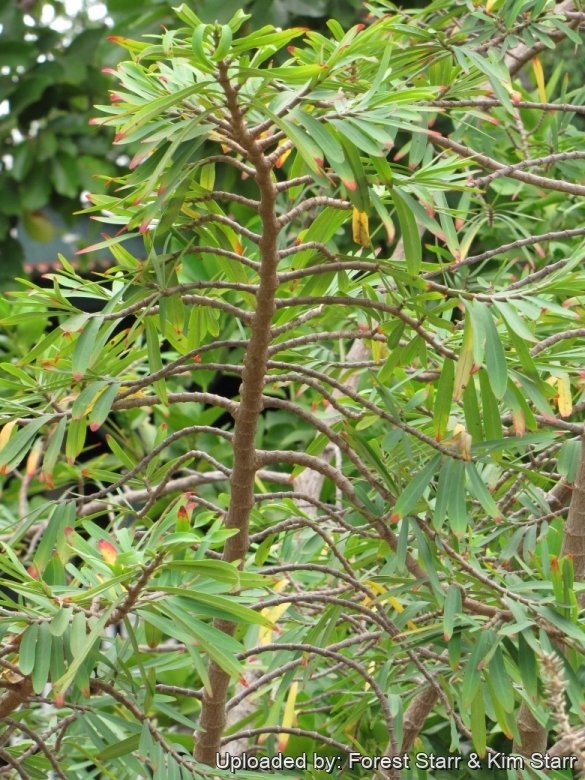
Stems: Slightly succulent adapted to store water, forming a loosely branching short trunk. The secondary or young branches are stiff, with short internodes. A milky, sticky latex naturally oozes from wounds.
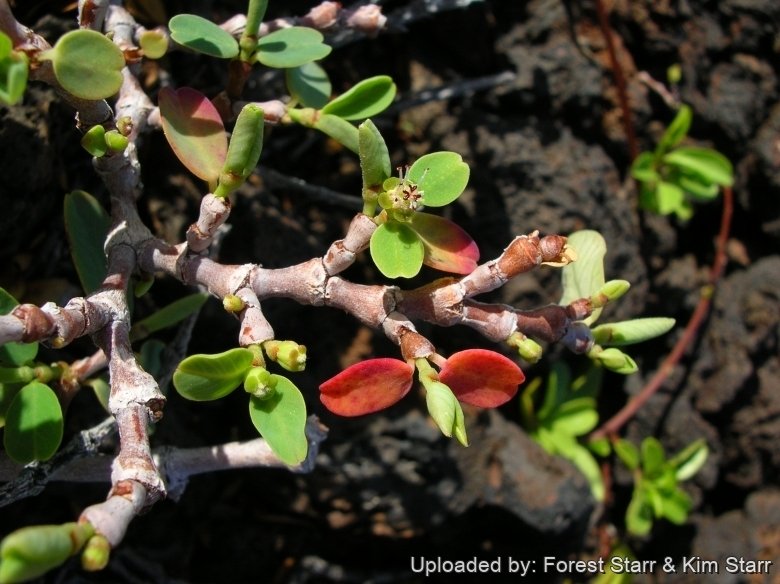
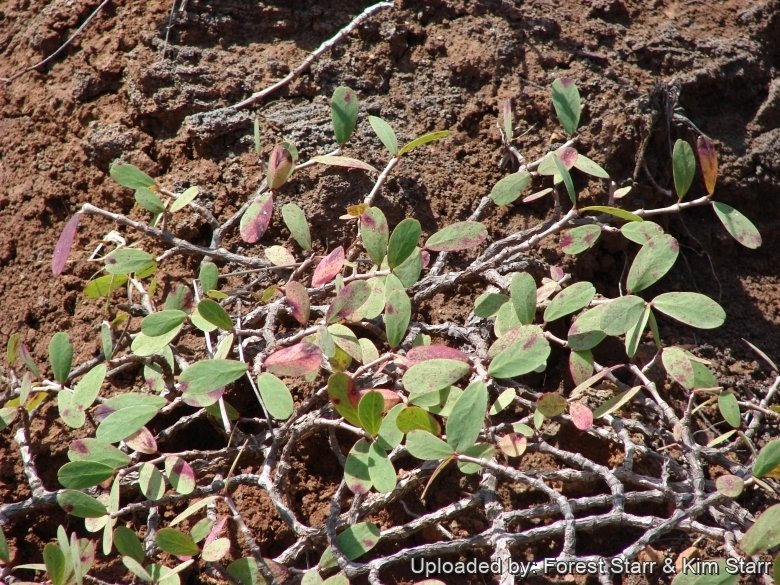
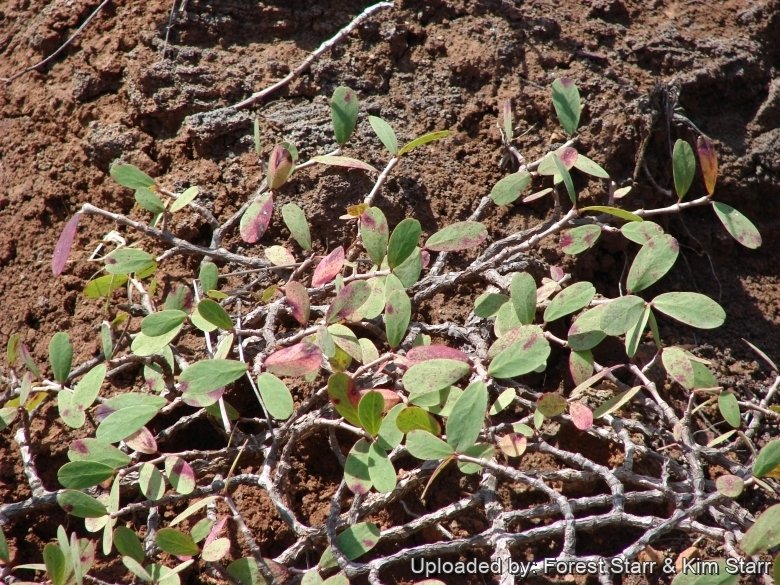
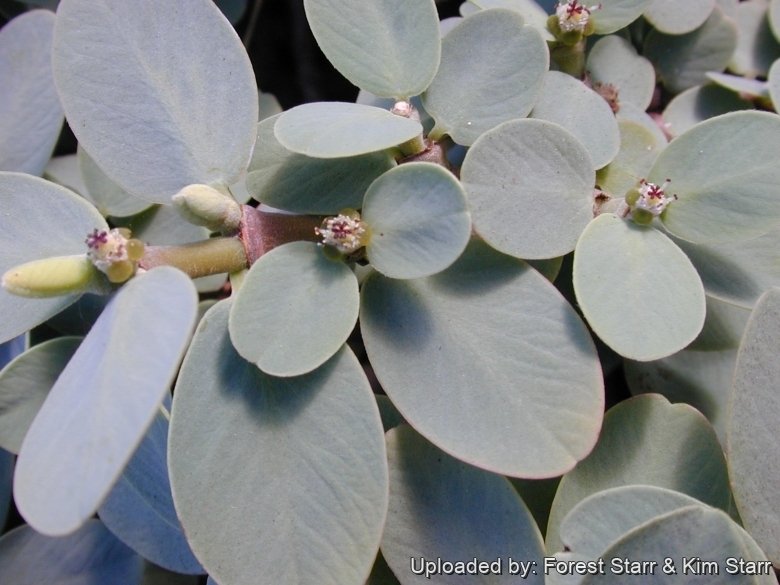
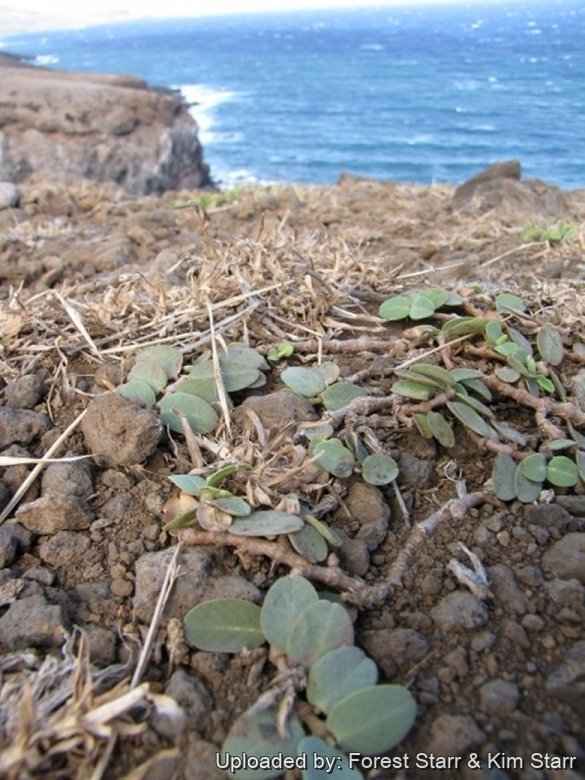
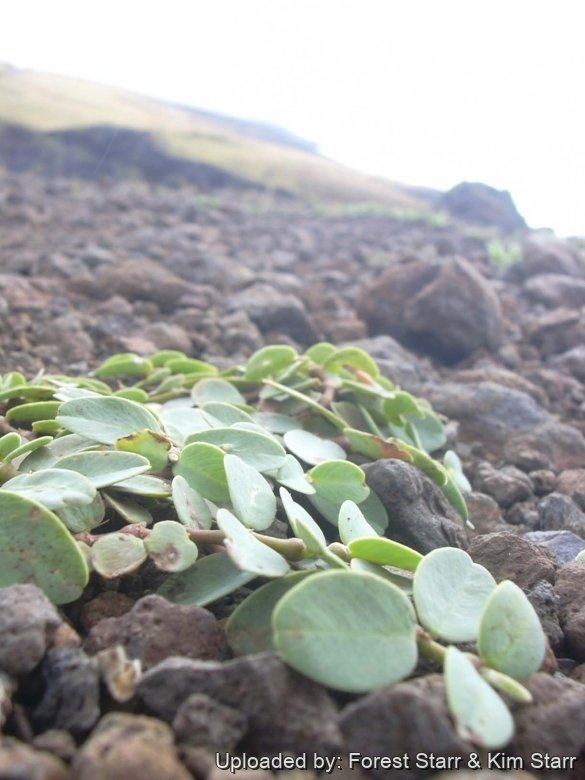
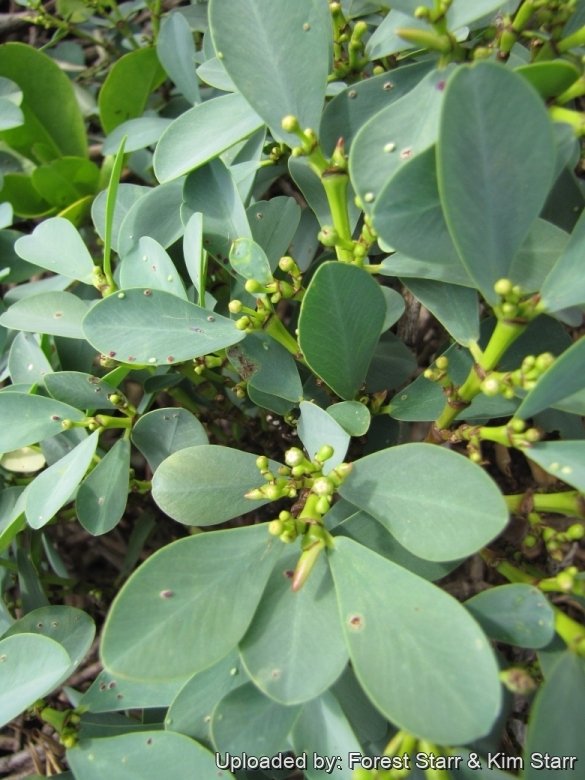
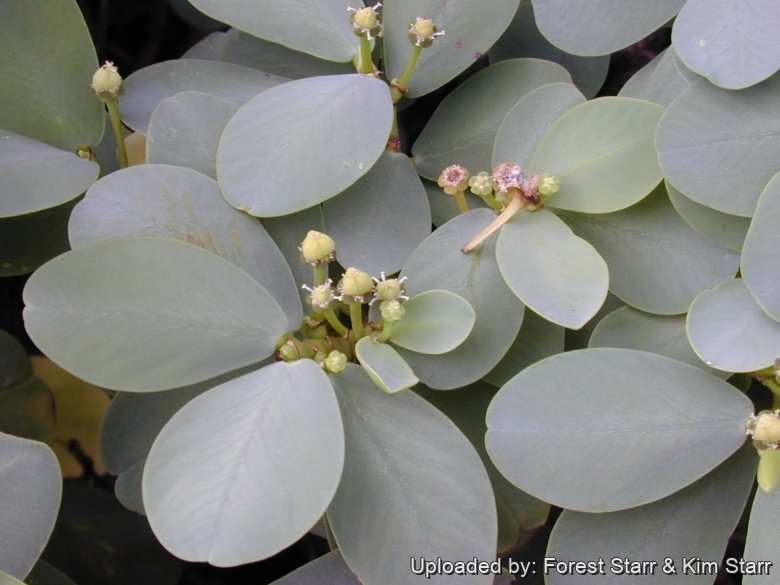
Leaves: Small, distichous (growing in two vertical rows) and may have a glaucous coating. Often the leaves in the summer assume a red-violet colouring. It does not lose its leaves in the winter, due to the warm climate of its range, but may shed the leaves in dry, hot weather. Damaged or old leaves turn a blood red as they die.
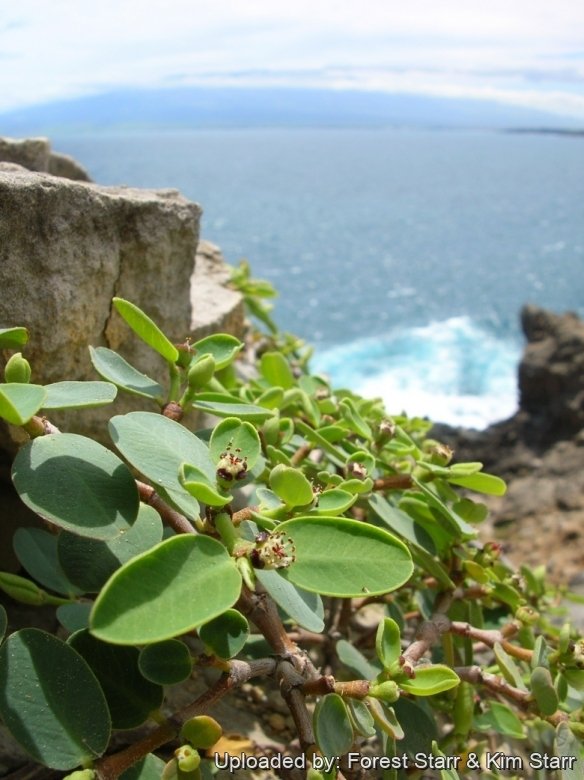
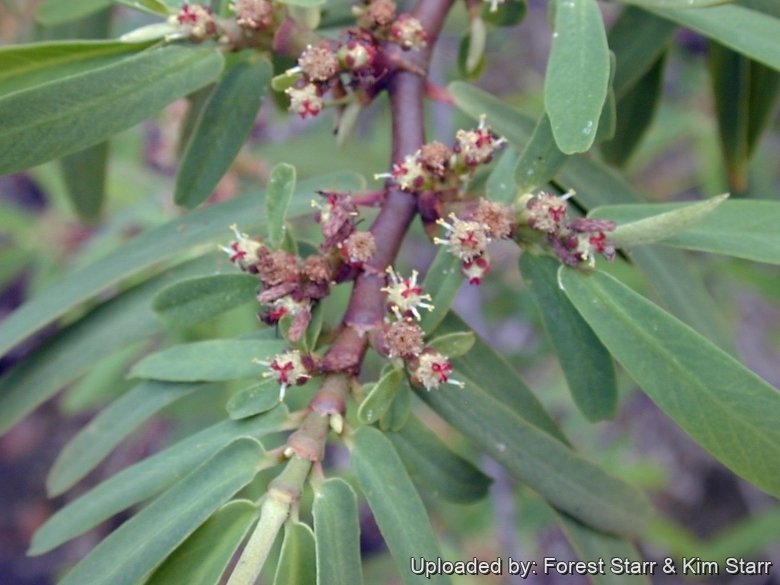
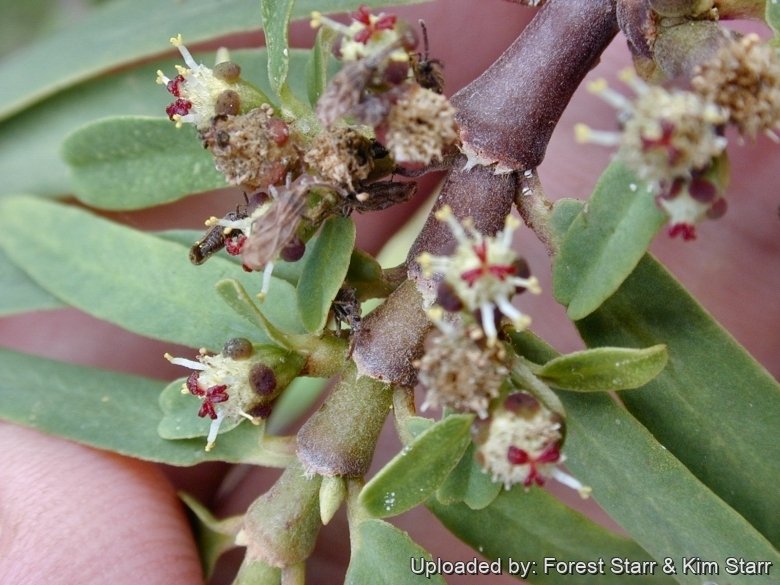
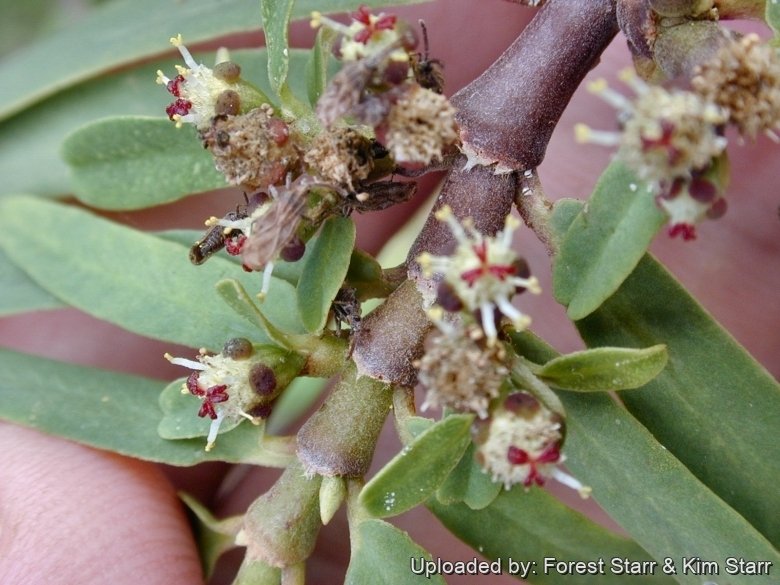
Flowers (cyathia): Small, brownish to greenish-white, not showy, a few millimeters in diameter, located in short or open-branched cymes, or ungrouped in leaf axils. Female cyathia have a three-part pistil over a three-part ovary, usually producing three (or sometimes more) seeds. The pungent flowers of ʻakoko have been described as smelling like bad breath.
Fruit: Green or reddish-brown or pink, rounded 2 to 4 mm long. Within each capsule are two or three small seeds.
Phenology: Euphorbia celastroides produces flower and fruit repeatedly throughout the year.
Seeds: Grey-brown seeds 0.5 to 2.5 mm long.
Origin and Habitat
Euphorbia celastroides is endemic to all the main Hawaiian Islands (Kauaʻi, Niʻihau, and Nīhoa). It is locally aboundant on low elevations.
Altitudinal range: This species is found from the coast to upland mesic forest.
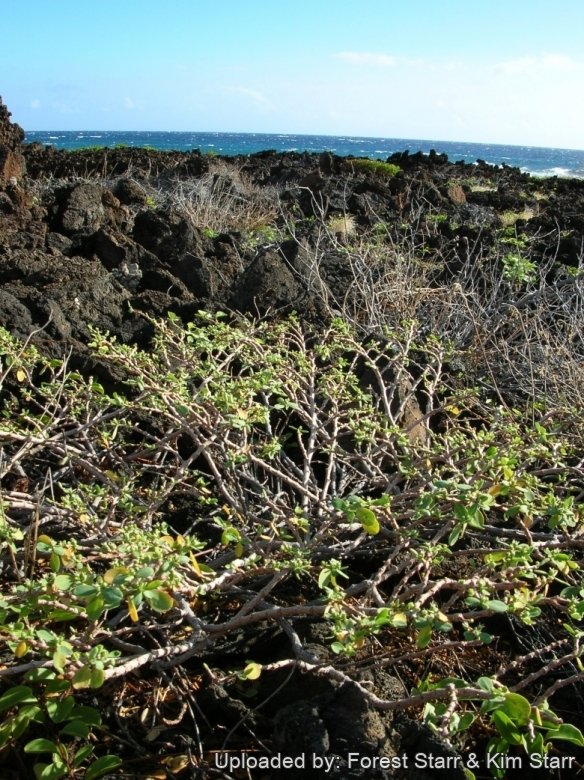
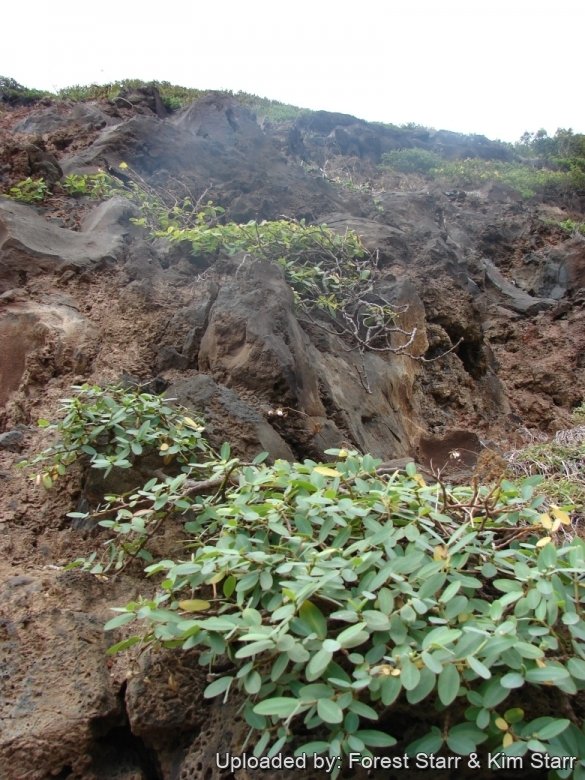
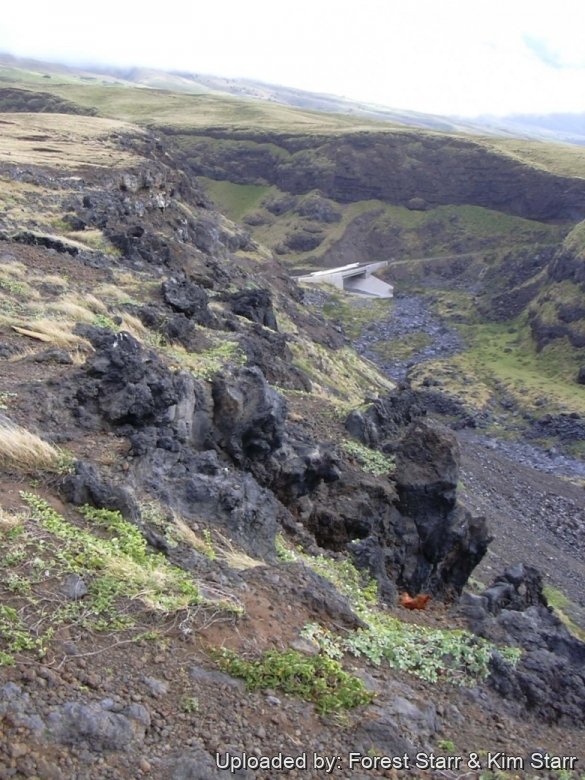
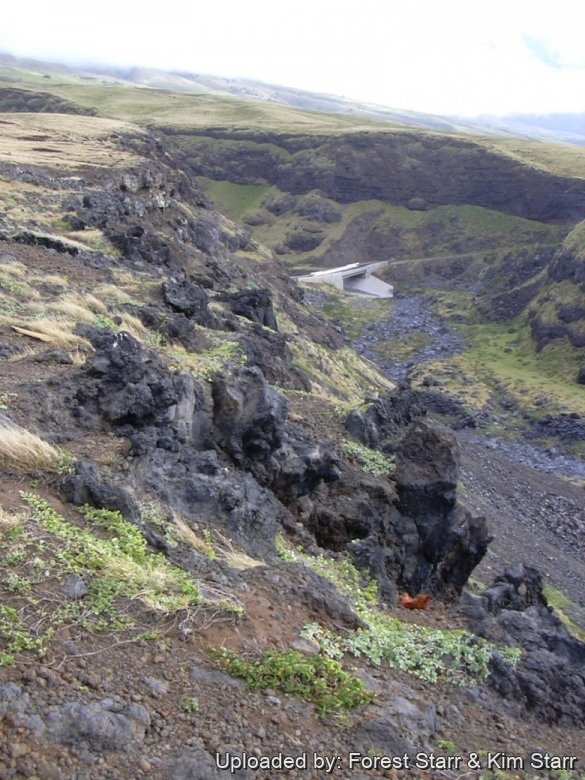
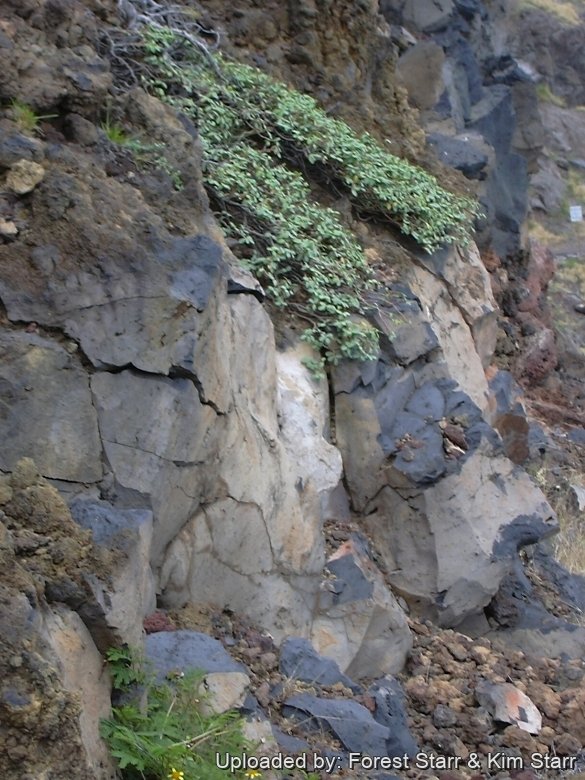
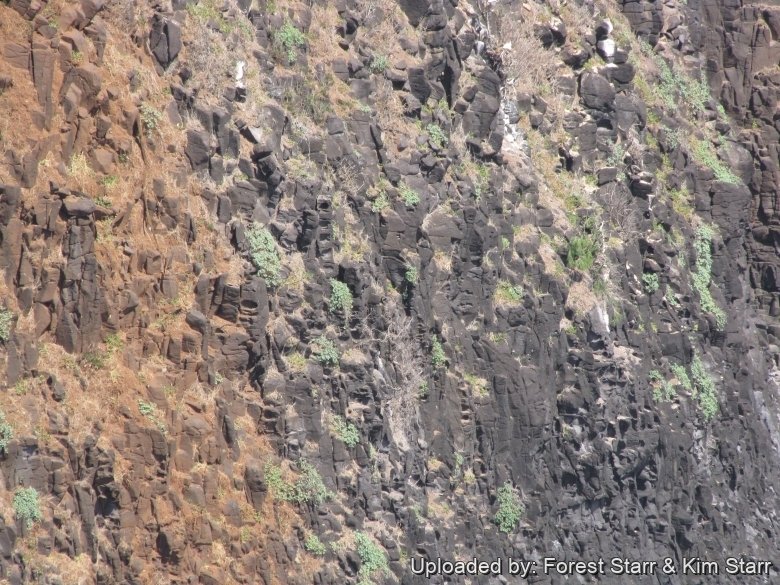
Habitat and ecology: Euphorbia celastroides is tolerant of drought and grows in dry, scrubby areas and sparsely wooded slopes, inland as well coastal often on calcareous soils. On Nīhoa it is a common component of the vegetation found on ledges and grassy slopes. This variety forms dense stands alone or mixed with pōpolo (Solanum nelsonii) and ʻilima (Sida fallax). The majority of the seabird Christmas shearwater (Puffinus nativitatis) that breed on Nīhoa, nest in ʻakoko thickets or the tufts of the grass kāwelu (Eragrostis variabilis). Due to its endemic nature, it is very vulnerable to human threats. Two examples of such threats are four-wheeled vehicles (which crush the plant) and introduced species (which compete for resources). One variety, Euphorbia celastroides var. kaenana, found at Ka’ena Point, Oahu, is federally listed as endangered.
Cultivation and Propagation
Euphorbia celastroides or akoko is an attractive tropical species that requires temperatures of 15 °C and light shade. This plant develops in a fashion similar to a shrub and is tolerant of heat and drought. Though this variety is seldom seen in cultivation, it is a beautiful addition to the landscape and rather easy to grow.
Growth rate: They can grow to half a meter a year and flowering and fruiting in optimal conditions.
Potting medium: A gritty, very free-draining compost is suitable, and clay pots help the plants to dry out between watering. Re-pot every 2-3 years.
Fertilization: Akoko respond well to liquid fertilizer (once every one to two months).
Waterings: They like only a short winter’s rest and should be kept almost completely dry during the winter months. If the soil is allowed to be dry for too long root loss could follow but equally the same result would occur if the plants are both wet and cold. From March onwards the plant will begin to grow and watering should be increased gradually until late May when the plant should be in full growth. Water regularly during the summer so long as the plant pot is allowed to drain and not sit in a tray of water. During hot weather you may need to water the plants more frequently so long as the plant is actively growing. From late September watering should be reduced to force the plant to go in to a state of semi dormancy, by October you should be back in to the winter watering regime.
Maintenance: This species do tend to get sort of leggy, which is particularly a problem if grown as a potted plant, and pruning is sometime necessary to shape. Repeatedly prunings also help to encourage new growth.
Hardiness: This spurge is tender, hates prolonged cool and is suited for tropical or subtropical climates, it is killed at 0°C or colder for any appreciable length of time, but may survive cold weather even if it end up getting nearly defoliated each winter. (USDA Zones 10a-12b) Any temps below 4° C degrees call for protection for this plant. Seedling growth arrests below 15°C.
Wind hardiness: It is very tolerant and even survives to strong hurricane wind with minimal damages, but will grow better with slow wind.
Salt tolerance: It is tolerant of coastal and beach exposure, as well as salt spray.
Landscape Use: Accent. Hedges.
Hawaiian Uses: The milky sap was one ingredient of the paint used on canoe hulls.
Pest and diseases: They are susceptible to fungal diseases. Wet soil quickly causes root and stem rot, especially during winter months. Pests of akoko include whitefly, scale insects, and mealybugs. Often the scale in-sects and mealybugs are brought in and protected by ants.
Propagation: Seeds or cuttings. It is best to collect seed just before or just after the capsules split open to be sure to have fresh but mature seeds. Because of the small size of the seedlings, place little or no cover over the seedbed. Take extra care to avoid letting the seedbed dry out. The seeds will begin sprouting in one to two weeks (sometimes take longer). Let the seedlings grow to about 5 cm in height before separating and transplanting to individual containers. You can also propagateEuphorbia celastroides by stem tip cuttings. Take cuttings about 10 cm in length from actively growing tips with mostly green wood. Rooting time is variable as long as two to three months. After root growth and new stem growth are obvious, transfer the new plant to a standard potting mix.
Notes
The genus Chamaesyce (now lumped in Euphorbia) is represented principally by herbaceous species in continental source areas, but is mostly represented by woody or near woody species in sixteen endemic species of Hawaiian spurge or ‘akoko (Chamaesyce spp.) all derived from one or, less likely, two colonizers. The genus Chamaesyce shows the progression from herb to tree with such species as Chamaesyce degeneri (a low herbaceous mat growing in the strand zone), Chamaesyce celastroides and Chamaesyce multiformis that exhibit growth forms ranging from a large but low, quite-tangled, mat of branches; through a somewhat spreading shrub; to a multitrunked small tree to Chamaesyce rockii and Chamaesyce olowaluana that truly qualifies as a tree, growing to 9 m high and occasionally reaching 30 cm in trunk diameter. Also definitely treelike is Chamaesyce herbstii, reaching about 8 m in height. There are at least several reasons for the preponderance of woodiness in the native Hawaiian flora. One of them might be the general tendency of many groups of plants to continue to grow in a climate such as Hawaii islands where there are no winters to bring things to a halt. Another might be, as mentioned above, that whereas “weedy” plants may have been favoured as colonists, there would have been strong tendencies to evolve tree-like species that would be better able to compete for light and space in the forests, particularly the wet forests, of the evolving Hawaiian landscapes. [S. H. Sohmer, R. Gustafson 1987; Alan C. Ziegler 2002]
Bibliography
Major references and further lectures
-
Forest & Kim Starr “Euphorbia celastroides (akoko)”. Plants of Hawaii. <http://www.starrenvironmental.com\>. Web. 27 Sep. 2014.
-
Wikipedia contributors. “Euphorbia celastroides.” Wikipedia, The Free Encyclopedia. Wikipedia, The Free Encyclopedia, 14 May. 2014. Web. 27 Sep. 2014.
-
Wagner, W.; D. Herbst; S. Sohmer “Manual of the flowering plants of Hawaii.” Honolulu: University of Hawaii Press 1990
-
National Museum of Natural History “Flora of the Hawaiian Islands” <http://botany.si.edu/pacificislandbiodiversity/hawaiianflora/\> Smithsonian Institution Web. 27 Sep. 20149
-
Andrew W. Mitchell “The Fragile South Pacific: An Ecological Odyssey” University of Texas Press, 1990
6)Geological and Natural History Survey of Minnesota “Reports of the Survey” Geological and Natural History Survey of Minnesota: Botanical series, Volume 2, 1898
-
John L. Culliney, Bruce P. Koebele “A Native Hawaiian Garden: How to Grow and Care for Island Plants” University of Hawaii Press, 1999
-
Warren Lambert Wagner, Derral R. Herbst, S. H. Sohmer “Manual of the Flowering Plants of Hawaii” Volume 1 University of Hawaii Press, 1990
-
National Museum of Natural History “Flora of the Hawaiian Islands” <http://botany.si.edu/pacificislandbiodiversity/hawaiianflora/\> Smithsonian Institution Web. 27 Sep. 2014.
-
Koutnik and Huft 4. “Chamaesyce.” In “Manual of the Flowering Plants of Hawaii” Warren L. Wagner, D.R. Herbst, S.H. Sohmer, eds., University of Hawaii Press and BishopMuseum Press, Honolulu. Pp. 602-617. 1990
-
Robert Pearcy & John Troughton “Photosynthesis in Tree Form Euphorbia Species from Hawaiian Rainforest Sites” Plant Physiol. Jun 1975; 55(6): 1054–1056.
-
Beatrice Krauss “Plants in Hawaiian Culture” Univ of Hawaii Pr August 4, 2001
-
Marie C. Neal “In Gardens of Hawaii” by June 1, 1965
-
Native Plants Hawaii. “Euphorbia celastroides var. celastroides” <http://www.nativeplants.hawaii.edu\> Web. 27 Sep. 2014.
-
S. H. Sohmer, R. Gustafson “Plants and Flowers of Hawai_i” University of Hawaii Press, 1987
-
Alan C. Ziegler “Hawaiian Natural History, Ecology, and Evolution” University of Hawaii Press, 2002
From llifle page Chamaesyce celastroides var. amplectens
Description
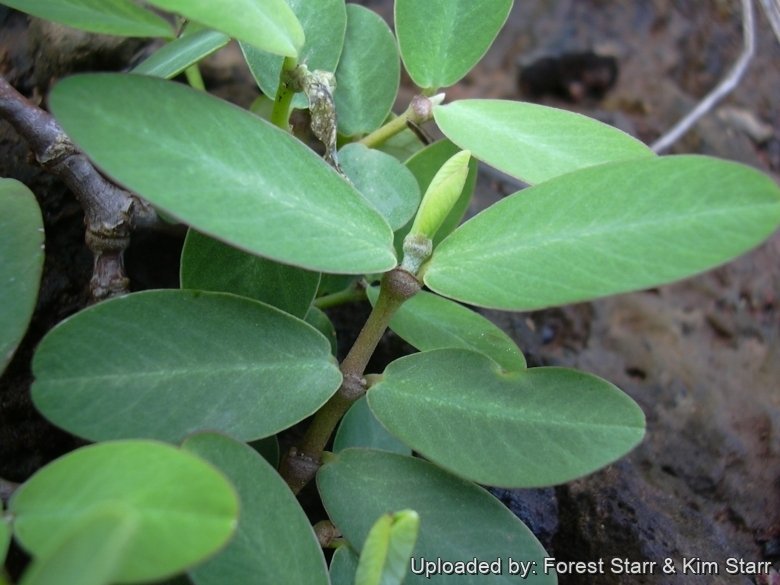
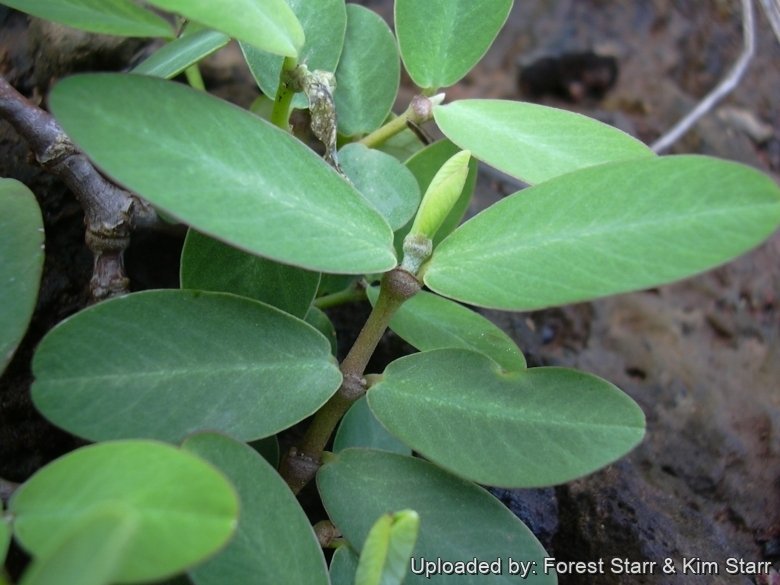
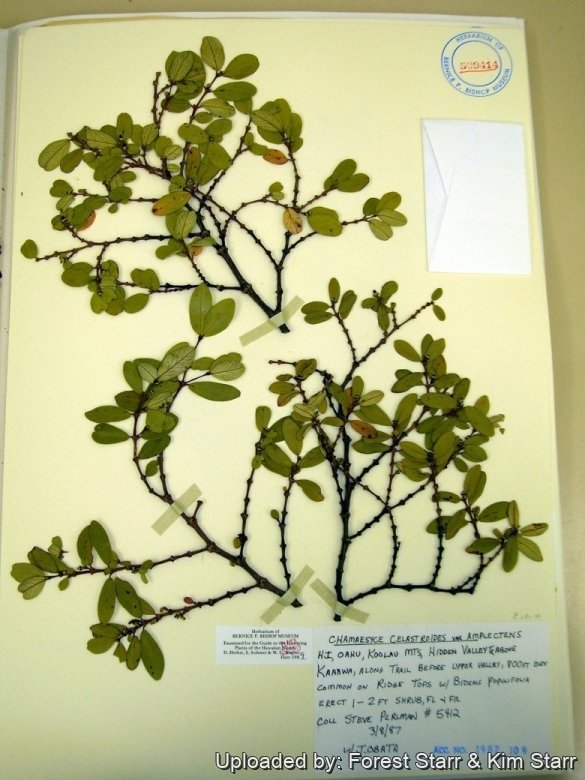
Euphorbia celastroides var. amplectens, previously also known as Chamaesyce celastroides var. amplectens is one of the several varieties of Euphorbia celastroides distinguished by its pubescent leaves. The variety amplectens is a variable medium-sized evergreen shrub and can have a spread of 3 metres or more. This species develops into a sprawling shrub. The flowers are not attractive. The red or pinkish fruits, however, enhance the beautiful foliage.
Stems: Forms a loosely branching short trunk. The secondary or young branches are stiff, with short internodes.
Leaves: Distichous (growing in two vertical rows), pubescent (with hairs), grey/silverish to light green that may have a glaucous coating. Often the leaves in the summer assume a red-violet colouring. It does not lose its leaves in the winter, due to the warm climate of its range, but is drought-deciduous. Damaged or old leaves turn a blood red as they die.
Flowers (cyathia): Small, brownish to greenish-white, not showy, a few millimeters in diameter, located in short or open-branched cymes, or ungrouped in leaf axils. Female cyathia have a three-part pistil over a three-part ovary, usually producing three (or sometimes more) seeds. The pungent flowers of ʻakoko have been described as smelling like bad breath.
Fruit: Green or reddish-brown or pink, rounded 2 to 4 mm long. Within each capsule are two or three small seeds.
Phenology: Euphorbia celastroides var. amplectens, produces flower and fruit sporadically throughout the year.
Seeds: Grey-brown seeds 0.5 to 2.5 mm long.
Origin and Habitat
Niʻihau, Kauaʻi, Oʻahu, Molokaʻi, Lānaʻi, Maui, Kahoʻolawe, Hawaiʻi islands, Hawaii, USA.
Habit: Euphorbia celastroides var. amplectens is a fairy common drought-deciduous variety found in upland arid rocky slopes on all the main islands. The variety amplectens, a common plant, apparently hybridzes with Euphorbia celastroides var. kaenana, an endangered species in the inland portion of var. kaenana range in part of Punapōhaku Gulch on the north side of Kahanahaiki Valley in the Mākua Military Reservation. This appears to be a hybrid swarm.
Cultivation and Propagation
Euphorbia celastroides var. amplectens or akoko is an attractive tropical species that requires temperatures of 15 °C and full sun to light shade. This plant develops in a fashion similar to a shrub and is tolerant of heat and drought.
Growth rate: They can grow to half a meter a year and flowering and fruiting in optimal conditions.
Potting medium: A gritty, very free-draining compost is suitable, and clay pots help the plants to dry out between watering. Re-pot every 2-3 years.
Fertilization: Akoko respond well to liquid fertilizer (once every one to two months).
Waterings: They like only a short winter’s rest and should be kept almost completely dry during the winter months. If the soil is allowed to be dry for too long root loss could follow but equally the same result would occur if the plants are both wet and cold. From March onwards the plant will begin to grow and watering should be increased gradually until late May when the plant should be in full growth. Water regularly during the summer so long as the plant pot is allowed to drain and not sit in a tray of water. During hot weather you may need to water the plants more frequently so long as the plant is actively growing. From late September watering should be reduced to force the plant to go in to a state of semi dormancy, by October you should be back in to the winter watering regime.
Pruning: Generally not necessary to prune plants except to remove dead branches and leaves for a cleaner appearance in the landscape. However this species do tend to get sort of leggy, which is particularly a problem if grown as a potted plant, and pruning is sometime necessary to shape. Repeatedly prunings also help to encourage new growth. A milky, sticky latex naturally oozes from wounds.
Hawaiian Uses: The milky sap was one ingredient of the paint used on canoe hulls.
Pest and diseases: They are susceptible to fungal diseases. Wet soil quickly causes root and stem rot, especially during winter months. Pests of akoko include whitefly, scale insects, and mealybugs. Often the scale in-sects and mealybugs are brought in and protected by ants. Spider mites can also can damage to leaves.
Propagation: Seeds or cuttings. It is best to collect seed just before or just after the capsules split open to be sure to have fresh but mature seeds. Because of the small size of the seedlings, place little or no cover over the seedbed. Take extra care to avoid letting the seedbed dry out. The seeds will begin sprouting in one to two weeks (sometimes take longer). Let the seedlings grow to about 5 cm in height before separating and transplanting to individual containers. You can also propagate Euphorbia celastroides by stem tip cuttings. Take cuttings about 10 cm in length from actively growing tips with mostly green wood. Rooting time is variableas long as two to three months. After root growth and new stem growth are obvious, transfer the new plant to a standard potting mix.
Bibliography
Major references and further lectures
-
Forest & Kim Starr “Euphorbia celastroides var. amplectens (Akoko)”. Plants of Hawaii. <http://www.starrenvironmental.com\>. Web. 27 Sep. 2014.
-
Wikipedia contributors. “Euphorbia celastroides.” Wikipedia, The Free Encyclopedia. Wikipedia, The Free Encyclopedia, 14 May. 2014. Web. 27 Sep. 2014.
-
Wagner, W.; D. Herbst; S. Sohmer “Manual of the flowering plants of Hawaii.” Honolulu: University of Hawaii Press 1990
-
National Museum of Natural History “Flora of the Hawaiian Islands” <http://botany.si.edu/pacificislandbiodiversity/hawaiianflora/\> Smithsonian Institution Web. 27 Sep. 20149
-
Andrew W. Mitchell “The Fragile South Pacific: An Ecological Odyssey” University of Texas Press, 1990
6)Geological and Natural History Survey of Minnesota “Reports of the Survey” Geological and Natural History Survey of Minnesota: Botanical series, Volume 2, 1898
-
John L. Culliney, Bruce P. Koebele “A Native Hawaiian Garden: How to Grow and Care for Island Plants” University of Hawaii Press, 1999
-
Warren Lambert Wagner, Derral R. Herbst, S. H. Sohmer “Manual of the Flowering Plants of Hawaii” Volume 1 University of Hawaii Press, 1990
-
National Museum of Natural History “Flora of the Hawaiian Islands” <http://botany.si.edu/pacificislandbiodiversity/hawaiianflora/\> Smithsonian Institution Web. 27 Sep. 2014.
-
Koutnik and Huft 4. “Chamaesyce.” In “Manual of the Flowering Plants of Hawaii” Warren L. Wagner, D.R. Herbst, S.H. Sohmer, eds., University of Hawaii Press and BishopMuseum Press, Honolulu. Pp. 602-617. 1990
-
Robert Pearcy & John Troughton “Photosynthesis in Tree Form Euphorbia Species from Hawaiian Rainforest Sites” Plant Physiol. Jun 1975; 55(6): 1054–1056.
-
Beatrice Krauss “Plants in Hawaiian Culture” Univ of Hawaii Pr August 4, 2001
-
Marie C. Neal “In Gardens of Hawaii” by June 1, 1965
-
- U.S. Fish & Wildlife Service “Chamaesyce celastroides var. kaenana” 5-Year Review Summary and Evaluation, page 5.
-
Native Plants Hawaii. “Euphorbia celastroides var. amplectens” Web. 27 Sep. 2014. <http://www.nativeplants.hawaii.edu/plant/view/Euphorbia\_celastroides\_amplectens\>
Source: Chamaesyce celastroides var. amplectens, LLIFLE - Encyclopedia of living forms, CC-BY-SA, retrieved 2026-10-25.
From llifle page Chamaesyce celastroides var. laehiensis
Description
The ʻakoko Euphorbia celastroides var. laehiensis, previously also known as Chamaesyce celastroides var. laehiensis, is one of the several varieties of the spurge Euphorbia celastroides distinguished by its glaucous (opaque bluish) pubescent (fuzzy) leaves. The variety laehiensis is a evergreen sprawling shrub and can have a spread of 2 metres or more. While the flowers are not showy, the bright pinkish to red fruits can be uniquely appealing en masse.
Stems: It forms a loosely branching short trunk. The secondary or young branches are stiff, with short internodes. A milky, sticky latex naturally oozes from wounds.
Leaves: Distichous (growing in two vertical rows), up to 15 mm long, grey-silverish, pubescent and have an opaque glaucous coating. Often the leaves in the summer assume a red-violet colouring. It does not lose its leaves in the winter, due to the warm climate of its range. Damaged or old leaves turn a blood red as they die.
Flowers (cyathia): Small, brownish to greenish-white, not showy, a few millimeters in diameter, located in short or open-branched cymes, or ungrouped in leaf axils. Female cyathia have a three-part pistil over a three-part ovary, usually producing three (or sometimes more) seeds. The pungent flowers of ʻakoko have been described as smelling like bad breath.
Fruit: Green or reddish-brown or pink, rounded 2 to 4 mm long. Within each capsule are two or three small seeds.
Phenology: Euphorbia celastroides var. laehiensis produces flower and fruit sporadically throughout the year.
Seeds: Grey-brown seeds 0.5 to 2.5 mm long.
Origin and Habitat
Euphorbia celastroides var. laehiensis is one of the recognised varieties of a widespread and variable species that grows at low elevations on arid talus slopes, at Lana’i and East Maui near Manawainui, in the island of Maui, Hawaii (USA). It is rare and endangered.
Habitat and ecology: It is found at low elevations and endangered.
Cultivation and Propagation
Euphorbia celastroides var. laehiensis or akoko is an attractive tropical species that requires temperatures of 15 °C and full sun to light shade. This plant develops in a fashion similar to a sprawling shrub and is tolerant of heat and drought.
Growth rate: They can grow to half a meter a year and flowering and fruiting in optimal conditions.
Potting medium: A gritty, very free-draining compost is suitable, and clay pots help the plants to dry out between watering. Re-pot every 2-3 years.
Fertilization: Akoko respond well to liquid fertilizer (once every one to two months).
Waterings: They like only a short winter’s rest and should be kept almost completely dry during the winter months. If the soil is allowed to be dry for too long root loss could follow but equally the same result would occur if the plants are both wet and cold. From March onwards the plant will begin to grow and watering should be increased gradually until late May when the plant should be in full growth. Water regularly during the summer so long as the plant pot is allowed to drain and not sit in a tray of water. During hot weather you may need to water the plants more frequently so long as the plant is actively growing. From late September watering should be reduced to force the plant to go in to a state of semi dormancy, by October you should be back in to the winter watering regime.
Pruning: Generally not necessary to prune plants except to remove dead branches and leaves for a cleaner appearance in the landscape. However this species do tend to get sort of leggy, which is particularly a problem if grown as a potted plant, and pruning is sometime necessary to shape. Repeatedly prunings also help to encourage new growth. A milky, sticky latex naturally oozes from wounds.
Hawaiian Uses: The milky sap was one ingredient of the paint used on canoe hulls.
Pest and diseases: They are susceptible to fungal diseases. Wet soil quickly causes root and stem rot, especially during winter months. Pests of akoko include whitefly, scale insects, and mealybugs. Often the scale in-sects and mealybugs are brought in and protected by ants. Spider mites can also can damage to leaves.
Propagation: Seeds or cuttings. It is best to collect seed just before or just after the capsules split open to be sure to have fresh but mature seeds. Because of the small size of the seedlings, place little or no cover over the seedbed. Take extra care to avoid letting the seedbed dry out. The seeds will begin sprouting in one to two weeks (sometimes take longer). Let the seedlings grow to about 5 cm in height before separating and transplanting to individual containers. You can also propagate Euphorbia celastroides by stem tip cuttings. Take cuttings about 10 cm in length from actively growing tips with mostly green wood. Rooting time is variableas long as two to three months. After root growth and new stem growth are obvious, transfer the new plant to a standard potting mix.
Bibliography
Major references and further lectures
-
Forest & Kim Starr “Euphorbia celastroides var. laehiensis (Akoko)”. Plants of Hawaii. <http://www.starrenvironmental.com\>. Web. 27 Sep. 2014.
-
Wikipedia contributors. “Euphorbia celastroides.” Wikipedia, The Free Encyclopedia. Wikipedia, The Free Encyclopedia, 14 May. 2014. Web. 27 Sep. 2014.
-
Wagner, W.; D. Herbst; S. Sohmer “Manual of the flowering plants of Hawaii.” Honolulu: University of Hawaii Press 1990
-
National Museum of Natural History “Flora of the Hawaiian Islands” <http://botany.si.edu/pacificislandbiodiversity/hawaiianflora/\> Smithsonian Institution Web. 27 Sep. 20149
-
Andrew W. Mitchell “The Fragile South Pacific: An Ecological Odyssey” University of Texas Press, 1990
6)Geological and Natural History Survey of Minnesota “Reports of the Survey” Geological and Natural History Survey of Minnesota: Botanical series, Volume 2, 1898
-
John L. Culliney, Bruce P. Koebele “A Native Hawaiian Garden: How to Grow and Care for Island Plants” University of Hawaii Press, 1999
-
Warren Lambert Wagner, Derral R. Herbst, S. H. Sohmer “Manual of the Flowering Plants of Hawaii” Volume 1 University of Hawaii Press, 1990
-
National Museum of Natural History “Flora of the Hawaiian Islands” <http://botany.si.edu/pacificislandbiodiversity/hawaiianflora/\> Smithsonian Institution Web. 27 Sep. 2014.
-
Koutnik and Huft 4. “Chamaesyce.” In “Manual of the Flowering Plants of Hawaii” Warren L. Wagner, D.R. Herbst, S.H. Sohmer, eds., University of Hawaii Press and BishopMuseum Press, Honolulu. Pp. 602-617. 1990
-
Native Plants Hawaii. “Euphorbia celastroides var. laehiensis” <http://www.nativeplants.hawaii.edu\> Web. 27 Sep. 2014
-
Beatrice Krauss “Plants in Hawaiian Culture” Univ of Hawaii Pr August 4, 2001
-
Marie C. Neal “In Gardens of Hawaii” by June 1, 1965
-
World Conservation Monitoring Centre 1998. Euphorbia celastroides var. laehiensis. The IUCN Red List of Threatened Species. Version 2014.2. <www.iucnredlist.org>. Downloaded on 28 September 2014.
Source: Chamaesyce celastroides var. laehiensis, LLIFLE - Encyclopedia of living forms, CC-BY-SA, retrieved 2026-10-25.
From llifle page Chamaesyce celastroides var. lorifolia
Description
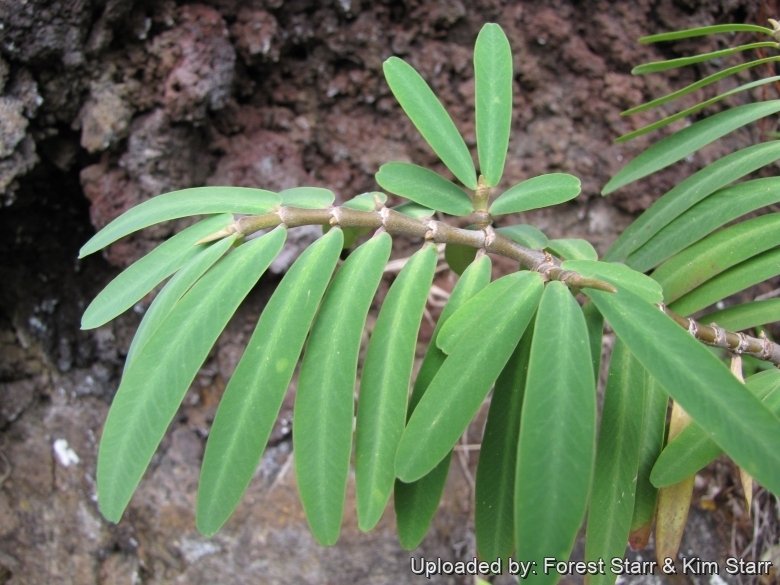
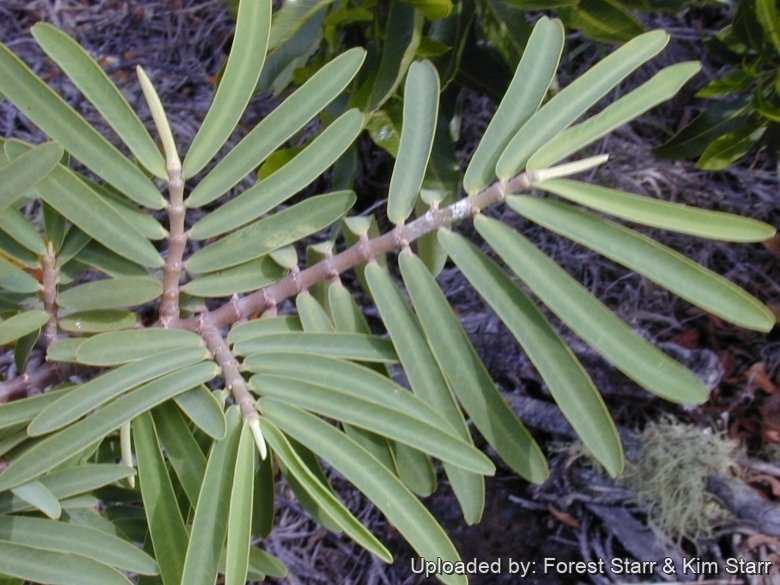
The Akoko Euphorbia celastroides var. lorifolia , previously also known as Chamaesyce celastroides var. lorifolia is one of the several varieties of the widespread and variableEuphorbia celastroides. It is a small shrub less than 60 cm tall or a small tree up to 5 metres that is easily distinguished by its long thin leaves. The flowers are not attractive. The red or pinkish fruits, however, enhance the beautiful foliage. The varietal name, lorifolia, strap-leaf, in reference to the long leaves of this ʻakoko.
Stems: It forms a loosely branching trunk. The secondary or young branches are stiff, with short internodes.
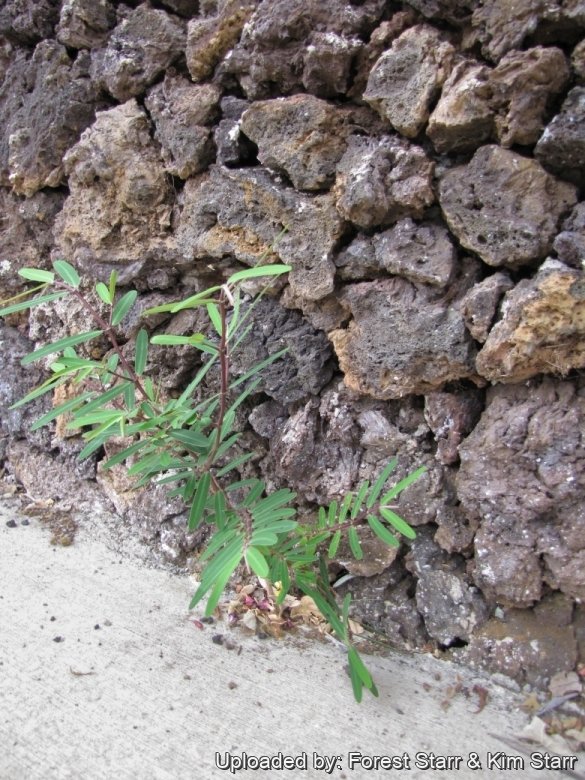
Leaves: Distichous (growing in two vertical rows), 5 to over 7.5 cm long light or medium green that may have a slight glaucous coating. Often the leaves in the summer assume a red-violet colouring. It does not lose its leaves in the winter, due to the warm climate of its range, but is drought-deciduous. Damaged or old leaves turn a blood red as they die.
Flowers (cyathia): Small, brownish to greenish-white, not showy, a few millimeters in diameter, located in short or open-branched cymes, or ungrouped in leaf axils. Female cyathia have a three-part pistil over a three-part ovary, usually producing three (or sometimes more) seeds. The pungent flowers of ʻakoko have been described as smelling like bad breath.
Fruit: Green or reddish-brown or pink, rounded 2 to 4 mm long. Within each capsule are two or three small seeds.
Phenology: Euphorbia celastroides var. amplectens, produces flower and fruit sporadically throughout the year.
Seeds: Grey-brown seeds 0.5 to 2.5 mm long.
Origin and Habitat
Lānaʻi and Maui island, Hawaii (USA)
Habitat and ecology: Chamaesyce celastroides var. lorifolia is a more tree-like variety found in moister coastal areas, graasy hill tops, and mesic forests on Lānaʻi where it is now rare and on Maui where it is placed in the vulnerable status, but it was one of the dominant components of high elevation dry forest. Though a tree-like species, it is apparently not as tall in height or as wide in diameter as another native tree ʻakoko (Chamaesyce olowaluana). Chamaesyce celastroides var. lorifolia is important for native animal and plant species. Hawaiʻi’s only native bees (Hylaeus spp.) use this species as a important food and nesting source. An extinct honeycreeper, the Lānaʻi hookbill (Dysmorodrepanis munroi), searched for small snails among foliage of ōpuhe (Urera glabra) and perhaps Chamaesyce celastroides var. lorifolia. Today, though the vast Chamaesyce celastroides var. lorifolia forests are gone, a few trees still remain on Lānaʻi and Maui, but now a faint reminder of times past. Disturbance caused by grazing, conversion to pastureland and the invasion of alien grasses, increasing the likelihood of serious fires, have all contributed to the decline in the habitat. These rare spurges are in danger of disappearing.
Cultivation and Propagation
Euphorbia celastroides var. lorifolia or akoko is an attractive tropical species that requires temperatures of 15 °C and light shade. This plant develops in a fashion similar to a shrub or small tree and is tolerant of heat and drought.
Growth rate: They can grow to half a meter a year and flowering and fruiting in optimal conditions.
Potting medium: A gritty, very free-draining compost is suitable, and clay pots help the plants to dry out between watering. Re-pot every 2-3 years.
Fertilization: Akoko respond well to liquid fertilizer (once every one to two months).
Waterings: They like only a short winter’s rest and should be kept almost completely dry during the winter months. If the soil is allowed to be dry for too long root loss could follow but equally the same result would occur if the plants are both wet and cold. From March onwards the plant will begin to grow and watering should be increased gradually until late May when the plant should be in full growth. Water regularly during the summer so long as the plant pot is allowed to drain and not sit in a tray of water. During hot weather you may need to water the plants more frequently so long as the plant is actively growing. From late September watering should be reduced to force the plant to go in to a state of semi dormancy, by October you should be back in to the winter watering regime.
Maintenance: This species do tend to get sort of leggy, which is particularly a problem if grown as a potted plant, and pruning is sometime necessary to shape. Repeatedly pruning also help to encourage new growth.
Hardiness: This spurge is tender, hates prolonged cool and is suited for tropical or subtropical climates, it is killed at 0°C or colder for any appreciable length of time, but may survive cold weather even if it end up getting nearly defoliated each winter. (USDA Zones 10a-12b) Any temps below 4° C degrees call for protection for this plant. Seedling growth arrests below 15°C.
Wind hardiness: It is very tolerant and even survives to strong hurricane wind with minimal damages, but will grow better with slow wind.
Salt tolerance: It is tolerant of coastal and beach exposure, as well as salt spray.
Landscape Use: Accent. Hedges.
Hawaiian Uses: The wood of this ʻakoko was used as firewood, the leaves medicinally, and the latex used as an ingredient in canoe paint.
Pest and diseases: They are susceptible to fungal diseases. Wet soil quickly causes root and stem rot, especially during winter months. Pests of akoko include whitefly, and scale insects. The plants also attracts root mealy bug which should be treated with a systemic pesticide or horticultural oil. Often the scale in-sects and mealybugs are brought in and protected by ants.
Propagation: Seeds or cuttings. It is best to collect seed just before or just after the capsules split open to be sure to have fresh but mature seeds. Because of the small size of the seedlings, place little or no cover over the seedbed. Take extra care to avoid letting the seedbed dry out. The seeds will begin sprouting in one to two weeks (sometimes take longer). Let the seedlings grow to about 5 cm in height before separating and transplanting to individual containers. You can also propagateEuphorbia celastroides by stem tip cuttings. Take cuttings about 10 cm in length from actively growing tips with mostly green wood. Rooting time is variable as long as two to three months. After root growth and new stem growth are obvious, transfer the new plant to a standard potting mix.
Bibliography
Major references and further lectures
-
Forest & Kim Starr “Euphorbia celastroides (akoko)”. Plants of Hawaii. <http://www.starrenvironmental.com\>. Web. 27 Sep. 2014.
-
Wikipedia contributors. “Euphorbia celastroides.” Wikipedia, The Free Encyclopedia. Wikipedia, The Free Encyclopedia, 14 May. 2014. Web. 27 Sep. 2014.
-
Wagner, W.; D. Herbst; S. Sohmer “Manual of the flowering plants of Hawaii.” Honolulu: University of Hawaii Press 1990
-
National Museum of Natural History “Flora of the Hawaiian Islands” <http://botany.si.edu/pacificislandbiodiversity/hawaiianflora/\> Smithsonian Institution Web. 27 Sep. 20149
-
Andrew W. Mitchell “The Fragile South Pacific: An Ecological Odyssey” University of Texas Press, 1990
6)Geological and Natural History Survey of Minnesota “Reports of the Survey” Geological and Natural History Survey of Minnesota: Botanical series, Volume 2, 1898
-
John L. Culliney, Bruce P. Koebele “A Native Hawaiian Garden: How to Grow and Care for Island Plants” University of Hawaii Press, 1999
-
George C. Munro “The Story of Lānaʻi”, pages 64, 67-68, 212-213.
-
Beatrice Krauss “Plants in Hawaiian Culture” by, page 138.
-
J.F. Rock “The Indigenous Trees of the Hawaiian Islands” by , pages 50, 261.
-
William McGeorge & W. A. Anderson “Euphorbia lorifolia, a Possible Source of Rubber and Chicle” by , page 98.
-
H. Douglas Pratt “The Hawaiian Honeycreepers: Drepanidinae” by , pages 130, 217-218.
-
Robert Pearcy & John Troughton “Photosynthesis in Tree Form Euphorbia Species from Hawaiian Rainforest Sites” by , page 1055.
-
A.C. Medeiros, C.F. Davenport & C.G. Chimera “Auwahi: Ethnobotany of a Hawaiian Dryland Forest”, page 21.
-
Native Plants Hawaii. “Euphorbia celastroides var. lorifolia” <http://www.nativeplants.hawaii.edu\> Web. 27 Sep. 2014.
-
World Conservation Monitoring Centre 1998. Euphorbia celastroides var. lorifolia. The IUCN Red List of Threatened Species. Version 2014.2. <www.iucnredlist.org>. Downloaded on 28 September 2014.
-
CROIZAT, L. AN-D 0. DEGEN;ER. 1938. “Euphorbiaceae” In: 0. Degener, ed., Flora
Hawaiiensis. Privately published.
- SHERFF, E. E. 1938. “Revision of the Hawaiian species of Euphorbia L.” Ann. Mo. Bot. Gard. 25: 1-94.
Source: Chamaesyce celastroides var. lorifolia, LLIFLE - Encyclopedia of living forms, CC-BY-SA, retrieved 2026-10-25.
From llifle page Chamaesyce celastroides var. stokesii
Description
The Akoko Euphorbia celastroides var. stokesii, previously also known as Chamaesyce celastroides var. stokesii is one of the several varieties of the widespread and variableEuphorbia celastroides. It is a small shrub usually less than 60 cm tall distinguished by its broadly obovate grey-green glaucous leaves. This species develops into a sprawling shrub. The flowers are not attractive. The red or pinkish fruits, however, enhance the beautiful foliage.
Stems: Forms a loosely branching short trunk. The secondary or young branches are stiff, with short internodes. A milky, sticky latex naturally oozes from wounds.
Leaves: Distichous (growing in two vertical rows), broadly obovate, grey-silverish to light green that may have a glaucous coating. Often the leaves in the summer assume a red-violet colouring. It does not lose its leaves in the winter, due to the warm climate of its range, but is drought-deciduous. Damaged or old leaves turn a blood red as they die.
Flowers (cyathia): Small, brownish to greenish-white, not showy, a few millimetres in diameter, located in short or open-branched cymes, or ungrouped in leaf axils. Female cyathia have a three-part pistil over a three-part ovary, usually producing three (or sometimes more) seeds. The pungent flowers of ʻakoko have been described as smelling like bad breath.
Fruit: Green or reddish-brown or pink, rounded 2 to 4 mm long. Within each capsule are two or three small seeds.
Phenology: Euphorbia celastroides var. stokesii, produces flower and fruit sporadically throughout the year.
Seeds: Grey-brown seeds 0.5 to 2.5 mm long.
Origin and Habitat
Euphorbia celastroides var. stokesii is from Niʻihau and nearby Kaʻula Islet, Kauaʻi (Kīlauea Pt.), Molokaʻi, and Kahoʻolawe.
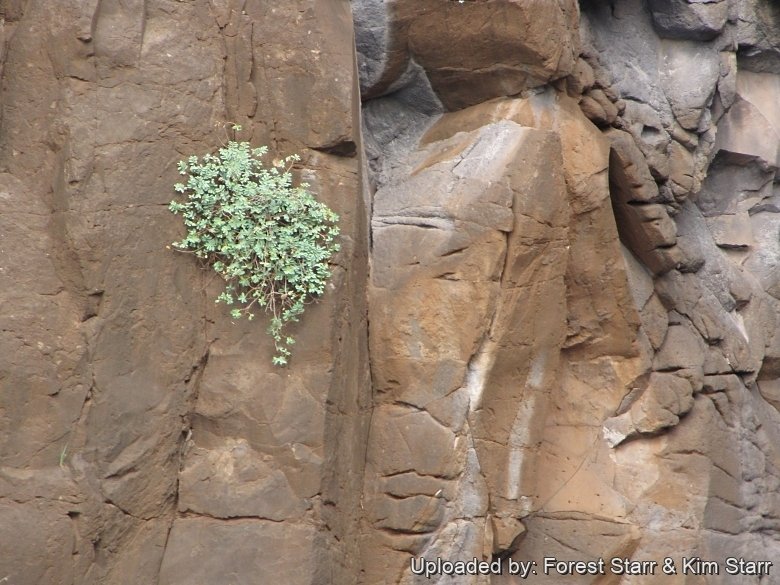
Habitat and ecology: This rare variety is down to about a thousand or so plants and found on windswept cliffs and ledges above the ocean. The habitat has been in rapid decline because of the spread of goats and other feral animals and invasive plants.
Cultivation and Propagation
Euphorbia celastroides or akoko is an attractive tropical species that requires temperatures of 15 °C and light shade. This plant develops in a fashion similar to a shrub and is tolerant of heat and drought.
Growth rate: They can grow to half a meter a year and flowering and fruiting in optimal conditions.
Potting medium: A gritty, very free-draining compost is suitable, and clay pots help the plants to dry out between watering. Re-pot every 2-3 years. It grew well on sand, cinder and coral too.
Fertilization: Akoko respond well to liquid fertilizer (once every one to two months).
Waterings: They like only a short winter’s rest and should be kept almost completely dry during the winter months. If the soil is allowed to be dry for too long root loss could follow but equally the same result would occur if the plants are both wet and cold. From March onwards the plant will begin to grow and watering should be increased gradually until late May when the plant should be in full growth. Water regularly during the summer so long as the plant pot is allowed to drain and not sit in a tray of water. During hot weather you may need to water the plants more frequently so long as the plant is actively growing. From late September watering should be reduced to force the plant to go in to a state of semi dormancy, by October you should be back in to the winter watering regime.
Hardiness: This spurge is tender, hates prolonged cool and is suited for tropical or subtropical climates, it is killed at 0°C or colder for any appreciable length of time, but may survive cold weather even if it end up getting nearly defoliated each winter. (USDA Zones 10a-12b) Any temps below 4° C degrees call for protection for this plant. Seedling growth arrests below 15°C.
Wind hardiness: It is very tolerant and even survives to strong hurricane wind with minimal damages, but will grow better with slow wind.
Salt tolerance: It is tolerant of coastal and beach exposure, as well as salt spray.
Maintenance: This species do tend to get sort of leggy, which is particularly a problem if grown as a potted plant, and pruning is sometime necessary to shape. Repeatedly prunings also help to encourage new growth.
Landscape Uses: Accent; container; hedges.
Hawaiian Uses: The milky sap was one ingredient of the paint used on canoe hulls.
Pest and diseases: They are susceptible to fungal diseases. Wet soil quickly causes root and stem rot, especially during winter months. Pests of akoko include whitefly, scale insects, and mealybugs. Often the scale in-sects and mealybugs are brought in and protected by ants.
Propagation: Seeds or cuttings. It is best to collect seed just before or just after the capsules split open to be sure to have fresh but mature seeds. Because of the small size of the seedlings, place little or no cover over the seedbed. Take extra care to avoid letting the seedbed dry out. The seeds will begin sprouting in one to two weeks (sometimes take longer). Let the seedlings grow to about 5 cm in height before separating and transplanting to individual containers. You can also propagate Euphorbia celastroides by stem tip cuttings. Take cuttings about 10 cm in length from actively growing tips with mostly green wood. Rooting time is variable as long as two to three months. After root growth and new stem growth are obvious, transfer the new plant to a standard potting mix.
Bibliography
Major references and further lectures
-
Forest & Kim Starr “Euphorbia celastroides (akoko)”. Plants of Hawaii. <http://www.starrenvironmental.com\>. Web. 27 Sep. 2014.
-
Wikipedia contributors. “Euphorbia celastroides.” Wikipedia, The Free Encyclopedia. Wikipedia, The Free Encyclopedia, 14 May. 2014. Web. 27 Sep. 2014.
-
Wagner, W.; D. Herbst; S. Sohmer “Manual of the flowering plants of Hawaii.” Honolulu: University of Hawaii Press 1990
-
National Museum of Natural History “Flora of the Hawaiian Islands” <http://botany.si.edu/pacificislandbiodiversity/hawaiianflora/\> Smithsonian Institution Web. 27 Sep. 20149
-
Andrew W. Mitchell “The Fragile South Pacific: An Ecological Odyssey” University of Texas Press, 1990
6)Geological and Natural History Survey of Minnesota “Reports of the Survey” Geological and Natural History Survey of Minnesota: Botanical series, Volume 2, 1898
-
John L. Culliney, Bruce P. Koebele “A Native Hawaiian Garden: How to Grow and Care for Island Plants” University of Hawaii Press, 1999
-
Beatrice Krauss “Plants in Hawaiian Culture” by, page 138.
-
Robert Pearcy & John Troughton “Photosynthesis in Tree Form Euphorbia Species from Hawaiian Rainforest Sites” by , page 1055.
-
A.C. Medeiros, C.F. Davenport & C.G. Chimera “Auwahi: Ethnobotany of a Hawaiian Dryland Forest”, page 21.
-
Native Plants Hawaii. “Euphorbia celastroides var. stokesii” <http://www.nativeplants.hawaii.edu\> Web. 27 Sep. 2014.
-
World Conservation Monitoring Centre 1998. Euphorbia celastroides var. stokesii. The IUCN Red List of Threatened Species. Version 2014.2. <www.iucnredlist.org>. Downloaded on 28 September 2014.
-
Marie C. Neal “In Gardens of Hawaii” June 1, 1965
Source: Chamaesyce celastroides var. stokesii, LLIFLE - Encyclopedia of living forms, CC-BY-SA, retrieved 2026-10-25.
From llifle page Chamaesyce celastroides var. tomentella
Description
Euphorbia celastroides var. tomentella is (was) one of the recognised varieties of a widespread and variable species. Specimens were known only from Oahu.
Glabrous.
Origin and Habitat
Hawaiian Islands, endemic to endemic to the island of Oahu.
Habitat and ecology: Euphorbia celastroides var. tomentella is a beach plant. It has not been collected since the 1840s. It has not been found in recent decades and is now presumed extinct.
Bibliography
Major references and further lectures
-
Bruegmann, M.M. & Caraway, V. 2003. Euphorbia celastroides var. tomentella. The IUCN Red List of Threatened Species. Version 2014.2. <www.iucnredlist.org>. Downloaded on 27 September 2014.
-
Forest & Kim Starr “Euphorbia celastroides (akoko)”. Plants of Hawaii. <http://www.starrenvironmental.com\>. Web. 27 Sep. 2014.
-
Wagner, W.; D. Herbst; S. Sohmer “Manual of the flowering plants of Hawaii.” Honolulu: University of Hawaii Press 1990
-
National Museum of Natural History “Flora of the Hawaiian Islands” <http://botany.si.edu/pacificislandbiodiversity/hawaiianflora/\> Smithsonian Institution Web. 27 Sep. 20149
-
Andrew W. Mitchell “The Fragile South Pacific: An Ecological Odyssey” University of Texas Press, 1990
6)Geological and Natural History Survey of Minnesota “Reports of the Survey” Geological and Natural History Survey of Minnesota: Botanical series, Volume 2, 1898
-
John L. Culliney, Bruce P. Koebele “A Native Hawaiian Garden: How to Grow and Care for Island Plants” University of Hawaii Press, 1999
-
Wikipedia contributors. “Euphorbia celastroides.” Wikipedia, The Free Encyclopedia. Wikipedia, The Free Encyclopedia, 14 May. 2014. Web. 27 Sep. 2014.
Source: Chamaesyce celastroides var. tomentella, LLIFLE - Encyclopedia of living forms, CC-BY-SA, retrieved 2026-10-25.
Cultivars and forms (6)
Gallery