Publication: Neue Pfl. Deutsch-Sudwest-Afr. 29 1914.
Description
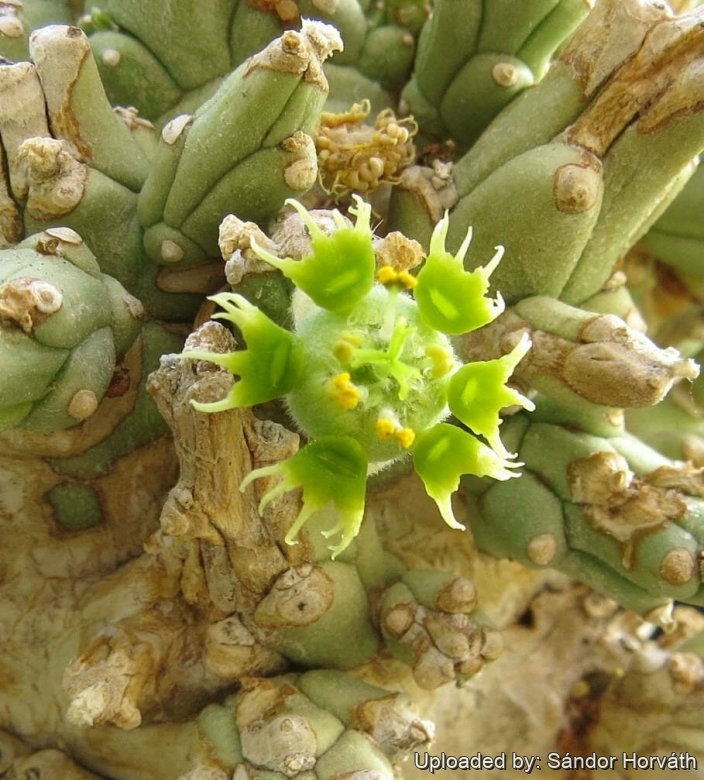
Euphorbia abdelkuri is a very peculiar candelabra-like succulent plant lacking both leaves and spines, which looks like a grey candle with whitish-grey melted wax on it. It form densely branched candelabra-like clumps usually not more than 1 m hight by 1.5 in diameter on one clump (but occasionally in habitat some plants can reach 3 m of height and an equivalent diameter). It is one of the most coveted Euphorbia species.
Remarks: It is the only Euphorbia species with yellow a yellow sap.
Roots: Spreading.
Stems: About 5 cm in diameter, pale greenish-grey, ash-grey to tan, columnar, more or less cylindrical, slightly constricted at intervals, spineless, simple, branching from the base or occasionally splitting dichotomously. Generally has 6 ribs with a somewhat wrinkled, worn looking ‘skin’ with slightly raised conical tubercles. Often skin peels away revealing greener tissues beneath. The colour of the new growth is grey-pink to dark brown and it will then turn to the grey tan colour. The latex is yellow viciously acrid and highly poisonous.
Leaves: Very small, ephemeral.
Inflorescence: Simple cymes, very contracted from the base of the tubercles born towards the top of the stems.
Flower (cyathia): Small, turbinate, about 5 mm in diameter on 8 mm long peduncles. Nectar glands yellowish. Pedicel very short.
Fruit: Trigynous, vaguely lobed, dull-green, about 8 mm in diameter.
Origin and Habitat
Endemic of the Abd al Kuri Island, next to Socotra Island, Yemen.
Habitat: It grows only in one locality on the Quatar Saleh (or Jebel Hassala) in a very arid area at an elevation of about 150 to 270 m in the middle of the mountain on limestone outcrops and granitic gravel slopes where they forms open thickets. The species is severely endangered and was reduced to only four clumps in 1967. The reasons for its decline are obscure: livestock do not touch it since it is highly poisonous. In the past this species was much more abundant all over a ridge from about 150 to 450 metres. Abd al Kuri is semi-desert with little or no vegetation.
Cultivation and Propagation
Due to its slow growth rate and rarity it is thought difficult to grow on its own roots. It is almost always grafted Euphorbia canariensis, but it may be degrafted and rootted and, surprisingly, it’s quite easy to grow. It’s uncommon to lose a plant. It like a sunny position. It does best in a mineral soil, good drainage is essential. Water sparingly during the summer months and keep dry in winter. It is a slow growing long lived plant and once established, it will be content in its position and with its soil for years. It can tolerate moderate shade, and a plant that has been growing in shade should be slowly hardened off before placing it in full sun as the plant will be severely scorched if moved too suddenly from shade into sun. Seems to have no problems growing in a heavy summer rainfall area, in extremely well drained, mineralized soil mix.
Frost tolerance: Very frost tender needs minimum winter temperatures around 10? C (or even more)
Propagation: It is usually reproduced by grafting or cuttings, but it may be propagated from seed sown during spring or summer (seeds are seldom available).
Grafting: The plants that are grafted on a more vigorous and easier stocks are easier to keep, grow faster and produce more flowers and seeds. The method of grafting euphorbias differs little from that of other succulents, except in one important aspect. The latex must be washed or sprayed off until hardly anything remains. After the latex flow has stopped, a further 1-2 mm slice can be taken from both surfaces without a new latex flow starting. Both scion and stock need to be at the start of the growing season. The stock should be cut as near as possible to the growing tip, as here the vascular bundles are dense and not yet woody and will feed the scion in the best possible way. Where possible stock and scion should be of similar diameter. The cut surfaces are held together with elastic bands in cross style, over the plant top and under the pot. The plants should be left in an airy and shady place for 7-10 days before the bands are removed. E. abdelkuri is grown almost exclusively grafted on Euphorbia canariensis which proven to be the ideal grafting stock. The grafting are very successful, new grafts often show growth within 3 weeks.
Warning: As with all other Euphorbias when a plant get damaged it exudes a thick milky sap known as latex. This latex is poisonous and particularly dangerous for the eyes, skin and mucous membranes. So pay extreme attention not to get any in your eyes or mouth. Cultivated plants must be handled carefully.
Bibliography
Major references and further lectures
-
Balfour, I. B. “Angiospermae” in Forbes, H. O. (ed.), “The natural history of Sokotra & Abd-el-Kuri” The Free Public Museum, Liverpool pp. 528-530 1903
-
James Cullen, Sabina G. Knees, H. Suzanne Cubey ?The European Garden Flora Flowering Plants: A Manual for the Identification of Plants Cultivated in Europe, Both Out-of-Doors and Under Glass? Cambridge University Press, 11/ago/2011
-
Lavranos, J.J. “The island of Abd al Kuri and its peculiar Euphorbia.” in: Cact. Succ. J. Amer. 43: 109-111 1971
-
Gren Lucas “The IUCN Plant Red Data Book: Comprising Red Data Sheets on 250 Selected Plants Threatened on a World Scale” IUCN, 01/gen/1978
-
Urs Eggli ?Illustrated Handbook of Succulent Plants: Dicotyledons? Springer, 2002
-
Volker Buddensiek “Sukkulente Euphorbien.” Ulmer, 1998
From llifle page Euphorbia multiramosa
Description
Euphorbia multiramosa is a dwarf, rather ugly-looking, irregularly shaped, succulent shrublet to 30 cm tall, with a deep tap root merging into a fat subglobose main stem. The whole stumpy body of the plant is covered with very numerous branches all over, except at a small central area at the apex. The branches are short, rebranching, tapering to a long spine-like point which ultimately dries away, and are covered with very prominent elongated tubercles in spiral series. The flowers are dark cream coloured. Euphorbia multiramosa differs from the related Euphorbia namaquensis in having a more compact distribution of branches, the peduncles being less persistent than in E. namaquensis and the cyathia (specialized flowers) are always produced singly and not in small cymes like often seen in E. namaquensis. There are also other floral differences.
Stems: Main stem subglobose 20 cm high and about 12 cm thick, covered with very numerous branches all over, except at a small central area about 3 cm. in diameter at the apex, spineless but with some persistent remains of the peduncles on the branches. Branches 4 to 11 cm. long, 0.5 to 1.5 cm. thick, simple or frequently with secondary branchlets, tuberculate, tapering to a long spine-like point which ultimately dries away, glabrous, blue-green; tubercles rather distant, triangular, tipped with a white tooth.
Leaves: Linear, 8-40 mm long, margin red, with small teeth 2 mm apart produced in clusters on the growing tips of the branches and soon deciduous
Inflorescences: Cymes simple, several roduced on the upper quarter of the lower side branches, sessile or on short peduncles to less than 1.5 cm, persisting. Bracts 1-2, on the peduncle, fleshy, spathulate, hairy and persisting. Cyathia to 13 mm across covered outside with stiff, erect, white hairs, with 5 nectar glands 5 with transversely oblong lobes each with 4–8 whitish bifid processes c.2 mm long, yellowish-green to brownish within.
Male flowers: Pedicel below the joint of the filament covered with stiff white hairs.
Female flower: Ovary ovate, 2 mm. long, glabrous, on a short pedicel 1 mm long; styles 5 mm long.
Fruits: Subglobose, obtusely 3-angled, 8 mm in diameter, densely bristly, sessile.
Seeds: Subconical, slightly verrucose, with a keel down the face, variably brown mottled.
Origin and Habitat
Euphorbia multiramosa is distributed on the desert plains of the Richterveld, from Vioolsdrift to Jakkalswater. Further recordings have also been made around Alexander Bay.
Altitude range: Approximately 600 metres above sea level.
Habitat and ecology: Nama Karoo Biome. Euphorbia multiramosa grows in a very dry area in reddish well-drained sand, in full sun, on level slope with very few associated plant species such as the bulbous Boophone disticha. Local abundance frequent but very scattered. It is threatened trampling of goat.
Cultivation and Propagation
Mature specimen of Euphorbia multiramosa will not grow successfully when collected in habit, and like many other plants of the Richtersveld, is best left to live out its lonely life where nature has deemed it should. Seed-grown specimens are much more easy to grow and now readily available in cultivation. When cultivating Euphorbia multiramosa it must be remembered that the plants grow fully exposed in hot desert conditions.
Soil: It does best in a mineral soil, good drainage is essential. It is a slow growing long lived plant and once established, it will be content in its position and with its soil for years.
Exposure: It likes a sunny position, but can tolerate moderate shade, and a plant that has been growing in shade should be slowly hardened off before placing it in full sun as the plant will be severely scorched if moved too suddenly from shade into sun.
Water requirements: Water with care during the summer monthand then leave the soil to dry out for a considerable time. Keep dry in winter.
Propagation: It is propagated from seed sown during spring or summer. Germination occurs within 3 weeks. Flowering can be achieved within 5-8 years.
Notes
White et al.(1941) expressed doubt as to whether the two names Euphorbia multiramosa and Euphorbia namaquensis represented distinct species. E. multiramosa was also included under Euphorbia friedrichiae in Bruyns et al. (2006). Williamson (2007) made extensive notes on E. multiramosa and E. namaquensis. He concluded that they represented distinct species, since ‘the general appearance of both plants is quite different… Cymes in E. multiramosa are only produced on the leeward aspect mostly from half to the lower third of the plant…the cymes are solitary with very short peduncles and the involucral glands smaller, sessile, horizontally curving outwards with 4–8 marginal processes. The capsules are glabrous and ± 8 mm in diameter. Euphorbia namaquensis has a single or up to two pairs of cyathia with elongated peduncles at branch apices and with involucral glands larger, shortly stipitate, suberect to erect and with 3–6 marginal processes and capsules densely pubescent 10–12 mm in diameter.’ In practice, the ‘general appearance’ of plants from north of Steinkopf (taken to be typical of E. multiramosa) and those from west of gamoep (taken to represent E. namaquensis) is identical; all the other features mentioned are actually very variable within populations. Consequently E. multiramosa and E. namaquensis differonly in the glabrous vs. pubescent capsules, though even this feature has been found to be variable in E. multiramosa. [P.V.Bruyns “Nomenclature and typification of southern African species of Euphorbia” Bothalia 42,2: 217–245 (2012)]
Bibliography
Major references and further lectures
-
Alain Campbell White, Robert Allen Dyer, Boyd L. Sloane “The succelent Euphorbisae (southern Africa)” Abbey garden press, 1941
-
Archer, R.H. & Victor, J.E. 2005. Euphorbia friedrichiae Dinter. National Assessment: Red List of South African Plants version 2015.1. Accessed on 2016/01/15
-
Eggli, U., ed. “Illustrated handbook of succulent plants: Dicotyledons”. 2002
-
“African Wildlife” Wildlife Society of Southern Africa., 1953
-
Neotype of Euphorbia multiramosa Nel [family EUPHORBIACEAE] The Bolus Herbarium (BOL), BOL139236 <http://plants.jstor.org/stable/10.5555/al.ap.specimen.bol139236\> web 15 January 2016
-
Bruyns, P.V. “Nomenclature and typification of southern African species of Euphorbia.” Bothalia 42(2):217-245. 2012.
-
Bruyns, P.V. “, Mapaya, R.J. & Hedderso N. T. 2006. “A new sub-generic classification for Euphorbia (Euphorbiaceae) in southern Africa based on ITS and psbA-trnH sequence data.” Taxon 55: 397–420
-
Williamson G. 2007. “Notes of Euphorbia multiramosa Nel (Euphorbiaceae) and related species.” Euphorbia World 3. 8–18
Source: Euphorbia multiramosa, LLIFLE - Encyclopedia of living forms, CC-BY-SA, retrieved 2026-10-25.
Gallery