Publication: Hort. Suburb. Lond. 107 1818
Description
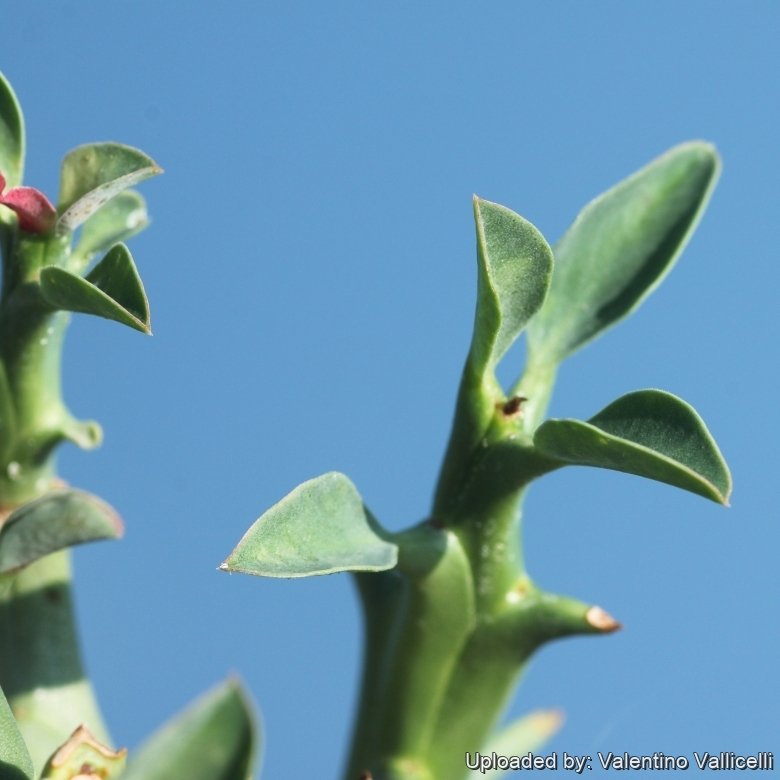
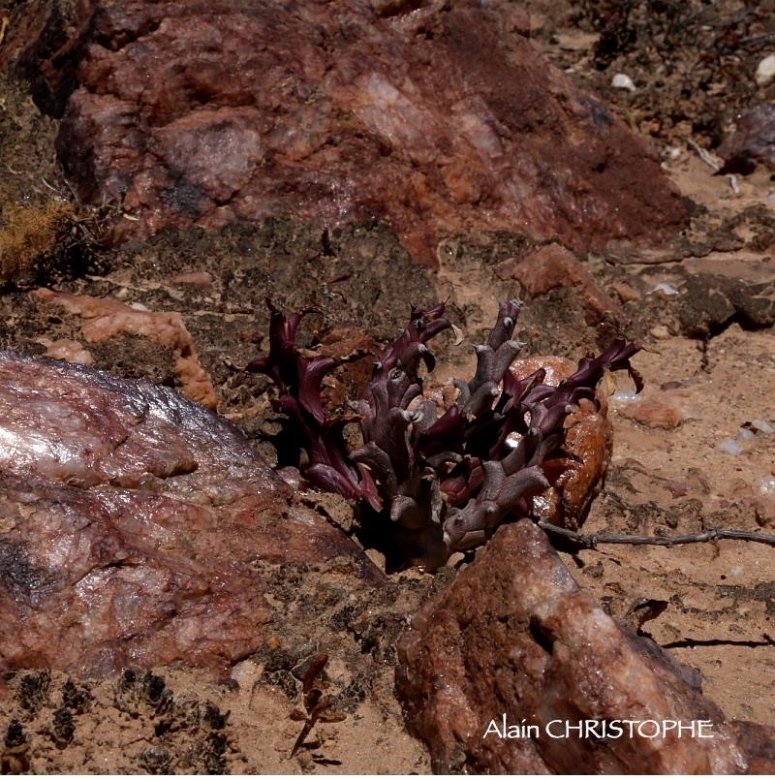
Euphorbia hamata is a thornless low-growing succulent, bushily branched from the base, sometimes forming large dense twisted masses 30(-45) cm high and 45 cm in diameter with small green to reddish flowers at the growing points. It is dioecious (unisexual).
Rots: Elongated or oblong tuber-like merging into stem 2,5-5 cm (or more) in diameter.
Stems: Branches knobby, 6-12 (or when dried 3–8) mm thick, fleshy, somewhat 3-angled, with somewhat distant conical tubercles scattered along them, glabrous, pale-green to reddish- purple in the sun, becoming grey on the old parts; tubercles 2-16 mm prominent, horizontally spreading or slightly recurved, bounded by a slight furrow and obtusely 3-ribbed down the decurrent part, bearing leaves when young and after their fall at first somewhat acute, but with age the apex of the tubercle withers and becomes obtusely rounded.
Leaves: Vestigial 9-18 mm long, 7-15 mm broad, sessile on the tubercles, ovate, elliptic or linear-lanceolate, obtuse or acute, rounded or broadly cuneate at the base, flat or slightly folded ( channelled) lengthwise, slightly fleshy, glabrous on both sides, green and early deciduous.
Inflorescence: Cyathia solitary; bracts usually 3 in a whorl, green to red forming a cup around the Cyathium at the apex of the branches and branchlets, 6–10 mm long, 4-10 mm broad, usually suborbicular and obtuse and apiculate at the apex, or occasionally broadly ovate and acute, glabrous; Cyathium sessile, much shorter than the bracts, 5–7 mm in diameter, unisexual, cup-shaped, glabrous, with elliptic, yellow to red 5 nectar glands and 5 fringed lobes; glands distant, probably spreading or deflexed, usually smaller than the lobes, 0,7 -1 mm long and broad, suborbicular, with the outer margin minutely crenulate (not toothed) or entire, and the inner slightly turned up. Styles united into a column 3-4 mm long, with short spreading bifid tips.
Blooming season: Winter.
Fruit: Capsule sessile, 6 mm in diameter, subglobose, glabrous.
Seeds: 3 mm long, ovoid, obtuse and with 3 slight radiating keels at the apex, minutely tuberculate, grey.
Origin and Habitat
It is widely spread from Namibia to Namaqualand and Hoedjies Bay in the south (Succulent Karoo parts of the Richtersveld and less frequent in the Sandveld)
Habitat: It grows in a dwarf shrubland along with leaf-succulent mesembs amongst rocks in quartzite gravel on gentle or steep slope and gravelly shale usually facing south-west, west and north-west. There is a very low total cover; probably because the surface is unstable with almost no soil.
Altitude: Up to approx. 500 m a.s.l.
Cultivation and Propagation
It is an easy to grow succulent plant for pot culture that will form a small caudiciform stem and make a fascinating specimen.
Growing rate: It is a relatively fast growing species that will make large clumps given the best conditions.
Soil: It grows well in a very draining mineral potting substrate, but it isn’t picky about soil.
Watering: The area to which this plant is native receives rains in both winter and summer, so it can be watered moderately all year around (except in the coldest month of the winter, as it rots easily, especially if overly wet). During the summer they enjoy average feeding and watering.
Hardiness: When dormant in winter, keep it totally dry at or around 4°C, even though it seems to tolerate light frosts well. Mature healthy plants are tough and can also be grown out-of-doors where frost is not too severe, but when left out it is more sensitive to frost and need protection from rain.
Exposure: They do need a lot of light to keep their compact growth-form, but different clones vary in their tolerance of full sunshine. Sometimes, in really hot full sun all day long, a plant will bleach out a bit.
Maintenance: It can be grown in a pot or planted in the ground, but as it enlarges, especially if generously watered and fed, it becomes a messy, twisted mass of knobby branches that eventually may need to be cut back.
Traditional uses: It is used in some areas as an excellent fodder plant especially for cattle.
Propagation: It is propagated by seeds or cuttings (It branches enthusiastically, and offsets are readily available). If you remove an offset, remember to let it dry for a week or so, letting the wound heal (cuttings planted too soon easily rot before they can grow roots). It is better to wash the cut to remove the latex.
Bibliography
Major references and further lectures
-
N.E.Brown, J.Hutchinson & D.Prain “Flora Capensis” Vol 5 Part 2, page 216 (1925)
-
Urs Eggli “Illustrated Handbook of Succulent Plants: Dicotyledons” Springer, 2002
From llifle page Euphorbia peltigera
Description
Euphorbia peltigera is a succulent plant about 30-40 cm high, branching in a bushy manner with a thick underground rootstock, very similar in habit and appearance to Euphorbia hamata.
Stem: Branches 6-12 mm thick, with conical spreading leaf-bearing alternate tubercles 3-18 mm prominent, bounded by slight furrows, minutely puberulous on the young parts, green.
Leaves: Alternate, sessile on the tubercles, 6-20 mm long, 6-12 mm broad, elliptic or ovate, acute or obtuse, slightly folded lengthwise, minutely puberulous on both sides, deciduous
Inflorescence: Bracts 3 in a whorl, forming a cup 15-20 mm in diameter surrounding a single involucre at the apex of the branches and branchlets, 8-12 mm long and 12-20 mm broad when flattened out, transverse, somewhat rhomboid-elliptic or suborbicular, broadly rounded or subtruncate, apiculate at the apex, minutely puberulous on both sides, green; involucre sessile, much shorter than the bracts, unisexual, cup-shaped, minutely puberulous, 3-6 mm in diam., with 5 glands and 5 erect oblong fringed lobes; glands broadly cuneate, 2-3 mm broad, suberect, rather closely contiguous, forming a cup, covered with very short rather crowded simple or divided teeth on its truncate margin, green.
Notes: This species very closely resembles Euphorbia hamata, but is easily distinguished by its stems, bracts and involucres being minutely puberulous and by the very different glands of the involucre.
Origin and Habitat
Little Namaqualand; near the Orange River
***Altitude:** Below 300 m a.s.l.
Bibliography
Major references and further lectures
- N.E.Brown, J.Hutchinson & D.Prain “Flora Capensis” Vol 5 Part 2, page 216 (1925)
Source: Euphorbia peltigera, LLIFLE - Encyclopedia of living forms, CC-BY-SA, retrieved 2026-10-25.