Publication: Sukkul. Euphorb. 80 (1907)
Description
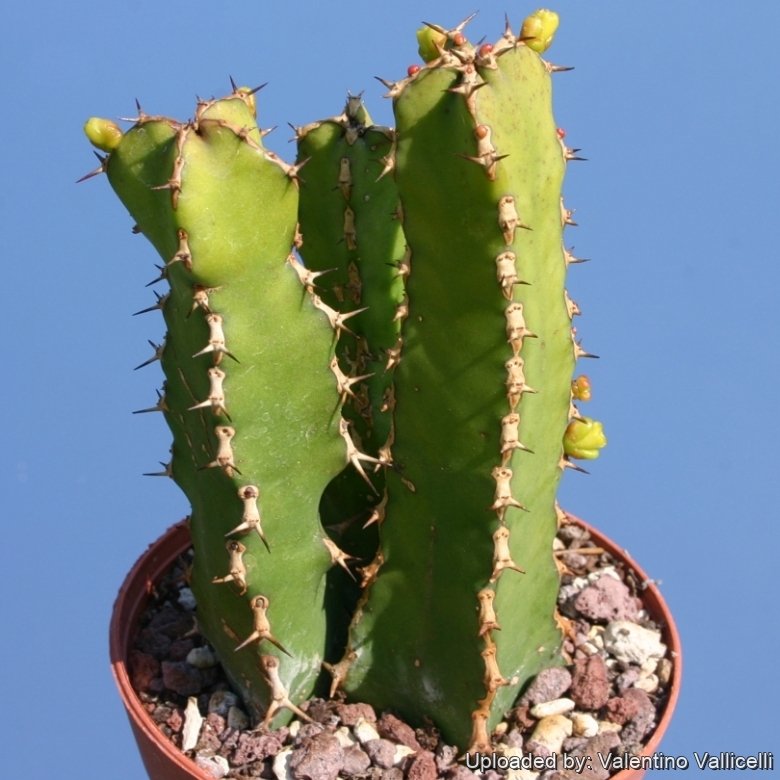
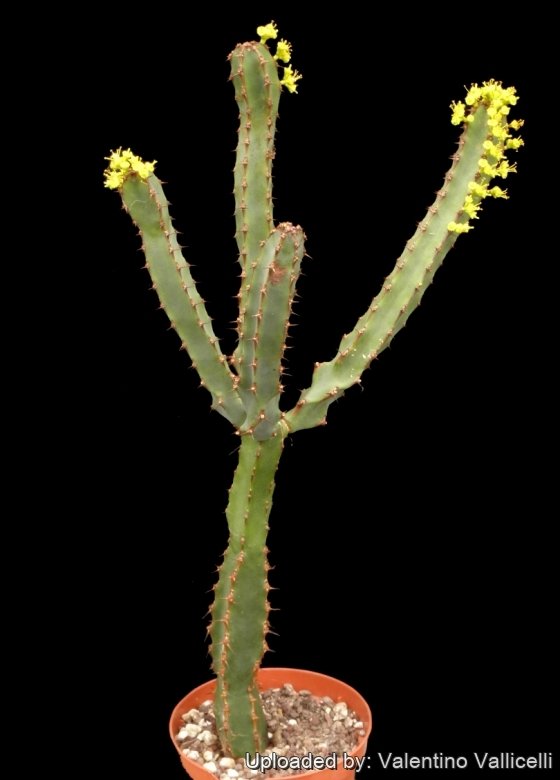
It is a succulent shrub freely branching from the base to form a very cactus-like plant up to 2 m high.
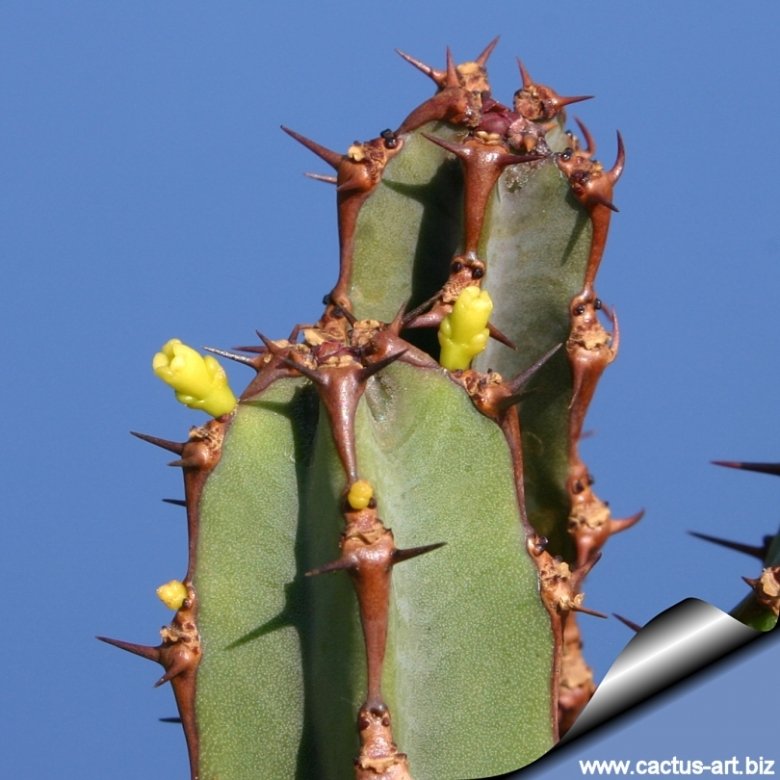
Stems: Branches erect, glabrous, pale yellowish-green, grey green to dark bluish green (depending on clones), up to 5,5 cm in diameter, moderately constricted at intervals into oblong irregular joints 7-18 cm long,
Ribs: (3-)4 to 7 (mostly 4 or 5 ), sharply angled with situated teeth approx 15-18 mm apart.
Spines: Stipular spines 6- 20 mm long in pairs; elongated, rudimentary, separate or joined.
Leaves: Small rudimentary , soon leafless.
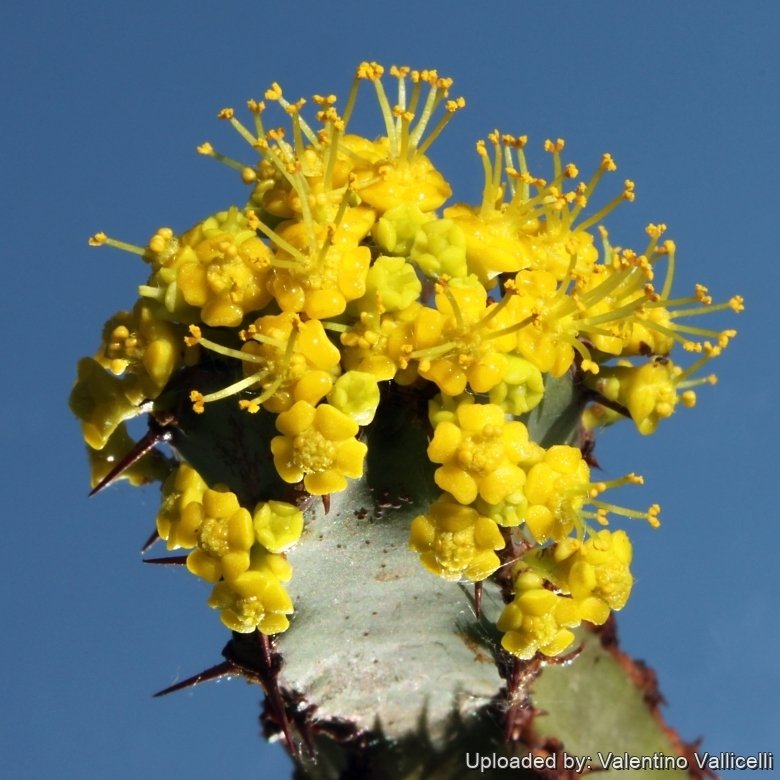
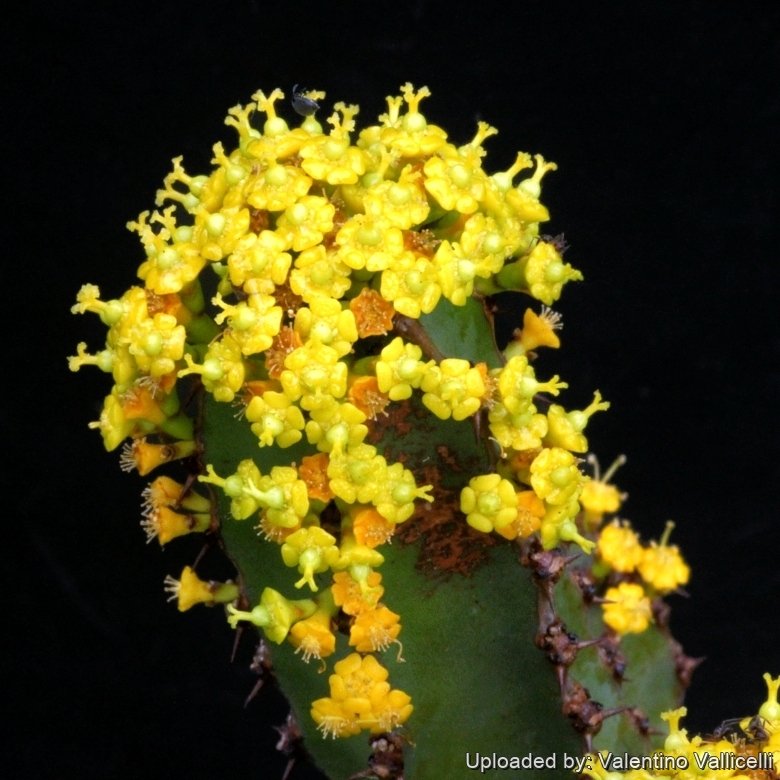
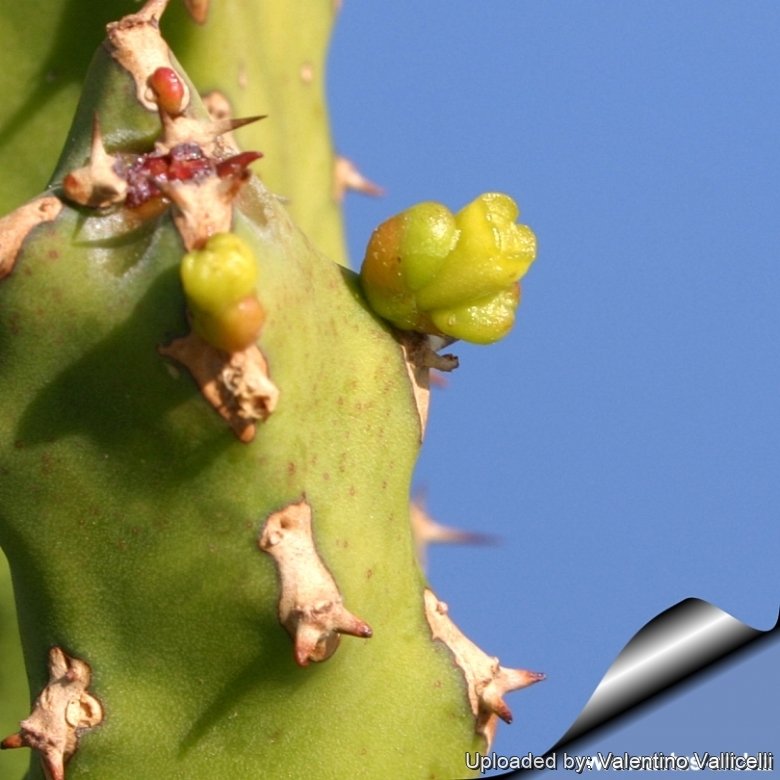
Flowers: The inflorescence is a Cyme, formed by 3 cyathia in an horizontal line, peduncles up to 3 mm.
Cyathia: Up to 5 mm wide Yellow, nectar glands oblong, touching.
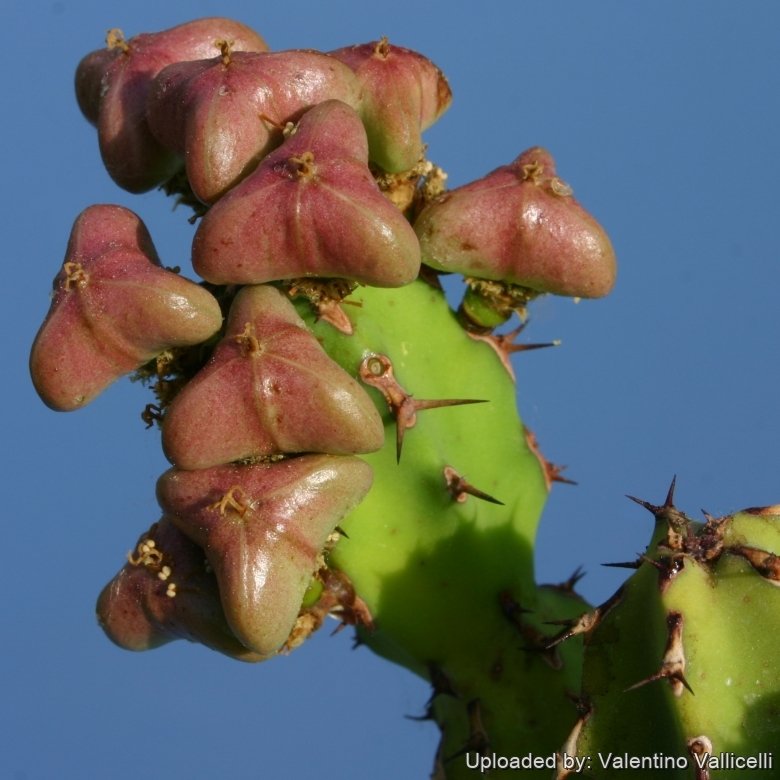
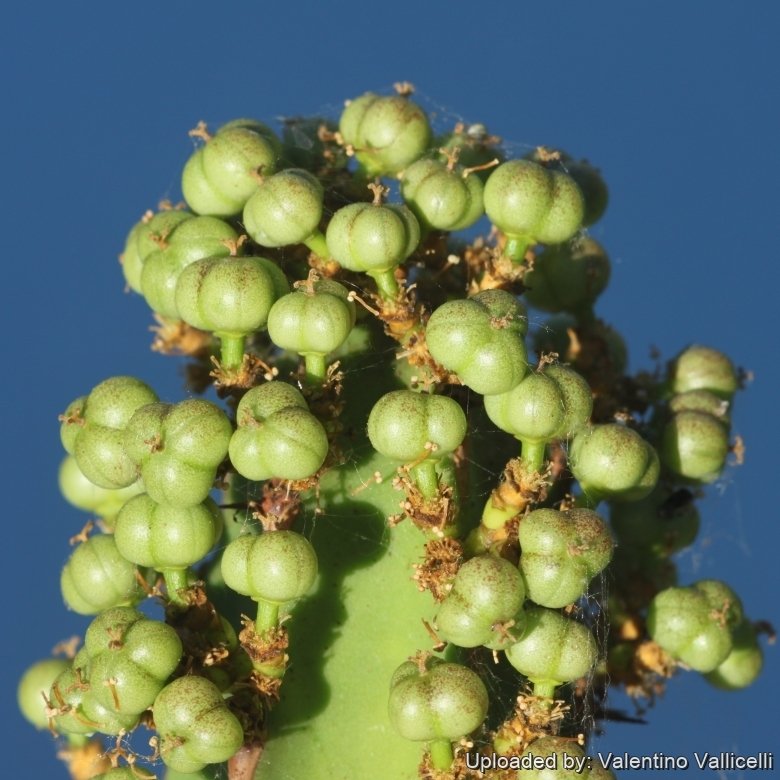
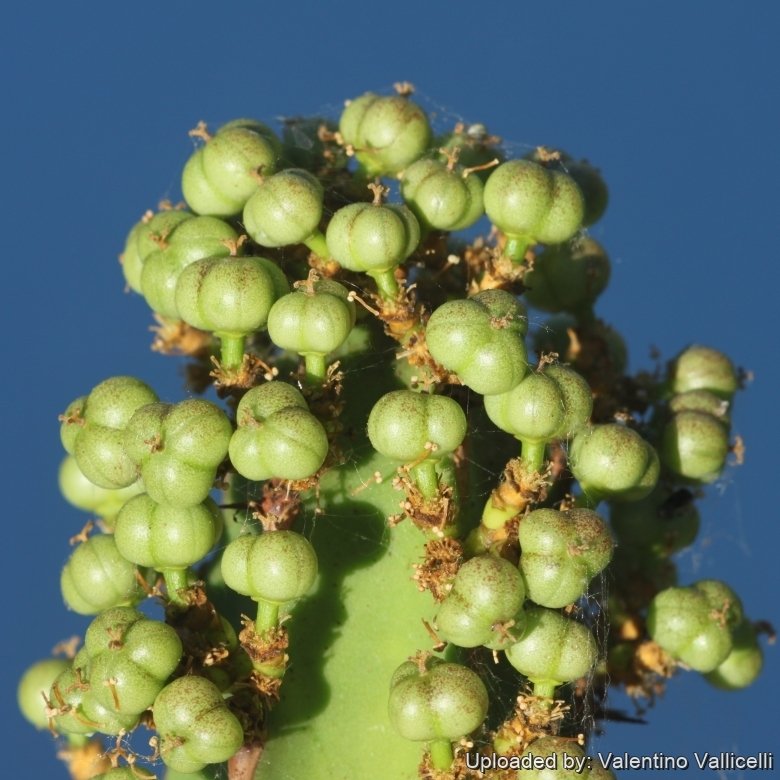
Fruit: slightly lobed, up to 7 mm in diameter, peduncle up to 6 m long.
Origin and Habitat
South Africa, Cape Province: Uitenhage Div. : between Zwartkops and Sundays River, etc.; Humansdorp, Uitenhage, Port Elizabeth and Albany Div.
Cultivation and Propagation
Need bright light to partial shade for best appearance. It responds well to warmth, with its active growth period in the late spring and summer months. Water thoroughly when soil is dry to the touch during active growing season (more than once a week during hot weather) In the winter months, waterigs should be suspended or restricted to once over the winter. The most common failure in growing this plant is over watering, especially during the winter months. Likes porous sub-acidic substrata (pH 6) with adequate drainage. Very tender, protect from frost.
Reproduction: It is propagated by cuttings. It is recommend taking Euphorbia cuttings in Spring/Summer when the plant is growing so that they have a better chance of success. They key is heat & good air circulation. These cuttings should be dipped in Hormone powder (but it is not needed) and left for a period of 3-4 weeks to callous. Then pot the cutting and don’t water ( or kept slightly moist) until rooted. These will root just fine, if you can put the pot outside in the summer, or put pot on a heating pad.
Warning: As with all other Euphorbias when a plant get damaged it exudes a thick white milky sap known as latex. This latex is poisonous and particularly dangerous for the eyes, skin and mucous membranes. So pay extreme attention not to get any in your eyes or mouth. Cultivated plants must be handled carefully. Watt & Breyer-Brandwijk (1962) described this plant as being virulently poisonous.
Bibliography
Major references and further lectures
-
Urs Eggli “Illustrated Handbook of Succulent Plants: Dicotyledons” Springer, 2002
-
Hermann Jacobsen “A handbook of succulent plalnts: Abromeitiella to Euphorbia” Blandford Press, 1960
-
James Cullen, Sabina G. Knees, H. Suzanne Cubey “The European Garden Flora Flowering Plants: A Manual for the Identification of Plants Cultivated in Europe, Both Out-of-Doors and Under Glass” Cambridge University Press, 11/ago/2011
-
Doreen Court “Succulent Flora of Southern Africa” CRC Press, 01/giu/2000
-
Alain Campbell White, Robert Allen Dyer, Boyd L. Sloane “The succelent Euphorbisae (southern Africa)” Abbey garden press, 1941
-
Werner Rauh “Cultivation and Description of Selected Succulent Plants Other Than Cacti” Smithsonian Institution Press 1984
-
Gibbs Russell, G. E., W. G. Welman, E. Reitief, K. L. Immelman, G. Germishuizen, B. J. Pienaar, M. v. Wyk & A. Nicholas. “List of species of southern African plants.” Mem. Bot. Surv. S. Africa 2(1–2): 1–152(pt. 1), 1–270(pt. 2). 1987.
Cultivars and forms (2)
Varieties (1)
Forms (1)
Gallery