Publication: Encycl. (Lamarck) 2(2): 417. 1788 [14 Apr 1788]
Description
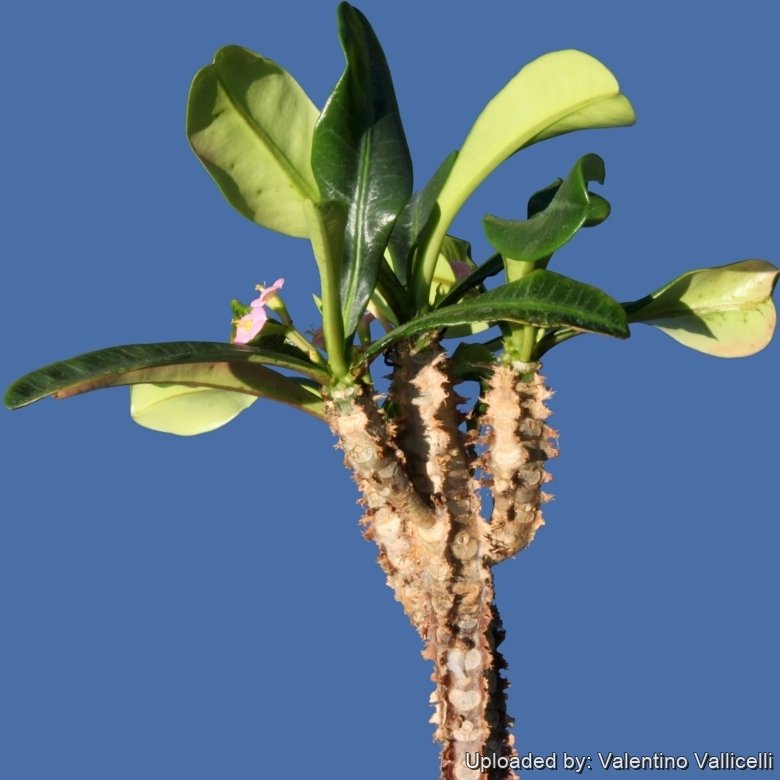
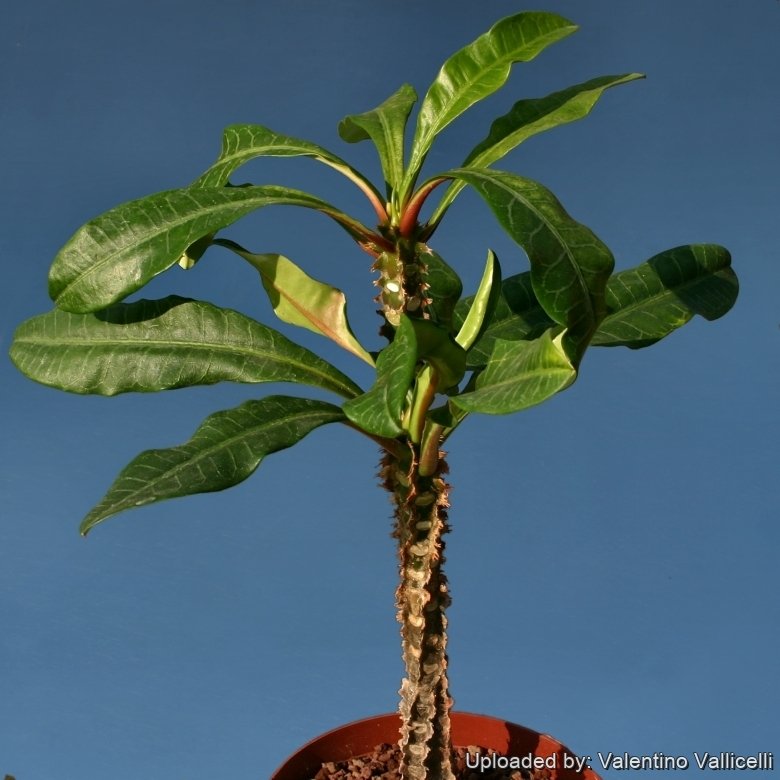
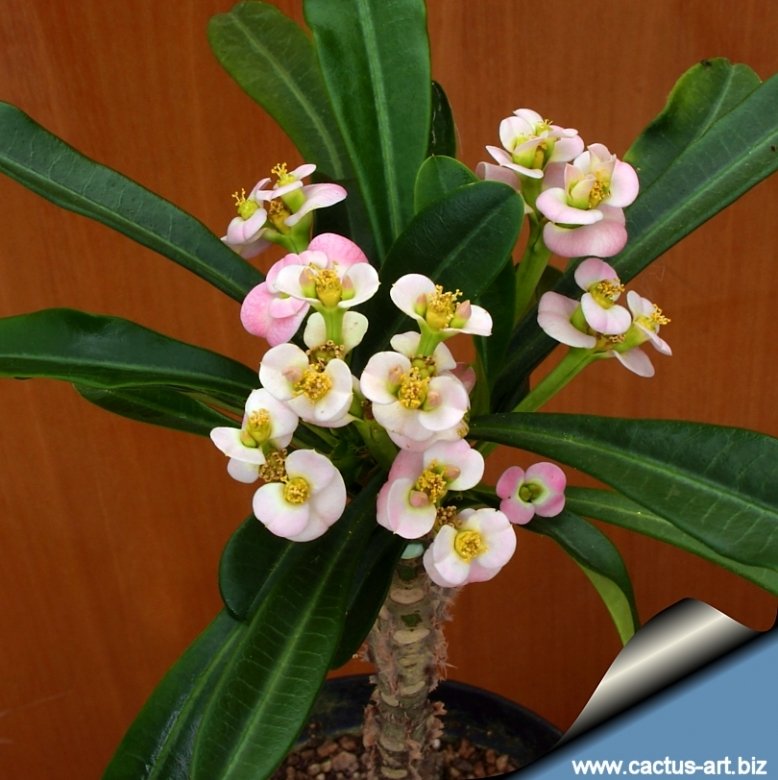
Euphorbia lophogona is a medium-sized ever-green or semi-deciduous succulent shrub, up to 120 cm tall
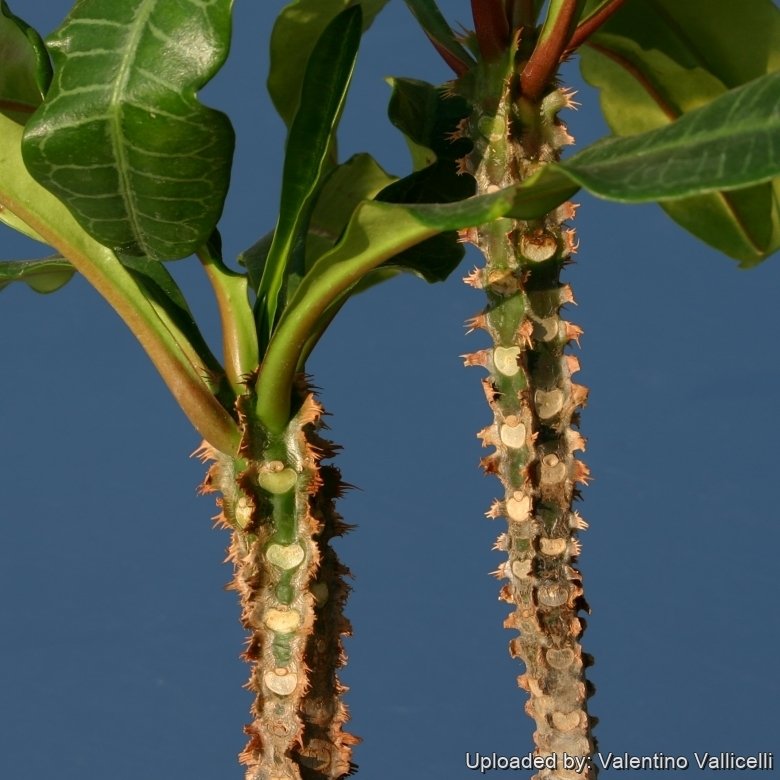
Stem: Unbranched or sparsely branched, sometimes spiraling, narrowing to the top, with longitudinal rows of thorns, with a diameter of 3 cm. The branches are 5-angled, broadening toward the tips, have grey leaf-scars, and are dark green to olive brown.
Leaves: Glossy bright green, elliptic, 12 by 2.5(-5) cm long, fleshy to quite leathery, with a prominent mid-vein, laced with white veins, and grow near the top of a stem. The leaf-stalks are 1.5 cm long and rather thick.
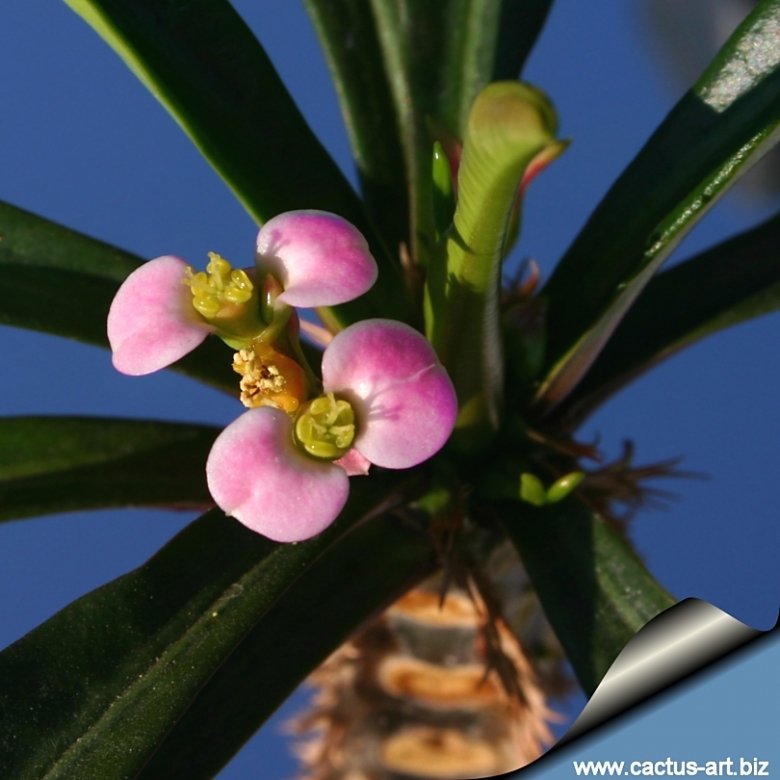
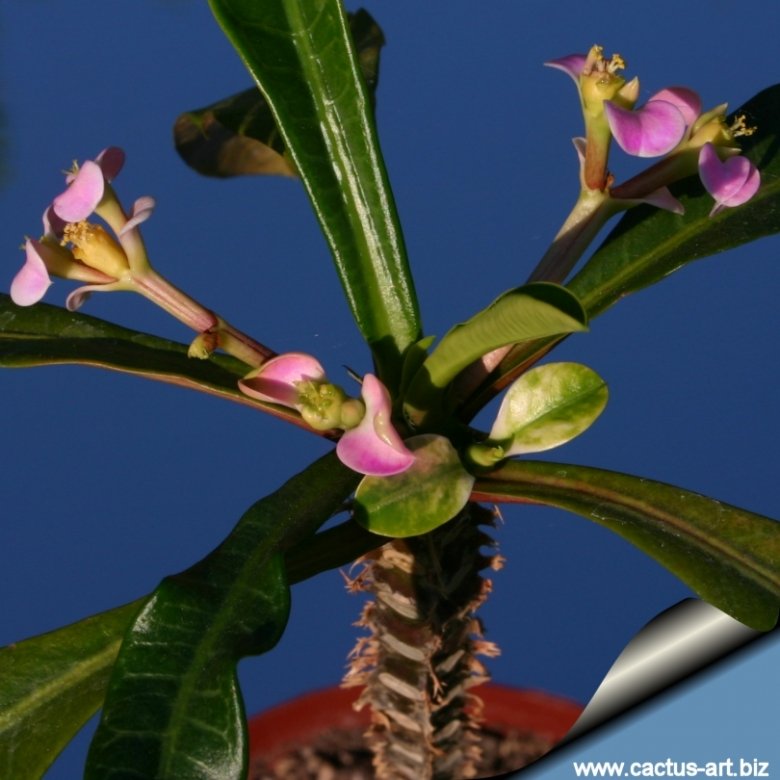
Flowers: The inflorescence of this species is usually on stalks, the true flowers are yellowish-green encircled by large white to pink pseudo flowers on a greenish-red stalk.
Blooming season: Summer.
Remarks: E. lophogona var. lophogna is distinguished from Euphorbia lophogona var. tenuicaulis, which is smaller and has whitish or pink pseudo flowers. Hybrids from this plant (e.g. Euphorbia x lomi (Euphorbia lophogona x Euphorbia milii) are among the most popular succulent plants in the international trade.
Origin and Habitat
Endemic to east coast of Madagascar, from Fort-Dauphin (where it is locally common) to Sainte-Marie island (Provinces: Fianarantsoa, Toamasina, Toliara) The typical variety of this species has a small extent of occurrence (13,587.1 km²) and an area of occupancy of 4,431.66 km². Recorded from 10 localities and comprises three subpopulations.
Altitude range: Elevation 0-499 metres above sea level.
Habitat: Subtropical or tropical coastal rainforests with a sandy soil. The specimens from Sainte-Marie island were all collected in 1880 suggesting that the species is now extinct there. The species is threatend by habitat degradation, fire, collection for national and international horticultural trade.
Cultivation and Propagation
Half sun to lit shade appears to be the optimum range but tolerate the most shade. Relatively flexible in its watering requirements. They can be watered regularly as long as the medium is open and well drained. As with any normal plant when watering, it is best to do so thoroughly, until a little water comes out through the drain holes. Allow the medium to dry out somewhat between waterings. Reduce watering to once every 1.5 weeks during winter. Space plants apart to allow air movement between branches and leaves. This will help with evaporation of extra water droplets collected during watering.
The ideal potting-medium is one with good moisture-retaining capacity but open and well drained with some extra manure for added nutrition. Regular fertilizing with low nitrogen and high phosphorus and potassium ratios are preferred. Feed during spring and summer to mid autumn and withhold feeding during winter. Tall plant will benefit from being staked, with bamboo or other suitable stakes, in order to stabilize the plants and provide a counterbalance to the weight of the masses of flowers. In the absence of staking, the stems of the plants will be under extreme pressure and may snap under the weight. Very tender, protect from frost.
Propagation: Cuttings It is recommend taking Euphorbia cuttings in Spring/Summer when the plant is growing so that they have a better chance of success. They key is heat & good air circulation. These cuttings should be dipped in Hormone powder (but it is not needed) and left for a period of 3-4 weeks to callous. Then pot the cutting and don’t water ( or kept slightly moist) until rooted. These will root just fine, if you can put the pot outside in the summer, or put pot on a heating pad.
Warning: As with all other Euphorbias when a plant get damaged it exudes a thick white milky sap known as latex. This latex is poisonous and particularly dangerous for the eyes, skin and mucous membranes. So pay extreme attention not to get any in your eyes or mouth. Cultivated plants must be handled carefully.
Bibliography
Major references and further lectures.
-
Urs Eggli “Illustrated Handbook of Succulent Plants: Dicotyledons” Springer Science & Business Media, 2002
-
Debra Lee Baldwin “Succulent Container Gardens: Design Eye-Catching Displays with 350 Easy-Care Plants” Timber Press, 20/Jan/2010
-
Werner Rauh, Herman Schwartz “Succulent and xerophytic plants of Madagascar” Volume 2 Strawberry Press, 1998
-
Huxley, A. “New RHS Dictionary of Gardening” 1992
-
Jankalski, S. “Crown of thorns hybrids past and present” . Cact. Succ. J. (US). 72:202 - 204. 2000.
-
Smoley, R. “Giant-flowered Euphorbia milii hybrids” Cact. Succ. J. (US). 72:198-200 2000.
-
John McLaughlin and Joe Garofalo “Crown - of – Thorns (Euphorbia milii)” Publications for the residents of Miami-Dade County. Fact-sheet No. 65. Printed 4 2002
-
Haevermans, T. 2004. Euphorbia lophogona. “The IUCN Red List of Threatened Species.” Version 2014.1. <www.iucnredlist.org>. Downloaded on 09 July 2014.
From llifle page Euphorbia fournieri
Description
This is a nice large, cactus-like, candlestick, tree Euphorbia with short thorns. It form a dense crown of ascending branches usually up to 4,5 m tall (but reported to reach 9 m of height ) This is a highly variable species with several forms and making precise descriptions may be difficult.
Stems: Columnar, angular branches, constricted into ovate segment appox 15 cm long,
Ribs: 8 (4 for E. acruensis) very deep, vertical or slightly twisted with thin walls and shallow sinuate teeth 12 mm apart.
Spines: Stipular spines in pairs closely packed (almost touching) on the rib border, triangular up to 7 mm wide and 10 mm long, separate, becoming corky.
Flowers: 1-5 cyathia up to 12 mm wide born together on simple cymes, peduncles up to 5 mm long stout, nectar glands elliptic yellow, almost touching.
Fruits: About 12 x15 mm wide, subglobose, fleshy, white turning red, hardening, becoming deeply lobed at maturity.
Seeds: Smooth, subglobose, 4,5 x 3,5 mm wide,
Remarks: It has a very clean and neat appearance and is often confused with with Euphorbia ammak, Euphorbia ingens and Euphorbia erythraea . Nevertheless this plant is often leafed out, especially if warm and given plenty of water. This makes it easy to tell from , which rarely has leaves, or they are so small and insignificant. Furthermore Euphorbia abyssinica grows more vertical in form than its cousins.
Origin and Habitat
It is the the principal tree euphorbia of northeast Africa ranging from East Sudan (Red Sea Hills) to Eritrea, Northern Ethiopia and Northern Somalia.
Habitat: Grows in the most exposed places in well-drained stony soils and in the crevices of rock faces of hills and slopes, in montane dry deciduous and evergreen woodland and bushland , woodland and shrub savanna at 850 to 2200 m altitude. It occurs widely throughout dryland Africa and it is often dominant.
Cultivation and Propagation
It is an easy species to grow that is suited for any well drained soil in full sun. But young plant are happy growing indoors, where they can easily reach the ceiling. Give the plant an airy growing medium which mainly consists of non organic material such us clay, pumice, lava grit, and only a little peat or leaf-mould. Water regularly during the active growing season from March to September. No water should ever be allowed to stand around the roots. Keep almost completely dry in winter. It is a moderately fast grower, and will quickly become large landscape masterpieces in just 3-5 years. Only downside is from strong winds, the columns often smash into each other, causing permanent scarring… best to plant in such a location where winds are not a big issue. If plant becomes very red, this is a sign that the roots have not developed properly. It can tolerate moderate shade, and a plant that has been growing in shade should be slowly hardened off before placing it in full sun as the plant will be severely scorched if moved too suddenly from shade into sun. Like quite small pots, repott in very later winter, early spring. Can be pruned for shape and branching. Frost tender, frost free zones only. It is definitely more tender than Euphorbia ammak or Euphorbia ingens, and slower growing, it will be content in its position and with its soil for years.
Propagation: It is easy to propagate by cuttings in late spring to summer, just take a cutting of the plant let it dry for 1 or 2 weeks and stuff it in the ground (preferably dry, loose, extremely well draining soil).
Warning: All Euphorbias contain a white sap that can be irritating to eyes and mucous membranes. If contact is made with this white sap, take care to not touch face or eyes before washing hands with soap and water.
Uses:
Gardening: This tree can be grown in large, rocky, well-drained soil in gardens in drier areas. It is very drought resistant but susceptible to frost. It makes one of the better house plants for an Euphorbia, dealing well with low light situations (though recommend higher light if possible). Somewhat user-friendly with only sparse spines along the edges of the plant. Slightly delicate, though, and spines tear off easily, exposing that latexy sap. It is also appreciated as a live fence because it is easily propagated from untreated mature branch cuttings.
Fuel production: The Italians attempted to grow Euphorbia abyssinica in 1935-36 to use its latex to produce a gasoline-like substitute.
Fishing: It is used to stupefy fish, making it possible to catch them by hand. The fish poison is prepared by soaking a bundle of grass in the latex, tying it to a stone and throwing it into the water. Paralysed fish rise to the surface within a short period of time.
Source: Euphorbia fournieri, LLIFLE - Encyclopedia of living forms, CC-BY-SA, retrieved 2026-10-25.
Gallery