Publication: Euphorbiaceae Study Group Bulletin 12(1): 32 (1999)
From llifle page Euphorbia infausta
Description
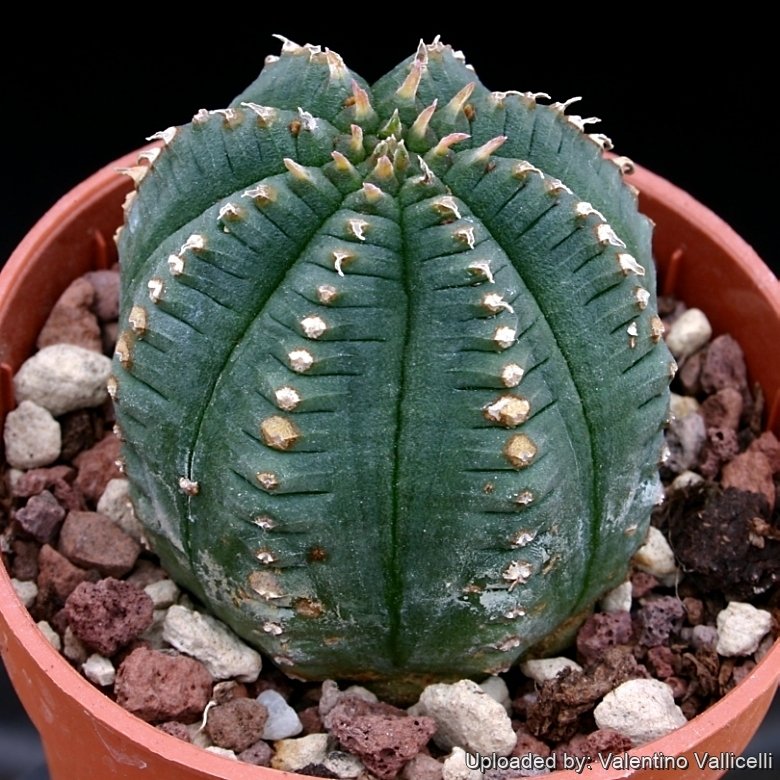
It is a dioecious small species that offsets from the base. The plants in the wild differ from one population to another, but also from one plant to another. This has caused much confusion.
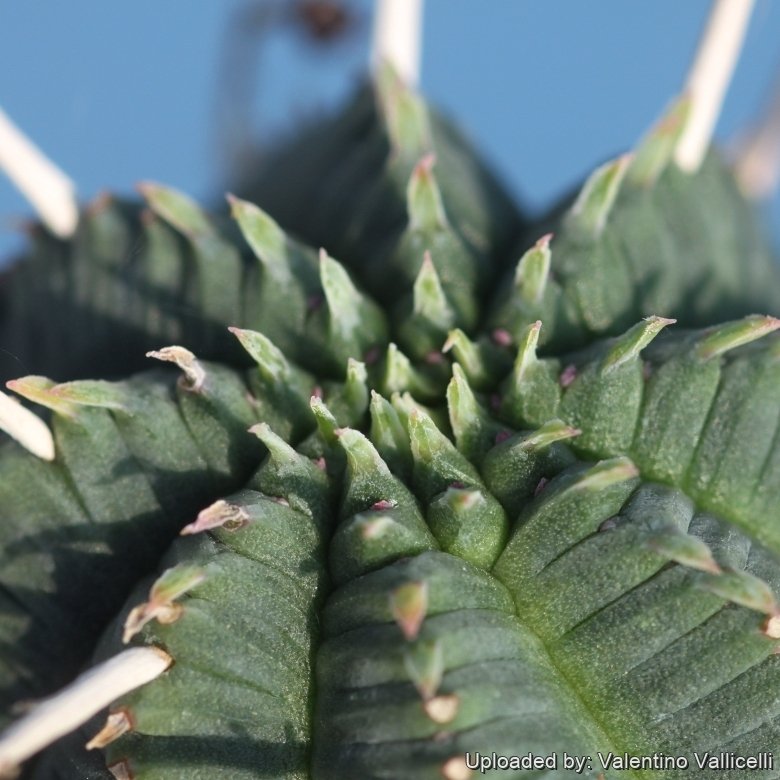
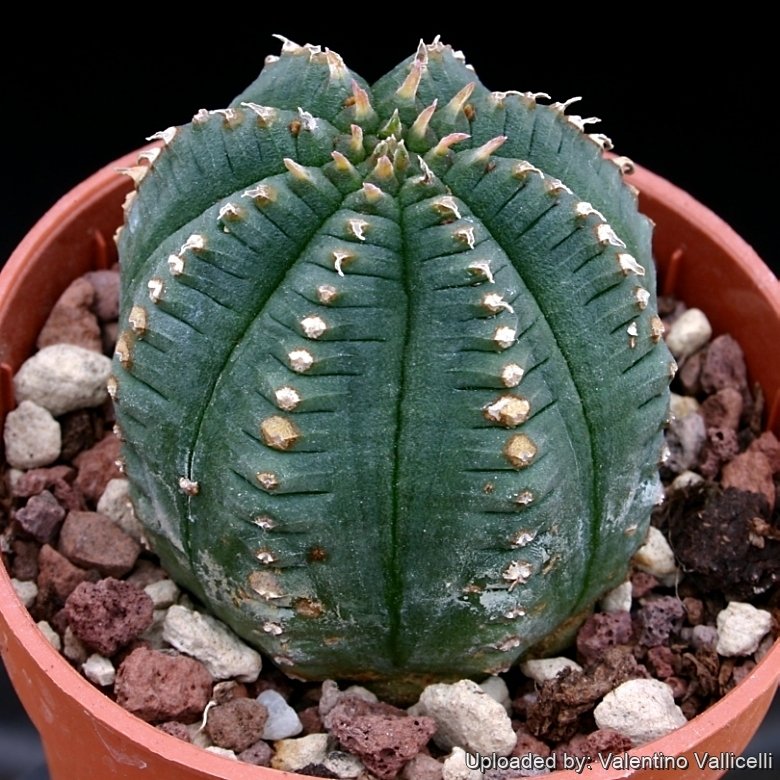
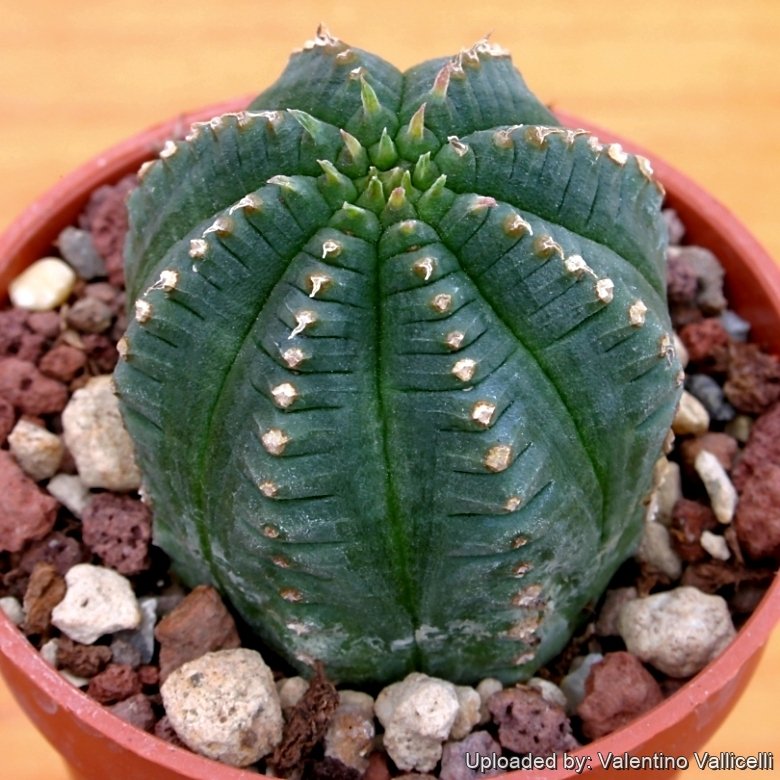
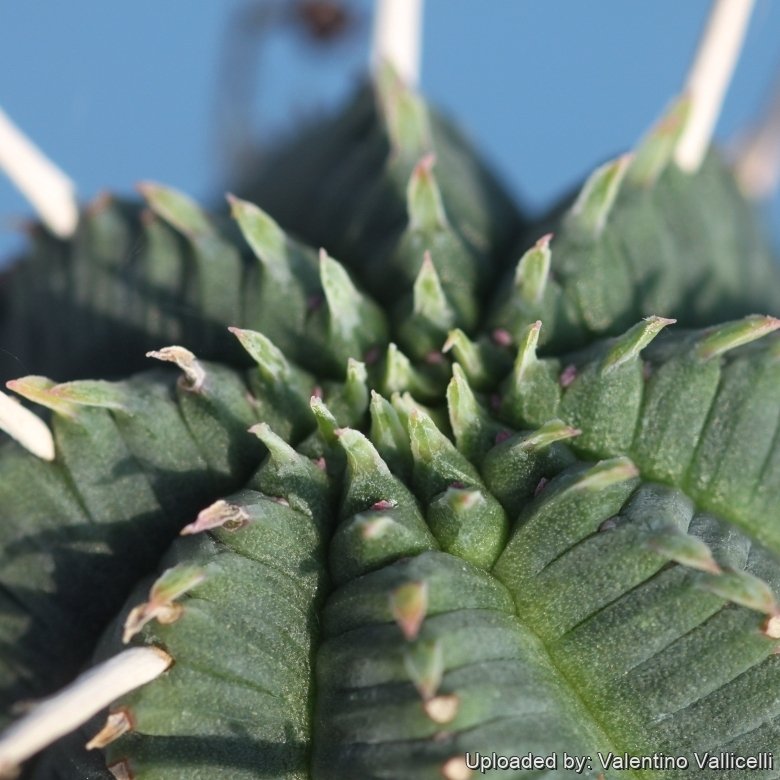
Stem: Spherical to obovoid, succulent, leafless and spineless up to 9 cm in diameter, more or less depressed at the apex, producing subglobose branches on its sides, glabrous, bright deep green, marked with oblique transverse darker green (or purplish) stripes, which are sometimes not very conspicuous.
Spines: The “spines” only found on male plant are the persistent hardened remains of the cymes.
Ribs: 8 to 2 vertical or spiral, somewhat acute, with nearly flat and slightly concave (not convex) sides, nearly even or faintly crenulate at the margin, with the leaf- or cyme-scars about 2-5 mm apart
Leaves: Rudimentary, soon deciduous usually less than 5 mm long, linear or linear-lanceolate, acute.
Flowers: cymes of the male plant erect or ascending (not depressed on the plant), at first with the peduncles simple, 1-2,5 cm long, and bearing only 1 involucre, finally developing at its apex 1–3 erect or ascending rays 6-24 mm long, each with 1 terminal involucre or with 2–3 involucres scattered along them, green, velvety-puberulous, often persistent and hardening; cymes of the female plant similar, but much shorter, always deciduous; involucre 2-4 mm in diam., cup-shaped, puberulous outside, light green, with 5 glands and 5 transversely rectangular or subquadrate ciliate lobes; glands 1-3 mm in their greater diam., transversely oblong, slightly convex, light green, minutely punctate; ovary sessile, glabrous; styles very shortly united at the base, with the free part 1 mm long, rather stout, two-lobed at the apex. The involucre and glands of the female plant are smaller than those of the male.
Fruit: Capsule.
Remarks: It is readily distinguished from Euphorbia meloformis (f. meloformis) by its more freely branching habit, less evidently banded stems, more distinctly crenate angles, especially on young plants, and particularly by the outstanding erect or ascending peduncles, which only branch at their apex and do not divide near their base into a trichotomous or dichotomous cyme pressed down on the top of the stem as in Euphorbia meloformis.
Origin and Habitat
South Africa, western Cape.
Altitude: 650 - 750 m elevation above sea level.
Cultivation and Propagation
Like a sunny position. It does best in a mineral soil, good drainage is essential. Water sparingly during the summer months and keep dry in winter. It is a slow growing long lived plant and once established, it will be content in its position and with its soil for years. It can tolerate moderate shade, and a plant that has been growing in shade should be slowly hardened off before placing it in full sun as the plant will be severely scorched if moved too suddenly from shade into sun. It is propagated from seed sown during spring or summer.
Bibliography
Major references and further lectures
- Urs Eggli “Illustrated Handbook of Succulent Plants: Dicotyledons” Volume 2. Springer, 2002
2)White, A., Dyer, R.A. & Sloane, B.L. ”The succulent Euphorbieae“ Abby Garden Press. Pasadena, California. 1941
-
Hermann Jacobsen ”A Handbook of Succulent Plants: Abromeitiella to Euphorbia” Blandford Press, 1960
-
Stuart Max Walters “European Garden Flora: A Manual for the Identification of Plants Cultivated in Europe, Both Out-of-Doors and Under Glass” Cambridge University Press, 1984
-
N. E. BROWN, J. HUTCHINSON and D. PRAIN. “Flora Capensis”, Vol 5 Part 2, page 216 1925
Source: Euphorbia infausta, LLIFLE - Encyclopedia of living forms, CC-BY-SA, retrieved 2026-10-25.
From llifle page Euphorbia pyriformis
Description
It is a compact highly branched succulent with a thickened storage root stock. It will form a dense mat with age.
Leaves: Fleshy organized in 2-6 pairs in each branch, smooth, light grey to bluish, trigonus narrowing toward the apiculate apex, keel ± oblique. Every year a few new leaves grow from the central stem.
Roots: Well developed, thickened tap-root.
Flowers: Daisy-like, organized in groups (cymes) of 1 to 3, but usually solitary, 20-30 mm in diameter, petals pure white to dark-pink with a white base, 1(-3) bracteolate. Filamentous staminodes white surrounding the stamens in a central cone. Stamens filament white, anthers yellow.
Blooming season: The long lasing flowers appears in spring.
Fruits: Dark-brown capsules, usually singles, bracteolates, base semi-globular with convex sides. Persisting for many year on the plants.
Seeds: 0.9-1 mm long, 0.6-08 mm wide.
Origin and Habitat
It is endemic to few sites in the Northern Cape, Griqualand West and Vredenfort, South Africa.
Habitat: Grows in grass land among sandstone rocks, in gravelly soil, often in pockets on rocks or or on pans. Rainfall/year: 300-500 mm in summer. This species look surprisingly like mesembs of the genus Hereroa that grow mixed together the same area but with yellow flowers in late summer.
Cultivation and Propagation
It is easy to grow and rewarding plants than can be grown in pots or in the rock-garden.. These plants grow on summer rain areas and were heading for winter dormancy. They can be watered year-round, water regularly from spring to Autumn but reduce watering frequency in winter, growth period is early Spring to late Summer, but is a very adaptable species that can grows opportunistically whenever the water availability and growing condition are favourable. Keep them cool, and half-shaded in summer, need full sun or light shade on the other seasons. Potted Ebracteola look best in a heavy soil and the same is true for plants in a rockery. Requires good drainage. Frost Tolerance: quite frost hardy and grows best where there are cold winters (it is reported to be hardy to at least -10° C if very dry).
Propagation: Seeds, cuttings.
Notes
Ebracteola has a gorgeous, thick root system and when it is potted up, the plant can be progressively raised over the ground so that some of the roots can be seen and is especially cultivated for their looks. Architecturally it is a real stunner. When the “caudex” shape of the raised roots is adequately in evidence this plant is incomparable. They also tend to grow more “heads” when they are raised.
Source: Euphorbia pyriformis, LLIFLE - Encyclopedia of living forms, CC-BY-SA, retrieved 2026-10-25.