Publication: Bull. Hist. Nat. Soc. Linn. Bordeaux 1: 27 1826
Description
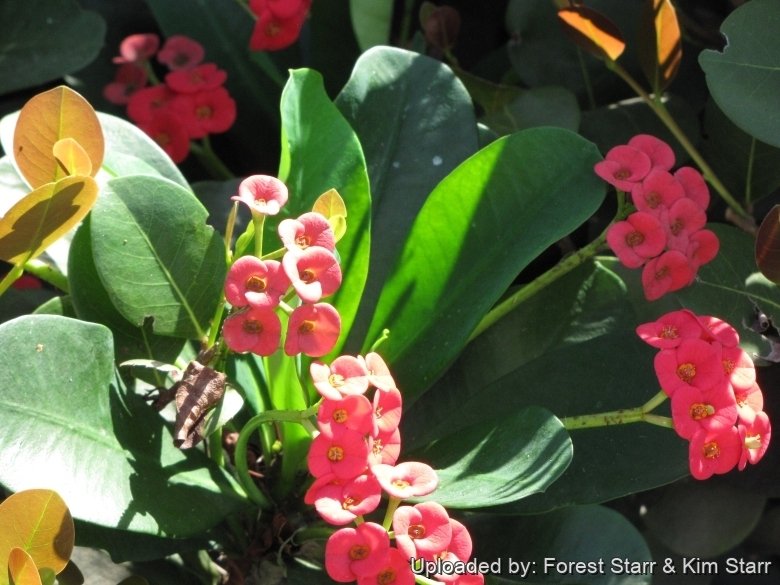
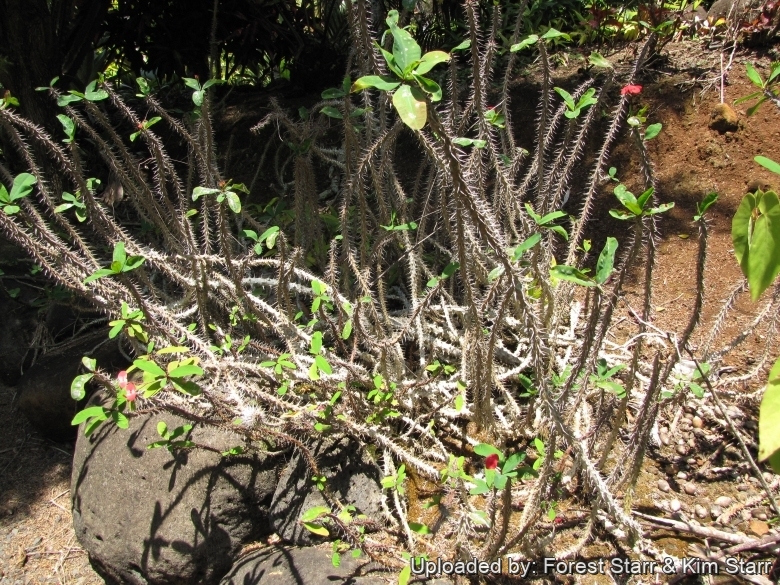
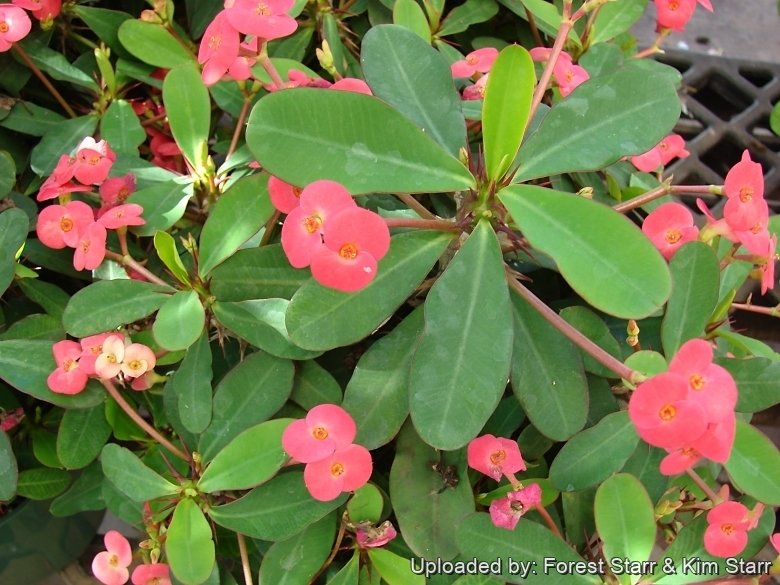
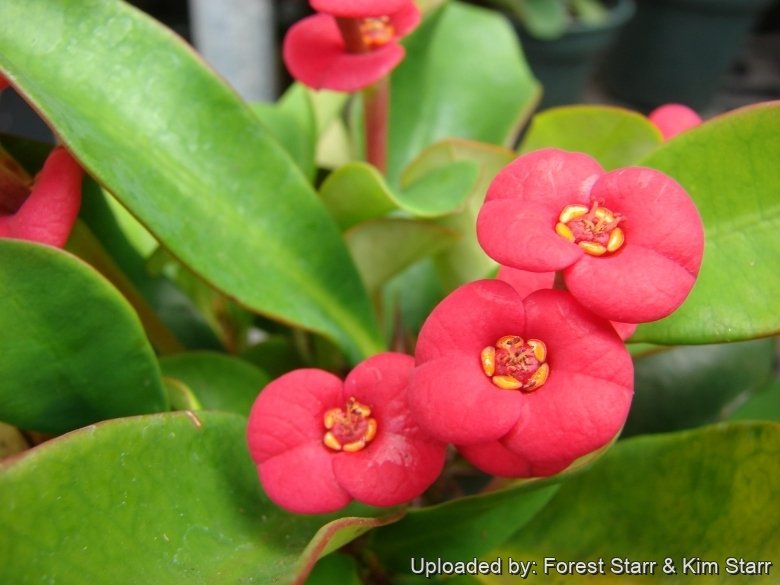
Euphorbia milii (crown of thorns, Christ plant, Christ thorn) is a thorny, much branched, semi-succulent shrub to ca. 1.5-1.8 m tall, branches covered with spines. It is semi-prostrate or somewhat climbing and quickly forms a low dense hedge which can be easily trimmed without harming the plant. It is widely grown in the tropics as an ornamental for the bright red bracts that resemble, from a distance, geraniums. Bracts of this beautiful shrub—which is seldom out of bloom—come naturally in bright red, but in cultivation it is available in all warm colours, including red, yellow, coral, and cream. The species name commemorates Baron Milius, once Governor of Réunion, who introduced the species to France in 1821. It is suspected that the species was introduced to the Middle East in ancient times, and legend associates it with the crown of thorns worn by Christ at the crucifixion. There are a number of varieties (at least eleven) of which var. splendens is the most popularly cultivated.
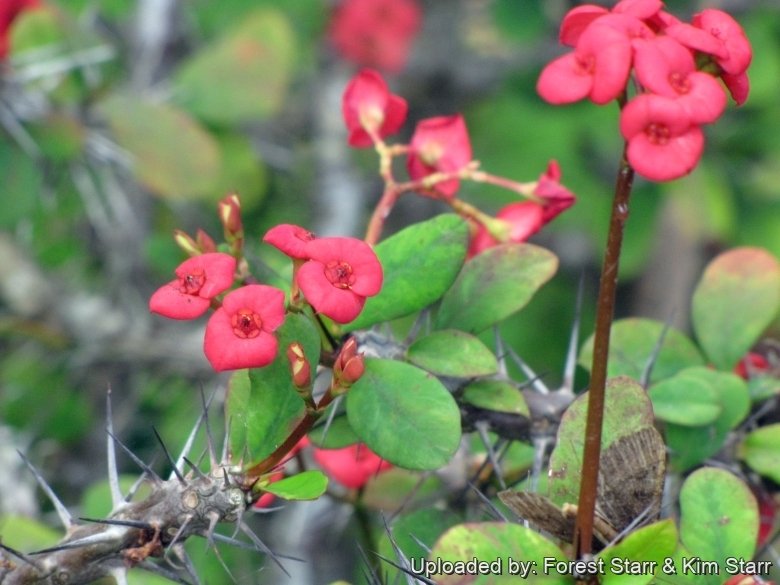
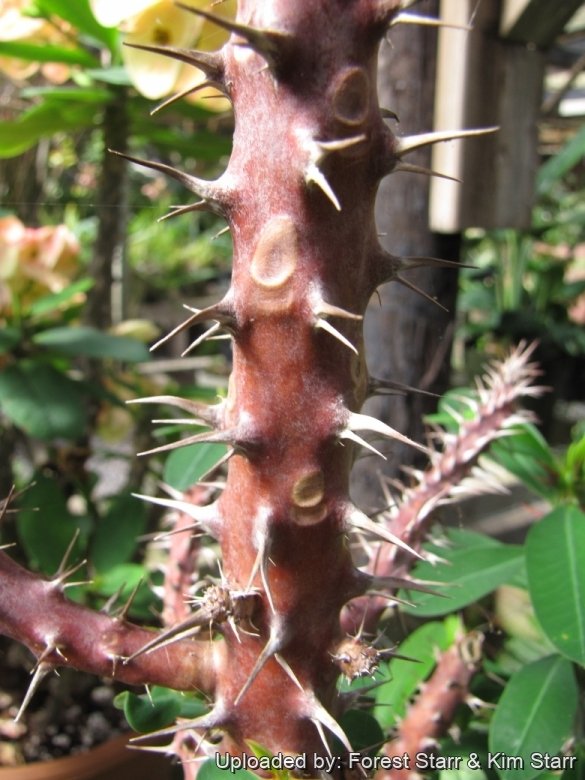
Stems: Cylindrical, 5-7 sided, with many prominent grey spines. Up to 60-90 cm long and ca.1 cm in diameter, bark greyish brown or purplish-brown. The sap is moderately poisonous.
Leaves: Alternate, spirally arranged on the stem, crowded near the branch tips on new growth, simple, dark green to greyish green, obovate (wider near the tip), spatulate or lanceolate, 1-5(-6) cm long and ca 1.5-2 cm broad, margins entire. They are deciduous in summer during the dry season, but often evergreen in cultivation.
Stipular spines: Straight, slender, 1-2(-3) cm long. The spines help Euphorbia milii scramble over other plants.
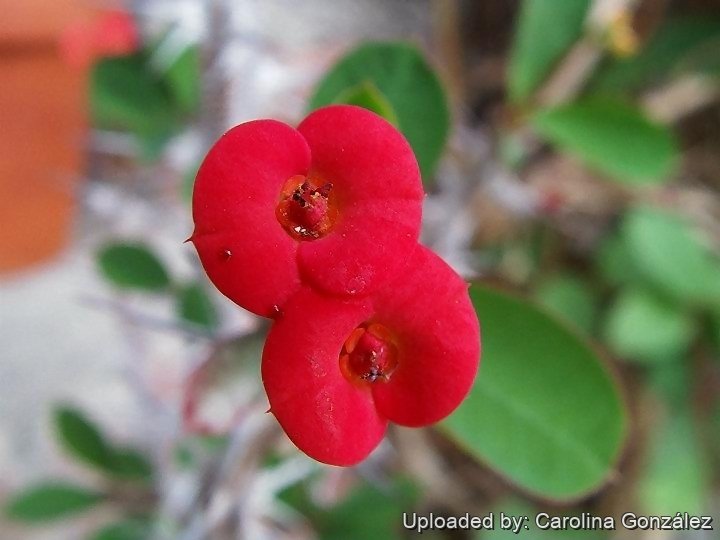
Flowers: Unisexual (plants monoecious), in clusters of cup-shaped structures known as “cyathia.” Cyathium sessile ca. 6 × 8 mm. Each cluster is subtended by a pair of conspicuous brilliant red (rarely yellow) petaloid bracts (cyathophylls), broadly ovate beneath or subcircular, ca. 12-15 mm across.
Staminate flowers: Numerous in each cyathium. Calyx absent. Corolla absent. Stamen 1.
Pistillate flowers: 1 per cyathium. Calyx absent. Corolla absent.
Blooming season: It flowers all year round whenever conditions become favourable, but are at their best in dry, sunny weather especially before corning into leaf.
Fruit (capsule): 1 seeded.
Origin and Habitat
Madagascar (Fort Dauphin area; 20 km south of Betroka; mountains near Ihosy, possibly between Antsirabe and Fianarantsoa; possibly north of Antananarivo, near Maevatanana; on the High Plateau near Imerina; Zombitse forest (Sakaraha) and at Le Table mountain near Tulear). It is also known from other tropical regions throughout the world and widely cultivated as ornamental.
Habitat and Ecology: Euphorbia milii seems to occur in a variety of bush and forest habitats, but always on rocks (usually granite formations). It is threatened by habitat degradation, fire and collection for the horticultural trade.
Cultivation and Propagation
Euphorbia milii is widely cultivated as an ornamental, and is a particular favourite houseplants. Cultivation of this plant is the same as that for the other shrubby varieties of Euphorbia from tropical areas (Madagascar, and central Africa), but it is one the easiest of all.
Growth rate: It is a relatively fast growing species.
Exposure: Full sun to lit shade appears to be the optimum range, but can tolerate the most shade, and a plant that has been growing in shade should be slowly hardened off before placing it in full sun as the plant will be severely scorched if moved too suddenly from shade into sun.
Wind and salt tolerance: This species is particularly tolerant of seaside conditions and salt spray, making it an excellent choice for planting along the coasts.
Waterings: Relatively flexible in its watering requirements. They can be watered regularly as long as the medium is open and well drained. As with any normal plant when watering, it is best to do so thoroughly, until a little water comes out through the drain holes. Allow the medium to dry out somewhat between waterings. Reduce watering to once every 1 month during winter. Space plants apart to allow air movement between branches and leaves. This will help with evaporation of extra water droplets collected during watering.
Soil: The ideal potting-medium is one with good moisture-retaining capacity but open and well drained with some extra manure for added nutrition.
Fertilization: Regular fertilizing with low nitrogen and high phosphorus and potassium ratios are preferred. Feed during spring and summer to mid autumn and withhold feeding during winter.
Maintenance: Tall plant will benefit from being staked, with bamboo or other suitable stakes. In the absence of staking, the stems of the plants may snap under the weight.
Hardiness: Very tender, protect from frost. As the natural way they need in winter at least 12 to 15 °, with adequate irrigation but have no problems with it, to stand next to radiators.
Pest and diseases: Mildew can occur in high humidity.
Propagation: Cuttings It is recommend taking Euphorbia cuttings in Spring/Summer when the plant is growing so that they have a better chance of success. They key is heat & good air circulation. These cuttings should be dipped in Hormone powder (but it is not needed) and left for a period of 3-4 weeks to callous. Then pot the cutting and don’t water ( or kept slightly moist) until rooted. These will root just fine, if you can put the pot outside in the summer, or put pot on a heating pad.
Warning: The milky sap produced by this shrub has been known to cause burning and blistering of the skin, and even temporary blindness, and death may result if any of its parts are eaten. All of these problems can be avoided if care is taken when handling the plant.
Notes
Most commercially available varieties are hybrids. Euphorbia lophogona is the most common partner in hybridization and easily hybrid seedlings arise randomly, when the plants are in collections close together. These hybrid are designated as Euphorbia x lomi.
A first group of this hybrids known as ‘California hybrids’ is characterized by interrupted crests of spines along the stems, which are intermediate between the paired spines of E. milii and the continuous spine-rows of Euphorbia lophogona.
A second group hybrids between E.milii and Euphorbia lophogona known as the ‘Heidelberger hybrids’ derives from natural plants found by Werner Rauh , who was a professor at the University of Heidelberg, about 50 km north of Tolagnaro (Fort Dauphin). Compared to the California hybrids the Heidelberger hybrids have thinner stems and smaller but thicker leaves.
A third group known as ‘Poysean hybrids’, characterized by very large cyathophylls, has been developed in Thailand. Their origin is unknown, but the conjecture suggests that one of the parents may be Euphorbia milii var tananarivae. In Thailand and other Asian countries these plants are regarded as bringing good fortune (lucky plants)
Bibliography
Major references and further lectures.
-
Urs Eggli, “Illustrated Handbook of Succulent Plants: Dicotyledons” Springer Science & Business Media, 2002
-
Debra Lee Baldwin, “Succulent Container Gardens: Design Eye-Catching Displays with 350 Easy-Care Plants” Timber Press, 20/Jan/2010
-
Conley K. McMullen, “Flowering Plants of the Galápagos” Cornell University Press, 1999
-
Werner Rauh, Herman Schwartz “Succulent and xerophytic plants of Madagascar” Volume 2 Strawberry Press, 1998
-
Huxley, A. “New RHS Dictionary of Gardening” 1992
-
Burkill, H.M. “The useful plants of west tropical Africa” Vol 2 1985.
-
S. Carter & L.C. Leach “Flora Zambesica” Vol 9 Part 5 2001
-
Bailey, L.H.. “Manual of cultivated plants” The McMillan Co., New York. 1949.
-
Huxley, A., M. Griffiths, and M. Levy (eds). “The new Royal Horticultural Society dictionary of gardening” Vol. 2. Grove’s Dictionaries Inc., New York. 1999.
-
Jankalski, S. “Crown of thorns hybrids past and present” . Cact. Succ. J. (US). 72:202 - 204. 2000.
-
Smoley, R. “Giant-flowered Euphorbia milii hybrids” Cact. Succ. J. (US). 72:198-200 2000.
-
John McLaughlin and Joe Garofalo “Crown - of – Thorns (Euphorbia milii)” Publications for the residents of Miami-Dade County. Fact-sheet No. 65. Printed 4 2002
-
Haevermans, T. 2004. Euphorbia milii. “The IUCN Red List of Threatened Species.” Version 2014.1. <www.iucnredlist.org>. Downloaded on 09 July 2014
-
Forest & Kim Starr “(Euphorbia milii (Crown of thorns, christ’s thorn)”. Plants of Hawaii. <http://www.starrenvironmental.com\>. Web. 27 Sep. 2014.
From llifle page Euphorbia antafikiensis
Description
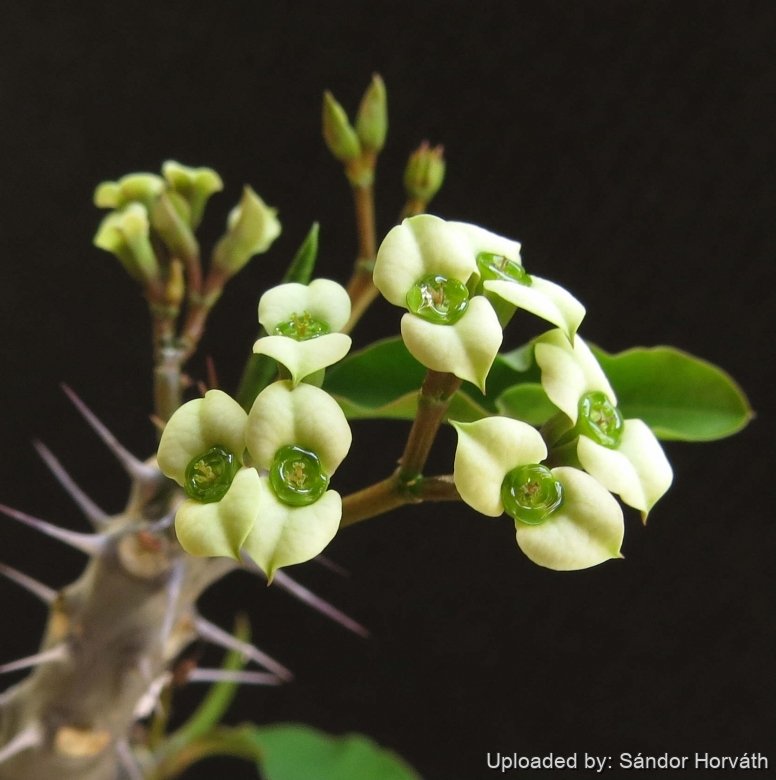
Euphorbia milii ‘antafikiensis’ is a nice Madagascan spiny euphorbia only known in cultivation. It is clearly part of the larger Euphorbia milii complex and distinguish by the yellow-white cyathophylls with green cyathia, and the dark green leaves. It is commonly known in cultivation as Euphorbia antafikiensis an undescribed name (n.n.). As is implied by the specific name, this should come from an unmapped place called Antafik localized somewhere in Madagascar.
Origin and Habitat
Unknown, (Madagascar?)
Source: Euphorbia antafikiensis, LLIFLE - Encyclopedia of living forms, CC-BY-SA, retrieved 2026-10-25.
Cultivars and forms (2)
Forms (1)
Cultivars (1)
Gallery