Publication: Bot. Mag. 91: t. 5534 1865.
Description
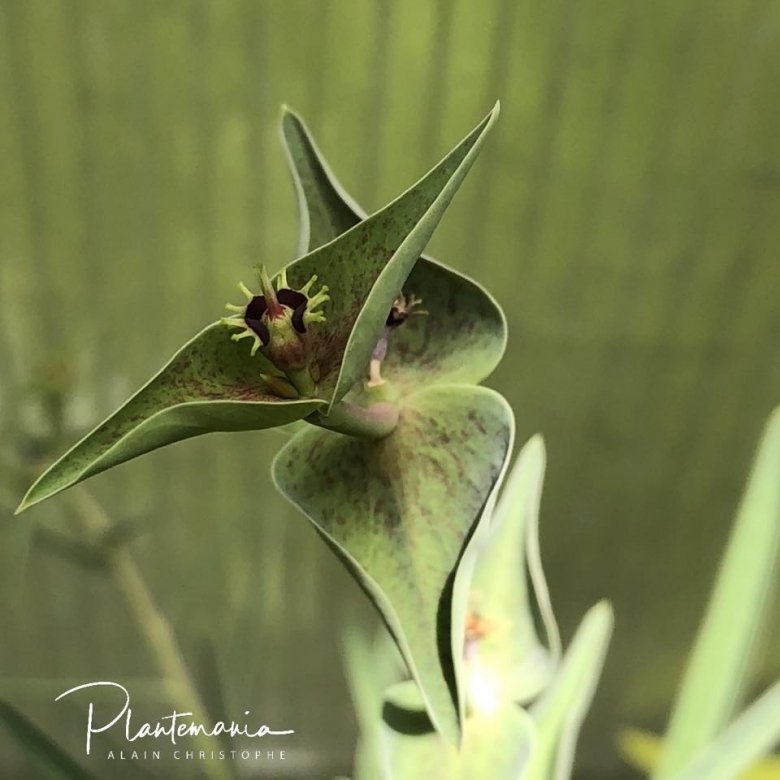
Euphorbia monteiroi (aka Euphorbia monteiri or Euphorbia monteroi) is a perennial, succulent herb or shrubs to 1 m (usually less than 30 cm tall). This species is unique in several ways, it has a swollen “cabbage stump” stem from a woody rootstock. The leaves on this basal part are long and thin. After rain, the tuberculate stem produces a crown of thin, leafy, deciduous inflorescences with a small dark-red flower on the tips. The long peduncles (stems of the inflorescences) eventually wither and persist, as spines for several seasons, curving over the top of the plant and form a useful canopy from the burning sun. The flowers are borne on long, thin branches with leaves which gradually become shorter. The roots are occasionally rhizomatous, branching below ground to form spreading plants. A white latex is exuded from points of injury anywhere on the plant
Stem: Cylindrical to 10 cm in diameter, simple or occasionally sparingly branched above usually only when damaged, covered with more or less prominent crowded tubercles (arranged in a close spiral),
Leaves: Linear-elliptic, usually petiolate, 5–21 times as long as wide, up to 21 cm long and 3 cm wide, petiole to 1 cm long.
Inflorescences (cymes): 3-5 at the axils of the leaf bases, often umbellately branched above; umbel often branched (2- to 8 forked), on leafy peduncles about 15-30 cm in length, rays about 7.5 cm long, alternately leafy, dying off and persistent. Paired bracts of the cymes usually longer than broad ( c. 3 × 2 cm) deltoid to ovate.
Flowers (Cyathia): 1 cm in diameter. Nectar-glands 4, elliptic, outer margin fringed with 3-6 short more or less lobed tiny ‘fingers’, red-brown to blackish purplish (very rarely green) .
Fruits (capsules): Subglobose, to 8 mm long and 12 mm broad, Pedicels 1 cm long, recurved.
Seeds: Ovoid, 5 x 3.5 mm, smooth.
Related species. E. monteiri is closely related to Euphorbia wildii which occurs on the Dyke soils in Zimbabwe, but its closest relative is probably Euphorbia longetuberculosa Hochst., common in southern Arabia. It has the same general appearance, but it becomes at the most 20 cm tall; the dorsiventral cyathia are small and insignificant.
Origin and Habitat
Euphorbia monteiroi is a tropical species which occurs in Angola, Namibia, Botswana, Southern Africa (Transvaal) and western Zimbabwe.
Altitude range: 1,000 - 1,070 metres above sea level.
Habitat and ecology: This species grows on sandy soils and limestone outcrops in open and sparsely vegetated plains and wooded grassland together with Hoodias and other succulents.
Cultivation and Propagation
E. monteiroi grows quickly in cultivation.
Exposure. Requires a sunny position.
Soil: Requires a well-drained soil
Medicinal uses: The plant is traditionally harvested from the wild for local medicinal uses. The thick, lateral roots are cut into slices and added to boiling milk. This liquid is said to purify the blood and to be a tonic for the metabolism.An infusion of the crushed roots is drunk as an emetic and purgative. A leaf and root decoction is taken to treat biliousness. A latex obtained at points of damage to the plant is applied to decaying teeth.
Warnings: The latex in most, if not all Euphorbias is caustic and toxic - skin contact often causing irritation and blistering; contact with the eyes causing temporary or even permanent blindness; whilst ingestion can cause purging or more severe problems.
Notes
The original species’ epithet for Euphorbia monteiroi was “monteiri”. Hooker deliberately latinized Monteiro as `Monteirus’ giving rise to the appellative “monteiri”. The old name Euphorbia monteiri is still used in many books.
Bibliography
Major references and further lectures
-
Hermann Jacobsen “Abromeitiella to Euphorbia” Blandford Press, 1960
-
Werner Rauh, “The Wonderful World of Succulents: Cultivation and Description of Selected Succulent Plants Other Than Cacti” Smithsonian Institution Press, 1984
-
Botanical Society of South Africa, “Journal of the Botanical Society of South Africa”, Parts 36-37, Botanical Society of South Africa., 1950
-
National Cactus and Succulent Society, “The National Cactus and Succulent Journal: The Official Journal of the National Cactus & Succulent Society”, Volumes 3-6, National Cactus and Succulent Society, 1948
-
Leffers A. “Gemsbok Bean and Kalahari Truffle”, Gamsberg MacMillan; Namibia. 2003
-
“Flora Zambesiaca” Website: http://apps.kew.org/efloras/fz/intro.html
-
“Protabase - Plant Resources of Tropical Africa.” Website: http://www.prota.org
-
“Kirkia”, Volume 6, Department of Research and Specialist Services, Ministry of Agriculture, 1967
-
Tropical Plants Database, Ken Fern. tropical.theferns.info. 2018-08-26. <tropical.theferns.info/viewtropical.php?id=Euphorbia+monteiroi>
-
Doreen Bolnick “A Guide to the Common Wild Flowers of Zambia and Neighbouring Regions” Macmillan Zambia, 1995
-
S. Carter & L.C. Leach, “Flora Zambesiaca” FZ, Vol 9, Part 5, 2001
-
Urs Eggli “Illustrated Handbook of Succulent Plants: Dicotyledons” Volume 2. Springer, 2002
Cultivars and forms (2)
Gallery