Publication: Bot. Gaz. 97: 580 (1936)
Description
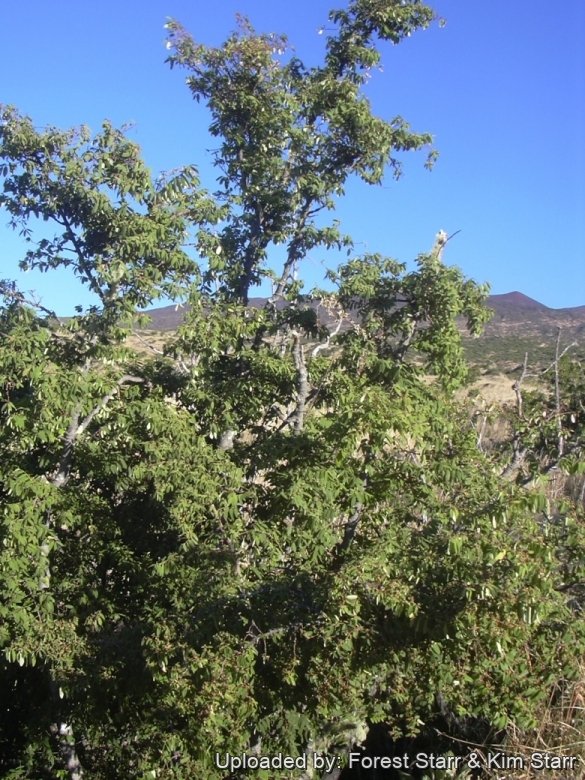
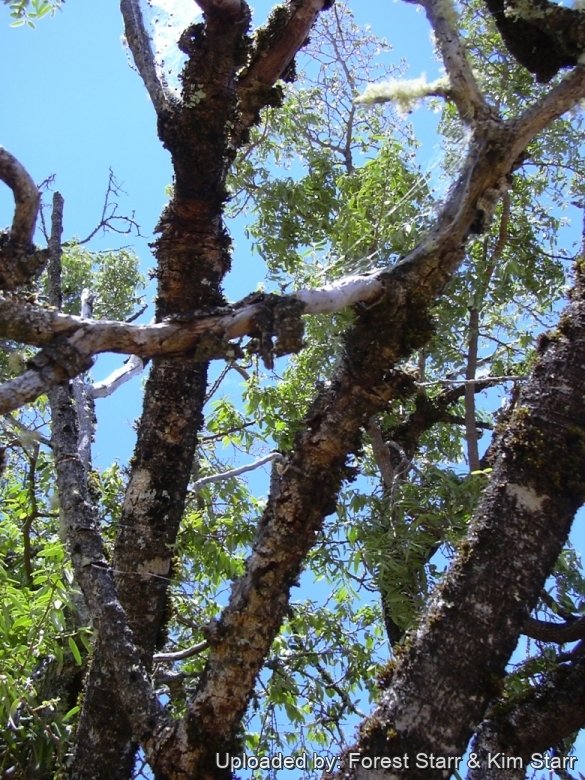
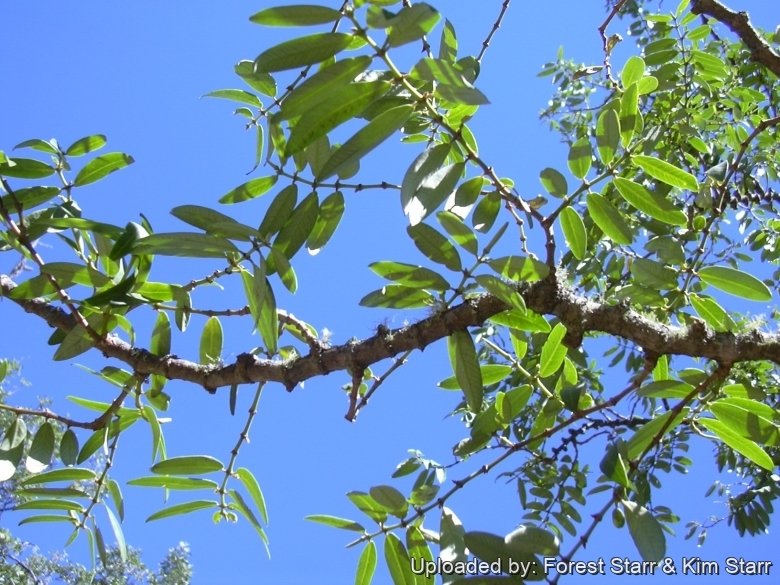
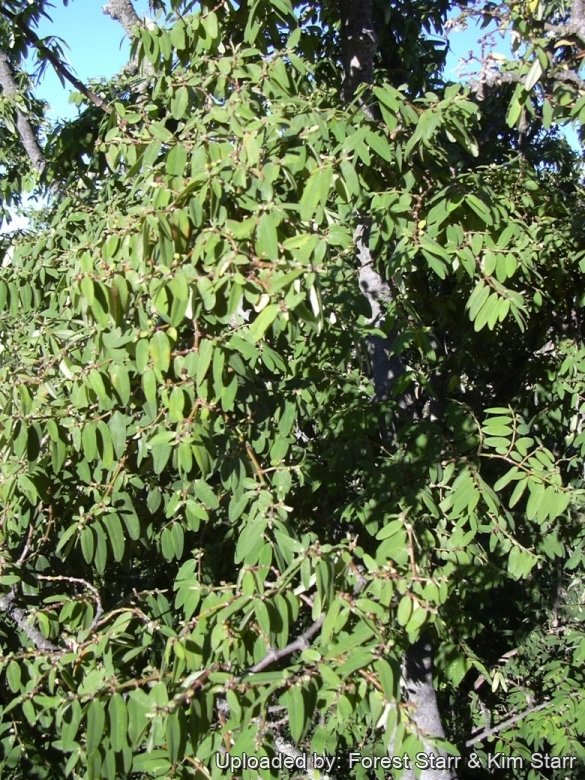
Euphorbia olowaluana (syn: Chamaesyce olowaluana), known in Hawaii as ?akoko, is a trees up to 9 m tall (perhaps the tallest Chamaesyce in the entire genus of 250 species worldwide!). The specific epithet olowaluana is named after Olowalu, West Maui, one of the locations where this species is found.
Stems: Trunk 2-7(-9) m tall 10-20(-30) cm in diameter. Branches glabrous to pilose, especially at the nodes. Stems produce a considerable flow of latex when bruised or cut.
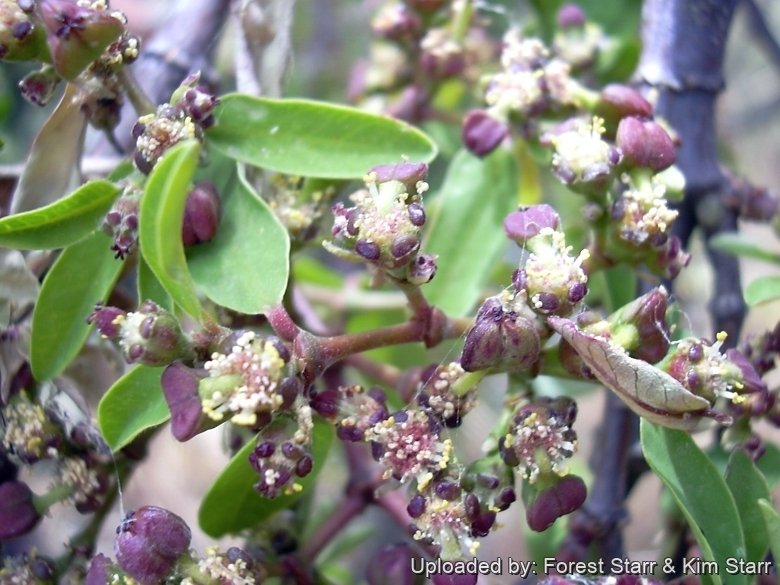
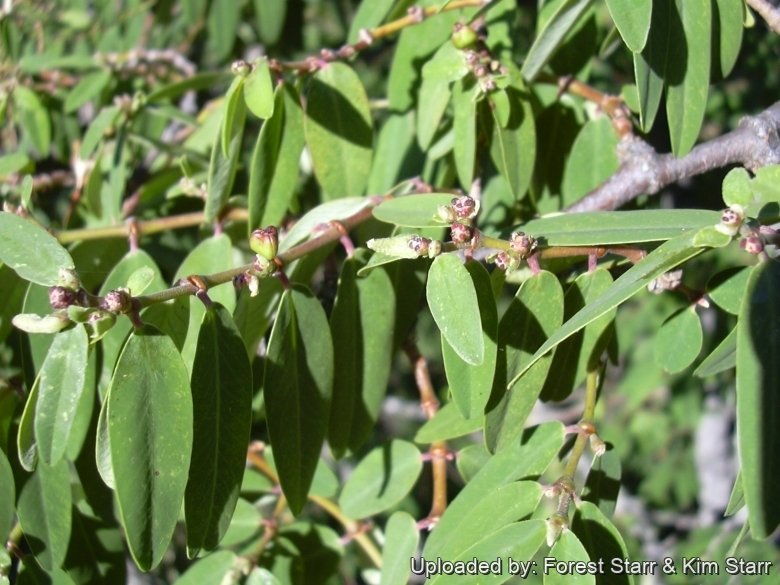
Leaves: Opposite, distichous (growing in two vertical rows), elliptic to lanceolate or rarely linear, 20-70 mm long, 4-15 mm wide, glabrous or pilose on lower surface and at basal margin, margins entire, apex acute, mucronulate, rarely retuse or truncate, base cuneate, oblique, petioles 1-3 mm long, lower surface pilose to glabrate, stipules acute to acuminate-triangular, 1-4 mm long, pilose to villous, erose, ciliate.
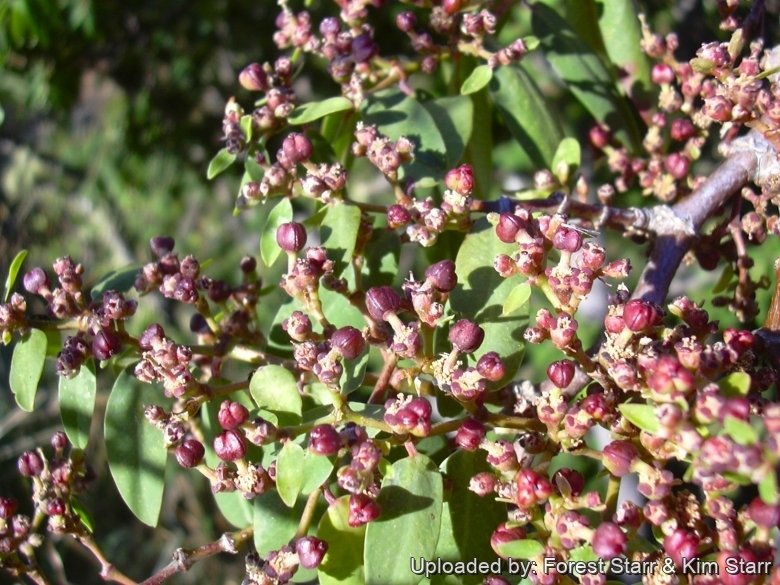
Flowers (cyathia): Solitary in the leaf axils or on shortened, much-reduced branches, peduncles 1-3 mm long, glabrous to villous; involucre campanulate, 1.5-2(-2.5) mm high, 2-3 mm wide, glabrous or pilose beneath the glands, glands 4, pilose to villous; styles red, bifid at least 1/2 their length, 0.5-1 mm long, pubescent; stigma thickened. The pungent flowers of ?akoko have been described as smelling like bad breath.
Fruit (capsules): Green, 2-3.5 mm long, glabrous to pilose, gynophores (stalk which supports the the ovule-producing part of the flower, elevating it above the branching points of other floral parts) recurved, exserted 2-4 mm from involucre, pilose.
Seeds: Grey to brown, 1.5-2 mm long, rugose.
Origin and Habitat
Western Maui and Hawaii,United States (Hawaiian Is.)
Altitude range: Euphorbia olowaluana (Chamaesyce olowaluana) was once common over a wide altitudinal range up to 2,800 metres above sea level.
Habitat and Ecology: It grows in scattered stands in dry open forests. Above 700 metres this plant is found as a shrub, while at lower elevations 350 metres it is a 7.5 metres tree with a trunk diameter of 30 cm inches. Chamaesyce olowaluana or akoko is an important habitat for at five species of native yellow-faced bees (Hylaeus spp.) most of which are exteremely rare and endangered. One is even named Hylaeus akoko. Disturbance caused by grazing, conversion to pastureland and the consequent invasion of introduced grasses increasing the likelihood of serious fires have all contributed to the decline in this habitat.
Cultivation and Propagation
Euphorbia olowaluana or akoko is an attractive tropical species that requires temperatures of 15 °C and light shade. This plant develops in a fashion similar to a small tree and is tolerant of heat and drought.
Potting medium: A gritty, very free-draining compost is suitable, and clay pots help the plants to dry out between watering. Re-pot every 2-3 years.
Fertilization: Akoko respond well to liquid fertilizer (once every one to two months).
Waterings: They like only a short winter’s rest and should be kept almost completely dry during the winter months. If the soil is allowed to be dry for too long root loss could follow but equally the same result would occur if the plants are both wet and cold. From March onwards the plant will begin to grow and watering should be increased gradually until late May when the plant should be in full growth. Water regularly during the summer so long as the plant pot is allowed to drain and not sit in a tray of water. During hot weather you may need to water the plants more frequently so long as the plant is actively growing. From late September watering should be reduced to force the plant to go in to a state of semi dormancy, by October you should be back in to the winter watering regime.
Maintenance: Pruning is sometime necessary to shape.
Hardiness: This spurge is tender, hates prolonged cool and is suited for tropical or subtropical climates, it is killed at 0°C or colder for any appreciable length of time, but may survive cold weather even if it end up getting nearly defoliated each winter. (USDA Zones 10a-12b) Any temps below 4° C degrees call for protection for this plant. Seedling growth arrests below 15°C.
Wind hardiness: It is very tolerant and even survives to strong hurricane wind with minimal damages, but will grow better with slow wind.
Salt tolerance: It is tolerant of coastal and beach exposure.
Landscape Use: Accent.
Hawaiian Uses: The wood of this ?akoko was used as firewood, the leaves medicinally, and the latex used as an ingredient in canoe paint.
Pest and diseases: They are susceptible to fungal diseases. Wet soil quickly causes root and stem rot, especially during winter months. Pests of akoko include whitefly, and scale insects. The plants also attracts root mealy bug which should be treated with a systemic pesticide or horticultural oil. Often the scale in-sects and mealybugs are brought in and protected by ants.
Propagation: Seeds or cuttings. It is best to collect seed just before or just after the capsules split open to be sure to have fresh but mature seeds. Because of the small size of the seedlings, place little or no cover over the seedbed. Take extra care to avoid letting the seedbed dry out. The seeds will begin sprouting in one to two weeks (sometimes take longer). Let the seedlings grow to about 5 cm in height before separating and transplanting to individual containers. You can also propagate it by stem tip cuttings. Take cuttings about 10 cm in length from actively growing tips with mostly green wood. Rooting time is variable as long as two to three months. After root growth and new stem growth are obvious, transfer the new plant to a standard potting mix.
Bibliography
Major references and further lectures
-
Forest & Kim Starr “Euphorbia olowaluana (Akoko)”. Plants of Hawaii. <http://www.starrenvironmental.com\>. Web. 27 Sep. 2014.
-
Bruegmann, M.M. & Caraway, V. 2003. Euphorbia olowaluana. The IUCN Red List of Threatened Species. Version 2014.2. <www.iucnredlist.org>. Downloaded on 30 September 2014.
-
Beatrice Krauss “Plants in Hawaiian Culture” Univ of Hawaii Pr August 4, 2001
-
Marie C. Neal “In Gardens of Hawaii” June 1, 1965
-
The Xerces Society http://www.xerces.org [Web. 27 Sep. 2014]
-
Joseph Francis Charles Rock “The indigenous trees of the Hawaiian Islands” J.F. Rock, 1913
-
Wagner, W. L. et al. 1990. “Manual of the flowering plants of Hawai`i.” University of Hawaii Press. (Bishop Museum Special Publication 83).
-
Wagner, W. L. et al. 1999. “Manual of the flowering plants of Hawai`i, revised edition with supplement” by Wagner, W. L. and D. R. Herbst, pp. 1855–1918. University of Hawaii Press, 1919 pp. in 2 volumes. (Bishop Museum Special Publication 97)
-
) National Museum of Natural History “Euphorbia multiformis” in “Flora of the Hawaiian Islands” <http://botany.si.edu/pacificislandbiodiversity/hawaiianflora/\> Smithsonian Institution Web. 27 Sep. 2014
-
S. H. Sohmer, R. Gustafson “Plants and Flowers of Hawai_i” University of Hawaii Press, 1987
-
Alan C. Ziegler “Hawaiian Natural History, Ecology, and Evolution” University of Hawaii Press, 2002
From llifle page Euphorbia lorifolia var. gracilis
Description
Euphorbia abdelkuri is a very peculiar candelabra-like succulent plant lacking both leaves and spines, which looks like a grey candle with whitish-grey melted wax on it. It form densely branched candelabra-like clumps usually not more than 1 m hight by 1.5 in diameter on one clump (but occasionally in habitat some plants can reach 3 m of height and an equivalent diameter). It is one of the most coveted Euphorbia species.
Remarks: It is the only Euphorbia species with yellow a yellow sap.
Roots: Spreading.
Stems: About 5 cm in diameter, pale greenish-grey, ash-grey to tan, columnar, more or less cylindrical, slightly constricted at intervals, spineless, simple, branching from the base or occasionally splitting dichotomously. Generally has 6 ribs with a somewhat wrinkled, worn looking ‘skin’ with slightly raised conical tubercles. Often skin peels away revealing greener tissues beneath. The colour of the new growth is grey-pink to dark brown and it will then turn to the grey tan colour. The latex is yellow viciously acrid and highly poisonous.
Leaves: Very small, ephemeral.
Inflorescence: Simple cymes, very contracted from the base of the tubercles born towards the top of the stems.
Flower (cyathia): Small, turbinate, about 5 mm in diameter on 8 mm long peduncles. Nectar glands yellowish. Pedicel very short.
Fruit: Trigynous, vaguely lobed, dull-green, about 8 mm in diameter.
Origin and Habitat
Endemic of the Abd al Kuri Island, next to Socotra Island, Yemen.
Habitat: It grows only in one locality on the Quatar Saleh (or Jebel Hassala) in a very arid area at an elevation of about 150 to 270 m in the middle of the mountain on limestone outcrops and granitic gravel slopes where they forms open thickets. The species is severely endangered and was reduced to only four clumps in 1967. The reasons for its decline are obscure: livestock do not touch it since it is highly poisonous. In the past this species was much more abundant all over a ridge from about 150 to 450 metres. Abd al Kuri is semi-desert with little or no vegetation.
Cultivation and Propagation
Due to its slow growth rate and rarity it is thought difficult to grow on its own roots. It is almost always grafted Euphorbia canariensis, but it may be degrafted and rootted and, surprisingly, it’s quite easy to grow. It’s uncommon to lose a plant. It like a sunny position. It does best in a mineral soil, good drainage is essential. Water sparingly during the summer months and keep dry in winter. It is a slow growing long lived plant and once established, it will be content in its position and with its soil for years. It can tolerate moderate shade, and a plant that has been growing in shade should be slowly hardened off before placing it in full sun as the plant will be severely scorched if moved too suddenly from shade into sun. Seems to have no problems growing in a heavy summer rainfall area, in extremely well drained, mineralized soil mix.
Frost tolerance: Very frost tender needs minimum winter temperatures around 10° C (or even more)
Propagation: It is usually reproduced by grafting or cuttings, but it may be propagated from seed sown during spring or summer (seeds are seldom available).
Grafting: The plants that are grafted on a more vigorous and easier stocks are easier to keep, grow faster and produce more flowers and seeds. The method of grafting euphorbias differs little from that of other succulents, except in one important aspect. The latex must be washed or sprayed off until hardly anything remains. After the latex flow has stopped, a further 1-2 mm slice can be taken from both surfaces without a new latex flow starting. Both scion and stock need to be at the start of the growing season. The stock should be cut as near as possible to the growing tip, as here the vascular bundles are dense and not yet woody and will feed the scion in the best possible way. Where possible stock and scion should be of similar diameter. The cut surfaces are held together with elastic bands in cross style, over the plant top and under the pot. The plants should be left in an airy and shady place for 7-10 days before the bands are removed. E. abdelkuri is grown almost exclusively grafted on Euphorbia canariensis which proven to be the ideal grafting stock. The grafting are very successful, new grafts often show growth within 3 weeks.
Warning: As with all other Euphorbias when a plant get damaged it exudes a thick milky sap known as latex. This latex is poisonous and particularly dangerous for the eyes, skin and mucous membranes. So pay extreme attention not to get any in your eyes or mouth. Cultivated plants must be handled carefully.
Bibliography
Major references and further lectures
-
Balfour, I. B. “Angiospermae” in Forbes, H. O. (ed.), “The natural history of Sokotra & Abd-el-Kuri” The Free Public Museum, Liverpool pp. 528-530 1903
-
James Cullen, Sabina G. Knees, H. Suzanne Cubey “The European Garden Flora Flowering Plants: A Manual for the Identification of Plants Cultivated in Europe, Both Out-of-Doors and Under Glass” Cambridge University Press, 11/ago/2011
-
Lavranos, J.J. “The island of Abd al Kuri and its peculiar Euphorbia.” in: Cact. Succ. J. Amer. 43: 109-111 1971
-
Gren Lucas “The IUCN Plant Red Data Book: Comprising Red Data Sheets on 250 Selected Plants Threatened on a World Scale” IUCN, 01/gen/1978
-
Urs Eggli “Illustrated Handbook of Succulent Plants: Dicotyledons” Springer, 2002
-
Volker Buddensiek “Sukkulente Euphorbien.” Ulmer, 1998
Source: Euphorbia lorifolia var. gracilis, LLIFLE - Encyclopedia of living forms, CC-BY-SA, retrieved 2026-10-25.
Cultivars and forms (2)
Gallery